


“If they [Plato and Aristotle] wrote about politics it was as if to lay down rules for a madhouse. And if they pretended to treat it as something really important, it was because they knew that the madmen they were talking to believed themselves to be kings and emperors. They humoured these beliefs in order to calm down their madness with as little harm as possible.”
“We know too little to be dogmatists and we know too much to be
skeptics.”—Blaise Pascal Pensées
“—and, in fact, the condition of most men’s souls in respect of learning and of what are termed “morals” is either naturally bad or else corrupted,—then not even Lynceus1 himself could make such folk see. In one word, neither receptivity nor memory will ever produce knowledge in him who has no affinity with the object, since it does not germinate to start with in alien states of mind; consequently neither those who have no natural connection or affinity with things just, and all else that is fair, although they are both receptive and retentive in various ways of other things, nor yet those who possess such affinity but are unreceptive and unretentive—none, I say, of these will ever learn to the utmost possible extent.”
1 Lynceus was an Argonaut, noted for his keenness of sight; here, by a playful hyperbole, he is supposed to be also a producer of sight in others.
Section I: General introduction
Two young fish are swimming lazily by when an older fish passes and says “Morning boys, how’s the water”? The two young fish continue to swim on when one turns to the other and asks “What the hell is water”?
This writing will attempt to show the what and the how of the necessity for thinking and the role that thinking plays in our human being-in-the-world and our being-with-others, and how these come together in the strife (polemos) that is our encounter with evil in our lives. That is, it will attempt to show what ‘human excellence’ (arête) or ‘virtue’ as it relates to our human being-in-the-world is. As the examples of the three historical figures chosen illustrate (Meno of Thessaly, Eichmann of Nazi Germany, and Donald Trump of the USA), without thinking there is no moral judgment because reality cannot be critically assessed; and when human beings are unable to grasp the reality of the world in which they live day-to-day, human beings cannot distinguish right from wrong, good from bad. The ability to think and tell right from wrong is what, according to Hannah Arendt (1982), ‘may prevent catastrophes’ when political and social conditions and contexts arise that may bring about catastrophic possibilities.
The conceptualization of evil (and particularly the claim being made here that thoughtlessness constitutes an important pre-condition and source of evil-doing) should encourage educators and students in the IB program overall, and in its Theory of Knowledge component in particular, to examine the contexts of human-being-in-the-world through the exploration of various aspects of contemporary and historical evil. Recognition of these characteristics or aspects of evil can make students aware not only of the dire consequences emerging from an incapacity to think critically, but also of their own possible complicity and responsibility in the emergence of evils, rather than claiming and blaming ‘victimization’ or blaming a single villain or the whole society as is often done nowadays. The three examples provided here are three examples of the concrete manifestations of the aspects of evil (the particular) which, at the same time, reveal evil in its essence (the general).
Through the three historical examples provided here – Meno, Eichmann and Trump – we can gain a view of the characteristics of the “depravity” and “vice” of evil men and of the properties of evil as a psychological and social phenomenon. The lack of depth of evil mirrors the lack of depth in the human soul of the “depraved” man and how this depravity is manifested in their actions. The ancient Greek Meno is a paradigm. All three men show an inability to learn, poor memory, a threatening posture when confronted, speak in cliches and “they said” opinions, and have a vicious quality about them. In the dialogue Meno, the slave-boy demonstrates more arête virtue, “human excellence” and true freedom than Meno himself because the slave-boy is willing to learn.
The three examples provided see, firstly, evil as the Great Beast of the political social collective being-with-others of human beings (being-with-others recognized as being a necessity for human beings) in the writings of Plato and the dialogue Meno in particular. Secondly, characteristics of “the banality of evil” as described by Hannah Arendt in Eichmann in Jerusalem: The Banality of Evil where she indicates that ‘when all are guilty, no one is’ points to more specific historical details of evil’s preponderance. Arendt’s account of the banality of evil and the individual responsibility for it offers opportunities for educators and students in the IB Program (through the critical thinking required in the Theory of Knowledge component that is an important part of the IB Learner Profile i.e. what the IB has come to define as arête or “human excellence”, virtue) to become aware of their own responsibilities as members of a society or social group. The IB Learner Profile is how the IB has come to resolve the knotty question of “what is human excellence?” and whether human excellence or virtue can be taught or learned which is the subject of the dialogue Meno. As the examples of the graduates from the universities that many IB students aspire to have shown very clearly, neither “human excellence” nor thinking is going to be a product of their education should they choose to attend these institutions.
As I am attempting to show here, Arendt’s ‘banality of evil’ might be more properly termed ‘the ubiquity of evil’, for its ‘spreading like fungus’ (as Arendt said of it) appears to be our experience of the phenomenon in today’s world. Through the learning from that history of the past, the modern manifestations of evil today in the right-wing Trumpism of American politics and other neo-fascist, authoritarian leanings in other societies and on other continents can be seen in countries throughout the world. This begs the question: Is the thinking required to resist evil even possible in authoritarian regimes or is it possible in the institutions of higher learning today?
All political action is concerned with preservation and change: “change for the better”; “avoiding something worse”. All political action has as its goal knowledge of the good and the good political society. The “common good”, the “one good”, determines our being-with-others and is our conception of what we think “virtue” or “human excellence” is. What we are witnessing today is the destruction of any notion of a “common good”.
What is evil? This writing will attempt to get at this most elusive of phenomenon. Perhaps it is a quixotic mission. What the essence of evil is is not revealed in the effects that evil brings about or causes, but these must be examined to some extent in order to trace the preliminary outlines that will lead to a sketch for a portrait of evil which will, hopefully, reveal evil in its essence. The difficulty of the task is obvious: evil, by its nature, flees from the light, and light is necessary in order to allow a thing to emerge, to be seen, to allow the truth of something to show itself, and to give us knowledge of that thing. In the Divided Line of Plato, this light is both a metaphor of the Good and Love, and this light is related to both ‘sight’ and to ‘hearing’. From these we can learn that evil is not the opposite of the Good but is the deprivation of the Good.
Arendt once remarked in a letter that evil lacks “depth”, that it is a “surface phenomenon” that “spreads like fungus” over things and over the human interactions with those things. To use the language of Plato, evil is a “shadow” phenomenon that has no being: something which lacks substance or “depth” and is ultimately related to nihilism. To say this is to say something extraordinary and leads one to perplexity. How can something which has no being be so manifestly present to us in our everyday lives?
The relation of evil to “lack of depth” is why Plato’s images of the Divided Line and the Great Beast from Bk VI of his Republic are used here. The Divided Line shows how “thoughtlessness” can come about and, through this “thoughtlessness”, how human beings can succumb to the temptations of the Great Beast. “Thoughtlessness” is related to the phenomenon of “stupidity”, and both are related to the concept of arête or “human excellence” or to the lack of “human excellence”; arête is usually translated as ‘virtue’. These two conceptions of arête are used interchangeably here.
The opposite of thoughtfulness is stupidity, and stupidity is related to the phenomenon of “intentional ignorance”. “Intentional ignorance” and “stupidity” are “moral” phenomenon, not intellectual phenomenon. In this writing, the concept of “opposite” is best seen as a “deprivation” for there are no truly “opposite” things just as there are no truly “equal” things. Intentional ignorance occurs when individuals realize at some level of consciousness that their beliefs are probably false, or when they refuse to attend to speech or information that would establish their falsity. People engage in intentional ignorance because it is perceived as useful. “Stupidity” and “intentional ignorance” are not intellectual but moral phenomena and properties; that is, they do not deal with thinking or the intellect but with actions. Dietrich Bonhoeffer, who was hanged by Hitler in 1945 in one of his concentration camps, once wrote:
“Stupidity is a more dangerous enemy of the good than malice… Evil always carries within itself the germ of its own subversion in that it leaves behind in human beings at least a sense of unease. Against stupidity we are defenseless. Neither protests nor the use of force accomplish anything here; reasons fall on deaf ears; facts that contradict one’s prejudgment simply need not be believed- in such moments the stupid person even becomes critical – and when facts are irrefutable, they are just pushed aside as inconsequential, as incidental. In all this the stupid person, in contrast to the malicious one, is utterly self-satisfied and, being easily irritated, becomes dangerous by going on the attack. For that reason, greater caution is called for than with a malicious one.”
We can see the phenomenon of stupidity described here by Bonhoeffer illustrated in the three examples we have chosen for our sketch: Meno, Eichmann, and Trump; and we can also see it in the quote from Plato’s “Seventh Letter” which begins this writing.
Thinking and self-knowledge are co-related. Where true thought is not present, there is no self-knowledge. Where there is no self-knowledge, there is no sense of “reality”. Where there is no sense of “reality”, there is no knowledge or recognition of good and evil. Where there is no knowledge or recognition of good and evil, there is no possibility of “human excellence” or
arête. Without a sense of “human excellence”, there is no polemos or strife within the individual mind or soul to resist the temptation to succumb to evil actions.
Section II: Evil and the Individual: Thinking and Thoughtlessness
Since we are proposing that thinking is an antidote to the sickness or illness that is evil in the soul, we must try to be clearer on what thinking and thoughtlessness are as they are used here. Science, technology and its apogee, artificial intelligence, does not think, and the “thinking” that is understood in the sciences is not an antidote or solution to the problem of evil. This means that, substantively, sociology, psychology, and political science are, for the most part, “useless” to us and for us as we engage in the strife that is the polemos or confrontation with evil, though they may provide some descriptors or colours for our palette as we journey to sketch our portrait.
One is not thinking if one does not rank the objects of thought in terms of thought-worthiness. This point flies in the face of many contemporary accounts of “rationality”, for they suggest that one can be thinking well as long as one is following the right method. The emphasis today is on the method of what is called thinking. What one thinks about does not provide the standard for the role of such “ratio-inspired” accounts of thinking; indeed, critical thinking has come to mean “critical whatever method-following thinking” instead of “critical whatever essential thinking”. Such “means-ends accounts” of thinking involve and propagate a distortion; a life spent rationally researching the history of administrative memos and emails is not a thoughtful life. We shall see later that Adolf Eichmann did not lead a “thoughtful life” in his seeing himself as “a scheduler of trains”. In rationally pursuing anything and everything we are not thinking.
The experience of thinking in our technological age has been shrunk to that of using a tool to operate within an already-fixed network of ends. This, for example, is the essence of artificial intelligence. This age and the evil concurrent with it, in other words, is more thought-provoking because in it ratio (as one side of a two-faced Logos) has triumphed over legein, the speaking, gathering; thinking has become so severed from the being-thoughtful that the thoughtful being is in danger of being entirely eclipsed. In the Divided Line of Plato, this two-faced nature of Logos is comparable and parallel to the two-faced nature of Eros. The logos associated with number is separated from the logos associated with “speaking”, with word. The arts are distinguished from the sciences as revealers of truth. Human being as the animale rationale, “the rational animal”, has become separated from human being as the zoon logon echon, “the animal capable of discursive speech”.
Because we are “embodied souls”, it is Memory that is associated with our understanding of need, or the urge that is behind the eros of our needs. Our memory retains our immediate experience based on sense perceptions. It is the repository of the knowledge acquired in one’s lifetime and of what was learned during the journey with the god prior to our lifetime (Plato, Phaedrus). It is the source of our desires which depend on previous fulfillment and insight.
Learning is the removal of forgetfulness and is a quest. The journey toward the light cannot be undertaken by “rote learning” i.e. memorization. This merely results in the learning of the opinions of others that result in stock phrases, cliches, the language of the meme. It results in oppression, not freedom. (See the commentary on the Meno in Part II of this writing.) The acquisition of skills, the gathering of information of all kinds, the convictions and practices which govern the conduct of our lives, all depend on the medium of accepted opinions. Our memory is the repository of those opinions. The action of learning conveys the truth about learning. It is not a “theory of knowledge” or “epistemology” but the very effort to learn itself.
In the works of Plato, the purpose of education is the formation of character. Institutions and their accompanying bureaucracies are secondary. Without evil or vice there is no higher development of human beings. The danger of evil and the action (or inaction) against evil contribute to the development of human beings, and this is our “excellence”, our “virtue”. Mere innocence is incompatible with the higher development of humanity. Self-knowledge and its acquisition (or lack thereof) is at the root of all thoughtlessness, and thoughtlessness contributes to the degeneration of human beings making them less humane.
Lack of self-knowledge and its relation to thinking is “thinking that one knows what one does not know”. This lack of self-knowledge is sometimes manifested in those who believe they are in possession of the truth, those that we would call ‘fanatics’ and ‘gaslighters’ today. Self-knowledge is tied with our knowledge of good and evil, better and worse, what we have come to call our “values”. These supposed “values” have been given to us from the historical knowledge of the society, the historical opinions, of which we happen by chance to be members. This historical knowledge involves “memory”. The “orthodoxy” of the historical opinions we have inherited becomes the dogmatism of the present.
Because we are “embodied souls”, beings in time, memory holds us in our essential nature as human beings. If the battle against evil most requires thought, we are experiencing a turning away from thought and seeing a subsequent rise in evil’s pervasiveness and perseverance in our being-with-others and in the “inner” worlds of our being with and within ourselves, our own self-knowledge. This is partially due to the destruction of memory. To learn means to respond to the most important and pressing things that address us at any given moment. The rise of evil is one of these most pressing things.
As Martin Heidegger once said, “Science does not think: and this is its blessing.” If science actually thought, we would cease to have science as we know it. And if this should happen, we would no longer have clean toilets, penicillin, and all of the wonderful discoveries of science. The type of
thinking that science does is an absolute necessity for our lives today. The type of thinking that science does accompanies ‘common sense’, and both are necessities in the conduct of our day-to-day lives. Science does not think because, if we look at Plato’s Divided Line, the grounding of science is in a faith: its belief, its trust, in that what is “real” is what it reveals. Science is the theory of the ‘real’.
Thinking is an action that can only be done by doing it. We shall never learn “what is called swimming”, for example, or “what calls for swimming” by reading a book on swimming. Only a leap into the deep end of the pool will tell us what is called swimming and what calls for swimming; action or praxis, conduct is key. The question of what thinking and thoughtfulness are can never be answered by proposing a definition of the concept “thinking”. As Plato makes clear in his Seventh Letter, thinking cannot be brought to language; if it could be, he would have done so.

In the West, the thought about thinking has been called “logic” based on the principle of reason (“Nothing is without reason”). This “logic” has received its flowering in the natural and human sciences under the term “logistics”. Logistics, today, is considered the only legitimate form or way of knowing because its results and procedures ensure the construction of the technological
world. Logistics is an interesting word in that its use as a noun implies “symbolic logic” (mathematical algebraic calculation) and it is also related to the conduct of warfare. Its use as mathematical calculation is found in what is called logical positivism which is a recent branch of the branch of philosophy that was previously known as empiricism. The thinking in logical positivism is the thinking expressed as algebraic calculation: only that which can be calculated
can be known and is worth knowing. To elaborate how this has come to be the case would require an analysis of 17th century philosophy and mathematics beyond what we intend in this writing. Suffice it to say that this is part of our inherited shared knowledge, our historical knowledge or memory that we have received from the philosopher Rene Descartes.
Today we think that thought is the mind working to solve problems. We can see this in many of the quotes that are looked to as words of inspiration for young people. Thought is the mind analyzing what the senses bring in and acting upon it. Thought is understanding circumstances or the premises of a situation and reasoning out conclusions, actions to be taken. This is thinking, working through from A to B in a situation. In Plato’s Divided Line, thoughts are
representations of the world (real or not doesn’t matter, only the mind’s action does), or considerations about claims or representations (knowledge issues or questions), and the conclusions or judgements that are made. We think we know exactly what thought and thinking are because they are what we think we do. And as the animal rationale, the “rational animal”, how is it possible for thinking to be something we can fly from as it is our nature? It must be
remembered that in our flight from our nature, we become less humane.
When we use the word ‘thinking’, our thought immediately goes back to a well-known set of definitions that we have learnt in our lives or in our studies, what we have inherited from our shared or historical knowledge, what is stamped in our memories. Definitions provide the limits to things, their horizons, so that they can be known to us. These limits we call “meaning”. To us thinking is a mental activity that helps us to solve problems, to deal with situations, to
understand circumstances and, according to this understanding, to take action in order to move forward. It is algorithmic. Thinking for us also means to have an opinion, to have an impression that something is in a certain way. Thinking means reasoning, the process of reaching certain conclusions through a series of statements. Thinking is “a means of mastery” or control over the ‘problems’ which confront us and stand as obstacles in our achieving our ends.
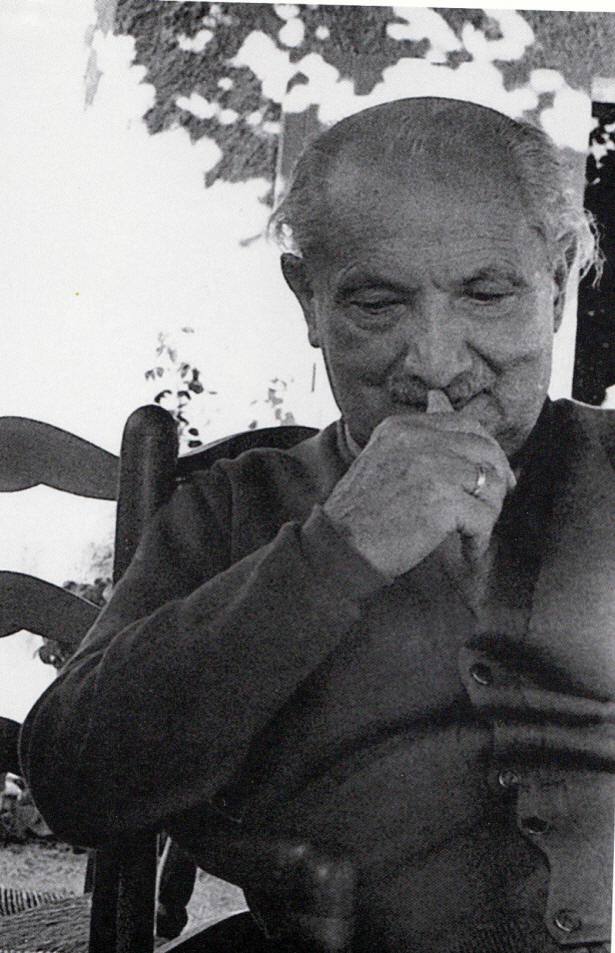
The German philosopher, Martin Heidegger, once wrote: “Thoughtlessness is an uncanny visitor who comes and goes everywhere in today’s world. For nowadays we take in everything in the quickest and cheapest way, only to forget it just as quickly, instantly. Thus one gathering follows on the heels of another. Commemorative celebrations grow poorer and poorer in thought. Commemoration and thoughtlessness are found side by side.” (Discourse on Thinking. Trans. John M. Anderson and E. Hans Freund. New York: Harper and Row 1966, p. 45) That the greatest thinker of the 20th century could succumb to the evil that was National Socialism and who implicitly approved of the gas chambers of the Holocaust (since he concluded that there were simply some human beings to whom no justice was due) indicates the difficulty of the task that the polemos against evil presents to us. For Heidegger, thoughtlessness is nihilism. (A fictional parallel to Heidegger’s historical failure can be seen in Frodo Baggins’ failure to destroy the Ring of Sauron in Tolkien’s The Lord of the Rings. In both cases, it is difficult to rush to the judgement of final condemnation when discussing both their failures.)
If we view our current thinking and approach to thinking in the light of Plato’s Divided Line and his Allegory of the Cave, we can see that the risk for humanity in our current approach to thinking is to be uprooted not only from our reality, from our world, but also from ourselves and from our natures as human beings. With this, the destruction of any possibility for self-knowledge occurs. If we think ‘poetically’, however, we allow ourselves to be aware of the risk implied in the technological age and its usefulness and we can, hence, act upon it. We can experience some of the freedom which is spoken about in Plato’s allegory when we are brought out into the Open where the light of the Sun shines and things are shown to us in their own being as they really are.
We recognize that in today’s world technological machineries and devices are indispensable. We need just think of computers and hand phones and their usage in our daily activities to be convinced, beyond any doubt, that “we depend on technical devices”. By thinking calculatively, we use these machineries and devices (tools, equipment) at our own convenience; we also let
ourselves be challenged by them and shaped by them, so that in this challenging we are urged to develop new devices that will be more suitable for a certain project or more accurate in the carrying out of certain research.
In Plato’s Republic, Socrates states that philosophers are quite “useless” to the city as the city is the polis of artisans or technites, those who are concerned with knowing (in their way) and making. When we hear the word “acting”, we immediately relate it to a familiar concept of action, such as the one that thinks of action as that which produces some kind of result, which means that we understand action in terms of cause and effect, and that action is the product of
agency.
In the “Letter on Humanism”, Heidegger defines the essence of action as
“accomplishment”, and he unfolds the meaning of accomplishment as “to unfold something into the fullness of its essence, to lead it forth into this fullness – producere”. It is the action that nature carries out when it brings a rose to blossom. This “accomplishment” in our actions is close to what is meant by arête or “human excellence” in this writing. “Higher acting” is not, therefore, an undertaking towards a practical doing, but is a ”higher acting” as accomplishment, in the sense of the leading forth of some thing into the fullness of its essence, including ourselves. Thinking is but one aspect of the fullness of the essence of human beings, and the leading to thought is a ‘natural’ activity for human beings.

“Thought” to us today usually means having an idea, a view, an opinion or a notion. Pascal, the French mathematician and contemporary of Descartes, in his journals given to us as Pensées,
searched for a type of “thinking of the heart” that was in conscious opposition to the mathematical thinking prevalent in his day. Thought, in the sense of logical-rational representations (concepts), was thought to be a reduction and impoverishment of the word “thinking”, just as “chemistry” was a reduction of the thinking occurring in “alchemy” and
“astronomy” of “astrology”. Thinking as it is understood here is the giving of thanks for the lasting gift which is given to us: our essential nature as human beings, which we are gifted through and by thinking for being what we essentially are. It is this gift that we are in danger of giving away, for in our thoughtlessness we are gradually becoming less humane.
To sum up what has been said so far, in the works of Plato, the purpose of education is the formation of character toward thoughtfulness. Without evil or vice there is no higher development of the souls of human beings. The danger of evil and the action (or inaction) against evil contribute to the development of human beings, and this development is human beings’ “excellence”, their “virtue”. Mere innocence is incompatible with the higher development of humanity. Self-knowledge and its acquisition (or lack thereof) is at the root of all thoughtlessness, and thoughtlessness contributes to the degeneration of human beings, making them less humane. Lack of self-knowledge and its relation to thinking is “thinking that one knows what one does not know” since this contributes to their illusion of control. This lack of self-knowledge is sometimes manifested in those who believe they are in possession of the truth, those that we would call ‘fanatics’ today. Self-knowledge is tied with our knowledge of good and evil, better and worse, what we have come to call our “values”. These supposed “values” have been given to us from the historical “knowledge” of the society, the historical opinions, of which we happen by chance to be members. This historical knowledge involves “memory”. The “orthodoxy” of the historical opinions we have inherited becomes the dogmatism of the present, and this dogmatism becomes rooted in an intolerance of the opinions of others in our being-in-the-world. Both those on the right and the left in their political leanings are guilty of this intolerance.
The lack of self-knowledge results in the lack of a “moral compass”. Our “moral compass” is, presumably, pointed toward the good; but if the good is “subjective”, then the “moral compass” will, by extension, be “subjective” also; it will become a “value” which we create in our day-to-day lives which will ultimately succumb to the urges of power and its attainment. This “subjectivity” results in moral weakness and allows one to easily succumb to the machinations of evil and evil-doers. Because the individual lacks self-knowledge, they act out of “duty” or “conformity”. They look to “belong” to a group, a clan, a nation, a political party which they believe is in possession of the truth. Within this sense of belonging, the evil that we do seems to be something simple, natural. “Only following orders”, working behind a desk as a “scheduler of trains” (Eichmann), it is the sense of duty that compels us to evil actions at times. In our actions, we have no comprehension that what we are
doing is “evil” as long as the actions we are doing are done efficiently and effectively i.e., they produce the desired results. Evil, when we are in its power, is felt as a necessity, a duty, not evil.
The individual who lacks self-knowledge does evil “unknowingly”, for “no one knowingly does evil”, as Socrates asserts in the dialogue Gorgias. When we do evil, we do not know it because evil flies from the light. Evil requires opaqueness, obfuscation and illusion. Evil deals with shadows, illusions, and delusions. The individual is a threat to evil if he or she thinks. But from where and from what do these appearances of evil arise? The evil that we do seems to be an illusion or is analogous to an illusion. When we are the victims of an illusion, we do not feel it to be an illusion but reality.
An example of the difficulty of bringing evil to light so that its essence and its truth may be seen both in the individual and the collective is found in the myth of the Ring of Gyges from Book II of Plato’s Republic. When given a ring, a shepherd named Gyges becomes invisible and anonymous. Through his invisibility he seduces a queen, kills her king, and takes over the kingdom. The argument is made that the Ring of Gyges – invisibility and anonymity- is the only barrier between a just and an unjust person. We are “just” out of fear of the laws and that it is only the laws which make us virtuous or “good” human beings. We are in fear of being exposed to the law because we have and retain some sense of shame. The master criminal is the person who is never suspected, the most respectable man in the community, the pillar of society.
Gyges’ ring finds other literary and mythical equivalents in the Ring of Sauron from The Lord of the Rings, the cloak of invisibility from the Harry Potter series, and the supposed “anonymity” of the internet (which accounts for the intolerance and violence prevalent among the trolls there). The myth and its implications say a great deal regarding the distinction between the ‘private’ and the ‘public’ spheres.
The Gyges myth and its mythical equivalents illustrate how the belief in anonymity skews the “moral compass”, the ability to distinguish good from evil, good from bad of individuals when they become “followers”. The act of setting aside, setting oneself aside, from the crime or evil one commits (sin) and not establishing the connection between the crime or action and its
results is at the root of much of the evil that occurs in our being-with-others in our being-in-the-world. This false anonymity is an “empowerment” that allows the individual to deny responsibility for the acts which they commit as they are directed toward the attainment of power in the belief that power is the dynamis (the “potentiality”) which allows them to attain the “good things” of life, one of which is that power or control itself. The “good things”, however, are susceptible to corruption because they are not the good itself. The connection between the evil and its result can only be made with thought and thinking. Thoughtlessness is essential to the proliferation of evil.
The desire for anonymity is the evil ersatz form or appearance of the mystery that is the destruction of the self (ego) in its desire to become one again with the whole of things. This destruction is best shown to us in Shakespeare’s King Lear where the once proud, tyrannical king is brought low to a “no-thing”. The play shows us that the tempests of Nature are not “evil”, but are deprivations of the good, ‘necessity’s harsh pinch’. The “evil” present is demonstrated in the machinations of human beings, and by the end of the play all truth, goodness, and justice have been destroyed (with the exception of the character Edgar, who must cloak himself in anonymity through disguise in order to survive). The two plots of the play, the Lear and Gloucester plots, parallel the “double” viewing that will be discussed in other parts of this writing. Today, we refer to human beings as “persons” or “personalities”, a term derived from persona, a mask used in ancient theatre. The term indicates that we view human beings as “surface phenomenon”, as objects, and not as “embodied souls”
The ultimate end of technology is the effacement of human beings, and this may be one of the reasons why anonymity has come to the fore in our age. We rightly abhor the killing of innocents by terrorists face-to-face and yet seem somewhat indifferent to the “collateral damage” enabled by the individual who sits behind a desk and pushes an enter key that sends a missile directed towards a target in which innocents are killed: there is a disinterested dehumanizing evil prevalent here, somewhat akin to the Ring of Gyges. Evil as the requitement
for evil does not produce the good, nor is evil to be seen in terms of “magnitude” just as the Good cannot be understood in terms of magnitude. The stories of “The Princess and the Pea” and The Lord of the Rings illustrate that the greatest good can be found in the “smallest” of things.

 Theory of Knowledge: An Alternative Approach