Sketch for a Portrait of Evil: Part IV

The Red Dragon and the Beast from the Sea

Donald Trump and the USA

Have you never observed in those who are popularly spoken of as bad, but smart men, how keen is the vision of the little soul, how quick it is to discern the things that interest it, a proof that it is not a poor vision which it has, but one forcibly enlisted in the service of evil, so that the sharper its sight the more mischief it accomplishes?” (Republic 518d-519a)

“A man who lies to himself, and believes his own lies becomes unable to recognize truth, either in himself or in anyone else, and he ends up losing respect for himself and for others. When he has no respect for anyone, he can no longer love, and, in order to divert himself, having no love in him, he yields to his impulses, indulges in the lowest forms of pleasure, and behaves in the end like an animal. And it all comes from lying – lying to others and to yourself.”

“The best way to keep a prisoner from escaping is to make sure he never knows he’s in prison.”

“What is hell? I maintain that it is the suffering of being unable to love.”

Fyodor Dostoevsky, The Brothers Karamazov

“What else is misery but the desire and possession of evil?” Plato, Meno 78b

This will probably be the most controversial of any of the four parts of this portrait of evil for it deals with contemporary events, events which have not yet become part of history for their outcomes are still uncertain. The analysis of Trump’s character and his actions that is presented here must be read in the light of what has already been written in the previous sections of this portrait of evil. Those who have specific counter-claims to the points made here are free to post them in the comments section below provided by the blog. Providing specific sources for the evidence to the counter-claims would be useful in properly bringing things to light.

The story of Donald J. Trump is that of the playboy who squandered his father’s fortune and who became an incompetent, vicious clown as the ruler of his people. His story is truly the stuff of myth; and it is a story that has been heard and recorded throughout history on a number of occasions and in various cultures. It is a story which continues to be ongoing.

Trump’s story is that of a “malignant narcissist” who comes to power to represent a regime or polis that has devolved into a mass “malignant narcissism” itself: the soul reflects the regime and the regime reflects the soul. One of the questions which needs to be asked is: what is the relationship between mass malignant narcissism and technology? How and why is mass malignant narcissism a response to the meaninglessness at the heart of the nihilism that is technology? Another question is: how is malignant narcissism a manifestation of evil as a lack of self-knowledge and an acceptance of mass thoughtlessness?

Trump is a playboy who had seen at an early age that he has no possibility in the regime as it currently stands (what could this “possibility” mean since he has achieved the highest position of power in that regime and has been assumed to be ‘sane’ by the mental health professionals within that regime?) and who, because of this, emerges as a demagogue whose nihilism mirrors the mass nihilism present in his followers. It ultimately seeks the destruction of the regime and the order that is brought about by the rule of law which is crucial to the regime’s survival.

Trump is a “true” white American. His malignant narcissism is rooted in his racism: early in his life he denied housing to African Americans because they would lower his property values, and he begins his political career challenging the authenticity of the first Black President of the USA Barack Obama’s birth certificate, for Trump fears that what he is and what he will become has no place in the multi-racial, multi-cultural society that is present-day America. Many of his fellow Americans agree with him, for they too see no reflection of themselves in the regime as it now stands (which one may best describe as ‘totteringly’).

His slogan becomes MAGA: “make America great again”, although the time when America was great is never clearly established, and it appears to have some roots in the time when America was a Confederacy prior to the first Civil War (I say ‘first’ for the followers are looking for a second Civil War). Trump’s story is not unique nor are his methods for securing power, and in examining him we can get more details for our sketch for our portrait of evil.

Trump cannot distinguish between right and wrong actions. He believes that cheating, lying, and “risky behaviour” are not wrongful if the wrongdoer (himself) does not intend to cause harm (in legal language, there is no mens rea) or if no harm results. (This is his defense at a number of his trials.) Trump, like Meno and Eichmann before him, clearly cannot see beyond himself. He is incapable of seeing ‘the big picture’ and this is shown in the errors that his judgement has made both in the past and present. He has no sense of good and evil (unless it is actions done against him where he perceives himself as the ‘victim’) and he does not believe that the laws apply to him for he has no sense of justice for he does not believe he ‘owes’ anything to anybody. He does not ask God for ‘forgiveness’ because he himself is perfect.

One may assert that Trump is unable to distinguish right from wrong because of his “bad upbringing”. Some of his critics say he is unable to make accurate normative judgements because he has been taught the “wrong values”. Trump’s education in the “wrong values” (primarily from his father, Fred Trump, and from his father’s consigliere Roy Cohn) causes him to make inaccurate judgements about the world in which he lives. He has, nevertheless, gained great success in that world and become one of its most powerful people. Because Trump is able to successfully and efficiently function in his society or world indicates that he is not insane or mad, according to most psychiatrists and social scientists today.

People who have been taught the “wrong values” are people suffering from a psychosis where “conscience” and “consciousness” have become separated. They are divided selves. Because their “consciousness” is not of a “real” world, like psychotics they are unable to make accurate judgements about the world in which they in fact do live. They lack what the Greeks called sophrosyne moderation and phronesis wise judgement, essential components of self-knowledge and arete or human excellence, virtue. They are, to paraphrase the psychiatrist R. D. Laing’s assessment, examples of that ‘Insanity (that) is a perfectly rational adjustment to an insane world’.

A study by the U.S. Department of Education in 2020 found that 54% of Americans could not read prose beyond the Grade 5 level; that is the age of an 11 or 12 year old. Trump exhibits many of the characteristics of an ill-bred 11 year old bully who has never been able to go beyond his Oedipal attachments and conflicts and the fears that arise at that age. Indeed, the American political scene at the moment exhibits many of the same characteristics of a primary or middle school playground where bullies and their followers attempt to impose their wills on the majority of the other children. They wish to impose barriers on that ‘open space’ that is the playground through the banning of books and other forms of human discourse.

The American polis’ attachment to the logos is very weak to begin with since it has been primarily formed by the opinions promulgated in the mass social media; and with its lack of attachment to the logos, a weak attachment to what may be called “the real world” has long been established. This is found in their responses to the world of the mass media in which they dwell. They are like the two young fish who do not know “what the hell” water is.

As Hannah Arendt noted in The Origins of Totalitarianism, “In an ever-changing, incomprehensible world the masses had reached the point where they would, at the same time, believe everything and nothing, think that everything was possible and that nothing was true. … Mass propaganda discovered that its audience was ready at all times to believe the worst, no matter how absurd, and did not particularly object to being deceived because it held every statement to be a lie anyhow.” This disbelief in the mass media was greatly exacerbated by the USA media’s coverage of the Iraq war during the period 2003-2011. The press’s failure to do its due diligence with regard to weapons of mass destruction being in the hands of Saddam Hussein (which became the “public” cause for the war rather than the control of the oil fields on behalf of the large multi-national oil conglomerates as the real reason behind the invasion and the ‘war on terror’) made the masses distrust the media to the point indicated by Arendt. Arendt in her quote from 1951 was referring to the regimes of Hitler and Mussolini.

American universities, where thought and the logos should be discussed and taught, chose to model themselves after the German universities of the late 19th and early 20th centuries so that they became “multiversities”, institutions dominated by the teaching of “useful” techne and, in turn, their primary activities became dominated by the money from the vested interests of the multi-national corporations, since research is expensive. In the pursuit of money and power, the original purpose of a ‘uni-versity’ became lost. In fact, the relative education of the German population at the time when Hitler came to power in the 1930s was much higher and stronger than is America’s at present. America has essentially failed in its ‘social contract’, and this is not only revealed by its wealth disparity but also by its lack of concern for the education of its citizens in favour of production and consumption.

Trump, a conman and a showman (qualities so appropriate to a political leader of the 21st century where politics has become the politics of the gutter, the realpolitik, and the glitter of the visual screen), follows a long line of flimflam artists first shown most hilariously by Mark Twain in his characters of the Duke and the Dauphin in Huckleberry Finn. Whether or not Trump’s tarring and feathering is in the cards has still not been decided for, at the time of this writing, he remains the top candidate of the Republican Party for President of the United States once again. How is this possible?

Gaslighting and the Media
Joseph Goebbels

Joseph Goebbels, the Nazi propagandist, was the first to formulate what has become known as the Big Lie, so popular among populist movements in the world today. Goebbels’ Big Lie runs: ““If you tell a lie big enough and keep repeating it, people will eventually come to believe it. The lie can be maintained only for such time as the State can shield the people from the political, economic and/or military consequences of the lie. It thus becomes vitally important for the State to use all of its powers to repress dissent, for the truth is the mortal enemy of the lie, and thus by extension, the truth is the greatest enemy of the State.”

One or many of the components of Trump’s Big Lie are promoted on a daily basis in American media through the sophistic technique known as “gaslighting”. Gaslighting is a technique of rhetoric, a sophism which uses fallacious arguments with the goal of attempting to deceive. While the term has been around since the title of a 1938 play and the movies based on that play, the plots of which involve a man attempting to make his wife believe that she is going insane, the term did not really find roots in English parlance until Donald Trump became a politician and decided to run for the Presidency of the United States i.e. around 2015.

Gaslighting requires both lying and fraud, characteristics of Donald Trump’s entire life both on a personal and social level, and in this specific instance involve the transference of a malignant narcissism from the individual to the nation or tribe/clan . For this transference to happen, the malignant narcissism must already be present in the souls of the individuals so that they may be ‘yoked’ together in an ersatz form of the true dialectic that we have spoken about in Part I of this writing.

Trump has been able to hone in on Americans’ growing sense of “meaninglessness” and nihilism to create an abusive relationship between Americans, their country, and their politics. His followers sense of “victimhood” arises from their sense of “entitlement” which, in turn, breeds a meaninglessness and ressentiment resulting from that meaninglessness and nihilism when that entitlement is not realized. From out of the despair of their meaninglessness, they lash out at that world they believe is the cause of that meaninglessness.

In modern forms of deception and manipulation such as fake news and deepfake, the idea of a deliberate conspiracy to mislead has made gaslighting useful in describing lies that are part of a larger plan such as Trump’s Big Lie regarding the 2020 election. Gaslighting is the form that modern day political rhetoric has taken, but it is also present in many of the interactions that human beings have among themselves both in their private and public spheres. Unlike lying which, before Trump, had tended to be between individuals, and fraud, which tended to involve organizations, gaslighting applies in both personal and political contexts and may be analyzed according to its parts, much like Aristotle analyzed the rhetoric of his day. Today’s gaslighting is a manifestation of what has been called here the antilogos.

The evil of gaslighting can be seen in a number of parallels between private and social political contexts and the transformation of what was once gutter politics into the present malignant narcissism. The first technique of gaslighting is called “countering”: this is when someone questions a person’s memory. “History” is the national memory, the shared opinions that members of a national entity have been given (usually in mythic form) regarding their past. We have already discussed in detail the importance of memory to thinking and to self-knowledge in other sections of this sketching of a portrait of evil.

“Countering” occurs when an authority or perceived “friend”, a person of trust, may say things such as, “Are you sure about that? You have a bad memory,” or “I think you are forgetting what really happened.” In the public sphere, there is an effort to re-write history so that the truth of the facts can be obscured. As Goebbels observed, facts are an enemy of the authoritarian state. Trump has shown many times that he has no knowledge of history whether it be of America or the World. Because he lacks such knowledge, his actions on the world stage are rash on many occasions because of his lack of phronesis or wise judgement.

“Countering” can also take the form of misplaced emphasis such as “The preservation of States’ rights was the main cause of the Civil War” rather than the acknowledged fact that “Slavery was the main cause of the Civil War” and the acknowledged economic benefits and power in competitive relations that followed from the ownership of the labour of slaves. Slavery was also present in Washington D. C. in 1862 prior to The Emancipation Proclamation. The main goal of gaslighting is the destruction of the possibility of “dialectic” and of the logos, the speaking and saying that allows truth to emerge by bringing light to things.

On the political and social level, during and after the 2020 election and throughout his administration, Trump has led a sustained campaign of political gaslighting. Gaslighting as an “elaborate and insidious technique of deception and psychological manipulation” used to “undermine the victim’s confidence in his own ability to distinguish truth from falsehood, right from wrong, or reality from appearance, thereby rendering him psychologically dependent on the gaslighter” allows the malignant narcissism already present in the “victim” to be transferred to that of the “leader”. This is leading to the destruction of democracy in America. (Many of those convicted of crimes committed on January 6, 2021 are now claiming to have been victims of gaslighting.) Trump is supported in his gaslighting efforts by a number of social media outlets. The ultimate goal of the gaslighter is the power to dominate, manipulate and control. Trump has made no secret that he will seek retribution for his perceived wrongs from his perceived enemies should he regain power.

Gaslighting requires the weakness of the sense of self and self-knowledge of the victim of the gaslighting. Trump uses gaslighting to make American voters doubt their memory of his past actions and positions. Trump has been accused of rape by a number of women (and found guilty of the rape of E. Jean Carroll in a civil case in the courts) and has been abusive of women throughout his life. These facts do not affect his followers’ view of him, for to his followers, his victims’ statements are not “facts” even though the notorious “Access Hollywood Tape” has shown the potential for such acts by Trump is highly possible.

Trump refuted basic scientific facts on the effects of Covid, for example, where over 1 million Americans died from the disease while he was President. This number was the highest number in the world, even though America lauds itself on the quality of its healthcare system and its bio-medical research. The distrust of the truth of science is but one facet of rejecting any light that might question the “reality” of Trump’s followers’ world-view. Science, bound within the confines of the corporation and greed for profits, has also been responsible for placing itself in this position.

Trump has led his followers to distrust reliable sources of information on the outcomes of the 2020 election, for example. The ultimate aim is to give himself a monopoly on “truth” which he, in his own malignant narcissism, hopes will ultimately lead to his attainment of authoritarian or dictatorial power. Authoritarian and totalitarian power structures (as we have seen from Joseph Goebbels’s definition of the Big Lie) require a monopoly on a “truth” which is not a truth at all. Again, it is a truth which is the enemy of the logos. Winston Smith, the hero of George Orwell’s 1984 works in the “Ministry of Truth”.

When confronted with the truth, Trump engages in gaslighting. “Withholding” involves someone pretending that they do not understand the conversation, or refusing to listen, to make a person doubt themselves. For example, they might say, “Now you are just confusing me,” or “I do not know what you are talking about,” or “I do not know this person”. An example was shown when Trump, under oath, mistook a photo of E. Jean Carroll for one of his wives even though he claimed “She’s not my type”.

Withholding is done on a massive scale in those media bent on the Big Lie. Withholding requires “intentional ignorance” in both the private and public realms. Putin’s regime in Russia, for example, uses ‘troll factories’ of intelligence agents and thousands of computer-programmed bots to attack the logos and to overload online discourse with anger, noise and misinformation, to defuse any constructive effort at opposing the regime. Genuine discourse is drowned out by conspiracy theories and vitriol, and users disengage and become apathetic. And this apathy is the goal.

The “malignant narcissism” characteristic of Trump and his followers can be found in his trivializing of important matters which are seen by those who he perceives as his political enemies.  Trivializing occurs when a person belittles or disregards how someone else feels about certain things. They may accuse them of being “too sensitive” or overreacting in response to valid and reasonable concerns on a private level. The fear of the destruction of democracy in America is seen as ‘over-reacting’ by Trump’s political supporters and the heads of many of America’s largest corporations. The disgust shown by many over Trump’s comparison of himself to Nelson Mandela and to Alexey Navalny, the Russian dissident murdered by Vladimir Putin, has been called ‘over-reacting’ by many of Trump’s followers.

Trivializing was used extensively in Trump’s response to Covid resulting in America, which had one of the top-ranked medical infrastructures in the world, having the highest number of Covid deaths in the world. In a ‘rational world’, such an outcome should not have been possible; but with Trump, one does not dwell in a ‘rational world’. The age of his political rival Joe Biden (when both men are relatively of the same age) and the questioning of Biden’s ‘fitness for office’ based on his age are some of the truly striking examples of the massive gaslighting currently going on in American politics.

In both the public and private spheres, denial is a phenomenon common to those who gaslight. Trump’s denialism has the aspects of a comedy that is a clown show; and while it is funny, its dangerous consequences are ever present. Denial is central to Trump’s playing of the “victim” in his destructive relations with America. Denial involves a person refusing to take responsibility for their actions. They may do this by pretending to forget what happened, saying they did not do it, or blaming their behavior on someone else. Trump’s use of denial reminds us that he is, mentally, a 12 year old child in the body of an old man, and it shows the meeting point of his gaslighting and his malignant narcissism.

In the confrontation with the logos that is to be found in the dialectical or private sphere, the gaslighter may chose the technique of diversion. This also occurs in the public sphere where a politician will attempt to change the topic from a discussion of a controversial subject not conducive to the politician’s views to another topic. “What about-ism” is a common example of diversion. With this technique, a person changes the focus of a discussion by questioning the other person’s credibility. For example, they might say, “That is just nonsense you read on the internet. It is not real.” Grasping what is real is essential to any self-knowledge and the development of a ‘moral compass’. Trump simply has no moral compass that can be discerned. His focus is on “what’s in it for me” and if others should benefit, all well and good.

Gaslighting typically uses stereotyping as one of its techniques. Trump constantly uses negative stereotypes about someone’s gender, race, ethnicity, sexuality, nationality, or age to gaslight them and he seems to have particular problems dealing with powerful women especially if they are of another race. Trump, through his gaslighting, demonstrates that he is primarily a surface phenomenon who has no depth and he has no depth because he lacks arete virtue or human excellence. He appeals to a populace who cannot read beyond the grade 5 level, particularly of white American men who have come to view themselves as “victims”, even though their “victimization” is the outcome of their own previous choices based on their own sense of ‘entitlement’. A great deal of their ressentiment has developed from their loneliness.

Trump and “the Big Lie”: Gaslighting in Operation

How is it possible that an obvious con man and social clown could achieve the highest political office in the USA? Trump has been indicted for his ‘incitement to insurrection’ on January 6, 2021. A copy of the indictment can be found here: https://www.justice.gov/storage/US_v_Trump_23_cr_257.pdf

In looking at the charges brought by a Grand Jury against Trump (contrary to Trump’s insistence that it was Joe Biden who brought the charges against him), we can see how Trump has constructed the current Big Lie in the U.S. and how his Big Lie operates by looking at its constituent parts.

Trump’s Big Lie begins with the lie that fraud changed the outcome of the 2020 election, that Trump “had actually won,” and that the election was “stolen.” (Pages 1 and 40-41 of the indictment) Trump’s claim of a stolen election whose winner was determined by massive fraud was (and continues to be) his overarching lie about the election. The majority of members of his political party believe him, not wanting to face the “reality” that the facts pose to them (for this would be the shame of admitting that they were conned), even though over 60 cases brought before the courts have been thrown out. The indictment asserts that Trump knew as early as November 2020 that his narrative was false – and had been told as much by numerous senior officials in his administration and allies outside the federal government – but he persisted in deploying it including on January 6, 2021 itself. This transference of fraud to his political enemies is part of an overall “strategy” (if one could call it that, for a strategy requires thought and Trump’s transference is entirely emotional).

A second component of the Trump lie was that fake pro-Trump Electoral College electors in seven states were legitimate electors. (Pages 5 and 26) The indictment alleges that Trump and his alleged co-conspirators “organized” the phony slates of electors and then “caused” the slates to be transmitted to Vice President Mike Pence and other government officials to try to get them counted on January 6, the day Congress met to count the electoral votes. Pence refused to accept the phony slate of electors and, for the moment, preserved American democracy by preventing a Constitutional crisis.

A third component of the Trump lie was that the Justice Department had identified significant concerns that may have affected the outcome of the election. (Pages 6 and 27) Attorney General William Barr and other top Justice Department officials had told Trump that his claims of major fraud were simply untrue. The indictment alleges that Trump still sought to have the Justice Department “make knowingly false claims of election fraud to officials in the targeted states through a formal letter under the Acting Attorney General’s signature, thus giving the Defendant’s (Trump’s) lies the backing of the federal government and attempting to improperly influence the targeted states to replace legitimate Biden electors with the Defendant’s.”

A fourth component of the Trump lie was that Pence had the power to reject Biden’s electoral votes. (Pages 6, 32-38) Pence had repeatedly and correctly told Trump that he did not have the constitutional or legal right to send electoral votes back to the states as Trump wanted. The indictment notes that Trump nonetheless repeatedly declared that Pence could do so – first in private conversations and White House meetings, then in tweets on January 5 and January 6, and then in Trump’s January 6 speech in Washington at a rally before the riot – in which Trump, angry at Pence, allegedly inserted the false claim into his prepared text even after his advisors had managed to temporarily get it removed. This led to members of the mob shouting “Hang Mike Pence” as the rioting was going on.

A fifth component of the Big Lie was that “the Vice President and I are in total agreement that the Vice President has the power to act.” (Page 36) The January 6th indictment alleges that the day before the riot, Trump “approved and caused” his campaign to issue a false statement saying Pence agreed with him about having the power to reject electoral votes – even though Trump knew, from a one-on-one meeting with Pence hours prior, that Pence continued to firmly disagree.

A sixth part of the Trump lie was that Georgia had thousands of ballots cast in the names of dead people. (Pages 8 and 16) The indictment notes that Georgia’s top elections official – Secretary of State Brad Raffensperger – a Republican – explained to Trump in a phone call on January 2, 2021 that this claim was false, but that Trump repeated it in his January 6 rally speech anyway. Raffensperger said in the phone call and then in a January 6 letter to Congress that just two potential dead-voter cases had been discovered in the state; Raffensperger said in late 2021 that the total had been updated and stood at four.

A seventh component of Trump’s Big Lie is the lie that Pennsylvania had 205,000 more votes than voters. (Pages 8 and 20) The indictment notes that Trump’s acting attorney general Jeffrey Rosen and acting deputy attorney general Richard Donoghue had both told him that this claim was false, but he kept making it anyway – including in the January 6 rally speech.

An eighth component of the Big Lie is the lie that there had been a suspicious “dump” of votes in Detroit, Michigan. (Pages 9 and 17) The indictment notes that Barr, the attorney general, told Trump on December 1, 2020 that this was false – as CNN and others had noted, supposedly nefarious “dumps” Trump kept talking about were merely ballots being counted and added to the public totals as normal – but that Trump still repeated the false claim in public remarks the next day. Barr wasn’t the only one to try to dissuade Trump from this claim. The indictment also notes that Michigan’s Republican Senate majority leader, Mike Shirkey, had told Trump in an Oval Office meeting on November 20, 2020 that Trump had lost the state “not because of fraud” but because Trump had “underperformed with certain voter populations.”

A ninth component of Trump’s Big Lie was the lie that Nevada had tens of thousands of double votes and other fraud. (Page 9) The indictment notes that Nevada’s top elections official – Secretary of State Barbara Cegavske, also a Republican – had publicly posted a “Facts vs. Myths” document explaining that Nevada judges had rejected such claims.

A tenth component of the Big Lie was the lie that more than 30,000 non-citizens had voted in Arizona. (Pages 9 and 11) The indictment notes that Trump put the number at “over 36,000” in his January 6 speech – even though, the indictment says, his own campaign manager “had explained to him that such claims were false” and Arizona House Speaker Rusty Bowers, a Republican who had supported Trump in the election, “had issued a public statement that there was no evidence of substantial fraud in Arizona.” Since that time, all legal cases brought suggesting voter fraud in Arizona have failed for lack of evidence.

Another component of the Big Lie (the 11th) was the lie that voting machines in swing states had switched votes from Trump to Biden. (Page 9) This is a reference to false conspiracy theories about Dominion Voting Systems machines, which Trump kept repeating long after it was thoroughly debunked by his own administration’s election cybersecurity arm and many others. The indictment says, “The Defendant’s Attorney General, Acting Attorney General, and Acting Deputy Attorney General all had explained to him that this was false, and numerous recounts and audits had confirmed the accuracy of voting machines.” Fox News agreed to a settlement of a fine of $787 million for promoting the Big Lie regarding the voting machines.

A twelfth component of Trump’s Big Lie was the lie that Dominion machines had been involved in “massive election fraud.” (Page 12) The indictment notes that Trump, on Twitter, promoted a lawsuit filed by an alleged co-conspirator, whom CNN had identified as lawyer Sidney Powell, that alleged “massive election fraud” involving Dominion – even though, the indictment says, Trump privately acknowledged to advisors that the claims were “unsupported” and told them Powell sounded “crazy.”

A thirteenth component of the Trump Big Lie was the lie that “a substantial number of non-citizens, non-residents, and dead people had voted fraudulently in Arizona.” (Page 10) The indictment alleges that Trump and an alleged co-conspirator, whom CNN has identified as former Trump lawyer Rudy Giuliani, made these baseless claims on a November 22, 2020 phone call with Bowers; the indictment says Giuliani never provided evidence and eventually said, at a December 1, 2020 meeting with Bowers, “words to the effect of, ‘We don’t have the evidence, but we have lots of theories.”

A fourteenth component of Trump’s Big Lie was the lie that Fulton County, Georgia elections workers had engaged in “ballot stuffing.” (Pages 13 and 14) This is the long-debunked lie – which Trump has continued to repeat in 2023 – that a video had caught two elections workers in Atlanta breaking the law. The workers were simply doing their jobs and, as the indictment notes, they were cleared of wrongdoing by state officials in 2020 – but Trump continued to make the claims even after Raffensperger and Justice Department officials directly and repeatedly told him they were unfounded. Rudy Giuliani who promoted this aspect of the Big Lie has since been fined $148 million dollars for doing so. Trump’s indictment is pending for the same fraudulent claims.

A fifteenth component of the Trump Big Lie was the lie that thousands of out-of-state voters cast ballots in Georgia. (Page 16) The indictment notes that Trump made this claim on his infamous January 2, 2021 call with Raffensperger, whose staff responded that the claim was inaccurate. An official in Raffensberger’s office explained to Trump that the voters in question had authentically moved back to Georgia and legitimately cast ballots.

A sixteenth component was the lie that Raffensperger “was unwilling, or unable,” to address Trump’s Big Lie claims about a “‘ballots under the table’ scam, ballot destruction, out of state ‘voters’, dead voters, and more.” (Page 16) In fact, contrary to this Trump tweet the day after the call, Raffensperger and his staff had addressed and debunked all of these false Trump claims.

A seventeenth component of Trump’s Big Lie was the lie that there was substantial fraud in Wisconsin and that the state had tens of thousands of unlawful votes. (Page 21) Both accusations were false. The indictment notes that Trump made the vague fraud claim in a tweet on December 21, 2020, after the state Supreme Court upheld Biden’s win, and he repeated the more specific claim about tens of thousands of unlawful votes in the January 6 speech.

An eighteenth component of Trump’s Big Lie was the lie that Wisconsin had more votes counted than it had actual voters. (Page 21) This, like Trump’s similar claim about Pennsylvania, was not true. But the indictment alleges that Trump raised the claim in a December 27, 2020 conversation with acting attorney general Rosen and acting deputy attorney general Donoghue, who informed him that it was false.

A nineteenth component of the Trump Big Lie was the lie that the election was “corrupt.” (Page 28) The indictment alleges that when acting attorney general Rosen told Trump on the December 27, 2020 call that the Justice Department couldn’t and wouldn’t change the outcome of the election, Trump responded, “Just say that the election was corrupt and leave the rest to me and the Republican congressmen.” (Deputy attorney general Donoghue noted the reported Trump remark in his handwritten notes, which CNN reported on in 2021 and which were subsequently published by the House committee that investigated the Capitol riot. Trump continues to tell his followers that all of the evidence compiled by the January 6 committee has been “destroyed”. This, of course, is false.)

A twentieth component of the Trump Big Lie is the lie, and one believed by most Republicans, that Trump won every state by hundreds of thousands of votes. (Page 34) The indictment says that, at a January 4, 2021 meeting intended to convince Pence to unlawfully reject Biden’s electoral votes and send them back to swing-state legislatures, Pence took notes describing Trump as saying, “Bottom line-won every state by 100,000s of votes.” This was, obviously, false even if Trump was specifically talking about swing states won by Biden rather than every state in the nation. That Republicans believe in this component of the lie has not been damaged by their subsequent lack of success in the elections following November 2020.

A twenty-first component of the Trump Big Lie is the lie that Pennsylvania “want[s] to recertify.” (Page 38) Trump made this false claim in his January 6 speech. In reality, some Republican state legislators in Pennsylvania had expressed a desire to at least delay the congressional affirmation of Biden’s victory – but the state’s Democratic governor and top elections official, who actually had election certification power in the state, had no desire to recertify Biden’s legitimate win.

Gaslighting and Trump’s Big Lie are inseparable. Throughout history, those in power have often sought to mislead and deceive people, but political gaslighting only meaningfully emerged in a modern, psychological sense under the authoritarian states of the 1930s and 40s. In his novel 1984, George Orwell’s protagonist Winston Smith works at the ‘Ministry of Truth’, rewriting and deleting historical documents to fit the ever-changing party line. The ultimate goal of gaslighting is to create dependency on the abuser. When people are paranoid, angry and distrust all media, the MAGA tribe becomes an anchor of belonging and certainty, and thus the transfer of malignant narcissism is completed.

Trump and the American Collective

“If, then,” I said, “the man resembles the state, must not the same proportion obtain in him, and his soul teem with boundless servility and illiberality, the best and most reasonable parts of it being enslaved, while a small part, the worst and most frenzied, plays the despot?”Republic Bk. IX 577d

Erich Fromm

In our discussion of the dialogue Meno, we showed how the character of Meno (and the historical Meno) suffered from malignant narcissism, a modern term though the Greeks were thoroughly familiar with its essence. Malignant narcissism, a term coined by the German psychologist Erich Fromm, is a form of narcissistic personality disorder that is highly abusive. Meno, at times in the dialogue, shows his abusive nature. Xenophon in his Anabasis claimed that the historical Meno was an abusive personality. People with this personality supposedly get a sense of satisfaction from hurting others and may manipulate people or lie to gain money, acclaim, and other things they desire, things that were characteristic of the historical Meno according to Xenophon.

Campbell’s Psychiatric Dictionary suggests that malignant narcissism includes traits of narcissistic personality disorder and antisocial personality disorder. Narcissistic personality disorder causes a person to seek constant acclaim and admiration, often by whatever means necessary. It also includes elements of antisocial personality disorder, which causes a person to engage in harmful, and sometimes criminal, behavior. Facts from Trump’s biography show him to have such a social pathology in abundance. HIs entire life has been one of fraud and deceit.

The separation of “consciousness” and “conscience” is clearly evident with a malignant narcissist, whether it be a single individual or the millions that compose a nation. Fromm states that malignant narcissism demonstrates “tendencies which are directed against life, which form the nucleus of severe mental sickness, and which can be said to be the essence of true evil.” (The Heart of Man, p. 27) In our writing here, we are calling this malignant narcissism nihilism. Malignant narcissism, according to Fromm, is a “syndrome of decay”, “the quintessence of evil”; and it is the “root of the most vicious destructiveness and inhumanity.” (Fromm, Ibid) It is to be found in the necrophilous, “the lover of death”. It is one face of the two-faced Eros.

That madness which arises from and is necessitated by the separation of “consciousness” and “conscience” in technologically advanced societies, where technology has achieved its apogee, is a madness which runs deep for it gives the appearance of being based on ‘rationality’. What is artificial intelligence by definition if not rationality without consciousness and conscience? ‘Rationality’ is but one face of the two-faced Logos that we have been speaking about in this writing.

One of the attractions of a man like Trump is that, in his individual malignant narcissism, millions of Americans find their “identities” as projections of their own malignant narcissism, one characteristic of which is their apparent unlimited capacity and willingness to kill or to do violence and destroy. At the time of this writing, this capacity remains merely at the fantasy, wish-fulfillment stage for most, but it is waiting to flourish, perhaps in a second Civil War for the USA. We hear of daily threats of violence from Trump’s supporters when he is challenged in the courts or in the public realm. Trump is not the flower of the tree that has been growing for over a century in what is called “the American right”. He is merely the fertilizer which has brought about that tree’s blooming and flourishing. 

In other writings on this blog I have used the metaphor of the American ship of state as being the Titanic. After the Titanic struck an iceberg and was certain of sinking, the gates allowing access for the third-class passengers to the decks where the lifeboats were available were ordered locked, for the authorities on board were aware that there were insufficient lifeboats for all of the passengers on board. This resulted in a disproportionate number of the victims coming from the third-class passengers. At a recent meeting in Davos, Switzerland, a number of American billionaires said that Americans need not fear another Trump presidency. Those billionaires will have access to the lifeboats so they have nothing to fear from a second Trump presidency; the third-class passengers, on the other hand, may have something to think about. This does not change the essential metaphor that I am using that America is the Titanic and it has struck an iceberg and it will inevitably sink. Like the Titanic, the reason for its sinking was in its original design and its overlooking of the real world of facts at its conception.

As the German philosopher Nietzsche once stated: “Technology is the highest form of will to power…the will to stamp becoming with the character of being”. ‘Rationality’ does this stamping. Nietzsche also recognized that this ‘rationality’ was the root of nihilism. The illusion which rationality creates is of a world where the structured, functional growth of life is in operation, but what is in fact occurring is the ‘killing’ of that world through its being turned into ‘object’ and the mass meaninglessness that results from doing so. The turning of the world into object requires the separation of “consciousness” and “conscience”. (This is where I disagree with Fromm for I do not think he has given an adequate consideration as to what technology is in his analysis of malignant narcissism.) The turning of the world into an object must be achieved in order for human beings to have power and dominance over all that is in being and to take possession of all that is in being. It is the desire to turn the organic into the inorganic. To repeat, one cannot love an object.

As was shown in Part III of this writing, Eichmann demonstrated the separation of consciousness from conscience for “he was a man fascinated by bureaucratic order and death. His supreme values were obedience and the proper functioning of the organization. He transported Jews as he would have transported coal. That they were human beings was hardly within the field of his vision, hence even the problem of whether he hated or did not hate his victims is irrelevant.” (Fromm, ibid p. 30-31) The structured, functional growth of life comes at the cost of the killing of Eros. In advanced industrial societies, this “structured functional growth” is the spreading of the “fungus” that is the ubiquity of evil or the banality of evil in Hannah Arendt’s words. Eros is the enemy of the anti-Logos that is the technological.

The phenomenon of narcissism, first developed by Sigmund Freud, illustrates the impact of the separation of consciousness from conscience on both the individual and social planes. Since these concepts deal with human behaviour, we can say that they deal with what “human excellence” or what arete is conceived to be in modern technological societies. Racism and scapegoating, done through the gaslighting of the Big Lie, for example, are necessities for the self-narcissism that projects itself into the national, political, and tribal collectives of modern day America.

The symptoms of narcissistic personality disorder include a lack of empathy for others. Meno, Eichmann and Trump simply do not have the ability that many human beings have of being able to put themselves in someone else’s position. They use relationships primarily as a tool for gaining self-esteem which is ultimately realized in power and recognition. They have little interest in others’ experiences, needs, or feelings since they believe themselves to be superior to others. They crave attention so they often indulge in attention-seeking behavior believing that any publicity is better than no publicity. They have feelings of entitlement or being special. Trump has a habit of walking out of courtrooms before the jury exits, a sign of his contempt for his fellow citizens and for the laws.

A narcissist only cares about himself, only decides on his own welfare, has an inflated sense of his own worth, a deep need for admiration and lack of any feeling for anyone else. He thinks everything is about him; he needs to claim credit for anything “good” and denies responsibility for any failure. Beneath apparent self-confidence — even brashness — is a fragile self-esteem that is threatened by even the slightest criticism. Examples of how these qualities are shown in Trump are daily news in America.

The need for attention and love is also present for people with malignant narcissism. However, how they go about getting this attention tends to be more aggressive, and they show less regard for the rights of others. Trump has been found guilty of sexual abuse and the rape of E. Jean Carroll in the courts. His antisocial personality traits cause him to abuse others willingly, and sometimes happily during his rallies before his adulating fans, for his own pleasure and personal political gain. His defamation of his victims shows all of the characteristics of malignant narcissism.

The phenomenon of mass malignant narcissism can also be found in some of Trump’s evangelical Christian followers who have anointed him as “a child of god” or as “a gift from God” without considering the implications and consequences their blasphemies have for their faith. Trump has not humbly shied away from such comparisons. This blasphemy is part of the syndrome of narcissism, the “syndrome of decay”, that is prevalent in America.

Many sects of evangelical Christianity are nihilistic; the ‘rapture’ is the thousand year old Reich in another form. Regarding malignant narcissism, Fromm states: “It is a madness that tends to grow in the lifetime of the afflicted person. The more he tries to be god, the more he isolates himself from the human race; this isolation makes him more frightened, everybody becomes his enemy, and in order to stand the resulting fright he has to increase his power, his ruthlessness, and his narcissism.” Trump displays his paranoia on a daily basis through his posts on “Truth Social”. We have spoken of this as the Ring of Gyges phenomenon earlier in this writing. If elaborated on, it might explain the need for anonymity and trolling in our mass social media today. In an exact parallel to the Gyges’ myth, Trump was said to have wanted Melania to parade about the pool at Mar-a-Lago in a bikini so that other men could see how beautiful she was.

An example of narcissism can be found in the response of Trump’s lawyer Alina Habba who, when asked whether it was more important to be beautiful or smart, responded: “Beautiful. You can always fake smart.” She is finding that such is not the case. What is common to all forms of narcissism is a lack of interest in the ‘real’, outside world and this real outside world is brought to presence through genuine discourse. There is a lack of interest in real, genuine discourse in the malignant narcissist and this lack of interest is exacerbated by the tools of discourse which technology has created and continues to create. Habba’s response shows the connection of the narcissist with the ‘surface phenomenon’ that is beauty, something we have seen in our discussion of Meno earlier. A woman who has been gifted by chance with natural beauty may look into a mirror and be convinced that that is all that she is; a woman not so gifted when looking in the same mirror knows that that, in fact, is not all that she is.

James Joyce

The bringing of things to light is “consciousness”. The saint is more aware of their sinfulness than any ordinary human being because they are more “conscious” than most human beings. Consciousness and conscience are the same. You cannot have one without the other. Donald Trump has nothing to ask for forgiveness for because he is ‘perfect’. This indicates how far from consciousness the man really is. The Irish writer James Joyce began his artistic mission with the goal “to forge in the smithy of my soul the uncreated conscience of my race”. This led to his writing of Finnegans Wake, a work he spent 17 years in making where the state of human being is one of perpetual epiphany such as the perpetual reading of his circular text and the reader being perpetually engaged in bringing the logos to light.

“Normal” people do not become angry when something they have done or
said is criticized, provided the criticism is fair and not made with hostile intent. The narcissistic individual, on the other hand, reacts with intense anger when he is criticized. (We are reminded of Bonhoeffer’s observations on “stupidity” in his letter quoted in Part I of this writing). He tends to feel that the criticism is a hostile attack, since by the very nature of his narcissism he cannot imagine that it is justified. The intensity of his anger can be fully understood only if one considers that the narcissistic person is unrelated to the world, and as a consequence is alone, and hence frightened.

It is this sense of aloneness and fear which is compensated for by his narcissistic self-engrandizement, his braggadocio, his need for lies. If he is the world, there is no world outside which can frighten him; if he is everything, he is not alone; consequently, when his narcissism is wounded he feels threatened in his whole existence. This explains the “stubbornness” of these individuals when one attempts to engage them in conversation; the stakes are of such paramount importance for them, for they are nothing less than that individual’s very existence.. This phenomenon is the ersatz form of that true gnosis that occurs when true thought and thinking achieves its goal.

When the one protection against his paranoia, his “self-identity”, is threatened, the fear emerges for the narcissist and results in intense fury. This fury is all the more intense because nothing can be done to diminish the threat by appropriate action; only the destruction of the critic—or himself—can save him from the threat to his narcissistic security. This is at the root of Trump’s insane “immunity” claim regarding the presidency, the “immunity” claims of the tyrant, and perhaps explains the reactions of his followers to the legal threats that Trump is facing in the American courts. These threats are against their own self-identifies and their very sanity is at stake.

Another component of the illness that is malignant narcissism is paranoia. Paranoia is a way of thinking and evaluating people and situations. It is persistent regardless of external conditions, unrelated to real danger, only connected to perceived danger. It moves along a spectrum from ideation to delusion to psychosis and the degree of paranoia equates with the degree it will interfere with “normal functioning”. Evidence of Trump’s paranoia includes his constant preoccupation with conspiracy theories and constant identification of himself as a “victim”. The malignant narcissist will harm any who defy, criticize or try to hold him responsible. He attacks them verbally and invites others to attack them physically. Trump’s daily musings abound with such threats.

Much has been said and written about Trump’s “fitness for the office of President of the United States”. Trump’s need to find believers and followers, to transform reality so that it fits his narcissism by attacking and attempting to destroy the institutions which prevail in America, and to destroy all his critics, is so intense and so desperate because it is his personal attempt to prevent his own outbreak of insanity. Trump’s ‘sanity’ is a surface phenomenon. Whether or not Trump goes to jail is secondary. If he should go to jail, he would already be a dead man, a mere shell of a man, since his world and his identity in that world would be destroyed. He is relying on nothing less than a second Civil War to prevent this from happening.

Paradoxically, the element of insanity in such leaders as Trump makes them also successful. Their insanity gives them that certainty and freedom from doubt which is so impressive to the average person. Trump really believes he did not lose the 2020 election because he has to believe it. The need to change the world and to win over others to share in one’s ideas and delusions requires also talents and gifts that the average person, psychotic or non-psychotic, lacks. Trump’s talent lies in the effortlessness behind his lying and fraud and his knowledge of the effects of modern mass media, that great tool for the creation of delusion and fraud.

If a person is “great” because of some quality they have, and not because of something they achieve (the quality of being handsome or beautiful as our Alina Habba and Meno examples illustrated), they do not need to be related to anybody or anything; they need not make any effort. Trump began his adult life with a half a billion dollar inheritance. In maintaining the picture of their “greatness”, they remove themselves more and more from reality and they have to resort to deception, illusion and lying in order to be better protected from the danger that their narcissistically constructed ego might be revealed as the product of their empty imaginations.

The malignant narcissism of a Trump is not self-limiting and in consequence it is crudely solipsistic, racist as well as xenophobic. Any examination of Trump’s speeches show these characteristics. A person who has learned to achieve cannot help acknowledging that others have achieved similar things in similar ways—even if his narcissism may persuade him that his own achievement is “greater” than that of others. One who has achieved nothing will find it difficult to appreciate the achievements of others, and thus he will be forced to isolate himself increasingly in narcissistic splendor. As has been shown in the courts, Trump’s “achievements” were based on deceptions, frauds and lies. His belief is that because others willfully participated in these deceptions, this fact makes them “legal”.

Malignant narcissism also includes characteristics of narcissistic personality disorder. Narcissistic personality disorder is a disorder in which a person has an inflated sense of self-importance. Trump’s “I alone can fix it” is an example of such a disorder. Narcissistic personality disorder is found more commonly in men. Symptoms include an excessive need for admiration, disregard for others’ feelings, an inability to handle any criticism, and a sense of entitlement. Treatment involves “talk therapy”, a euphemism for what we have been calling “dialectic” here. (We use the term “euphemism” here, for some may find the obligation to think offensive in these circumstances.)

Tyrants suffer from such a disorder according to Plato. The tyrant is the unhappiest of human beings for Plato for he has lost all sense of “otherness”. The loss of the sense of otherness, as Socrates observed, is the misery that results from desiring evil and obtaining it. Such misery is the inability to love. The inability to love creates the mass meaninglessness which is this misery on the social level. We can also see this disorder in the quotes from Dostoyevsky which begin this writing on Trump. Such a loss is possible for all and, therefore, forgiveness should also be possible for all.

A person with malignant narcissism may harm others to gain attention, feed their sense of superiority, and get what they want. Trump provides examples of these characteristics in abundance. For this reason, a person who is a malignant narcissist may also have traits of antisocial personality disorder. Individuals with this illness disregard or are hostile toward the rights of others; they tend to be aggressive and at times violent; they show a lack of remorse for harming others, a tendency to lie, repeatedly break the law, are chronically irresponsible and are impulsive or reckless in their actions. The biography of Trump and his daily actions provide copious examples of these characteristics.

A person with malignant narcissism may also appear superficially charming. We saw such superficial charm in the character of Meno and our discussion on that dialogue. Trump, too for some, is found to be charming. Malignant narcissists may manipulate people to gain praise through the use of gaslighting or lie about others to depict themselves in a more flattering light. We ask how 74,000,000 Americans could have voted for Trump a second time. Narcissists are sometimes charming. They are plausible, or the grift they use wouldn’t work. They show confidence and creativity as well as arrogance, impulsivity, irritability and diminished judgment. Americans refuse to recognize the evidence which is before their eyes regarding Trump. They forgive his behavior. They rationalize for him because they do not wish to believe he is who he appears to be even though he explicitly shows himself to be what he really is.

People who have a narcissistic personality crave attention and acclaim. They believe they are special and want others to believe this, too. After all, they have been told since they were infants that they are special by the mere fact that they have been born. They do not have to achieve anything and they may feel that they are due this recognition from all of those about them. Their mantels are filled with “certificates of participation” which they have convinced themselves mean more than what they do. As they grow older, they may seek the attention they want through positive strategies, such as getting a good job or being charming; or negative ones, such as lying to others or abusing loved ones.

A man saying he knows “more about ISIS than the generals” and “I alone can fix it” is grandiose to the point of pretension. (Experts on interior decoration might be able to expand on this with regard to Trump’s “Versailles” taste in appointing his residences. He shares more than the flimflam with Twain’s Duke and Dauphin.) His repeated lying reflects his constant need for attention. Lack of empathy is evidenced in the constant violation of the rights of others from grabbing women to grabbing babies from their mothers’ arms. Absolute disregard for others is demonstrated in his constant grifts: tricking others out of their money without remorse or any acknowledgement of the harm he is doing to them. Trump’s insistence that he is entitled to whatever he wishes to possess, such as the nation’s top-secret documents without regard for national security, is another example.

Trump and the Fact/Value Distinction:

The social sciences’ need for the fact/value distinction, rooted in the separation of “consciousness” from “conscience”, prevents them from making judgements on sociopaths or psychopaths since this would require them to judge a person’s moral character or conscience (what we have been calling arete or “human excellence” in this writing), neither of which science can objectively prove the existence of or judge. Such an inability shows a deprivation of “consciousness” in those sciences themselves and is their required moral obtuseness.

When the judgement was made by the psychologist John Gartner that “Trump suffers from malignant narcissism, a diagnosis [that is] far more toxic and dangerous than mere narcissistic personality disorder because it combines narcissism with three other severely pathological components: paranoia, sociopathy, and sadism”, his diagnosis was dismissed by the American Psychology Association. According to Fromm, when combined with paranoia, sociopathy and sadism, this perfect storm of psychopathology defines the ‘quintessence of evil,’ the closest thing psychiatry has to describing “a true human monster.” Such a description of Trump was immediately attacked in “official” psychological circles.

Gartner goes on to describe Trump’s narcissism: (he knows “more about everything than anyone” and “has empathy for no one but himself”); paranoia (“his demonization of the press, minorities, immigrants, and anyone who disagrees with him, are all signs of paranoia”); sociopathy (“a diagnosis that describes people who constantly lie, violate norms and laws, exploit other people, and show no remorse”); and sadism (“He takes gleeful pleasure in harming and humiliating other people. He is undoubtedly the most prolific cyberbully in history.”).

Allen Frances, the chair of the task force that wrote the Diagnostic and Statistical Manual of Mental Disorders IV, wrote in the NY Times: “I wrote the criteria that define this disorder, and Mr. Trump doesn’t meet them. He may be a world-class narcissist, but this doesn’t make him mentally ill, because he does not suffer from the distress and impairment required to diagnose a mental disorder.” (This presumes that because Trump is able to “function” effectively and efficiently in our world, he lives in a “real world” and not the world that he, through his sycophants, have constructed for themselves.) For Mr. Frances, apparently, threats of violence and abusive actions against women, for instance, do not make a human being “mentally ill”; they do not create “distress and impairment” for the abuser and the abused. Mr. Frances continues: “Psychiatric name-calling is a misguided way of countering Mr. Trump’s attack on democracy. He can, and should, be appropriately denounced for his ignorance, incompetence, impulsivity, and pursuit of dictatorial powers.” “In other words, his behavior may be bad, but that does not mean that he’s mentally ill.” I myself can only add that madness can only run deep in a society which holds forth its opposite. The Tarasoff rule, which requires psychiatrists to notify the appropriate authorities and individuals (in this case the American people) of a man who presents a clear and present danger to the them does not apply in Trump’s case evidently. The American Psychiatric Association’s chief funding is from the pharmaceutical industry which was quite supportive of Trump’s anti-Medicare and anti-Medicaid positions. The authoritarian state requires corruption and nepotism.

Trump and the Christian Nationalist Movement
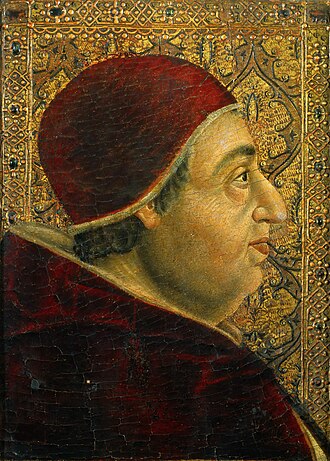
Pope Alexander VI

The Christian evangelical movement strives to make America into a fascistic theocracy which is somewhat ironic since its sworn enemies are those other national theocracies (Iran, China) that have put their own idols in place for their own worshipping, be those idols of a religious or political nature. Religion is what we bow down to or what we look up to, and this is why the virtue of piety is linked to what we have come to understand as human excellence. Piety and virtue arete have always been held together.

Human beings cannot live without some meaning of some kind. Mass meaninglessness seeks for something that will provide it with the sole truth regarding the nature of the things that are and give meaning to those things and to the the worlds in which those things appear. The Christian nationalists seek to turn Christ into an “armed prophet” rather than the failed “unarmed prophet” of the New Testament and in doing so leave their Christianity and the Christ of the New Testament behind them.

The distinction between “armed” and “unarmed” prophets was first noted by the Italian political philosopher Machiavelli in his writings. For Machiavelli, Christ the “unarmed” prophet failed in establishing a kingdom while other “armed” prophets were successful in doing so. The best example was Moses. In Machiavelli’s lifetime, Pope Alexander VI turned the Roman Catholic Church into the “armed prophet”, and the later horrors of the Spanish Inquisition, which began in 1478, could be said to be primarily of his doing. (More will be said about Machiavelli and Pope Alexander VI in the summary comments on these writings.)

That Machiavelli, the first philosopher of power, was evil goes without saying; he himself says as much about himself. The evangelical Christians appear to have forgotten the three temptations or tests of Christ that we spoke about in Part I of our “Sketch”. Where Christ succeeded, they have failed; where Christ failed, they are hoping to succeed.
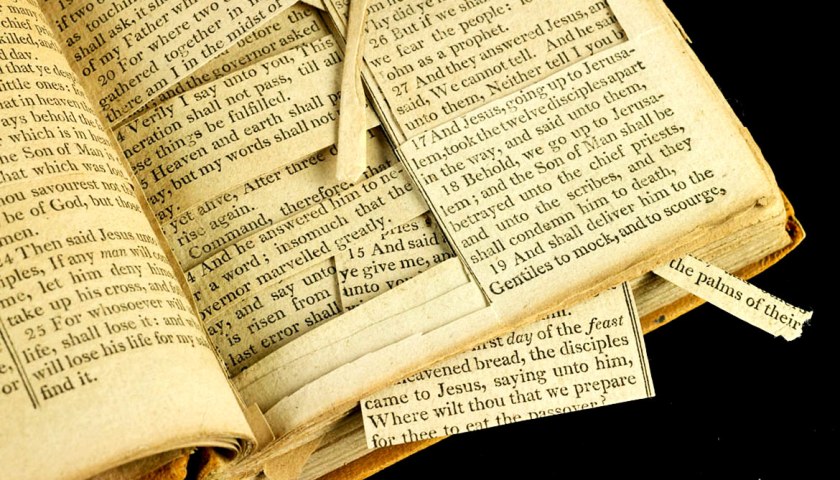
Thomas Jefferson’s Bible

Christian Nationalism has created a mythological version of American history. It runs roughly as follows: “America was founded as a Christian nation; the founders were traditional Christians; the founding documents are based on Biblical principles; America has a special role to play in history; it has therefore been blessed with enormous power and prosperity; however, those blessings and those missions are endangered by the presence of non-whites, non-Christians, and non-native born people on American soil.” It should not be surprising to see the connections with neo-Nazi movements and the acceptance of those movements by the Christian Nationalists.

Christian Nationalism is powerfully associated with various political positions including: opposition to immigration, abortion, gun control, and mask-wearing and support for punitive policing, mass incarceration, capital punishment, gerrymandering, voter suppression, and—as should be obvious by now—support for Donald Trump.

While American evangelicalism has not been Christian Nationalist per se, its support for Donald Trump has been moving it closer to the desire for a fascistic theocracy. This change has been an evolutionary process over the century for evangelicalism. Donald Trump and American evangelicals have never been natural allies. Trump has owned casinos, flaunted mistresses in the tabloids, and clearly has not read the Bible in his lifetime for when asked to quote his favourite verse he said “It’s too personal” and evaded the question.

In 2016 many people doubted whether Trump could gain the support of evangelicals, whose support he needed. He chose Mike Pence, an evangelical Christian, as his vice-presidential running mate. Eight years later, evangelical support for the former president and current Republican frontrunner is no longer in question, and the Covid 19 pandemic had a lot to do with it. Evangelicals saw the Covid shut down as an attack upon them using “godless science” and leftist philosophies, and they rebelled against it. This process has gradually evolved to where there are now prominent evangelical leaders who have come to believe that Trump is “God’s instrument on Earth.”
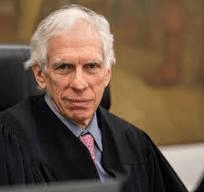
Judge Arthur Engoron

Like the Holy Roman Church 500 years before it, many in the evangelical Christian movement have succumbed to the third temptation of Christ. Many of its leaders suffer from the paranoia and sociopathy that characterizes malignant narcissism present in today’s world, and their relationship to Trump is entirely transactional. This has given the appearance of ‘a cult of personality’ surrounding Trump.

The evangelical concerns have become manifest in the ‘culture wars’ that are ongoing in the USA and have intensified since the election of Barack Obama, a black President, in 2008 and Trump’s “descent down the golden escalator” to announce his candidacy for President of the United States in 2015. The lines separating the evangelical movement and white Christian Nationalism have become very blurry indeed. Judge Arthur Engoron’s judgement that Trump’s “lies and lack of remorse border on the pathological” was a conservative assessment of the man’s character, but this characterization apparently does not affect the support given to him by evangelical and Christian nationalist followers.

When Trump’s part in history is finished, it will be hard to look upon the man as a tragic figure rather than as the clown or buffoon of a comedy. (In a survey of professional historians, Trump was voted the worst President in the history of the United States.) The hero of a tragedy must be an essentially good man who, through his own lack of moderation sophrosyne and wise judgement phronesis, his own lack of self-knowledge, misses the mark in his judgements of how things really are and thus brings about his nemesis or “just desserts” which is usually his death.

One is hard-pressed to find aspects of goodness in Trump’s character. Trump is the quintessential “human being as surface phenomenon” and his life has been consistent in this aspect of his character and his actions; it has been one of image and deceit, lack of depth. His capacity for bringing about evil and mischief was demonstrated by his choice to enter politics in the USA. His being elected as leader was an example of technology’s effect on the human soul of human beings. That a fraud and villain could be seen as a model of human excellence says much not only about the situation in the USA but also about the condition of human beings whose being is determined by the technological in the modern age.

Sketch for a Portrait of Evil: Part III

The Red Dragon and the Beast from the Sea

Adolf Eichmann of Nazi Germany

Good can be radical; evil can never be radical, it can only be extreme, for it possesses neither depth nor any demonic dimension yet–and this is its horror–it can spread like a fungus over the surface of the earth and lay waste the entire world. Evil comes from a failure to think.”― Hannah Arendt, Eichmann in Jerusalem: A Report on the Banality of Evil

Evil comes from a failure to think. It defies thought for as soon as thought tries to engage itself with evil and examine the premises and principles from which it originates, it is frustrated because it finds nothing there. That is the banality of evil.”― Hannah Arendt

As there is an inner connection between consciousness and conscience, there is also an inner connection between the ability or inability to think and the problem of evil. Since thinking’s end is to bring to presence, to bring to unconcealment, evil abhors this effort since evil abhors the light. Evil requires shadows, illusions, obfuscations; it is the enemy of truth and unconcealment, and such unconcealment is “consciousness”. Evil abhors the light and flies from the light which is “consciousness” itself. Contrary to the “nothingness” of evil that Arendt finds (this is merely its nihilism), we find that evil is ubiquitous and that its presence is everywhere. This ubiquity makes evil only appear to be banal and contributes to its banality. Because of the horror shown in its unconcealment, it remains unspoken and is, literally, the ‘unspeakable’. If there is anything demonic about evil, it is its ‘unspeakableness’.

For Arendt, the faculty of thinking (the dynamis of thinking, the possibility and “potentiality” of thinking) is not the erotic “thirst” for knowledge; it is a potentia of every human being and not the privilege of only a few. (This is a somewhat erroneous view of Plato and of Aristotle since both see ‘the desire to know’, the eros for knowledge, as the essence of human being itself and not just a characteristic of the few.) The roots of Arendt’s thinking are to be found in the neo-Kantians of 19th century Germany, the Hermann Cohen school of Kant at Marburg, Germany where Arendt famously (and notoriously) attended classes held by Martin Heidegger.

Arendt believes that if Kant is right and the faculty of thought has a “natural aversion” against accepting its own results as “solid axioms” (because they are merely the “opinions” of Plato), then we cannot expect any moral propositions or commandments, no final code of conduct from the thinking activity, least of all a final definition of what is good and what is evil. For Arendt, good and evil are “values” which the thinking activity creates as principles for its conduct from out of the principle of reason (technology), and not self-existing realities which thinking must attempt to comprehend. If it is true that thinking deals with invisibles, it follows that it is “out of order” in Arendt’s view since Arendt believes that we move in a world of appearances in which the most radical experience is that of the disappearance that is our death. By ‘radical’, we interpret Arendt to mean ‘most real’, ‘most deep’, ‘most grounded’. Contrary to Arendt’s thinking, the most radical experience for the ‘thinker’ is the experience of the absence of God which later becomes ‘the death of God’.

Arendt’s analysis of evil focuses on the evils which result from systems put in place by totalitarian regimes. That these regimes are predicates of the subject technology as we have stated here, the systems that those regimes put in place must also contribute to the “metaphysical” ends of that technology which are the logistics in preparation for warfare. In her early analysis, she does not address the character and culpability of individuals who take part in the perpetration of evil within those systems.

View of the entrance to the main camp of Auschwitz (Auschwitz I), bearing the motto “Arbeit Macht Frei” (Work makes one free)

In Eichmann in Jerusalem: A Report on the Banality of Evil, Arendt turns her attention to individual culpability for evil through her analysis of the Nazi functionary Adolf Eichmann who was tried in Jerusalem for organizing the deportation and transportation of Jews to the Nazi concentration and extermination camps. Arendt went to Jerusalem in 1961 to report on Eichmann’s trial for The New Yorker magazine. In Eichmann in Jerusalem, she argues that “desk murderers” or “schedulers of trains” such as Eichmann were not motivated by demonic or monstrous motives. They were motivated merely by ambition and recognition, common motives among human beings. Instead, according to Arendt, “It was sheer thoughtlessness—something by no means identical with stupidity—that predisposed Eichmann to become one of the greatest criminals of that period” (Arendt 1963, 287–288). According to Arendt, Eichmann’s motives and character were banal or trite rather than monstrous. She describes him as a “terrifyingly normal” human being who simply did not think very deeply about what he was doing.

Plato distinguishes between thinking and knowing, between reason with its representational images composed of numbers and words (logos), the eros the urge or need to think and to understand, and the intellect which is capable of certain, verifiable knowledge. Plato separates knowing from thinking as knowing is an action or event that has occurred in the past (gnosis), while thinking is an action that occurs in the present. Knowing and thinking are associated with our being- in- time, and it is through our knowing (gnosis) with the aid of memory that we are able to transcend time.

Historically, thought has become understood and dominated by the idea that it is “reason” due to the Latin understanding and translation of logos as “reason” and the subsequent essence of human beings’ being described as the animale rationale. As we have tried to show up to this point, in the modern, thought is determined as logic and logistics, the theoretical episteme of “knowing” and the logistike or technai of “making” or “making happen”.

Through history, the pistis or “faith” and “trust” established by the schema, the metaphysical underpinnings of representational thinking that has become technology, the framing, requires the certainty and correctness of the correspondence between the mind’s thinking and the object that is thought. This agreement is the correspondence theory of truth. The technological is one aspect of being’s revealing. The irony is that it is through this view of reason that we have discovered that human beings’ essence may not, in fact, be reason; and because of this, in the ‘eye of reason’ so understood, human beings have become dispensable, usable, and disposable resources. Nietzsche is the philosopher who thought through this and shows this most clearly.

The metaphysical underpinnings of representational thinking attempt to ‘stamp becoming with the character of being’, which Nietzsche asserted as technology, the ‘highest form of the will-to-power’. For Nietzsche, technology as will-to-power requires a thinking and a willing that is beyond good and evil. We can see how this view of thinking and willing can be derived from Plato’s Divided Line if we view it from only one direction, with only one side of the face of Eros. In such thinking, the other face of Eros simply does not exist for it has not been experienced.

Immanuel Kant

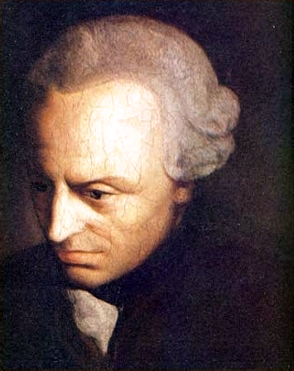
“Consciousness” and “conscience” (“with knowledge”) in Plato are the same thing; one cannot be ‘conscious’ and not have a ‘conscience’. The two have become separated, and “conscience” ceases to be the word of the logos in the soul and becomes Kant’s “practical reason”. A man such as Eichmann was simply not ‘conscious’ (in a Platonic sense) and therefore had no ‘conscience’ even though Eichmann insisted that his moral position derived from Kant, perhaps revealing the inadequacies of Kant.

The interior dialogue of thought which is true consciousness can only be done when one has gone home and examines things, when one takes a moment to stop and think. This stopping to think is antithetical to technology. Thinking, reflection, attention and contemplation is a private act and so technology bores ever more into the privacy of individuals to destroy it. Someone who does not know the discourse of the interior dialogue or monologue between the “me and myself” will not mind nor care about contradicting himself and he will never be able or willing to give an account of what he says or does, nor will he mind committing any crimes since he is sure they will be forgotten the next moment. Such was the condition of Adolf Eichmann, and such is the condition of Donald Trump. Social pathologies are present in both and they were there before they arrived on the scene. In these pathologies, they mirror the societies of which they are members.

Thinking in its non-cognitive, non-specialized sense is a natural need eros of human life and is given to every human being. Specialists in thinking are also subject to the inability to think as it is an ever present possibility for everybody. However, this non-wicked “everybody” is capable of infinite evil. As Arendt notes regarding Eichmann: “The trouble with Eichmann was precisely that so many were like him, and that the many were neither perverted nor sadistic, that they were, and still are, terribly and terrifyingly normal. From the viewpoint of our legal institutions and of our moral standards of judgment, this normality was much more terrifying than all the atrocities put together.” The lack of a “conscience” was present in its absence just as “consciousness” was present in its absence among the many, the “everybody” and the “nobodies”.

Adolf Eichmann

The most massive moral failure of European history was “the final solution of the problem of the Jews”. This “final solution” was made possible through technology and was a predicate of that technology. The Jews were perceived as ‘a problem’ that needed to be fixed; successfully fixing this problem was the motivation behind Adolf Eichmann’s ambition in the day-to-day details of his life. The ‘fixing’ of this problem first required the eradication of any consciousness that the Jews were, in fact, other human beings. They might just as well be coal or any other resource that the regime needed at the time to ‘fix a problem’. The “otherness” of the Jewish people as human beings, as neighbours, had to be taken away from them. Once this was done, ‘conscience’ had no role to play since “consciousness” was no longer present, and Eichmann remained unrepentant for the remainder of his life for he believed he had done nothing wrong and was ‘only following orders’ or directives from the higher-ups in the regime.

As human beings, we all have the potential to think…or not to think, to be conscious or not be conscious. This is the essence of our freedom as was shown in our discussion of the Meno. For a great many human beings, the need to earn their daily bread causes them to be caught up in massive corporate or bureaucratic structures that enable evil’s flourishing. These structures are the products of, or the outcomes of, the technology that has led to their being; just as our computers and handphones are the tools made possible by that technology and which owe their being to that technology: they are not technology itself. The eradication of human beings is the ultimate goal required by technology and, thus, the destruction of “conscience” and “consciousness” is a requirement for this realization for these are the essential elements of what human beings are. As this decaying and eradicating process slowly unfolds, human beings become less humane.

Lack of self-knowledge and thoughtlessness go hand in hand. In the technological, the logos that distinguishes human beings from all other beings is brought to presence as cliches, stock phrases, and the adherence to standardized codes of expression and conduct. (Meno’s learning from Gorgias as an example; Eichmann’s responses to the questions put to him at his trial; Donald Trump’s media events.) The human being is made to fit the “brand” or image of the corporation or public entity to which they belong; if they do not, they are not “true Nazis” or RINOs. When they do not do so, they will no longer be a part of that entity.

The corporations (and the higher institutions of learning that have modelled themselves upon it such as the Harvards and Yales of the world who have so obviously failed in their goal to “educate” the public) have replaced the polis as the determiner of the character of those who belong to it; the regime in which the corporation happens to be placed is secondary. This ‘fitting in’, this ‘fittedness’ (the perverse, evil, ersatz form of ‘justice’) has the socially recognized function of protecting us against “reality” by giving to us an ‘alternative reality’ against consciousness and conscience when we come up against reality. The individual’s thinking attention is an inhibitor and an enemy to the efficiency and effectiveness of the technology that interprets the “reality” (gives it its meaning) that the facts and events make by virtue of their existence in their certain way. (Arendt, The Life of the Mind). As Arendt notes, “The sad truth is that most evil is done by people who never make up their minds to be good or evil.” Arendt is here describing the technological human being, or humanity in the technological age.

There appears to be a clear connection and relationship between the fact-value distinction (the separation and distinction between judgements of “fact” from judgements of “value” so necessary for the seeing and thinking of our modern day social sciences), and the separation of “consciousness” and “conscience” as it reveals itself in our day-to-day lives. Since science is unable to objectively prove the existence of a person’s “moral character” or “conscience”, science is unable to pass judgements on the actions that human beings are capable of committing or on the acts that human beings have committed. Science, by necessity, must be morally obtuse. The terms “good” and “evil” simply have no meaning for it because they are “values” not real existent things or beings; they are surface phenomenon only. In this they follow Nietzsche’s influence on 19th century thought, but its roots are from much earlier in Western thinking.

As we have shown in our discussion of the Meno, this inability to determine what human excellence is is at the root of the lack of a “moral compass” among so many human beings living today. Since the modern day social sciences are a predicate of the subject technology, this is an example of technology’s determining or shaping of the logos or language over the last several centuries. In the USA, the American Psychological Association’s application of the Goldwater Rule towards the book The Dangerous Case of Donald Trump is an example. The APA is fully capable of giving advice with equal alacrity to tyrants or monarchs (and because it does so, it receives its annual grants and dispensations from various sources, primarily the pharmaceutical industry, to carry on as it does. Drugs are a necessity to counteract the mass meaninglessness that the technological society has produced.)

In describing the evil that was Adolf Eichmann, that separation of ‘consciousness’ and ‘conscience’, Arendt stated in Eichmann in Jerusalem: The Banality of Evil regarding Eichmann: “For when I speak of the banality of evil, I do so only on the strictly factual level, pointing to a phenomenon which stared one in the face at the trial. Eichmann was not Iago and not Macbeth, and nothing would have been farther from his mind than to determine with Richard III ‘to prove a villain.’ Except for an extraordinary diligence in looking out for his personal advancement, he had no motives at all… He merely, to put the matter colloquially, never realized what he was doing… It was sheer thoughtlessness—something by no means identical with stupidity—that predisposed him to become one of the greatest criminals of that period. And if this is ‘banal’ and even funny, if with the best will in the world one cannot extract any diabolical or demonic profundity from Eichmann, this is still far from calling it commonplace… That such remoteness from reality and such thoughtlessness can wreak more havoc than all the evil instincts taken together which, perhaps, are inherent in man—that was, in fact, the lesson one could learn in Jerusalem.” (italics mine). In her description of Eichmann here, Arendt is careful to make a distinction between Eichmann and the other Germans who were caught up in the events of their time. She strongly asserts that “if all are guilty, then none are guilty”. Eichmann is specifically guilty because his thoughtlessness as a ‘scheduler of trains’ put him in the position of committing the greatest evils. His actions showed him to have lived out his life within the ring of Gyges. As Arendt stated: “…the greatest evil perpetrated is the evil committed by nobodies, that is, by human beings who refuse to be persons”. By not being a person one is, in a sense, invisible, anonymous.

The difficulty we have with Eichmann is whether or not to conclude that there is an Eichmann in each of us waiting for the appropriate socio-historical conditions to emerge. This, at least, urges us to thoughtfulness and provides us with the moral mission to prevent a repetition of genocidal murder by shaping the world’s political systems to allow for and to protect individual rights and freedoms, things that are currently in great danger of being lost in the USA today.

Eichmann was shaped by the forces of Nazism, and as a “follower” this determined his sense of identity as a self. Under the conditions prevailing during the Third Reich, only “exceptions” could be expected to react “normally”. The Nazi regime was not “normal”. While on the stand before the court in Jerusalem, Eichmann could not reveal anything new about himself because he had chosen an “unchanging” identity, an identity as a starting point by which he established his “self-knowledge” (as was seen in the character of Meno) and not the end point which reveals the true knowledge of the self that is gained through thinking. This lack of self-knowledge leads to an inability to think which leads men like Eichmann to act in the way that they do: erroneously and horribly.

The sense of self-identity in Eichmann was weak: his lack of success in his education and his lack of natural gifts led to his lies about himself about who he really was. “Bragging had always been one of his cardinal vices.” (Arendt, Eichmann p. 49) Eichmann appears to share this vice with Meno and Donald Trump, the other figures that we are exploring in our attempt at a portrait of evil. The facts surrounding Eichmann’s background are varied. Eichmann never harboured any ill feelings against his victims and he made no secret about this fact. He was an ambitious man and his early life failed to realize those ambitions. Like Donald Trump, he was not a reader of books but read newspapers and was a fan of the films of Leni Riefenstahl. He was someone who was prepared to sacrifice everything and everybody for an “ideal” and that ideal had been given to him by the Nazi party.

The distinction between a “movement” and a “party” is that a “movement” is not bound by a policy or program. Nazism was such a movement. (The Republican party of the USA is not bound by a “program” or “policy” currently, and they have no specific one that can be pointed to as their goal. They have devolved from the ‘party of Lincoln’ into a “movement”. The result is a chaos that mirrors the chaos of German politics prior to Hitler’s coming to power. When in power, the regime unified itself behind the military-industrial complex with the goal of righting the wrongs of the Treaty of Versailles.)

It has been noted by biographers that Eichmann was lacking any sense of “otherness”; he was unable to look at anything from the other fellow’s point of view. (Arendt Ibid, p 65) He dwelt within the “bubble” of the “world” created for him by Nazi propaganda. Modern propagandists or “sophists” differ from ancient sophists. As we saw with Meno, the ancient sophist was satisfied with a verbal victory in the moment at the expense of truth whereas the modern propagandist/sophist wishes for a more lasting victory at the expense of reality or the revealing of truth. The truth must, of necessity, remain hidden.

The dual discourse that is the logos shows itself in the modern as it did in ancient times. “Officialese” became Eichmann’s language because he was genuinely incapable of uttering a single sentence that was not a cliché, much in the manner of Meno. He could believe that he was not lying and not deceiving himself for he and his world were in perfect harmony. Trump and his MAGA followers experience this same harmony of lies. The implementers of the “final solution” were not ignorant of what they were doing; they were just prevented from equating it with their “normal” knowledge of murder and lies for their sense of “otherness” had been destroyed.

As was pointed out previously in Part I, the multitude or the “mob” or the “social collective” is what Plato described as the Great Beast. In his day, this was perceived as the polis and the deme that constituted the polis, the town and country. Today we see it as the State, the Nation, etc. The Great Beast that is the collective (no matter which name it goes by) requires “the big lie”, whether it be “the noble lie” of Plato or “the Big Lie” of Joseph Goebbels or that being created by Donald Trump in the USA today, the ‘us vs. them’ lie.

Plato’s “noble lie” is the founding myth of the civic identity of a people grounding that identity in the natural brotherhood of the entire indigenous population (they are all autochthonous, literally “born from the earth”, from before conscious memory), making the city’s differentiated class structure a matter of divine dispensation based on the arete or “excellence” of each individual soul in its ability to carry out its work or function (the demiourgos who molds them puts different elements in their souls in varying strengths such as fire, air, and water; the body is composed of the element of earth). If people can be made to believe that they are brothers, they will be strongly motivated to care for their city and for each other because one’s chief concern is for “one’s own”.

In the Nazi vision of the world, the lack of autochthony of the “wandering” Jews was at the root of the German belief that the Jews were “poisoning the blood” of the German people and could justifiably be exterminated because they were perceived as a threat. They were perceived as aliens and enemies, and certainly not one’s brothers. African and Native Americans were made to suffer the same fate in the USA.

In the history of misinformation there is probably no other document which has caused more evil than The Protocols of the Elders of Zion (which many neo-Nazis today still believe to be fact) and which became a “gospel” of world-wide anti-Semitism. This writing which originated in Russia in 1905 remains as well-read today as it was during its early period. The Protocols is entirely a work of fiction, intentionally written to blame Jews for a variety of ills. It claims to document a Jewish conspiracy to dominate the world. The conspiracy and its alleged leaders, the so-called Elders of Zion, never existed. In 1903, portions of The Protocols of the Elders of Zion were serialized in a Russian newspaper, Znamya (The Banner). The version of the Protocols that has endured and has been translated into dozens of languages, however, was first published in Russia in 1905 as an appendix to The Great in the Small: The Coming of the Anti-Christ and the Rule of Satan on Earth, by Russian writer and mystic Sergei Nilus. (Holocaust Encyclopedia)

At the heart of Nazi propaganda was “the Big Lie” as it was formulated by Joseph Goebbels: “If you tell a lie big enough and keep repeating it, people will eventually come to believe it. The lie can be maintained only for such time as the State can shield the people from the political, economic and/or military consequences of the lie. It thus becomes vitally important for the State to use all of its powers to repress dissent, for the truth is the mortal enemy of the lie, and thus by extension, the truth is the greatest enemy of the State.” Lies, particularly the Big Lie, and the suppression of truth are necessary for the Great Beast to thrive, for truth is the greatest enemy of the Great Beast. The Great Beast requires the Anti-Logos for its health.

In The Origins of Totalitarianism, Arendt states what the impacts of the Big Lie were and could be:

“In an ever-changing, incomprehensible world the masses had reached the point where they would, at the same time, believe everything and nothing, think that everything was possible and that nothing was true. … Mass propaganda discovered that its audience was ready at all times to believe the worst, no matter how absurd, and did not particularly object to being deceived because it held every statement to be a lie anyhow. The totalitarian mass leaders based their propaganda on the correct psychological assumption that, under such conditions, one could make people believe the most fantastic statements one day, and trust that if the next day they were given irrefutable proof of their falsehood, they would take refuge in cynicism; instead of deserting the leaders who had lied to them, they would protest that they had known all along that the statement was a lie and would admire the leaders for their superior tactical cleverness.”

Her words are prophetic for what is currently happening in America. The Internet and social media has exacerbated the effects of the Big Lie among those who do not wish to take on the responsibility of thinking.

The great wars of the 20th century were the “technological wars”. Their outcomes were determined by technology. From the catastrophe of WW I, totalitarian regimes emerged. The totalitarian regimes of the 20th century are not the same as the tyrannies spoken of by the ancient Greeks, and the essential difference between the two is the presence of technology. Within the technological, the evil that came to presence and showed itself in Nazism and in the events of WW II, entered the world stage. The evil that showed itself as Adolf Eichmann is an ever-present strife for all human being-in-the-world, for an Eichmann is present in all of us waiting only for the proper historical circumstances and contexts to come forward. Who among us is not motivated by ambition and a “good reputation” (eudoxa)?

As we have seen from our earlier discussions of Plato’s Divided Line “morality”, when conceived as a fixed body of principles and aims for conduct based on trust and faith fixed by an authority or by choice whether collective or individual (arete as “orthodoxy”), is distinguished from “philosophy” and thinking. Thinking does not prescribe norms or “values”; it is itself the “ethical”, a radical ethics, in that the course of “action” or praxis is already determined and made present by the thinking.

The representational thinking that is the essence of the technological (the “picturing” and “framing”), the lower form of Eros, delivers technological human beings over to mass society that can only find meaning through the gathering and ordering of all their activities and plans (logos) in a way that corresponds to technology. This has resulted in the “mass meaninglessness” characteristic of technological societies at their apogee. This also is the essence and danger of artificial intelligence; it is the precursor to the great evils to come since it will be destructive of the essence of humanity and of any sense of human “excellence”.

What is the relationship between thinking and practical behaviour? Thinking is a praxis a deed, an activity, but it surpasses all other types of praxis in that it is part of the essence of what “human excellence” or “virtue” is, that which allows human beings to surpass and overcome their mere humanity . Thinking itself is two-faced. On the one hand, it permeates action and production and measures these by their grandeur and the utility of their outcomes. At the same time, thinking illuminates itself in its humility, in ‘knowing that one does not know’.

As was shown in the Divided Line, the praxis of thinking can be either theoretical or practical thinking, the enframing application of thought as techne, and the conjunction of these two ways of being-in-the-world. Thinking is also meditation, contemplation, and attention with careful concern for the logos, for speech and its truth. Thinking is not merely a “producing” or “bringing forth” activity, but is rather the arete of the essence of human being. Thinking, when compelled by eros the urge to know, is not “of its own”. When thinking is of its own, it is not always productive of truth. When it is productive of truth, it does so because it is given a “dispensation”. Under the conditions of tyranny, it is far easier to act than to think. “Just do it” is a very apt slogan for the human being-in-the-world under the tyranny of technology. As Socrates notes in the Meno: “what is being miserable but desiring evil and obtaining it?”

The “knowing” and “making” and “making happen” that is technology (that combination of the Greek words techne and logos) shows itself to us as no mere “means” but as a way of revealing the world and thus a way of being-in-the-world. Through the history of Western philosophy and science, the world came to reveal itself as a ‘disposable object’, a picture, an idea of producing, a product of the imagination and reason. (We have attempted to show this in our previous discussion of the Divided Line.) The West at some point (perhaps in that period known as the Renaissance) made a choice that it would concern itself with the lower form of eros and attempt to bring about that justice that appeared absent from the Necessity of the world’s “reality”. Science became “the theory of the real”. Human beings became the centre of that world; but at the same time, they themselves became an object within that world-view.

The revealing that rules in modern technology is a challenging which puts to nature the unreasonable demand that it supplies energy that can be extracted and stored as such. But does this not hold true for the old windmill as well? Its sails do indeed turn in the wind; but they are left entirely to the wind’s blowing. The windmill does not “unlock energy” from the air currents in order to store it. Agriculture became the mechanized food industry and we have seen a number of counter movements to this view of agriculture such as the “organic food” movement. In the our daily activities, air is now set upon to yield nitrogen, the earth to yield ore, ore to yield uranium; uranium is set upon to yield atomic energy, which can be released either for destruction or for peaceful use. The earth and the human beings within it are viewed as “resources”, disposable resources.

Martin Heidegger

There is a strange, uncanny interdependence of thoughtlessness and evil and that appearance which appears to be thought (the “imitative thought” of technology) and how it is related to the essence of evil. The 20th century’s greatest philosopher, Martin Heidegger, showed this uncanny relation in a comment made in his Black Notebooks which has made quite a scandal in academic circles and persists in being scandalous due to Heidegger’s silence regarding the Shoah in the post-war years: “Agriculture is now a mechanized food industry, in essence the same as the production of corpses in the gas chambers and extermination camps, the same as the blockading and starving of countries, the same as the production of hydrogen bombs”. To be clear, Heidegger does not say that the Holocaust is identical to modern agriculture. He is saying that they share the same ‘essence’, that is the essence of technology, what in German is called Gestell the ‘enframing’, the ‘schema’. What the essence of technology is is the banality-of-evil that Hannah Arendt speaks of, “the evil that spreads like a fungus” throughout everything. These aspects of evil share the same essence but they are not identical with evil itself nor are they identical to each other, just as an oak or a willow are not identical even though they share the same essence of treeness.

In The Human Condition Arendt says: “Love, by its very nature, is unworldly, and it is for this reason rather than its rarity that it is not only apolitical but anti-political, perhaps the most powerful of all anti-political forces.” Love, attention, thought deal with the private rather than the public sphere. The private and public spheres are constantly in strife with each other. It is the private aspect that gives to love the ‘unworldly’ character that Arendt speaks about. Since the public sphere is concerned with turning all that is into an “object”, the individual is faced with the constant challenge to remain engaged with it. One cannot love an object. Because the seeking of truth is what makes human beings human we can say that the seeking of truth, whether from the lower or upper forms of Eros, is done because it is good.

Corruption is an essential requirement for evil to flourish. Historical documents from the times of the Nazi regime show the horrible comedy of some of the meetings between Eichmann and the leaders of the Jewish communities in the various countries under German occupation. The shameful role of the Vatican throughout the Holocaust exemplifies the lack of morals and ethics that occurs when one compromises with the “earthly powers” of geo-politics: the Church’s concern for its members in Germany allowed them to overlook what was occurring to the Jewish people even though they were well aware of it. (As a note, Martin Heidegger was a Catholic.)

The issue of thinking and thought and its relation to evil asks the question of whether or not it is “possible” to carry out evil “thoughtlessly”. Socrates long ago asserted that “no one knowingly does evil”, and this assumes that there are two types of “thinking” being discussed by those who assert that Eichmann knew full-well what he was doing during his time as “the scheduler of trains” and those who assert that he was neither “conscious” nor had a “conscience” regarding his actions. In the Third Reich, evil had lost the quality by which most people recognize it–the quality of temptation, which is the ‘consciousness’ and ‘conscience’ in which it is commonly recognized. Eichmann was successful in organizing the chaos that was ‘the final solution’ because his office organized the “logistics”, the means of transportation that were behind the massacre. He did not determine who would work, or who would die for he did not hold any such extraordinary power. Doing evil became equated with ‘doing one’s duty’, with ‘getting on with the job’, and the evil involved in this was not discernable because there was no thinking involved in doing one’s job.

The success of the Nazi regime required the compliance of the Wehrmacht, the State, and the industrial bureaucracies: the military/industrial complex as a predicate of its subject technology wherein it finds its essence. This compliance was forthcoming due to the universal rage at the terms of the Treaty of Versailles. The sheer injustice of the Treaty made this rage justified to some extent. Is the same justification for rage present in the followers of Trump and the Christian nationalists in the USA today? Is their rage dependent on their perceived loss of power in their country, their fear of the threat of becoming ‘meaningless’ in the country in which they were born, of their being ‘replaced’? what are the roots of their ressentiment? The USA is not autochthonous because its making as a country did not occur before conscious memory (as is the case with the polis in Plato’s ‘noble lie’ regarding autochthony or rootedness and with many European nations).

The technological administrative massacres of Eichmann are not unique to the 20th century. The conquest of North America began with the genocide of its Native Peoples and the establishment of its colonies based on slavery. While these ‘facts’ are evil enough in themselves, the attempts to be ‘intentionally ignorant’ of those evils further exacerbates the difficulty of coming to some sense of self-knowledge of who one is as a North American, and it weakens the capacity and the capability of thinking regarding one’s own actions.

Within the parameters of the social sciences’ “fact/value” distinction, there are many people who want to abandon the concept of evil because they may be overwhelmed by the task of understanding and preventing evil or they are overwhelmed by the calling to do so and would rather focus on the less daunting task of questioning the motives of people who still use the term. This is part of the quixotic nature of the task of trying to make evil a visible phenomenon. This is strange, uncanny since evil is the most prominent of ‘surface phenomenon’ and has no depth. It, nevertheless, is ‘radical’ in nature. Arendt, following Kant, denies the radicality of evil.

The problem we have is that evil persistently refuses to be an abstract concept try as we might to make it as such. This is because evil is not a “value”, not something of human knowing and human making but something which has an essence of its own and exists as and in its own. Evil, like the idea of technology, has many predicates. We may try to look at “evil actions” and throw some light on them by contrasting them with arete or “human excellence”. We may look to the “evil personality” and try to show the agency of thoughtlessness behind evil’s flourishing. We may look at analyses of “evil institutions” and seek to determine the origins of evil in those places.

Those ‘fact/value’ scientists who are skeptical of using the term evil find that the concept of evil requires unwarranted metaphysical commitments to the notion of a devil or daemon, or notions of “possession” by dark spirits. We have tried to show here aspects of what “possession” may, in fact, mean through our discussions of the various faces of Eros and the Logos. The urge to turn all that is into an ‘object’ so that it will give us its reasons for being as it is causes many individuals to abandon any notion of trying to come to terms with evil for evil resists “explanation”; like life itself it remains uncanny, mysterious even though it surrounds us like the sea surrounds a fish. (A joke: Two young fish are swimming lazily when another older fish passes by and says “Morning boys, how’s the water?” The two young fish continue swimming for a moment when one turns to the other and says “What the hell is water?”)

The modern day social scientist is uncomfortable with “uncanniness”. The concept of evil is “useless” because of its uncanniness. In true modern day social scientific fashion, the American Psychological Association or APA, sees the concept of evil as harmful or dangerous when used in moral, political, and legal judgements or contexts, and so, it has recommended that it should not be used in those contexts, if at all i.e. the ‘fact/value’ distinction must rule. Modern day social science requires moral obtuseness.

The final stage of evil’s corruption is perversity or wickedness. Donald Trump’s speeches to his MAGA followers illustrate this aspect of evil’s projection onto others as Donald Trump constantly calls his political enemies ‘perverse’ and ‘wicked’. As we have seen with our discussion of the Meno, someone with a perverse will inverts the proper order of the incentives that might be present. Meno, instead of prioritizing the moral law over all other incentives, prioritizes self-interest over the moral law. His actions conform to the moral law only if they are in his perceived self-interest. Someone who acts only out of their perceived self-interest need not do anything wrong because actions which best promote their self-interest may conform to the moral law in place at the time. But since the reason he performs morally right actions is self-interest and not because those actions are morally right, his actions have no moral worth and, according to Kant, his will manifests the worst form of evil possible for a human being. Kant considers someone with a perverse will an evil person (Kant 1793, Religion Within the Limits of Reason Alone Bk I, 25).

For Arendt, radical evil involves making human beings as human beings superfluous. Again we reiterate: this is the end of technology. This superfluidity is accomplished when human beings are made into living corpses who lack any spontaneity or freedom, when “consciousness” and “conscience” are separated. According to Arendt, a distinctive feature of radical evil is that it isn’t done for humanly understandable motives such as self-interest, but merely to reinforce totalitarian control and the idea that everything is possible. Here we can see radical evil’s connection with technology. Totalitarian and authoritarian regimes are predicates of the subject technology. The future technological world, if it can come into being before it destroys itself, will be a great tyranny. The ‘mass meaninglessness’ required by it will fulfill Socrate4s’ saying regarding evil: “What is being miserable but desiring evil and obtaining it”.

Sketch for a Portrait of Evil: Part II

The Red Dragon and the Beast from The Sea

Meno of Thessaly

A link to a copy of Plato’s Meno can be found here: http://mat.msgsu.edu.tr/~dpierce/Dersler/Genel-Matematik/plato-meno-loeb.pdf

To properly read a Platonic dialogue is to engage in the act of thinking itself, and this is the whole purpose and reason for their form and content. His writings are not treatises and essays. This engagement in thinking makes them conducive to the thwarting of evil.

If thinking begins with the acknowledgement of ‘knowing that you do not know’, then the unique object that is the Platonic dialogue assists the reader by placing a conundrum or a riddle before the reader’s eye and begging the question from the reader: “What the heck is going on here?” The “what”, “how”, and “why” questions come before one in this unique mode of presentation in the history of philosophy and of thinking. In the dialogue of the Meno, we are shown that virtue or arête, or what “human excellence” is is the search for knowledge that is conducted through thinking. The question of the dialogue, “what is virtue arête?”, is identical with the question of “what is the principle of all value judgements?” This makes it useful for the reflection required in the Core Section of the Theory of Knowledge course.

The dialogues of Plato are more akin to drama and theatre and, therefore, there is an emphasis on the “showing forth before the eye” with them. What is it then that we are to see in a Platonic dialogue? Like Shakespeare, we cannot assume that we are getting the thoughts of the writer Plato through the words of the various characters. When Macbeth says that “Life is an idiot full of sound and fury signifying nothing”, we cannot presume to say that this is Shakespeare’s view of life. It is the view of life of a man or a character who has committed numerous evils, including (like Gyges in the myth) assassinating a king. This is the life of a man who has violated life’s laws (which is but another name for doing evil: doing evil is violating life’s laws). Macbeth’s fate is to have his head mounted on a stick with a sign saying “Behold the tyrant” written underneath.

The dialogues of Plato are either performative or narrative. The Meno is an example of a performed dialogue; the Republic is an example of a narrative dialogue, and in that particular case, narrated or told by Socrates himself. The dialogues also may be either compelled or freely engaged in. The Meno is an example of a “compelled” dialogue; Socrates is forced to speak even though he may not wish to do so. Because he is compelled to speak, Socrates may not say everything he knows: he will be a dissembler; he will be “ironic”. In theatre, irony is the tone of the language of tragedy; it pervades the language of how the substance of the events that take place are told. Tragedy shows us the nobility of human beings, their excellence, while comedy shows their ‘ugliness’, or their foibles.

The Meno is a dialogue that begins as a comedy and ends as a tragedy or as an “omen” or “prophecy” of the tragedy to come for both Meno and for Socrates. There is also the comic element of presenting an impossibility before one: the whole dialogue of the Meno is the impossibility that a man such as Meno would ask such a question as to what arête or virtue/human excellence is. Based on what we have heard of Meno’s ‘reputation’, we laugh at his asking this question. This impossibility of Meno’s asking the question regarding human excellence shifts into the reality of the tragedy of Socrates’ and Meno’s deaths with the arrival and presence of Anytus, who represents the polis of Athens in the dialogue.

By examining Plato’s dialogue Meno, we can see the “double” nature of learning and thinking as understood in the Greek term anamnesis or “re-collection”. “Re-collection” involves both the double nature of the Logos as well as the two-faced nature of Eros. Meno, a Greek from Thessaly history tells us, was an unscrupulous young man eager to accumulate wealth and subordinated everything else to that end. He is known to have consciously put aside all accepted norms and rules of conduct, was perfidious and treacherous, and perfectly confident in his own cunning and ability to manage things to his own profit. (Xenophon, Anabasis). Historically, Meno was considered an arch-villain for his betrayal of his Athenian mercenaries to the Persian King. For this betrayal, it is said that Meno himself was tortured for a year before he was executed by the Persian King. Meno was also notable for being extremely handsome, and it is said that he used his outward appearance to seduce others to conform to his will. The insatiable desire to pursue and accumulate wealth reveals an insatiable desire to accumulate power, for wealth is power’s master key. Its pursuit outside of any other concerns reveals the thoughtlessness of those who pursue ‘means’, those who are driven by the lower form of eros.

The dialogue Meno has four interlocutors or dramatis personae: Socrates, Meno, Meno’s slave-boy, and Anytus one of the accusers of Socrates. In coming upon Socrates in one of his visits to Athens, he asks Socrates what Socrates thinks “human excellence” or arête is. Arête is usually translated as “virtue”, but the term should be thought without the Christian overtones. “Men: Well Socrates, can you tell me if excellence can be taught? Or is it incapable of being taught but attained instead through practice? Or is it incapable of either being attained through practice or learned, and does it come to people rather by nature or by some other means?” (70a) Can “human excellence” be taught and learned (is it a mathemata, an object of thought?) or is it obtained by “habit”/practice ( through “rote learning” and the repeated exercise of certain actions such as may be observed in ‘pious’ actions much as an athlete achieves greater excellence through repetitions of actions required by their particular sport?) or does it come to people “by nature”, are they born with it i.e., is it from the genes? Responses to these three questions form the structure of the dialogue.

Notice the irony present here, the “unexpectedness” of this event. We might say that its comedy is comparable to a Donald Trump coming upon a Mahatma Gandhi or a Mother Teresa and asking them what “human excellence” or “virtue” is. Its “impossibility” borders on the “irrational”. What is Meno’s purpose in asking such a question? If we visualize what we are reading in the dialogue, we can further see the comedy of the setting. Meno who is handsome, wealthy, powerful (for he is surrounded by a great entourage of admirers) and young, is contrasted with Socrates who is “ugly”, poor, alone and old. But these are ‘outward appearances’ only, and the reality of what these characters are may be something else.

Anytus of Athens

Meno is a house-guest of Anytus, an Athenian politician, who is most note-worthy for accusing Socrates of impiety and corrupting the young resulting in the death of Socrates. Anytus was one of the nouveau riche of Athens and served as a general in the Peloponnesian War. His father was wealthy from his tannery business and Anytus inherited that wealth. As a general, Anytus failed in one of his missions and was accused of treason, which was a common charge against generals who failed in their missions at the time. Rumour had it that Anytus is said to have escaped from the charge by bribing the jury, and it was later said that he also bribed the poet Meletus and other members of the jury to bring the charges against Socrates. Anytus was a ‘corrupt’ politician by ‘hearsay’. We do not have any direct evidence of the accusations made against him.

The first question that we have to ask is why Meno approaches Socrates and asks him what arête is. Why does this arch-villain (by reputation, by hearsay) ask Socrates what human excellence or virtue is? While Meno’s villainy has yet to be demonstrated, is it being suggested that Meno was already “bad” before he met Socrates? The distinction between hearsay and truth, if it cannot be determined from words, must be gathered from the actions which the written words imitate. Is Meno sincere in his asking? For what purpose is his asking? Has he been bribed by Anytus to ‘poke the bear’ that is Socrates and compel him to speak on a subject that will reveal Socrates’ impiety and corruption of the young? Is Meno just looking for some “fun” at Socrates’ expense and is he just showing his ‘meanness’ and ‘bullying’, his ‘cruelty’ in accosting Socrates, a trait shown by wanna’-be tyrants at all times throughout history?

Socrates initially responds to Meno’s question ironically: he notes that the Thessalians’ reputation for horsemanship and moneymaking has now been enhanced by their acquisition of wisdom since the arrival of Gorgias, an infamous sophist. There is the association of eros with the acquisition of wisdom but this is done ironically. Socrates claims that the followers of Gorgias are able to answer in a confident and grand manner all of the questions of which they have absolutely no knowledge.

The connection between the two faces of Eros is established in this introduction. The eros that is sexuality is contrasted to the Eros that is love of the whole, or wisdom, and both are connected to learning and thinking. Gorgias is the rhetorician who speaks to the many, the public; the speech among the few or friends/companions is the private or the dialectic, what we might call ‘talk therapy’. The eros that is sexuality is of the private realm. The public speech looks for victory in eristic discussion; it does not care whether truth is revealed or not. It is the speech of politics par excellence. The private speech between lovers is “useless” to the city or to politics. Socrates tells Meno that if there are any who do know what virtue is, they are ‘specially favoured mortals’. (71b)

We are told that Meno, too, is a student of Gorgias, the famous rhetorician and sophist. Meno claims to have made many speeches to large gatherings on the subject of virtue prior to his discussion with Socrates. Meno’s speeches mimic Gorgias: his thought is ‘imitative’ and he is shown to be incapable of thinking for himself. Socrates claims to have a poor memory and asks Meno to remind him of what Gorgias said on the subject of virtue. Meno’s imitative thinking is shown to be thoughtlessness. An ‘imitative’ thought is not a thought; it is the shadow of a thought.

Meno’s First Response

Meno’s first response is to show that one’s understanding of virtue is based upon one’s social circumstances, the context in which one finds oneself: “MEN: ….for it is according to each activity and age that every one of us, in whatever we do, has his virtue ; and the same, I take it, Socrates, will hold also of vice.” (71e – 72a) Meno’s answer is what we call “common sense”. We may compare Meno’s answer to our response to the question “What do you do?” and we usually respond with the job that we are engaged in: “I am a teacher”, “I am a used-car salesman”, etc. It is the second question following “Who are you?” or “What’s your name?” In both answers we are applying distinctions between ourselves and others and identifying those characteristics that make us the unique being that we are.

The thinking that gathers and assembles a many into a ‘one’ is called dianoia by the Greeks. The gathering and assembling is done through the logos or speech/word or number and it is driven by ‘imitative thought’. This is what artificial intelligence does: it gathers and assembles in speech or number based on a pre-conceived framework or algorithm. While we are capable of identifying and giving a name to the parts of virtue/excellence, we are unable to name that which gives a ‘oneness’ to arête or virtue. The ‘common sense’ understanding does not give us knowledge of what virtue itself is i.e., it provides us with the many eide of the ‘outward appearances’ of virtue but does not give us the idea or oneness of, and thus knowledge of, virtue itself. Meno is unable to answer Socrates’ question. The problem of the one and the many has come to the fore.

Gorgias taught that the actions of human beings lend themselves to genuine imitation in life and in words: “It is not what you say; it is what you do”. This learning and acquisition is what we call ‘habit’ and is the result of habit; we act ‘virtuously’ out of the habit that we have learned through the training given by the society of which we are a member. It is what we call “education”; but instead of being ‘a leading out’, (the word education derives from the Latin educare ‘to lead out’) it is the consolidation of the individual to the collective within. This learning and training is based on the ‘opinion’ of what the society holds most dear and it is reflected in its laws. We are driven to obey these laws by coercion and fear.

Meno’s Second Response

Socrates asks Meno to try again and to give him a response as to what arête is in its singularity. Meno responds that it is “the power to rule over other human beings”, the dynamis politike. Because Meno is the man that he is, Socrates must ask: “To rule justly, or not?” Meno’s response is one of ‘political convenience’: to rule justly, of course, for justice is virtue. Socrates reminds Meno that justice is ‘a virtue’, not virtue itself.

Socrates introduces the example of the schema or figure and suggests “roundness” or the sphere. A schema is a closed, a visible thing i.e., its ‘shape’, its ‘outward appearance’ eidos indicates what it is. Shapes are many, as the geometrical forms are many. But the ‘one’ behind the many outward shapes (eidos) is the idea. A sphere is capable of containing all the many geometrical forms. A shaped surface always accompanies colour. We are aware of shapes only by seeing colours: they are co-extensive and “identical” i.e. they are not the Same. Chroma (colour) and schema (figure) are complementary. Schema needs “body” (res extensa) and body needs colour (chroma). A schema is that which is bounded, limited and is contained by these boundaries and limits. (If we think of our word “information”, we can say that it is the “form” that “informs”.)

“Knowledge” always accompanies “human excellence”; they are complementary. Just as the sphere is capable of containing all shapes and figures within it, white is capable of containing all other colours (light). The knowledge that arises from the knowledge of terms or concepts is based on ‘habit’, the collection and assemblage of data within the form that informs. The ‘habit’ identifies the way of knowing of the technicians or technites who proceed as if they knew what the entities are with which they start with as obvious and end up—when everyone agrees on the terms—with what they set out to investigate. This is the essence of artificial intelligence. It is the application of knowing and making i.e. technology (logos + techne).

Being taught by Gorgias, Meno is searching for a ‘verbal victory’ in his discussions with others without caring the slightest for the matter under discussion. Socrates tells Meno that he will try to speak with him as a ‘friend’ (dialectic) and not as one of those who search for verbal victories. Are we to presume that somehow this discussion is being carried on privately? Are there not around listening to the conversations between Socrates and Meno? Dialectic is ‘friendship’, serious conversation. Socrates will not use any unknown terms with Meno homologia “the same logoi“, but will try to use the terms that Meno is familiar with so that their conversation can proceed.

We are shown that Meno’s memory is faulty. Gorgias’ teaching is memory or the “re-collection” of the opinions of others. It is ‘historical knowledge’ and a ‘repeating’, rooted in a technē developed by the rhetoricians. Memory itself is two-fold and is tied to the two-faced nature of Eros. Its contribution to knowledge and thought can lead one downwards or upwards. There is no memory without experience, and there is no experience without memory. When memory is tied to the images and shadows of the opinions regarding the things that are, it will remain bound to or limited by the surface or outward appearances of things. These things manifest themselves to us as beautiful and we are urged to take possession of them for we believe we have a need of them and, indeed, the soul does have a need for them. But just as Eros is a two-faced being so, too, is the soul a ‘two-faced’ being, being an ‘embodied soul’. Psyche is wedded to Eros.

When trying to get Meno to tell him what arête or human excellence is, Socrates is aware that doing so is not going to be done by “reasoned discourse”. Meno, because of his outward handsomeness and beauty, loves flattery, and to convince him, he must be flattered. He tyrannizes those who follow him. His outward beauty hides the ugliness that is the depth of his ‘shallow’ soul. Meno’s thinking is always ‘coloured’ by what other people say and by what has some standing or reputation in the eyes of the collective. Memories provide the horizons or boundaries in which we live and memory and its contents are complementary. The memories of the collective are the doxa of the collective.

At (77b) in the dialogue, Meno says “excellence is what the poet says it is, “to delight in beauties and to have power”. The delight in ‘beauties’ is sexuality, but also having possession and control over those ‘beautiful things’. What are the grounds for attributing goodness or badness to things? The longing for something is the desire to take possession of it, to make it one’s own. The desire for good things can sometimes turn into an obsession regarding their possession. People sometimes choose bad things because they believe that they will do them some good and bring about their happiness. Socrates says elsewhere that “what else is misery but the desiring of evil and obtaining it”. Knowledge is what makes people choose the good things; ignorance enables or is responsible for their choosing the ‘bad’ things. Knowledge enables eudaimonia or happiness, while ignorance results in misery.

For Meno, human excellence is the ability to take possession of the good things which, for Meno, is the ‘getting’ of gold and silver, not the ability, the ‘know how’ (dynamis) to do so. Socrates finds that having to ask and add to Meno’s second attempt to define arête “according to what is just in the eyes of men and the gods” illustrates what kind of human being Meno is. The getting of wealth requires the addition of “justice” or “moderation” or “piety” or some other part of human excellence, which requires knowledge of some kind, but this is superfluous to Meno.

Meno’s second attempt to define arête has still not resolved the problem of the ‘one and the many’ that arose in the first part of the discussion and was depicted by Socrates as ‘a swarm of bees.’ As with the Good and the ‘good things’ that are such because they participate in the Good, the distinction between the eidos and the idea is that with the eidos of the ‘outward appearances of things’, their forms or shapes, one has a many while with the idea we are dealing with ‘ones’. The eide are the many goods or the many virtues that are not the good or virtue itself. Is there a ‘bad’ itself? An answer to this question is what is being attempted in this writing.

The theme of searching and learning is central to the Meno. Meno’s argument is: “It is not given to man to search for anything, neither for what he knows nor for what he does not know: he would not search for what he knows for he already knows it and there is no need for any search; nor would he search for what he does not know for he would not know what to search for.” (80 d-e) Socrates strongly disagrees with Meno and says “…I have heard (and heard of) men as well as women with an expert knowledge of the highest things…” Meno cuts Socrates off; he wants to know who they are. Socrates says he has heard from others who are ‘priests’, and ‘priestesses’, and ‘poets’ regarding the highest things i.e. he has heard from others about these things. One first hears from others whom one has come to ‘trust’ before one proceeds to question and to ‘know for one’s self’ and to take possession of such knowledge.

In order to have a discussion and exchange opinions, to hear from others, we must agree on some starting points. (This is why there is no conversing with the ‘alternative facts’ people in America and why conversations with them are simply a ‘talking past’ each other. If the ‘showing forth’ of the truth of something is not the goal of the logos then there is no point in engaging with people who are not motivated by ‘a good will’ to search for the truth of the thing under discussion.)

We constantly talk around ‘unknowns’ (X) since this allows us to talk about the ‘properties’ of something, even though we do not know what the thing itself is. “Knowledge”, although “one” in itself, appears to be in many parts i.e. the arts and the sciences. “Knowledge” appears to be one of the ultimate archai or “beginnings” of all being, and this is its association with Eros, the Logos, and the soul. In the modern age, we have come to conclude that what gives us this knowledge is “reason”. The “Other”, the oneness of which is nothing but its being divided throughout into parts (for an “other” is always an “other” of an “other” i.e. the sphere and other figures) is the beginning on which the differences between one thing and any other thing depend and from which all duality and plurality stem: it makes a “world” possible. In the modern, it is “reason” which makes this world possible.

Psyche and Eros

The tripartite soul of the individual human being mirrors the tripartite nature of the Divine Soul. In Greek myth Psyche, the most beautiful of mortal beings, is wed to Eros, the child of Aphrodite (Beauty itself, desire itself), and Ares (“spiritedness”, “will”, courage, anger), although some versions of the myth have Aphrodite wed to Hephaestus, the artisan or technite of the gods. Still other versions of the myth have Eros as the most primordial of the gods. It is through Eros’ doing, his love for Psyche, that Psyche gains her immortality. The Latins began the great denigration of the figure of Eros by turning him into the modern day Cupid.

The immortal soul through “re-collection” is capable of learning the “whole” since it already knows the whole but has forgotten it. Learning is a “seeing”, but not the seeing that we are familiar with as a sense perception. There is a discrepancy and a distinction between knowing something and knowing what somebody else has said about that something, and about seeing something for one’s self and seeing it as someone else has seen it. To see it as someone else has seen it is like looking at a photograph or painting or image of the thing.

The logoi are given to us as either number or word. Human beings are distinguishable from all other beings because they possess the logoi. The pre-existence of the soul depends on the existence of intelligible objects. The proper condition of the soul is phronesis or wise judgement which arises from the knowledge or ‘experience’ of these intelligible objects. The knowledge that the soul possesses is acquired at some moment in time. The soul which lasts forever never ceases to exist in time. Nature never ceases to exist in time. The question “why” comes to the fore when we are unable to understand what presents itself to our immediate experience. The things we see are images of the intelligible originals (ideai) in spite of the widespread opinion that “mere” words and their meanings do nothing but reflect and possibly distort their “reality” before us.

There is something by itself that is ‘beautiful’, ‘good’, ‘big’, and so on, and there is a connection between these intelligible objects and Being itself. Something is beautiful because it partakes in Beauty itself. This partaking is what the Greeks understood as parousia, the ‘being-alongside-of-something-in-its-presence’. In the dialogue Meno , what is understood as arête or excellence comes to presence with the parousia of knowledge (phronesis) and prudence (sophrosyne). With this partaking, the “seeing” is doubled: there is both the eide or the outward appearances of things that is grasped through sense perception, and the ideai or the things as they are comprehended by the intelligence or the sight of the invisible. Each of the eide is something that has being; and by sharing in those eide, things come to derive their names. It is through the sharing or participating in the eide that everything comes to be as it is.

At the very centre or peak of the dialogue of Plato’s Meno, Socrates attempts to show how learning is “re-collection” (anamnesis) by using one of Meno’s slave boys as an illustration of how learning can come about.  Being at the centre, the section of the dialogue with the slave-boy is the peak of the action of either the comedy or the tragedy that is the dialogue. Given that the solution to the mathematical problem posed to the slave-boy is an “impossibility”, we can say that the dialogue is, overall, a comedy in its nature. On the other hand, given that the solution to the mathematical problem is an “irrational number”, an “unspeakable entity”, the aura of tragedy also appears to pervade the whole of the action of the dialogue. Again, it should be remembered that the Greek word mathemata means “what can be learned and what can be taught”. The main theme or question of the dialogue Meno is whether arête or virtue is something that can be learned or can be taught or if it is acquired through the dispensation of the gods, and the purpose of both tragedy and comedy is to show that arête (or lack thereof) in action.

The two-faced nature of Eros is present throughout the “double” appearance that is the dialogue of the Meno. How we answer a question is not a “yes” or “no” choice but the choice between two possible ways of arriving at an answer. How we answer may not be related to what the question is about. We, like Meno, may be moved by our desire to please or to harm other people, or the urge to satisfy our vanity, or the pursuit of some plan that may be important for us or, as is most often the case, on what we have heard other people say, persuasively or casually. Or again, we can respond directly to what the question is about and try to give a ‘truthful account’. If asked our opinion, what we “think” about a given subject, we can try to find and state what seems necessarily inherent in or connected to the subject. We must submit ourselves to the necessity revealed by our thinking. It is the only necessity that is in our power to submit or not to submit to. To do so, we must look “inside” ourselves. This is the essence of what we call our “freedom”. Meno’s inability to submit to the questioning shows his lack of freedom.

The “looking inside ourselves” can make us understand and “learn” as to whether or not the response is necessarily true or false and respond “yes” or “no”. The two ways of responding are the two ways of arriving at an “opinion”. The teacher is not “responsible” (aitios > from aitia “the cause of…”) for the pupil’s learning: the “responsibility” is the pupil’s own. “One thing is what is truly responsible (for something), another thing is that without which what is responsible could not possibly become effectively responsible.” If there is “teaching” and “learning”, their relationship is not simply a “causal” one. (This relates to Eros’ or Love’s penetrating the soul and is the reason why Eros is depicted as shooting arrows. The soul has to assent to the penetration or the arrows will simply bounce off of the soul that has hardened itself against penetration. The virtue of courage, for example, is derived from Love but first that Love must penetrate the soul.)

Socrates and the Slave-boy: Part three

In the mathematical example, Socrates’ question to the young slave boy is: “Given the length of the side of a square, how long is the side of a square the area of which is double the area of the given square?” (85d13 – e6) As we know (and Meno does not), the given side and the side sought are “incommensurable magnitudes” and the answer in terms of the length of the given side is “impossible” (if post-Cartesian notions and notations are barred). The side can only be drawn and seen as “shown”:

Stage One (82b9 – a3): The “visible” lines are drawn by Socrates in the dust emphasizing their temporality, their being images. Images, whether constructed with numbers or words i.e. the logoi, are ‘imitative’ thoughts.There are two feet to the side of the “square space”. The square contains 4 square feet. What is the side of the “double square”? The slave boy’s answer: “Double that length.” The boy’s answer is misled by the aspect of “doubleness”. He sees “doubleness” (as we do) as an “expansion” of the initial square rather than a “withdrawal” of that square to allow the “double” to be. We need to keep this “double” aspect in mind when we are considering the seeing and meaning of the Divided Line as it was presented in Part I of this writing.

Stage Two: When the figure is drawn using the boy’s response (“double that length”), the size of the space is 4 times the size when only the double was wanted. The side wanted will be longer than that of the side in the first square and shorter than that of the one shown in the second square. In this second stage, the boy is perplexed and does not think he knows the right answer of which he is ignorant. Being aware of his own ignorance, the boy gladly takes on the burden of the search since successful completion of the quest will aid in ridding him of his perplexity.

Socrates contrasts the slave boy and Meno: when Meno’s second attempt at finding the essence of “human excellence” (arête) failed earlier in the dialogue when he claimed that “human excellence” was in having and retaining power, Meno’s own words are said to him; but Meno, knowing “no shame” in his “forgetfulness” of himself, resorts to mocking and threatening Socrates. (This resort to violence is characteristic of those lacking in “self-knowledge”.)  One cannot begin the quest to know when one thinks one already knows, when one thinks that one is in possession of the truth. The “conversion” of our thinking occurs when one reaches an aporia or “a dead end” and falls into a state of perplexity, becomes aware of one’s own ignorance, and experiences an erotic need for knowledge to be rid of the perplexity. The quest for knowledge results in an “opinion”: a “justified true belief”. The human condition is to dwell within and between the realm of thought and opinion.

Stage Three: The boy remains in his perplexity and his next answer is “The length will be three feet”. The size then becomes 9 square feet when the boy’s answer is shown to him by Socrates as he draws the figure shown on the left.

The number sequence is significant. We have gone from a 1 to a 4 to a 9 to a 16 (or 16 to a 9) in the expanding sequence.

Stage Four: Socrates draws the diagonals inside the four squares. Each diagonal cuts each of the squares in half and each diagonal is equal. The space (4 halves of the small squares) is the correct answer. It is the diagonal of the squares that gives the correct answer. The diagonals are “inexpressible lengths” since they are what we call “irrational numbers”. (We note that the square drawn by Socrates is the same square that is present in the intersection of two cones of the gyres that were shown previously in Part I of this writing and will be later shown again in this writing.) We who are modern are no longer perplexed by the mystery of the One and what a “one” is and, therefore, give it no further thought, although the recent discoveries of the James Webb Space Telescope are bringing the question back to forefront again.

The diagonal in the illustration at Stage Four is the hypotenuse of the right-angled triangle that is formed: a2 + b2 = c2. Pythagoras is said to have offered a sacrifice to the gods upon this discovery, for to him it showed the possibility of true, direct encounters with the divine, and true possibilities for redemption for human beings from the human condition, the movement from thought and opinion to gnosis. But 12 + 12 does not equal the hypotenuse given in the result, and 22 results in the slave-boy’s first response. Some silly modern mathematicians see this as a refutation of Pythagoras and his geometry rather than as the origin of that geometry, the point where thinking and contemplation begins, not where it ends. To achieve the result arrived at by Socrates requires the intervention of a third: the crossing lines that partition the initial square from a one to a four. These crossing lines are Time and Space themselves.

For the Pythagoreans, human beings were considered “irrational numbers”. They believed that this best described that ‘perfect imperfection’ that is human being, that “work” that was “perfect” in its incompleteness. This view contrasts the Sophist Protagoras’ statement that “Man is the measure of all things”, for how could something incomplete be the measure of anything. The irrational number (1 + √5) /2 approximately equal to 1.618 was, for the Pythagoreans, a mathematical statement illustrating the relation of the human to the divine. It is the ratio of a line segment cut into two pieces of different lengths such that the ratio of the whole segment to that of the longer segment is equal to the ratio of the longer segment to that of the shorter segment. This is the principle of harmonics on stringed musical instruments, but this principle operated, the Pythagoreans believed, on the moral/ethical level as well. “The music of the spheres” which is the world of these harmonic vibrations and relations provided for the Pythagoreans principles for human action or what the Greeks called sophrosyne, what we understand as ‘moderation’, since any of the relations which were not precise would be ‘out of tune’.)

A statement attributed to Pythagoras is: “The soul is a number which moves of itself and contains the number 4.” One could also add that the human soul contains the number 3 which was the principle of self-movement (Time) for it consists of three parts (past, present, and future), thus giving us 4 + 3 = 7, the 4 being the res extensa of material in space, i.e., the body. 7 was a sacred number for the Pythagoreans for it was both the ’embodied soul’ of the human being as well as the ‘Embodied Soul’ of the Divine which is the physical world before us.

In terms of present day algebra, the divine ratio can be constructed by letting the length of the shorter segment be one unit and the length of the longer segment be x units. This gives rise to the equation (x + 1)/x = x/1; this may be rearranged to form the quadratic equation  x2 – x – 1 = 0, for which the positive solution is x = 1 + √5)/2 or the golden ratio.

If we conceive of the 0 as non-Being, we can conceive of the distinction between modern day algebra and the Greek understanding of number. For the Pythagoreans, the whole is the 1 and the part is some other number than the 1 (x). It should be noted that the Greeks rejected Babylonian (Indian) algebra and algebra in general as being ‘unnatural’ due to its abstractness, and they had a much different conception of number than we have today. (The German philosopher Heidegger in his critique of Plato’s doctrine of the truth and of the Good shown in Bk VII of Republic, for example, deals with the Good as an abstract concept thus performing an exsanguination on the political life and the justice that is shown in the concrete details of Bk VI as well as the rest of the dialogue of Republic. Heidegger’s text on Plato was written in 1933, the year he became a member of the Nazi party. Is this the reason that Heidegger failed to recognize the Great Beast that was Nazi Germany in 1933? And was it this unwillingness to recognize this fact that allowed this philosopher to tragically succumb to that Beast?)

The Pythagoreans and their geometry are not how we look upon mathematics and number today. Our view of number is dominated by algebraic calculation. The Pythagoreans were viewed as a religious cult even in their own day. For them, the practice of geometry was no different than a form of prayer or piety, of contemplation, attention, and reflection. The Greek philosopher Aristotle called his former teacher, the Greek philosopher Plato, a “pure Pythagorean”.

This “pure Pythagoreanism” is demonstrated in Plato’s illustration of the Divided Line which is none other than an application of the golden mean or ratio to all the things that are and how we apprehend or behold them. The detailed example from Plato’s Republic is given in the first part of this writing.  The demonstration of the slave-boy’s anamnesis or recollection is a further example of the same principles contained in the Divided Line and demonstrates Plato’s Pythagoreanism.

The importance of Pythagorean ideas to Plato’s work cannot be underestimated. Examples of the doctrines of the Pythagoreans such as rebirth, initiation, “purification”, the spherical earth, ethical themes related to “magnitudes” and their relations, musical harmony, Orphic rituals and the mysteries are to be found in abundance throughout his dialogues. The geometry of the Greeks revealed to them that the earth was spherical and not flat.

In Plato’s work, “re-collection” is distinguished from “rote learning”. The teaching of Gorgias is an example of rote learning. Rote learning is the sequencing of things not resembling each other which are perceived through the senses; they lack clarity and meaning. “Images” of things are such that they are an image of an image. These are the things belonging to eikasia or the “imagination”.

The world as “image” reminds us of the original through the image. The outward appearance of the beauty of the world reminds us of the original Beauty in which that outward beauty participates. This remembrance of the original is called anamnesis or “re-collection”. For example, if we speak of equal things the equal itself is not confined within the domain of the visible, although we can only acquire knowledge of the equal itself from the visible. The quality of the equality of things on a visible level is a flawed one: two visible things are not quite equal (B = C in the Divided Line). Perfect equality can never be found in the visible things since they would be identical and would then be a one . We can perceive the “approximately equal” because we know of the “equal itself”. Because we know the equal itself, we are able to “recollect” this knowledge and relate the visible to an “intelligible original” which is not visible. The act of relating is done through the logos present in dianoia eikasia, “the thoughtful imagination”. We liken properties of visible things to the more precise invisible objects of thought, the nearly equal to the equal itself. “Re-collection” is the gathering together into a ‘one’ of the eidenai or knowledge of the outward appearances of things and taking possession of it, making it our own. What we call learning is the recovering of the knowledge that we already have.

The soul’s pre-existence depends on the existence of intelligible objects. Its state is phronesis, the “wise judgement” that comes from “experience”. The soul exists in time: the knowledge that the soul possesses is acquired at some moment in time. The soul exists after Death due to its unchanging nature and the timeless order of being. The soul which lasts forever never ceases to exist in Time. The soul assimilated into the One or the Good Itself exists outside of Time.

There are two ways of being engaged in thought. Dianoia (thought) can be a comparing or separating: it distinguishes those who make illusions from those who make images, those who are propagandists and gaslighters from those who are myth-makers. In the Divided Line this is the realm of AB, the realm of the Visible. The Divided Line begins with diaeresis, the thinking that separates, and culminates with noesis or gnosis. Diaeresis attempts to define what something is by separating it into distinctive “ones” or “species”. Dianoia brings the multiple qualities or the categories  of a thing into a “oneness” again, a genus. This leads to our development of taxonomies.

Arithmos is a “counting” and a “counting on”. We use our fingers to count. Diaeretic thinking (“one” finger) gives us enough clarity about things that we are not urged to raise any questions about them. Other perceptions are perplexing and confusing (a finger appears big or small, hard or soft, thick or thin) because “opposite qualities” have been “mixed” up in them. That we are perplexed about such things manifests the dianoia or the thought in them. To apprehend “contradiction” or “opposition” is dianoia and shows that dianoia is in the things and not in the senses. Things can be “good” or “evil” in different respects. “Good” and “evil” are each a “one” but together are “two”. Our sense of sight without the help of dianoia (thought) cannot distinguish between the two. Dianoia does so. Diaeretic thinking is deductive in nature; dianoic is inductive. Diaeresis leads downward; dianoia leads upward and gives “depth” to things. The looking “inwards” provides a depth to things that cannot be achieved by looking at their surfaces only.

Counting and numbering done with the fingers (arithmos) is a discriminating and a relating. We separate and combine the things we count i.e., three chairs. Counting is logismos and underlies any act of diaeresis. In counting, we substitute “pure invisible ones/units” which do not differ from each other. In counting three chairs, we overlook their particularity as separate, distinct chairs. By measuring through arithmos and logistic, the technai, we acquire a more precise meaning with regard to the “bigger than…”, “harder than…”, “thinner than…”. The physical, visible things of the Divided Line (AB) are used as “images” becoming transformed in thought into invisible objects, numbers, geometrical entities or what we term the “mathematical” or that which can be learned and that which can be taught and thought. When we do so, we can do so because the structure or schema can be precisely investigated, understood, learned and easily remembered. These objects of thought give greater clarity or “unconcealment” (aletheia) than that which is present in visible things and the rays of the Sun cannot remove this lack of clarity or unconcealment or its “precision”. Precision and correctness come to the fore. There is some unconcealing of things in ‘true opinion’ but it, nevertheless, remains opinion.

Knowledge understood as epistemological is dependent on, and in relation to, the higher section of the Divided Line (CD). Socrates at 534a4-5 of Republic, shows that episteme (theoretical thought) is to pistis (trust, faith, belief) as natural and technical thought is to imagination. The natural thought exercised in the visible world is changed into the unconcealing power of dialectical insight with the conversion or turn about of the entire soul. It marks the beginning of a new life of philosophia tolerable only to a few. It is constantly in conflict with our natural and technical thinking which is turned toward the visible world and immersed in it. Socrates, through the images of the Cave and the Divided Line as well as the demonstration with the slave-boy in the Meno, takes us on an ascending path.

Because we are “embodied souls”, it is Memory that is associated with our understanding of need, or the urge that is behind the eros of our needs. Need is the essential condition of our human being. Need is not evil itself, but the deprivation of good. Our memory retains our immediate experience based on sense perceptions. It is the repository of the knowledge acquired in one’s lifetime and of what was learned during the journey with the god prior to one’s life (Phaedrus). It is the source of our desires which depend on previous fulfillment and insight.

Learning is the removal of forgetfulness and is a quest. The journey toward the light cannot be undertaken by “rote learning” i.e. memorization or by the techniques of rhetoric as taught by Gorgias. This merely results in the learning of the opinions of others that results in the recitation of stock phrases, cliches, the language of the meme. It results in oppression, not freedom. The acquisition of skills, the gathering of information of all kinds, the convictions and practices which govern the conduct of our lives all depend on the medium of accepted opinions. Our memory is the repository of those opinions. The action of learning conveys the truth about those opinions. It is not a “theory of knowledge” or “epistemology” but the very effort to learn.

Modern science, through Newton and Galileo, made the principle of unlimited straight movement (Time and being) its understanding of the schema or structure of things rather than the principle of circular movement. This is why, for Plato, science cannot think since it is constantly directed toward the ‘shadows’ of things rather than to the things themselves. Rather than the physical objects themselves being the symbols of the higher things of thought, the symbols of thought (the numbers and signs of algebraic calculation) determine the nature of the physical things. The things no longer become objects of perplexity but rather objects that can be manipulated and “used” through the application of the forces identified within the schema.

This long digression from the height of the dialogue of the Meno is an attempt to clarify the nature of thought and thinking and to illustrate why evil as a surface phenomenon has its roots in the power that manifests itself in the manipulation of ready-to-hand objects that are understood only as “shadows”. This “knowing” and “making” manipulation shall become clearer in Parts III and IV of this writing.

If “thought” is present within the physical things themselves and is not placed there by human beings, then thoughtlessness, too, must also be a possibility for human beings and things when viewing and understanding the nature of physical objects. Being has need of human beings. In the demonstration with the slave-boy, the object that is the original square drawn in the dust “withdraws” to allow the “double” square to be by its coming to appearance. The double square can only be by the seeing of an object of an “unspeakable length”, the irrational number. In our ”natural” manner of thinking, this irrationality is “skipped over”, and with this skipping over, so too our perplexity regarding the natures of things.

This benumbing perplexity of giving thought to things is captured by Meno’s calling Socrates a “stingray” or a “torpedo fish” that causes its victims to be unable to act. In his Apology, Socrates compares himself to a gadfly, a pest that keeps one awake. The arousal of the gadfly can have a number of consequences: the arousal can lead to license and cynicism due to the lack of content together with being taught how to think, changing the non-results or “uselessness” of thought into negative results: since we can’t define what piety or evil is, let’s be impious or act as we wish. Nihilism is an ever-present danger with thinking. It is, partially, the attempt to find results where further thinking is no longer necessary. Nihilism is at the heart of what we commonly understand as thinking today.

The quest for knowledge is a love, desiring for what is not there. Since it is a “love” and “desire”, the objects of thought can only be lovable things – beauty, wisdom, justice – the Good. Ugliness and evil are excluded by definition from thinking’s concern. Evil and ugliness are deficiencies or deprivations of good. They have no roots of their own, no essence of which thought can get hold. They are shadows and are akin to the “statues of Daedalus” which run away because they have no “knowledge” to yoke them in place. They are subject to revolution and change because they are subject to the corruption of time.

“Re-collection” is the key to self-knowledge, and self-knowledge is the key to freedom and to “human excellence”. In responding to Socrates’ questions, the slave-boy demonstrates that what we think we know gives us an “illusory” empowerment and confidence, whereas when we know that we do not know, we are in a state of perplexity. (84b) The slave-boy’s willingness to learn shows him to have a higher arête than the wealthy, handsome Meno. Even in his slavishness, he is free whereas Meno, due to his unwillingness to learn, is not. To be in a state of perplexity is higher than being in a state of certainty that derives from “opinion”. This is ironically alluded to by Socrates in wishing to return to the question of virtue following the demonstration. (86e)

Socrates makes clear that Meno lives by his belief in his second response that virtue is command over other human beings and being in control of the dynamis or potential for obtaining what are perceived as the “good things” i.e. money and reputation, the gratification that comes from the possession of ‘beauties’. Meno’s understanding of “freedom” is “license” i.e. acting on one’s whims. Such a view of freedom comes from lack of self-knowledge. That thinking and acting which is dominated by the urge to control does not first seek to ask what the thing is but, dealing with the surface of the phenomenon, attempts to determine how best to reach the end or completion of the thing so that the thing will become “useful” to the individual. (86e) The truth of Meno’s character and the nature of his soul is coming more to the light.

Socrates ironically alludes to himself as Meno’s “slave” and thus establishes a connection between himself and the slave-boy who both have higher dignity or arête because they are willing to enquire and learn whereas Meno (and Anytus who follows after him) have no desire to do so, believing that they are already in possession of the truth. In this section of the dialogue, it is clear that it is eros that tempts the soul to succumb to the beauty of the outward appearances of things including the beauty of other human beings. These things are of the realm of Necessity and are subject to the same laws. The power of our “natural” thinking stems from our interpretation and under-standing of Necessity, and it is this understanding that leads to the conclusions that are arrived at. It involves our determination of what a thing is before we understand the nature of the thing.

In section (87a-b) of the dialogue, Socrates proposes that he and Meno proceed in their inquiry through the use of an “hypothesis”. He will follow the technai of the geometrician when attempting to solve the problem of whether a triangle can be inscribed in a circle (sphere) containing a rectangle where the triangle (the soul) is equal in area to the given rectangle (square? the body?). The question of what is arête is conceived as a triangle. Socrates will approach the question using what is considered to be the “natural” direction of thought.

If virtue is knowledge, then it must be teachable; but error, too, is also teachable as well as “opinion” and the providing of misinformation. The triangle that is virtue arête is composed of knowledge, sophrosyne (moderation), and phronesis (“wise judgement). The errors that occur within the action that is arête or human excellence are due to the lack of moderation and the lack of judgement regarding what the goodness of those actions might be. (Below are two attempts to illustrate Socrates’ rectangle within the circle. Which is correct?)

In looking at Socrates approach in this section of the dialogue, we have to distinguish between the two different types of thinking. Going back to Plato’s Divided Line will aid us here. We have a different kind of eikasia (Imagination) in our  thought than in the visible world. The domains of eikasia and pistis (faith, trust, belief) are together called the domain of “opinion”. The object of “opinion” lies between what is and what is not and exhibits the character of an “image” or “shadow”. Thought (dianoia) instead of ascending from the foundations upwards towards its source (the Good) moves downwards towards a final completion, result or “work” i.e. the visible things, the artifacts of human making. One aspect of our thought is always engaged in supplying “foundations” for what has to be clarified or revealed i.e. our under-standing. Visible things depend on, or are “obliged to”, “intelligible originals”; “intelligible originals” depend on the Good. With each stage in thinking comes greater clarity or unconcealment. The downward path, the paths of hypothesis and supposition, lead away from the source of the Good, repeating the pattern of all “technical” as well as “natural” thinking; and this is illustrated in the downward movement of the gyres in the illustration provided.

The “suppositions” and “hypotheses” of thought are turned into “sources” or archai, laws and principles. The various technai remain concerned with the visible and do not deal with the obscurity of their own “beginnings” and so, according to Plato, do not deserve the name of “knowledge”. They cannot account for their own sources and so their clarity or unconcealment is between “knowledge” and “opinion”. The power to account for their sources is not given to mortal human beings. As is shown in the allegory of the Cave, we need to reverse our direction of our search and turn our attention to the source(s) from which our thinking achieves its clarifying or unconcealing function in revealing truth.

The counting and numbering, the “natural” activity we undertake with regard to the visible things of our familiar, trusted world is an “imitating” of what Plato refers to as the “dialectical” dividing and collecting which thinking undertakes on the higher level. The objects on the higher level are collections or assemblages of intelligible units which are not “indifferent mathematical monads”, such as 8 “ones” counted up to the sum of 8 such as can be thrown together, but are invisible and uncountable eide, so that the 8 itself is an uncountable eide. The assemblages of the eide are the domain of the intelligible. Their “shadows” are the numbers used in the technai of arithmetic and logistic which are our basic manner of “natural” thought which provide the foundations for our basic understanding of thought.

The movement of thinking follows from a better understanding of the part to a better understanding of the whole as is shown in the illustration of the gyres. The part is enclosed within the whole. We cannot know the part without knowing the whole, and we cannot know the whole without knowing the part. The elusiveness of truth cannot be overcome and we are only capable of striving for knowledge. “Analytic” deals with “unknowns” and proceeds “inductively” in its method to make them “knowns”. The parts are known while the whole is unknown. Our opinions and the things themselves have this characteristic.

The question of “what is virtue arête?” is identical with the question of “what is the principle of all value judgements?”. We moderns distinguish judgements of “fact” from judgements of “value”. This “fact – value” distinction results in the lack of a “moral compass” so prevalent today. Judgements of value require a greater attention, contemplation and thought than those judgements that derive regarding judgements of fact. Meno has a low understanding of virtue arête which adheres to the most common understanding of virtue arête. Adherence to the most common understanding results in the tyrant as was shown in the myth of Er of Bk X of Republic.

“Excellent men” are “good” men by virtue of their excellence i.e., by their possession of virtue or excellence. Being “good men”, they are “beneficial”, for everything that is good does us some good. The things that do us some good can also bring us harm depending on how we use them. The “right use” is key. Phronesis wise judgement and sophrosyne “self-control, docility” or “prudence” aid the soul in its engagement with being-in-the-world and in our being-with-others so that the soul is led to happiness. When the soul is misled by lack of judgement, misery is the result.

The “beneficial” and the “good” are used interchangeably in the dialogue. Phronesis, although not identical with knowledge always appears linked with knowledge “as knowledge of some kind”. Phronesis is “like” sophrosyne although not identical to it. Whenever something beneficial comes into being, this may be said to be phronesis. For Socrates, the domain of knowledge encompasses the domain of goodness. The domain of phronesis completely encompasses the domain of the beneficial. The exercise of wise judgement is a part of arête virtue, excellence. This is to be understood as parousia.

Beauty, when it is seen by us as the beauty of the world, has lost its “wholeness” but not its “splendour”. This “splendour” urges us to find its wholeness once again, and it is the root of sexual attraction and love. Both phronesis and beauty can be found among us as parousia. Phronesis may have lost its “splendour” but not its “wholeness”. Phronesis is what makes human beings excel, but it is inconspicuous. Its “splendour” is the “beauty within”, and it is rooted in self-knowledge. Wise judgement through experience or action is not “forgotten”. “Good men” are not born good “by birth”.

The Arrival of Anytus: Part IV

The arrival of Anytus into the dialogue is that point where the dialogue turns from a comedy into a tragedy, although tragic undertones and possibilities have been present throughout as with any comedy. Anytus is the representative of the city of Athens in all its glory and wealth, as well as all its pettiness, depravity and corruption. His replies to Socrates questions are brief, reluctant and condescending. Anytus’ presence comes to the fore when Socrates expresses his doubts about whether arête is teachable or not since he himself has found no teachers of it in his journey. Anytus is the outward appearance of what Athens has taken as its notion of arête virtue and is the model or paradigm upon which the opinions and interpretations of virtue are based.

The conversation with Anytus has the main theme of the search for the “teachers of virtue” and begins with a discussion of excellence as a technai or a “competence” in some skill whether it be medicine or shoemaking or flute playing. (90 b) The learning of excellence or competence is a product of memory since those who are skilled must have learned their skills from someone or somewhere at some point in time. If you want your child to learn medicine or cobbling or flute-playing, you would send them to an appropriate technite for them to learn the skill. The teacher would accept payment for teaching their skill. It would be folly anoia or absurd alogia to send a child who wants to learn a certain art to someone who does not want to teach for a fee (here it should be remembered that Socrates did not teach for a fee) or to someone who has no desire to teach. Anytus adds that “It would be stupidity to boot”.

With the question of excellence or virtue, however, things are different. Who are the teachers of virtue? Gorgias, the sophist, is a teacher of rhetoric: “the ability to speak to and for the many, the multitude”. To persuade the many involves “bewitching” them to a degree, gaslighting them. Anytus condemns the sophists, although he has not met any. He condemns by “hearsay”. This is in contrast to Socrates who knows of Meno’s reputation but wishes to discover for himself the nature of the man before him. While “hearsay” opinion may be “true opinion”, it is distinguished from the knowledge that comes from direct experience gnosis. To “know thyself” involves both self-knowledge as well as the knowledge that comes from the possession of the experience of the thing for one’s self, the knowledge which rises above opinion.

“The best men”, “the perfect gentlemen” are not able to teach virtue to the young: is this the fault of the “gentlemen” or the young? Or the regime? The “good citizen” of the Nazi regime is not the “good citizen” of a liberal democracy. The virtue of Nazi Germany is not the virtue of a liberal democracy which seeks tolerance and openness. The Aryan “blond beast” is not the model of excellence put forward by liberals.

With regard to the common understanding of virtue, Socrates implies that it is Protagoras who is responsible for the current situation in Athens. Anytus, however, has never met Protagoras nor any other sophist. To those who listen to the sophists, Anytus says “Any: No, they are very far from madness, Socrates. In fact it is much more the case that the young people who give them money are mad, and those who let them do so, their relatives, are even more mad, and by far the maddest of all are the cities that allow them free entry, and do not drive away any stranger who even attempts to engage in anything of this kind or any citizen either.” (92b) Socrates tells Anytus that Meno is desirous of “becoming a good man”. He is longing for wisdom and excellence, behaving properly with regard to one’s own house and city, one’s parents, fellow citizens, and strangers i.e., the acquisition of a techne which makes “a good man.” Socrates ironically suggests the sophists. Anytus disagrees; he does not want anyone near to him to be disgraced by frequenting such fellows. Anytus appears to overlook the fact that Meno has been a frequent student of Gorgias.

Socrates uses the example of Protagoras who amassed a fortune through such teaching and contrasts him with Phidias, the best of the sculptors of the time. How is it possible that Protagoras’ reputation still stands while any cobbler would be out of business in 30 days? Those sophists either deceive and corrupt the young deliberately or are completely unaware of what they are doing. Anytus says that it is not they who are mad but anyone who pays them money who is so, as well as the families and the cities that are mad.

Socrates is willing to grant that the Sophists are not the teachers of excellence that Meno needs. He agrees with Anytus that they would convert Meno into a knave. (Do we assume here that Meno is already a knave through his contact with Gorgias?) This seems to suggest that Meno is a knave before Socrates meets him and that his “reputation has proceeded him”. One does not ask why Anytus chooses to house him while he is in Athens. This, presumably, is what one does with the wealthy and powerful in spite of their reputations. We may see parallels in Roy Cohn, the lawyer of the Trump family, and of Heinrich Heydrich, the mentor of Adolf Eichmann, in the modern pantomimes. Who should Meno turn to in Athens?

Were the distinguished men of Athens who possessed excellence also good teachers of their own excellence? (93 b) The issue is whether excellence is teachable. Themistocles, Aristides, Pericles, and Thucydides were not able to teach their own sons “human excellence”. The four historical examples were all politicians of Athens. Three of them were generals in her armies. Thucydides, son of Melesias, was an Athenian politician and rival of Pericles. He is not to be confused with the famous historian of the Peloponnesian War.

Anytus agrees that Themistocles was the Athenian most representative of arete. The oldest is the best, much like in America where the founding Fathers were/are considered the best. Themistocles was a politician who lead the Athenian army to two victories over the Persian invaders and later became a politician. He is the model whom Anytus believes is most representative of Athenian virtue. Themistocles was unable to pass on his “excellence” to his son. In fact, all four of the historical examples mentioned were unable to teach their sons about human excellence. Given Socrates’ criticism of the older generations, Anytus replies to Socrates: “Any: Socrates, you seem all too ready to speak ill of people, so I would like to give you some advice, if you are prepared to heed me. Be careful, because in any city it is probably easier to do a person harm rather than do them good, but this is especially so in this city. But I think you know this yourself.” (95a) Following this threat, Anytus quickly departs.

Why is Anytus so angry? Anytus thinks he himself is one of those men i.e., Anytus regards himself not only as one of the distinguished men of Athens, but also as one of its foremost leaders. Anytus’ own son may be an example of the failure to teach human excellence. His anger is based on his own high opinion of himself, his amathia (“stupid ignorance”). We must repeat that “stupid ignorance” is a moral failure not an intellectual one. Diotima’s words (Symposium 204 a-b) warn us that “stupid ignorance” strikes us when a person who is neither distinguished nor capable of the exercise of wise judgement phronesis thinks of himself as quite self-sufficient. We see such “stupid ignorance” on display in many of our politicians today. Anytus lacks his father’s qualities of moderation. Anytus considers himself a man of worth on the level with Athens’ greatest (similar to Donald Trump when comparing himself to former Presidents). This lack of sophrosyne as well as phronesis is his amathia, his ‘stupid ignorance’. But Anytus has an important thing to fall back on to bolster his self-appreciation: his fellow citizens hold him in high esteem. (Donald Trump has his MAGA followers.) Is his anger due to the “contempt” Socrates’ appears to show towards these figures that made Athens the great city that it was in the eyes of the world?

A human community lives by “memories” (historical knowledge). The “great men” are part of this memory. To hold them in contempt is to deny the ultimate authority of the polis. Anytus’ anger is rooted in “prevailing opinion” concerning the respectability or unworthiness of people, based on the “reputation” of those people. The “opinions” of the polis, where it is easier to do evil than to do citizens good, is the role Anytus plays in the dialogue. Anytus’ anger parallels Meno’s earlier warning and threat to Socrates that he should not leave Athens and travel to another city. Anytus can rely on Athens’ powerful popular support. This unveiling of Anytus’ character is an indictment of the entire polis. The soul of Anytus is Athens’ soul. The essence of the Great Beast that is the human collective makes the question of what human excellence is a political one.

The ability to learn “human excellence” like all other things depends on the quality of the learner’s soul. Aristotle spoke of arete as “competence” and the “completion” or goal of this “competence” was directed towards the acquiring and making of the “good things”. It is clear that for Socrates/Plato, arete is not mere “competency” i.e. skills as technai. It is something beyond these i.e. “excellence” rather than mere “competence”. “Excellence” is the measure of competence. If it is merely competence, then it is a techne or skill that can be taught and Protagoras is correct in that “Man is the measure of all things”.

Meno returns to the conversation upon Anytus’ departure and says Gorgias never tried to teach “human excellence” but rather he tried to make “expert orators” i.e., he was attempting to teach a techne. At 96d he wonders whether good men can exist at all, and if they did how could they have possibly come to exist. Excellence appears to be not teachable and no one possesses excellence from birth, ‘by nature’. If excellence is not teachable, excellence cannot be knowledge of any kind, neither technai nor episteme. Anytus believes that opinion and reputation are the keys to statesmanship. Men seem to conduct their affairs under the leadership of knowledge, so Socrates says that he and Meno must be “no good” themselves and must look for a teacher of excellence. Socrates believes that good men must do us good so men who know the right way must be sought.

Socrates ironically uses the example of knowing the way to Larissa which, as we remember from the introduction to the dialogue, is the city which has become ‘wise’ since Gorgias’ presence among them and is the locale of Aristippus, Meno’s lover. Larissa is one possible destination for the journey towards knowledge. Knowledge and “right opinion” are compared and contrasted. Someone who, from experience, knew the road to Larissa would be able to guide others who did not know the way themselves. Also, those who had a “right opinion” or knowledge from hearsay would also be able to guide others correctly. With regards to human affairs, the second individual would not be a worse leader than the first as long as he retained his “right opinion”. While the first man knows “the truth” through experience, the second believes something which happens to be true without the certainty that it is true. “True opinion” is not a worse leader when conducting our affairs than is the exercise of wise judgement phronesis but the man who has the right opinion about the road without having traversed it will have it because someone else has instructed him correctly on the matter or he has gained his knowledge from a map. He must have committed the knowledge to “memory”.

“Orthodoxy” is the combination of the two Greek words orthos and doxa meaning “attunement to human affairs”, to the right way of conducting them, to the right way of acting. An ortha-doxa is an ‘opinion’ which is responsible for right action, for an action beneficial to us, to others, and to the community. Its “rightness” is in its truth, its relation to justice as “fittingness”. The exercise of wise judgement phronesis is a state of knowing, of eidenai or episteme: the man who exercises wise judgement is knowledgeable about the affairs of the world. Phronesis provides the “right lead” in the human soul. It is the moral compass. The person who possesses phronesis “opines rightly”. Right opinion does us no less good than knowledge. The man who possesses knowledge will always “hit the mark” while the man with “right opinion” will sometimes hit, sometimes miss the mark. “Right opinion” is not the knowledge that comes from direct experience (gnosis) which teaches wisdom regarding matters.

A right opinion can be either true or false. In the dialogue, no mention is made of false opinion. “Right” opinions are a matter of hearsay (“historical knowledge”) and it is a matter of chance whether they be true or false. If one happens upon the right road by chance, “right opinions” are subject to change and become false opinions. Socrates says that Meno has not paid enough attention to “Daedalus’ statuary”. (97d) They have to be chained in place or else they will run away. To own a work of Daedalus in its unchained state is not worth very much for it does not stay put; but if it is chained, it is worth a great deal. They can provide all that is good and beneficial. But they don’t stay put. One must “bind” them: find reasons for them in one’s own thinking. Knowledge is held in higher esteem than right opinion by being “bound fast”.

The “right opinions” Socrates is talking about determine the praiseworthy actions of men. The “right opinions’ are those we entertain with regard to men responsible for human affairs. Our opinion determines their reputation, and if our opinion is correct their good reputation, the doxa, is deserved. Their good reputation persists only if our opinion about them remains stable. “Right opinion” indicates instability; knowledge indicates “permanence” and stability. Knowledge is the counter-balance to right opinion. But knowledge can be lost. Phronesis appears to be immune to forgetfulness for it is based on experience. But does not the man who recognizes the wisdom of others have the ability to possess phronesis? And so be able to guide our actions?

The “binding” or “yoking” of right reasons is done through the logos in one’s own thinking. It is the logos which binds the statues of Daedalus just as it is the logos which binds us to our mortal being. The finding of reasons for something (logoi) is what we mean by understanding and learning. The goal is knowledge (gnosis). Does this not embody all the excellence human beings can attain? A statue is a monument to honour a god or a man. It is a memorial, a visible manifestation of somebody’s glory or “reputation”. The inconstancy of human opinion and reputation is demonstrated by our relation to the statuary that we erect. The effort required of the journey and the learning within the journey is meaningful only if there is a state of knowledge different from the state of “right opinion” for “rightness” presupposes the existence of truth which only episteme and phronesis can unveil. That state of truth is gnosis. Socrates states at 98b: “Soc: And yet, I too am speaking as someone who does not know, someone who is making conjectures. But I do not think I am merely conjecturing that right opinion and knowledge are different, rather, if indeed I were to claim to know anything, and there is little I would claim, this is one thing I would include among things that I know.” Socrates knows the difference between right opinion and knowledge as gnosis.

The logos of the dialogue collapses at this point. Knowledge and “true opinion” can be acquired by human being by being ‘told’ about them. In the dialogue, the term orthodoxa is replaced by eudoxa which means “good opinion”. “Good opinion” is not the same as “true opinion”. Good opinion deals with repute, and the “trust” and “belief” in which we live (and in which Meno and Anytus live). Human beings who are “politicians” are comparable to soothsayers and diviners: they speak “true” but they do not know what they say. If soothsayers or prophets happen to predict the truth, a “divinity” may speak through them or they may be told by a divinity what to say. They may also be bribed or told what to say by clever men. Socrates equates Anytus to a diviner (92c), but this is not a compliment. Socrates, ironically, becomes a seer by saying that he will converse again with Anytus at a future time for Anytus will be one of the chief accusers at his trial. The conclusion reached is that even though we do not know what human excellence is, it seems to come to human beings by “divine allotment”. As the dialogue concludes, Socrates quotes Homer who said: “Among the dead, Teiresias alone is in his senses.” Teiresias, the blind prophet famous in many works of Greek literature, is alone able to ‘see’ among the ‘dead’ who, so it happens, are those we call the living.

Sketch For a Portrait of Evil: The Essence of Evil: Sections V – VII

The text describes the connection between justice, language, and evil as portrayed in Plato’s Republic. It explores how justice is linked to human society and outlines the temptations of Christ as depicted in the Christian Bible. The relationship between language, technology, and thought is scrutinized as a driving force for evil in modern society. It presents language as a transformative tool that influences human existence and understanding.

Section V: The Collective and Evil

The Red Dragon and the Beast of the Sea

If injustice is an evil that can experienced by human beings, then justice must be a social virtue or excellence of human beings. To understand what this excellence or virtue is one must understand the society in which justice is present. If justice is the rendering of what is due to other human beings, what is ‘fitting’ for them, then the question of what is due other human beings comes to the fore. What is our “debt” to other human beings; what do we “owe” them? This can only be determined by our being-with-others in the world. No society or collective is possible without some form of justice, some form of “debt” to others. Even the Mafia requires justice in order to achieve its unjust ends. Donald Trump exhorts his followers to violence in order to protect himself from his own injustice. Thinking and understanding in our being-with-others are more important than enthusiasm or spiritedness when it comes to the bringing about of justice.

In the Republic, a city is necessarily founded in speech for there are no actual cities that are just. The Republic outlines the essential limitations of a political society and these limitations are imposed by Necessity itself and by the being-of-human-beings by nature, what we are as human beings. The dialogue of the Republic is delivered by Socrates to Plato’s brothers, Glaucon and Adeimantus, so it would appear that Plato is concerned about ‘looking after his own’ i.e., his own family. The Republic is a most anti-erotic text, but we must understand this in light of the two-faced nature of Eros itself. In examining the one type of eros that is spoken against, we will come to understand the nature of the Eros that is being spoken for in the dialogue.

In the Republic, the regime mirrors the character of the individuals living within and under the regime. This principle must be kept in mind in order to understand the particular individuals who will be explored in this writing. Meno of Thessaly, Eichmann of Nazi Germany, and Donald Trump of the USA are all products of the regimes of which they are members. This outcome, that the individual will reflect the regime and vice versa, is not surprising given the outline of the Divided Line that Socrates proposes and due to the dual nature of Eros that is in operation at all times within human beings.

Plato lists five types of regimes corresponding to the five main character types of the human soul: 1. Kingship; 2. Oligarchy; 3. Timocracy; 4. Democracy; and 5. Tyranny. There are many more various types of regimes, but these are the main ones and the other regimes may be found to be an admixture of the five. Because of the lack of the virtue of moderation sophrosyne to be found in the cities, Plato thought that “…it is inevitable that such cities constantly rotate
between tyranny, oligarchy, and democracy, and that those ruling such cities are unable to bear the very mention of a just government based on equality under the law.” (Seventh Letter 326d)
Such rotations or revolutions are due to the cities being based on the opinions or doxa that have been derived from the lower form of eros, the appetites, and from the notions of the good that arise through the opinions that develop from such an ethos. The ethos develops from the logoi of the artisans and technicians and determines what arete or human excellence will be conceived to be within the collective. Satisfaction of the needs that arise from the lower form of eros, which is the chief characteristic of oligarchies, democracies and tyrannies, create a laziness on the part of the soul that leads it into a further withdrawal from its desire to unite with the Good.

The Great Beast

\The collective or the social, the polis, is described as a great beast in Bk. VI of Plato’s Republic (493 a-e). The polis is the great corruptor of the souls of human beings, and this corrupting, decaying influence is done primarily through how “education” is perceived to be within the polis:

“Each of these private teachers who work for pay, whom the politicians call sophists and regard as their rivals, inculcates nothing else than these opinions of the multitude which they opine when they are assembled and calls this knowledge wisdom. It is as if a man were acquiring the knowledge of the humors and desires of a great strong beast which he had in his keeping, [493b] how it is to be approached and touched, and when and by what things it is made most savage or gentle, yes, and the several sounds it is wont to utter on the occasion of each, and again what sounds uttered by another make it tame or fierce, and after mastering this knowledge by living with the creature and by lapse of time should call it wisdom, and should construct thereof a system and art and turn to the teaching of it, knowing nothing in reality about which of these opinions and desires is honorable or base, good or evil, just or unjust, [493c] but should apply all these terms to the judgements of the great beast, calling the things that pleased it good, and the things that vexed it bad, having no other account to render of
them, but should call what is necessary just and honorable, never having observed how great is the real difference between the necessary and the good, and being incapable of explaining it to
another. Do you not think, by heaven, that such a one would be a strange educator?” “I do,” he said. “Do you suppose that there is any difference between such a one and the man who thinks
[493d] that it is wisdom to have learned to know the moods and the pleasures of the motley multitude in their assembly, whether about painting or music or, for that matter, politics? For if a man associates with these and offers and exhibits to them his poetry or any other product of his craft or any political service, and grants the mob authority over himself more than is unavoidable, the proverbial necessity of Diomede will compel him to give the public what it likes, but that what it likes is really good and honorable, have you ever heard an attempted proof of this that is not simply ridiculous?” [493e]

In establishing an outline for a portrait of evil, it is necessary to discuss Plato’s Great Beast as well as the three temptations of Christ from the Gospel of Matthew in the Christian Bible. In the Republic, Thrasymachus is the character who acts like the city of Athens and his behavior is, initially, that of a beast. He is the representative of the polis as he is a rhetorician, and he is among those who form the opinions of the polis for pay. He is dependent on the polis for his
livelihood and his livelihood is dependent on his technē, to initiate the opinions that the polis will eventually uphold. Socrates eventually ‘tames’ Thrasymachus through shame, for this is a quality that distinguishes human beings from other animals or beasts: we are capable of feeling shame.

Those who succumb to the Great Beast are those who think and act in conformity with the prejudices and reactions of the multitude to the detriment of the individual search for truth and goodness that is the essence of thinking. The modern day phenomenon of “intentional ignorance” is an example of the Greek expression of “Diomede’s necessity”. Because Odysseus was essential for the destruction of Troy Diomedes, the admiral of the Greek navy, refrained
from punishing him. From this action was said to have arisen the Greek proverbial expression “Diomedes’ necessity”, applied to those who act contrary to their inclination for what they perceive as the greater good. For the Greeks, the Trojan War was a great evil, a great error. The implication is that the pre-conceived conception of the ‘good end justifying any means’ is among the greatest of evils.

Because the social is transcendent to the individual, conformity to the social or the collective or to any of the powers which happen to reside in it, is an imitation of the true act of Divine Grace; and the individual who does so conform feels as if they have received a divine gift. Thoughtfulness is a danger to conformity and is thus a danger to the Great Beast which is founded upon opinion and ignorance.

One of the errors that human beings make is that they fail to recognize the perfection of their imperfection; that is, they fail to recognize their need for otherness. This need for otherness is rooted in the recognition of the beauty of the world and the recognition of beauty in general. This failure of acknowledging the urge of the higher Eros accounts for their succumbing to or
conformity with the Great Beast, for the false sense of self-sufficiency destroys the Eros that urges them to greater human excellence (virtue) and causes them to lack a sense of otherness or justice in its true sense. In the traditional religions of the world, this is understood as ‘sin’. Sin is, literally, the denial of the light. Thoughtfulness is the enemy of “opinion” or doxa. Tolerance for every opinion is impossible, contrary to what might be believed by the liberals of today. The fact/value distinction ultimately leads to intolerance rather than to any ‘value neutral’ thinking.

The desire for Totalitarianism is the desire for the destruction of thought, the elimination of the thinking individual. It is “sinful” both in the collective and in the individual sense. Totalitarianism desires to destroy thought and thinking because thought is dangerous to it. Because societies rest on opinions, the historical knowledge which is the orthodoxy that devolves into dogma, they are subject to change, revolution (what the artist/poet William Blake represented through his figure of Orc). The movement from “orthodoxy” to dogmatism is a natural or necessary descent. The nihilism at the base of these totalitarian regimes is exhibited in “the thousand year old Reich” etc. which believes if it cannot exist, then nothing should or will exist. This is a similarity that these regimes share with many cults. The cult element must be present within them.

In the Divided Line of Plato, we can see a distinction between what Plato called the ‘true’ arts and those he called the ‘sham’ arts. For example, medicine is a ‘true’ art for it seeks the health of the body; cookery is a ‘sham’ art for it seeks pleasure in its hopeful end of contributing to the body’s health. In the Republic the character of Glaucon, one of Plato’s brothers is shown, due to his misguided erotic nature, to succumb to both duress and temptations. Glaucon is depicted as the ‘democratic man’. The Republic itself is Plato’s most anti-erotic dialogue, but the two-faced eros which is attacked in it is that eros that shows its most debased side, the lower eros. In its structure, the Republic resembles the spiraling gyres illustrated here showing an ascent and a descent. The peak of the ascent in Republic occurs in Bks. VI and VII while the descent occurs from Bks. VIII-X, ending in the myth of Ur.

In modern day regimes, in those societies leaning toward totalitarianism and authoritarianism, we see an alliance between the mob and the elite, the convergence of the intellectuals (in America, the lawyers of Harvard, Yale, and Princeton) and the gutter born movements of the radical left and right. There is a shared contempt for “parliamentary politics” and the rule of law based on the belief in the “phoniness” of the appeals made by the bourgeois to the “public interest” or the “common good”. In the oligarchic, democratic and tyrannic regimes, politics becomes subservient to the appetites i.e. the political sphere becomes the administrative and protective apparatus required by the technological and economic realms. The activities of production and
consumption come to dominate the lives of ordinary citizens and political leaders; and given the determining need for efficiency and speed, the obesity of the citizens through the fast-food industry conjoins with the addictive hope of gambling industry for the individuals who are striving for some form of meaning in the meaninglessness that dominates their living moments.

Section VI: Christianity and the Three Temptations: Contours in the Portrait

The First Temptation of Christ

Since we will be discussing ‘Christian nationalism’ and its connection to evil in Part IV, a few words are necessary in order to clarify what is meant by ‘Christianity’ in this writing. To understand the metaphysical underpinnings of Christianity, its grounds, one needs to recognize that there are three realms within it: the realm of Necessity in which beings dwell (including human beings, AB of the Divided Line) and are given over to its laws (such as gravity),
the realm of Being wherein lie those things that do not change (our principle of reason and the mathematics that result from it, for instance, CD) and the realm of the Good which is beyond both Being and Necessity and is the realm of God. The existence of and dominion over these three realms correspond to the existence of the Triune God or Trinity: the Father (God, the Good), the Son (the Father’s Creation, “the Lamb slain from the foundation of the Earth”, “the Word made flesh”, the Logos), and the Holy Spirit (Grace, the Word). The Father is the Good, the Son is His creation and is the Word made flesh, and the Holy Spirit is the mediator between the two and is the bringer of Grace to human beings.

This is a Platonic interpretation of Christianity. Plato insists that there is a great gulf separating the Necessary from the Good and yet, paradoxically, they are related to each other. In Christian dogma we may say that this is the gulf between God and His Crucifixion. In Christianity, this relation is understood as the Holy Spirit who gives the gift of tongues (the logoi) to those who receive His grace through the parousia (being-present-alongside, being present-
within) of Christ’s crucifixion. (Logos) In His creation of the world, God withdraws from His creation, the realm of Necessity, in order to allow it to be. He is, in a way, the great Artist who like any ordinary artist must also withdraw from his creation in order to allow it to be. The true act of creation is a denial of the Self; it is allowing something to be other than one’s self and is a recognition of “otherness” itself. (This is the most painful reality of the act of abortion: the refusal to allow another being to be for the sake of one’s own self.) The greatest obstacle to our unification with the Good itself is our ego, our “personality”. Through the trials and tests of suffering and affliction, this ego is destroyed. We have this principle given to us in our great Art such as the play King Lear. God’s withdrawal is the example that He gives to us in our relation to ourselves and to the world: we must deny our Selves in order that we may be united with Him.

Because creation is from God, it must be Good for He is all Good and the good is One. Those artists who create from themselves and do not withdraw from their art do not create great art, and this is the foundation of one of our mistaken approaches to appreciating the works of art created where we focus on the biographical, historical, social contexts, and the techniques of artists, thus turning the art into an object over which we stand demanding of it to give us its
reasons for being as it is i.e., its “meaning”. This is what we call the philosophy of “aesthetics” or the “sensual” and its appearance is concurrent with the coming to be of the principle of reason in our philosophy, arts and our sciences. Without this withdrawal of Self from that which is created, there can be no creation and certainly no great creation. There is only a “making” or that which resides in AB of the Divided Line.

When God interacts within the web of Necessity and its physical laws, He Himself is subject to these laws and He submits to these laws. Without such submission on the part of God, a great injustice would occur since only human beings would suffer God’s creation and not God Himself. But God does suffer His creation and has chosen to do so. The most prominent and
important example of this is the crucifixion of Christ where God Himself accepts the death of His Son without intervening to prevent it from happening even though Christ requests that God intervene on His behalf. God’s presence is His absence and silence in the crucifixion. The Lamb is slain from the foundation of the world (creation) (Rev 13: 8) and is the creation itself. Creation is a suffering being.

Fyodor Dostoevsky

This preamble is to prepare us for an interpretation that will lead to an understanding of the three temptations of Christ, and from this interpretation of these temptations to get a much clearer outline of some of the characteristics necessary for any portrait of evil. Fyodor Dostoevsky has written on the three temptations of Christ in his masterpiece “The Grand Inquisitor” from his great novel The Brothers Karamazov. One may find a link
to this text here:

http://www2.hawaii.edu/~freeman/courses/phil100/11.%20Dostoevsky.pdf.

The three temptations or “trials” and “tests” of Christ are all united by their relationship to “power” and of human beings’ possession and relationship to it and, in fact, whether or not human beings can have a true possession of it. The three temptations are related to Necessity, the Self, and the Social. The three temptations or “tests” of Christ focus on: 1. “bread” or food for the body (an essential need of the body) and its relation to grace or the “food for the soul”; 2. “gravity” and the web of Necessity’s relation to the body and to the Self; and 3. political power, or the Self and its relation to the living of human beings in communities. They speak of our needs, or perceived needs, as human beings, and they distinguish between the lower and the higher forms of Eros that we have spoken of earlier.

The Greek word that presents the difficulties for us is “πειρασθῆναι (peirasthēnai)” in the three temptations of Christ. It is translated as “to be tempted”, but it could also be understood as “to be tested” in the way that we test something to ensure its genuineness, its trueness, its authenticity. We might say that the three temptations of Christ are “tests” of Christ in order to
ensure His genuineness or authenticity prior to His Ministry on Earth. As human beings we, too, are tested by these very same temptations at various points throughout our lives. They are our tests of genuineness, authenticity and “human excellence”.

The text from Matthew is as follows:


Matthew: 4:1 Then Jesus was led by the Spirit into the wilderness to be tempted by the devil. 2 After he fasted forty days and forty nights he was famished. 3 The tempter came and said to him, “If you are the Son of God, command these stones to become bread.” 4 But he
answered, “It is written, ‘Man does not live by bread alone, but by every word that comes from the mouth of God.’”

5 Then the devil took him to the holy city, had him stand on the highest point of the temple, 6 and said to him, “If you are the Son of God, throw yourself down. For it is written, ‘He will command his angels concerning you’ and ‘with their hands they will lift you up, so that you will not strike your foot against a stone.’” 7 Jesus said to him, “Once again it is written: ‘You are not to put the Lord your God to the test.’”

8 Again, the devil took him to a very high mountain, and showed him all the kingdoms of the world and their grandeur. 9And he said to him, “I will give you all these things if you throw yourself to the ground and worship me.” 10 Then Jesus said to him, “Go away, Satan! For it is written: ‘You are to worship the Lord your God and serve only him.’”11 Then the devil left him, and angels came and began ministering to his needs.

The Gospel of Matthew 4: 1-11

The text of the three temptations suggests that it is the “Spirit” (the Holy Spirit, understood here as Eros in its higher form) that leads Christ into the “wilderness” to be tested by the devil. The “wilderness” as the place of temptation or the test is present in many of our fairy tales and myths, such as “Little Red Cap” (“Little Red Riding Hood”). It is sometimes metaphorically
presented as “the dark woods” or “the belly of the Beast” and so on, and it is the place where the tests occur. Our stories and our cinema continue this tradition of the place of tests in multivarious forms and guises. Plato’s Cave in Republic is the “belly of the Great Beast” (the social) and the test is whether to recognize the light of truth coming from the Sun (the Good) and to begin one’s journey toward the Good, or to return to the world of the “shadows” and its
pleasures and rewards ( this is related to the third temptation). Without the tests or temptations, the soul becomes flabby and weak and loses its “excellence”.

“Every word that comes from the mouth of God” is through the Holy Spirit, and it is His grace that is given to us at every moment of our lives. The logos that comes from “the mouth of God” is Love. This “spiritual bread” is as necessary to the soul as is the bread that is the staple food required of our bodies if we are “to live”. If we are famished we could very well wish that the stones before us would become bread; but they will not do so (the miracles of manna from heaven, the loaves and the fishes, etc. aside), for our hunger, the stones
and the lack of bread are of the realm of Necessity, the realm of time and space.

To insist that the stones before us become bread is to deny the will of God and to attribute evil to God: why does He feed others and not me? It is very easy for us to feel that we are favoured by God when we are well fed. But this, too, is a failure to pass the test: God’s justice is to visit rain upon the just and unjust, the fed and the unfed, in equal amounts. We fail the test in not being able to distinguish the realm of Necessity from the realm of the Good. The “spiritual
bread”, in the form of the Word that comes from the mouth of God, is omnipresent and available to anyone who asks. God is quite capable of turning stones to bread, but to turn stones to bread requires that God cross the vast distance that separates Himself from the Necessity of His creation and He must submit to Necessity’s laws when He does so. Given the recent discoveries of the JWST, one can gain an appreciation of how great a task the crossing of that distance is.

This separation of the realm of Necessity from the realm of the Good and the crossing of the gap between the two realms is highlighted in the second temptation. It is the temptation or test of suicide, an act that we have within our capability but which is denied us because we are not our own. The belief that we are our own, both body and soul (if we still believe in such a thing as a soul) is one that dominates our thinking and actions in the modern age. “To be or not to
be” (and this speech of Hamlet’s encapsulates much that is trying to be said here and is Hamlet’s error, that which makes him a tragic hero) is a temptation or test of God to intervene on our behalf and to deny the law of gravity or the laws of Necessity that separate God from us. When the devil takes Christ to the top of the temple of Jerusalem and asks Him to throw Himself down, Christ’s response is that such an act is a “temptation” of God, and we are denied
putting God to the test: it is God who tests us, not we who test God. To test God is a sin. Our submission to Necessity is our submission to the will of God, and this submission on our part is one of our greatest tests. The denial of the will of God for our own desires is one of our greatest temptations.

The third temptation is that temptation or test given to us regarding our living in communities. The kingdoms of the world and their grandeur, their splendour, belong to Satan, and they, too, are products of Necessity and subject to the same laws that rule over all material things (gravity, for instance).

There is n0 figure in Greek mythology that aligns with Satan. The closest is Hades/Pluto; and in his own realm, he is equivalent in power to Zeus himself. Satan’s temptation is to “test” us in our desire to serve him or to serve God. Satan can give to us the kingdoms of this world because they are his to give. He cannot give us the Good, only imitations and false facsimiles, the surface phenomenon. He will give us these kingdoms if we are loyal to him. Money, fame, rewards, recognition, “social contacts” are all in his realm as he is the “god” of these things.

The sin here is our deceiving ourselves that we have the power to achieve the Good ourselves: “the good end justifies any means”, a sin that has resulted in the deaths of countless millions of human beings throughout history for it is a sin that comes about through the worship of false gods, the pledging of loyalty to Satan in whatever form he may happen to appear at the time. It is the placing of our “interests” before our “values” and “principles” (to use a common phrase nowadays) of those who choose to fall prey to this third temptation which is thinking that they have it in their power to bring about the Good themselves. It is the sin of the Christian nationalists at the moment. It is the sin that results from the deception that one is in possession of the sole truth, the highest light. It is to place oneself higher than Christ Himself who during His crucifixion utters the cry: “My God, my God why have you forgotten (forsaken) me?”

To recapitulate: the three temptations of Christ involve the three realms of Necessity, Being, and the Good which correspond to the Three Persons of the Holy Trinity. Each temptation has to do with the phenomenon of power and of human beings’ relationship to it. The temptations or tests occur because we are beings in bodies who must decide to serve God’s will or our own. To overcome the temptations or tests which the Spirit gives us, Christians are given the Lord’s Prayer, the Word. Similar examples of gifts from the Divine are to be found in all cultures where human beings are still free to think.

Section VII: Language and the Collective

Sophocles

“I would not give a cent for the mortal whom empty hopes can set afire.”

Sophocles Ajax

The language of the collective or the social is rhetoric and prose, while the language of thinking and thought is dialectic and poetry. Plato never speaks of language; he speaks of the logos. Language is characteristic of a people within a nation i.e., German, English, Greek, Persian. Plato speaks of “human speech”. The individual language, the distinct words of various languages, is determined by convention; language itself or speech is determined otherwise and beyond human convention. The distinctions between rhetoric and philosophy and poetry and philosophy are made throughout the works of Plato and are important for understanding the use of language in the collective. In Plato the right life is the “philosophic” life or being on the way to philosophy, not the political life for the language of philosophy is dialectic while the language of politics is rhetoric.

The Republic provides examples of the angry rhetorician in the person of Thrasymachus. Anger is a very important emotion in the Republic. In the two-faced nature of Eros, eros the lower order of needs and urges, is the tyrant incarnate. The other face of Eros is the true king, the Eros wedded to Psyche, the Soul. The compulsion of Necessity drives the lower face of eros, and
this is mirrored in the compulsion of the Divine Eros which drives the need for the care and concern for the otherness of human beings and their worlds i.e. justice. Philosophy is not “logic” and the love of technē; philosophy is nothing more (nor less) than a living thoughtfulness, done with gentleness and magnanimity. It is required that the philosopher possess both the dialectical as well as the rhetorical arts. In the Divided Line of Plato, the strife between the need to distinguish the imaginative from the real in the spiritual realm (which forms the heart of thoughtfulness) encompasses the lives of living human beings.

The great question of Republic is how or if the collective can be ruled by thoughtfulness. The metaphor of the Great Beast suggests that this is not possible: rhetoric may tame the beast but it will not be able to bring it to thought. The only possibility is if a “Muse” of thoughtfulness, a daemon of thoughtfulness, can establish the relation or proportion between thought and the multitude. Through this divine proportion or relation, the thoughtful person assimilates themselves to the divine and the divine takes possession of the person, not the collective. But this assimilation cannot be done with or within the multitude.

One of the great difficulties regarding language for liberal societies is that if you limit the right to freedom of speech to the freedom of true and honest speech, you admit the right of censorship as a matter of course. The philosopher who was the most severe moralist, Kant, taught that lying is absolutely wrong (a renunciation of his ‘categorical imperative’); but legally, the right to lie must be protected. Just as the Republic is a “utopia” (literally “no place”) politically, it is also a “utopia” philosophically for it demonstrates that ‘perfect imperfection’ that is human being: the striving after that completion which can never be achieved i.e., the Good and the good polis. (In the Bible, no human being sees the face of God and lives. Exodus 33:20, “He [God] said, “you cannot see my face, for man shall not see me and live. ‘”)

In Bk. V of Republic, the lover of knowledge is distinguished from the lover of gossip, of hearsay. The lover of knowledge loves the ideas which beget the beautiful in the outward appearance of the eidos of things. The ‘reality’ of the things becomes manifest through the eidos and thus their truth is revealed. The lover of gossip, of hearsay, loves the shadows, merely. This is the distinction between the two faces of eros and Eros. Plato’s doctrine of the ideas is that the
essence of human beings is Eros, the desire for completion, the desire for something perfect.

The philosopher is distinguished from others who ‘love to see’ (Aristotle, Metaphysics Bk I) by the manner of her seeing. This manner of seeing is determined in the admixture of Being and Becoming, in the BC section of the Divided Line, the distinction between the eide and the ideas, between the ‘here’ and ‘there’. Philosophy is not merely the means for the bringing about the just life; it is the just life itself, the good life itself. For human beings, political activity is a life of praxis or doing, while the philosophic life is one of contemplation or beholding what is always. In the realm of political activity, what is always is Necessity which is the schema or pattern, a permanence over that which is always changing. Necessity itself does not change: Time is the moving image of eternity. The goal of political action is to establish “here” laws which are in accord with the “there” of the “the beautiful, the just and the good” and to preserve those laws which have already been so established. (Republic Bk VI 484 c-d)

Psyche and Eros

Justice as action or praxis is a by-product of philosophy. Historians of philosophy and professors of philosophy are not philosophers, although some rare individuals may be. For Plato, the sophists would be what are called “intellectuals” today. The “philosophic soul”, on the contrary, and the way of being of the philosopher are indistinguishable. The philosophic soul has the love of the whole and all its parts first. Second, the philosophic soul hates the lie, for it loves the ‘light’. Third, since the love of the pleasures of the soul is in the philosophic soul’s very being (Eros), it will be much more powerful than the love of the pleasures of the body i.e., wealth, for instance (eros). Sophrosyne moderation will be the key for the philosophic soul. In one of the accounts of the myth of Psyche and Eros, it is Eros that is responsible for Psyche’s becoming immortal. Fourth, the philosophic soul will not be petty. It will not lose itself in the world of anonymity and self-interest for its own sake. The philosophic soul will be magnanimous in character. Fifth, it will not fear death but will face it with courage. Sixth, the philosophic soul will be just and gentle; it will be merciful if required for it has care and concern for other beings
and with their being-in-the-world. Seven, the philosophic soul will be a good learner for learning will help in the strife that is being-in-the-world. To be a good learner requires a good memory and the philosophic soul will generally have a good memory.

In the Republic, the poet is the most universal “imitator” because his knowledge/wisdom is that of the human soul. The poet is called a “sophist” in Bk X because he represents those for whom “gain” is most important and these are those citizens of the oligarchic, democratic, and tyrannic regimes. When the focus of eros is lowered upon desiring the most unnecessary of necessities,
the “death of the soul” arises from injustice due to a lack of moderation sophrosyne and wise-judgement phronesis, and injustice is evil. This injustice is coeval with the deprival of the soul from its sense of the good as the sense of the good withdraws further from the soul into oblivion.

The soul is an ‘embodied soul’ and as such its natural condition is to be constantly in strife. Without this strife or polemos (war, confrontation), the soul becomes lethargic. This implies that for some human beings, while they may still be alive, their souls are, in fact, quite dead. If the soul is to be ‘saved’, it must be turned about, ‘converted’ and compelled to see the true light of the things that are. Plato was well aware of the different natures of human souls and his writings are designed to say different things to different souls. Unlike other writings, the Platonic dialogue cannot become the subject or content of ‘artificial intelligence’ because it involves thinking itself, “consciousness” itself. Treatises and essays can become the subject of ‘artificial intelligence’ because they say the same thing to everyone. ‘Artificial intelligence’ says the same things to everyone. This, for Plato, was the great danger of writing and it is the great danger of language.

When we wish to give thought to language and the collective and its relation to evil, we need to give thought to the relationship between language and technology and its relation to thoughtfulness and thoughtlessness. The very essence of what we are as human beings, our ontology (onto-logos), our being-in-the-world is contained in our language and in our relation to, and understanding of, language. We need to dwell on the two-faced nature of the logos that is pointed out to us in Plato’s Divided Line.

To understand language within the collective is a matter of how we understand what “education” is. Plato’s allegory of the Cave is, after all, about the importance of education, for it is education (from the Latin educare “the leading out”) that will bring us to thoughtfulness. When giving thought to education, we contrast “instruction” with “teaching”; and to do so is to
recognize that “instruction” sees itself as “useful” while teaching is to be characterized as “useless”; and it must be “useless” in order to allow the true learning and thinking in the teaching to happen.

To reflect on the issue of “uselessness” and “usefulness” is to connect these seemingly irrelevant themes to the status of education in our modern technological age and what we think education is today. In order to begin this reflection, we must think upon language and rethink language. We must reflect upon the two-faced nature of the logos. If our way of thinking is one that values only that which is immediately useful, then language is only conceived and appreciated from the perspective of its usefulness for us. More importantly, this
suggests it is the essence of technology as framing that somehow determines the “transformation of language into mere information.”

How does our understanding of language and technology contribute to our understanding of evil as a phenomenon? In our understanding of the role of language and its relation to evil as a ‘surface phenomenon’, we must be mindful of the Divided Line’s sections AB, AC and A. This requires that we look at the two-faced nature of the logos or language and how it relates to knowledge and thinking. This requires that language must first be re-thought.

The rethinking of language takes place from and within the rethinking of technology so that we are able to understand that technology’s flowering in ‘artificial intelligence’. This flowering requires the removal of human beings from the formation and construction of the technological world. The relation between technology and language is crucial for a rethinking of language in
our modern technological age. It is therefore necessary to talk about that technological language, which defines a language that is technologically determined by what is most peculiar to technology, that is, by framing (or “positioning” or enframing, the schema), what we have been calling Necessity in this writing. It is imperative that we ask what is language and in what
special way it remains exposed to the dictates of technology. Such imperatives to our thinking about language are only met in the rethinking of the current conception of language that we might characterize in the following way:

Today we think of speech logos as a faculty, an activity and achievement of human beings. It is the operation of the instruments for communication and hearing (artificial intelligence). Speech is the expression and communication of emotions accompanied by thoughts (dispositions) in the service of “information” and in the passing on of information. Speech is a representing and portraying (picturing, the making of pictures) of the real and unreal. Because human beings live within societies, this necessitates that they have language of some kind.

The traditional connection of subjects “the things” + predicates “the qualities of the things”, the categories, (the sentence, the statement) illustrates how reason has come to determine the relationship between language and thinking. Thinking is commonly regarded as the human activity of representing objects in this view (AB and AC of the Divided Line). and thus language or logos has been seen as a means for conveying information about objects. “In-form-ation” results from our providing a “form” in order to “inform” regarding what we call “data”. This provision of a form is what we call “classification”, a providing of definitions or the limits and horizons of things.

Traditional historical thinking places thinking as “reason” (reason, “logic” which has its root in “logos” which in Greek is “language”, “speech”) as the determining factor (the “-ation” or “aitia” in Greek, “that which is responsible for”) in the relation between language and thinking. Reason provides the “form” in a calculative way so that the data (the content) can be structured so that it may “inform”. This is shown in our current conception of language as an
instrument of expression” in the “service of thinking”. The common view believes that thought uses language merely as its “medium” or a means of expression, an instrument. Thought is seen as logic, reason in this view. This instrumental view of language and thinking is the thinking that has made possible artificial intelligence. For the poet William Blake, it was “Newton’s sleep”; for Plato, it was the enchainment of the prisoners in the Cave.

We assume that language is a tool used by human beings to communicate information. We think that the same fact can be expressed in many different languages, even though we know that this is not the case at the present time. Artificial intelligence will seek to create the univocal meta-language so that this will indeed become the case in the future. We think a competent speaker is in control of language and can use it efficiently to convey data to his/her
audience. This is the essence of rhetoric as techne.

In the quest for efficiency in communication, we have devised artificial languages that give us more control over language. Symbolic logic, computer programming languages, and the technical languages of the sciences are set up as systems in which each sign can be interpreted in only one way. Each sign points clearly to what it represents so that the sign itself becomes completely unobtrusive. The perfect language in this view is a technique for perfect representation. We have discovered that language in algebraic calculation.

The conception of language as a mere means of exchange of information undergoes an extreme transformation in our modern technological age that is expressed in the definition of language as “information”. This is the levelling of language, the logos, to a “surface phenomenon”. The analytic school of thought on language offers a prime example of a “metaphysical-technological
explanation” of language stemming from the “calculative frame of mind.” This view believes that thinking and speaking are “exhausted by theoretical and natural-scientific representations and statements,” and that they “refer to objects and only to objects.” Language, as a tool of scientific-technological knowing–which must establish its theme (thesis, theory) in advance as a
calculable, causally explicable framework– is only an instrument that we employ to manipulate objects. We refer to this as an algorithm: the world is looked upon as a calculable, causal framework that gives us a problem that must be solved.

This must be thought about in relation to what we understand as “artificial intelligence” or AI: how does or will our understanding of what reason and language are determine the nature of what is called “artificial intelligence” and of the machines that will use it? In the age of cybernetics, human beings will be the materials that will be ordered and disposed of i.e. the human resources, the human capital.

If we think about what we call “dead” languages for a moment, we will notice that they are called “dead” because they are no longer subject to changes in meaning. Any “living” language will have changes in meaning and interpretation according to the historical time in which it occurs. As the poet T. S. Eliot wrote:

“Words strain,

Crack and sometimes break, under the burden,
Under the tension, slip, slide, perish,
Decay with imprecision, will not stay in place,
Will not stay still.”

Our modern attempts to fixate language into an unambiguous tool for communicating information regarding the representation of beings/things illustrates our desire to fulfill the revealing of truth as representation, to follow the correspondence theory of truth and the principle of reason. This is the segment AC of the Divided Line. There is “truth”, but how we understand what this truth is is relative to the historical situation in which it occurs; it is not a “subjective” truth, but a communal, collective truth: that is, it is not based on personal knowledge or gnosis but is the knowledge that we all share, the doxa or opinion that has been handed over to us. In our current situation, this is the global “revealing” through technology and this revealing drives us to realize the “global village” or “internationalism” along with what we call “international mindedness”. The “system” which results from the “framing” that is the technological requires no individual thinker or thinking. In science, time and place are not important and scientists from disparate locations can carry out their work with the certainty that their “accounts” will be correct when properly following the method established within the framing. This is because the language which they use is fixated. In our portrait of evil, we can say that this is the phenomenon of evil ‘spreading like a fungus’ over all things.

The quest for a universal, unambiguous language such as that which AI determines and requires can only succeed in creating stillborn languages. These languages are locked into a particular interpretation of the world and the things in it (representational revealing) and are incapable of responding creatively to new experiences and events. Artificial languages (and one might say artificial intelligence since it will be based on these languages) are not more “objective” than natural languages—they are just narrower and more rigid because their goal is certainty and efficiency.

Living language is fundamental to our revelation of the world; it is an essential part of what enables us to be someone, to be a human being, to have access to self-knowledge and to notice things in the world in the first place. It is essential to our self-knowledge. Language has the power to reveal our world and transform our existence. But the lucid and creative moments are few for individuals and fewer still for societies; the rest is inauthentic and derivative. Every day “idle talk” is a pale, dull reflection of the “creative meanings” that are first revealed and achieved in the language of poetry.

Where does the understanding of language as representation come from? As the “doctrine of the logos” in Aristotle is interpreted as assertion or statement, logic is the doctrine of thinking and the science of statement (or the making of statements—propositions, the creation of “pictures”), that is, “logic” (the principle of reason) provides the authoritative interpretations of thinking and speaking that rule throughout the technological. More specifically, logistics has as its basis the modern interpretation of the statement or assertion as the “connection of representations” (the correspondence and coherence theories of truth).

The general form of what is called modern thinking is thus a “scientific-technological manner of thinking.” This thinking, this world-picture, threatens to “spread to all realms” thereby magnifying the “deceptive appearance which makes all thinking and speaking seem objectifying.” This thinking and speaking finds its full realization in algebraic calculation. It is this
form of objectifying thinking that strives to “represent everything henceforth only technologically-scientifically as an object of possible control and manipulation.” With it, language itself takes a corresponding form: it becomes “deformed into an instrument of reportage and calculable information”. However, while the form that language takes is thus instrumental, in such a form of thinking, language itself exerts its own influence insofar as it is
“treated like a manipulable object to which our manner of thinking must conform.” Language itself allows itself to be treated in such a way. Language and reason are, in the end, inseparable. This is the two-faced nature of the logos.

There is a kind of language that, as the expression of this form of thinking, is itself one-tracked and one-sided and thus loses sight of the two-faced nature of the logos. One “symptom” of the growing power of the technological form of thinking is in our increased use of designations consisting of abbreviations of words or combinations of their initials in acronyms. Our text messaging and our love of acronyms is a technological form of language in the sense that these herald the ordering in which everything is reduced to the univocity of concepts and precise specifications. This reduction and ordering also leads us to view all activities we engage in to be leveled to one level: the student who is asked to create a work of art either in words or other media, sees their activity as nothing more significant than their being in a shopping mall or at a supermarket. The activity ceases to have any priority in importance. In this view, “speed reading” and the use of AI to carry out projects will come to flourish since we cannot learn from texts anything other than “information” and this “learning” must be done as “efficiently” and quickly as possible.

All that remains of language as information is “the abstract form of writing that is transcribed into the formulae of a logic calculus” whose clarity “ensures the possibility of a secure and rapid communication” (our text messaging and our public discourse as media bytes). The principles transforming language are technological-calculative. It is from the technological possibilities of the tools that technology has produced, its equipment, that the instruction (command) is set out as to how language can and shall still be language. Such instruction (command) spells out the absolute and overriding need for the clarity of signs and their sequences; the algorithm dominates. The fact that the equipment’s structure conforms to linguistic tasks such as translating (i.e. whether the command/instruction is in Chinese or English does not matter) does not mean that the reverse holds true. For these commands are “in advance and
fundamentally bound up” with the equipment itself. With the “inexorability of the limitless reign” of technology comes the insatiable technological demand for a technological language, so that its power increases to the point that the technological language comes to threaten the very essence of the other face of logos, language as Saying-Showing that is to be found in the CD section of the Divided Line. It is “the severest and most menacing attack on what is peculiar to
language,” for language becomes “atrophied” into the mere transmission of signals. This Evil is the anti-Logos.

Norbert Wiener

Moreover, when information (in the form of command) is held as highest form of language on account of its univocity, certainty and speed, then we have a “corresponding conception” of the human being and of human life. Norbert Wiener, a founder of Cybernetics, said that language “is not an exclusive attribute of man but is one he may share to a certain degree with the machines he has constructed.” This view is itself possible only when we presuppose that
language is merely a means of information. This understanding of language as information represents, at the same time, a “threat to the human being’s ownmost essence.” The fact that language is interpreted and used as an instrument has led us into believing that we are the masters of language and of technology, but the truth of the matter might well be that technology takes language into its management and masters the essence of the human being
creating a fundamental change in human ontology (human being-there-in-the-world).

The gripping, mastering effect technological language has over our very essence as human beings makes the step or leap to thoughtfulness extremely difficult. Language itself denies us its essence and instead surrenders itself to us as our instrument of domination over beings. When this is passed on to the machines that we make they, too, will become instruments of domination over whatever ends they themselves will direct themselves toward.

It is extremely difficult for us in the modern age to even begin to understand the other face of the logos, a non-instrumental conception of language. The interpretation and form of “language as information” and of “information as language” is, in this sense, a circle determined by language and in language, within “the web of language.” Hence, Heidegger has referred to language as “the danger of all dangers” that “necessarily conceals in itself a continual danger for itself.” In fact, “we are the stakes” in the “dangerous game and gamble” that the essence of language plays with us, for the essence of evil is alive within it.

Theory of Knowledge: An Alternative Approach

Why is an alternative approach necessary?