

Section V: The Collective and Evil

If injustice is an evil that can experienced by human beings, then justice must be a social virtue or excellence of human beings. To understand what this excellence or virtue is one must understand the society in which justice is present. If justice is the rendering of what is due to other human beings, what is ‘fitting’ for them, then the question of what is due other human beings comes to the fore. What is our “debt” to other human beings; what do we “owe” them? This can only be determined by our being-with-others in the world. No society or collective is possible without some form of justice, some form of “debt” to others. Even the Mafia requires justice in order to achieve its unjust ends. Donald Trump exhorts his followers to violence in order to protect himself from his own injustice. Thinking and understanding in our being-with-others are more important than enthusiasm or spiritedness when it comes to the bringing about of justice.
In the Republic, a city is necessarily founded in speech for there are no actual cities that are just. The Republic outlines the essential limitations of a political society and these limitations are imposed by Necessity itself and by the being-of-human-beings by nature, what we are as human beings. The dialogue of the Republic is delivered by Socrates to Plato’s brothers, Glaucon and Adeimantus, so it would appear that Plato is concerned about ‘looking after his own’ i.e., his own family. The Republic is a most anti-erotic text, but we must understand this in light of the two-faced nature of Eros itself. In examining the one type of eros that is spoken against, we will come to understand the nature of the Eros that is being spoken for in the dialogue.
In the Republic, the regime mirrors the character of the individuals living within and under the regime. This principle must be kept in mind in order to understand the particular individuals who will be explored in this writing. Meno of Thessaly, Eichmann of Nazi Germany, and Donald Trump of the USA are all products of the regimes of which they are members. This outcome, that the individual will reflect the regime and vice versa, is not surprising given the outline of the Divided Line that Socrates proposes and due to the dual nature of Eros that is in operation at all times within human beings.
Plato lists five types of regimes corresponding to the five main character types of the human soul: 1. Kingship; 2. Oligarchy; 3. Timocracy; 4. Democracy; and 5. Tyranny. There are many more various types of regimes, but these are the main ones and the other regimes may be found to be an admixture of the five. Because of the lack of the virtue of moderation sophrosyne to be found in the cities, Plato thought that “…it is inevitable that such cities constantly rotate
between tyranny, oligarchy, and democracy, and that those ruling such cities are unable to bear the very mention of a just government based on equality under the law.” (Seventh Letter 326d) Such rotations or revolutions are due to the cities being based on the opinions or doxa that have been derived from the lower form of eros, the appetites, and from the notions of the good that arise through the opinions that develop from such an ethos. The ethos develops from the logoi of the artisans and technicians and determines what arete or human excellence will be conceived to be within the collective. Satisfaction of the needs that arise from the lower form of eros, which is the chief characteristic of oligarchies, democracies and tyrannies, create a laziness on the part of the soul that leads it into a further withdrawal from its desire to unite with the Good.
The Great Beast
\The collective or the social, the polis, is described as a great beast in Bk. VI of Plato’s Republic (493 a-e). The polis is the great corruptor of the souls of human beings, and this corrupting, decaying influence is done primarily through how “education” is perceived to be within the polis:
“Each of these private teachers who work for pay, whom the politicians call sophists and regard as their rivals, inculcates nothing else than these opinions of the multitude which they opine when they are assembled and calls this knowledge wisdom. It is as if a man were acquiring the knowledge of the humors and desires of a great strong beast which he had in his keeping, [493b] how it is to be approached and touched, and when and by what things it is made most savage or gentle, yes, and the several sounds it is wont to utter on the occasion of each, and again what sounds uttered by another make it tame or fierce, and after mastering this knowledge by living with the creature and by lapse of time should call it wisdom, and should construct thereof a system and art and turn to the teaching of it, knowing nothing in reality about which of these opinions and desires is honorable or base, good or evil, just or unjust, [493c] but should apply all these terms to the judgements of the great beast, calling the things that pleased it good, and the things that vexed it bad, having no other account to render of
them, but should call what is necessary just and honorable, never having observed how great is the real difference between the necessary and the good, and being incapable of explaining it to
another. Do you not think, by heaven, that such a one would be a strange educator?” “I do,” he said. “Do you suppose that there is any difference between such a one and the man who thinks
[493d] that it is wisdom to have learned to know the moods and the pleasures of the motley multitude in their assembly, whether about painting or music or, for that matter, politics? For if a man associates with these and offers and exhibits to them his poetry or any other product of his craft or any political service, and grants the mob authority over himself more than is unavoidable, the proverbial necessity of Diomede will compel him to give the public what it likes, but that what it likes is really good and honorable, have you ever heard an attempted proof of this that is not simply ridiculous?” [493e]
In establishing an outline for a portrait of evil, it is necessary to discuss Plato’s Great Beast as well as the three temptations of Christ from the Gospel of Matthew in the Christian Bible. In the Republic, Thrasymachus is the character who acts like the city of Athens and his behavior is, initially, that of a beast. He is the representative of the polis as he is a rhetorician, and he is among those who form the opinions of the polis for pay. He is dependent on the polis for his
livelihood and his livelihood is dependent on his technē, to initiate the opinions that the polis will eventually uphold. Socrates eventually ‘tames’ Thrasymachus through shame, for this is a quality that distinguishes human beings from other animals or beasts: we are capable of feeling shame.
Those who succumb to the Great Beast are those who think and act in conformity with the prejudices and reactions of the multitude to the detriment of the individual search for truth and goodness that is the essence of thinking. The modern day phenomenon of “intentional ignorance” is an example of the Greek expression of “Diomede’s necessity”. Because Odysseus was essential for the destruction of Troy Diomedes, the admiral of the Greek navy, refrained
from punishing him. From this action was said to have arisen the Greek proverbial expression “Diomedes’ necessity”, applied to those who act contrary to their inclination for what they perceive as the greater good. For the Greeks, the Trojan War was a great evil, a great error. The implication is that the pre-conceived conception of the ‘good end justifying any means’ is among the greatest of evils.
Because the social is transcendent to the individual, conformity to the social or the collective or to any of the powers which happen to reside in it, is an imitation of the true act of Divine Grace; and the individual who does so conform feels as if they have received a divine gift. Thoughtfulness is a danger to conformity and is thus a danger to the Great Beast which is founded upon opinion and ignorance.
One of the errors that human beings make is that they fail to recognize the perfection of their imperfection; that is, they fail to recognize their need for otherness. This need for otherness is rooted in the recognition of the beauty of the world and the recognition of beauty in general. This failure of acknowledging the urge of the higher Eros accounts for their succumbing to or
conformity with the Great Beast, for the false sense of self-sufficiency destroys the Eros that urges them to greater human excellence (virtue) and causes them to lack a sense of otherness or justice in its true sense. In the traditional religions of the world, this is understood as ‘sin’. Sin is, literally, the denial of the light. Thoughtfulness is the enemy of “opinion” or doxa. Tolerance for every opinion is impossible, contrary to what might be believed by the liberals of today. The fact/value distinction ultimately leads to intolerance rather than to any ‘value neutral’ thinking.
The desire for Totalitarianism is the desire for the destruction of thought, the elimination of the thinking individual. It is “sinful” both in the collective and in the individual sense. Totalitarianism desires to destroy thought and thinking because thought is dangerous to it. Because societies rest on opinions, the historical knowledge which is the orthodoxy that devolves into dogma, they are subject to change, revolution (what the artist/poet William Blake represented through his figure of Orc). The movement from “orthodoxy” to dogmatism is a natural or necessary descent. The nihilism at the base of these totalitarian regimes is exhibited in “the thousand year old Reich” etc. which believes if it cannot exist, then nothing should or will exist. This is a similarity that these regimes share with many cults. The cult element must be present within them.

In the Divided Line of Plato, we can see a distinction between what Plato called the ‘true’ arts and those he called the ‘sham’ arts. For example, medicine is a ‘true’ art for it seeks the health of the body; cookery is a ‘sham’ art for it seeks pleasure in its hopeful end of contributing to the body’s health. In the Republic the character of Glaucon, one of Plato’s brothers is shown, due to his misguided erotic nature, to succumb to both duress and temptations. Glaucon is depicted as the ‘democratic man’. The Republic itself is Plato’s most anti-erotic dialogue, but the two-faced eros which is attacked in it is that eros that shows its most debased side, the lower eros. In its structure, the Republic resembles the spiraling gyres illustrated here showing an ascent and a descent. The peak of the ascent in Republic occurs in Bks. VI and VII while the descent occurs from Bks. VIII-X, ending in the myth of Ur.
In modern day regimes, in those societies leaning toward totalitarianism and authoritarianism, we see an alliance between the mob and the elite, the convergence of the intellectuals (in America, the lawyers of Harvard, Yale, and Princeton) and the gutter born movements of the radical left and right. There is a shared contempt for “parliamentary politics” and the rule of law based on the belief in the “phoniness” of the appeals made by the bourgeois to the “public interest” or the “common good”. In the oligarchic, democratic and tyrannic regimes, politics becomes subservient to the appetites i.e. the political sphere becomes the administrative and protective apparatus required by the technological and economic realms. The activities of production and
consumption come to dominate the lives of ordinary citizens and political leaders; and given the determining need for efficiency and speed, the obesity of the citizens through the fast-food industry conjoins with the addictive hope of gambling industry for the individuals who are striving for some form of meaning in the meaninglessness that dominates their living moments.
Section VI: Christianity and the Three Temptations: Contours in the Portrait

Since we will be discussing ‘Christian nationalism’ and its connection to evil in Part IV, a few words are necessary in order to clarify what is meant by ‘Christianity’ in this writing. To understand the metaphysical underpinnings of Christianity, its grounds, one needs to recognize that there are three realms within it: the realm of Necessity in which beings dwell (including human beings, AB of the Divided Line) and are given over to its laws (such as gravity),
the realm of Being wherein lie those things that do not change (our principle of reason and the mathematics that result from it, for instance, CD) and the realm of the Good which is beyond both Being and Necessity and is the realm of God. The existence of and dominion over these three realms correspond to the existence of the Triune God or Trinity: the Father (God, the Good), the Son (the Father’s Creation, “the Lamb slain from the foundation of the Earth”, “the Word made flesh”, the Logos), and the Holy Spirit (Grace, the Word). The Father is the Good, the Son is His creation and is the Word made flesh, and the Holy Spirit is the mediator between the two and is the bringer of Grace to human beings.
This is a Platonic interpretation of Christianity. Plato insists that there is a great gulf separating the Necessary from the Good and yet, paradoxically, they are related to each other. In Christian dogma we may say that this is the gulf between God and His Crucifixion. In Christianity, this relation is understood as the Holy Spirit who gives the gift of tongues (the logoi) to those who receive His grace through the parousia (being-present-alongside, being present-
within) of Christ’s crucifixion. (Logos) In His creation of the world, God withdraws from His creation, the realm of Necessity, in order to allow it to be. He is, in a way, the great Artist who like any ordinary artist must also withdraw from his creation in order to allow it to be. The true act of creation is a denial of the Self; it is allowing something to be other than one’s self and is a recognition of “otherness” itself. (This is the most painful reality of the act of abortion: the refusal to allow another being to be for the sake of one’s own self.) The greatest obstacle to our unification with the Good itself is our ego, our “personality”. Through the trials and tests of suffering and affliction, this ego is destroyed. We have this principle given to us in our great Art such as the play King Lear. God’s withdrawal is the example that He gives to us in our relation to ourselves and to the world: we must deny our Selves in order that we may be united with Him.
Because creation is from God, it must be Good for He is all Good and the good is One. Those artists who create from themselves and do not withdraw from their art do not create great art, and this is the foundation of one of our mistaken approaches to appreciating the works of art created where we focus on the biographical, historical, social contexts, and the techniques of artists, thus turning the art into an object over which we stand demanding of it to give us its
reasons for being as it is i.e., its “meaning”. This is what we call the philosophy of “aesthetics” or the “sensual” and its appearance is concurrent with the coming to be of the principle of reason in our philosophy, arts and our sciences. Without this withdrawal of Self from that which is created, there can be no creation and certainly no great creation. There is only a “making” or that which resides in AB of the Divided Line.
When God interacts within the web of Necessity and its physical laws, He Himself is subject to these laws and He submits to these laws. Without such submission on the part of God, a great injustice would occur since only human beings would suffer God’s creation and not God Himself. But God does suffer His creation and has chosen to do so. The most prominent and
important example of this is the crucifixion of Christ where God Himself accepts the death of His Son without intervening to prevent it from happening even though Christ requests that God intervene on His behalf. God’s presence is His absence and silence in the crucifixion. The Lamb is slain from the foundation of the world (creation) (Rev 13: 8) and is the creation itself. Creation is a suffering being.

This preamble is to prepare us for an interpretation that will lead to an understanding of the three temptations of Christ, and from this interpretation of these temptations to get a much clearer outline of some of the characteristics necessary for any portrait of evil. Fyodor Dostoevsky has written on the three temptations of Christ in his masterpiece “The Grand Inquisitor” from his great novel The Brothers Karamazov. One may find a link
to this text here:
http://www2.hawaii.edu/~freeman/courses/phil100/11.%20Dostoevsky.pdf.
The three temptations or “trials” and “tests” of Christ are all united by their relationship to “power” and of human beings’ possession and relationship to it and, in fact, whether or not human beings can have a true possession of it. The three temptations are related to Necessity, the Self, and the Social. The three temptations or “tests” of Christ focus on: 1. “bread” or food for the body (an essential need of the body) and its relation to grace or the “food for the soul”; 2. “gravity” and the web of Necessity’s relation to the body and to the Self; and 3. political power, or the Self and its relation to the living of human beings in communities. They speak of our needs, or perceived needs, as human beings, and they distinguish between the lower and the higher forms of Eros that we have spoken of earlier.
The Greek word that presents the difficulties for us is “πειρασθῆναι (peirasthēnai)” in the three temptations of Christ. It is translated as “to be tempted”, but it could also be understood as “to be tested” in the way that we test something to ensure its genuineness, its trueness, its authenticity. We might say that the three temptations of Christ are “tests” of Christ in order to
ensure His genuineness or authenticity prior to His Ministry on Earth. As human beings we, too, are tested by these very same temptations at various points throughout our lives. They are our tests of genuineness, authenticity and “human excellence”.
The text from Matthew is as follows:
Matthew: 4:1 Then Jesus was led by the Spirit into the wilderness to be tempted by the devil. 2 After he fasted forty days and forty nights he was famished. 3 The tempter came and said to him, “If you are the Son of God, command these stones to become bread.” 4 But he
answered, “It is written, ‘Man does not live by bread alone, but by every word that comes from the mouth of God.’”5 Then the devil took him to the holy city, had him stand on the highest point of the temple, 6 and said to him, “If you are the Son of God, throw yourself down. For it is written, ‘He will command his angels concerning you’ and ‘with their hands they will lift you up, so that you will not strike your foot against a stone.’” 7 Jesus said to him, “Once again it is written: ‘You are not to put the Lord your God to the test.’”
8 Again, the devil took him to a very high mountain, and showed him all the kingdoms of the world and their grandeur. 9And he said to him, “I will give you all these things if you throw yourself to the ground and worship me.” 10 Then Jesus said to him, “Go away, Satan! For it is written: ‘You are to worship the Lord your God and serve only him.’”11 Then the devil left him, and angels came and began ministering to his needs.
The Gospel of Matthew 4: 1-11
The text of the three temptations suggests that it is the “Spirit” (the Holy Spirit, understood here as Eros in its higher form) that leads Christ into the “wilderness” to be tested by the devil. The “wilderness” as the place of temptation or the test is present in many of our fairy tales and myths, such as “Little Red Cap” (“Little Red Riding Hood”). It is sometimes metaphorically
presented as “the dark woods” or “the belly of the Beast” and so on, and it is the place where the tests occur. Our stories and our cinema continue this tradition of the place of tests in multivarious forms and guises. Plato’s Cave in Republic is the “belly of the Great Beast” (the social) and the test is whether to recognize the light of truth coming from the Sun (the Good) and to begin one’s journey toward the Good, or to return to the world of the “shadows” and its
pleasures and rewards ( this is related to the third temptation). Without the tests or temptations, the soul becomes flabby and weak and loses its “excellence”.
“Every word that comes from the mouth of God” is through the Holy Spirit, and it is His grace that is given to us at every moment of our lives. The logos that comes from “the mouth of God” is Love. This “spiritual bread” is as necessary to the soul as is the bread that is the staple food required of our bodies if we are “to live”. If we are famished we could very well wish that the stones before us would become bread; but they will not do so (the miracles of manna from heaven, the loaves and the fishes, etc. aside), for our hunger, the stones
and the lack of bread are of the realm of Necessity, the realm of time and space.
To insist that the stones before us become bread is to deny the will of God and to attribute evil to God: why does He feed others and not me? It is very easy for us to feel that we are favoured by God when we are well fed. But this, too, is a failure to pass the test: God’s justice is to visit rain upon the just and unjust, the fed and the unfed, in equal amounts. We fail the test in not being able to distinguish the realm of Necessity from the realm of the Good. The “spiritual
bread”, in the form of the Word that comes from the mouth of God, is omnipresent and available to anyone who asks. God is quite capable of turning stones to bread, but to turn stones to bread requires that God cross the vast distance that separates Himself from the Necessity of His creation and He must submit to Necessity’s laws when He does so. Given the recent discoveries of the JWST, one can gain an appreciation of how great a task the crossing of that distance is.
This separation of the realm of Necessity from the realm of the Good and the crossing of the gap between the two realms is highlighted in the second temptation. It is the temptation or test of suicide, an act that we have within our capability but which is denied us because we are not our own. The belief that we are our own, both body and soul (if we still believe in such a thing as a soul) is one that dominates our thinking and actions in the modern age. “To be or not to
be” (and this speech of Hamlet’s encapsulates much that is trying to be said here and is Hamlet’s error, that which makes him a tragic hero) is a temptation or test of God to intervene on our behalf and to deny the law of gravity or the laws of Necessity that separate God from us. When the devil takes Christ to the top of the temple of Jerusalem and asks Him to throw Himself down, Christ’s response is that such an act is a “temptation” of God, and we are denied
putting God to the test: it is God who tests us, not we who test God. To test God is a sin. Our submission to Necessity is our submission to the will of God, and this submission on our part is one of our greatest tests. The denial of the will of God for our own desires is one of our greatest temptations.
The third temptation is that temptation or test given to us regarding our living in communities. The kingdoms of the world and their grandeur, their splendour, belong to Satan, and they, too, are products of Necessity and subject to the same laws that rule over all material things (gravity, for instance).
There is n0 figure in Greek mythology that aligns with Satan. The closest is Hades/Pluto; and in his own realm, he is equivalent in power to Zeus himself. Satan’s temptation is to “test” us in our desire to serve him or to serve God. Satan can give to us the kingdoms of this world because they are his to give. He cannot give us the Good, only imitations and false facsimiles, the surface phenomenon. He will give us these kingdoms if we are loyal to him. Money, fame, rewards, recognition, “social contacts” are all in his realm as he is the “god” of these things.
The sin here is our deceiving ourselves that we have the power to achieve the Good ourselves: “the good end justifies any means”, a sin that has resulted in the deaths of countless millions of human beings throughout history for it is a sin that comes about through the worship of false gods, the pledging of loyalty to Satan in whatever form he may happen to appear at the time. It is the placing of our “interests” before our “values” and “principles” (to use a common phrase nowadays) of those who choose to fall prey to this third temptation which is thinking that they have it in their power to bring about the Good themselves. It is the sin of the Christian nationalists at the moment. It is the sin that results from the deception that one is in possession of the sole truth, the highest light. It is to place oneself higher than Christ Himself who during His crucifixion utters the cry: “My God, my God why have you forgotten (forsaken) me?”
To recapitulate: the three temptations of Christ involve the three realms of Necessity, Being, and the Good which correspond to the Three Persons of the Holy Trinity. Each temptation has to do with the phenomenon of power and of human beings’ relationship to it. The temptations or tests occur because we are beings in bodies who must decide to serve God’s will or our own. To overcome the temptations or tests which the Spirit gives us, Christians are given the Lord’s Prayer, the Word. Similar examples of gifts from the Divine are to be found in all cultures where human beings are still free to think.
Section VII: Language and the Collective

“I would not give a cent for the mortal whom empty hopes can set afire.”
Sophocles Ajax
The language of the collective or the social is rhetoric and prose, while the language of thinking and thought is dialectic and poetry. Plato never speaks of language; he speaks of the logos. Language is characteristic of a people within a nation i.e., German, English, Greek, Persian. Plato speaks of “human speech”. The individual language, the distinct words of various languages, is determined by convention; language itself or speech is determined otherwise and beyond human convention. The distinctions between rhetoric and philosophy and poetry and philosophy are made throughout the works of Plato and are important for understanding the use of language in the collective. In Plato the right life is the “philosophic” life or being on the way to philosophy, not the political life for the language of philosophy is dialectic while the language of politics is rhetoric.
The Republic provides examples of the angry rhetorician in the person of Thrasymachus. Anger is a very important emotion in the Republic. In the two-faced nature of Eros, eros the lower order of needs and urges, is the tyrant incarnate. The other face of Eros is the true king, the Eros wedded to Psyche, the Soul. The compulsion of Necessity drives the lower face of eros, and
this is mirrored in the compulsion of the Divine Eros which drives the need for the care and concern for the otherness of human beings and their worlds i.e. justice. Philosophy is not “logic” and the love of technē; philosophy is nothing more (nor less) than a living thoughtfulness, done with gentleness and magnanimity. It is required that the philosopher possess both the dialectical as well as the rhetorical arts. In the Divided Line of Plato, the strife between the need to distinguish the imaginative from the real in the spiritual realm (which forms the heart of thoughtfulness) encompasses the lives of living human beings.
The great question of Republic is how or if the collective can be ruled by thoughtfulness. The metaphor of the Great Beast suggests that this is not possible: rhetoric may tame the beast but it will not be able to bring it to thought. The only possibility is if a “Muse” of thoughtfulness, a daemon of thoughtfulness, can establish the relation or proportion between thought and the multitude. Through this divine proportion or relation, the thoughtful person assimilates themselves to the divine and the divine takes possession of the person, not the collective. But this assimilation cannot be done with or within the multitude.
One of the great difficulties regarding language for liberal societies is that if you limit the right to freedom of speech to the freedom of true and honest speech, you admit the right of censorship as a matter of course. The philosopher who was the most severe moralist, Kant, taught that lying is absolutely wrong (a renunciation of his ‘categorical imperative’); but legally, the right to lie must be protected. Just as the Republic is a “utopia” (literally “no place”) politically, it is also a “utopia” philosophically for it demonstrates that ‘perfect imperfection’ that is human being: the striving after that completion which can never be achieved i.e., the Good and the good polis. (In the Bible, no human being sees the face of God and lives. Exodus 33:20, “He [God] said, “you cannot see my face, for man shall not see me and live. ‘”)
In Bk. V of Republic, the lover of knowledge is distinguished from the lover of gossip, of hearsay. The lover of knowledge loves the ideas which beget the beautiful in the outward appearance of the eidos of things. The ‘reality’ of the things becomes manifest through the eidos and thus their truth is revealed. The lover of gossip, of hearsay, loves the shadows, merely. This is the distinction between the two faces of eros and Eros. Plato’s doctrine of the ideas is that the
essence of human beings is Eros, the desire for completion, the desire for something perfect.
The philosopher is distinguished from others who ‘love to see’ (Aristotle, Metaphysics Bk I) by the manner of her seeing. This manner of seeing is determined in the admixture of Being and Becoming, in the BC section of the Divided Line, the distinction between the eide and the ideas, between the ‘here’ and ‘there’. Philosophy is not merely the means for the bringing about the just life; it is the just life itself, the good life itself. For human beings, political activity is a life of praxis or doing, while the philosophic life is one of contemplation or beholding what is always. In the realm of political activity, what is always is Necessity which is the schema or pattern, a permanence over that which is always changing. Necessity itself does not change: Time is the moving image of eternity. The goal of political action is to establish “here” laws which are in accord with the “there” of the “the beautiful, the just and the good” and to preserve those laws which have already been so established. (Republic Bk VI 484 c-d)
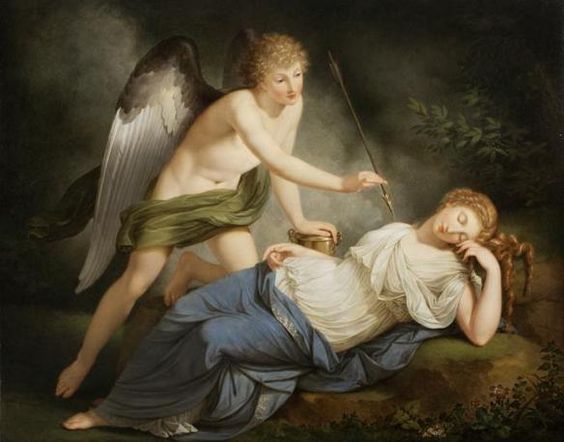
Justice as action or praxis is a by-product of philosophy. Historians of philosophy and professors of philosophy are not philosophers, although some rare individuals may be. For Plato, the sophists would be what are called “intellectuals” today. The “philosophic soul”, on the contrary, and the way of being of the philosopher are indistinguishable. The philosophic soul has the love of the whole and all its parts first. Second, the philosophic soul hates the lie, for it loves the ‘light’. Third, since the love of the pleasures of the soul is in the philosophic soul’s very being (Eros), it will be much more powerful than the love of the pleasures of the body i.e., wealth, for instance (eros). Sophrosyne moderation will be the key for the philosophic soul. In one of the accounts of the myth of Psyche and Eros, it is Eros that is responsible for Psyche’s becoming immortal. Fourth, the philosophic soul will not be petty. It will not lose itself in the world of anonymity and self-interest for its own sake. The philosophic soul will be magnanimous in character. Fifth, it will not fear death but will face it with courage. Sixth, the philosophic soul will be just and gentle; it will be merciful if required for it has care and concern for other beings
and with their being-in-the-world. Seven, the philosophic soul will be a good learner for learning will help in the strife that is being-in-the-world. To be a good learner requires a good memory and the philosophic soul will generally have a good memory.
In the Republic, the poet is the most universal “imitator” because his knowledge/wisdom is that of the human soul. The poet is called a “sophist” in Bk X because he represents those for whom “gain” is most important and these are those citizens of the oligarchic, democratic, and tyrannic regimes. When the focus of eros is lowered upon desiring the most unnecessary of necessities,
the “death of the soul” arises from injustice due to a lack of moderation sophrosyne and wise-judgement phronesis, and injustice is evil. This injustice is coeval with the deprival of the soul from its sense of the good as the sense of the good withdraws further from the soul into oblivion.
The soul is an ‘embodied soul’ and as such its natural condition is to be constantly in strife. Without this strife or polemos (war, confrontation), the soul becomes lethargic. This implies that for some human beings, while they may still be alive, their souls are, in fact, quite dead. If the soul is to be ‘saved’, it must be turned about, ‘converted’ and compelled to see the true light of the things that are. Plato was well aware of the different natures of human souls and his writings are designed to say different things to different souls. Unlike other writings, the Platonic dialogue cannot become the subject or content of ‘artificial intelligence’ because it involves thinking itself, “consciousness” itself. Treatises and essays can become the subject of ‘artificial intelligence’ because they say the same thing to everyone. ‘Artificial intelligence’ says the same things to everyone. This, for Plato, was the great danger of writing and it is the great danger of language.
When we wish to give thought to language and the collective and its relation to evil, we need to give thought to the relationship between language and technology and its relation to thoughtfulness and thoughtlessness. The very essence of what we are as human beings, our ontology (onto-logos), our being-in-the-world is contained in our language and in our relation to, and understanding of, language. We need to dwell on the two-faced nature of the logos that is pointed out to us in Plato’s Divided Line.
To understand language within the collective is a matter of how we understand what “education” is. Plato’s allegory of the Cave is, after all, about the importance of education, for it is education (from the Latin educare “the leading out”) that will bring us to thoughtfulness. When giving thought to education, we contrast “instruction” with “teaching”; and to do so is to
recognize that “instruction” sees itself as “useful” while teaching is to be characterized as “useless”; and it must be “useless” in order to allow the true learning and thinking in the teaching to happen.
To reflect on the issue of “uselessness” and “usefulness” is to connect these seemingly irrelevant themes to the status of education in our modern technological age and what we think education is today. In order to begin this reflection, we must think upon language and rethink language. We must reflect upon the two-faced nature of the logos. If our way of thinking is one that values only that which is immediately useful, then language is only conceived and appreciated from the perspective of its usefulness for us. More importantly, this
suggests it is the essence of technology as framing that somehow determines the “transformation of language into mere information.”
How does our understanding of language and technology contribute to our understanding of evil as a phenomenon? In our understanding of the role of language and its relation to evil as a ‘surface phenomenon’, we must be mindful of the Divided Line’s sections AB, AC and A. This requires that we look at the two-faced nature of the logos or language and how it relates to knowledge and thinking. This requires that language must first be re-thought.
The rethinking of language takes place from and within the rethinking of technology so that we are able to understand that technology’s flowering in ‘artificial intelligence’. This flowering requires the removal of human beings from the formation and construction of the technological world. The relation between technology and language is crucial for a rethinking of language in
our modern technological age. It is therefore necessary to talk about that technological language, which defines a language that is technologically determined by what is most peculiar to technology, that is, by framing (or “positioning” or enframing, the schema), what we have been calling Necessity in this writing. It is imperative that we ask what is language and in what
special way it remains exposed to the dictates of technology. Such imperatives to our thinking about language are only met in the rethinking of the current conception of language that we might characterize in the following way:
Today we think of speech logos as a faculty, an activity and achievement of human beings. It is the operation of the instruments for communication and hearing (artificial intelligence). Speech is the expression and communication of emotions accompanied by thoughts (dispositions) in the service of “information” and in the passing on of information. Speech is a representing and portraying (picturing, the making of pictures) of the real and unreal. Because human beings live within societies, this necessitates that they have language of some kind.
The traditional connection of subjects “the things” + predicates “the qualities of the things”, the categories, (the sentence, the statement) illustrates how reason has come to determine the relationship between language and thinking. Thinking is commonly regarded as the human activity of representing objects in this view (AB and AC of the Divided Line). and thus language or logos has been seen as a means for conveying information about objects. “In-form-ation” results from our providing a “form” in order to “inform” regarding what we call “data”. This provision of a form is what we call “classification”, a providing of definitions or the limits and horizons of things.
Traditional historical thinking places thinking as “reason” (reason, “logic” which has its root in “logos” which in Greek is “language”, “speech”) as the determining factor (the “-ation” or “aitia” in Greek, “that which is responsible for”) in the relation between language and thinking. Reason provides the “form” in a calculative way so that the data (the content) can be structured so that it may “inform”. This is shown in our current conception of language as an
“instrument of expression” in the “service of thinking”. The common view believes that thought uses language merely as its “medium” or a means of expression, an instrument. Thought is seen as logic, reason in this view. This instrumental view of language and thinking is the thinking that has made possible artificial intelligence. For the poet William Blake, it was “Newton’s sleep”; for Plato, it was the enchainment of the prisoners in the Cave.
We assume that language is a tool used by human beings to communicate information. We think that the same fact can be expressed in many different languages, even though we know that this is not the case at the present time. Artificial intelligence will seek to create the univocal meta-language so that this will indeed become the case in the future. We think a competent speaker is in control of language and can use it efficiently to convey data to his/her
audience. This is the essence of rhetoric as techne.
In the quest for efficiency in communication, we have devised artificial languages that give us more control over language. Symbolic logic, computer programming languages, and the technical languages of the sciences are set up as systems in which each sign can be interpreted in only one way. Each sign points clearly to what it represents so that the sign itself becomes completely unobtrusive. The perfect language in this view is a technique for perfect representation. We have discovered that language in algebraic calculation.
The conception of language as a mere means of exchange of information undergoes an extreme transformation in our modern technological age that is expressed in the definition of language as “information”. This is the levelling of language, the logos, to a “surface phenomenon”. The analytic school of thought on language offers a prime example of a “metaphysical-technological
explanation” of language stemming from the “calculative frame of mind.” This view believes that thinking and speaking are “exhausted by theoretical and natural-scientific representations and statements,” and that they “refer to objects and only to objects.” Language, as a tool of scientific-technological knowing–which must establish its theme (thesis, theory) in advance as a
calculable, causally explicable framework– is only an instrument that we employ to manipulate objects. We refer to this as an algorithm: the world is looked upon as a calculable, causal framework that gives us a problem that must be solved.
This must be thought about in relation to what we understand as “artificial intelligence” or AI: how does or will our understanding of what reason and language are determine the nature of what is called “artificial intelligence” and of the machines that will use it? In the age of cybernetics, human beings will be the materials that will be ordered and disposed of i.e. the human resources, the human capital.
If we think about what we call “dead” languages for a moment, we will notice that they are called “dead” because they are no longer subject to changes in meaning. Any “living” language will have changes in meaning and interpretation according to the historical time in which it occurs. As the poet T. S. Eliot wrote:
“Words strain,

Crack and sometimes break, under the burden,

Under the tension, slip, slide, perish,

Decay with imprecision, will not stay in place,

Will not stay still.”
Our modern attempts to fixate language into an unambiguous tool for communicating information regarding the representation of beings/things illustrates our desire to fulfill the revealing of truth as representation, to follow the correspondence theory of truth and the principle of reason. This is the segment AC of the Divided Line. There is “truth”, but how we understand what this truth is is relative to the historical situation in which it occurs; it is not a “subjective” truth, but a communal, collective truth: that is, it is not based on personal knowledge or gnosis but is the knowledge that we all share, the doxa or opinion that has been handed over to us. In our current situation, this is the global “revealing” through technology and this revealing drives us to realize the “global village” or “internationalism” along with what we call “international mindedness”. The “system” which results from the “framing” that is the technological requires no individual thinker or thinking. In science, time and place are not important and scientists from disparate locations can carry out their work with the certainty that their “accounts” will be correct when properly following the method established within the framing. This is because the language which they use is fixated. In our portrait of evil, we can say that this is the phenomenon of evil ‘spreading like a fungus’ over all things.
The quest for a universal, unambiguous language such as that which AI determines and requires can only succeed in creating stillborn languages. These languages are locked into a particular interpretation of the world and the things in it (representational revealing) and are incapable of responding creatively to new experiences and events. Artificial languages (and one might say artificial intelligence since it will be based on these languages) are not more “objective” than natural languages—they are just narrower and more rigid because their goal is certainty and efficiency.
Living language is fundamental to our revelation of the world; it is an essential part of what enables us to be someone, to be a human being, to have access to self-knowledge and to notice things in the world in the first place. It is essential to our self-knowledge. Language has the power to reveal our world and transform our existence. But the lucid and creative moments are few for individuals and fewer still for societies; the rest is inauthentic and derivative. Every day “idle talk” is a pale, dull reflection of the “creative meanings” that are first revealed and achieved in the language of poetry.
Where does the understanding of language as representation come from? As the “doctrine of the logos” in Aristotle is interpreted as assertion or statement, logic is the doctrine of thinking and the science of statement (or the making of statements—propositions, the creation of “pictures”), that is, “logic” (the principle of reason) provides the authoritative interpretations of thinking and speaking that rule throughout the technological. More specifically, logistics has as its basis the modern interpretation of the statement or assertion as the “connection of representations” (the correspondence and coherence theories of truth).
The general form of what is called modern thinking is thus a “scientific-technological manner of thinking.” This thinking, this world-picture, threatens to “spread to all realms” thereby magnifying the “deceptive appearance which makes all thinking and speaking seem objectifying.” This thinking and speaking finds its full realization in algebraic calculation. It is this
form of objectifying thinking that strives to “represent everything henceforth only technologically-scientifically as an object of possible control and manipulation.” With it, language itself takes a corresponding form: it becomes “deformed into an instrument of reportage and calculable information”. However, while the form that language takes is thus instrumental, in such a form of thinking, language itself exerts its own influence insofar as it is
“treated like a manipulable object to which our manner of thinking must conform.” Language itself allows itself to be treated in such a way. Language and reason are, in the end, inseparable. This is the two-faced nature of the logos.
There is a kind of language that, as the expression of this form of thinking, is itself one-tracked and one-sided and thus loses sight of the two-faced nature of the logos. One “symptom” of the growing power of the technological form of thinking is in our increased use of designations consisting of abbreviations of words or combinations of their initials in acronyms. Our text messaging and our love of acronyms is a technological form of language in the sense that these herald the ordering in which everything is reduced to the univocity of concepts and precise specifications. This reduction and ordering also leads us to view all activities we engage in to be leveled to one level: the student who is asked to create a work of art either in words or other media, sees their activity as nothing more significant than their being in a shopping mall or at a supermarket. The activity ceases to have any priority in importance. In this view, “speed reading” and the use of AI to carry out projects will come to flourish since we cannot learn from texts anything other than “information” and this “learning” must be done as “efficiently” and quickly as possible.
All that remains of language as information is “the abstract form of writing that is transcribed into the formulae of a logic calculus” whose clarity “ensures the possibility of a secure and rapid communication” (our text messaging and our public discourse as media bytes). The principles transforming language are technological-calculative. It is from the technological possibilities of the tools that technology has produced, its equipment, that the instruction (command) is set out as to how language can and shall still be language. Such instruction (command) spells out the absolute and overriding need for the clarity of signs and their sequences; the algorithm dominates. The fact that the equipment’s structure conforms to linguistic tasks such as translating (i.e. whether the command/instruction is in Chinese or English does not matter) does not mean that the reverse holds true. For these commands are “in advance and
fundamentally bound up” with the equipment itself. With the “inexorability of the limitless reign” of technology comes the insatiable technological demand for a technological language, so that its power increases to the point that the technological language comes to threaten the very essence of the other face of logos, language as Saying-Showing that is to be found in the CD section of the Divided Line. It is “the severest and most menacing attack on what is peculiar to
language,” for language becomes “atrophied” into the mere transmission of signals. This Evil is the anti-Logos.

Moreover, when information (in the form of command) is held as highest form of language on account of its univocity, certainty and speed, then we have a “corresponding conception” of the human being and of human life. Norbert Wiener, a founder of Cybernetics, said that language “is not an exclusive attribute of man but is one he may share to a certain degree with the machines he has constructed.” This view is itself possible only when we presuppose that
language is merely a means of information. This understanding of language as information represents, at the same time, a “threat to the human being’s ownmost essence.” The fact that language is interpreted and used as an instrument has led us into believing that we are the masters of language and of technology, but the truth of the matter might well be that technology takes language into its management and masters the essence of the human being
creating a fundamental change in human ontology (human being-there-in-the-world).
The gripping, mastering effect technological language has over our very essence as human beings makes the step or leap to thoughtfulness extremely difficult. Language itself denies us its essence and instead surrenders itself to us as our instrument of domination over beings. When this is passed on to the machines that we make they, too, will become instruments of domination over whatever ends they themselves will direct themselves toward.
It is extremely difficult for us in the modern age to even begin to understand the other face of the logos, a non-instrumental conception of language. The interpretation and form of “language as information” and of “information as language” is, in this sense, a circle determined by language and in language, within “the web of language.” Hence, Heidegger has referred to language as “the danger of all dangers” that “necessarily conceals in itself a continual danger for itself.” In fact, “we are the stakes” in the “dangerous game and gamble” that the essence of language plays with us, for the essence of evil is alive within it.

 Theory of Knowledge: An Alternative Approach