

The Text: 1.6
1.6 These ten Sephiroth which are ineffable, whose appearance is like scintillating flames (like the appearance of lightning), have no end but are infinite. The word of God is in them as they burst forth, and as they return; they obey the divine command, rushing along as a whirlwind, returning to prostrate themselves at his throne.
Alt. Trans. These ten Sephiroth which are ineffable, whose appearance is like scintillating flames, have no end but are infinite. The word of God is in them as they burst forth, and as they return; they obey the divine command, rushing along as a whirlwind, returning to prostrate themselves at his throne.
Wescott Trans: 1.6. The Ten ineffable Sephiroth have the appearance of the Lightning flash, (17) their origin is unseen and no end is perceived. The Word is in them as they rush forth and as they return, they speak as from the whirl−wind, and returning fall prostrate in adoration before the Throne.
Wescott Note:
17. Lightning flash. In the early edition the words “like scintillating flame” are used: the Hebrew word is BRQ. Many Kabalists have shown how the Ten Sephiroth are symbolized by the zig−zag lightning flash.
Commentary on 1.6

The vision or seeing of the Sephirot is like lightning, a flash that gives insight into the nature of created things. The Sephirot “burst forth” into appearance and then “return” into hiding, into “oblivion” or “forgetfulness”. The “bursting forth” is the Greek aletheia or “truth” and is here understood as “the word of God is in them”. Truth and language are related and intertwined with one another. To see the Sephirot is a “looking down” into the depths. (When the saints see Christ crucified, it is a looking down at Him on the cross i.e., St. John of the Cross, Teresa of Avila.) Since their appearance is like lightning, the Sephirot can only be visualized in an instant before they disappear. (Plato’s emphasis on the “correctness of the glance”. The meaning of the Sephirot can be misunderstood or misinterpreted. This would be quite contrary to Heidegger’s understanding of this phrase in Plato. The “correctness” that Heidegger criticizes because it gave rise to the need for certainty in modern metaphysics and the sciences is not what Plato understood as the necessity for “correctness”. Another type of thinking is involved).
The ten Sephirot as the emanations of the Logos are in themselves infinite. It is through the Sephirot, the 10 sayings of God, that all things come into being. (“I am the way, the truth, and the life. No one comes to the Father except through me.”) While created beings must come to be and pass away, the Sephirot themselves do not. The Sephirot indicate that whatever human beings or Nature makes or causes to come into being, it was always already there because the Sephirot are infinite. (From this, a more correct term for what we call “creativity” would be “in-spiration” – that which is responsible for the “breathing in” or the “giving life to” our forming and making of things, works of art, say. The things or works themselves were always already there.)
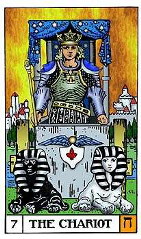
The “rushing and returning” indicates movement and rest. Aristotle’s dynamis as “possibility” or “potentiality”; kinesis or motion, movement; steresis or rest; energeia as completion or action at an end; entelechia the purpose or place (the stand, the topos of the thing) of something, the finished thing. Through all of these are “will” and “desire” understood as the dynamis, and these are related to the logos or speech and eros as ‘urge’. This is the moment of mystical vision, the moment when prayers are answered, the moment when the artist sees that which he or she is about to create . At these moments, we experience a re-birth or a change, an epiphany, which removes what were previous boundaries or limits to our being and we are able to rise up to the next level. This experience is that of the “embodied soul” as a Chariot, a chariot of fire.
The Text: 1.7
1.7 These ten Sephiroth which are, moreover, ineffable, have their end even as their beginning, conjoined, even as is a flame to a burning coal: for our God is superlative in his unity, and does not permit any second one. And who canst thou place before the only one? (And before One, what do you count?)
Alt. Trans. These ten Sephiroth which are, moreover, ineffable, have their end even as their beginning, conjoined, even as is a flame to a burning coal: for our God is superlative in his unity, and does not permit any second one. And who canst thou place before the only one?
Wescott Trans: 7. The Ten ineffable Sephiroth, whose ending is even as their origin, are like as a flame arising from a burning coal. For God (18) is superlative in his Unity, there is none equal unto Him: what number canst thou place before One.
Wescott Note:
18. God; the Divine name here is Jehovah.

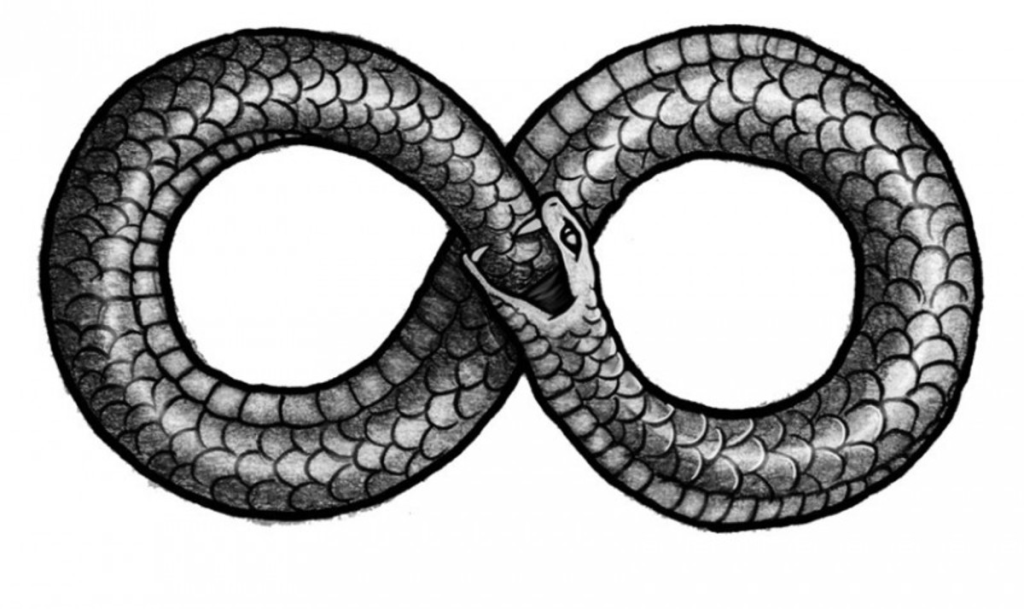
Since the Sephirot are embedded in a sphere, their shape and movement are circular. The end and the beginning are conjoined, yoked together. The ouroboros as the symbol of the infinite is seen within them. Beginning with Keter (Crown) and ending in Malkhut (Kingship), they may be seen as Cause and Effect: the Crown is responsible for (cause) the Kingship (effect), and the Kingship (effect) is responsible for, or obliged to, or brings about the Crown. (The placement of the Magician’s card at one may be questionable. Should he not be at 10? In the discussion of The Thirty-two Paths of Wisdom, I place The Magician at #10.)
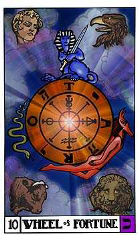
The Wheel of Fortune, Necessity, would therefore be placed at 1, or prior to the one. The Magician as a Maker uses the ready-to-hand objects of the physical world (the wands, pentacles, cups and swords) to make the things that are useful to human beings. He is the techne, the artisan, the maker. The Wheel indicates the circularity of the movement: the movements within the Tree of Life, the paths, are not linear, but circular. They are present as arcs, incomplete in themselves? They are the wheels within wheels. Within the Wheel of Fortune card in the four corners are placed the symbols of the four Evangelists of the Christian Gospel, the “testimony” or speech that is the understanding of the whole.)
The analogy used is that of “a flame to a burning coal”. The flame is the cause of the effect of the coal’s burning and the coal’s burning is the cause of the effect of the flame. The flame, fire, rises upward; the coal, the earth, moves downward in the potentia of its dynamis. The two are conjoined. Within the five dimensions of the spherical World, Keter as cause and Malkhut as effect could be in different places with Malkhut above Keter. Keter is sometimes seen as “will” by the Kabbalists, but “power” or “force” would, I think, be a better interpretation of this word. There is a distinction between the Divine Will understood as Necessity, and the human will which manifests itself in the worlds of Yetzirah and Asiyah.
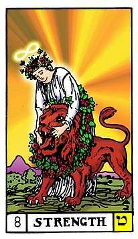
The Strength card, #11, shows no effort in controlling the passions or the “natural urges” within and without her represented in the figure of the lion. Is she exercising will or exercising power? Are the two related in Aristotle’s concept of dynamis? The Order of the Golden Dawn changed the original numberings of Strength and Justice from #11 to #8, but it is clear that The Magician #1 and Strength #11 are meant to be contrasted. Justice is represented as the “completed work” of The Magician energeia. The dynamis of the artist is present in The Magician whether he is forming the work or not. He can form the work and it is in this forming or performance that he is called an artist! But the potentia for the action, movement is present whether there is a performance or not.) The “will”, the choice, the decision is in the action itself; the “power” is present whether the action, choice or decision is performed or not.
If a pair of Sephirot are two points on an infinite line, the points come together at the “point at infinity”, the circular movement within the spherical. All lines or paths meet at “the point of infinity”, or the Heart, the centre of the sphere. Not to be involved in motion is to be at the centre of the sphere or wheel. Within the sphere, there are no opposites; there are deprivations. Evil is the deprivation of Good; poverty the deprivation of wealth; fullness the deprivation of need (Eros). The physical world requires space in order to be, an “open region” where it can manifest itself.
The spiritual realm is both within and beyond space: the soul is embedded in a body. The physical world is in both space and time. With the physical is time: being and time. The realm beyond the physical, the spiritual, does not require space and time. Angels, daemons, mediators are required to bring the realms of the physical and spiritual together. The flame of a candle cannot rise unless it is attached to something physical, the wax from which it derives or originates. Matter is our infallible judge. It is from matter, the physical appearance of the beauty of the world and individual human beings who happen to be in it, that we come to see Plato’s ‘fire catching fire’ as the effect of Love upon the flesh and the spirit.
In the spiritual realm, closeness is “resemblance”, kinship, friendship. The mediator brings two unlike things (such as two human beings) into a relation with each other so that they can resemble each other while remaining distinct individually: a:b:c, where b is the mediator between a and c bringing them into a relation. This relation exists on both the spiritual and physical levels.
The purpose of human being and of being human is to overcome the darkness of being, to bring being to light, to reveal being in its truth. The purpose of the Logos is to bring light to the world through life (eros), the light which the darkness cannot apprehend or comprehend. Both the darkness and the light are present simultaneously in human beings since we are embodied souls. The light is Love. The word for ‘truth’ in Hebrew is Emet which begins with the first letter of the alphabet and ends with the last letter. The two are joined together by Mem the middle letter of the alphabet. This suggests that the truth and the Logos are one and that this is Love (Eros).
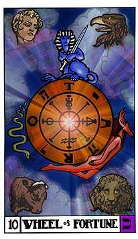
On the Wheel of Fortune tarot card are the letters TORA (in a counter-clockwise direction) and the letters TARO (in a clockwise direction). This appears to indicate that one can achieve union with God either through the revelation of the Divine Law (Tora, the movement West), or one can achieve this same union through Being (Taro, the movement East). Judaism and Islam have their revelations of God given through the Divine texts of the Torah and the Koran, the Divine Law. Christians have their revelation given to them through the Being of Christ given in the testimony of the Gospels. Given the other principles in operation here, this would seem to suggest that the Torah and the Tarot are the Same (as Christ Himself suggests). The paths of the Tree of Life as Nativ or personal paths must be undertaken by the individual alone, whether it be in choosing to accept the Divine Law as revealed or by carrying out the journey by other means to find contact with the Divine Presence through personal experience. This experience is what has come to be known as Gnosticism.
Numbers do not come into being until the formation of the physical universe. For numbers, understood as arithmos, the numbers used to count, there must exist quantity and plurality. Prior to the formation of the World, there was only God, Chaos, and God’s Spirit hovering over Chaos, but these are to be understood as the Trinity of the One. With His withdrawal, the Other appears (the physical universe) and with the Other, number is brought into being. (Or number and language, the Logos, always existed in the Spirit; and with the withdrawal of God, come to presence in physical being? This would explain why the physical is necessary to reach the spiritual through the logos of number and language, and would thus account for the circularity of the Tree of Life and the spherical nature of World.)
The Text: 1.8
1.8 And as to this Decad of the Sephiroth, restrain thy lips from comment (bridle/yoke thy lips from comment), and thy mind from thought of them, and if thy heart fail thee return to thy place; therefore is it written, “The living creatures ran and returned,” and on this wise (regarding this) was the covenant made with us.
Wescott Trans: 1.8. Ten are the ineffable Sephiroth; seal up thy lips lest thou speak of them, and guard thy heart as thou considerest them; and if thy mind escape from thee bring it back to thy control; even as it was said, “running and returning” (the living creatures ran and returned) (19) and hence was the Covenant made.
Westcott Note:
19. The text gives only RTzUAV ShUB−−”currendo et redeundo,” but the commentators have generally considered this to be a quotation from Ezekiel i. 14, referred to H ChIVT, the living creatures, kerubic forms.
This verse of the Sefer Yetzirah is said to deal with techniques of meditation, the clearing of the mind of language and the representations associated with language (what we commonly understand as thinking and thought). The purpose of the mantras and the whirling of the dervishes is to clear the mind so that one may experience the Sephirot directly. The Sephirot are the revelation of the truth of the things that are in their shining forth, their epiphanic, lightning-like appearance. The appearance of the Sephirot is the cause of the “running of the heart” which, due to its failure (because it is bound to the physical), must return to the foundation of its physical base and to the representations of the mind through Understanding. It is Plato’s “fire catching fire”, the glimpse of the Love that is the Heart of the World itself and which, due to its relation as potentiality for love, is “caught” or yoked with the Love that is the mediator of the World. This mystical union is beyond thought or speech (hence the “bridling” and the “yoking”.)
The covenant made between God and His creation is that His redemption is promised even though one must return to the physical. A covenant is a “mean” which joins two “unequal” or incommensurate entities, in this case God and the individual soul. For human beings, communion with the spiritual is erotic, a need, and the possibility of this communion is promised in such a way that it cannot be broken. (“What God has joined together let no man put asunder”). Our sin is our breaking of our covenant with God; His promise is redemption from that sin. When we cease to desire the spiritual, we become less than human. The mediation that is the bridge between the spiritual and the physical is the covenant of God. This mediation or covenant spiritual is what we commonly understand as Grace.
The Text: 1.9
1.9. These are the ten emanations of number. One is the Spirit (Breath) of the Living God, blessed and more than blessed (holy, benedicted) be the name of the Living God of Ages (the Life of Worlds). The Holy Spirit is his Voice, his Spirit, and his Word.
Wescott Trans.: 1.9. The ineffable Sephiroth give forth the Ten numbers. First; the Spirit of the God of the living; (20) Blessed and more than blessed be the Living God (21) of ages. The Voice, the Spirit, and the Word, (22) these are the Holy Spirit.
Wescott’s Notes:
20. The Spirit of the Gods of the Living. RUCh ALHIM ChIIIM; or as R. gives it, “spiritus Deorum Viventium.” Orthodoxy would translate these words “The spirit of the living God.”
21. AL ChI H OULMIM; “the Living God of Ages”; here the word God really is in the singular.
22. The Voice, Spirit and Word are QUL, RUCh, DBR. A very notable Hebrew expression of Divinatory intuition was BATh QUL, the Daughter of the Voice.
Commentary on 1.9:
This verse speaks of the One as the Holy Trinity, the Word made flesh (earth). One is Air (Spirit), which is God’s voice, spirit and His Word. It is through the One that Wisdom and Understanding come about through number and speech, and it is from these that we have knowledge. This is the “Breath of the Living God”, the God’s presence in His creation.

On the Tree of Life, Keter (Crown) is the first number to come into existence. The Holy Spirit is the “gift of tongues” which manipulates letters into words and gives human beings the ability to name things and, thus, to bring them into being. For the ancient Greeks, human being was the zoon logon echon, the living being capable of speech/language. The “spirit” is the dynamis and energeia of Aristotle, that of living beings, their animation, motion and completeness. While things that do not have soul can achieve completeness, ensouled beings experience an absence, a need, of that which makes them complete. Human beings are the needing beings, and their existence is essentially one of eros, the strife of fullness and need. One could say that human beings are perfect in their imperfection.
The act of speaking, the formation of words and language brings the things of the world into being. The naming, through the word, brings the being to a stand in its place in space and makes discourse, communication about it possible. Keter, through Tiferet (Beauty) to Yesod (Foundation), brings about the Sephirot through which all things are experienced (Malkhut). “The beginning is in the end, and the end is in the beginning”. This must be understood as simultaneous, not chronological.
It is through God (Word) that we are able to name things. The naming of things is a “holy act”. His Name is “blessed and benedicted”. God “descends” to us and we “descend” (kneel in prayer) to Him. “Bene-dicted” is literally “the good speech”, the good word, both what is said and what is received; the prayer and its answer, the speaking and the hearing. God is the “Life of Worlds”. We live in a number of worlds simultaneously, but it is “speech” that is the “life” within these worlds and makes these worlds possible. Language is the sharing of these worlds with one another. With the erosion and disintegration of language comes the destruction of the possibility of these possible worlds and the movement towards a one-dimensional, surface oriented world. Modernity is the great example of the growth of this wasteland of one-dimensionality. This one-dimensionality is visible to anyone who travels the world at this time. Those things that are the products of technology have the Same at their core.
God is “the Voice of Breath and Speech”. To breathe is to in-spire and it is this in-spiration which gives voice its ability to speak. Breath is the mediator between voice and speech. The movement is from right to left from our point of view and from left to right when viewed from the Tree of Life. “In the beginning God created…” Voice; “The breath of God hovered on the face of the water…” Breath; “God said, Let there be light…” Speech. “Divine inspiration” relates to prophecy, “the highest speech”. Prophecy was the highest speech because of the predictive powers given to it by its comprehension of all time i.e., past, present, and future. The predictive powers of the modern sciences through mathematical calculation is now considered “the highest speech”. This can account for the Hebrew esteem of the prophets and the Greek esteem for the poets, for both spoke “the highest speech” in relation to their two cultures.

 Theory of Knowledge: An Alternative Approach