
Text: 1:10
1.10 Second, from the Spirit (Breath) he made Air (Breath) and formed for speech twenty-two letters, three of which are mothers, A, M, SH, seven are double, B, G, D, K, P, R, T, and twelve are single, E, V, Z, CH, H, I, L, N, S, O, Tz, Q, but the spirit is first among these. Third, Primitive Water. He also formed and designed from his Spirit, and from the void and formless made earth, even as a rampart, or standing wall, and varied its surface even as the crossing of beams. Fourth, from the Water, He designed Fire, and from it formed for himself a throne of honor, with Auphanim, Seraphim, Holy Animals, and ministering Angels, and with these he formed his dwelling, as is written in the text “Who maketh his angels spirits and his ministers a flaming fire.” (Psalm civ. 4.)
Wescott Trans. 1.10. Second; from the Spirit He produced Air, and formed in it twenty−two sounds−−the letters; three are mothers, seven are double, and twelve are simple; but the Spirit is first and above these. Third; from the Air He formed the Waters, and from the formless and void (23)[1] made mire and clay, and designed surfaces upon them, and hewed recesses in them, and formed the strong material foundation. Fourth; from the Water He formed Fire (24)[2] and made for Himself a Throne of Glory with Auphanim, Seraphim and Kerubim, (25)[3] as his ministering angels; and with these three (26)[4] he completed his dwelling, as it is written, “Who maketh his angels spirits and his ministers a flaming fire.” (27)[5]
Wescott’s Notes:
[1]23. Formless and Void. THU and BHU; these two words occur in Genesis i. 2, and are translated “waste and void.”
[2]24. Note the order in which the primordial elements were produced. First, Spirit (query Akasa, Ether); then Air, Vayu; then Water, Apas, which condenses into solid elementary Earth, Prithivi; and lastly from the Water He formed Fire.
[3]25. The first name is often written Ophanim, the letters are AUPNIM; in the Vision of Ezekiel i. 16, the word occurs and is translated “Wheels.” ShRPIM are the mysterious beings of Isaiah vi. 2; the word otherwise is translated Serpent, and in Numbers xxi. 6, as “fiery serpents”: also in verse 8 as “fiery serpent” when Jehovah said “Make thee a fiery serpent and set it upon a pole.” Kerubim. The Hebrew words arc ChIVTh H QDSh, holy animals: I have ventured to put Kerubim, as the title of the other Biblical form of Holy mysterious animal, as given in 1 Kings vi. 23 and Exodus xxv. 18, and indeed Genesis iii. 24. Bible dictionaries generally give the word as Cherubim, but in Hebrew the initial letter is always K and not Ch.
[4]26. Three. In the first edition I overlooked this word three; and putting and for as, made four classes of serving beings.
[5]27. This is verse 4 of Psalm civ.
Commentary on 1:10

This verse speaks of the formation of the created World through the formation of letters and language. The Spirit is distinguished from Air in that the Spirit is considered Direct Light (the light of the Sun, for instance, or the Idea of the Good perhaps) while Air is considered Reflected Light, the light that allows for physical things to be seen, the light that comes from the fire of the artisans and technicians in Plato’s allegory of the Cave and allows for inspiration. This is aligned with the Sephirot Keter and Malkhut which occur simultaneously (and is the reason for my placement of The Magician card at #10 rather than #1 on the Tree of Life; The Magician is in reference to the worlds of Asiyah and Yetzirah, the worlds of material and its formation. The Magician is associated with the human will). Malkhut is visible through the reflected light of the spiritual upon created things; it is the light of the rational mind and what we would call “understanding” or how we come to interpret the things in our world and create a world for ourselves. It is through the letters, speech and numbers that are the products of the Direct Light that one can elevate the things that are into the reality of their true existence by apprehending the truth of their essence. It is in doing so that we are essentially human. The revealing of truth through the logos is what makes us essentially human. Note that there are two types of thinking and seeing implied here.
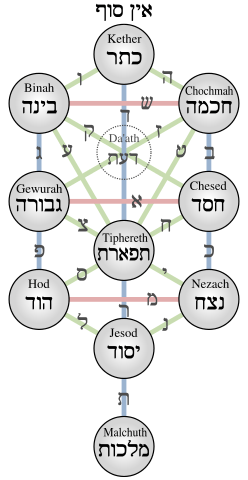
The Direct Light is the light that the darkness cannot comprehend, and this is illustrated by the placement of Malkhut outside of the two pillars of Jakim and Boaz and at the foot of the third pillar with its connections to Keter (Crown), Tiferet (Beauty), and Yesod (Foundation). The connection between the physical universe (Kingdom/Malkhut/ the cave of Plato’s Republic) is through an understanding of its foundation (Yesod), an apprehension of its Beauty (Tiferet), and the final apprehension of the Direct Light of the Sun (Keter). This triad of foundation, beauty, and light is parallel to the triad of Wisdom, Understanding and Knowledge that the first three Sephirot indicate. They may also be said to correspond to the stages outlined in Plato’s allegory of the Cave with regard to the ascent from the Cave to the light of the Sun and the revelation of the Idea of the Good. In the allegory of the Cave, four stages are present, the fourth being the return to the Cave. They are also parallel to the four divisions of the Divided Line that Plato outlines in Bk. VI of his Republic. More discussions of the Cave, the Divided Line, the worlds of the Sefer Yetzirah and their relations to the two-faced natures of Eros and the Logos will be found in an upcoming post on these topics.
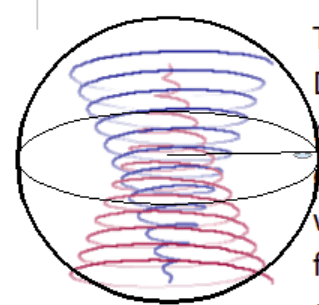
A distinction between thinking and Thought is being made here. Thought is connected to the Direct Light while thinking is done through the Reflected Light. Thought is led in its ascent through the contemplation of the physical, through an understanding of its foundation, through the revelation of its beauty and the apprehension of the Direct Light of the sun. Thinking occurs from the descent of the Spirit or the Voice into the letters, words and numbers that bring about the house of being. (“Language is the house of being. In its home humans dwell.”) The two gyres illustrate the different directions and movements in thinking and Thought. Thinking leads downward; Thought moves upwards.
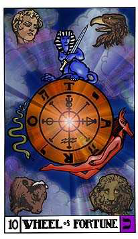
It is important to remember that the creation occurs all at once and that its formation is secondary to its Being itself. The formation is within the 6 days of creation; the creation begins with the “Let there be light” or the first Saying of God. The One is God; the Second is Other than God. With the creation of the second, God withdraws and the sphere of space is created and the limits or horizons of the creation are established. These limits are the Law of Necessity (what we would call The Wheel of Fortune in Tarot). With creation, Space (Air) is established, and with it, the created things themselves, from which Time comes into being and vice versa.
“Light” is the concept of giving and this giving is shown in the withdrawal of God from that which He created or has given. The Light is Love in that, in His withdrawal, God allows His Creation to come into being. The making of a great artist is also a “giving” and is analogous to this giving that is God’s. This giving and self–denial is a metaphor for what should be the principle of human actions or that which defines ‘human excellence’ or virtue: all of creation is ethical as well as moral. For a woman, her most truly human act is her imitation of the Divine in the ‘giving of birth’ to another human being, the self-denial that is a recognition of ‘otherness’. The raising of children is a gradual withdrawal allowing the child to be.
In his dialogue Timaeus, a dialogue set the morning after the occurrence of the dialogue Republic, Plato focuses on the definition of space which he calls the khôra. The khôra (also chora; Ancient Greek: χώρα) was the territory of the Ancient Greek polis outside the city proper. The term has been used by Plato to designate a receptacle (as a “third kind” [triton genos]; Timaeus 48e4), a space, a material substratum, or an interval. Space is the receptacle of the original gift from God that is the creation.
In Plato’s account, the khôra is described as a formless interval, alike to a non-being, in between which the Ideas (Sephirot) were received from the spiritual realm (where they were originally held, the Direct Light) and were “copied”, being shaped into the transitory forms of the sensible realm (the reflected Light of Malkhut); the khôra “gives space” and has maternal overtones (a womb, matrix):
“So likewise it is right that the substance which is to be fitted to receive frequently over its whole extent the copies of all things intelligible and eternal should itself, of its own nature, be void of all the forms. Wherefore, let us not speak of her that is the Mother and Receptacle of this generated world, which is perceptible by sight and all the senses, by the name of earth or air or fire or water, or any aggregates or constituents thereof: rather, if we describe her as a Kind invisible and unshaped, all-receptive, and in some most perplexing and most baffling partaking of the spiritual, we shall describe her truly.”— Plato, Timaeus, 51a
Plato calls the partaking of the physical with the spiritual “perplexing and most baffling”. God’s act of creation perplexes and baffles us. In the secondary process, we might think of it as how technology (the “spirit”, the “will”) “gives space” to the making of the gadgets and tools that we call technology (but this is incomplete) and to the applied sciences that direct that making. Technology itself is the way of being and seeing that allows for the tools of technology to be possible. Our way of being and seeing allows the things to be and to be understood in the way that they are. This is the world of yetzirah, the world of “formation”. The connection here is that it is the Logos: language, letters, speech, that are the mediation between the spiritual (the realm of “no-thingness”) and the physical realms. As space is a receptacle, the letters of language are themselves receptacles or receivers of that which comes from the spiritual. This is where the notion of “in-spire” originates, and is the origin of “inspiration”, “that which is responsible for the ‘breathing in”.

The twenty-two letters come into being through the Logos or the AlefBeth. The second Sephirot (The High Priestess card of the Tarot #2 is shown holding a scroll upon which is written TORA, the Law) Chakmah, is the blank slate that the Logos writes upon, although the Logos is/was present prior to Chakmah. This is why the left side (or right side, depending on the perspective) of the Tree of Life is Feminine, and the Sephirot on the right should be considered “receptive” rather than “giving”. The masculine principle is the ‘giving’ side of the Tree of Life and this ‘giving’ comes from the Light of Keter.
The “engraving” and “carving” of the letters is described as such since this was the manner of early writing on clay tablets. To write, the clay needed to be removed or withdrawn, and the shape determined by a pre-determined form. When we form words, we remove letters from the whole of the alphabet, although the whole alphabet always remains present. In oral speech, we “engrave” through the articulation and pronunciation of sounds and “carve” them through expression and enunciation.
“The Spirit is first among these” would indicate that all letters and language itself retains the one breath that is the Logos, the Word, or the Sephirot that is Keter, the Direct Light that is associated with Air. It is the light from Keter given to Chakmah that finds its realization in Malkhut or the physical universe, or in Binah which is Understanding. For Christians, Christ is Keter, Tiferet, Yesod and His crucifixion is His realization in Malkhut. (“The Lamb slain from the Foundation of the World” – Rev: 13.8. “The Book of Revelations” speaks of the Beast that will gain control of all language and peoples, and be at war with the saints; and all nations will bow down and do homage to him. This might suggest to some the arrival of the universal, homogeneous State of Hegelian philosophy, that it is the Great Beast, or as some scholars have suggested, the early Church of Rome was, in fact, the Great Beast since it modelled itself as a universal, homogeneous, catholic entity.)
Text: 10 a
1.10 a Third, Primitive Water. He also formed and designed from his Spirit, and from the void and formless made earth, even as a rampart, or standing wall, and varied its surface even as the crossing of beams.
(Alternative Translation)
Three: Water from Breath With it He engraved and carved (22 letters from?) Chaos and Void Mire and clay He engraved them like a sort of garden He carved them like a sort of wall He covered them like a sort of ceiling (And poured snow over them And it became dust As it is written, “For to snow He said, “Become earth!” (Job 37.6)
Commentary on 10 a:

The formation of earth comes from the coming together of Breath and Water. Breath gives birth to Wisdom; wisdom is water: unlimited, undifferentiated, unformed. Understanding (Binah, the Empress #3) imposes limits, de-fines things, brings things into the “open region” of space and gives form to them, what Plato called the eidos or the outward appearance of the thing. “Wisdom is like rain” (Isaiah 55: 9-11). “Be perfect as your Heavenly Father is perfect, for He causes His rain to fall in equal amounts upon the just and the unjust.” (Matthew 5: 48) Here is described the distinction between the Necessary and the Good. The Necessary is the “standing wall” and “rampart” between God and the creation, and this is represented by the letter Vav in the Hebrew alphabet ו Vav (cane signifying the severity of Necessity). The engraving “like a sort of garden” is the letter Heh in Hebrew ה Heh (jubilation the gratitude for life itself). We are reminded again of the original form of Alef, two Yods separated by a Vav.
Some analysts say that Chakmah (Sephirot #2) follows chronologically the creation of earth or the physical universe (Malkhut), but how can this be so? Solids require space and space must be present before solids can come into being (solids understood as res extensa, “extended things”). Chakmah is related to Time (Binah) through the mediation of the mother letter Shin (tooth, fire) ש Shin, and later we shall see how Chakmah is associated with Kronos or Saturn which is Time, and the “gloom” of Time which is the mortality related to created things. Chakmah is the “pool” through which the reflected light of Malkhut is given back to the Direct Light of Keter.
There is both ascent and descent implied here. Earth is created from water which has become “snow” or a solid. The “snow” is fixed Time. Fixed Time is Memory which must be re-called, re-membered (made present in representations from the reflected light of Malkhut) and revealed in the standing present and thus given physical form once again. With the creation of created beings so, too, is Time created and Time becomes “a moving image of eternity” or that which is beyond Time.

Chakmah is seen as a formless solid here, “mire and clay”, “chaos and void”, from which the letters are derived which give form to the mire and clay. The world of our perceptions is not what it seems, this Malkhut world of reflected light. Behind the apparent solidity of everyday objects lies a shadowy world of potentiality (Aristotle’s dynamis). This world of Chakmah defies easy description, as its form is so different from our everyday experience; we may compare it to the world that is described in quantum mechanics. Yet our common everyday world of solid tables, ashtrays, stars, and galaxies somehow arises from what transpires underneath in the movement of the dynamis of potentiality to the reality or actuality of energeia. The Hebrew Torah is likened to water before it is handed over to others; then it becomes likened to stone. Oral speech is fluid like water; written speech is permanent like stone, and the Law is written in stone because it has been handed over to others.
The similes used in this passage of the Sefer Yetzirah are said to allude to the creation of the Hebrew letters which have a top, centre, and bottom. The top and bottom of the letters are said to have heavy horizontal lines. The middle have thin vertical lines. The vertical lines separate the letters from each other. The bottom are the garden (foundation), the vertical are the wall of separation, and the top the ceiling. Chakmah is the source of the letters; when the letters are combined into words, they then become Binah. To the Kabbalists, God entrusted the creation of letters, numbers and speech to the angel Metatron, Prince of the Face, and He is identified here with the Second Person of the Trinity, Christ, and with the god Eros who was identified as having “two faces”. He is the “Prince of Creation,” or the “Logos,” with which God created the universe. He is also the prince of the eidos or the “outward appearance” of things. (Eros is born of Aphrodite and Ares/Venus and Mars: Love/Beauty and Strife.)
Text: 1-10b
1.10 b Fourth, from the Water, He designed (formed) Fire, and from it formed for himself a throne of honour, with Auphanim, Seraphim, Holy Animals (Holy Chayot), and ministering Angels, and with these he formed his dwelling, as is written in the text “Who maketh his angels spirits and his ministers a flaming fire.” (Psalm civ. 4.)
Commentary 1-10b
This part of the verse represents one of the four universes that are part of the whole of creation: 1. Atzilut (Sephirot), No-thingness (the world of shadows); 2. Beriyah (Creation), the Throne, something from nothing; 3. Yetzirah (Formation) Angels, Something from Something; and 4. Asiyah (making action, work and the work, dynamis and energeia), the shade of the physical, Completion (energeia). This section seems to bridge the world of Yetzirah and the world of Beriyah.
Fire turns water into cloud through the combination or strife of hot and cold and then returns it in the form of rain. There is an ascent and descent implied here. Whereas water or rain falls everywhere, fire itself is focused. The bridging of the world of Yetzirah and the world of Beriyah comes about through the Sephirot Tiferet, Sephirot #6. Fire gives birth to Light; the physical world is perceived through reflected light. Breath gives birth to Wisdom. Water gives birth to gloom (Time). According to the Kabbalists, the world of Beriyah is dominated by Binah which is the imposition of limits and horizons on the unlimited that is Chakmah. (This interpretation is questionable unless and until one thinks that the world of Creation must be “clothed” in the representations of Binah thinking or theoretical thinking.)
The Serafim, the highest order of angels or the archangels Michael, Gabriel and Raphael, are the three most commonly agreed upon by the various religious sects. They represent power, force or potential but they, too, are also intermediaries between the realm of the spiritual and that of the physical. The “ministering angels” are the daemons or mediators who appear as “flaming fire”. The angels are God’s messengers who appear as the “lightning” of the Sephirot, and they capture the fire that is the soul of human being and elevate the soul. Plato refers to this as the love that is the “fire catching fire”. It is fire that is the element of decreation, a narrowing and a focusing, while water is the element of creation, a withdrawal and expansion.
The realm of Heaven (the universe of Atzilut) is derived from Breath (Air), Fire and Water, the Trinity of the Son, Father and the Holy Spirit. This realm is beyond the realm of Space and Time, and beyond this is the realm of the Good (the Ain, Ain Soph, and Ain Soph Aur). Because the realm of Heaven is beyond space and time, I do not assign paths to the topmost triangle or trinity of the Tree of Life. The paths of Alef, Mem, and Shin are the crossroads or horizontal paths of the Tree of Life giving it balance and stability, much like the forces of yin and yang in Taoist philosophy.
Space and Time become the realm of Necessity and Chance, the world of Malkhut, but the Word is what brings this realm into being. Time and Space are the Cross of Christ who, in the Gospel of St. John, is “the Way, the Truth, and the Life” as well as the “light of the world”. To be “born again” requires a conversion and a “baptism” that is from the water and the Spirit, and the Holy Spirit’s symbol is the dove of peace that overcomes the condition of the strife that existed prior to the conversion, or the gift of tongues of fire thus uniting the three Persons that are the Trinity in the single epiphanic vision.
In life, there are three conversions and three rebirths required, or so it appears. The first occurs at the crossroads of Netzach and Hod, and this is the rebirth from Mem water; the second is at the crossroads of Chesed and Gevurah, and this is the rebirth from Shin fire; and the third is at the crossroads of Chokmah and Binah, and this is the rebirth from Alef air. These rebirths are ‘liberations’: the first being from water or the appetites, the flesh; the second, from fire or thoughts; and the third, from the emotions that are the products of air. Each rebirth is a purification.
Text: 1-11
1.11 He selected three letters from the simple ones (elementals), and sealed them as forming his great Name, I H V and he sealed the universe in six directions. Five. – He looked above, and sealed the height, with I H V. Six. – He looked below, and sealed the deep, with I V H. Seven. – He looked forward, and sealed the East, with H I V. Eight. -He looked backward, and sealed the West, with V H I. Nine. – He looked to the right, and sealed the South, with V I H. Ten. -He looked to the left, and sealed the North, with H V I.
Wescott Trans. 1.11. He selected three letters from among the simple ones and sealed them and formed them into a Great Name, I H V, (28)[1] and with this He sealed the universe in six directions. Fifth; He looked above, and sealed the Height with I H V. Sixth; He looked below, and sealed the Depth with I V H. Seventh; He looked forward, and sealed the East with H I V. Eighth; He looked backward, and sealed the West with H V I. Ninth; He looked to the right, and sealed the South with V I H. Tenth; He looked to the left, and sealed the North with V H I.
Wescott’s Notes:
[1]28. Here follow the permutations of the name IHV, which is the Tetragrammaton−−Jehovah, without the second or final Heh: IHV is a Tri−grammaton, and is more suitable to the third or Yetziratic plane. HVI is the imperative form of the verb to be, meaning be thou ; HIV is the infinitive; and VIH is future. In IHV note that Yod corresponds to the Father; Heh to Binah, the Supernal Mother; and Vau to the Microprosopus−−Son.
Commentary on 1-11:
This verse speaks of the formation of Space and Necessity. The three letters selected by God from the twenty-two that form the whole alphabet are called the Three Mothers: Alef, Mem, Shin. Mothers imply matrixes, receptacles, but here they are sealed with I H V, with God’s name, Yod Heh Vav. Three-dimensional space has six directions and each of these is “sealed” with the name of God or its variants.

If we look at the number 10, the zero is not “nothing” but an indication of the circularity of the space that indicates “a new beginning”; it is a place holder, a site. The 1 is in the 10 and the 10 is in the 1; i.e., the end is in the beginning and the beginning is in the end. The binary system of the philosopher and mathematician Leibniz (the inventor of finite calculus) is the result of this method of enumeration and is the basis for modern computing.
The nature of number itself remains a great mystery. The first three letters of the Hebrew alphabet are Alef, Bet, and Gimel. Alef is a mother (connector, hook) and Bet and Gimel are doubles, letters that can be pronounced in two ways (c as is “circuit”, or c as in “camel”). The first three simple letters are Yud, Heh, Vav. Yud is said to include the first four letters of the alphabet whose numerical equivalents are: 1+2+3+4=10. After 4 comes 5, the numerical value of Heh, and then 6, the numerical value of Vav. Of the three mothers Alef is Breath (Air), Mem is water, and Shin is Fire; while the letter Yud corresponds to Water, Heh corresponds to Fire, Vav corresponds to Breath (Air).
With regard to the three mothers (what we might call vowels in today’s language though there are no vowels in Hebrew), both the Sefer Yetzirah and Plato seem to agree that they are “mysterious” and “perplexing” in their receptivity. Other Kabbalists say that there are actually 10, not three, letters that can used as connectors, and these letters correspond to the Sephirot themselves. The ten would seem to be the three mothers and the seven doubles. These connectors make the words that are written and spoken language and they are capable of infinite combinations with the other 12 letters of the Hebrew alphabet. The combined letters can make the words to be used in mantras or chanting that will lead one to awareness of the Divine, so some Kabbalists say.
When attempting to visualize the Tree of Life, one must see it as a forked-limbed tree: the fork has three branches and is composed of the three pillars of Jakim, Boaz, and Keter. The branching off from the central trunk of Keter occurs at Tiferet. This branching determines how the Logos and Eros are to be understood and interpreted. This is the point of the second re-birth. The positions of Heh and Vav determine the directions along a given axis, the directions in which the path of thought is to take. I have chosen to see Heh as the branch that leads from Tiferet to Chakmah, while Vav is the branch from Tiferet to Binah.
When moving up the Tree of Life in the process of decreation, the forked point that occurs at Tiferet, the Logos, leads West through Vav in the principle of reason as a principle of being. The principle of Love which is the foundation of reflective thought, contemplation and prayer moves East through Heh to Chokmah or Wisdom. The movement on the left branch or trunk is power, will to power, the language of public discourse (rhetoric), technology as a way of being in the world. It is exoteric. The movement on the right branch or trunk is self-nullification, decreation, the rejection of power (even though one possesses it as potentiality or possibility), the dialogue among friends (two or three) in dialectic, and the sophrosyne or phronesis that are the principles of moral, ethical action. It is esoteric.
1+2+3=6 (Tiferet/Beauty) and all paths move through Tiferet #6. What is most important is the direction of the movement. Analysts look at the Sefer Yetzirah as “opposites” when speaking of the directions, but a more appropriate word would be “deprivals”, “a need for…” (Eros). Evil is not the opposite of the Good, but a deprival of the Good, a need for the Good. Stern Justice is deprived of Mercy; and because it is so, it is not true Justice. When it is moved by Mercy and Compassion then it becomes true Justice. The actions of Eros may be performed out of a sense of need or from a position of “fullness”. The “fullness” of Eros demonstrates generosity and compassion for one’s fellow human beings.

The “forming” of “opposites” is done by taking the first letter and placing it at the end i.e., VHY is north, while VYH is south. (But since a sphere is circular and in perpetual motion, how can one speak of “opposites” in a circle? The ouroboros or the serpent eating its own tail indicates, for example, that evil is ultimately self-consuming; but this does not only pertain to evil. The World #21 card of the Tarot illustrated here has three ouroboros’s tying the encircling laurel leaves together: the one that is the whole plus the two on either side. The banner encompassing the female figure is a Beth). East is VYH; West is VHY. Up is YHV; down is HYV. This changing of the position of the letters indicates the circular motion being spoken about. We are not talking about straight lines here, but arcs within a sphere. Water moves downward in a widening gyre, and fire moves upwards in a narrowing gyre.
As one moves about on the wheel, one experiences both fullness and need in some fashion. The point of perception from which the wheel is to be viewed (the determining of directions) is done from the centre (“the heart”, Tiferet #6), or it can be done from the position of Vav within the wheel. In the interpretation offered here, Vav is the Law of Necessity, the ground of the principle of reason as a principle of being. God’s creation is one of wheels within wheels, or gyres within gyres, and the proper response to it is Love. The direction is determined by the two remaining letters: YH is the direction toward fullness or the widening gyre; HY the direction toward deprival or the narrowing, focusing gyre.
The three columns of the Tree of Life are East/West on the left-hand side, North/South on the right, and Up/Down in the middle. There are many different interpretations of this by the Kabbalists and their interpretations begin from how the letters YHV are to be placed. The centre line or pillar is composed of Keter, Tiferet, Yesod and Malkhut.

A few words regarding Aristotle’s theory of causality are necessary here. What is the relation between the Creator and the Creation? Many view this relation as one of Cause and Effect: we interpret cause as “that which is responsible for” and effect as “that which is indebted to” or “obliged to” its cause. Aristotle speaks of the “Uncaused Cause”. This concept prevails in the Big Bang Theory of the origin of the Universe. The Creation is indebted to, or obliged to the Creator for its being. The relation is not one of opposites: the Creator “gives to” the Creation its being through His withdrawal. The Creation is obliged to, or indebted to the Creator for its being. The giver and the gift are not opposites but are held in a relation to each other.
A few words need to be said here about the manner in which the principle of reason became a principle of being in the history of thought in the West and in the Sefer Yetzirah in particular. Near the time when the Sefer Yetzirah was supposedly written, the Greek word logos became translated as ratio in Latin. The principle of reason states: nihil est sine ratione, “no-thing is without (a) reason”. Logos was understood as “word”: things come into being through the word. Ratio was understood as the principle of causation, cause and effect as well as the principle of contradiction: one must speak without contradicting oneself. One looks for and renders reasons for the things that are and for the events that occur: both ontological and ethical principles or foundations can be grasped here.
“Reason” as “logic” can be seen as rooted in the principles of grammar: subject/predicate where the predicate or “qualities” cannot contradict the subject i.e., “All men are mortal. Socrates is a man. Socrates is mortal”: the statement is not the cause of Socrates’ death. This is the root of logistics. Whatever happens to be possible has a reason for its possibility; whatever happens to be necessary has a reason for its necessity. Whatever happens to be actual has a reason for its actuality. Reason is the grounds or foundations. It, thus, becomes a principle of being. We live with the principle of reason as commonplace because it is immediately illuminating. (See The Illuminating Intelligence Path 14 of The Paths of Wisdom). We have entrusted our senses, our cognition, to the principle of reason (See the path of Vav The Intelligence of the Senses #17).
As we have already stated, the revealing of truth is human nature. The philosopher Leibniz once stated: “A truth is only a truth if a reason can be rendered for it.” This is the essence of what is called the correspondence theory of truth. It replaces the idea of truth as “unconcealment” that the Greeks understood. Truth is a correct judgement; the connection of a predicate to a subject, The Unity Directing Intelligence (Path #13 of the paths of Wisdom) that connects the qualities of the predicates to the subject that is spoken about. The rendering of reasons is an “account” of the “why” some thing is this way and not that way. Judgement justifies accounts, gives specific reasons. The “account” requires a “site” and that site is other human beings in a community. The ground of the truth of judgement is represented as ratio.
(In the Sefer Yetzirah the letter Resh represents The Path of Trials #25 and it is the Judgement between Yesod (foundation) and Tiferet (Beauty). Tiferet is both the logos and ratio i.e., the point where the Tree of Life forks into three branches. Ratio branches to the left or West, and Logos branches to the right or East.) The ultimate flowering of the principle of reason is artificial intelligence. Artificial intelligence is a complete self-contained, self-enclosed world based on the principle of reason.

After Descartes, humans experienced themselves as an “I” that relates to the world such that it renders this world to itself in the form of connections (relations) correctly established between its representations/judgements and thus sets itself over against this world as object. The subject and predicate and the reasons for their connections must be rendered back to the representing “I”. The reason is a ratio, an account given to the judging “I” regarding the thing. When reasons have been rendered, the thing comes to a stand as an object, as an object for a representing subject. The completeness of the reasons to be rendered (Hod) is the “perfection” of the thing’s stand as an object as something firmly established for human cognition. The “account” means that all can rely on the account rendered. Every thing counts as existing only as a calculable object for cognition.
Text: 1-12
1.12. These are the ten ineffable existences: the spirit of the living God, Air (Breath from Breath), Water (Water from Breath), Fire (Fire from Water), Height (Up) and Depth (Down), East and West, North and South.
(“There was first of all a period when Nothing existed . . . Gradually Nothing took upon itself the form and limitation of Unity, represented by a point at the centre of a circle.” (H. A. Giles, A History of Chinese Literature, New York, 1901, p. 3).
Wescott Trans. 12. Behold! From the Ten ineffable Sephiroth do, proceed−−the One Spirit of the Gods of the living, Air, Water, Fire; and also Height, Depth, East, West, South and North. (29)[1]
[1]29. Note the subdivision of the Decad into the Tetrad−−four elements; and the Hexad−−six dimensions of space.
Commentary 1:12
One of the ancient problems of philosophy is that of Identity and Difference, or unity and difference. This problem is present in the formation of the World. We find the World “other” to us, different from ourselves, yet at the same time there is a connection between this otherness and ourselves that we experience through our bodies.
In order for a relation to come into being, there must be an element of similarity or identity that can be joined or yoked together (the principle of Pythagorean geometry). The Soul of the human being is related to the spirit of the living God. To be living, a thing must be in motion, and for Aristotle, the highest motion is circular (the movements of the stars and planets, for example). The Soul of the human being is “identical” to the spirit of the living God; but because we are an embodied soul, we are distant from God and yet, paradoxically, near to God. The Living God is embodied in His creation through the life of the Living Word. The Word embodies all that has come into being and all that will come into being. Whatever will come into being will come through Word. In the Sefer Yetzirah, when the living word comes into being, it becomes “stone”, something that is not living, the Ten Commandments as an example.
The giver must be close to the recipient, not identical per se. They must be “proportional”, commensurable. In the Pythagorean doctrine, human beings are incommensurables, irrational numbers. They are brought into a relation by the “mean”, thus the Logos. The original Creation of the World is not a chronological event occurring over six days, but a simultaneous event (a Big Bang, if you will), but its formation and unfolding occurs chronologically; thus with the creation of Space and Time, the formation of the World ensues. Space or Chaos is the second level of Creation. (“In the beginning God created the heavens and the earth…And God’s spirit hovered above the waters and He said “Let there be light”).
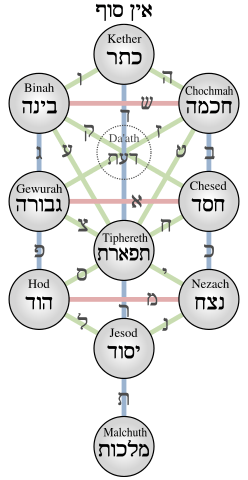
If we look at the Tree of Life in terms of the concepts of cause and effect, identity and difference, and relation, we can say that Chakmah gives rise to (or descends to) Chesed or Mercy, or perhaps Love understood as agape, Charity, on the left side of the Tree (#4). This corresponds with the pillar of Jakim, the white pillar. The deprivation of Chakmah or wisdom is the Sephirot of Binah or Understanding. Understanding is the deprivation of wisdom, the lack of or “withholding” of wisdom. Wisdom is knowledge of the whole while Understanding is knowledge of particulars. Binah gives rise to Gevurah, Force or Power (Strength in numbers). The right side of the Tree of Life seems to indicate “social” constructions i.e., living in communities and the shared knowledge that comes from living within those communities. It is the realm of the political. The deprivation of Love, Mercy or Charity within the Understanding gives rise to the “withholding” or deprivation that is understood as knowledge within those communities that is of the nature of Gevurah or Force. (Knowledge understood as power, social status, prestige.)
The relation necessary to temper Force and to balance it with Mercy is to be found in Tiferet #6, Beauty. Tiferet is placed both below and above Gevurah and Chesed and this indicates a movement both up and down since Tiferet is tied to Keter (up) and Yesod, as well as to Malkhut (down). Both Gevurah and Chesed must share something in common that Tiferet (Beauty) can bring into a relation. Could this something in common be the shared Beauty of the World, the recognition of the Otherness of the World?
Yesod is related to the sexual organs and it is Beauty which causes the sexual organs in both male and female to “rise up”, literally, as a response. Human sexuality is the “foundation” (Yesod) of communities and thus the social. Our “eros” is first driven by our attraction to the beauty of other human beings. Hod is Glory, or recognition within the social and is the deprivation of Netzach or true Victory. So much of social Glory is based on fraud and illusion.
The Sephirot are perceived “like lightning”, in a flash. They are not something which is constantly beheld. This is similar to Plato’s Allegory of the Cave. The shadows on the wall of the Cave created by the reflected light of the fire behind the cave dwellers are, according to Plato, “non-beings”. This is the shared knowledge of the social, what the Sefer Yetzirah calls the Understanding or what we call intelligence. The Ideas (the Sephirot) are apprehended in the glance, and there is an emphasis on the “correctness” of the glance (the Sephirot are 10, not 9, not 11). But it is merely a glance.
In the Sefir Yetzirah the initiate must “understand with wisdom and be wise with understanding” (SY 1:4). The part can only be truly understood from the whole and knowledge of the whole is wisdom. In Plato’s allegory, the initiate is the prisoner who has been released from their chains. Both Republic and the Sefer Yetzirah require a significant other; the journey cannot be begun or accomplished on one’s own.

The Sephirot, like the Ideas, are the truth of beings, arising like “lightning” and disappearing into concealment, hiddenness, “running and returning”. The Sephirot are “depths”, states of fullness and deprival. Binah understanding is a state of separation and disunity (subject/object, mind/body). The initiate must overcome this duality by “imbedding the end in the beginning”, the whole into the part. This can only be achieved by what the Sefer Yetzirah refers to as Wisdom. (Mantra: What do you see behind your head? Ans: Nothing). In order to perceive what is behind the head a mirror is required; that is Chakmah requires a mirror which uses Malkhut’s reflected light to clothe things in Binah representations (“shadows”). (Is this the “joke” of Leonardo Da Vinci’s “Vitruvian Man” where the writing is written backwards from right to left and requires a mirror to view it from left to right?)

 Theory of Knowledge: An Alternative Approach