
Text:
2.1 The foundations are the twenty-two letters, three mothers, seven doubles, and twelve single letters. Three mothers, namely A, M, SH, these are Air, Water, and Fire: Mute (Hums) as Water, Hissing as Fire, and Air of a spiritual type, is as the tongue of a balance standing erect between them pointing out the equilibrium which exists.
Alt. Trans.: Twenty-two foundation letters, Three Mothers, Seven Doubles, And Twelve elementals: The three Mothers are Alef, Mem, Shin. Their foundation is A pan of merit (fullness) A pan of liability (need) And the tongue of decree deciding between them.(mediation)
Three Mothers: Alef, Mem, Shin: Mem hums, Shin hisses And Alef is the Breath of air deciding between them.
Wescott Trans. 2.1. The twenty−two sounds and letters are the Foundation of all things. Three mothers, seven doubles and twelve simples. The Three Mothers are Aleph, Mem and Shin, they are Air, Water and Fire. Water is silent, Fire is sibilant, and Air derived from the Spirit is as the tongue of a balance standing between these contraries which are in equilibrium, reconciling and mediating between them.
Commentary on 2.1

The foundations of the created world are revealed through the 22 letters of the Hebrew alphabet by means of the 10 Sephirot. The image created is one of a balance, a scale, the symbol of Justice. The Tree of Life itself is a symbol of this. The Three Mothers represent the three columns into which the Sephirot are divided and come to constitute the three pillars of the Tree of Life. Boaz is the pillar of Mem (water), Jakim is the pillar of Shin (fire) and Keter is the breath (air) or Spirit (the Logos) which judges between them. Water moves downward; fire rises. The movement, as we perceive it, is clockwise.
The ‘tongue of balance’ or the ‘tongue of decree’ is a metaphor for the Logos. The function of the Logos is as a reconciler and mediator. It is the ‘speaking silence’ that is the Beauty of the World, as well as the Law of decree that is Necessity. It is the Torah and the Ain Sof.

The Scale here is the Law of Necessity, the law which rules over all created things. It is the schema or plan which creation and created things must follow. It is the Divine Will. The justice of the law of Necessity is one of the most difficult things for human beings to comprehend. It raises questions such as: if God is all Good, why does He allow the innocent to suffer? Why does He allow the wicked to prosper? The evil Demiourgos of the Gnostics and the questions of the “Book of Job” come to mind. (“The Book of Job” is originally in Greek with God’s answers to Job written in Hebrew. Needless to say, God’s answers to Job are not “psychologically satisfying” to the suffering human being who is crying out for justice!)
Examples of the Sternness of Necessity are all about us, while examples of Mercy can sometimes be hard to find. The “hissing” of Fire is caused by water’s contact with it. The implication is that mercy, love, and charity are always present and there is strife between the elements of water and fire which is mediated by air (“of a spiritual type”, which means that it is ‘no-thing’). This is one of the bridges between the spiritual and the physical. The emphasis is on holding things in harmony and of the reconciliation between them. It is through the meeting of fire and water that earth is formed.
Shin and Mem also denote the name “Shem”. Shem is one of the sons of Noah who participated in Noah’s spiritual experience, his direct contact with God. Some Kabbalists give the writing of the Sefer Yetzirah to Shem who taught it to Abraham (which is close to how the Sefer Yetzirah is being understood here if the non-Hebrew influences are taken into account within the final Hebrew text). The word “Shem” designates “name”, to name things. It is through the “naming” of things that things are brought to presence and are revealed. It is through “names” that we can grasp the spiritual essence of a person or object, if by “names” we mean the logos.
The pronunciation of the letters is also said to be a valuable meditation technique similar to the word “Om”, for instance, or the Gregorian chants of medieval Christians. Meditation is thought, contemplation, attention, prayer and it is distinguished from the thinking that is involved in the realm of yetzirah or the realm of knowing and making, the world of ‘formation’.
If we compare what is said here to Plato, the Sephirot are the Ideas which are limited to 10 and which beget all numbers and all enumeration. The Ideas beget the eidos or the outward appearances of things that brings things to a stand and give us “understanding”. Understanding is formed from the middle pillar of Keter, the logos, which is the air or “spiritual breath” that speaks the “judgement” of what things are. The logos is composed of number and speech and these are seen as identical. From the logos is physical creation identified and made.
Text 2.2:
2.2 He hath formed, weighed, transmuted, composed, and created with these twenty-two letters every living being, and every soul yet uncreated.
Alt. Trans.
Twenty-two Foundation letters: He engraved them. He carved them, He permuted them, He weighed them, He transformed them, And with them, He depicted all that was formed and all that would be formed.
Wescott Trans. 2.2. He hath formed, weighed, and composed with these twenty−two letters every created thing, and the form of everything which shall hereafter be.
Commentary on 2.2:
“He engraved them”: the letters are written on a tabula rasa a blank slate, no-thingness. They are “carved” out and separated (things that are given form and separated, the process of thinking known as diaresis to the Greeks). The letters are “permuted” or “arranged” so that words are formed. The words give names to things so that they are “weighed”, measured, and defined i.e., judged. Once measured, they can be ‘transformed’. The outward appearance of a thing was what Plato called the eidos of the thing, the ‘form’ of the thing, what allows a thing to be “measured”, “weighed” and “composed” . The Forms and Ideas of Plato are distinctive concepts, not identical or the same as is commonly understood. The Forms are the emanations of the Ideas and begot from the Ideas.
From the letters, all that was formed and all that will be formed was always already there. The things that are formed are “depicted”, “from the picture”, given an outward appearance (eidos in Greek), so that the things can be seen in images and pictures (as well as the letters themselves) and thus could be visualized so that understanding and knowledge could take place. The emphasis is on seeing or viewing. Prior to the seeing, a form must first be in place and this shape must be accompanied by colour or the light. This form is a product of the logos and can be understood through the geometry of the ancients. Geometry deals with space; weighing and composing deal with place and with Time. Place is understood as topos in Greek, and it is the site of human beings’ making in their various worlds.
Text 2.3:
2.3 Twenty-two letters are formed by the voice, impressed on the air, and audibly uttered in five situations (places): in the throat, guttural sounds (Alef, Chet, Heh, Eyin); in the palate, palatals (Gimel, Yud, Kaf, Kuf); by the tongue, linguals (Dalet, Tet, Lamed, Nun, Tav); through the teeth, dentals (Zayin, Samekh, Shin, Resh, Tzadi); and by the lips, labial sounds (Bet, Vav, Mem, Peh).
Wescott trans. 2.3. These twenty−two sounds or letters are formed by the voice, impressed on the air, and audibly modified in five places; in the throat, in the mouth, by the tongue, through the teeth, and by the lips. (31)[1]
[1]31. This is the modern classification of the letters into guttural, palatal, lingual, dental and labial sounds.
Commentary on 2.3:
Here the passage speaks of oral communication, voice, speech. The movement is from inner to outer, from hidden within the throat, to revealing upon the lips, the audible. Voice is the third action that is mentioned following the creation of the whole (the One God) and the formation of letters (the Logos). The Voice gives rise to creation itself.
The Sefer Yetzirah speaks of five Loves: Keter, Chakmah, Chesed, Tiferet, and Netzach which represent “fullness” as I understand it. The other column represents the five Judgements: Binah, Gevurah, Hod, Yesod, and Malkhut which I call “needs”, but the use of the word “judgement” here indicates the essence of the principle of reason and its site of truth. One could understand “judgement” as “outcome” or “end”. The judgements are sometimes called “Strengths” which can be seen as force or power, the bringing into reality or completion of those urges which we experience in everyday life, those desires which are related to ‘will’, or the potentiality and possibility related to Aristotle’s dynamis brought to completion as energeia or “work”, “works”. This may be related to the natural desire to overcome needs. The desire, the aspiration of thought, and its fulfillment is a “movement” and indicates the combination of being and time.
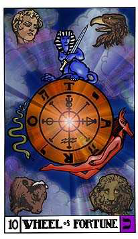
When inscribed within a sphere and the sphere is then rotated clockwise, fullness is the result. When the sphere is rotated counter-clockwise, evil or need is the result. The Wheel of Fortune #10 is not to be conceived as a two-dimensional circle but rather as a sphere. The following chart relates to the Sephirot’s relation to their position in space within the sphere:
Keter – Malkhut Good -Evil Ethical
Chakmah – Binah Past-Future Time
Chesed – Gevurah South-North Space
Tiferet – Yesod Up-Down Space
Netzach – Hod East-West Space
Text 2.4:
2.4 These twenty-two letters, the foundations, He arranged as on a sphere, with two hundred and thirty-one modes of entrance. If the sphere be rotated forward, good is implied, if in a retrograde manner evil is intended.
Alt. Trans. Twenty-two foundation letters: He placed them in a sphere Like a wall with 231 Gates. The sphere oscillates back and forth. A sign for this is; There is nothing in good higher than Delight There is nothing evil lower than Plague.
Wescott trans. 2.4. These twenty−two letters, which are the foundation of all things, He arranged as upon a sphere with two hundred and thirty−one gates, and the sphere may be rotated forward or backward, whether for good or for evil; from the good comes true pleasure, from evil nought but torment.
The first chapter of the Sefer Yetzirah speaks of the spiritual realm, the ruler of which is “the heart”. The heart acts like a general in battle in dealing with the strife that is created between the different urges and desires created by the “will” or eros that is the condition of the embodied soul of human beings. The “heart” can act out of “fullness” or “need”. The heart is the Sephirot Tiferet. The human form is a microcosm of the macrocosm that is the created world. One is reminded of the words of the English poet William Blake from his poem “Auguries of Innocence”: “God appears and God is light/ To those poor souls that dwell in night/ But does a human form display/ To those who dwell in realms of day.”

The second chapter of the Sefer Yetzirah deals with Space and Time. In space and time we deal with contraries, the deprivations of the qualities from each other. The sphere is said to oscillate back and forth: fullness and need oscillate within time and the movement is cyclical. Time is cyclical in the Sefer Yetzirah, not linear i.e., going from past to present to future, although this appearance is given in the movement from Chakmah to Binah where the past of Chakmah moves through the present of Keter to the future that is Binah. Oscillation is movement in place. These movements can be illustrated by the motions of a gyre.
The circumference of the circle/sphere is “like a wall” with 231 gates. The mathematical formula for this is: n (n – 1) / 2; 231 = 22 x 21 / 2 gates. The “wall” is the limit imposed on the unlimited, on Necessity. All of our arts and sciences develop from how we know, understand, and deal with Necessity. There are 22 points within the the sphere and the things of the world are brought to appearance within/on the circumference (the horizon). 3 points; 4 points=6 lines; 5 points=10
The number of lines that can connect the 22 letters is 231 which are the paths (letters) and gates of the Sephirot. Two letters can be combined in 231 ways. Each of the combinations is also a triangle: two letters plus the third that is part of “the wall”, one of the mother letters. The 0 is not a number, per se, but a placement indicator. The Egyptians and the Greeks rejected the concept of 0, so a 10 is not a 1 + 0, but a placement that allows the cyclical movement of the numbers to take place. (Knowledge of binomial and binary combinations would be useful here since this is the mathematical language of computers.) In this case, the number and the letter are interchangeable. One can have a 08 as well as an 80. They are not references to quantity but to quality i.e., they are not subjects (nouns), but predicates (adjectives, adverbs).
As has already been indicated, one cannot have number without space since number deals with quantity, and number must have an Other besides the One. The One itself is beyond the second one composed of the triune of Keter, Chakmah, and Binah, which constitute both space and time and these are contained within the sphere of Creation: their end is their beginning so the 1 is in the 10 and the 10 is in the 1. Time gives being to beings in space, and this Time is the moving image of the eternity of the One in its essence. Time is the dynamis (possibility and potentiality) and the kinesis (movement, action) of Life itself.

In the legend of the formation of the Golem, one is to proceed around the circle of the sphere chanting the letters from Alef to Tav; to unmake the Golem, one reverses the direction from Tav to Alef. (There is a correspondence here between the ‘creation’ and the decreation of the human being). The Golem appears to be not only the making of a soulless human being or other animal (since only God can give “soul” to beings since “soul” is eternal like Himself and part of Himself), but also the making of any made thing accomplished through the numbers and the letters.
The Golem would be a general term for the artifacts of man which do not have their origin in Nature: genetic splicing is but one manner of accomplishing the making of a “Golem”; Artificial Intelligence would be another. Cybernetics is but another synonym for the making of the Golem. The Golem appears to be something akin to the voodoo doll or the Orcs and Gollum of Tolkien, yet at the same time the Golem might suggest that through meditation one is able to visualize the “perfect human being”, the beings that are the perfection seen in Greek statues or Da Vinci’s “Vitruvian Man”. Human beings in their being are the perfect imperfection. (The Golem reminds one of the condition of the prisoners of Plato’s Cave being “unconscious” and “soulless”.)
A Christian might see a vision of God as Christ i.e., in the form of man. The goal of the whole of the Sefer Yetzirah is the formation of the “spiritual Golem”. I would suggest that it is rather the attainment of the revelation of the Mediator (Christ) as body or the bringing of the Mediator (Christ) into actual presence or parousia. This is done through the “fullness” and “need” that is Eros. This presents us with a problem, however, if we are Christians. One does not go in search of Christ but rather prepares oneself to be found and received by Him. The sheep does not go in search of the Shepherd; it is the Shepherd’s task to find the sheep. The sheep bleats in order to be found. The bride (the embodied soul, Psyche) prepares herself in order to be received by the bridegroom (the Divine, Eros).
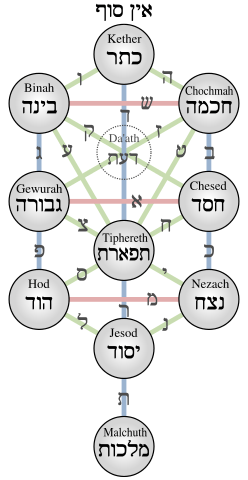
What is confusing about the Sefer Yetzirah is whether there are three or ten Mothers as to their relation to the Hebrew alphabet. The Mothers are the connectors between the paths: two columns, 231 gates. Mem and Shin connect Chakmah and Binah (Alef), Mem and Alef connect Gevurah and Chesed (Shin), and Alef and Shin connect Hod and Yesod (Mem). These crossroads are the points of separation of the three worlds of Asiyah, Yetzirah, and Beriyah. A rebirth, conversion, and a baptism is required to access these different realms. These rebirths are of the “water and of the Spirit”, of the “fire and of the water” or of the Logos (Breath) and of the spirit.
Some Kabbalists include an eleventh Sephirot named Da’at in their composition of the Tree of Life. Da’at is sometimes called “the Void”, but Da’at appears to be the web of Necessity itself, the limit or law which rules over all created things. What we call “knowledge” derives from our understanding of these limits whether in the physical or psychological realms. The two columns of Jakim and Boaz are comprised of these eleven Sephirot twice over i.e., the twenty-two letters of the Hebrew alphabet. The first eleven are said to represent the “front” (the face, the look, the outward appearance of things, what Plato called the eidos). The second eleven are the “back”, the contraries or the deprivations of things. (This would coincide with Eros as two-faced, looking in different directions and in his representation as Fullness and Need). The name “Israel” itself signifies the whole of created things, not what we understand as the state of Israel today.
When the Sefer Yetzirah states that “there is nothing in Good higher than delight”, this can be understood in a similar fashion to the Greek word eudaimonia or “good spirits”, what we understand as “happiness”. The deprivation of happiness is affliction, what is referred to as “plague” in the text of the Sefer Yetzirah. In Hebrew, the word for “delight” is oneg; the word for affliction or “plague” is nega. One obtains the words by rotating the letters back to front.
The sphere of creation is oscillating, rotating. One must be within the sphere, at the centre, to be unmoved by its oscillations or rotations, and Tiferet is the centre of this sphere, both the height and depth. From the centre, inside, there are no directions, no contraries. Only when one is off-centre, outside, is this perception possible and one is subject to the oscillations or turnings of the wheels upon wheels that are within the sphere itself. (King Lear Act 5 sc. iii and Act 4 sc. vii “But I am bound upon a wheel of fire,/ That mine own tears do scald like molten lead”.). Along the journey, the “dark night of the soul” as experienced by the saints occurs the closer one gets to Keter. They report that there is a complete disconnect with God (Christ’s “Father, why have you forgotten me?”, St. John of the Cross, Simone Weil). Following the dark night, the revelation is received. The dark night would occur at the third crossroads on the upward motion and the first crossroads on the descending motion on the Tree of Life.
Text 2.5:
2.5 For He indeed showed the mode of combination of the letters, each with each, Aleph with all, and all with Aleph. Thus, in combining all together in pairs are produced these two hundred and thirty-one gates of knowledge. And from Nothingness did He make something, and all forms of speech and every created thing, and from the empty void He made the solid earth, and from the non-existent He brought forth Life. He hewed, as it were, immense columns or colossal pillars, out of the intangible air, and from the empty space. And this is the impress of the whole, twenty-one letters, all from one, the Aleph.
Wescott trans. 2.5. For He shewed the combination of these letters, each with the other; Aleph with all, and all with Aleph; Beth with all, and all with Beth. Thus in combining all together in pairs are produced the two hundred and thirty−one gates of knowledge. (32)[1]
See the notes to the Wescott translation below.
Wescott trans. 2. 6. And from the non−existent (33)[2] He made Something; and all forms of speech and everything that has been produced; from the empty void He made the material world, and from the inert earth He brought forth everything that hath life. He hewed, as it were, vast columns out of the intangible air, and by the power of His Name made every creature and everything that is; and the production of all things from the twenty−two letters is the proof that they are all but parts of one living body. (34)[3]
[1]32. The 231 Gates. The number 242 is obtained by adding together all the numbers from 1 to 22. The Hebrew letters can he placed in pairs in 242 different positions: thus ab, ag, ad, up to at; then ba, bb, bg, bd, up to bt, and so on to ts, tt: this is in direct order only, without reversal. For the reason why eleven are deducted, and the number 231 specified, see the Table and Note 15 in the edition of Postellus.
[2]33. Non−existent; the word is AIN, nothingness. Ain precedes Ain Suph, boundlessness; and Ain Suph Aur, Boundless Light.
[3]34. Body; the word is GUP, usually applied to the animal material body, but here means “one whole.”
Commentary on 2.5:

Passage 2.5 is a summary of all that has been said up to now in the Sefer Yetzirah. The combining together of the pairs of letters produce the 231 gates of knowledge, but all are from the one Alef. The formula for the combinations is n (n – 1) / 2. Within Alef are the three elements of air, fire and water indicating the Pythagorean understanding of numbers as a triune (and the One God as a Trinity). The physical universe, earth, substance, is created from these three elements. “The void” is Chakmah or the unlimited, space without definable limits; it is of the element water. It is no-thing. To make no-thing into some-thing requires the imposition of language and number so that they can be measured and weighed and then named, “the shape of water”. This shaping is called the Beriyah level of the Universe, the creation of something from nothing (Atzilut, Yetzirah, and Asiyah being the other three). Binah and the Beriyah level of creation are simultaneous. “From non-existence (“no-thing”) He brought forth Life” as well as Language, and both occur simultaneously.
“He carved (hewed) immense columns or colossal pillars”: “Wisdom has built its house; it has carved its seven pillars” (Proverbs 9:1) The great pillars of Wisdom are the seven subjects of education, and hence Understanding: grammar, logic, rhetoric (Language), arithmetic, music, geometry, and astronomy (Number). Wisdom is realized through the study of the 7 subjects. The 7 pillars are also said to correspond to the lower 7 Sephirot of created things. The 7 days of the week are the “light of the world”, the reflected light of Malkhut (Time) from the primary light of the Sun of Tiferet. The 7 doubles of the alphabet are the vertical lines of the Tree of Life derived from the three Mothers. The three Mothers are associated with the past, Time. Together they spell out the word “last night”. Understanding is the shared knowledge that we would deem “historical knowledge”, and it is comprised of the 7 pillars of Wisdom; it comes from the past and is part of the communities of which we are members.
The illustration on the left indicates the horizontal lines of Alef, Mem, and Shin. The movement is from right to left on the Tree: from Chakmah to Binah (Shin), from Chesed to Gevurah(Alef) , from Netzach to Hod (Mem).
The One Name of God is YHVH: tetra (four), gramma (letters) or Tetragrammaton. The whole of language and number is said to develop from the combinations made through this name. The name invokes the shape of Alef: two Yods with a Vav as a diagonal barrier between them.
In the passage, the initiate “foresees, transforms and makes”. To “foresee” is to “pre-dict”; to “transform” is to change in order to “make” – pro-duction. The forming and making in the realm of Yetzirah and Asiyah is what we understand as the “technological”, the “knowing” and “making”. What is implied in human making is that the human bringing into being of things is that those things were always already there and that the human being merely reveals that which is part of “every thing that will ever come into being”. The Balinese, for example, celebrate their Honda motorcycles as ‘a gift from the god’. Honda did not ‘create’ the motorcycles; they were always already there and Honda merely revealed them and made them.
Human beings make from “another”; Nature makes from itself. The human being does not create; he “makes” from the seeing (foreseeing, pre-diction), the arranging (transforming), and the production or bringing forth into being or revealing that which was always there. (From this one could say that J. R. R. Tolkien is literally correct in saying that technology is “black magic”! In the past, permission was required from on High to make an actual physical Golem, but that does not seem to have stopped modern day scientists. Note the similarities of the words Golem and Tolkien’s Gollum. The ‘eye of Sauron’ and the techne of Saruman would appear to be the seeing that is the technological.)

 Theory of Knowledge: An Alternative Approach