
The Paths Emanating From Binah
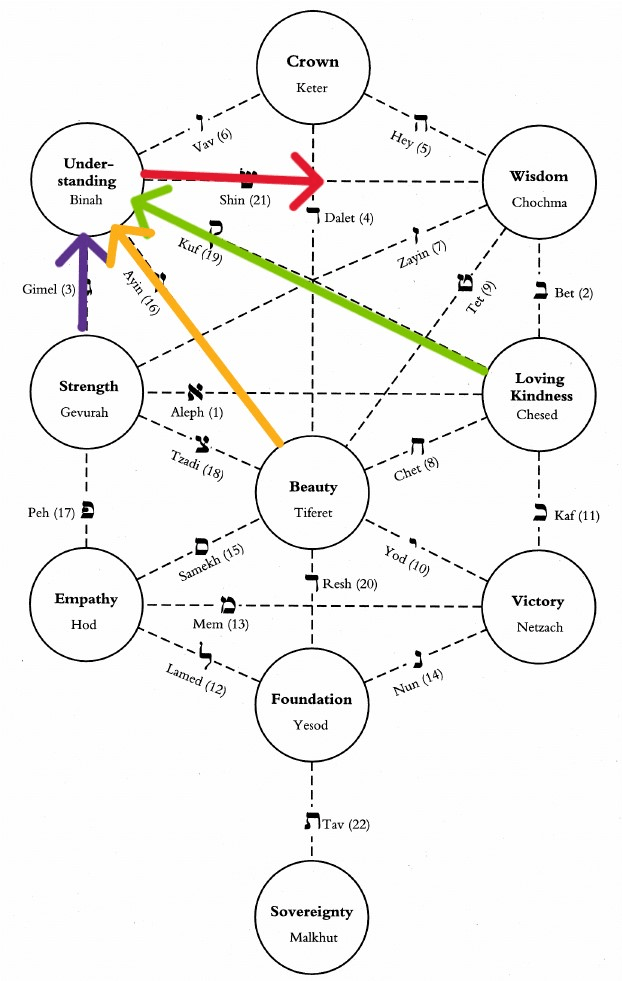
The paths leading to and from Binah are:
- #3 The Sanctified Intelligence
- #14 The Illuminating Intelligence: Letter Shin Alef Mem with the element of Shin emphasized (Red)
- #15 The Stabilizing Intelligence: Letter Tet (Green)
- #17 Intelligence of the Senses: Letter Vav (Orange)
- #13 The Unity Directing Intelligence Letter: Peh (Purple)
The Third Path is the Sanctifying Intelligence, and is the basis of foundation of Primordial Wisdom, which is called the Former of faith, and its roots, Amen; and it is the parent of Faith, from which virtues doth Faith emanate.
Alt. Trans. “The third path is called the sanctifying consciousness. It is the foundation of primordial wisdom and is called “enduring faith [Amen]”, and its roots are truth [Amen]. It is the father of trust [Amen], from which the power of faith [Amen] emanates.”
Wescott trans. The Third Path is the Sanctifying Intelligence, and is the foundation of Primordial wisdom, which is called the Creator of Faith, and its roots are AMN; and it is the parent of Faith, from which doth Faith emanate.
Path 3. Sanctified Intelligence (Consciousness) (Sekhel MeKudash): This is the foundation of the Original Wisdom and it is called “Faithful Faith”. Its roots are AMeN. It is the Father of Faith, and from its power faith emerges.
The 3rd Path: The Sanctifying Intelligence
The third path of wisdom is The Sanctifying Intelligence. The third path of wisdom is the sephirot Binah in the Western Tree and Chakmah in the Hebrew Tree. The word “sanctifying” here means “to make pure, to set apart, to consecrate”, to “make holy”. What “sanctifies” or makes “holy” is the presence of the Divine in the Unlimited (the whole) and this presence prescribes the limits to the Unlimited. That which prescribes the limits is the Logos, and this is ultimately the Law of Necessity or the Divine Will. This is mirrored in the logistikon or the divine part of the soul. The prescribing of limits through the logos is not a setting apart that cuts off, but a site wherein and from where something commences and emerges as that which it is. For something to be that which it is is its ‘holiness’.
We began this commentary with a quote from Simone Weil: “Faith is the experience that the intelligence is illuminated by Love.” The intelligence is illuminated by the “amen” (“so be it”, “let it be”) that is the foundation of primordial Wisdom i.e., faith is the product of the acceptance of the Divine Will which manifests itself in Necessity. This acceptance is not an easy task as is illustrated by the fact that the first test or temptation of Christ is to turn stones to bread. This acceptance may be said to be a mastery of the appetitive part of the soul. This acceptance may also be said to rest in the concept of amor fati which is ‘the love of fate’. Only a few exceptional human beings are capable of this faith in its true form.
All of what we call knowledge is a product of Necessity. This knowledge is illuminated for us through Love, not only through the principle of reason. Here it is not the thing that is made ‘holy’, but the seeing itself that is ‘holy’ i.e., ‘set apart’, ‘made pure’. Fire is the element of purification. It is through our acceptance of the Divine Will that all things are made holy for us. The site wherein and from where something commences and emerges and becomes holy is the intellect (logistikon) when it is illuminated by Love. The truth, the unconcealing that is the root of faith, is the illumination of things, the bringing out of unconcealment, through Love. This is what we call ‘experience’. Experience is consciousness or awareness of, intelligence of some thing.
Since Chakmah is the “unlimited”, it cannot be known in any specific way. Binah separates and produces or brings forth particular things, makes them “pure”, sets them apart and “consecrates” them by giving a name to them. The giving of names to things is a “holy act”; it is what distinguishes and separates human beings from other animals and from other created beings. The type of thinking that separates and comes to know things through this separation is called diaresis in Greek. To bring things together, to unify them, is called dianoia. Binah is a combination of both types of thinking and brings about Understanding, how we come to interpret our world. This Understanding is the foundation of primordial Wisdom.
This third path is sometimes referred to as the “General Consciousness” which would indicate a connection to path #30, the third path on the upward direction of the Tree of Life, from bottom to top. (Path #30. General Intelligence (Consciousness) (Sekhel Kelali): “It is called this because it is the means by which the astrologers collect their rules regarding the stars and the constellations, forming the theory that comprises their knowledge of the Ophan-wheels of the spheres.”) Whereas the 30th path is in the realm of Asiyah, the 3rd path is in the realm of Beriyah. The 30th path is not the intelligence illuminated by Love. They are mirror images of each other. The knowledge which the astrologers have is knowledge of Necessity. Its source was geometry. The original knowledge of the astrologers was in their contemplation and attention to the movements of the heavens but it appears to have devolved into something else a long time ago (as is indicated by path #32 The Administrative Intelligence).
Diaretic thinking produces classifications, taxonomies. Though the world presents itself in multivarious particulars, the One is present within them, and this bringing together into a one is the thinking that is called dianoia. The “gathering together into a one” is one of the many possible translations of the Greek word logos. In philosophy, this is the problem known as “the one and the many”.
In Plato, one may see this problem outlined in the relation between the Ideas and the Forms. The Forms (eidos) are the outward appearances of things and these are innumerable. The Forms, however, are the emanations or begettings of the Ideas which are the essence of the Forms or what the things really are in their being. The Ideas of Plato are the Sephirot of the Sefer Yetzirah, and both have their roots in Pythagorean geometry. The practice of geometry was initially one of contemplation and prayer, a relation to the world as presence-at-hand. The “gathering together” that brings about our “understanding”, our interpretation of the world, is only possible through the logos. This gathering together can be done through the principle of reason or it can be done through Love. Both are matters of “seeing” and “viewing”. Both means are by ways of the logos. With the principle of reason, Love is absent or diminished; it is the lower form of eros, the thymoeides or “spirited” part of the soul. The requirement is to combine the Love that is Eros with the Logos that is the true essence of the thing in order to dwell in the proper relation with the Divine. This is done through the logistikon part of the soul.
Binah is the third Sephirot and is related to Understanding. How we come to understand the world is determined through Time and through Memory, and this is the influence of Chakmah and the element of water (material) upon that of fire (the mind, the head). Binah imposes limits on the unlimited of Chakmah; it gives shape to water. We might say that the ‘shape of water’ is what we call history. The philosopher Thales thought that all things are composed of water. Heraclitus opposed Thales’ view and asserted that all things were composed of fire.
The limits which give presence to the things that are present have come about through the logos of number and word. Through the logos of number and word, we are able to de-fine things and to give them a name. The things become particulars, singulars, and they are separated from the whole of the things that are. This is why Binah is associated with “The Sanctifying Intelligence”. This naming and defining of things is considered “holy” in the Sefer Yetzirah, for it is our distinction as human beings from the other living creatures about us. Our ability to have a history and be aware of it through Memory is what is distinctive about us.
We might say that Binah is the recognition of three ways of viewing the world or the foundation of the three worlds: the world of ‘reality’ which is associated with Asiyah and the sephirot Malkhut (the material world); the world of history (historicism) which is a world with human beings at the centre and is associated with Yetzirah and Beriyah. The world of ‘virtual reality’ which is a discovery of modern times and goes beyond the real world as it is encountered creates a world within a world. We might consider ‘virtual reality’ a ‘second Cave’ which distances us still further from the truth of things. AI and its applications would be part of this ‘second cave’, a further distancing and closing off of our humanity from the reality of the Truth. That this intelligence is called ‘artificial’ is a recognition of its distance from the reality of things; it is an artifice or a making of human beings. This distance from things is the no-thingness at its height, and we must understand this as a blossoming of our nihilism in the modern age. (The four stages of truth in Plato’s allegory of the Cave correspond to the four universes of the Sefer Yetzirah.)
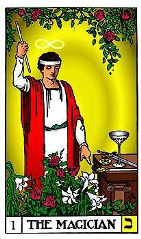
We can encounter the beings in our world as either “presence-at-hand” or “readiness-to-hand”. Present-at-hand beings are to be contemplated while ready-to-hand beings are encountered as something “useful”, something which exists in order to complete human beings’ tasks or goals. They are seen as “equipment” or “tools”. Human beings’ care and concern allows them to encounter beings as useful for ‘projects’. The things are manipulable, disposable. They are ‘for’ something. What the things are, their meaning, is determined by human beings’ projects and these projects establish and determine the worlds in which those things will appear and come to prominence. This is the meaning and significance of the Tarot card of The Magician #1 who, through the energy of his upward held wand, is able to make use of the cups, swords and pentacles that lie before him. The wand is a symbol of his will and energy. This will is associated with reason, Shin, the head. This will is the thymoeides or ‘spirited’ part of the human soul when it comes to domination.
In the modern view, ready-to-hand beings possess no telos or purpose of their own: their “value” is determined by human beings’ projects. Their particularity is replaced by uniformity. They are all calculable masses in motion in space and time. This was the revolution begun in the seeing of modern science (Galileo and Newton) as distinguished from the science of the ancients. In the virtual world, we can say that the logos has no ‘value’ of its own outside the projects that human beings have determined for it. Their “value” lies in their ‘in-order-to’, their relation to human beings’ projects. A project is ‘that which is thrown forward’ as the end or purpose in advance. Nature is ‘thrown forward’ and is ‘discovered’ or encountered as ‘environment’ in advance. We can look at a tree as ready-to-hand: its fruit, a shady place to rest, etc.; or we can look at its ‘presence-at-hand’: its colour, its bark, its DNA structure, but this manner of looking at the tree reveals nothing of the tree’s nature i.e., the tree as a living being.
Physis or nature, according to the Greeks, is “that which emerges and remains in view”. For Plato, every being conceals and discloses through its eidos or “appearance” at the same time: our knowledge and understanding of what appears to be is doxa or “opinion”. The wall of the Cave, the enclosure that is our created world, reflects shadows cast by the fire from the framework of the technites, the artisans, the powerful, within the Cave. This framework is ‘the thrown forward’, the shadows on the wall. Doxa and physis are in tension or strife with each other. Metaphysics, historically, attempts to “preserve” the concealing-revealing nature of the natural, what Aristotle called the “stable presencing”, (the meaning of the 15th path of Wisdom leading from Binah to Chesed), and this belief in the ‘stable presencing’ is shown in some of the paths of the Sefer Yetzirah.
In “The 32 Paths of Wisdom”, this attempt at preservation, of making something permanent, is sometimes called “The Constant or Settled Intellect” (Examples: Path #4: Settled Intelligence (Consciousness) (Sekhel Kavua): “It is called this because all the spiritual powers emanate from it as the (most) ethereal of emanations. One emanates from the Other by the power of the Original Emanator, may He be Blessed.”); “The Everlasting or Enduring Intellect” (Path #16: “Enduring Intelligence (Consciousness) (Sekhel Nitzchi): “It is called this because it is the Delight of the Glory (Eden). As it is, there is no Glory lower than it. It is called the Garden of Eden, which is prepared for the (reward of) the saints.”), “The Sustaining Intellect” (Path #23: Sustaining Intelligence (Consciousness) (Sekhel Kayam): “It is called this because it is the sustaining power for all the Sephirot”); and “The Continuous Intellect” (Path #31: Continuous Intelligence (Consciousness) (Sekhel Timidi): “Why is it called this? Because it directs the path of the sun and moon according to their laws of nature, each one in its proper orbit.”) Poiesis or ‘the emergence that remains in view’ is at the heart of causation (the bringing forth that is done through the logos as related to the four causes of Aristotle discussed earlier). Modern natural science’s view of nature, as a final view, secures permanently the distinction between the Good and Being, facts and values. There are no “moral facts” i.e., “natural morals”. This modern view is contrary to the world of the Sefer Yetzirah.

Human beings, as natural beings, bring themselves to presence; they “occasion” themselves from out of themselves. When Shakespeare says “the art itself is nature”, this would indicate that what he sees himself as doing in his dramas is analogous to “the blossom bursting forth”. The pen and ink and human beings are like the earth, air, and sun. Art is human beings’ revealing of the truth in the most appropriate way that they are capable of. The language of this revealing is “prophecy” or “art”, that language that is beyond time. This distinguishes this language from that of AI where language is understood as historical and algorithmic.
Binah manifests the interactions of the first horizontal line of Mem/Alef/Shin, the vertical double letter line of Peh, and the diagonal lines of Vav and Tet. The path of Peh does not interact with Tiferet; and because of this lack of interaction, how the natures of the paths will be expressed through Binah will come to determine how an individual human being will come to view their world; it will be their understanding of their world. Peh, meaning ‘mouth’, indicates the language of rhetoric, the language that directs itself to the passions and attempts to persuade the passions which have their root in Mem. Binah, as the Sanctifying Intelligence, has its roots in Shin, the purifying alchemical fire.
Two paths lead from The Sanctifying Intelligence to channel or communicate these emanations to the Sephirot below. The one path links the Divine to the human soul (Tiferet); the other path links to Gevurah or the “social” and this is what we would understand as traditional religion, our “shared knowledge” and understanding, and it is linked to Binah. Peh and Vav are these linking paths.
The Sephirot are what things truly are in their essence; the Sephirot are not in motion. Because they are not in motion, they can be said to have always been; they are eternal. The essence of all that has been made and all that will be made is continually present in the Sephirot and this essence is not subject to historical situations and interpretations, although these interpretations are all that can be given of them. This is referred to as parousia here, the “being alongside”, the “being present together”. Through the thinking that is dianoia, the essence of things is “revealed” and thus their “truth”. This “revealing” is done through Binah and its path to Tiferet, the Beauty of the world which is represented by the letter Vav.
The following passage from the Gospel of Matthew may illuminate this point: Matthew 11: 27:“All things have been committed to me (handed over to me) by my Father (the Good that is beyond Being). No one knows the Son (The Light which the darkness cannot comprehend, Tiferet #6) except the Father (the Good), and no one knows the Father (the Good) except the Son (the Light) and those to whom the Son chooses to reveal Him (the Good).” Notice that the revelation of the Divine is in the hands of the Logos and that this revelation is what is called Grace, the gift received from the Divine.
Binah is “the clothing”, the images and representations, by which the essence of things is brought into appearance and made visible; and through this visibility, we are given Understanding. Binah is the essence of the historical interpretations of things. This is its association with Time. Binah is the archetypal Mother, Nature, and her womb is the receptacle for the Seed that is the dynamis of being. She is the “matrix” and the khôra of Plato, what we might interpret as Space and Time. In Plato’s dialogue Timaeus, she is described as the receptacle in which all becoming takes place. The fires (the goods) that we see coming into being and being extinguished are just appearances, in the receptacle, of the Fire Itself (the Good). At 52b, Plato describes this receptacle as “space.”
The coming into being and passing away of things is Time. The coming together of Space and Time is the Law of Necessity, the Divine Will. Plato uses the term demiourgos or demiurge, the one who takes the pre-existing materials of chaos (Chakmah), arranges them according to the models of the eternal ideas (the Sephirot), and produces or brings forth all the physical things of the world, including human bodies. Demiourgos means “craftsman” or “artisan” in Greek, but it is something of a tricky word in its interpretation. The Greeks see the shaper of the world as a “manual labourer”, and so the relation of the demiourgos to Christ is somewhat apt since He Himself was a carpenter, the one who builds a “house” that becomes a “home” which aligns with the letter Beth. The associations of the ox and camel as beasts of burden also relate to this labouring, the labouring which produces ‘a work’.
The 13th Path: The Intelligence of the House of Influx/ The Unity Directing Intelligence
Path 13: Intelligence of the House of Influx/ Unity Directing Intelligence (Consciousness) (Sekhel Manhig HaAchdut): It is called this because it is the essence of the Glory (Beauty). It represents the completion of the true essence of the unified spiritual beings.
The Thirteenth Path is named the Uniting Intelligence and is so called because it is itself the essence of Glory (beauty). It is the Consummation of the Truth of individual spiritual things.
Alt. Trans. ” The thirteenth path is named the uniting consciousness because it is the essence of glory (Beauty). It represents the completion of the true essence of the unified spiritual beings.”
Wescott trans. The Thirteenth Path is named the Uniting Intelligence, and is so called because it is itself the Essence of Glory (Beauty). It is the Consummation of the Truth of individual spiritual things.
Case trans. The thirteenth path (Gimel, joining Keter to Tiphareth) is called the Uniting Intelligence, or Conductive Intelligence of Unity, because it is the essence of glory (beauty), and the perfection of the truths of spiritual unities.
The Letter Peh and the 13th Path: The Unity Directing Intelligence
We spoke in the Third path, The Sanctifying Intelligence, of the thinking that is termed dianoia, that thinking which unites things that are separated into a one, that thinking which brings things together into a one thing so that the thing can be seen and be named. The thirteenth path is the bridge between the universe of Beriyah and the universe of Yetzirah. Yetzirah along with Asiyah is the world of action, the formation of things which brings about their “consummation” or perfection, their completion. This formation and completion is related to ‘justice’. These things brought to completion may be physical things or ethical things, since “glory” (the beautiful) refers to actions and their results. It is the world of “values”, that which human beings ascribe to things of their own doing and their own making. “Values” are what human beings make or determine regarding actions or things; they are not the “good”. “Glory” is not the Good, though it is often mistaken for the Good. The Glory of creation is its beauty; the essence of the creation’s beauty is its relation to the Divine, the One, the Good. The light from Tiferet is here in action to bring about the relation between the Divine Unity and the individual things within creation.
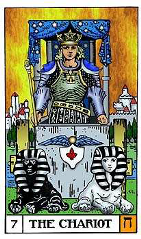
The four causes of Aristotle which we spoke about are within both the physical and spiritual realms; that is, they have to do with both ontology and ethics. The actions which human beings take require a dynamis, whether in an active or passive form, a potential or a possibility of being able to come into being or not to come into being. In the Tarot, it is the card of The Chariot #7, although some Kabbalists ascribe it to the card of The High Priestess #2. This may account for the many similarities between the Priestess and the Chariot cards in their depictions. Paul Foster Case considers the Thirteenth Path to belong to the letter Gimel and to be associated with Tiferet; but this cannot be the situation. The letter Gimel refers to “wealth”, the “value” of created things, the multiplicity of created things, the “wealth” or “abundance” of things, and it is associated with the strife amidst that multiplicity of things. It is one of the 7 double letters indicating that its understanding can be viewed in two ways (at least). These two ways are the outward and downward path to Malkhut or the inward and upward path to Keter.
This strife among the created things and the urges that arise in human beings is that which needs to be brought into “friendship” or balance and this is done through the connection between the primal water of the Holy Spirit (Chakmah), the undifferentiated pre-conscious, to the fire of Keter (Shin) through Air (Alef) from which earth (wealth) is created. It is how one perceives this wealth of the earth that is key. The thymoeides part of the soul can assist the logistikon part of the soul or be be in conflict with it. this conflict rests in the desire of the thymoeides aspect of eros to possess and consume that which it perceives, while the logistikon wishes the soul to merely contemplate it.
The NOW is eternity once the individual has been reconciled to the One (Strength) which is the heart (Alef) of all things (Tiferet). This is how one can understand Plato’s statement that “Time is the moving image of eternity”, when eternity is experienced in the NOW. What is one to do practically i.e., in the way of action? One is “to mind one’s own business” and take care of those things that come to one when they occur: to recognize and distinguish between the Necessary and the Good and to prevent the worst from happening when one cannot assist in bringing about some good with regard to human affairs. It is not in our power to bring about the Good; that is in God’s hands. The greatest evils occur when we think we can bring about the Good i.e., “the good end justifies any means”. The greatest evils are perpetrated by those who believe that they are in possession of the Truth, and this evil is demonstrated on a daily basis in our being-with-others.
Religious proselytizing, for example, is an evil because it involves will to power. So much evil has been perpetrated by those who believe they possess the truth. To proselytize is to “expand”, and the proper response (according to the Sefer Yetzirah) is to “withdraw”. Christ’s instructions to his disciples to go out and “make disciples of all nations” is not that they should be “converted” through severity and fear i.e., through social and political action. One’s own actions are the tools of conversion; one “converts” by providing an example for others through their being-in-the-world, by “withdrawing” and “letting be”. This is the significance of the philosopher’s return to the Cave in Plato’s allegory. The history of the Roman Church is rampant with this sin, but Islam also partakes in this evil. Tolerance is lacking in those who believe they possess the truth. God Himself, as they understand Him, provides the example: if He is ‘the eternal fiery Father’ who demands subservience through fear, this is how the “converts” will relate to others. If He is the hidden God who loves in silence through the dark night that is existence, this is how His “converts” will respond. The seeing and understanding is all.
We spoke in the Third path of the thinking that is termed dianoia, that thinking which unites things that are separated, that thinking which brings things together into a one thing so that the thing can be named. The thirteenth path is the bridge between the universe of Asiyah and the universe of Yetzirah. Yetzirah is the world of action, the formation of things which brings about their “consummation” or perfection, their completion. These things may be physical things or ethical things, since “glory” refers to actions. It is the world of “values”, that which human beings ascribe to things by their own doing and their own making. “Values” are what human beings make or determine regarding actions or things; they are not the “good”. “Glory” is not the Good.
There are clearly errors in the commentaries that place Gevurah as “Justice” and not Hod. If the uniting intelligence is the essence of “glory”, then it must manifest itself in the Beauty of the world or in the “glorious” actions that human beings are capable of performing once they have been given the Love that unifies all beings. The glory that derives from “social prestige” is the second temptation of Christ. (Matthew 4:3) The unity or sense of oneness that one derives from belonging to a clan, country, political party or some other “collective” is a false form of the unity that belongs to “two or three gathered together in my Name”, what we have been calling dialectic here. His Name is Love, not the Law; it is not the power that derives from “social prestige” and recognition. Christ has no need to devolve into the ‘armed prophet’ of the Christian nationalists. He can look after Himself.
The NOW is eternity once the individual has been reconciled to the One which is the heart of all things. This is how one can understand Plato’s statement that “Time is the moving image of eternity”, when eternity is experienced in the NOW.
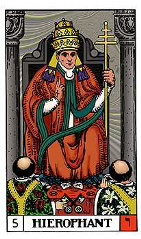
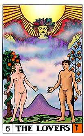
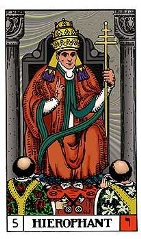
The emanations from Gevurah, which is on the pillar of Severity and Fear, are represented in the Tarot by The Hierophant #5 whose contrary is either The Devil #15 or The Tower #16. This is a crucial point in the Tarot and in the Sefer Yetzirah’s Tree of Life as 15 and 16 are at the very centre of the 32 paths. They occur at that point in the Tree of Life where there is a fork at Tiferet, one branch going East and one branch going West. At this point, a decision for the individual must be made (as is represented in The Lovers #6 card.) This branching of the Logos is indicative of the way West as the principle of reason as a principle of being on the Tree of Life. The branch East on the other hand indicates reflective thought, contemplation and prayer, the thinking that is moved by Love. The movement on the left branch or trunk is power and will to power, involving the language of public discourse (rhetoric) and technology as a way of being in the world. The movement on the right branch or trunk is self-nullification, the rejection of power (even though one possesses its potentiality and possibility), the dialogue among two or three friends (dialectic) and the sophrosyne and phronesis that is moral, ethical action.
The views and the seeing of The Hierophant #5 are to be contrasted with those of The Lovers #6 and can, in fact, be mistaken for The Lovers. The logos of The Hierophant is represented by Peh and it is the form of language that we call rhetoric, while the logos of The Lovers is represented by Zayin and Heh and these are what is known as the language of dialectic, the conversation between two or three friends. Below is an illustration of what is being said here:
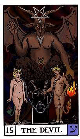
The Hierophant #5 revolves to The Devil #15 i.e. the speech of rhetoric Peh becomes the way of seeing of the eye of Eyin ע through the hearing, the letters Reish ר and Tav ת corresponding to the right and left ear respectively.
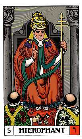
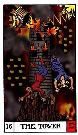
The Hierophant #5 can also revolve to The Tower #16. In the Tarot illustrated here, The Hierophant is signified by the letter Vav ו, while The Tower is signified by the letter Peh פ. The Tower is the Tower of Babel and represents an attempt to build a way to heaven through human will. #16 represents the middle point in the Thirty-two Paths of Wisdom and it is at this point that the Tree of Life branches off in different directions. These different directions are shown in the card by the 12 Yods on one side of the Tower and the 10 Sephirot on the other. I would allot #15 to The Tower.
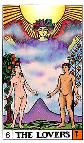

The Devil card has been allotted #15 in most Tarot decks. The letter Ayin ע or ‘eye’ has been assigned to it. The Lovers #6 has the letter Zayin ז meaning ‘manacle’ assigned to it. This seems to be an error. There are real manacles in The Devil card while there may be ‘bonds’ in The Lovers card. There are three figures in The Hierophant as well as in The Devil card. 10 + 5 = 15. There are two figures in The Tower card. One can be manacled by the Beast, the anti-Logos, or one can be bonded together or yoked together by the Daemon Michael (or Metatron). The torch of the Beast is about to ignite the tail of the male in The Devil card.
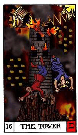
The Tower #16 is the card of revolution. The crown of The Tower of social prestige is blasted by the lightning bolt that is beyond the Sephirot shown in the right side of the card. I would reverse The Tower and The Devil cards in the Tarot deck in order to reflect their essential differences from each other.
The succumbing to the Great Beast is the succumbing to the three temptations of Christ: the material temptation of turning stones to bread (i.e. opposing the will of God and not recognizing the limits imposed by Necessity); the social temptation of power over the kingdoms of the world (desiring or possessing the power of “social recognition” or social prestige, the temptation of the collective); the individual temptation, suicide (the temptation of God by denying the will of God and the defying of the Law of Necessity). In the Tarot, the symbolism of The Devil mirrors that of The Lovers but is contrary to that of The Lovers: the manacles of The Devil are the Tree of Life and the Tree of Knowledge in The Lovers. The manacles are attached to the cube of the physical world; no such cube exists in The Lovers card. The Devil represents a false or ersatz form of unity to which one becomes bound and loses one’s freedom and one’s individuality. This is why I would assign #16 to The Devil and #15 to The Tower. The Tower is the lightning bolt of Zeus, or of God, and is the nemesis for the worship of false gods or the worship of power and social prestige. In the ascending direction, the worship of The Devil leads to The Tower; in the descending direction, The Tower leads to that revolution or expansion which simply replaces itself with The Devil.
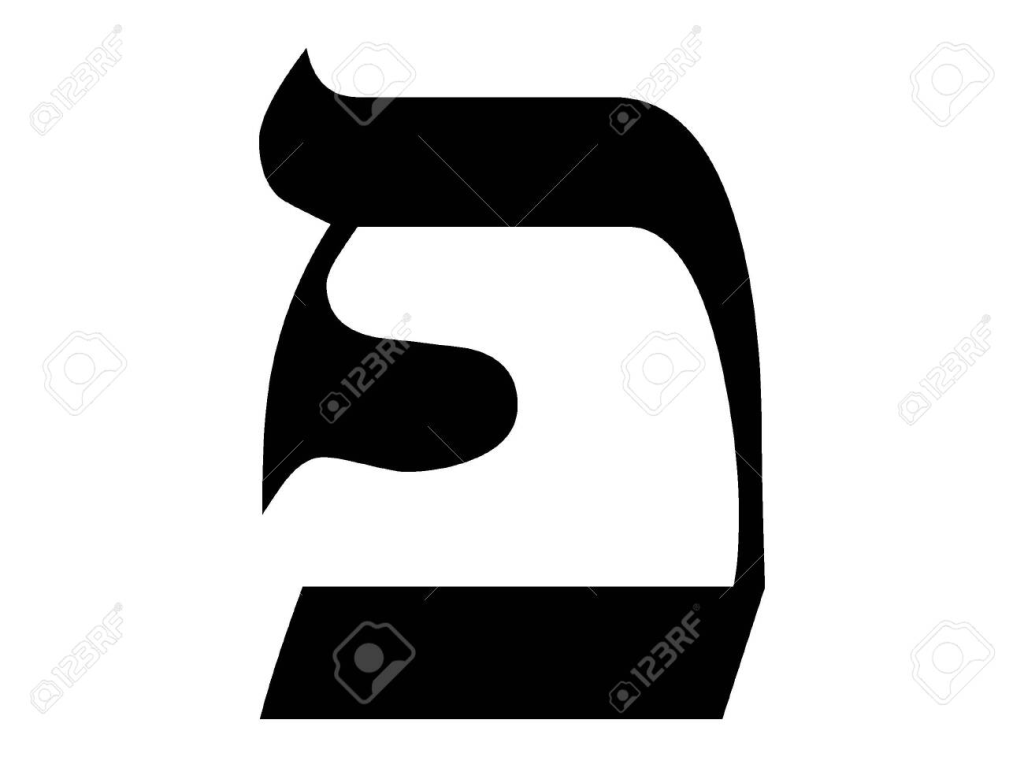
The Hebrew letter Peh means “mouth” and refers to the power of speech, but also to the taking possession of something and consuming it. In the collective, the social, the individual is “possessed” and “consumed”. I have associated the letter Peh with The Unity Directing Intelligence. In Kabbalah, speech as the Logos is a spiritual power, which can cause good or evil depending on how it is used. “A truth that’s told with bad intent/ Beats all the lies you can invent”, as the poet William Blake told us in his “Auguries of Innocence”.
What one thinks determines how one is in one’s being-in-the-world, and what one speaks has the power to become completed in action, just as the magic word “abracadabra” has the power “to create while I speak”. All speech is, in essence, the power of this “abracadabra”. Violent words and images lead to violent actions. The ethical is grounded in one’s way of being-in-the-world; the ethical is not the ‘values’ which are self-created and socially created, but is the presence of the grace which is the divine blessing which determines individual actions. One sees concrete examples of this on a daily basis in the humblest of human beings.
The quality of speech is the quality of the life’s essence and creative existence. This is why the care and concern for proper speech is so important to the being and well-being of human beings and why the destruction of speech through modern technology is so concerning with regard to our humanity as humane beings. The Peh teaches us to view our words as that which preserves our essence as human beings. Not giving speech care and concern causes us to become more bestial.
The shape of the Peh is a Khof with a Yod inside of it. More discussion of these two letters will be given below. The shape represents the spiritual spark of the Neshama soul, contained inside the physical body. With words and silence, we can communicate the essence of our soul and existence. This requires that the inner and outer life match – that the physical existence is fully aligned manifesting the spiritual intentions of the soul within it. As it says in the Talmud Baba Metsiah “Don’t say one thing with the mouth and another with the heart.” The Yod is also the Nekudah Sheba Lev, the point in the heart where spiritual awakening begins. Our attempts at the alignment of the physical with the spiritual level is the strife or polemos which is the essence of life.
The power of the Peh is a double-edged sword. As it says in Proverbs 18:21 “Life and death are in the hands of the tongue.” Because of this, the Peh represents the requirement to govern one’s own nature. Routine speech, speech to manipulate, all the distortions of speech must give way to viewing speech as a miracle. Then, speech can be used for its true purpose – to speak one’s destiny and to activate the spirit through one’s thoughts and speech.
Peh is similar to the letter Kaf כ in shape (it is a container letter) , but Peh contains a “tooth”; the letter Shin means ‘tooth’. In appearance, it bears some similarities to the letter Shin, although sideways. It is for these reasons that I have placed Peh above Kaf on the Tree of Life as both are double letters and thus vertical lines.
In Kabbalah speech, the logos, is a spiritual power, which can cause good or evil depending on whether it is used falsely or truly. Our being is determined by what one thinks and how one thinks, and these in turn determine our actions, what our character is and how one is. Since it is in the nature of human beings to reveal truth, what one speaks has the power to become reality. Lies become realities through false speech. Violent words lead to violent actions. When our speech is not used to reveal truth, we become more inhumane, bestial, violent, and insane. As Socrates said: “The opposite of knowledge is not ignorance but madness.” Madness is the stupidity of the social, the mob, the party, the clan. The quality of the speech determines the quality of the life’s essence and creative existence. This is why speech and language are so important and so dangerous, particularly in the West at this point in its history.
The shape of the Peh is a Khaf with a Yod inside of it or, as suggested above, a Khaf with a Shin inside it. The Shin represents the spiritual spark or the emotional, passionate fire of the soul, contained inside the physical body which is the Yod of our own being. Passionate speech deals with rhetoric; the speech before crowds and assemblies. With words and silence, we can communicate the essence of our soul and existence. This requires that the inner and outer life match – that the physical existence is fully aligned manifesting the spiritual intentions of the soul within it. Socrates’ prayer to Pan at the end of the dialogue Phaedrus expresses this: “Dear Pan, and all you other gods that dwell in this place, grant that I may become beautiful within, and that such outward things as I have may not war against the spirit within me. May I count him rich who is wise, and as for gold, may I possess only so much of it as a temperate man might bear and carry with him.” This is similar to what it says in the Talmud Baba Metsiah “Don’t say one thing with the mouth and another with the heart.” The Yod is the point in the heart where spiritual awakening begins. However, the alignment of the physical with the spiritual is no easy task as even someone such as Socrates needs to pray for a balance between them.
The letter Vav and the 17th Path: Intelligence of the Senses
The Seventeenth Path is the Disposing Intelligence, which provides Faith to the Righteous, and they are clothed with the Holy Spirit by it, and it is called the Foundation of Excellence in the state of higher things.
Alt. Trans. “The seventeenth path is called the consciousness of disposition. It provides faith to the compassionate (Khasidim) and clothes them with the Holy Spirit (Ruach Elohim). Within the Supernals, it is called the foundation of beauty (Tiphareth).”
Wescott trans. The Seventeenth Path is the Disposing Intelligence, which provides Faith to the Righteous, and they are clothed with the Holy Spirit by it, and it is called the Foundation of Excellence in the state of higher things.
Case trans. ·The seventeenth path (Zayin, joining Binah to Tiphareth) is called the Intelligence of Sensation (or, the Disposing Intelligence), and it establishes the faith of the compassionate, clothes them with the Holy Life-Breath, and is called the Foundation of Tiphareth in the plane of the Supernals.
Genesis 1.17 And Elohim set them in the firmament of the heaven to give light upon the earth, 18 and to rule over the day and over the night, and to divide the light from the darkness; and Elohim saw that it was good.
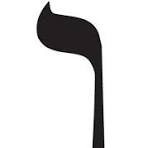
The Seventeenth Path is the awareness of or knowledge of Beauty or the knowledge of the senses, and I would relate this path to the letter Vav , the letter that makes conjunctions, connections, and relations for it is through seeing, through the senses, that we apprehend the world about us. It is the Kabbalistic indication of the statement of Simone Weil: “Faith is the experience that the intelligence is illuminated by Love.”
“Experience” is that knowledge which comes to us from our senses. When illuminated or lit by the fire of Love, this knowledge becomes ‘fire catching fire’ with the result that “faith” is produced (The Sanctified Intelligence #3). Through the viewing of the world through Love, care and compassion for the things that are begins. In such knowledge, one is “clothed” by the Holy Spirit or “holy breath”, Grace, and becomes loving and compassionate. This is true ‘inspiration’. This is why it is a “dispositional knowledge”. It is a knowledge governing our emotional dispositions as well as our mental and spiritual dispositions.
The knowledge produced by the senses does not give us an answer to the question “why”. The opposite of ALP (Alef) or “intelligence”/”knowledge” is PLA (“wonder”) and it is from “wonder” that “philosophy” begins. It is a knowledge that is “useless”, whereas the knowledge that comes about from “know how” i.e., reason and the will, is knowledge that is put to use to meet the ends that human beings devise.
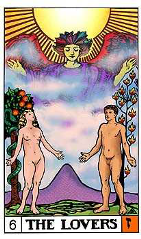
Some commentaries say that to achieve such knowledge, one must be guided by The Hierophant; but it is clear that the true guide is the Mediator in the form of Eros or Jesus Christ i.e., Love. The Lovers card #6, has the mediator between the couple as the angel Raphael, (some commentaries say Metatron or Michael, and this would coincide with the ‘strife’ that is present at this point along the journey). The Lovers card implies a choice; and in this case, it is one between the head and the heart. The Fool #0, The Lovers #6, and Judgement #20 are all cards that imply choices and have a relation to the crossover paths of the Tree of Life.
The Hierophant is the representative of the ‘historical knowledge’, the ‘opinion’ or doxa that has been produced through reason and will to power and becomes the knowledge that is shared by those who dwell in the society which produces such knowledge. It is the knowledge that casts the shadows on the walls of the Cave that is Nature. It relates to piety and to what those in that society bow down to or look up to. Language creates the ‘worlds’ in which human beings dwell for it is what gives meaning to the things within those worlds. The Logos dwells in the human heart which is the ‘house of being’ of the individual, and from this dwelling a home may be built both within a world and among each of the inhabitants who come to share in the ‘making’ of that world. Relations and connections can be made.
17 And Elohim set them in the firmament of the heaven to give light upon the earth;
In the passage from Genesis, we see for the only time that it is Elohim that “sets them” i.e., the sun and the moon, in the heavens to divide the darkness from the light. The Moon is associated with darkness (Chakmah, The High Priestess #2); the Sun is associated with the light (Tiferet, The Lovers #6). It is through the Holy Spirit (the Holy-Breath, Shin/Alef) that it is possible for the individual to experience direct contact with the Divine. This contact is called Grace. It is grace that allows the individual to rise up to the realm that is beyond the law and justice that is Necessity. Once again, the action of Elohim, the setting of the light that is the Sun and Moon, which is mirrored by human beings in their choices regarding the viewing of their worlds, for it is the light and the truth that is revealed by the reflected light of the moon or the direct light of the sun that will determine, “set”, what will be meaningful and how it will be meaningful for human beings in their worlds.
In the Scholastic philosophy of The Middle Ages, it was the concept of “intuition” which included the “consciousness” of and “intelligence” of something. This “intuition” was the parousia of God, the having God present, and this was considered the highest form of human being, that human excellence that was defined as ‘virtue’. The “intuitional disposition” no longer looks beyond itself to be fulfilled (this is indicated in the Strength card #11 of the Tarot). The contrary of this experience is the Absolute Knowledge of Hegel and Marxists.
The Beauty of the World is the covenant of God. It is always present (NOW) and given to all human beings at all times. In most commentaries on the Sefer Yetzirah, it descends through Binah from Chalkmah and Keter. This is the zigzag shape, or rather the gyring shape as I suggest here, of the paths and their ascent or descent on the Tree of Life.
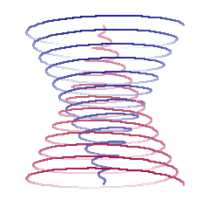
The Holy Spirit (Logos) combines the elements of water, air, and fire as is shown in the various depictions and symbols associated with it. This would suggest that the pattern of descent is Keter through Chakmah, through Binah to Tiferet, through Netzach, to Hod, then Yesod, through to Malkhut. The pattern of the ascent would be Malkhut to Yesod, to Hod then Netzach, through Tiferet to Gevurah, to Chesed to Binah, from Binah to Chokmah, and finally to Keter. I would suggest that the initial descent is from Keter to Tiferet, for Chakmah or Space and Binah or Time are, were, and will be always present in the Creation of the Other from out of the One. For this reason, I do not ascribe paths to the original three Mothers of the primordial triangle.
The manner of our dispositions towards the world determines how we view the world and how we will act within it. Our dispositions change according to which of our many worlds we happen to be engaged in and they colour our worlds like the tones of a musical key: we may view the world in A minor or C major, for instance. We are happy in the world of our hobbies, for instance, while we are not so when we are engaged in the world of our duties on occasion.
The descent to Tiferet is not through Gevurah (as is said in some commentaries) but is directly from the primal Trinity of Keter, Chokmah or “wisdom”, and Binah or “understanding”. Genesis 1:17 relates to the establishment of Time: the solar and lunar calendars and of the “light” that separates from the darkness i.e., what we call history. History establishes Gevurah from which it gets its power and legitimacy; but this power and legitimacy or legality are effects of the Law of Necessity: the things bounded and limited by Time and Space. Space is prior to Time. With Time comes creation and human beings. “And Elohim set them in the firmament of heaven to give light upon the earth”.
Tiferet has the ‘breath of Elohim’: the Way, the Truth, and the Life: “No one comes to the Father except through me.” For Christians, Christ is the mediator between heaven and earth, mortals and gods (Daimons). The Ruach Elohim (the Holy Spirit) cannot descend from Gevurah or through Gevurah. It is the fire and air from Keter that is the pure logos. Gevurah is the “borrowed logos”, the “borrowed” word that is the text set in stone. This is why I have associated the path from Binah to Gevurah with the letter Peh פ.
“Willing” is the product of rational human beings (Shin is associated with the ‘head’). It is associated with some thing and directed towards some thing that we do not yet possess and that is ‘not yet’. Falsehood is understood as “pseudos”: the statements that are false in their synthetic structure of the things, their predicates (the imposition of limits from Binah). Truth is the ‘uncovering” or “unveiling” of the things that are. Falsehood is the covering up of things that are not. The narratives constructed by most modern societies are those created out of ‘falsehood’ and are necessary in order to cover up the truth by bringing to presence things that are not, the ‘shadows’.
Vav: Path 17. Intelligence of the Senses (Consciousness) (Sekhel HaHergesh): This is prepared for the Faithful saints so that they may be able to clothe themselves in the spirit of holiness. In the arrangement of the supernal entities, it is called the Foundation of Beauty (Yesod HaTiferet).
The meaning of the letter Vav is a paradoxical one in Hebrew. Vav is the power to unite everything that is separated in creation, and as the 6th letter of the Hebrew alphabet it is sometimes associated with Tiferet. But this power to unite is associated with the human will. In the letter Alef, it is the Vav which separates the Divine Yod from the individual yod. We have written earlier about the thinking that is dianoic thought from the Greek i.e., that thinking that takes the leaves, branches, trunk, roots of a tree and combines them into the one that is called “a tree”. Dianoia is the thinking of reason and it is based on the principle of reason. It is the thinking that controls the understanding of path ‘#13, The Unity Directing Principle, the path going from Binah to Gevurah.
Literally, Vav means “hook” or “peg” and the Hebrew letter is a vertical line ו. It represents the Kav, the vertical line extension of the barrier that separates the Creator’s perfection from the created world and its imperfection (remembering that the word ‘perfection’ here is understood as ‘completeness’). The Vav is the Law of Necessity which constantly directs the world, placing the limits upon the cycle of existence until the perfect Oneness of the Creator, which underlies all of creation, is revealed to those few who have been chosen to have it revealed to them.
Vav would thus relate to Shin as the purifying fire; this is an analogy to the very real world of human affliction and suffering. Vav is related to the Orr Yashar, the direct light of the Creator, entering the world and it receives this influence from Tiferet. This would relate it to Christ who is the direct light of the Divine and would thus associate Vav with Tiferet, the sixth Sephirot and the Beauty of the World. This is what is meant by its being “the essence of the Glory”. The bringing of things into “completion” as particulars so that they may be named is the essence of The Unity Directing Intelligence Path 13. It should be emphasized here that these are to be seen as social phenomenon.
As a connector, Vav contains the mediatory power to connect the will and the earth through the senses. This mediatory power is the contrary of that mediatory power that is present in Tiferet. As the Law of Necessity, the Vav can be considered a channel or canal, which connects the human will to the will to power that is the life-force that bestows all the energy of created things to the dispositions of human beings. It represents the ladder of Jacob Yaakov – rooted in earth, with its head in the heavens, what is known as Jacob’s Ladder, but the gyring motion considered here is an “expansion” i.e., the individual’s expansion of their will to power, their ‘empowerment’, and this puts the ladder on somewhat shaky foundations.
The Vav is the extension of the essential dot Yod י from which all of creation comes forth and which is contained in Alef, but it is the contrary and deprivation of Heh which emanates from Tiferet to Chakmah. The Vav is the crucial choice that is present in the Sephirot Tiferet regarding how we distinguish the Necessary from the Good. Whereas the Heh teaches us the private esoteric path to the Divine, the Vav indicates the public path that can be found in the worship of the collective, the social, what Plato called the Great Beast.
Vav represents the number 6 and represents the six days of the creation of the world, as well as the six physical dimensions (right left, front and back, up and down) of Space. The first day of creation is related to Chesed and is attributed to “kindness”. God’s withdrawal allows creation to be. The Light of God is two-fold: one Light is beyond Being (the Good) and then there is the light within creation itself from the sun, moon, and heavens. Creation begins at the number 4.
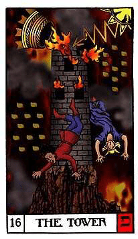
The second day of creation has the attributes of “severity”, “contraction”, and “judgement” associated with it. It relates to the Sephirot of Binah and Gevurah. The deprivation and need of the original creation is experienced here and its significance is the separation of the waters. It is associated with the Flood and with The Tower of Babel, The Tower #15 (as I would assign this number to The Tower).
The third day of creation is associated with Tiferet and is associated with beauty, mercy and the balance between the positive and negative elements of creation.
The fourth day of creation is associated with Netzach, with splendour and the victory that comes from endurance. It is also associated with the creation of the sun and moon.
The fifth day of creation is associated with Hod and has the attribute of acknowledgement but also of devastation.
The sixth day of creation is associated with Yesod and with the creation of human beings. It is associated with Adam whose name contains the letters Alef, Dalet and Mem. Adam is the human being who is perfect in his thought, speech and action i.e., he is the “complete” human being.

The Vav is also said to be representative of the male phallus, the fertilizing agent, bringing life, abundance, continuity, and addition and represents the extension beyond Tiferet to Yesod in the downward movement of the Tree of Life. The letter Vav in Hebrew serves as both a conjunction and a verb modifier from present, past and future tenses. It is thus associated with Time. Time is associated with Saturn, and Saturn is associated with The Devil #16 (as I would associate this number with this card) of the Tarot.
In the Book of Revelations of St. John, the number of the Beast is 666. I would attribute the giving of this number to the 6 in the realm of Asiyah. The Great Beast occurs in Bk. 6 of Plato’s Republic and is identified as the social, the collective wherein power is given to those who are able to predict the shadows that will appear upon the wall of the Cave. This is today’s modern science. The realm of the social is subjected to the same laws that operate in the Law of Necessity, and the power relations operating therein can be understood as analogous to gravity.
In contrast to the path of Heh which has the senses connected to the human heart, the path of Vav is connected to or through the human will, the human eye, and the human head. Through its connection with Binah, it establishes the human understanding of the things of this world. Because of this, the power of the sephirot Binah or Understanding is more predominant in the path of Vav than that of Chokmah or Wisdom.
Because Chesed receives the mercy and kindness that comes from its relation to Tiferet, the severity of the emanations deriving from Binah are not tempered or brought into balance by Tiferet’s effect on Binah. The shaping of the viewing from which the knowledge and understanding is experienced through the Vav is thus deprived of the direct light that comes from Tiferet and it is thus a reflected light. This reflected light is primarily determined by Memory and is the historical knowledge established through Time. This is the crossing over of the path of Vav with the path of Chet which has been discussed above.
It is said by some commentators that Vav is related to the Orr Yashar, the direct light of the Creator, entering the world, but if it is directly connected from Chokmah to Gevurah, this light would be a borrowed light, a shadow of the true Light. If these commentaries are correct, the Vav would be related to Christ who is the direct light of the Divine and would thus associate Vav with Tiferet, the sixth Sephirot and the Beauty of the World. The peg or hook would be the Cross of Christ. The whole of Necessity is the Cross of Christ and this Cross is the Divine Will. It is the Creation itself. The human body is this cross in microcosm.
As the connector or conjunction, Vav contains the mediatory power to connect the spirit and the earth, spirit here understood as Will as that which is behind the Senses. It can be considered a channel or canal, which connects and bestows all the energy or life-force, the Will to Power, of the shefa שפע the abundance from below up to the created beings and things. It could be said to represent that theoretical knowledge which historically came to dominate the understanding of the world, what is called metaphysics. It is rooted in the realm of Beriyah, and from this informs the formation of things in the world of Yetzirah.
The Letter Tet and the 15th Path: The Constituting Intelligence
15. Stabilizing Intelligence (Consciousness) (Sekhel Ma’amid): It is called this because it stabilizes the essence of creation in the “Glooms of Purity”. The masters of the theory said this is ‘the Gloom at Sinai’. This is the meaning of “Gloom is its cocoon”. (Job 35.9)
The Fifteenth Path is the Constituting Intelligence, so called because it constitutes the substance of creation in pure darkness, and men have spoken of these contemplations; it is that darkness spoken of in scripture, Job xxxviii. 9, “and thick darkness a swaddling band for it.”
Alt. Trans. ” The fifteenth path is called the constituting consciousness because it constitutes the essence of creation in pure darkness. According to masters of contemplation, this is that darkness referred to in scripture: ‘and thick darkness its swaddling band.'”
Wescott trans. The Fifteenth Path is the Constituting Intelligence, so called because it constitutes the substance of creation in pure darkness, and men have spoken of these contemplations; it is that darkness spoken of in Scripture, Job xxxviii. 9, “and thick darkness a swaddling band for it.”
Case trans. The fifteenth path (Heh joining Chokmah to Tiphareth) is called the Constituting Intelligence, and is so called because it constitutes creative force (or. the essence of creation) in pure darkness. According to masters of contemplation this is that darkness mentioned in Scripture: “Thick darkness a swaddling-band for it.”
Genesis 1:14-15 — “And Elohim said: ‘Let there be lights in the firmament of the heaven to divide the day from the night; and let them be for signs, and for seasons, and for days and years; and let them be for lights in the firmament of heaven to give light upon the earth.’ And it was so.”

If path #4, The Settled Intelligence, is called this “because all the spiritual powers emanate from it as the (most) ethereal of emanations. One emanates from the Other by the power of the Original Emanator, may He be Blessed”, then the 15th path as the Constituting or Stable Intelligence is the knowledge or awareness of that from which the spiritual powers emanate. The 15th path refers to the substance or the physical material of the Creation, and this material substance comes forth from the darkness of the waters of Chokmah. It provides the balance, the yin and yang of the duality of the nature of Creation.
The Fifteenth Path is the path of the knowledge and intelligence of the substances of things, their essences as to what we think they are when a name has been assigned to them. It is that knowledge of the things that are concealed beneath the outward appearances of those things. On the other hand, this path could also be the error of that which passes for knowledge in the world in which we live in. It would then be the knowledge of the shadows or shades or that which passes for knowledge in the world of those committed to the empirical knowledge of things only, those committed to the world of “facts”. The ‘stability’ of this knowledge is subject to instability.
This knowledge is the product of the “reflected light” of Malkhut; it is not knowledge of the true light of Keter which descends to Tiferet through the letter Alef (although some commentators attribute this to the letter Beth which is one of the ‘doubles’ and so would imply two ways of viewing such a path). As such, this knowledge when it is associated with The Moon and The High Priestess of the Tarot, is not “true knowledge” of things. It is “opinion” regarding the nature of things. To try to make this clearer: with the withdrawal of God to allow His creation to be and the subsequent descent from the One to the Ten, there is the simultaneous creation of the movement upward from Malkhut to Keter. These movements are symbolically shown in the representations of the Sun and the Moon. The Sun is the original light while the Moon is a ‘reflected light’ from the light received from the Sun. The movement downward is the widening gyre of the paths; the movement upwards is the narrowing or focusing of the paths in the direction of the One.
It is through our thinking that we bring things to a “stand” by giving them boundaries and horizons and then by naming or defining them, making them specific. In the placement of boundaries and the naming, the thing comes to be what it is for us. But this is merely the shadow of the thing. The thing is able to be brought to a stand because there is the light that is the “reflected light” of Malkhut. The thing is able to stand in its permanence before us but its true essence remains hidden from us because it is “veiled”. It is the sides of the cube which we are unable to see.
The Fifteenth path is ascribed to the letter Heh by Case in the W.T., although this may be questionable as the letter Heh is the first “elemental” or singular letter, and it would appear that a double or one of the three Mothers is required here (perhaps Shin or Mem).I have assigned the letter Tet to this path, from Binah to Chesed, since the path crosses over the path from Keter to Tiferet but has no interaction with it i.e., it has no interaction with the Sun nor with the qualities that emanate from Tiferet. (Does the crossing over of paths indicate choices that have to be made or choices that have been made?)
In the Hebrew Tree, the 15th path is ascribed to the Sefirot Tiferet, and this could be possible if the Tiferet were not the Logos. In the Western Tree of Case, this path is the linking of Chesed to Gevurah in the Sephirot and between The Emperor #4, The High Priestess #2, and The Hierophant #5 cards in the Tarot. The High Priestess is not a “true” mediator in the Tree of Life, and so she is not able to bring into a relation The Emperor, a symbol of the phallic power of Nature, with the power of convention that is The Hierophant. The attribute of Loving Kindness which is ascribed to the Sephirot Chesed is not made possible by Chakmah, but rather Tiferet. Chakmah is the ‘cold, sterile Mother’. The linking, however, of The Emperor #4, The High Priestess #2, and The Hierophant #5 would indicate that which is taken for knowledge in the societies in which we live.
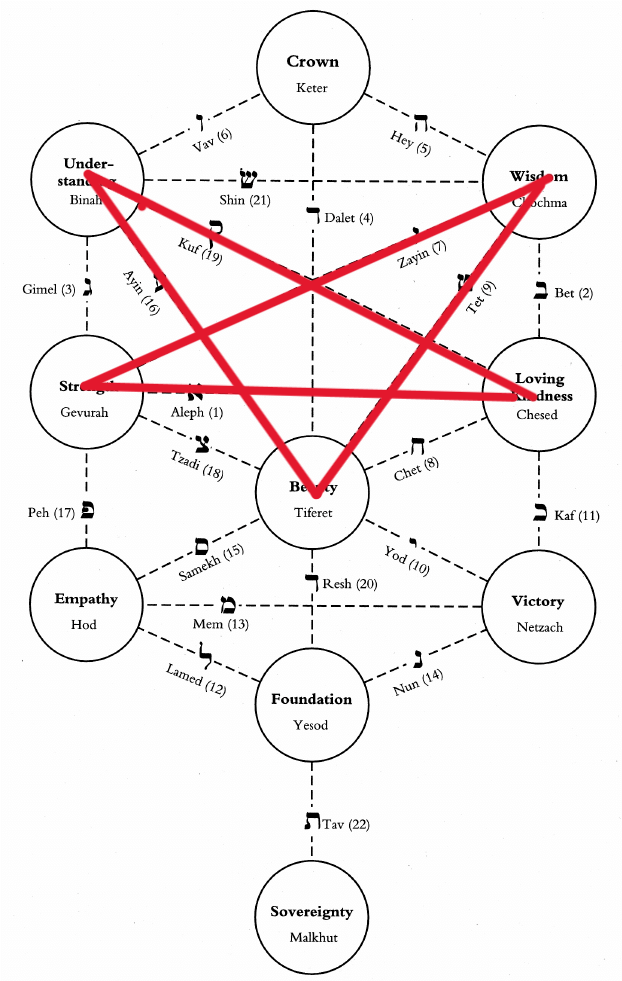
These two powers of Chesed and Gevurah are incommensurables, and are therefore placed on opposite sides of the Tree of Life. They are what are traditionally referred to as Nature and Convention. The true mediator between them would be Tiferet from the Hebrew Tree but such is not the case. What joins them is in fact the movements of the paths of what crowns The Devil #16 in the Tarot as is illustrated on the left.
The three paths proceeding from the Sephirot Chakmah are all masculine and this may indicate why the worldviews derived from this seeing or viewing of the world are all phallo-centric. Chakmah is the khôra of Plato, the receptable into which are cast the “seeds” or the Forms that will become, through the demiourgos, the Logos, the created things of the world. We moderns might refer to the Forms as the Archetypes that will give to the created things their “form” or outward appearance. (It appears to me that the attributes that Case gives to The Emperor card are actually those that belong to the Strength card. It is she who, like Hamlet’s Horatio, is able “to suffer Fortune’s buffets and rewards with equal thanks”. The Emperor is more suitable to the corporate organization that suffers the stock market’s buffets and rewards with due concern for its bottom line.)
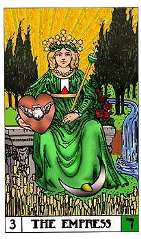
Teth, the 9th Hebrew letter has a literal meaning of “basket” or “nest” and is the symbol of those goods טוב in creation that we sometimes mistake for the Good itself. It is also connected to the womb wherein the human being gestates for nine months so it is a “container” letter and is connected to the other container letters of the Hebrew alphabet. It is connected to the Womb of the World and so it is appropriately linked to Binah and to The Empress #3.
Tet has to do with purity and impurity, and is the teaching of how to distinguish between the Necessary and the Good, the sacred and the profane. This also relates it to the letter Qof ק. We have to choose the Good over those things that we call goods in our existence and which we consume as we live out our lives in Time. It is also the very difficult realization that even within the bad things that happen, the sufferings that occur out of Necessity, there is a hidden good which is beyond our comprehension.
While all of our knowledge comes from our understanding of the realm of Necessity, the Divine Will itself is inscrutable. To believe that we know what this will is is a great temptation to sin; it is blasphemy. However, the common belief in “the power of positive thinking”, which derives from the exercise of the will and provides many with solace in the face of the suffering of the innocent, is hardly an answer to this great mystery of Life. “The power of positive thinking” works with the imagination and the will and too often involves fantasy and a denial of the real world in which we exist. The real world must be confronted through faith.
Teth also represents femininity, pregnancy and is thus connected to Binah. It includes the kindness and mercy of creation and the principle that everything is eternal and nothing is ever lost. This same principle, that nothing is ever lost, is to be found in the stories and myths from all cultures throughout the world.
Teth’s essence is feminine, representing the number 9 for the 9 months of pregnancy, and is shaped like a womb, a spiral, a container where things change and transform (3 + 3 + 3). It is the “open region”, the field of manifestation of natural things, and is the essence of the feminine that contains all in her i.e., Nature. The infinite is contained in Teth and it brings about the finite.
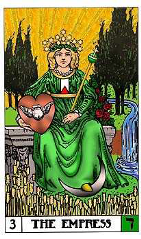
This shows its relation to Binah where the unlimited of Chakmah is given limits through Binah. Truth in Hebrew is אמת (emet), and is spelled alef—the first letter of the alef-beis; mem—the middle letter; and the tav—the last letter. It indicates that the end is in the beginning and the beginning is in the end. This suggests the “completion” implied in both the natural and human making of things. Teth is a bridge between the worlds of Asiyah and Yetzirah, the making that is from out of itself (Nature) and the making that is “in another and for another” that is human making.
The Teth is that knowledge of good and evil that is with human beings from the beginning and is part of their nature. The suffering that is part of our strife in Necessity teaches us to distinguish between the good and the bad, and by choosing the good to clean and purify and thereby to do that which is impossible: to erase the bad deed that was done which was the sin of being born! This is the first step in the process of decreation. (This sin is the choice we make to be born). This illustrates that Tet is on the left side of the Tree of Life and is part of the upward movement that is the spiritual cleansing of the soul through the fires of Shin. Tet contains the principle common in all mythologies of the world that nothing is lost, nothing is wasted, and all is eternal; Death is a part of Life. The Teth is the container that creates the ability of Tikkun – that all souls are born to life with one purpose – to restore themselves to the Good as at the beginning.
Teith, or Tet the 9th Hebrew letter has a literal meaning of basket or nest, and is the symbol of the good טוב in all creation. Strangely, it also has the literal meaning of ‘snake’, and this may represent a sense of the hidden danger that may be present at its core. Tet has to do with purity and impurity, the sacred and profane (the influence of The Sanctifying Intelligence). It crosses the paths of both Beth and Chet within the Tree of Life as it makes its way downwards from Binah to Chesed, and may or may not be influenced by Tiferet in this crossing. Does it suggest that within the ‘appearance’ of being nurturing and caring, there is a hidden evil as this nurturing and caring can be an ersatz or false form of the true care and concern of the Divine. Since it is a ‘container’ letter like the letter Chet, it is an ‘enclosure’ and ‘surrounding’ or ‘womb’. Teith also represents femininity, pregnancy, and it achieves this through impregnating influence of the masculine Alef Beth.
Through the influence of Binah, Tet is the field of manifestation, the essence of the feminine Chakmah that contains all in her. The infinite or the permanent (being) is contained in Teith and it brings about the finite through the manifestation of the particular thing. The human desire for procreation is the desire for the Incarnation. Both Tet and Chet are container letters and, in this case, the ‘container’ is the human body. The contraries to the forces of Tet and Chet are to be found in the letters Nun and Zayin.
The Teith contains the Chesed (kindness and mercy) of creation, but it does so at the third level, and this might suggest that the ‘kindness’ and ‘mercy’ shown may be for manipulative purposes. The distinguishing between the good and the bad that occurs here it at the ‘conventional’ level i.e., it is determined by the societies of which we are a part and is a product of that learning that is historical. The dominant ethical and moral beliefs will be determined by the ideology that has become dominant in the society of the time i.e., capitalist or communist, fascist or libertarian. It is the narrative or the form that the logos has taken that matters.
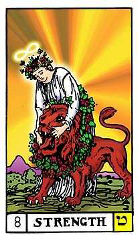
Case links the Nineteenth Path to the letter Tet, ט and says that it is a horizontal link between the pillars of Chesed (Mercy) and Gevurah (Severity). This cannot be the situation since the Sefir Yetzirah assigns these three horizontal paths to the three Mothers: Alef, Mem, Shin; air, water, and fire respectively. Both the three vertical pillars of the Tree of Life (Jakim, Boaz and Beauty) and the three horizontal braces for those pillars (Air, Water, Fire) within the Tree belong to the three Mother letters, what we would call the vowels in English. The influence of the 19th path could be carried by this Mem/Shin/Alef crossover but it would be heavily influenced by Mem. The illustrator of the Tarot used here assigns the letter Tet to Strength following Case’s suggestions. The historical meanings assigned to the letter Tet do not seem to match those features that are characteristic of the Tarot card understanding of Strength.
If the Eighteenth Path of Chet deals with “gravity” or “necessity” and the downward movement of the emanations from the spiritual, then the Nineteenth Path deals with “grace”, the grace that allows for the upward movement. Upward movement is associated with Shin, the element of fire. This is the reason why it might be associated with the Strength #11 of the Tarot, for it is through Grace that she is able to tame the chaos that is the hidden world of the subconscious and the passions that dwell there, the bestial qualities of human being represented by the lion. Modern commentators, influenced by Freud, attribute this control to the “rational” content of the superego, and this is but one ingredient of the cup of poison that Freud bestowed on love and eros. The awareness, intelligence or consciousness of the ‘secret’ of all spiritual activities is that they are illuminated by a Love which is not blind. For Freud, Love is blind since it is a matter of chance.
The ’highest blessing’ is the Love of God disseminated through the Beauty of the world and the awareness of this love is given to us by the grace of God. The Beauty of the world is the mediator that gives this grace. It assures us of God’s covenant with us. It is “love” that is the ‘secret’ of all ‘spiritual activities’. Because it is ‘secret’, it is ‘hidden’ and so must be brought to light.

God, in His withdrawal from His creation, renounces “all power”; He Himself has made Himself subject to the laws that He has created, and we experience His withdrawal as absence or silence. His withdrawal is a metaphor, or the example provided, for the embodied soul that is the human being; we, too, must renounce the temptation to use the power that is potentially available to us. Our most potent example is suicide, the third temptation of Christ, where we have it in our power to tempt God to defy His own Will and to save us as we exercise our will. The Grace of God must traverse the entire expanse of Space and Time in order to be present for us in its true, direct form. Netzach is the terminus of the pillar of Mercy; the renunciation of power is what Mercy is all about. This principle is at the root of all that we call the ‘ethical’.
Desire is the erotic urge to fulfill a need: the urge may lead downwards to Yesod (sexuality) or upwards to Tiferet. Downwards is the illusion and mania of the Moon, while upwards is towards the Sun and the “harmony and friendship”, the “reconciliation” through Love i.e., The Lovers card #6. As Simone Weil said: “If we forgive God for not existing, He will forgive us for existing”.
While The Magician #1 is associated with will and power and the intelligence that manipulates the things ready-to-hand, Strength #11 is associated with the heart and its emotions and passions which she easily controls. She is Prudence and sophrosyne, the balance between mercy and severity, and thus she represents true justice, not the justice of the conventional laws written by human beings. Case goes so far as to say that it is The Hierophant (the emphatic representative of the superego) who teaches Strength how to tame the lion, but this appears not to be the situation. The Hierophant is too involved in the concerns of the physical, material world to be able to teach Strength anything; the Force and Power of The Hierophant is contrary to the force and power that Strength demonstrates. This is why Justice is correctly placed as #8, for in this situation Case would be correct in saying that it is The Hierophant who teaches Justice since it is The Hierophant who writes the Laws. But these laws are not what underlies the power of Strength. (This corresponds to the historical situation of the Church and the Papacy around the time of the revival of the Tarot during the Renaissance. There were plenty of reasons for early Tarotists to see the Papacy as The Devil (the Great Beast) and its future being the revolution of The Tower card which is what, indeed, occurred.)
The language of the Nineteenth Path is that of rhetoric, the written speech of the many (politics) and not the conversational speech of two or three friends that is dialectic. This written speech is represented by the letter Peh. The speech of The Hierophant or Gevurah is rhetoric; the speech of The Lovers is Tiferet, the conversation between friends.
The Self or the Ego is the greatest obstacle to unification with the Divine and this obstacle is represented by both the letters Tet and Chet. The Divine provides the metaphor for the true path for a human being: it is in withdrawal that the Other is allowed to be, and human beings are to mirror this withdrawal in their own selves with the decreation of the Ego and allow the Other and others to be. Needless to say, such withdrawal is not easy nor without suffering. One of the purposes of affliction in human life is the destruction or decreation of the Ego and the purification of the Self. This mystery is beyond most human beings (and it is certainly beyond me!) It can be said to be captured in Shakespeare’s play King Lear.
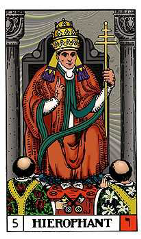
The knowledge of The Hierophant and Gevurah is the knowledge of the collective memory of the community. We are all products of this collective memory, and what we call knowledge and understanding (Binah) is associated with this collective memory both in its contents and methodologies (the influence of Chakmah). Again, it should be stressed that this knowledge pertains to the Law of Necessity, and we are reminded that there is a great chasm separating the Necessary from the Good, in fact nothing less than limits of space and time or the created things themselves.
To experience the grace of God requires that God cross over His creation to grant us this gift. The discoveries of modern science show us just how great this distance is. This knowledge that is the collective memory is what we call “history”. It is this collective memory which drives the will to power of the communities where it is venerated. The relation of such knowledge to “justice” has been discussed previously in this writing.
Genesis 1.6 And Elohim said: ‘Let there be a firmament in the midst of the waters, and let it divide the waters from the waters.’
Genesis 1.21 And Elohim created the great sea-monsters, and every living creature that creepeth, wherewith the waters swarmed, after its kind, and every winged fowl after its kind; and Elohim saw that it was good.
The following chart shows the paths and their connections to the letters and symbols of the Tarot:
| Card | Path | Letter | Meaning | Symbol |
| 3: The Empress | Binah (Understanding) Path 3: The Sanctifying Intelligence: This is the foundation of the Original Wisdom and it is called “Faithful Faith”. Its roots are AMeN. It is the Father of Faith, and from its power faith emerges. | The imposition of limits upon the unlimited through the intervention of the Logos. This imposition is carried out through Shin whereas when the path emanates from Chokmah, the influence is from Mem. | Separate, enclose The thinking which provides limits to the unlimited and so makes particular things discernible. Distinction between the sacred and profane. The roots of faith are acceptance and submission to the will of God i.e., the Law of Necessity. Faith emerges through the power of the intelligence. | |
| Path 14: Illuminating Intelligence (Consciousness) (Sekhel Meir): It is called this because it is the essence of the speaking silence (Chashmal). It gives instructions regarding the mystery of the holy secrets and their structure. | Shin/Alef/Mem מ ש | “Speaking silence” is the beauty of the world which is the image of the absent God. Through the beauty of the world, the covenant of God is realized and from this realization the mystery of the hidden truth is revealed. | “Speaking” is the Word; its silence is that it is not uttered. This crossover path is what gives to Strength her quality of Grace, for it is the light passing through the Time and Space of Creation. It is through Strength (endurance, waiting) that we “hear” the Word of God. | |
| Path 15. Stabilizing Intelligence (Consciousness) (Sekhel Ma’amid): It is called this because it stabilizes the essence of creation in the “Glooms of Purity”. The masters of the theory said this is ‘the Gloom at Sinai’. This is the meaning of “Gloom is its cocoon”. (Job 35.9) | Tet ט | The Law of Necessity stabilizes the substance of Creation in the darkness of its purity. It is this darkness that cannot comprehend the Light. | Does the ‘dark night of the soul’ experienced by the saints and the mystics correspond to the ‘glooms of purity’ experienced prior to the revelation of the Word? Moses receives the Word of God at Sinai. The darkness of the world is the Cross of Christ, the Lamb slain from the foundation of the Earth. The gloom that is experienced as God’s absence, but it is a ‘cocoon’ meaning a period of metamorphosis, just prior to revelation. | |
| 16: The Devil: | Binah (Understanding)/ Tiferet (Beauty) Path 17. Intelligence of the Senses (Consciousness) (Sekhel HaHergesh): This is prepared for the Faithful saints so that they may be able to clothe themselves in the spirit of holiness. In the arrangement of the supernal entities, it is called the Foundation of Beauty (Yesod HaTiferet). | Vav | Hook, Nail, Cane as an instrument of punishment, severity, fear? The wand of the Magician; the Devil’s torch in the card. The cubic shapes upon which The High Priestess, The Emperor, and The Devil sit or stand. | Connections, Secure, (the Social) Vav as that which makes connections without the mediation of Love. (Connection of the Beast as 666 since Vav is of the number 6 and is three levels removed from the Divine) The wand as a symbol of the will; the torch as a symbol of desire? Path is also called Intelligence of Dispositions, how the world will be viewed, the tonality of the viewing of the world (hearing of the Word). Relation to Eros as ‘two-faced’, fullness and need. The manacles binding the individuals are not tight. |
| 5. The Hierophant | Binah (Understanding) Gevurah (Severity) Path 13. Unity Directing Intelligence (Consciousness) (Sekhel Manhig HaAchdut): It is called this because it is the essence of the Glory. It represents the completion of the true essence of the unified spiritual beings. substance from the Cause of Causes. | Peh פ | Mouth, speech. The need to consume. It is the language of rhetoric, the speech that appeals to the emotions, the appetites, the dispositions. | Historical knowledge, distinguished from the private knowledge gained by traversing the Nativot or private paths. The knowledge that comes to be “written in stone”. The knowledge associated with will and will to power as contrary to the knowledge that is gained by dialectic or conversation between friends. An ersatz form of friendship for there is no true mediation to make the two become one or the two or three hundred to become a One. |

 Theory of Knowledge: An Alternative Approach