Plato’s Divided Line: The Two Faces of Thought and Thinking

The Division Between Love (Eros) and Thinking (Logos)

The most popular site on this blog is Plato’s allegory of the Cave. I am somewhat puzzled by this as the Allegory presents many difficulties as far as its understanding is concerned when it comes to relating it to the ethics and morals required by the Core of the Theory of Knowledge course. The Allegory cannot be properly understood without some knowledge of the Divided Line from Bk VI of Republic .(506c – 511e) Also, one requires some knowledge of Plato’s theory of the tripartite soul that he believed is the essence of human beings. For Plato, the human being was the zoon logon echon, the living being that perdures in logos which is language and number. Later, the Latins would identify the essence of human being as the animale rationale, the “rational animal”, the animal the perdures in “reason”. We shall try to come to some understanding of these definitions here and to show some of the consequences of our choosing the Latinate definition of the essence of human beings.

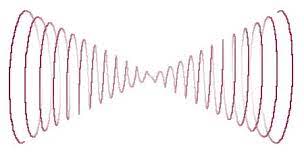
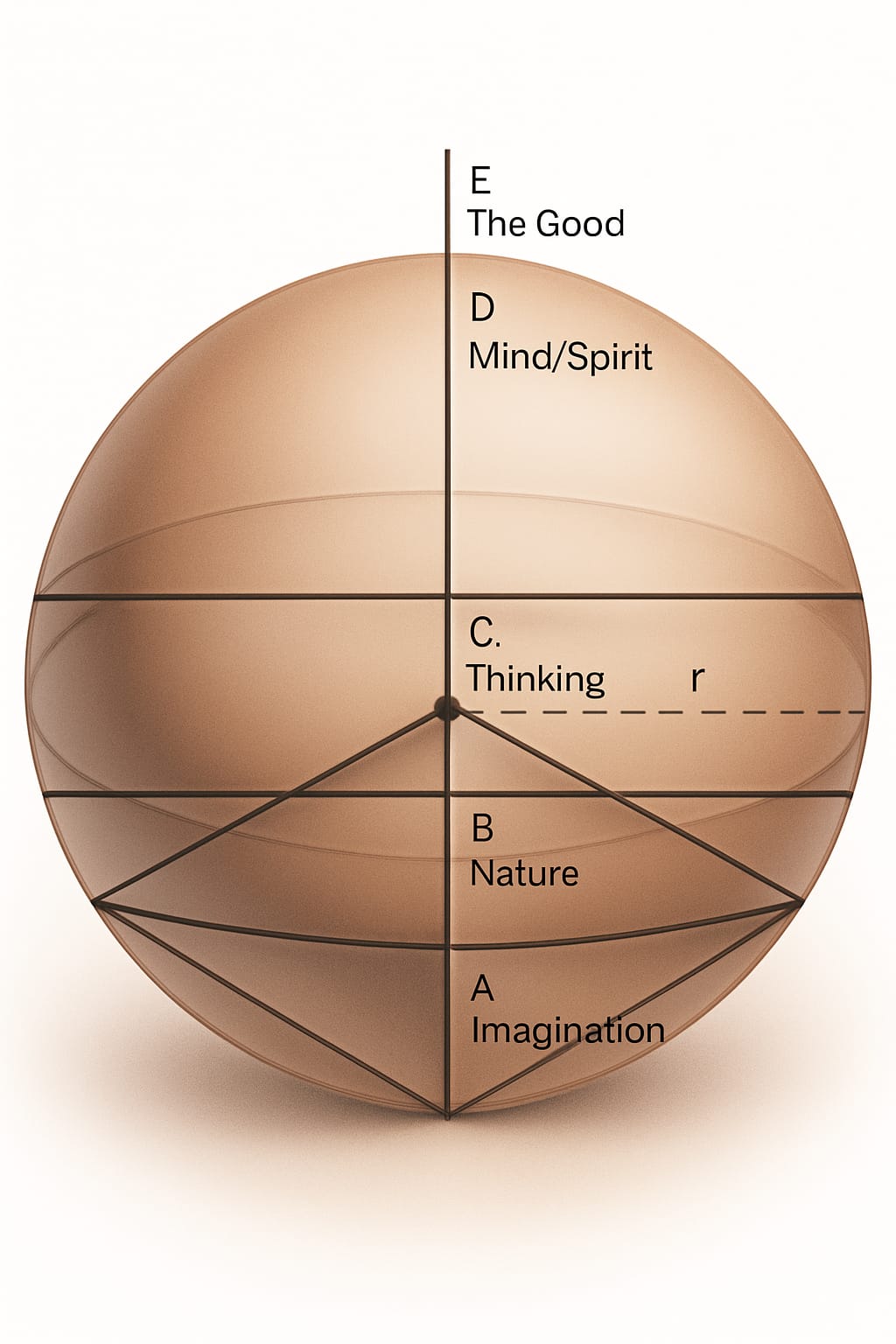
In the illustration above, the human soul’s proper “place” or “site” is at the centre of a sphere that is the being of Time and Space and the created things that are within Time and Space. The sphere itself is constantly in motion. The sphere is what Plato called “the moving image of eternity”, the sempiternal nature of created things.

The realm of “E” is the realm of the Good i.e. the Eternity that encloses or embraces the entirety of the cosmos or creation. The Good begets the Ideas which are in the realm designated by section “D”. The ideas can be approached through the Mind, the Nous, the Spirit, the Intelligence. The Ideas in turn beget the Eidei, the outward appearances of the things that “shine” and which we perceive through the sense of sight because of the “light” that acts as a metaxu or mean between our “eye”, the Sun, and the things that are. This occurs in section “C”. This light, as metaxu, is Eros; the ‘eye’ itself must have a quality that is ‘sun-like’ for there to be a possibility of a commensurable relation between it and the things beyond it.

From this perception occur our axioms and the principles that establish our understanding of the things that are in the world and those beyond it, what the philosopher Kant called the “transcendental imagination”. This perceiving occurs in the “C” section of the Divided Line and establishes our understanding of the things that are. It is the source of our trust, faith and belief in our interpretation of the reality of the things that are that they are as we say and think they are. This we understand as the true. Science, for example, is the theory of the real. “Theory” is a manner or mode of “seeing” and derives from the same root as “theatre”, “the seeing place”. The “theory” is a product or outcome of the “site” or the place from which the seeing is done. Section “C” is equal to section “B” in the Divided Line.

Section “B” is physis or the Cosmos, what we understand as Nature. It is the Cave in Plato’s allegory of the Cave. The Cave is “more real” than the shadows that are “thrown forward” or projected onto the walls of the cave by the artisans and technicians. Even the shadows require light to be produced, but this light is not directly from the Sun. It is a derived or borrowed light (such as that of the Moon, although the light in the cave is due to the fire which has been ignited, presumably, by the artisans and technicians). Fire is a product or derivative of the Sun. In the Cave, there remains a dim presence of the Sun itself but it is ineffectual.

Section “B” = Section “C” in Socrates’ discussion of the Divided Line. It is thought which gives us the things (the techne of the artisans and technicians, “the mind that makes the object” as Kant’s transcendental imagination would have it) and there are no things without thought, whether the thing be natural or artificial or as artefact, as the “work” we produce. The thinking that occurs in Section “C” is that representational thinking that is brought forward or ‘thrown forward’ from Section “A”, the Eikasia or Imagination.

Techne or “know how”, “knowing one’s way about or within something” is but one manner of thinking that the imagination produces. The thinking of the poets is also one manner of thinking that arises from the imagination. Poetic thinking is distinct from the techne of the technicians and still further a different type of thinking than that of the philosophers. This technological thinking of the artisans and technicians occurs on the outer circumference of the sphere, in the realm of the imagination. It is the farthest thinking from that of the philosophers.
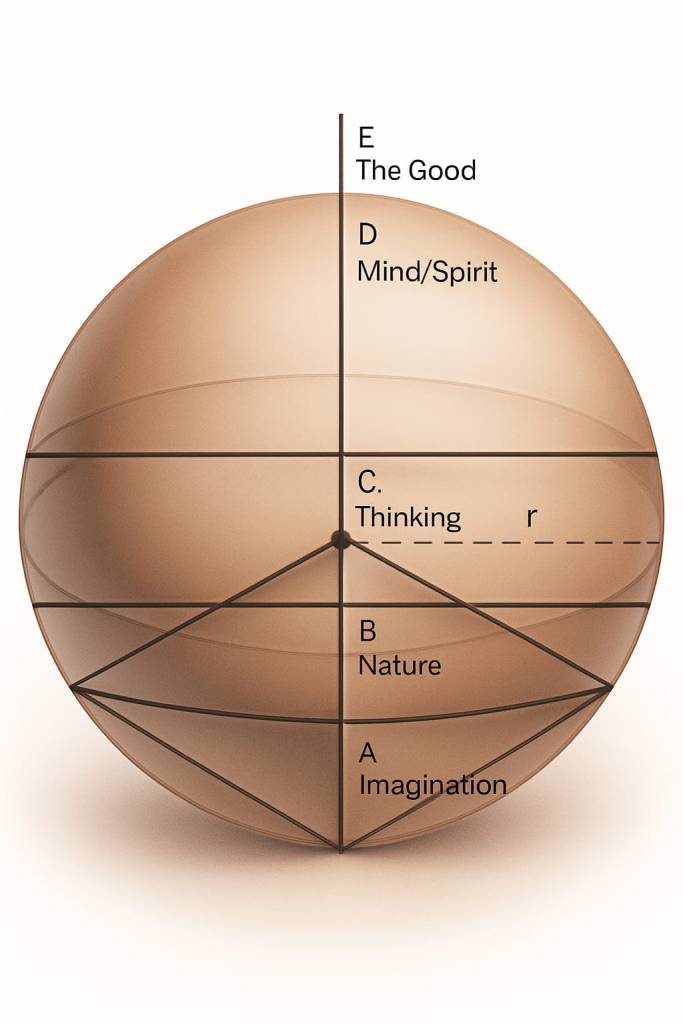
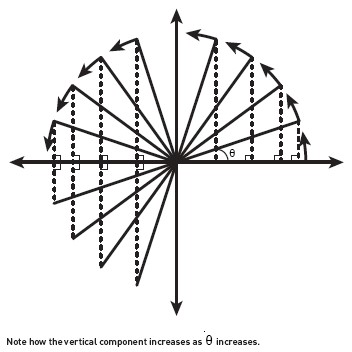
Poetic thinking and techne are the diagonals given in the illustration of the sphere provided here. Both proceed from the “I” in the centre of the sphere which reaches out and “projects” to the circumference of the sphere. The circumference of the sphere is the ‘surface’ phenomenon of things, the deception of their ‘outward’ beauty. It is the thymoeidic part of the soul that is at the root of this projection. The thymoeidic part of the soul deals mostly with will, emotions and feelings, what the Greeks understood as pathos. Our projections are given back to us in the form of a ‘lighted up’ of things. It is eros that does the “lighting up”.

If we look at the statement of Aeschylus that “In war, truth is the first casualty”, we can say that war is evil for all evil requires deception, subterfuge, the hiding from the light. This deception is to be found on the surfaces of phenomenon. That which is thrown forward by the ‘self’ at the centre of the sphere to the circumference through the thymoeides is an ‘irrational number’ in mathematics, what we call pi (the ratio between a circle’s diameter and its circumference), since the two diagonals thrown forward comprise the diameter of the sphere. The movement of the soul outward toward the circumference is a widening gyre from out of the depths of the centre to a shallowness or dispersal of being, or a “shadowiness” of being on the circumference. In this shallowness, the soul is more easily susceptible to the influences of evil and to being led by deception and machination. The soul is furthest away from self-knowledge when it is mired in the outer influences of the sphere.
Jean Paul Sartre

In Preface II to this writing on “The Prince of the Two Faces”, we noted the statement of the French philosopher J. P. Sartre that “Hell is other people” and said that it illustrated the gap between love or eros and intelligence (nous, spirit, mind) as well as “thinking” or “thought” and how these are presented through the logos in the modern age when thinking and thought are understood as “information”. How love and intelligence (nous, spirit, mind) have come to be understood and how they relate to logos and eros is what must be undertaken at this time. Of course, these writings are simply impertinent precis of what are some of the most complex and troubling ideas present in our being-in-the-world today.

Plato’s discussion of the Divided Line occurs in Bk VI of his Republic. In Bk VI, the emphasis is on the relation between the just and the unjust life and the way-of-being that is “philosophy”. Philo-sophia is the love of the whole for it is the love of wisdom which is knowledge of the whole or the aspiration towards knowledge of the whole. The love of the whole and the attempt to gain knowledge of the whole is the call to ‘perfection’, ‘completeness’ that is given to human beings. Since we are part of the whole, we cannot have knowledge of the whole. This conundrum, however, should not deter us from seeking knowledge of the whole and, indeed, this seeking is urged upon us by our erotic nature. It is the urge to be god-like and can lead to tyranny. All human beings are capable of engaging in philosophy, but only a few are capable of becoming philosophers. As human beings, we are the ‘perfect imperfection’. We are ‘perfect’ in our incompleteness.

The whole is the Good (A-E); and that which is is part of the whole so it must, at some point, participate in the Good of which it is a part to some extent. That which we call the ‘good things’ of life such as health, wealth, good reputation, etc. are subject to change and corruption because they are not the Good itself. These are the things that we love. They are wholly in Time. To only love the ‘good things’ is to love the part, and this love of the part channels one off in another direction from that initial erotic urge directed toward the whole or the Good. This is why the ‘good things’ in themselves can become evils and why we can become obsessed with, and succumb to, the urges we feel for their possession. The desire for immortality and the desire for will to power can become hubristic. They can lead to tyranny.

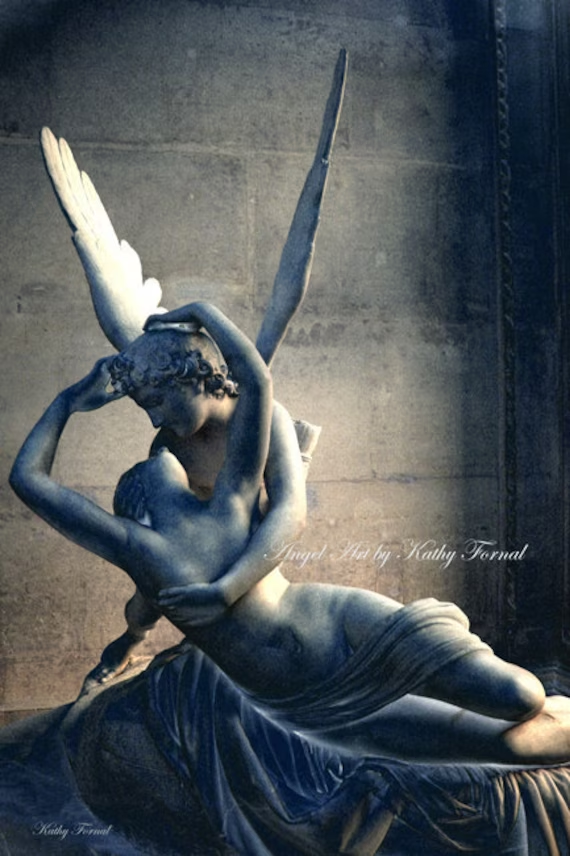
Eros is not the winged cherub or child named Cupid (which is derived from the Romans), nor is it merely the sexual urge which is the modern day focus, thanks primarily through the writings and works of Freud. “Love (eros) is the oldest of all the gods,” says an old Orphic fragment. Another Orphic fragment runs: “Firstly, ancient Khaos’s stern Ananke (Necessity, Inevitability) and Kronos (Chronos, Time) who bred within his boundless coils Aither (Aether, Light) and two-sexed, two-faced, glorious Eros (Phanes), ever born through Nyx’s (Night’s) fathering, whom later men call Phanes, for he was first manifested.” This Orphic fragment is saying the same as the Book of Genesis from the Hebrew Bible: “1 In the beginning God created the heaven and the earth. 2 And the earth was without form, and void; and darkness was upon the face of the deep. And the Spirit of God moved upon the face of the waters. 3 And God said, “Let there be light”: and there was light. 4 And God saw the light, that it was good: and God divided the light from the darkness.” The “light” and Eros are born simultaneously, and this birth is the connection between the Good (God in the Hebrew Bible), the Logos (Intelligence, Mind, Spirit) and Love or Eros between the Intelligence and Love.

Eros is associated with Time; Logos is associated with Space. It is the Logos which grants and gives “form” and “shape” to the void that is prior to Being. Both Time and Space are associated with Ananke Necessity. Ananke is associated with Eros.

Acts of creation are ones that arise out of love, and sometimes that love can be misguided if it is not properly directed by the Logos. Love requires withdrawal and the allowance of things to be if it is to be true. It is an ‘owning’ that is a ‘disowning’ that allows care and concern to grow within its ‘space’, its site. Both Love and the logos allow themselves to be given shapes and forms that are necessarily further from the real truth of the things that are. These shapes Plato calls the shadows.

Plato’s Divided Line from Bk VI of his Republic is a visual representation of the journey of the individual soul that is outlined allegorically in Bk VII of the text in the allegory of the Cave. The Divided Line is the logos as a representation of enumeration or number, while the allegory of the Cave is the logos as mythos or “word” i.e. poetry, and in both cases we are meant to “behold” that which the logos reveals. Both the Divided Line and the Allegory of the Cave are abstractions. The Allegory is intended to be more ‘moving’ emotionally than the speeches outlining the Divided Line. In the Allegory, for instance, there is an emphasis on the physical pain that is involved in the turning toward the Good since we are beings in bodies. There is an emphasis on eros as pathos.

The Divided Line distinguishes between the two faces of the Logos and the two faces of Eros. This distinction is done with regard to how ‘reason’ or the logos (that part of the soul which is called the logistikon by Plato) is to be understood and, subsequently, how eros is to be understood in the concrete details of human living. These details are made even more explicit in the speeches related in the Platonic text Symposium. From these concrete details we can understand the gap that exists between Intelligence and Love in our modern understanding. One face of the Logos is language as rhetoric which is the language that informs the many. Artificial intelligence and its “reason” is rooted in “rhetoric”. The other face of the logos is rooted in dialectic: the “informing” that occurs between two or three individuals that assists the soul on its way to self-knowledge.

For Plato, Eros as Love is what distinguishes the higher Eros from the lower eros. While the higher Eros emphasizes withdrawal and “letting be”, the lower eros is a possessing, holding and consumption of that which is “loved”. The higher Eros emphasizes an engagement in but not a possession of that which is loved. In some of the myths regarding Eros, Psyche the human soul, first hopes to catch a glimpse of Eros and then to hold and possess him. When she does so, Eros disappears and she must begin a long and painful journey to find him again.

Love has no place in the political; it is anti-political in that it is primarily a private act and the political deals with public acts which are associated with the thymoeidic part of the soul and the community at large. The thymoeidic part of the soul is torn between the public and the private spheres. The political emerges out of the private individual things, just as the city emerges from out of the household, the community from out of the family, the family from the individual body.

The root of the agon or conflict between philosophy and the political, as it is for philosophy and poetry, is how Love or eros is understood and interpreted. Alcibiades, the ‘political beast’ who shows up uninvited in the Symposium, has a passion for Socrates, but this passion is not Love. Socrates knows who Alcibiades is and what his nature is so he spurns Alcibiades’ advances and yet at the same time tries to lead him to philosophy because Socrates is aware of Alcibiades’ exceptional nature. Socrates recognizes the greatness of Alcibiades’ ‘spiritedness’ (thymoeides) and tries to lead him to philosophy but fails to do so. Alcibiades’ failure is the result of his love for the polis and for the favours he receives from the many. That many historians attribute the fall of Athens to the Spartans to Alcibiades’ betrayal of the Athenians illustrates to us the importance of this event in the lives of the participants in both Republic and the Symposium and to the history of the West in general. It signified nothing less than the end of what we call the Golden Age of Greek civilization and culminates in the imperialism of Alexander the Great.

Thinking, thought and self-knowledge are co-related. The openness to love and intelligence are co-related. Where true thought is not present, there is no self-knowledge, there is no “intelligence”. Where there is no self-knowledge, there is no sense of ‘reality’. Where there is no sense of reality, there is no knowledge or recognition of good and evil. Where there is no knowledge or recognition of good and evil, there is no possibility of “human excellence” or arete. Without a sense of “human excellence”, there is no polemos or strife within the individual soul to resist the temptations to succumb to evil actions through the many urges of the lower eros and one is unable to move to a higher state of consciousness nor, in many cases, does one desire to move to a higher state of consciousness. One finds the pleasures of the lower eros enough. This satisfaction was found among the Epicurean philosophers and the later Empirical philosophers.

In its urging towards an ascent, Eros’ affect is to make us love the light and truth and hate darkness and falsehood. Care and concern for others and our sense of “otherness” develops from this higher Eros’ erotic urge. The ascent from the individual ego and its love of the part, experienced in the love of a single, beautiful other, to a knowledge of the whole and the love of the whole of things is a process that the immortal part of the soul (logistikon) undergoes in its journey towards “purification” from the love of the meeting of our own necessities and urges (epithymetikon) to the love of the Good. “Depth” arises from the ascent which is toward the centre of the sphere. The descent brings about our desires for the surfaces of things, which is the lower form of eros. These are located on the outer circumference of the sphere. Evil is a “surface phenomenon” and eros is a part of it, and evil is located and thrives on the outer circumference of the sphere. It is the given of the human condition, of its being-in-the-world.

The content which is given to us in the image of the Divided Line in Bk VI of Republic is emphatically ethical for it deals with deeds, not with words. The philosophic way-of-being is erotic by nature. To be erotic is to be in ‘need’; sexuality is but one powerful manifestation of the erotic in our lives and it illuminates our desire for immortality through the procreation of children. The procreation of children is the recognition of the ‘otherness’ that is our being- in- the- world. In general, the two faces of Eros have to do with mortality and immortality. They are bound together like two sides of the same coin. It is the awareness of our mortality that makes the desire for otherness a need.

The ‘spirited’ (thymoeides) part of the soul acts as a mediator or metaxu between the logistikon or “rational” part and the epithymetikon or “appetitive” part of our souls which in turn determine our various “militaristic” and sexual passions which manifest themselves in our love of sports and competition or our love of wealth among many other varied activities and pursuits in the various worlds that we participate in. This is eros as pathos in our human natures.

When such drives dominate the soul, there is a predilection for politics, for power within the community or polis to make such an acquisition of such goods or objects easier. Such a desire for power is rooted in a desire for immortality through ‘honour’ and ‘fame’ through the thymoeides part of the soul. The ‘procreation’ that is the root of sexuality is the desire for immortality through offspring. This desire for immortality through offspring is the desire for the Incarnation, the ‘procreation’ of the Good, the begetting of the Good in beauty. The separation of the desire for offspring from the orgasm that is the result of that sexuality is but one manifestation of that gap between intelligence (nous, mind, spirit) and love that is revealed in Sartre’s “hell is other people” statement noted above. It is a manifestation of the tyrannous soul.

The philosophic soul reaches out for knowledge of the whole and for knowledge of everything divine and human. It is in need of knowledge of these things, to experience and to be acquainted with these things. This noetic knowledge is a gnosis, an en-owning of the knowledge of which one has taken “possession”, not through consumption but through participation. It is an active being-in and concern-with and yet, at the same time, a “letting be” through a contemplative consideration of what is close at hand. The non-philosophic human beings are those who are erotic for the part and not the whole. They are deprived of knowledge of what each thing is because they see by the borrowed light of the moon (the images of the imagination that are our representations) and not the sun; their light is a reflected and dim light. They wish to control, commandeer and consume that which has emerged into being. The hubris of human beings, and their great danger both to themselves and to otherness, is to try to commandeer and control being itself.

Eros is the “sun-like” quality of the “eye” that allows the eye to perceive the Sun’s goodness. Eros acts as the metaxu or the “between” or the “in between”, the mean proportional of geometry, the “open” space that occasions or establishes a relation between two incommensurate properties or things. In the prison cells that are our ’embodied souls’, the ‘form’ that the logos takes acts as a barrier but it is also a way through. The metaxu are ‘means’, what we call the ‘goods’ of the world. As such, they are the ‘bridges’ to the Good itself.

Metaxu can also be translated as “among,” “in the midst of,” or “in the meantime”, the “in-between” space or that “open” region that is the realm of mediation between two distinct realities or concepts such as is shown to us in each segment of the Divided Line.  “Metaxu” can be seen as a space of mediation between the divine and the human, or between the earthly and the spiritual. It is a bridge. It is Eros as the “space” or “site” of the longing and striving for the something that is beyond the immediate.  It is the meeting point or place of Eros (Time) and Logos (Space) and from within it, truth as aletheia or ‘unconcealment’ occurs in the revelation of the beauty of the thing being observed which is further extended to the beauty of the world or the whole. The beauty of the world is the parousia or “presence” of the Good yet, at the same time, the metaxu form the region of good and evil. They act as barriers to the Good.

In the Allegory of the Cave the prisoners see the shadows of the artifacts carried before the fire that the artisans and technicians have ignited and tend. They have no clear pattern or ordering in their souls, and they lack the experience (phronesis or wise judgement) that is tempered with sophrosyne (moderation) that they have acquired through the experience of suffering or strife. The purpose of suffering is self-knowledge which is revealed, ironically, as the destruction of the “ego” or self. The best example of this that we have in English literature is Shakespeare’s King Lear. In the play, King Lear has become an “0”, a ‘nothing’, and the destruction of his pride and his loss of place in society allows him to gain a new sense of otherness and to be reborn. In his rebirth, the first thing that he apprehends is Cordelia, the living embodiment of truth and truth-telling in the play. From the play, it is clear that the process of re-birth is not an easy one.
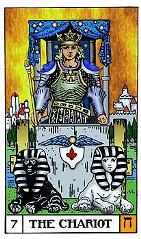
The philosophic soul is one that has an understanding endowed with “magnificence” (or “that which is fitting for a great man” and is thus distinguished from the understandings of those who are not “great men”) and is able “to contemplate all time and being” (486a) i.e. the understanding that is in the soul of the philosopher is ‘prophetic’. The prophet speaks ‘the highest’ speech. The philosophic soul has from youth been both “just and tame” and is not “savage and incapable of friendship”. The philosophic soul is not ‘rough’, but ‘smooth’. The meaning of the statement above Plato’s academy is not that “No one enters unless he knows geometry” as a specific study of the mathematical arts, but that “No one enters unless he has the capability of being a friend”. (See the connection to The Chariot card of the Tarot where the two sphinxes, one white and one black representing the mystery of the soul, are in contention or strife polemos with each other.)

In looking for the philosophic way-of-being-in-the-world, Socrates concludes: “….let us seek for an understanding endowed by nature with measure and charm, one whose nature grows by itself in such a way that as to make it easily led to the idea of each thing that is.” (486d) The philosophical soul is as it is by nature. It grows by itself from out of itself. It is not a product of education alone, although education can assist it on its way in the same way a farmer attending his crops assists his crops on their way. Socrates sees his main task as being a mid-wife.

Is this all souls or only some souls? Are all souls capable of attaining the philosophical way of being? The modern answer to these questions, through the impact of Christianity and the modern philosophers, is a “yes” while the ancient answer appears to be a “no”. Saints and philosophers are rare plants to the ancients.

Shakespeare’s Hamlet may be said to be a play regarding this conflict in the thymoeidic part of the soul. Hamlet’s ‘doubt’, his need for certainty and surety, prevents him from seeing the reality in which he has been placed and from taking the proper action necessary which is the fate that has been given to him. Hamlet’s doubt gives him an ‘unbalanced soul’. In contrast, Horatio is shown by Hamlet to be an example of the ‘balanced soul’ who is in possession of what Aristotle called phronesis:

“…for thou hast been
As one, in suffering all, that suffers nothing,
A man that fortune’s buffets and rewards
Hast ta’en with equal thanks: and blest are those
Whose blood and judgment are so well commingled,
That they are not a pipe for fortune’s finger
To sound what stop she please.” (Hamlet Act III sc. ii)

Horatio is an example of a ‘just man’, for his “balanced soul” allows him to take actions that are well-considered, wise. He is able to take life’s goods and evils with equal thanks, and this dispassionateness allows him to make the proper judgements at the appropriate time. This ability to make proper judgements is the proper relation of the logistikon and thymoeidic parts of the soul. The epithymetikon part of the soul creates distortion and chaos for the judgement when it dominates. The flute or pipe, the wind instrument, is the musical instrument of Dionysus, the god of tragedy, while the lyre or stringed instrument is the instrument of the god Apollo. Apollo is the god associated with the Sun and with truth.

Socrates uses an eikon or image (A-B of the Divided Line) to indicate the political situation prevalent in most cities or communities. The eikon uses the metaphor of the “ship of state” and the “helmsman” who will steer and direct that ship of state. The rioting sailors on the ship praise and call “skilled” the sailor or pilot, the “knower of the ship’s business”, the man who is cleverest at figuring out how they will get the power to rule either by persuading or forcing the ship-owner to let them rule. Anyone who is not of this sort and does not have these desires they blame as “useless”. They are driven by their “appetites”, their hunger for the particulars which they perceive as ends i.e. what Plato describes as human beings when living in a democracy, oligarchy, or a tyranny. In the modern age, we have killed off the ship-owner and replaced him with the ‘helmsman’, the cybernaut.

This is the reason why Plato places democracy just above tyranny in his ranking of regimes from best to worst, tyranny being the worst since both these regimes, democracy and tyranny, are ruled by the appetites and not by phronesis and sophrosyne or what we understand as ‘virtue’. (Democracy’s predilection for capitalism is a predicate of the rule by the appetites and the lower form of eros. The soul’s power to distinguish between self-interest and the common good becomes weakened or corroded under democracy so that tyranny is the ultimate result. It is the destruction of the sense of otherness in the soul. Human beings are, as individuals, tyrannic by nature and this is primarily due to the influence of eros. Technology has a great impact in increasing this tendency toward tyranny and towards the tyrannic soul. We seek the ‘gigantic’ and ‘intense’ rather than the ‘pure’.)

The erotic nature of the philosophic soul “does not lose the keenness of its passionate love nor cease from it before it has grasped the nature itself of each thing which is with the part of the soul fit to grasp a thing of that sort, and it is the part akin to it (the soul) that is fit. And once near it and coupled with what really is, having begotten intelligence and truth, it knows and lives truly, is nourished and so ceases from its labour pains, but not before.” (490b) The language and imagery used here is that of love, procreation, and childbirth, and this indicates its connection to both the lower and higher forms of Eros.

The world of the sensible must be experienced through the body, the epithymetikon part of the soul. With regard to the Divided Line, the world of the sensible, the Visible, “is equal to” the world of Thought: the mathemata or “that which can be learned and that which can be taught”. That which can be learned and that which can be taught is initially the visible, that which can be sensed and experienced. Socrates sees himself as a mid-wife, helping to aid this birthing process that is learning. It is a birthing process because it is a poiesis or a “bringing forth”.

At Republic Bk. VI 508 b-c, Plato makes an analogy between the role of the sun, whose light gives us our vision, to the visible things to be seen and the role of the Good in that seeing. The sun rules over our vision and the things to be seen. The eye of seeing must have an element in it which is “sun-like” in order that the seeing and the light of the sun be commensurate with each other. Vision does not see itself, just as hearing does not hear itself. No sensing, no desiring, no willing, no loving, no fearing, no reasoning can ever make itself its own object. Eros as pathos cannot be grasped through human reason but can only be spoken of through human language.

The Good to which the light of the sun is analogous, rules over our knowledge and the real being of the objects of our knowledge (the forms/eide) which are the offspring of the ideas or that which brings the visible things to appearance and, thus, to presence or being, and also over the things that the light of the sun gives to vision: “This, then, you must understand that I meant by the offspring of the good that which the good begot to stand in a proportion with itself: as the good is to the intelligible region with respect to intelligence (D-E) and to that which is intellected (C-D), so the sun (light) in the visible world to vision (B-C) and to what is seen (A-B).” This “begetting” of the Good hints at its connection to Eros and to Logos.

Details of the Divided Line: Section A-B

Eros and Logos manifest themselves in the A-B section of the Divided Line as the mediation points or metaxu that unite the tripartite soul of the human being to the things that are. “A” of the Divided Line is Eikasia or Imagination. These are the likenesses, images, shadows, models, imitations, and icons that our vision produces. They are the “schema” and “plans” that human beings put forward in order to create their understanding of their worlds. “To produce” is to “pro-create”, to “bring forth”. The end of all procreation is the desire for immortality. Nature’s procreation is sempiternal: it exists eternally within Time. For Plato, Time is the moving image of eternity. Our desire for children is the desire for immortality on the natural level. Eternity is that which exists outside of Time. Eros functions as that desire for immortality through procreation manifested in sexuality on the physical level. When the desire for children is divorced from sexuality, this is but one example of where human beings enter that stage where their sense of “otherness” is gradually eroded and their desires become “tyrannous”, self-serving. For human beings, children are the fact of “otherness”. In literature, for example, the tyrant Macbeth and his wife have no children.

Section A-B of the Divided Line is what we understand as ‘civilization’, those artefacts created by human beings that are distinct from nature because they are made by human beings. They are the shadows on the walls of the Cave. Nature and convention are in opposition to one another, and it is by nature that we are measured even though we believe that it is we who do the measuring. This is why eikasia or imagination is placed below Nature on the Divided Line; Nature is of the higher order or a higher dignity when it comes to Truth and its unconcealment.

In the illustration shown, the two diagonals that emerge from C and culminate on the surface of the sphere at B are two types of thinking associated with techne that occur in the C section of the Divided Line: poetic thinking or the thinking of the arts, and the thinking that is the know-how of the artisans and technicians. In both types of thinking, there is a metaxu that is needed, a ‘light’ that is required, and that ‘light’ is studied through geometry and the dialectical discussions that surround geometry. “Depth” occurs by a movement towards the centre of the sphere, not from the “height” that is the sphere’s surface. This movement is provided by eros. Goodness is at the sphere’s centre; evil is on the surface.

Newton

In the cosmology of the poet and and painter William Blake, the scientist Newton is depicted at the bottom of the sea sitting upon a rock (which oddly looks like a urinal or toilet) creating a geometric cone upon a scroll. He is surrounded by darkness. There is a polypus or octopus swimming by, and this creature is equivalent to the Great Beast of Plato i.e. the political, or the social. The fact that Newton is not putting his geometry down in a book or in stone but on a scroll indicates that Newton is using the creative imagination. As a scientist, or rather the scientist for Blake, Newton is joined with Bacon and Locke who, as seekers of truth and despite their errors, appear in the heavens on the day of the Apocalypse among the chariots of the Almighty, counterbalancing Milton, Shakespeare, and Chaucer, the greatest representatives of the the Arts. Theses philosophers and poets are all English-speaking.

Plato has a similar line up in his Symposium with the greatest representatives of the arts and scientists present at the banquet in which the topic of Eros will be discussed. The subject of both the Arts and the Sciences is the beautiful: order, proportion, harmony. The Sciences deal with these in the realm of the suprasensible and the necessary while the Arts are concerned with the sensible and contingent. Chance and evil, necessity, are present in both.

The essential urge of Eros is the desire for immortality and this is shown in Eros’ affect on all three parts of the Platonic soul. The epithymetikon (appetite or desire, which houses the desire for physical pleasures, especially sexuality) partially realizes this desire through the begetting of offspring. This ‘begetting’ mirrors the begetting of the eidos through the ideas: the offspring, while appearing to be the same are different . In all cases, the ‘image’ of Beauty in the outward appearances of the mortal things is what attracts and urges us to ‘possess’ and ‘consume’ those things which we desire. Our belief is that in possessing and consuming such things, immortality will follow. It is Khronos (Time) who eats his own children.

The image of a thing of which the image is an image are the things belonging to eikasia or the “imagination”. This is what we understand as ‘civilization’. These are the things ‘procreated’ by human beings through the logos whether the logos be understood as representational thinking such as mathematics or logic, or the creative works of the technites or artists and technicians, such as writings or shoes. The idea that is to be the next pair of Nikes was always already there. It was waiting for the artisan and technician to give birth to it, to “pro-create” it, and bring it forward into being. This is the distinction between the procreation of Nature and that of human beings: nature’s procreation is in itself from out of itself, while human beings are a combination of this (sexuality, nature) and “in another for another” (techne) i.e. the next pair of shoes derives from materials that are not of human beings nor of human making.

We are ‘reminded’ of the original by the image: the Beauty of Nature is the “image” that reminds us of the Good. Just as Nature is sempiternal, eternally in Time, the Good is eternal, eternally outside of Time. Nature is a mirror-image of the Good while Nature is, at the same time, dominated by Necessity Ananke. Necessity is Time. And there is a great gap separating the Necessary from the Good; that gap is the whole of Time and Space. That gap is mirrored in the separation of Love from the Intelligence in the A-C section of the Divided Line. The mediation of what we call “Intelligence” (mathematical calculation, the principle of reason) is a mirrored image of the mediation of Love and the things that are. The Intelligence that is the principle of reason is a “possessing”, commandeering logos, while the Intelligence that is Love is a ‘letting be’ and a contemplation of the things that are. In our being-in-the-world, we wish to consume the objects of our senses. The beautiful is that which we desire without wishing to eat it. We desire that it simply should be. To do so requires the renunciation of the imagination and the products of the imagination. This is not an easy thing to accomplish.

The sphere of Space encloses the beings that are in Time. It is the logos that encloses beings within Time. It is the Logos that establishes limits and brings the things that are to a ‘stand’. The soul, psyche, of human beings is eternally in Time. When the soul is assimilated into the One that is the Good, it ceases to be in time. Nature is eternally in time. Time is the moving image of eternity. Eros is a moving image of the Good that is beyond time. Nature is sempiternal, everlasting, endless.

The thymoeides part of the soul (spiritedness, which houses anger, as well as other spirited emotions), realizes the desire for immortality in its desire for “eternal fame and glory”. There is a “beauty” (kalon) in the carrying out of great deeds. We cannot, for example, deny that there is no beauty in the site of the Three Gorges Dam. Public care and concern (“spiritedness”) is linked to self-interest and it is here that we find the motivation of the politicians. The desire for immortality is in the desire for the doing of great deeds which will bring the individual before the public in some manner. Whether through military campaigns, the creation of ‘works’, or sporting achievements, this recognition is another way in which the soul tries to achieve a partial immortality, eternal fame, just as children are a ‘partial immortality’ in the physical realm.

The techne or artisan is the servant of the people: “in another, for another”. His “work” illustrates his mastery of a ‘part’ of knowledge, his own art, his “know how”, that knowledge that the philosopher aspires to for the whole of things. This mastery is driven by the thymoeides part of the soul, that which is driven for the mastery (thymus) of the eidos (the outward appearances of things).

The logistikon is that part of the soul that is the smallest part of the soul, and it is the only part of the soul that is beyond Necessity because it is part of the Good itself. In the illustration provided below, the logistikon is the centre point of the sphere that may be said to be within Time and out of Time, or it is at least the closest one can come to in being out of Time. References to the logistikon are found throughout our literature in myth and fairy tales as the ‘smallest’ of things that grow that have the greatest consequence. The sphere itself is as a great Wheel of Fortune that is in motion. This is Necessity. The only way of escaping the turnings of the Wheel is by being at the centre of it (King Lear Act V sc. iii).

In the A-B section of the Divided Line, the logistikon acts as that which ‘ties things down’, the logos that gathers things together and holds them in place. The ‘knowing’ and ‘making’ of the artisan and the technician (technology) is the interaction between the logistikon and the thymoeides parts of the soul of the artisan and technician. It is the face of the logos that is the principle of reason, of logic, and the language that forms our collective discourse (rhetoric). One of the faces of the Logos is that it is the “form” that makes the “informing” possible.

Section B-C of the Divided Line: Technology as Shadow

Section B-C of the Divided Line corresponds to physical things and to that which can be ‘counted on’ i.e. it represents trust, confidence, belief, faith (pistis). The physical things are those that can be seen or perceived with the senses. It is eros as ‘light’ that provides this capability. They are the things that are at our disposal, the ready-to-hand. In the Divided Line B = C: the physical things and our trust/belief in them is equal to the thoughts that we can think of those things through the representations of our perceptions of those things with our senses i.e. the Forms or Eidos of the things, the “outward appearances of the things”.

We have two definitions of what human beings are that have come down to us historically from the Greeks and the Latins. From the Greeks, human beings are the zoon logon echon, “the living being that dwells and perdures in language”. From the Latins, humans are the animale rationale, the “rational animal”. From the Latin definition arises the principle of reason, and this is what is in operation in section C of the Divided Line and determines one type of thinking and the logos from which it is derived.

A principle contains within itself a ratio, a reason for something else. The principle of reason is the ground/reason for all other principles and that means for what a principle is per se, for what a statement is, for what an utterance is. That about which the principle of reason speaks is the ground of the essence of language, of logos. This ground or essence is what we understand as one of the faces of Eros. Principles are derived from axioms. In Greek, axiom means “to find something worthy”. “Worthiness” is the trust, belief given to us by the “self-shining forth” of the axioms. Given our illustration, the problem is that the principle’s ratio is itself an ‘irrational number’, a contradiction.

The axioms determine the principles that have been derived from them. In Greek axiom is “to let something repose in its countenance and preserve it therein”. It is related to representational thinking and to eidos. Principia
are the sort of things that occupy the first place, that stand first in line.
Principia refers to a ranking and an ordering. They are our objects of sophia.
The ordering realm (Section A-C) is the realm of principles (sophia). We have determined that the sole purpose of axioms is to secure a system that is free of contradictions. The axiomatic character of axioms is to eliminate contradictions. Our concepts, axioms, principles (fundamental principles) serve the axiomatic securing of calculative thinking. What we call science is axiomatic, but for Plato science does not think in the manner that philosophers think.
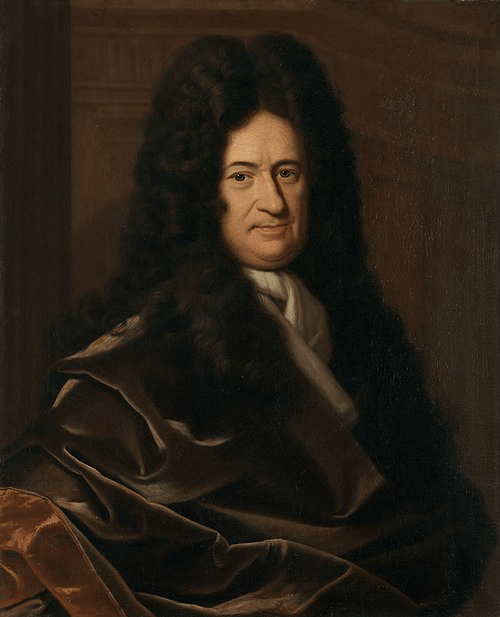
Wilhelm Gottfried Leibniz

For the philosopher Leibniz, the principle of reason is the principle of rendering sufficient reasons. To render in Latin is “to give back”. Our “cognition” (ways of knowing), “consciousness” is the rendering back of reasons. In Latin, cognition is representatio: the object, what is encountered, is presented to the cognizing “I”, presented back to and over against it, and thus made present. “Ob-ject” comes from ob-“against” and jacio “that which is thrown”.

Cognition must render to cognition the reason for what is encountered—and that means to give it back to cognition if it is to be a discerning cognition. “Beauty is in the eye of the beholder” because a sufficient reason, a ratio, cannot be given in an account of what is considered to be “beautiful”, although we have the theory of aesthetics which attempts to do so and which itself is based on the principle of reason. Under the principle of reason, eros becomes stifled, exsanguinated.

The principle of reason is reached only when it is understood as the fundamental principle of demonstrations: i.e. the fundamental principle of statements such as those given in our research, experiments, essays, presentations, etc. It is the principle of reason which is the dominant form of the logos in section C of the Divided Line in our modern age. The principle of reason is a Principle for sentences and statements i.e. for what is called “philosophical” and scientific knowledge (methodologies). The principle of reason is necessary for the rendering of reasons in the true statement/sentence. The principle of reason is the fundamental principle of the necessary founding of sentences and principles. This is what makes the principle of reason the essence of what we call Artificial Intelligence and the meta-languages associated with it.

What is empowering about the Principle is that it pervades, guides and supports all cognition (ways of knowing) that express themselves in sentences and propositions. The principle of reason is valid for everything which in any manner is. Cognition, our “ways of knowing “, is a kind of representational thinking. In this “presentation” something we encounter comes to a stand, is brought to a standstill as object. For all modern thinking the manner in which the things “are” is based on the objectness of objects. For representational thinking, the representedness of objects belongs to the objectness of objects. This is what Plato understood as “the shadows” and this is represented by the square in the illustration provided above.

“Ob-ject” comes from the Latin which means “the thrown against”. The “against” of the object must be a founded one: how the object is. Something
is, which means that it can be identified as being a being, only if it satisfies the fundamental principle of reason as the fundamental principle of founding. The principle of reason is the fundamental principle of cognition (ways of knowing) as the Principle for everything that is. It establishes our “under-standing” of what and how things are in the world that is ready-to-hand. It is the reason why “beauty must be in the eye of the beholder”.

We are who we are as human beings only insofar as the rendering of reasons empowers us. This is what makes us the animale rationale. It is from this “empowerment” that we judge what is human and what is not, what is sane and what is not, what is just and what is not, etc. This empowerment, the demand to render reasons, threatens everything of humans’ being-at-home and robs us of the roots of our subsistence i.e. of everything that has made human beings great up till now . It is the nihilism that threatens civilization, the ceasing of concern for what “human excellence” is, for what “virtue” is. There is a connection between the demand to render reasons and the withdrawal of roots, and the subsequent rootlessness of modern humanity.

For the Greeks, ousia or presence was understood as the thing’s way-of-being in the world. The city or society came about because of the body and the needs of the body. The city is a product of the procreation of eros writ large. The city was, thus, the individual writ large. The city represented the individuals which composed it in that its regime would reflect the opinions of those who are predominant in the community, those who hold power. It is because of this power that Plato considers it the Great Beast.

B-C in the Divided Line is the point where we see the two faces of Eros as well as the two faces of the Logos. The wants and the needs of the body for the individual are radically private and at the same time require other human beings for their fulfillment. The city or polis is an artefact brought forth by human beings and it has both the characteristics of being a natural thing and those of an artificial thing. Plato’s Cave in his Allegory is both a natural thing and a product of human invention and production. As the law of necessity controls the realm of nature, so too do laws control the ‘life’ that is shown in the polis. The walls of the Cave reflect the projected shadows of the interpretations of the Cave given through the representational thinking that is the Eikasia or “imagination” of the cave-dwellers. It is here that the essence of technology as “information” or the “form that informs” finds its source.

In the image of the Divided Line, the first thing the dweller inside of the Cave sees are the reflections of the shadows upon the walls of the Cave. These shadows or images form our views of the things that are. These provide us with our “understanding” of things whether they are the things of nature, the artefacts which human beings produce, or the things that are the products of our representations of them such as our sciences or our arts. Our “understanding” is an interpretation of the things, not an under-standing of the things themselves. Eros is not satisfied with these understandings and longs for the things in themselves. This is due primarily to Eros’ chief desire which is the achievement of immortality, that which is beyond change; and the things and our interpretations of them are subject to change.

In the B-C section of the Divided Line, the mind or logistikon part of the soul (the intelligence which became translated as ‘reason’ and so its connection to logos) is aided by the thymoeides or ‘spirited’ part of soul to attain to that object to which the appetitive part of the soul is directed. The appetitive part of the soul is urged by the thing’s “goodness” or perceived goodness, be it in food, drink, sex or whatever, and that this goodness will assist the body to survive and promote the soul’s search for immortality. The soul as a ‘one’, a whole, is directed or attracted by the kalon or beauty of the thing, to possess or ‘consume’ that which it perceives as beautiful. That which is perceived as beautiful is that which is ‘perfect’ or complete. Sexually, this is the individual beautiful human being at the beginning stages of the journey that leads to the perfection that is the Good (or immortality). The individual desires to “consume” the other human being so that the two may become one in a literal sense.

The word beautiful (kalos) is distinct from good (agathon) and it also means ‘fair’, ‘fine’, ‘noble’. Everything outstanding in body, mind or action can be so designated, and the aspiration for these qualities can be related to the thymoeides part of the soul and the eros which drives it. We have designated this quality as “human excellence” among human beings, arete, what we call “virtue”. What is loveable either to sight or mind is beautiful. It is what we designate as “moral” with the distinction that it is beyond obligation or duty, what we cannot expect everyone to perform. It is of a higher rank than the just, which every human being can be expected to perform. The core of a just political order was defined by “virtue” for the ancients, while today “freedom” is believed to be at the core of the just political society. Both of these views may be said to be present in A-C section of the Divided Line. This emphasis was directed by the eros that is the thymoeides part of the soul.

In earlier writings on this blog, it was recognized that the evil or wicked were not alone the individual criminals but those who wished to rule for their own self-assertion. Such people were more destructive of justice than those who ruled simply in terms of the property interests of one class. Because tyrants were the most dangerous for any society, the chief political purpose anywhere was to see that those who ruled had at least some sense of justice which mitigated self-assertion. This was at the core of earlier education systems. The IB, too, has this mitigation of self-assertion at its core. The great danger of the thymoeides part of the soul was its tendency to tyranny. This tendency is also part of Eros.

In Section A-B of the Divided Line, the logos of the logistikon of the soul is concerned with the calculation from which knowledge is derived. This calculus has shaped what we understand by modern science and is at the heart of what we understand as technology. It finds its place or site in that field of mathematics that we call algebra. Money, technology, algebra are analogous as signs of our worship of power.

As Eros is two-faced so, too, is the logos in the realms of the physical and imaginative. The “mathematics” (“that which can be learned and that which can be taught”) of the logos is of two types: the arithmos of the particular things, those things that exist in Time, those things that can be counted and counted on, and the geometria of that which exists in Space, those things that are the works of the Logos. As logos understood as the “calculable” through algebra comes to predominate so, too, does the notion of justice as “calculable” come to predominate (this is the modern view of justice i.e. “the greatest good for the greatest number”).

The thymoeides part of the soul is concerned with “passion”, and it is this passion which unites with the logistikon part of the soul and brings about the urge to attempt to attain immortality through ‘noble’ and ‘fine’ deeds or works. The understanding of what ‘fine’ deeds are is part of the ‘cognition’ or perception of how ‘human excellence’ is understood beforehand. We ‘love’ the beauty of ‘human excellence’ when it is shown to us. It is the passion to possess this beauty that compels us to perform excellent deeds in whatever context those deeds may be performed.

Section C-D of the Divided Line

Many will find the proposition that science does not think the most controversial put forward in this writing. What does it mean for Plato (and Heidegger) to say this? How does this statement cast a light on what we understand as artificial intelligence and on rationality in general?

The Forms or eide (the outward appearance of things) are begotten from the ideai which, in themselves, are begotten from the Good. “Begottenness” is of Eros. The forms give presence to things (ousia) through their outward appearance. The “seeing” of this presence is dependent on “sight” which, in turn, is dependent on the light of the sun. In order for this to occur, the eye must have something “sun-like” in it just as the soul must have something like “the good” in it to be able to “bring forth” the representations of the things that are in the mind or intellect.

There is nothing without thought; there is no thought without things. In the Divided Line, B = C. “Otherness” is a condition of being. Human beings are essential for being to be. Being needs human beings to be. Being is reality. What we call science is the theory of the real, the “seeing” of the real. (“And would you also be willing,” I said, “to say that with respect to the truth, or lack of it, as the opinable is distinguished from the knowable, so the likeness is distinguished from that of which it is the likeness?”) The “images” and “shapes” of things, the eide, such as the city or society is the individual writ large. The polis or city is a city of artisans and technicians, of technites. The “knowing one’s way about or within something” begins in the household and caters to the production of novelty, efficiency. The logos, like Eros itself, is two-faced or of two types. The jumping off point or the leap is the recognition that the Sun in the realm of Becoming (Time), like the idea of the Good in the realm of Being, is responsible for everything that is. The Sun is Time as the moving image of eternity, and all that is in being owes its existence to Time. The Good is eternity, and all that is in Being and Becoming owes its existence to the Idea of the Good.

Dianoia is that thought that unifies into a “one” and determines a thing’s essence. The eidos of a tree, the outward appearance of a tree, is the “treeness”, its essence, the idea in which it participates. We are able to apprehend this outward appearance of the physical thing through the forms or eide in which they participate for these give them their shape. The understanding, the hypo-thesis (dianoia) is the “standing under” of that seeing that is thrown forward, the under-standing, the ground. Thought under-stands the limits and boundaries of things and gives them “measure” through the use of number or language logoi. The giving of measure to the seeing is geometry and geometry deals with ratios; and from it, the hearing of the harmonia of music, the music of the spheres, is recognized and produced. The music of the spheres is the recognition of the whole of which each being is a part, and how that part is related to the whole. Thought comprehends the “measure” of the things that bring about “harmony” and unites the individual being or thing to the whole. The proportionals are arranged about a “mean” which is “hidden” or “irrational”. The principle of stringed instruments and their ratios is applicable to the whole of the universe, both the visible and invisible.

Section D of the Divided Line is the Ideas Ideai which are begotten from the Good and are the source (archai) of the Good’s presence parousia amidst that which is not the Good, both in being and becoming. The Good is seen as “the father” whose seeds (ideai) are given to the receptacle or womb of the mother (Space) to bring about the offspring that is the world of A-E (Time), within the whole of things within Space. The realm of A-E is the realm of the Necessary. (Timaeus 50- 52e). The dialogue of Timaeus occurs the morning after the dialogue that we call Republic. It is the continuation of an ascent from the eikasia of the imagination and opinion of Section A (Republic) to the physical reality of Section B of the Divided Line (Timaeus). Timaeus is a revealing of the Ananke, what the Greeks understood as Necessity. The dialogues of the Sophist, Theatetus and The Statesman illuminate Section C of the Divided Line. Symposium and Phaedrus are dialogues that help to illuminate Section D.

Because the ideas are begotten from the Good, the ideas are the essences of things, their “oneness”, that which they really are. The ideas in turn beget the eidos which bring things to presence in their ready-to-handedness in time for human beings. The things come to a stand through the eidos and give us what we call our “understanding”. The nature of this understanding is pre-determined by the logos within being, by the “frame” or the “form” that is a product of the logos.

Noesis is often translated by “Mind” but “Spirit” might be a better translation. Contemplation, attention, “dialectic” are the activities of noesis. Knowledge (gnosis), intellection, the objects of reason (logoi but not understood as logistics but as noesis, ideai, episteme) is what is understood as “knowledge” in this section of the Divided Line. “Knowledge” is permanent and not subject to change as is “opinion”, whether “true” or “false” opinion. Opinions develop from the pre-determined seeing which is the understanding of the essences of things prevalent at a certain time. Understanding is prior to the interpretation of things and the giving of names to things.

The Idea of the Good (agathon) is what provides “the truth to the things known (i.e. their “unveiling”, their “showing forth”) and gives “the power to the one who knows… and, as the cause of knowledge and truth, you can understand it to be a thing known; but, as fair as the two are – knowledge and truth – if you believe that it is something different from them and still fairer than they, your belief will be right.” (Republic 508e – 509a) The Idea of the Good is the essence of things that come to be whether in the Visible or the Invisible realms. The Good is beyond both Time and Being. When the soul is in direct contact with the Good, gnosis is achieved and the soul is no longer in Time for it becomes part of the One of all that is. The Good is responsible for (aitia ‘the cause of’) the knowledge and truth (aletheia, unconcealment) of all that is. Without it, knowledge and truth could not be attained. Everything would be ‘irrational’. Eros as Love and the Beautiful is this face of the two-faced Eros.

The whole of the Divided Line (A-E) is the Good’s embrasure of both Being and Becoming, that which is both within Time and Space. This embrasure is spherical in shape. The Good itself is beyond this sphere that is Being and Becoming (i.e. space and time) and there is an abyss separating the Necessary (which is both Space and Time) from the Good. Within the Divided Line, that which is “intellected” (C-D) is equal to (or the Same i.e. a One) as that which is illuminated by the light of the sun in the world of vision. (B-C)

Details of the Divided Line

Below is a summary of the points made regarding the Divided Line:

“This, then, you must understand that I meant by the offspring of the good that which the good begot to stand in a proportion with itself: as the good is in the intelligible region with respect to intelligence (DE) and to that which is intellected [CD], so the sun is (light) in the visible world to vision [BC] and what is seen [AB].”

E. The Idea of the Good: Agathon, Gnosis “…what provides the truth to the things known and gives the power to the one who knows, is the idea of the good. And, as the cause of the knowledge and truth, you can understand it to be a thing known; but, as fair as these two are—knowledge and truth—if you believe that it is something different from them and still fairer than they, your belief will be right.” (508e – 509a)  
D. Ideas: Begotten from the Good and are the source of the Good’s presence (parousia) in that which is not the Good. The Good is seen as “the father” whose seeds (ἰδέαι) are given to the receptacle or womb of the mother (space) to bring about the offspring that is the world of AE (time). The realm of AE is the realm of the Necessary. (Dialogue Timaeus 50-52 which occurs the following morning after the night of Republic)D. Intellection (Noesis): Noesis is often translated by “Mind”, but “Spirit” might be a better translation. Knowledge (γνῶσις, νοούμενα) intellection, the objects of “reason” or the logos (Logoi) (νόησις, ἰδέαι, ἐπιστήμην). “Knowledge” is permanent and not subject to change as is “opinion” whether “true” or “false” opinion. Opinions develop from the pre-determined seeing which is the under-standing of the essence of things.  
C. Forms (Eide): Begotten from the Ideas (ἰδέαι) . They give presence to things through their “outward appearance” (ousia). There is no-thing without thought; there is no thought without things. Human being is essential for Being. Being needs human being. “And would you also be willing,” I said, “to say that with respect to truth or lack of it, as the opinable is distinguished from the knowable, so the likeness is distinguished from that of which it is the likeness?”  C. Thought (Genus) Dianoia is that thought that unifies into a “one” and determines a thing’s essence. The eidos of a tree, the outward appearance of a tree, is the “treeness”, its essence, in which it participates. We are able to apprehend this outward appearance of the physical thing through the “forms” or eide in which they participate. Understanding, hypothesis (διανόια). The “hypothesis” is the “standing under” of the seeing that is thrown forward, the under-standing, the ground.  
B. The physical things that we see/perceive with our senses (ὁρώμενα, ὁμοιωθὲν)B. Trust, confidence, belief (πίστις) opinion, “justified true beliefs” (δόξα, νοῦν). Opinion is not stable and subject to change. The changing of the opinions that predominate in a community is what is understood as “revolution” or “paradigm shifts”. “Then in the other segment put that of which this first is the likeness—the animals around us, and everything that grows, and the whole class of artifacts.”  
A. Eikasia  Images Eikones: Likeness, image, shadow, imitation, our vision (ὄψις, ὁμοιωθὲν). The “icons” or images that we form of the things that are. The statues of Dedalus which are said to run away unless they are tied down (opinion). It is the logoi which ‘ties things down’.A. Imagination (Eikasia): The representational thought which is done in images. Our narratives, myths and that language which forms our collective discourse (rhetoric). Conjectures, images, (εἰκασία). The image of a thing of which the image is an image are things belonging to eikasia. We are “reminded” of the original by the image. “Now, in terms of relative clarity and obscurity, you’ll have one segment in the visible part for images. I mean by images first shadows, then appearances produced in water and in all close-grained, smooth, bright things, and everything of the sort, if you understand.”  The Platonic “imagination” is distinguishable from the “transcendental imagination” of Kant. For Kant, the “transcendental imagination” refers to a “blind yet indispensable function of the soul” which is responsible for synthesizing sensory data into coherent experiences (logos) making the objects of experience possible (eros). Human consciousness and self-awareness is both sensibility/sense perception and understanding, and the “transcendental imagination” transforms mere sensations into conscious perceptions. Here, Kant is speaking about the ‘form’ that ‘informs’ i.e. technology. Like Kant, for Plato the imagination is not merely reproductive but is productive in that it makes experience, in general, possible through the coming together of the logos and eros. Unlike Kant, for Plato Eros is not “blind”.

See also https://mytok.blog/2023/08/18/platos-divided-line-and-the-golden-mean/
Mathematics and Ethics

Technology as Information

We will be discussing how “mathematics” provides the principles for our actions i.e. how mathematics determines our ethics. We shall examine some considerations of the differences between what is called calculative thinking and what is called contemplative thinking. In this examination we will come to a closer understanding our technological being-in-the-world. Mathematics is understood as “what can be learned and what can be taught”.

What we call mathematics is a theoretical viewing of the world which establishes the surety and certainty of the world through calculation. Calculative thinking determines that the things of the world are disposables and are to be used by human beings in their various dispositions. This commandeering challenging of the world and the beings in it is what we have come to call “knowledge”, and is made possible by what we call “knowledge”. This under-standing (i.e. that which “stands under” or grounds) is that upon which all of our actions are based. This surety or certainty that beings are in the way that we say they are through calculation arises through the viewing and use of algebraic calculation in the modern world. Algebraic calculation is a language of signs and numbers. The results of what is and what has been achieved through this calculative thinking are what we have come to determine what knowledge is in our day and what is best to be known and how it is to be known. What is the relationship between these calculations and what we call “information” and how does information relate to ethics?

Ethics are based on what Aristotle called phronesis: our careful deliberation over what best actions will ultimately bring about the best end result. We call this end result our happiness or what Aristotle called our eudaimonia. But how can happiness be the end result of what is, essentially, a hubristic way of viewing and being in the world? What we choose to be through our doings in the worlds of our projections is that which demonstrates our skills, aptitudes, and fitness to bring forth the “work” that is the “product” or outcome of the activities in those worlds whether those outcomes or “goods” be works, services or ideas. It is eros that urges the soul to “hear” that calling from the logos that sets us upon the journey to self-knowledge that allows us to adapt to the inevitable change that is a re-birth that seeks for that which is fitting to the soul.

A Reading of King Lear

We shall reflect on this question of self-knowledge and how the mathematical impacts self-knowledge by examining the passage below from Shakespeare’s King Lear Act V sc. iii.

CORDELIA
We are not the first
Who, with best meaning, have incurr’d the worst.
For thee, oppressed king, am I cast down;
Myself could else out-frown false fortune’s frown.
Shall we not see these daughters and these
sisters?

KING LEAR
No, no, no, no! Come, let’s away to prison:
We two alone will sing like birds i’ the cage:
When thou dost ask me blessing, I’ll kneel down,
And ask of thee forgiveness: so we’ll live,
And pray, and sing, and tell old tales, and laugh
At gilded butterflies, and hear poor rogues
Talk of court news; and we’ll talk with them too,
Who loses and who wins; who’s in, who’s out;
And take upon’s the mystery of things,
As if we were God’s spies: and we’ll wear out,
In a wall’d prison, packs and sects of great ones,
That ebb and flow by the moon.
EDMUND
Take them away.
KING LEAR
Upon such sacrifices, my Cordelia,
The gods themselves throw incense. Have I caught thee?
He that parts us shall bring a brand from heaven,
And fire us hence like foxes. Wipe thine eyes;
The good-years shall devour them, flesh and fell,
Ere they shall make us weep: we’ll see ’em starve
first. Come.

Explication of the Passage from King Lear

To attempt a summary and explication of the whole of the greatest work in the English language is impertinent.  But a brief introduction is necessary to understand the play as it appears in the scene above.

At this point in the play, Lear and Cordelia, supported by French troops, have lost the civil war for Britain to Edmund’s forces. Lear, as King, has been ultimately responsible for this civil war. At the beginning of the play, he has disowned his ‘truthful’ daughter Cordelia and fallen victim to the flattery and machinations of his two eldest daughters, Goneril and Regan. He has divided the kingdom in two giving each sister control of half, the intention being to avert future strife. Lear, at the same time, wishes to retain the appurtenances of a king, the appearances of a king, while retaining none of the responsibility: Lear is satisfied with the appearances rather than the realities of things. It is this satisfaction with the appearance of things that leaves Lear open to the machinations of his two daughters, Goneril and Regan.

Lear’s responsibility is, chiefly, a moral one. Goneril and Regan soon work together to remove from Lear the power and possessions that he once held. Lear becomes an “O”, “a nothing”. In his “nothingness”, Lear becomes mad and rages against the ingratitude shown by his daughters and the injustice that he sees in the nature of things and in the created world as it is.

This scene from Act V above is Lear’s anagnorisis or moment of enlightenment, the moment in tragedies when all tragic heroes recognize the errors of their ways and the consequences of their hubris. These consequences we call nemesis or just desserts.

Lear ends up houseless and homeless and wanders on a heath in the heart of a terrible storm. Lear’s physical, mental and spiritual sufferings soon drive him mad. The storm’s effect is a purification of Lear: Lear removes his clothing to become naked, to reveal human being as a mere ‘bare forked animal’; his ego is destroyed in the madness; he no longer focuses on himself but is able to see the ‘otherness’ of human beings and to feel compassion and pity for them (in the characters of Edgar as Poor Tom and the Fool) because he sees himself and his humanity in them. Edgar, too, has become a ‘nothing’ due to the machinations of his bastard brother Edmund and is a parallel to Lear in the double plot of the play.

Lear has gone from King to nothing and he is ready for re-birth. His ego has blinded him to understanding what his true relationship to his god is: initially he looked upon this god and his power as being something which he, Lear, himself possessed. Lear believed that only he himself possessed this truth. He dismisses the truth-tellers in the play: his Fool and his daughter Cordelia. In Lear’s kingdom, truth is not to be revealed. Only those who flatter are those that are heard.

The play King Lear is a play about the consequences of not knowing who we truly are, as individuals and as a species, as human beings. Lear, focused as he is on his ego, his Self, is willingly duped by machination in the play; he is willingly duped by flattery as this flattery is recognition of his social prestige. His later suffering and madness bring him to a true understanding of his relation to the god and to other human beings, and this relationship is Love expressed through the care and concern that he later shows to Poor Tom and the Fool. Love is, as Plato describes it, “fire catching fire”. It is recognition that in the most important things, all human beings are equal in that all are capable of the capacity for Love. Given the inhumane nature of human action in many cases in the real world, it is not without reason that Love has been described as a homeless, houseless beggar in our mythologies. Our literature sometimes refers to him as Eros.

Many critics suggest that this play is atheistic; Lear has lost his faith in God. The above passage suggests that such is not the case: what Lear has come to understand is his true relationship to his God, the true relationship of all human beings to God. Lear has lost the illusion of what he had once understood as God and what his relationship was to that God. It is this illusion that is the trap cast for those who believe that they are in possession of the truth or that truth is a product of their own creation or doing. Such a belief gives the individual the illusion of power. The God in King Lear is absent: He will not perform some miracle preventing the hangings of Cordelia and the Fool by the Captain later in the play. The essence of human being and of our humanity is to reveal truth. Great catastrophes are the result when we do not do so. In King Lear, the truth is destroyed. Good does not triumph over the evil of human actions in this play and we, too, by our very silence, are made complicit in the deaths of Cordelia and the Fool. In King Lear, human beings are not “beyond good and evil”.

In the play, the god exhibits Himself by His absence. Absence is not non-existence. It is the absence of God in the play that gives reason to those who interpret the play atheistically. One of the many themes of the play is what happens to human beings when they ignore the truth and persecute the truth-tellers. They, too, become subject to machinations and gaslighting. It is the tyrannous element present in all human beings. In their ignorance, they become victims in the struggle for power. When we show our astonishment at the discoveries of the James Webb Space Telescope, we are actually witnessing the withdrawal of the God into hiddenness in order to allow those distant galaxies to be. As Being comes to presence, the God withdraws.

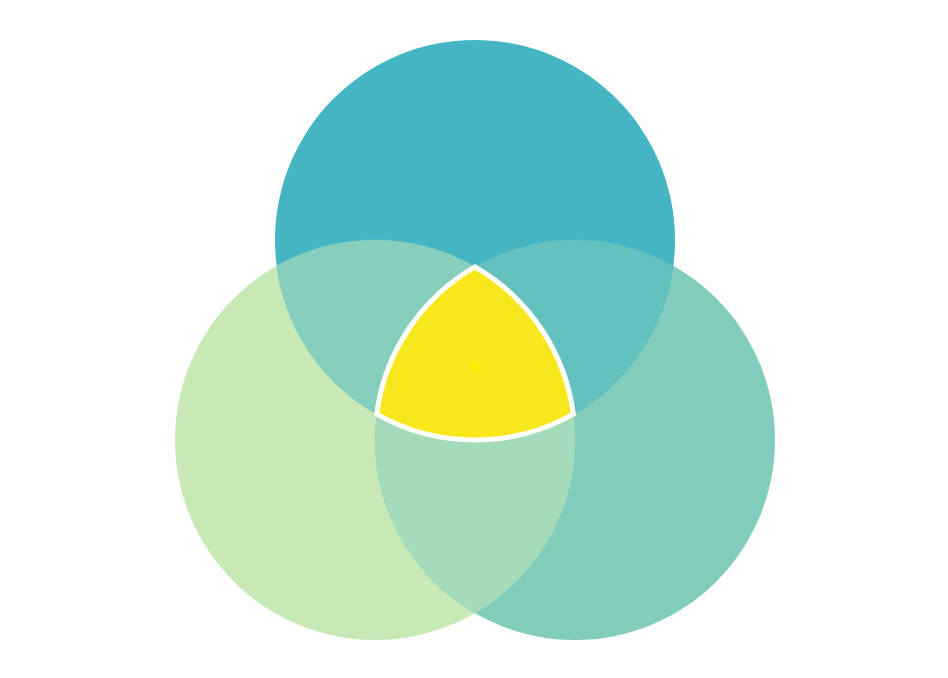
Pythagorean circle
In relation to King Lear, the above should be viewed as a sphere with each of the triangles being wheels within wheels or spheres within spheres.

The play King Lear shows that the purpose of suffering is to allow for the de-creation of our selves, the de-struction of ourselves, our “I”s or egos. We today see no purpose in suffering, particularly the suffering of the innocent. One of the purposes of suffering is the destruction of the ego or self through affliction. This same decreation of the self was behind the geometry of the Pythagoreans. For the Pythagoreans, the study of geometry served an identical purpose: the purification of our selves or souls through a contemplative understanding of the things that are. When we stand on the circumference of the sphere above and are subject to its spinning, we suffer the ups and downs of Fate. We are beings in Time. Being at the centre of the sphere allows us to be free of its spinning. The spinning of the wheel or sphere is Time.

There is a Wheel of Fortune motif that runs throughout King Lear: Fortune is personified in the passage through alliteration ‘false fortune’s frown’ to illustrate that it is, in this case, one of human making: even with the best of intentions one can incur the worst: good does not triumph over evil in this sphere but is subject to the same necessity as are rocks and stones. To decreate one’s Self is to have the Self replaced by an assimilation into the divine; it is to become one of ‘God’s spies’, to see all with God’s eyes and to see all for God. God requires human beings “to see” His creation. His creation is Necessity; and there is a great gap separating the Necessary from the Good. Being requires human beings. When a human being sacrifices the Self, the ego, his most treasured possession, for assimilation in God, “the gods themselves throw incense” upon this sacrifice. We believe our Self to be our most precious possession; the renouncing of this possession is the purpose of our lives, and this renunciation is not pleasant: it is done through suffering. Few people are capable of it. I am not sure that one would want to be the parent of a saint. It is a pain-filled event much as ‘the turning’ in Plato’s allegory of the Cave is a pain-filled event.

Simone Weil
“Suffering (affliction), when it is consented to and accepted and loved, is truly a baptism”

The centre of the sphere is both in time and space and out of time and space. The Self as center here is indifferent to the size of the prison, the size of the circle, the size of the sphere. For Lear, imprisonment will be a liberation, not a restriction. “Suffering (affliction), when it is consented to and accepted and loved, is truly a baptism” (Simone Weil, “The Love of God and Affliction”). This is similar to Hamlet’s praise of Horatio (Act III sc. ii) where Hamlet says:

“…for thou hast been
As one, in suffering all, that suffers nothing,
A man that fortune’s buffets and rewards
Hast ta’en with equal thanks: and blest are those
Whose blood and judgment are so well commingled,
That they are not a pipe for fortune’s finger
To sound what stop she please.”

Horatio has what we may call a ‘balanced soul’: each of its parts does what it is supposed to do. Having this balanced soul is what we understand as “self-knowledge”. This self-knowledge allows one to accept the buffets and rewards of fate with equal thanks. Of course, it is easy for us to be thankful for the goods that we receive from fate. It is not so easy to accept the inevitable afflictions that come with being alive with equal thanks.

Baptism is a spiritual re-birth. It is usually associated with the element of water. The purification of the soul is associated with fire, with alchemy. Love is ‘fire catching fire’. On the heath, Lear experiences both the baptism with water and the purification through fire. The spiritual rebirth for Lear is clear from this passage in Act V sc. iii as well as from Act III onwards in the play where he experiences both a physical and spiritual re-birth. In order to do so, he must lose all that has attached him to his world and his ego must be destroyed. He must, in a real sense, ‘die’ and become a ‘nothing’. This is the purpose for Lear’s nakedness and madness in the play.

The attempted suicide of Gloucester in the play due to his suffering is a counterpoint to this: suicide is a sin against the gods because we falsely believe that our self is our own and of our own making. Gloucester’s realization that this is not the case results in his finding Edgar again and having ‘his heart burst smilingly’. His death is the counterpoint to Lear’s death: Lear’s heart will break due to the depth of his affliction at the loss of his Fool and Cordelia. Death is the inevitable end for us all. Contrary to our view, in the world of Shakespeare some kinds of suffering have a purpose and some suffering simply does not, and human beings are not beyond the good and evil that is present in the suffering that has no purpose or meaning. My saying this is in opposition to that statement recently by a Republican congresswoman who said that death is inevitable in order to justify her voting for the cuts that would be made to healthcare for the poor.

Our “personal knowledge” is our ‘sphere of influence’ on our worlds and on the other human beings who inhabit our worlds. The impact of our spheres of influence will be determined by the amount of self-knowledge we possess, and on the skills, aptitudes, fitness (techne) that we possess for the tasks. Those spheres that we inhabit in our lives should be seen as composed of wheels within wheels with our actions the spokes of the wheels. The spokes are our ‘projections’ and provide support for our spheres. The spokes reach out to the circumferences of the wheels: from the diameter, the right angled triangle cannot exceed that circumference. The sphere created by the circumferences may be large or small; most of our lives are spent in our attempts to enlarge this sphere. The spokes that are the radii of the self are the whorls of a gyre initiated by the soul and projected upon the world that we are in in order to create a world. In the whorl that is the motion within our sphere, we are ’empowered’ to carry out our activities, but the prison of ourselves is still a ‘prison’ beginning with our bodies and our egos which are placated by the social prestige which comes from the fulfillment of our urges and desires. At each stage on the whorl, there is a leaping-off possibility that presents itself through the metaxu or relation of the logos.

We become and are satisfied in being the ‘poor rogues’ and ‘gilded butterflies’ that Lear and Cordelia will chat with. The outer edges of the sphere in its spinning indicate the fates of those who are ruled by Fortune: ‘who loses and who wins; who’s in, who’s out’. It is the fate of all of us who are dominated by the wish for social prestige, recognition. This fate and our desire for this fate is part of the ‘mystery of things’, the mystery of being: to see this we must remain at the centre of the sphere where we are not moved by the wheel’s or the sphere’s spinnings, nor are our desires dominated by the wish for social prestige and recognition.

Lear, through his madness and suffering, has been re-born (see other sections of the play particularly Lear’s awakening when he sees Cordelia as an angel, a mediator, and in the play she is, from the beginning, representative of truth). His self, ego, I, has been destroyed. He becomes a “nothing”. In this scene from Act V, Lear demonstrates the friendship that is the love between two unequal yet equal beings. Lear’s ‘kneeling down’ when asked for his blessing in order to ask for forgiveness is his recognition of this equality. It is no longer the view of the Lear who said “I am a man more sinned against than sinning”, a false view of Lear’s at the moment of its occurrence in the play for it is the view of most of us with regard to our own sufferings. We see ourselves as victims.

It is with a great and terrible irony that after these speeches of Lear’s and Cordelia’s, the following occurs:

EDMUND: Come hither, captain; hark.
Take thou this note. (30)
[Giving a paper] Go follow them to prison:
One step I have advanced thee; if thou dost
As this instructs thee, thou dost make thy way
To noble fortunes: know thou this, that men
Are as the time is: to be tender-minded (35)
Does not become a sword: thy great employment
Will not bear question; either say thou’lt do ‘t,
Or thrive by other means.
CAPTAIN: I’ll do ‘t, my lord.

EDMUND: About it; and write “happy” when thou hast done. (40)
Mark, I say, instantly; and carry it so
As I have set it down.
CAPTAIN: I cannot draw a cart, nor eat dried oats;
If it be man’s work, I’ll do ‘t.

The Captain’s final words are a statement for all of us motivated by social prestige. That Edmund should give the Captain a paper or document instructing him is a particularly ironic note. Human crime or neglect is the cause of most suffering. On the orders of superiors we carry out acts that we believe are “man’s work” i.e. they are not the work of Nature but we ascribe the moral necessity for our actions to Nature: “I cannot draw a cart, nor eat dried oats”. We believe that we are compelled to commit immoral actions because we believe Nature imposes its necessities upon us; and, at times, Nature does indeed do so. We believe such actions to be our ‘duty’. But if we live with a thoughtful recognition that there are simply acts which we cannot and must not do, we are capable of staying within these limits imposed by the order of the world upon our actions.

Such words as the Captain’s have been used by human beings to justify to themselves and to others the reasons for their actions from the committing of petty crimes to genocides. They see their crimes as performing a duty, just “following orders”, or as Adolf Eichmann said: “I was just a scheduler of trains; I didn’t kill anybody”, or as Elon Musk in his destruction of USAID does not see himself as responsible for the possible deaths of 15,000,000 human beings. It is indicative of a loss of a sense of ‘otherness’. It is the Ring of Gyges: the invisibility and anonymity we seek in order to dispel any responsibility for our actions. We allow this committing of crimes to ourselves when it is accompanied by an increase in our ‘good fortunes’.

The root of all crimes is, perhaps, the desire for social prestige whether that is achieved through position, money or recognition. The root of all sin is the denial of the light, the denial of truth, the denial of what is the essence of our humanity. This denial results in our becoming increasingly inhumane and cruel. For the Captain, it is Edmund who will determine what ‘happy’ will become for him by his giving to the Captain ‘noble fortunes’; and the Captain believes it. He does not see his act as “inhumane” but calls it “man’s work”. He will achieve his noble fortunes through the committing of an ignoble act, a heinous act.

One would need to look far across the breadth and depth of English literature to find two more contrasting views of humanity in a work than that which is presented here in these two brief scenes from King Lear. Human beings are capable and culpable of both forms of action: we have an infinite capacity for Love and forgiveness as well as a finite capacity for committing the most heinous crimes; only Love is both beyond and within the circle or sphere, and all human action is done within the sphere (or the realm of Necessity). At bottom, all sin is the sin against the light, or truth.

Contemplation and Calculative Thinking: Living in the Technological World

The passages from King Lear give us an entry to understanding a practical alternative way of being-in-the-world to the current conditioning or ‘hard-wiring’ of our way of being under the technological world-view operating as it does within the principle of reason. This alternative way involves contemplative thinking as opposed to calculative thinking. This contemplative thinking is open to all human beings: it is not a special mental activity. It is an attitude toward things as a whole and a general way of being in the world. It is the attitude that Lear proposes for himself and Cordelia on how they will spend their time in prison: while they will still be in the world, they will not be of the world. While they will be involved with the “poor rogues” and “gilded butterflies”, the world of those rogues and butterflies will not be their world.

What does this mean for us? It suggests that we are in the technological world, but not of this technological world; we are here in body but not in spirit. This is not a Ludditian rejection of technology. We are free in our relation to technology. We avail ourselves of technological things but we place our hearts and souls elsewhere. This detachment involves both a “being-in” and a “withdrawal-from”. Like Lear and Cordelia, we let the things of the technological world go by, but we also let them go on. Like Lear and Cordelia, the detachment is both a “no” to the social and its machinations, but it is also a “yes” to it in that it lets that world go on in their entertaining of it.

What is Calculative Thinking?
10 spirals should be seen inside of this cone. The spirals are projected to the circumference of the sphere.

The illustrated gyres on the left are an example of our ‘projections’ of our understanding of our being-in-the-world. These projections are a product of Eros expressed as ‘need’. Being is the essence of technology: Eros as time adapts itself to the Logos as “form” (space) and is thus able to “inform” and to be of use in the meeting of those ‘needs’ that are the projections of Eros.

Calculative thinking is how we plan, research, organize, operate and act within our everyday world. This thinking is interested in results and it views things and people as means to an end. It is a viewing that sees human beings as “human resources” or “human capital”. It is our everyday practical attitude towards things. Contemplative thinking is detached from ordinary practical interests. From where does calculative thinking originate?

Our “spheres of influence” are in a relation to and occupy the spheres of others

Calculative thinking is illustrated by the spirals or gyres illustrated above. From the centre of the sphere that is our site in our being-in-the-world, we send out or ‘project’ what plans, research, activities we are involved in and these create a world that is itself sphere-shaped. These plans and activities are ‘echoed’ back to us. It is the logos as language and enumeration (mathematics) which establishes those spheres that are the worlds of our experience. These spheres are the worlds of the ‘poor rogues’ and ‘gilded butterflies’ whom Lear and Cordelia will entertain. These spheres are sometimes called “bubbles” today, and various types of human beings may occupy and share the same bubble or sphere or part of a bubble or sphere much like in a Venn diagram. We speak of a “sphere of influence” that we attribute to the powers of various individual human beings. This is the projection that they have over and into the spheres that are projected by others. We measure our freedom by how much of our sphere is truly in our possession and not under the influence of powerful people. The amount of this freedom is determined by the self-knowledge that we may have at any given time.

It is language and enumeration that are the metaxu or media that establish our relation to everything that is and to everything that is not. It is language, with the assistance of eros, which entraps us into seeing presence and the things that presence as “data” and this “data” must then be transformed into a “form” so that it may “inform” and thus become a “resource”. This is why our age is called the Information Age.

The piety that is religion establishes what should be looked up to and what should be bowed down to. Aristotle called or implied that human beings are ‘the religious animal’ in his discussions of piety in both his Politics and his Nichomachean Ethics. In other days, this piety was indicated by that object or site which held the highest point and dominated one’s view. In the West, the highest point was dominated by the spire of the cathedral or the minarets of the mosque from which the imam made his call to prayer. These indicated the way of being of the individuals who lived within those communities. In the East, it was the statue or temple of the Buddha, or it was in the prohibition that no human construction was to be higher than the highest coconut tree within the sphere of site of a Balinese person. These are now not the most dominant points. The most dominant points are the communications towers that are the logistics and infrastructure of our Information Age and these are global in influence.

“Information” develops into the setting in order of everything that presences as “data”, and information establishes itself in the “resources” that result, and rules as “resource” itself. This is the essence of artificial intelligence and it is the danger of artificial intelligence. The algorithm rules and determines the understanding and thinking of the spheres of the individuals whose spheres have been created from that algorithm which are made manifest in their projections. While living within the world of technology, human beings are physically, mentally and spiritually changed by that technology.

Elon Musk

The danger of the tyranny embedded in technology is obvious: the creators of the algorithm will determine the understanding and thinking as well as the actions of those who are subject to the algorithm. They are the new sophists who use rhetoric as their meta-language. They will pre-determine their spheres and thus their actions. This is the essence of cybernetics, the unlimited mastery of human beings by other human beings. Cybernetics provides a framework, a form which determines the principles of communication (the form that informs and how it informs, similar to the rhetoric of the sophists of ancient days), the control, and the feedback (the algorithm). Cybernetics determines future actions. The term cybernetics originates from the Greek word “kybernētuēs,” meaning “steersman” or “governor”. Cybernetics is political. It deals with the control of the many. One should be reminded of the many analogies Plato makes in his dialogues with regard to ‘the steersman’ or the ‘helmsman’. Cybernetics is the technology of the helmsman or steersman.

What we choose to be in our doings in the worlds of our projections is that which demonstrates our skills, aptitudes, and fitness to bring forth the “work” that is the product or produce of that world be it goods, services or ideas. We feel ‘at home’ in these worlds. This ‘at home-ness’ is what is understood as ‘justice’; our being in those worlds is something we are ‘fitted for’, what is suitable for us. The ‘unbalanced soul’ driven by the desire for power or prestige will seek to occupy all of the space (logos) within the world that the sphere represents. These are those who do not have the skills, aptitude or fitness (the techne) for a world that they have become involved in and so they must use deceit, machinations and lies. Their product will be injustice.

Human beings come to presence as the ‘perfect imperfection’ dominated by Eros as need (Time). In the perduring of their presence, they are the zoon logon echon. Their perdurance is in language (logos): word and enumeration. In their perdurance, human beings adapt and change, but these adaptations and changes are appearances only. They are ‘surface phenomenon’ and are subject to evil, the denial of the good and the denial of the light. The coming to presence of the ‘form’ that ‘informs’ is the algorithm that is the principle of reason. The principle of reason is a principle of Being: it is Eros present as ‘need’ and shows one of his faces.

“Stupidity” is a moral phenomenon, not an intellectual phenomenon. “Intentional ignorance” is the giving over of responsibility for one’s actions, much like the story in the ring of Gyges. There is a parallel between invisibility and anonymity, and this invisibility shows itself in the inability of the individual who believes in the “invisibility” of their anonymity to think or relate to the consequences of their actions. Moral decay and depravity, the lack of self-knowledge that involves the uncertainty of what it means “to be a man”, what is “male excellence”, are all results of the failure to live within the essence of being human by revealing truth. These make the individual less “humane”. These social phenomenon are all connected and rooted in the sin against the light: the failure to bring things to light and the denial of the light.

The essence of technology which presents itself in the appearance of information correspondingly changes the essence of human being by closing down those open regions that are possibilities of freedom for human beings both in thought and action. The various worlds of human beings become closed down because they are limited in possibilities, and reality becomes replaced by fantasy, an empty, unthoughtful wishing that constructs “virtual” worlds. These virtual worlds are essentially nihilistic in nature and mirror the worlds of the rhetoricians and sophists from ancient days. The virtual worlds are the outer reaches of the gyre that has been projected from the central position of the self. The aspirations of those who wish to colonize Mars, for instance, are an example of this nihilism in action. These fantasy worlds are a diminution of the temporal and spatial limitations of necessity or reality, and they accentuate the immediate, the gut reaction. This places the viewer/hearer in the center of the action or the sphere. In the Aristotelian context, pathos or emotion discourages critical analysis fostering an immediacy that endures long enough to inspire one to action (or simply to purchase a product). This is the opposite of Aristotelian phronesis.

The ‘tech bros’ and ‘cybernauts’ are those who have lost all sense of ‘otherness’ and who have come to the conclusion that there are some human beings to whom no justice is due for they are merely ‘resources’ and disposables or they are ‘useless’. That technology as information grounded in the principle of reason is Being itself, then technology will never allow itself to be mastered either positively or negatively by human doing alone. Technology cannot be overcome by human beings for that would mean that human beings have overcome Being i.e. immortality. It is from within the Eros and the Logos that we must look for salvation from the way of being that is technology.

H.L. Mencken-8x6
“No one ever went broke underestimating the intelligence of the American people.”

One type of calculative thinking is that thinking we call ‘machination’. It does not require computers or calculators and it is not necessarily scientific or sophisticated. It would be better understood in the sense of how we call a person “calculating”. When we say this we do not mean that the person is gifted in mathematics. We mean that the person is designing; he uses others to further his own self-interests. Such a person is not sincere: there is an ulterior motive, a self-interested purpose behind all his actions and relations. He is engaged with others only for what he can get out of them. He is an “operator” and his doings are machinations. His being-in-the-world may be said to rest on the saying attributed to H. L. Mencken: “No one ever went broke underestimating the intelligence of the American people.” The ‘calculating’ person seeks empowerment or an increase in the influence of his sphere that has intersected the spheres of others.

Calculative thinking is, then, more of a general outlook on things, a disposition, a ‘way of life’. It is an attitude and approach that the things are there for what we can get out of them. People and things are there for us to exploit. This general outlook is determined by the disclosive looking of technology, how it reveals truth, and its impositional attitude towards things. The transforming of the world that is, our reality, into ‘data’ kills both eros and logos and creates a sterile, homogeneous world from which we flee into the realm of ‘virtual worlds’ which, too, are a product of that same limited imagination that constructed the understanding of that reality that is always before one. Calculative thinking inevitably requires moral obtuseness.

There is no lack of calculative thinking in our world today: never has there been so much planning, so much problem-solving, so much research, so many machinations. TOK itself is a branch and flowering of this calculative thinking. Indeed, what is called critical thinking is but another example of the calculative thinking found in other areas of what is called thinking. But in this calculative thought, human beings are in flight from thinking. The thinking that we are in flight from is contemplative thinking, the essence of which is to reveal truth, the very essence of our being human and the way in which we engage in our ‘humanity’. In this flight, we are very much like Oedipus who, after hearing the omen from the oracle at Delphi and its prophecy, rashly flees in the hope that he can escape his destiny. As with Oedipus we, too, are blind and unable to see in our flight from thinking and in our rash attempts to “change the world”.

What is Contemplative Thinking:

Contemplative thinking, on the other hand, is the attention to what is closest to us. It pays attention to the meaning of things, the significance of things, the essence of things. It does not have a practical interest and does not view things as a means to an end but, much like Lear and Cordelia, dwells on the things for the sake of disclosing what makes them be what they are. It is an engagement which is a disengagement.

Contemplative thinking allows us to take upon ourselves “the mystery of things”, to be “God’s spies” in the two-way “theoretical looking” of Being upon us and of ourselves upon Being. To be “God’s spies” we must remove our own seeing and our own looking, that looking and seeing that we have inherited as our “shared knowledge”, our “perspectivism”, and allow Being to look through us. This seeing and looking through is not a redemption that is easily achieved or bought. The pain-filled ascent in the release from the enchainment within the Cave to the freedom outside of the Cave or Lear’s suffering and de-struction on the heath in the storm are indications of the kinds of exertions that are required. King Lear in his anagnorisis has arrived at the truth of what it means to be, as such, and of his place in that Being. Contemplative thinking is a paying attention to what makes beings be beings at all, but contemplative thinking is not a redemption which can be cheaply bought.

The word “con-templation” indicates that activity which is carried out in a “temple”. It is that which is responsible for a communing with the divine. A common word for it is “prayer”. The temple is where those who gather receive messages from the divine. Our ’embodied souls’ are temples. Lear and Cordelia’s prison is, as such, a “temple” to Lear. Within a temple, one receives auguries. An augury is an omen, a being who bears a divine message which must be heard by those to whom it is spoken. In and through this hearing, one is given to see the essence of things and to “give back” those essences to Being.

Contemplation is the observing of beings just as they exist and attending to their essence. It is a reserved, detached mode of disclosing that expresses itself in gratitude, the giving of thanks: we give thanks to Being for being. This attention is available to all human beings who through their love, like Lear and Cordelia, are open to the otherness of beings without viewing those beings as serving any other purpose than their own being.  For human beings, it is the highest form of action directed by what the essence of human being is, the revealing of truth through the logos. It is arete or virtue, what we understand as ‘human excellence’. As the highest form of human being itself, it must be available to all since it is our very nature as human beings. It is the height of what the Greeks called arete “virtue”, “human excellence” and signifies the height of being human.

Eros, Logos and the Tripartite Soul

Psyche and Eros

“Spiritedness” and Human Excellence

Eros is the “procreator” of “true virtue”, and true virtue comprises courage, moderation, wise judgement and justice. It was believed that these qualities were the ‘highest’ that a human being could attain and comprised human excellence, the ideal, the model, the paradigm. It was believed that these qualities could be attained through eros as Love. Each of the speakers of the Symposium addresses these four virtues in some way, and in their logoi reveal themselves as individuals as well as the nature of all human beings to some extent.

In Alcibiades’ speech in Symposium, we have his criticism of the love of the philosopher which he asserts is beyond the human. In this, he is in agreement with Aristophanes. Alcibiades’ intense ‘love’ and ‘passion’ for Socrates is contrasted with Socrates’ dispassionate attitude towards him as a result of Socrates being in love with what Socrates calls the Beautiful rather than the ‘beautiful’ Alcibiades himself. The example of Alcibiades is used as a warning by Plato of the disaster that can result if we do not develop our eros in an appropriate way. But from what and where is this ‘appropriate way’ and how is it to be ‘appropriated’? How are we as ordinary human beings going to achieve the state of not “wanting” the things that we have come to desire and of knowing the difference between what is truly desirable and what is not? How do we develop the way of thinking that discerns this?

Since Eros is described as ‘fullness’ and ‘need’, we may look at Socrates through such a lens. As “Need”, Socrates’ outward appearance is ugly and far from beautiful; he is ‘ugly’ like Silenus, the satyr, according to Alcibiades (203 c; 215 a-b). It is ironic that Socrates puts on make up before he goes to Agathon’s symposium, and we must think about this detail in the drama that we are about to read. This is not the only ‘mask’ that he wears in that drama that he is about to participate in; Diotima is also a mask adopted by Socrates. According to Alcibiades, Socrates is “dirty and barefoot…always sleeping on the ground without blankets” (203 d, 220 b 3-5). He is “poor” and disdains material resources. He is unique and unlike any other human being that Alcibiades has encountered. The outer appearance of the ‘mask’ hides the beauty within that is far more lovelier and this is the beauty that Alcibiades is after.

Alcibiades

As “Fullness”, Socrates is a “schemer after the beautiful and the good” as he likes to be around beautiful young men, according to Alcibiades. His military actions at Potidaea and Delium suggest that he is “courageous, impetuous and intense”. (203 d) He is “passionate for wisdom and resourceful in looking for it, philosophizing all his life” since he is ceaselessly reflecting. According to Alcibiades, he is “a clever magician, sorcerer and sophist” since he charms all kinds of people with his words (203 d). Is Alcibiades referring to Socrates’ use of rhetoric or his use of dialectic? Socrates is a “daimonion” man, capable of being an intermediary or a metaxu between the divine and the human for other human beings. Socrates is capable of producing or ‘bringing forth’ true virtue and not the image of it, and this is what attracts Alcibiades to him. Socrates tries to encourage Alcibiades to gain self-knowledge and to care for his soul which in Alcibiades’ case means that he must give up his ‘love’ of the hoi polloi which Alcibiades is unable to do for it is the root of his power, and Alcibiades’ first love is power. According to Alcibiades, Socrates is a “babushka doll” with many hidden layers. Inside one Socrates, one will find another. For Socrates, Alcibiades is possibly a great man who has chosen to remain with his love for the surfaces of things.

The “lower eros” or the “pandemian eros”, the eros common to all, moves human beings to seek for a kind of immortality, an image of immortality, while the “true Eros” leads human beings to seek for a “true immortality”. The “lower eros” also leads human beings to seek for images of immortality rather than the true immortality which Socrates believes is to be found in the Good. Alcibiades is the “democratic man” who leads a dissipated life governed by an unrestrained indulgence of the appetites. The consequences of Alcibiades’ immoderation ultimately lead to his impiety and his failure to lead the Sicilian expedition which ultimately leads to Athens’ downfall in the Peloponnesian War. An undisciplined Eros can lead to the complete loss of all that one ‘loves’ and can lead to consequences far beyond one’s self. This principle is as true today as it was in ancient times.

Who and what an individual is is shown by the leading passion of their lives or their eros. For most of us, this is shown in our “love of one’s own” and in the tasks which we choose to do. Some desire “procreation” in beautiful bodies leaving the “produce” behind as offspring. Others feel the desire for immortal fame and honour in the procreative production of “works” or of deeds or of the enactment of laws.

Poets who produce images of the gods but who have no knowledge (gnosis) of the gods provide the horizons for the lives of the many who live in their “opinions” under the laws enacted by those in power. They live in the service of the Great Beast which Plato outlines in Bk VI of his Republic. Others are individuals who are destroyed by their passions giving us the essence of tragedy as will be the case with many of the participants in the drama that is the Symposium. At the time the drama of the Symposium is retold to us through Apollodorus, only Aristophanes and Socrates have survived.

The Tripartite Soul

Plato’s tripartite soul is revealed to us in Bks IV, VIII, and IX of Republic, but its principles operate throughout the whole text. The ‘appetitive’ part of the soul is called the epithymetikon and it is primarily related to the objects that are our physiological needs and these require ‘wealth’ or power or an agency of some type to be appropriated. The ‘spirited’ part of the soul is called the thymoeides, and it is that part of the soul that is primarily concerned with the polemos or strife for victory and honour or just the struggle to be alive which is the primary reason for our focus on ourselves. The thymoeides is primarily concerned with ‘will’ and ‘will to power’. The logistikon is that part of the soul which desires the revealing of truth, and with the truth the genuine Good.

What a person’s soul or character is and how it will manifest itself depends on early experience and education and which desires come to govern our lives. The development or deterioration of the logistikon or ‘noetic’ part of the soul will occur when reason is only used as a calculative tool that determines which ‘appetites’ are stronger or more intense; but this reason in itself is unable to distinguish what is really good on its own. If the appetitive part of the soul predominates, the epithymetikon, it has to calculate according to how best to meet those appetitive aspirations (see Pausanias’ speech in Symposium). When the thymoeides comes to predominate, the technological way-of-being in the world comes forward. The thymoeides part of the soul will primarily be a product of and reflect the regime which rules in our being-with-others in our communities. In all of these cases mentioned, the soul will be unbalanced.

The “philosopher” is the person who achieves the maximum development of the desire for truth and the revealing of the Good and achieves the true essence of what a human being truly is. Human beings desire truth; not to do so is to become inhumane. Where the logistikon fails, the thymoeides part of the soul comes to predominate as a desire for power and as will to power. This will show itself in the desire for wealth and the possession of goods or that which can be “consumed”. The thymoeidic part of the soul acts as an intermediary with the other two parts and is pliable enough to let either of the other two parts come to predominate.

Knowledge of the Good is a condition for knowing what the Good is for the individual as well as the community, and it is a condition of social justice and individual justice which is the self-knowledge arrived at when the individual has the sophrosyne to see the relations of the parts of the soul to the whole i.e. knowledge of the parts to the whole. This knowledge brings about a balance to the soul and allows the individual to be just. Eros (as the cosmic whole of things) is the order (necessity, Time) in which a human being comes-to-be and through his good or evil actions is punished or rewarded accordingly.

Today, we refer to the three parts of the soul as the ‘personality’. Psyche is denigrated through the use of this word. The id, ego, and superego of Freud is a characterization of the lower eros of Plato only. The “blind love” of Freud replaces the love of the Good that is the Platonic Eros, and the Platonic Eros is driven by the “intelligence”, “mind” or “spirit” which he refers to “as fire catching fire”. For Freud, love is a case of contingency and chance. For Plato, Love is that infinitesimal element of the logistikon part of the soul which transcends necessity and chance. For Plato, the human being is like a chimera which has different forms of animals molded into one, such as a sphinx. The desires of the logistikon part of the soul are what reason considers as ‘the right thing to do’ for our actions and it is often at odds with the appetitive part of the soul.

Plato’s Divided Line

The logistikon of the soul is two-faced: it is both calculative for the appetitive part which it receives from the thymoeidic part of the soul, and it has an impulse all its own which historically has been rendered as “reason”. Its calculative part reveals itself in our algebra which further becomes our way of controlling and commandeering the world we dwell in. The conflict in the soul is the manifestation of the aggressiveness and desire for victory that comes from the thymoeidic part of the soul and which can be used to fight against the appetites forming an alliance with reason or it can seek honours and victory against reason’s advice. This strife occurs in Section C of Plato’s Divided Line described in Bk VI of Republic. The choice involves our desire for immortality through love of one’s own that is the product of one’s own body or through “immortal fame”. The conflict manifests itself in that conflict that we have identified as “critical reason” and its conflict with the appetites.

The erotic “needs” to meet the physical, appetitive part of the soul i.e. drink and thirst, food and hunger and this “need” causes us to focus on ourselves only. These drives are for the objects themselves in order to “consume” them. These objects are “good” in themselves (and we call them “goods” in economics), but some are not good though they may appear to be good. The appetitive part of the soul relates to its ‘physical embodiment’, that which is subject to Necessity. The Necessary never desires the good in itself and in its blindness can choose the bad. The choice belongs only to the logistikon. The logistikon is ‘consciousness’. The “strife” occurs when the logos drives towards the good and the appetites seek objects independent of their goodness. The inability of the appetitive part of the soul to discriminate between what is good and bad is that it cannot establish a “limit” by itself but needs the logistikon with its desire for the good if it is to establish the appropriate limit.

The drive towards what the logos considers good and the appropriation of the goods that are the desires of the appetites is decisive for each human being because it determines what is to be done at a certain moment, which desires will lead our lives, and whether or not we become lovers of truth and whether we are able to get closer to the genuine Good. It is how we participate in justice.

The Soul and the Regime: Republic Bks IV, VIII and IX

Bk IV of Republic discusses the soul’s “physical embodiment”, its attachment to Nature and its significance as a mirror of the political order which surrounds it. In the Symposium, the speaker Phaedrus represents this level of the soul as it relates to eros. Phaedrus’ speech shows his membership in the oligarchic, timocratic social class to which he belongs. He is today’s “literary aesthete.”

Phaedrus’ name is significant in its meaning: it derives from the original Greek word phaino, which was one of the original names of Eros. The Greek word “phainesthai” (φαίνεσθαι) means “to seem”, “to appear”, or “to be brought to light”, thus it is associated with the Greek idea of “truth” (aletheia) but only with the truth’s idea of “seeming” to be true as “presence” (ousia) or appearance. It is the passive form of the verb “phainein” (φαίνω), which means “to show” or “to make appear”. Essentially, “phainesthai” describes something that appears to be or that is revealed but may not be really there.

These namings are significant in their relation to the epithymetikon part of the soul: the individual is led to the “appearance” or the “seeming” of that which, at first, appears to be good or beautiful. The “making” of the technites in the city will be of such a nature that they will use the images and representations given to them by that which is in order to bring into being things that are unnecessary needs for the soul and for the city. This is the underlying idea behind Socrates’ censorship of the poets from his ideal city, for the poets promote freedom as ‘license’ rather than freedom as thoughtful contemplation. Since Plato was a poet himself, we may presume that not all poets are included in this prohibition but only some types of poets. The Imagination as outlined by Plato in the Divided Line may be said to indicate the two-faced nature of the Logos: the imagination as a kind of thinking done by the lesser poets and technicians, and the Divine Imagination as used by the great poets (such as Plato himself) and the philosophers.

For Socrates, the analogy of the city and the individual (435a-b) proceeds from the three analogous parts in the soul with their natural functions (436b).  The four virtues of the individual (by which “human excellence” is defined) are also shown in the polis by its organization. By using instances of the polemos or conflict in the soul, he distinguishes the function of the logistikon or thoughtful part from that of the epithymetikon or appetitive part of the soul (439a).  Then he distinguishes the function of the thymoeidic or spirited part from the functions of the two other parts (439e-440e).  The function of the logistikon part is the two-part thinking understood as rational calculation and as meditative, reflective, thankful consciousness. The spirited part, the thymoeides, is the two-fold experience of emotions driven by rage and anger or the care and concern that is love and the sense of otherness. That of the appetitive part or epithymetikon is the pursuit of material and bodily desires, the pursuit of beauty’s “surface”. Since this pursuit is the root cause for the creation of the city itself, it becomes a question of how this pursuit will be carried out as it is given in the city’s laws.

Socrates explains the virtues of the individual’s soul and how they correspond to the virtues of the city (441c-442d).  A well-ruled city reflects the well-ruled souls of the individuals that comprise it. As a corollary, the poorly ruled city will be shown in the nature of the individuals who rule it and who are members of it. Socrates points out that one is just when each of the three parts of the soul performs its function (442d).  Justice is the natural balance of the soul’s parts in performing their functions, and injustice is an imbalance of the parts of the soul in the subsequent actions that the individual carries out. (444e).  With imbalance in the soul comes a subsequent loss of a sense of otherness. Socrates is now ready to answer the question of whether justice is more profitable than injustice that goes unpunished (444e-445a).  To do so he will need to examine the various unjust political regimes and the corresponding unjust individuals in each (445c-e).

Socrates is about to embark on a discussion of the unjust political regimes and the corresponding unjust individuals but is prevented from doing so by Adiemantus and Polemarchus. He will return to this topic in Bk VIII. Instead, Socrates discusses the role of women as guardians and the need for the “ideal city” to sever ties to love of one’s own (which is an indication of the first of the impossibilities of the creation of the lower eros-free state and the possibility of its coming into being). The imposition of Polemarchus and Adiemantus is an indication of our need to compromise with the being of others in our worlds. One needs to also consider the relation between the ideas contained in the numbers 5 and 8 when reflecting on the content that is being discussed in both Bks V and VIII of Republic since the numbers as ideai will illuminate the content being discussed.

An example of the imbalanced soul is given through the story of the Ring of Gyges from Bk II of Republic. The story is related by Glaucon, the very “erotic” older brother of Plato, who is himself an “imbalanced soul” at the time of the dialogue. The purpose of the Republic is to instruct him. The premise of the story of Gyges is that we only act justly because we fear punishment should we not do so. Acting justly is not a good thing in itself. The ring gives one the “gift” of invisibility and anonymity. The ring provides one with the “ability” to dismiss one’s responsibility for one’s actions and thoughts, one’s words and deeds. It creates a gulf in the soul between one’s words and one’s deeds.

This “overlooking” of responsibility may be seen as analogous to what we understand as “intentional ignorance” which appears to be exacerbated by the “anonymity” that some believe the Internet provides today. “Intentional ignorance” can be seen as both a failure of the “imagination” (as outlined by Plato in the Divided Line) due to the lack of self-knowledge and an ironic desire for the “15 minutes of fame” that public recognition provides them. In the modern, 15 minutes is the best we can do, not believing eternal fame or glory are possible.

The belief in the anonymity which some think the Internet provides has given rise to those imbalanced souls being given a voice which allows them to obscure and obfuscate the truth regarding the real world about them, and this imbalance carries over to their being-in-the-world or worlds which they happen to construct and occupy. The avoidance of the recognition by many Christians (or those who wish to call themselves Christians such as J. D. Vance and the MAGA Christians in the USA) of the immorality of their immigration policies is an example of this “intentional ignorance”. This ignorance allows one to retain a belief in their own moral imperfections in spite of the Christian call to perfection (the cruelty, the racism, the inhumaneness of their dehumanization of their fellow human beings). Their evil is the outcome of self-deception and their lack of self-knowledge.

This intentional ignorance opens the door to lawlessness and licentiousness. Human beings who have become ensnared in this way of being-in-the-world behave irrationally and incoherently wherever the social, collective emotions rule. The social prestige that is given to a position of power becomes predominant in one’s desiring. One’s crimes and sins, one’s “stupidity”, are disconnected. “Stupidity” is a moral not an intellectual phenomenon. The metaxu, the eros, is destroyed. The metaxu as justice consists in establishing relations and connections between analogous things identical with those between similar terms, even when the things concern us personally (one’s own) and are an object of attachment for us. This is what the geometry of the “dialectical” purification of the logistikon is all about. It involves an act of will and an act of choosing.

In Bk VIII, the soul’s being with others in communities and its sense of justice is the focus of discussion. The first deviant regime from just kingship will be timocracy, the regime that emphasizes the pursuit of honor rather than wisdom and justice (547d ff.). The aristocratic individual, whose thymoeidic part of the soul is primarily concerned with honour and fame, becomes the oligarchic individual due to the soul’s desire for wealth over honour and fame. Wealth is more easily attained than honour and fame.

The oligarchic soul devolves into the democratic soul when the desires of the appetites come to predominate. The democratic soul then becomes the tyrannical soul. The order of the regimes presented is a descent of the soul of the individual and of the eros of that soul. The timocratic individual will have a strong spirited part in his soul and will pursue honor, power, and success (549a).  This city will be militaristic.  Socrates explains the process by which an individual becomes timocratic: he listens to his mother complain about his father’s lack of interest in honor and success (549d).  The timocratic individual’s soul is at a middle point between the logistikon and the thymoeidic or spirited part of the soul.

Oligarchy arises out of timocracy and it emphasizes wealth rather than honor (550c-e).  Socrates discusses how it arises out of timocracy and its characteristics (551c-552e): people will pursue wealth; it will essentially be two cities, a city of wealthy citizens and a city of poor people; the few wealthy will fear the many poor; people will do various jobs simultaneously; the city will allow for poor people without means; it will have a high crime rate.  The oligarchic individual comes by seeing his father lose his possessions and feeling insecure he begins to greedily pursue wealth (553a-c).  Thus he allows his appetitive part to become the more dominant part of his soul (553c).  The oligarchic individual’s soul is at middle point between the spirited and the appetitive part.

Socrates’ discussion of democracy illustrates its relation to the epithymetic part of the soul.  Democracy comes about when there is a gap between the rich and poor; the rich become too rich and the poor become too poor (555c-d).  Too many unnecessary goods and desires make the oligarchs soft and the poor revolt against them (556c-e).  In a democracy most of the political offices are distributed by lot (557a).  The primary goal of the democratic regime is freedom understood as license (557b-c).  People will come to hold offices without having the necessary knowledge (557e) and everyone is treated as an equal in ability (equals and unequals alike, 558c), and incompetent individuals will feel themselves entitled to offices for which they have no ability or fittedness. The democratic individual comes to pursue all sorts of bodily desires excessively (558d-559d) and allows his appetitive part to rule his soul for he is without limits.  He comes about when his bad education allows him to transition from desiring money to desiring bodily and material goods (559d-e).  The democratic individual has no shame and no self-discipline (560d).

Tyranny arises out of democracy when the desire for freedom to do what one wants becomes extreme (562b-c).  The freedom or license aimed at in the democracy becomes so extreme that any limitations on anyone’s freedom seem unfair.  Socrates points out that when freedom is taken to such an extreme it produces its opposite, slavery (563e-564a).  The tyrant comes about by presenting himself as a champion of the people against the class of the few people who are wealthy (565d-566a).  The tyrant is forced to commit a number of acts to gain and retain power: accuse people falsely, attack his kinsmen, bring people to trial under false pretenses, kill many people, exile many people, and purport to cancel the debts of the poor to gain their support (565e-566a).  The tyrant eliminates the rich, brave, and wise people in the city since he perceives them as threats to his power (567c). 

Socrates indicates that the tyrant faces the dilemma to either live with worthless people or with good people who may eventually depose him and chooses to live with worthless people (567d).  The tyrant ends up using mercenaries as his guards since he cannot trust any of the citizens (567d-e).  The tyrant also needs a very large army and will spend the city’s money to obtain it (568d-e), and he will not hesitate to kill members of his own family if they resist his ways (569b-c).

Bk IX discusses the differences between the tyrannical and the philosophic soul. Socrates begins by discussing necessary and unnecessary pleasures and desires (571b-c).  Those with balanced souls ruled by the logistikon are able to keep their unnecessary desires from becoming lawless and extreme by imposing limits (571d-572b).  The imposition of limits is done through the logistikon. Today, this tyrannical aspect of the soul is manifested in our desire for the “novel”, the “new” and in our creation of unnecessary desires.

In Bk VI of Republic Plato, in his discussion of the Divided Line, shows that the “know how” of the artists (poets) and technicians (scientists) devolves from the production or bringing forth of the products of their expertise to the bringing forth of ‘novelty’ or the ‘new’ with regard to those products in order to satisfy the desires of the appetites of those individuals who have bowed down to their tyrannical natures. The lust for the ‘new’ imposes itself on the eros of the poets and scientists so much so that it becomes a form of enslavement to production itself for its own sake. In the Republic, the search is for a form of thinking that will rise above this enslavement to the calculation of pleasures directed to the satisfaction of the desires and appetites that have been created. The tyrannical individual feels a sense of entitlement to the possessing of these objects of pleasure through wealth or other means.

The tyrannical individual comes out of the democratic individual when the latter’s unnecessary desires and pleasures become extreme; when he becomes full of the lower form of Eros or lust for power (572c-573b).  The tyrannical person is mad with lust (573c) and this leads him to seek any means by which to satisfy his desires and to resist anyone who gets in his way (573d-574d).  Some tyrannical individuals eventually become actual tyrants in the various worlds in which they happen to be (575b-d).  Tyrants associate themselves with flatterers and are incapable of friendship because they are incapable of “dialectic” having lost contact with the logistikon parts of their souls. (575e-576a). The loss of a sense of otherness leads to an imbalance that results in a loss of any sense of justice.

Applying the analogy of the city and the soul in Bk IX, Socrates proceeds to argue that the tyrannical individual is the most unhappy individual (576c ff.).  Like the tyrannical city, the tyrannical individual is enslaved (577c-d), least likely to do what he wants (577d-e), poor and unsatisfiable (579e-578a), fearful and full of wailing and lamenting (578a).  The individual who becomes an actual tyrant of a city is the unhappiest of all (578b-580a).  Socrates concludes this first argument with a ranking of the individuals in terms of happiness: the more just one is the happier (580b-c) for he possesses a sense of otherness.

Socrates distinguishes three types of human beings: one who pursues wisdom (the philosopher, driven by the logistikon part of the soul), another who pursues honor (the individual driven by the thymoeidic part of the soul), and another who pursues profit (those who are driven by the epithymetic part of the soul) (579d-581c).  He argues that we should trust the wisdom lover’s judgment in his way of life as the most pleasant, since he is able to consider all three types of life clearly (581c-583a). Those who live the other types of lives are lacking in self-knowledge and do not know who they are. Because they do not know who they are and in their “intentional ignorance”, like Gyges, they have divorced themselves from any responsibility for the acts they do and they commit acts of evil ‘unknowingly’ for they are unable to distinguish the necessary from the good.

In his third argument regarding the happiness or unhappiness of the tyrant, Socrates begins with an analysis of pleasure: relief from pain may seem pleasant (583c) and bodily pleasures are merely a relief from pain but not true pleasure (584b-c).  The only truly fulfilling pleasure is that which comes from an understanding that sees the objects which it pursues as permanent, that is, a way of being-in-the-world that moves beyond the images of that which is impermanent to the forms and ideas of that which is permanent (585b-c).  Socrates adds that only if the logistikon part rules the soul will each part of the soul find its proper pleasure (586d-587a). 

He ironically concludes the argument with a calculation of how many times the best life is more pleasant than the worst: seven-hundred and twenty nine (587a-587e) or 9 to the third power (9 x 9 x 9 or 999).  This calculation outlines the difference between the Logos as number as we understand it in arithmetic, and the Logos as number understood as idea. Socrates discusses an imaginary multi-headed beast or chimera to illustrate the consequences of justice and injustice in the soul and to support justice (588c ff.). The physical characteristics of the soul and its desires produce a multi-headed hydra which the soul can vary and produce from out of itself. The bestial urges of the soul are the multiple appetites which constitute it. (See Blake’s illustrations of The Beast from the Sea.) The chimera which is the human soul in Bk IX is akin to, but not the same as, the Great Beast of Bk VI. The Great Beast of Bk VI (his number is 666) is the ‘social’ towards whom the political is directed while the beast of Bk IX is the individual soul of all human beings.

Education and the Training of the Soul

“Spiritedness” (anger, wrath, rage, emotions generally) is aligned with the logistikon in its polemos or strife against the appetites in its decisions on what is “the right thing to do” in order to defeat the urges of the appetites by imposing limits on them. The “spirited” part of the soul predominates when the lower part of the logistikon, that part which calculates, is ruling over the appetites. The calculations deal with the intensities of the pleasures which the appetites can give rise to. Today, what we understand as our technological way of being-in-the- world originates the activities that we pursue from the influence of the thymoeidic part of the soul. What we understand as evil originates in the thymoeides part of the soul, but human excellence also resides there.

Training the appetites is one of the aims of childhood education through the stimulation and weakening of the desires and wants in appropriate ways. The intention is to try to make sure that the individual can overcome the focus on the self in order to gain a sense of otherness and be able to participate in justice. The tyrant has released his lawless appetites not in dreams but in life: he is a “wolf”. The tyrant requires lawlessness in order to better achieve his ends. We are all potential tyrants. Unnecessary appetites can be gotten rid of in most cases. The creation of unnecessary appetites is the eros of the democratic regimes ruled by oligarchic capitalists who engage in these activities in order to increase their power through wealth. These unnecessary appetites show up as the desire for ‘novelty’ or the ‘new’ in the creation of ‘wants’ that are unnecessary for the human being.

The “timocratic man” becomes desirous of wealth and the possession of material things when he has found that the search and struggle for human excellence in itself is too difficult and he is too timid to achieve it in military campaigns. This love of possessions (the lowest form of “love of one’s own”) focuses on the “consumption” of the beauty of those things. The consumption of beauty is driven by the misguided belief that somehow one can find “immortality” through the possessions themselves. The corruption of an aristocratic regime and its descent to an oligarchic regime is due to the admission of the desire for wealth by its rulers: “He (the aristocratic man) secretly runs away from the laws like a child from his father” (549 a-b).

The love of wealth develops from the lack of a “musical education” in childhood, and the lack of a musical education then requires training by “force” and not “persuasion”. “Musical education” is contact with beauty and goodness, the mathemata (what can be learned and what can be taught) or what we understand as “reality”. Without training in “geometry” (“music”), the appetites grow without limits, especially the desire for wealth.

The logistikon part of the soul is trained through music (mathematics, geometry). The child is to receive ‘right stories’ in order to inculcate ‘right beliefs’. In democratic regimes, these stories are directed towards a sense of “entitlement” to the satisfaction of unnecessary appetites. “Democracy” has its evolution in this desire for wealth: the unnecessary appetites, created by the artisans and technicians, come to predominate. Power is the root of all evil and is most manifest in the desire for wealth. All worthy opinions and appetites are destroyed and the tyrant emerges. The philosopher and the tyrant are on opposite poles.

The thymoeides part of the soul, which has “anger” as a chief emotion and aggressiveness to confront the dangers of the world, is where andreia or will is to be found, and the will can be directed by will to power or the love of wisdom. For the Greeks, andreia is an episteme or way of knowing, so animals cannot have it. How is will connected to the logos?

At 588 d in Republic, the soul is depicted as a lion. The lion seeks and desires renown and predominance. “Spiritedness” is the desire for victory. It is “irrational”. It is the desire for competitive success and the esteem from others and oneself that comes with it. The tendency to form an ideal image of oneself in accordance with one’s conception of what is fair and noble requires social recognition to be confirmed. But this image is a false image of “self-knowledge”. This error is the reason so many individuals become involved in cults or movements that erase the hope of attaining a true sense of “self-knowledge” or “consciousness”. The “spirited” nature is incapable of discerning the good and the bad on its own and so attaches itself to the changeable, the physical. It makes the logos hold false opinions and judgements. The “uneducated” spirited nature becomes hard and ruthless instead of brave. At the same time, “artistic education” must be combined with sports so that the person does not become too soft and gentle. The greatest crimes are performed by natures of great eros in the thymoeidic part of the soul, but these natures are corrupted by deficient education which is usually the inability to impose limits on the epithymetikon part of the soul through the logos. The logos as rhetoric (the language of the masses) appeals to the thymoeidic and epithymetic parts of the soul.

The desire for wealth is the root of the appetitive part of the soul when it is “unlimited” by the logos. If knowledge does not confer honour, it is worthless. This gives importance to rhetoric as the logos of the timocratic, oligarchic and democratic man. Flattery and meanness of spirit result from subjecting the “spirited” soul to the “mob-like beast” (590b 3-9). With the desire for money and the constant satisfaction of the beast’s needs, the spirited element gets used to being trampled on so that it turns into a monkey instead of a lion. A sense of “victimization” results.

The two-fold nature of the thymoeidic part of the soul might be captured in the phrase “the call to arms”, for the call can be either the call from another human being whose beauty attracts one, or it can be the call to attain renown and glory in military deeds. Without proper training, the “spirited” part of the soul will behave in a beast-like way i.e. “irrational”. The logos is not merely reason as calculation. This is but one face or aspect of the two-faced Logos which relates to the two-faced Eros. The lack of moderation (sophrosyne) gives the terrible creature, the great beast with many heads, too much freedom (590 b). The individual is a microcosm of the polis of which he is a member and a further microcosm of the universe of which he is a part.

The epithymetikon part of the soul, because it is unlimited and seeks the satisfaction of unnecessary desires and appetites (what we would call “novelty” today) pulls the soul in their direction. Even in the best souls, the best one can do is to contain the appetites through the measuring of the logos and its imposing of limits. The appetites do not help the soul in its attempts to obtain the good.

If the “spirited” part of the soul is aptly trained by participation in “sports” and the logos trained “musically” to perceive the harmony of “right opinion” for what is good and what is not, what is honourable and what is not, what is worth fighting for and what is not, what is to be feared and what is not, “spiritedness” can then help the logistikon to achieve both individual and political goods founded on an understanding of reality (self-knowledge).

Courage is the knowledge of what is to be feared and what is not to be feared. The pull of the appetites towards bodily pleasures is what is to be feared most of all for it can become obsessive. It is destructive of right education which teaches right opinions and is destructive of the logos/logistikon as a whole. The highest courage is required for ‘gnostic’ knowledge of the Good which will give knowledge of political good as well as self-knowledge.

Animals have a kind of ‘rationality’, but it is not the rationality that reflects and calculates. The “aristocratic man” who lacks the right “musical education” and who is highly “spirited” does not have the “consciousness” to distinguish good from bad, true from false, and considers fighting and winning as ends in themselves. He has a distorted understanding of reality as a whole. The logos is in contact with the things that change and this leads to false judgements about what is honourable and what is not. The aristocratic man does not fight against real enemies i.e. the appetites and the enemies of the polis. The logos is poorly developed and the appetites are not trained to stay within ‘limits’. When this occurs, the person becomes wild and savage, a “beast”. The oligarchic, democratic and tyrannical men who have no “musical” training are incapable of restraining the appetites to stay within limits for they are overwhelmed by a need for will to power and do not remain within the limits of the necessary. The person becomes a ‘coward’. The timocratic man becomes psychologically unstable and becomes a lover of wealth. The overdevelopment of the appetites in the timocratic man are not governed by the logos. The environment provides the wrong conception of what is good.

The will that fights for victory and fame without the direction of the logos becomes pure savagery; and its corruption, weakened by the appetites, becomes a lover of wealth. With the proper training, the will becomes an ally of the logos in the search for truth and the Good. Courage is the manifestation of proper training supporting the right beliefs which are to be able to identify what is to be feared and dared. The most fundamental fight is that against the appetites.

The Logos/Logistikon

The logos is that through which we learn, reason and judge. It is most broadly what we understand as word and number. As word it encompasses rhetoric (the speech to many) and dialectic (the speech to a few). As number it encompasses number as calculation (arithmetic, algebra) and as geometry (mathemata that which can be learned and that which can be taught). Its dual aspects allows it to become an ally of the thymoeides in its making judgements regarding what is good or what is bad.

“Dialectical knowledge” (gnosis, Love) is the highest knowledge achievable. The logos is common to all human beings. It manifests itself in the desire for love and friendship. “Knowledge” exists in all of us, as do the appetites and the desire for recognition of our selfhood. What is understood as “reason” is a particular form of desire, a desire that compels the individual into finally achieving contemplation of the form of the Beautiful through to the idea of the Beautiful itself.

In its urging towards an ascent, Eros’ affect is to make us love the light and truth and hate darkness and falsehood. Care and concern for others and our sense of “otherness” develops from Eros’ erotic urge. This is what we understand as justice and is our participation in justice. Justice is experienced in both the thymoeidic and logistikon parts of the soul when these parts are in balance and are effectively carrying out their work. The ascent from the individual ego and its love of the part, experienced in the love of a single, beautiful other, to a knowledge of the whole and the love of the whole of things is a process that the immortal part of the soul (logistikon) undergoes in its journey towards “purification” from the love of the meeting of our own necessities and urges to the love of the Good. The tyrannic and democratic soul wishes to possess and consume all that comes before it. “Depth” arises from the ascent which is toward the centre of the sphere in the illustration provided. The descent brings about our desires for the surfaces of things, which is the lower form of eros. This descent is towards the outer circumference of the sphere. Evil is a “surface phenomenon” and eros is a part of it.

Theory of Knowledge: An Alternative Approach

Why is an alternative approach necessary?