A Commentary on the Sefer Yetzirah: 1.6-1.9

The Text: 1.6

1.6 These ten Sephiroth which are ineffable, whose appearance is like scintillating flames (like the appearance of lightning), have no end but are infinite. The word of God is in them as they burst forth, and as they return; they obey the divine command, rushing along as a whirlwind, returning to prostrate themselves at his throne.

Alt. Trans. These ten Sephiroth which are ineffable, whose appearance is like scintillating flames, have no end but are infinite. The word of God is in them as they burst forth, and as they return; they obey the divine command, rushing along as a whirlwind, returning to prostrate themselves at his throne.

Wescott Trans: 1.6. The Ten ineffable Sephiroth have the appearance of the Lightning flash, (17) their origin is unseen and no end is perceived. The Word is in them as they rush forth and as they return, they speak as from the whirl−wind, and returning fall prostrate in adoration before the Throne.

Wescott Note:

17. Lightning flash. In the early edition the words “like scintillating flame” are used: the Hebrew word is BRQ. Many Kabalists have shown how the Ten Sephiroth are symbolized by the zig−zag lightning flash.

Commentary on 1.6

St. John of the Cross

The vision or seeing of the Sephirot is like lightning, a flash that gives insight into the nature of created things. The Sephirot “burst forth” into appearance and then “return” into hiding, into “oblivion” or “forgetfulness”. The “bursting forth” is the Greek aletheia or “truth” and is here understood as “the word of God is in them”. Truth and language are related and intertwined with one another. To see the Sephirot is a “looking down” into the depths. (When the saints see Christ crucified, it is a looking down at Him on the cross i.e., St. John of the Cross, Teresa of Avila.) Since their appearance is like lightning, the Sephirot can only be visualized in an instant before they disappear. (Plato’s emphasis on the “correctness of the glance”. The meaning of the Sephirot can be misunderstood or misinterpreted. This would be quite contrary to Heidegger’s understanding of this phrase in Plato. The “correctness” that Heidegger criticizes because it gave rise to the need for certainty in modern metaphysics and the sciences is not what Plato understood as the necessity for “correctness”. Another type of thinking is involved).

The ten Sephirot as the emanations of the Logos are in themselves infinite. It is through the Sephirot, the 10 sayings of God, that all things come into being. (“I am the way, the truth, and the life. No one comes to the Father except through me.”) While created beings must come to be and pass away, the Sephirot themselves do not. The Sephirot indicate that whatever human beings or Nature makes or causes to come into being, it was always already there because the Sephirot are infinite. (From this, a more correct term for what we call “creativity” would be “in-spiration” – that which is responsible for the “breathing in” or the “giving life to” our forming and making of things, works of art, say. The things or works themselves were always already there.)
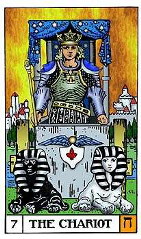
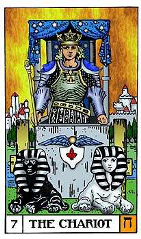
The “rushing and returning” indicates movement and rest. Aristotle’s dynamis as “possibility” or “potentiality”; kinesis or motion, movement; steresis or rest; energeia as completion or action at an end; entelechia the purpose or place (the stand, the topos of the thing) of something, the finished thing. Through all of these are “will” and “desire” understood as the dynamis, and these are related to the logos or speech and eros as ‘urge’. This is the moment of mystical vision, the moment when prayers are answered, the moment when the artist sees that which he or she is about to create . At these moments, we experience a re-birth or a change, an epiphany, which removes what were previous boundaries or limits to our being and we are able to rise up to the next level. This experience is that of the “embodied soul” as a Chariot, a chariot of fire.

The Text: 1.7

1.7 These ten Sephiroth which are, moreover, ineffable, have their end even as their beginning, conjoined, even as is a flame to a burning coal: for our God is superlative in his unity, and does not permit any second one. And who canst thou place before the only one? (And before One, what do you count?)

Alt. Trans. These ten Sephiroth which are, moreover, ineffable, have their end even as their beginning, conjoined, even as is a flame to a burning coal: for our God is superlative in his unity, and does not permit any second one. And who canst thou place before the only one?

Wescott Trans: 7. The Ten ineffable Sephiroth, whose ending is even as their origin, are like as a flame arising from a burning coal. For God (18) is superlative in his Unity, there is none equal unto Him: what number canst thou place before One.

Wescott Note:

18. God; the Divine name here is Jehovah.

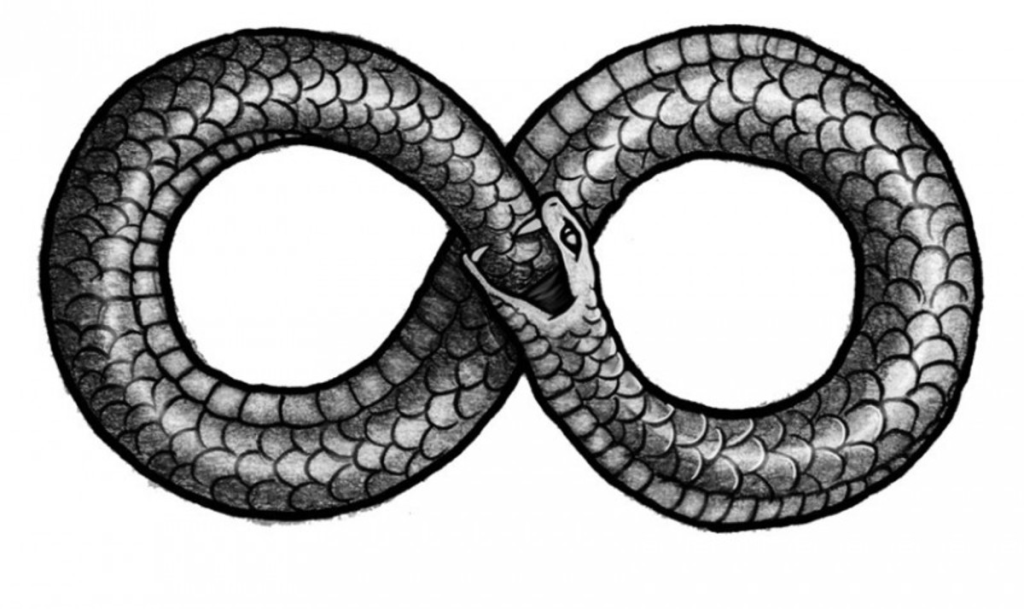
Since the Sephirot are embedded in a sphere, their shape and movement are circular. The end and the beginning are conjoined, yoked together. The ouroboros as the symbol of the infinite is seen within them. Beginning with Keter (Crown) and ending in Malkhut (Kingship), they may be seen as Cause and Effect: the Crown is responsible for (cause) the Kingship (effect), and the Kingship (effect) is responsible for, or obliged to, or brings about the Crown. (The placement of the Magician’s card at one may be questionable. Should he not be at 10? In the discussion of The Thirty-two Paths of Wisdom, I place The Magician at #10.)
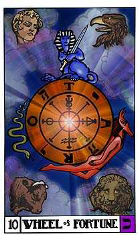
The Wheel of Fortune, Necessity, would therefore be placed at 1, or prior to the one. The Magician as a Maker uses the ready-to-hand objects of the physical world (the wands, pentacles, cups and swords) to make the things that are useful to human beings. He is the techne, the artisan, the maker. The Wheel indicates the circularity of the movement: the movements within the Tree of Life, the paths, are not linear, but circular. They are present as arcs, incomplete in themselves? They are the wheels within wheels. Within the Wheel of Fortune card in the four corners are placed the symbols of the four Evangelists of the Christian Gospel, the “testimony” or speech that is the understanding of the whole.)

The analogy used is that of “a flame to a burning coal”. The flame is the cause of the effect of the coal’s burning and the coal’s burning is the cause of the effect of the flame. The flame, fire, rises upward; the coal, the earth, moves downward in the potentia of its dynamis. The two are conjoined. Within the five dimensions of the spherical World, Keter as cause and Malkhut as effect could be in different places with Malkhut above Keter. Keter is sometimes seen as “will” by the Kabbalists, but “power” or “force” would, I think, be a better interpretation of this word. There is a distinction between the Divine Will understood as Necessity, and the human will which manifests itself in the worlds of Yetzirah and Asiyah.
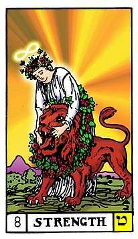
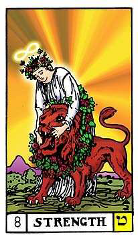
The Strength card, #11, shows no effort in controlling the passions or the “natural urges” within and without her represented in the figure of the lion. Is she exercising will or exercising power? Are the two related in Aristotle’s concept of dynamis? The Order of the Golden Dawn changed the original numberings of Strength and Justice from #11 to #8, but it is clear that The Magician #1 and Strength #11 are meant to be contrasted. Justice is represented as the “completed work” of The Magician energeia. The dynamis of the artist is present in The Magician whether he is forming the work or not. He can form the work and it is in this forming or performance that he is called an artist! But the potentia for the action, movement is present whether there is a performance or not.) The “will”, the choice, the decision is in the action itself; the “power” is present whether the action, choice or decision is performed or not.
If a pair of Sephirot are two points on an infinite line, the points come together at the “point at infinity”, the circular movement within the spherical. All lines or paths meet at “the point of infinity”, or the Heart, the centre of the sphere. Not to be involved in motion is to be at the centre of the sphere or wheel. Within the sphere, there are no opposites; there are deprivations. Evil is the deprivation of Good; poverty the deprivation of wealth; fullness the deprivation of need (Eros). The physical world requires space in order to be, an “open region” where it can manifest itself.

The spiritual realm is both within and beyond space: the soul is embedded in a body. The physical world is in both space and time. With the physical is time: being and time. The realm beyond the physical, the spiritual, does not require space and time. Angels, daemons, mediators are required to bring the realms of the physical and spiritual together. The flame of a candle cannot rise unless it is attached to something physical, the wax from which it derives or originates. Matter is our infallible judge. It is from matter, the physical appearance of the beauty of the world and individual human beings who happen to be in it, that we come to see Plato’s ‘fire catching fire’ as the effect of Love upon the flesh and the spirit.

In the spiritual realm, closeness is “resemblance”, kinship, friendship. The mediator brings two unlike things (such as two human beings) into a relation with each other so that they can resemble each other while remaining distinct individually: a:b:c, where b is the mediator between a and c bringing them into a relation. This relation exists on both the spiritual and physical levels.

The purpose of human being and of being human is to overcome the darkness of being, to bring being to light, to reveal being in its truth. The purpose of the Logos is to bring light to the world through life (eros), the light which the darkness cannot apprehend or comprehend. Both the darkness and the light are present simultaneously in human beings since we are embodied souls. The light is Love. The word for ‘truth’ in Hebrew is Emet which begins with the first letter of the alphabet and ends with the last letter. The two are joined together by Mem the middle letter of the alphabet. This suggests that the truth and the Logos are one and that this is Love (Eros).
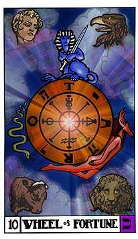
On the Wheel of Fortune tarot card are the letters TORA (in a counter-clockwise direction) and the letters TARO (in a clockwise direction). This appears to indicate that one can achieve union with God either through the revelation of the Divine Law (Tora, the movement West), or one can achieve this same union through Being (Taro, the movement East). Judaism and Islam have their revelations of God given through the Divine texts of the Torah and the Koran, the Divine Law. Christians have their revelation given to them through the Being of Christ given in the testimony of the Gospels. Given the other principles in operation here, this would seem to suggest that the Torah and the Tarot are the Same (as Christ Himself suggests). The paths of the Tree of Life as Nativ or personal paths must be undertaken by the individual alone, whether it be in choosing to accept the Divine Law as revealed or by carrying out the journey by other means to find contact with the Divine Presence through personal experience. This experience is what has come to be known as Gnosticism.

Numbers do not come into being until the formation of the physical universe. For numbers, understood as arithmos, the numbers used to count, there must exist quantity and plurality. Prior to the formation of the World, there was only God, Chaos, and God’s Spirit hovering over Chaos, but these are to be understood as the Trinity of the One. With His withdrawal, the Other appears (the physical universe) and with the Other, number is brought into being. (Or number and language, the Logos, always existed in the Spirit; and with the withdrawal of God, come to presence in physical being? This would explain why the physical is necessary to reach the spiritual through the logos of number and language, and would thus account for the circularity of the Tree of Life and the spherical nature of World.)

The Text: 1.8

1.8 And as to this Decad of the Sephiroth, restrain thy lips from comment (bridle/yoke thy lips from comment), and thy mind from thought of them, and if thy heart fail thee return to thy place; therefore is it written, “The living creatures ran and returned,” and on this wise (regarding this) was the covenant made with us.

Wescott Trans: 1.8. Ten are the ineffable Sephiroth; seal up thy lips lest thou speak of them, and guard thy heart as thou considerest them; and if thy mind escape from thee bring it back to thy control; even as it was said, “running and returning” (the living creatures ran and returned) (19) and hence was the Covenant made.

Westcott Note:

19. The text gives only RTzUAV ShUB−−”currendo et redeundo,” but the commentators have generally considered this to be a quotation from Ezekiel i. 14, referred to H ChIVT, the living creatures, kerubic forms.

This verse of the Sefer Yetzirah is said to deal with techniques of meditation, the clearing of the mind of language and the representations associated with language (what we commonly understand as thinking and thought). The purpose of the mantras and the whirling of the dervishes is to clear the mind so that one may experience the Sephirot directly. The Sephirot are the revelation of the truth of the things that are in their shining forth, their epiphanic, lightning-like appearance. The appearance of the Sephirot is the cause of the “running of the heart” which, due to its failure (because it is bound to the physical), must return to the foundation of its physical base and to the representations of the mind through Understanding. It is Plato’s “fire catching fire”, the glimpse of the Love that is the Heart of the World itself and which, due to its relation as potentiality for love, is “caught” or yoked with the Love that is the mediator of the World. This mystical union is beyond thought or speech (hence the “bridling” and the “yoking”.)

The covenant made between God and His creation is that His redemption is promised even though one must return to the physical. A covenant is a “mean” which joins two “unequal” or incommensurate entities, in this case God and the individual soul. For human beings, communion with the spiritual is erotic, a need, and the possibility of this communion is promised in such a way that it cannot be broken. (“What God has joined together let no man put asunder”). Our sin is our breaking of our covenant with God; His promise is redemption from that sin. When we cease to desire the spiritual, we become less than human. The mediation that is the bridge between the spiritual and the physical is the covenant of God. This mediation or covenant spiritual is what we commonly understand as Grace.

The Text: 1.9

1.9. These are the ten emanations of number. One is the Spirit (Breath) of the Living God, blessed and more than blessed (holy, benedicted) be the name of the Living God of Ages (the Life of Worlds). The Holy Spirit is his Voice, his Spirit, and his Word.

Wescott Trans.: 1.9. The ineffable Sephiroth give forth the Ten numbers. First; the Spirit of the God of the living; (20) Blessed and more than blessed be the Living God (21) of ages. The Voice, the Spirit, and the Word, (22) these are the Holy Spirit.

Wescott’s Notes:

20. The Spirit of the Gods of the Living. RUCh ALHIM ChIIIM; or as R. gives it, “spiritus Deorum Viventium.” Orthodoxy would translate these words “The spirit of the living God.”

21. AL ChI H OULMIM; “the Living God of Ages”; here the word God really is in the singular.

22. The Voice, Spirit and Word are QUL, RUCh, DBR. A very notable Hebrew expression of Divinatory intuition was BATh QUL, the Daughter of the Voice.

Commentary on 1.9:

This verse speaks of the One as the Holy Trinity, the Word made flesh (earth). One is Air (Spirit), which is God’s voice, spirit and His Word. It is through the One that Wisdom and Understanding come about through number and speech, and it is from these that we have knowledge. This is the “Breath of the Living God”, the God’s presence in His creation.

Aristotle

On the Tree of Life, Keter (Crown) is the first number to come into existence. The Holy Spirit is the “gift of tongues” which manipulates letters into words and gives human beings the ability to name things and, thus, to bring them into being. For the ancient Greeks, human being was the zoon logon echon, the living being capable of speech/language. The “spirit” is the dynamis and energeia of Aristotle, that of living beings, their animation, motion and completeness. While things that do not have soul can achieve completeness, ensouled beings experience an absence, a need, of that which makes them complete. Human beings are the needing beings, and their existence is essentially one of eros, the strife of fullness and need. One could say that human beings are perfect in their imperfection.

The act of speaking, the formation of words and language brings the things of the world into being. The naming, through the word, brings the being to a stand in its place in space and makes discourse, communication about it possible. Keter, through Tiferet (Beauty) to Yesod (Foundation), brings about the Sephirot through which all things are experienced (Malkhut). “The beginning is in the end, and the end is in the beginning”. This must be understood as simultaneous, not chronological.

It is through God (Word) that we are able to name things. The naming of things is a “holy act”. His Name is “blessed and benedicted”. God “descends” to us and we “descend” (kneel in prayer) to Him. “Bene-dicted” is literally “the good speech”, the good word, both what is said and what is received; the prayer and its answer, the speaking and the hearing. God is the “Life of Worlds”. We live in a number of worlds simultaneously, but it is “speech” that is the “life” within these worlds and makes these worlds possible. Language is the sharing of these worlds with one another. With the erosion and disintegration of language comes the destruction of the possibility of these possible worlds and the movement towards a one-dimensional, surface oriented world. Modernity is the great example of the growth of this wasteland of one-dimensionality. This one-dimensionality is visible to anyone who travels the world at this time. Those things that are the products of technology have the Same at their core.

God is “the Voice of Breath and Speech”. To breathe is to in-spire and it is this in-spiration which gives voice its ability to speak. Breath is the mediator between voice and speech. The movement is from right to left from our point of view and from left to right when viewed from the Tree of Life. “In the beginning God created…” Voice; “The breath of God hovered on the face of the water…” Breath; “God said, Let there be light…” Speech. “Divine inspiration” relates to prophecy, “the highest speech”. Prophecy was the highest speech because of the predictive powers given to it by its comprehension of all time i.e., past, present, and future. The predictive powers of the modern sciences through mathematical calculation is now considered “the highest speech”. This can account for the Hebrew esteem of the prophets and the Greek esteem for the poets, for both spoke “the highest speech” in relation to their two cultures.

A Commentary on the Sefir Yetzirah 1:2-1:5

1.2 Ten are the numbers, as are the Sephiroth, and twenty-two the letters; these are the Foundation of all things. Of these letters, three are mothers, seven are double, and twelve are simple. (This translation of the Sefer Yetzirah is from Rabbi Aryeh Kaplan’s excellent text which can be found here: https://books.google.co.id/books/about/Sefer_Yetzirah.html?id=aqc-61vr4q0C&redir_esc=y )

Alt. Trans. Ten are the numbers, as are the Sephiroth, and twenty-two the letters, these are the Foundation of all things. Of these letters, three are mothers, seven are double, and twelve are simple.

Wescott Trans: 1.2. Ten are the ineffable Sephiroth. (9) Twenty−two are the Letters, the Foundation of all things; there are Three Mothers, Seven Double and Twelve (10) Simple letters.

Wescott Notes:

9. The Ineffable Sephiroth. The words are SPIRUT BLIMH, Sephiruth Belimah. The simplest translation is “the voices from nothing.” The Ten Sephiruth of the Kabalah are the “Ten Primary Emanations from the Divine Source,” which are the primal forces leading to all manifestation upon every plane in succession. Buxtorf gives for Sephiruth−−predicationes logicae. The word seems to me clearly allied to the Latin spiritus−−spirit, soul, wind; and is used by Quintilian as a sound, or noise. The meaning of Belimah is more doubtful. Rittangelius always gives “praeter illud ineffabile.” Pistorius gives “praeter ineffabile.” Postellus evades the difficulty and simply puts the word Belimah into his Latin translation. In Frey’s Hebrew Dictionary BLIMH is translated as nothing, without any other suggestion; BLI is “not,” MR is “anything.” In Kabalistic writings the Sephiruth, the Divine Voices and Powers, are called “ineffbilis,” not to be spoken of, from their sacred nature.

10. The classification of the Hebrew letters into a Triad, Heptad and Dodecad, runs through the whole philosophy of the Kabalah. Many ancient authors added intentional blinds, such as forming the Triad of A.M.T., Ameth, truth; and of AMN, Amen.

Commentary:

The Sephirot are not actual numbers but are the source of the numbers: that is, they are the source of the logos or, more properly, the logos itself. Sephirah means “counting” (or “counting on”). We “count” and “count on” the physical universe to ensure us that our knowledge of it is true knowledge. We begin to count with the fingers of our hands. We ‘count on’ those things that are ready-to-hand, things that we can touch and manipulate. Numbers are one of the ways in which we view, interpret and encounter things. Just as we view and de-fine things through words, we can also do so through numbers.

Number is not possible without the space and time of the physical universe for number must express itself in quantity and there is no quantity in one. Wisdom (Chakmah) and Understanding (Binah) lead to Knowledge, and Knowledge and Understanding lead to Wisdom. Wisdom is said to have 7 pillars which are the 7 subject or knowledge areas of study, “the seven pillars of wisdom”. Knowledge is the product of Understanding and Understanding is prior to knowledge. The link between Wisdom and Understanding is the Word, or the letters, and the link between Understanding and knowledge is also the Word which imposes limits on things and makes them particulars. We understand, for instance, the plant-like of the plant and the animal-like of the animal before we have knowledge of the particular plants or particular animals and through speech can name them and can point them out to others.

Space is prior to Time and the Sephirot are sometimes referred to as “the 10 Sephirot of No-thingness (space)”, the Ain. I write “no-thing” to distinguish it from the nihil which is our common understanding of the nothing. It is with Time that things come into being; and according to the Sefer Yetzirah, things come into being through the three books of text, number and speech which are mediaries between Wisdom and Understanding. Knowledge and Understanding must also be linked through the Word. Through the “naming” of things, things are given their place (topos in Greek) in space and so can be talked about. The world and its experiences and contexts that have been created is to be interpreted as “text”. We read the world or worlds in which we live.

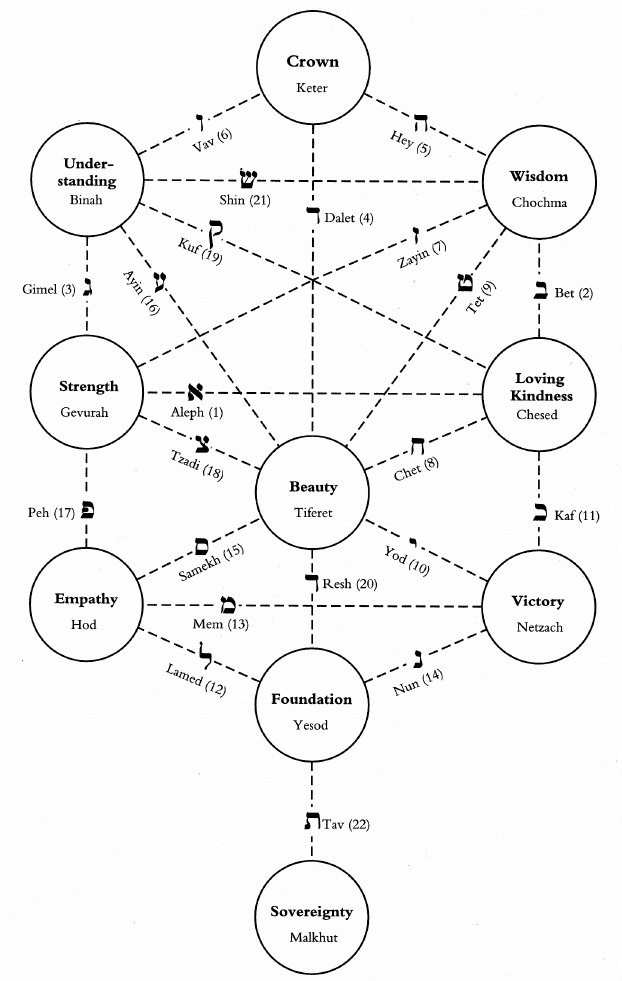
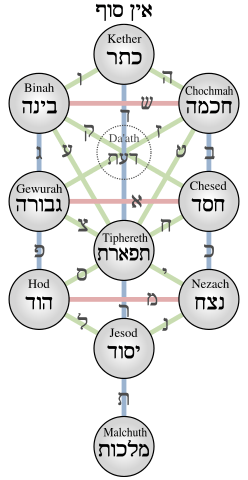
The lines in the Tree of Life total 22: 3 horizontal, 7 vertical and 12 diagonals corresponding to the 22 letters of the Hebrew alphabet. The 3 horizontals are called Mothers, the 7 verticals are called Fathers, and the 12 diagonals are called Simples. It is through the letters that the universe was created and they are called the 22 Foundation letters. It is through the letters that we come to understand and know the world.

The letters are not only involved in the inception of the world but they also sustain it. It is through text, number, and speech that the world is sustained and, as such, it is through human beings that “the way, the truth and the life” is sustained in the world since human beings are the only beings capable of speech. If one knows how to manipulate the letters correctly, one then knows how to manipulate the elemental forces and things of creation through the principle of reason. This relates to what the Greeks understood as techne, a knowing that involves a making (and what our word “technology” means today, and what is understood as yetzirah or “formation” in the text). This knowing and making is what artists and scientists do. This is but one side of the knowing that is present in the Sefer Yetzirah.

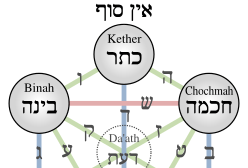
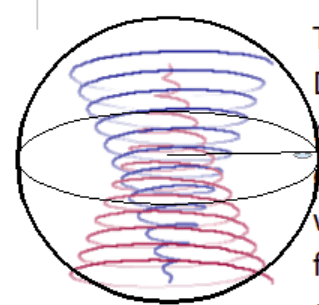
The three primary letters of the Kabbalah are א Alef (Ox), מ Mem (water) and ש Shin (tooth); and these are called the Three Mothers. They are the horizontal lines highlighted in red in the illustration on the left. Alef is the first letter of the Hebrew alphabet, Mem is the middle letter, and Shin is the second to last. The last letter (Tav) is not used because it is one of the Doubles (and thus would seem to imply a choice). The Doubles are illustrated in blue.

The three Mother letters are called “crossroads” because they are horizontal lines and cross over to the other side of the Tree of Life from left to right when viewed from the ascending motion or from the bottom up. They move from right to left when viewed in the descending motion, from top to bottom. (Notice that the Sephirot of Chesed and Gevurah are linked by the letter Alef which has passed through Tiferet initially. Chesed is Loving Kindness or Mercy, while Gevurah is Severity or Force. Chesed is what we understand by manifest Nature while Gevurah is what we understand by Convention. Tiferet is Beauty, and the letter Alef is in the centre of its name. It is the fire that is symbolized as the Sun. More will be said about this later.)

The twelve Simples or Elementals are illustrated in green and they are the diagonal channels of movement within the Tree of Life which are the netivot or private paths that one must traverse before one is able to ascend the Tree of Life.

The Sefer Yetzirah: 1:3

1.3 The ten numbers formed from no-thing are the Decad: these are seen in the fingers of the hands, five on one, five on the other, and over them (precisely in the middle) is the Covenant by voice spiritual (the Circumcision of the tongue), and the rite of Circumcision corporeal (as of Abraham).

Alt. Trans. The ten numbers formed from no-thing are the Decad: these are seen in the fingers of the hands, five on one, five on the other, and over them is the Covenant by voice spiritual, and the rite of Circumcision, corporeal (as of Abraham).

Wescott Trans: 1.3. The ineffable Sephiroth are Ten, as are the Numbers; and as there are in man five fingers over against five, so over them is established a covenant of strength, by word of mouth, and by the circumcision of the flesh. (11)

Wescott’s Notes;

11. The Two Covenants, by the Word or Spirit, and by the Flesh, made by Jehovah with Abraham, Genesis xvii. The Covenant of Circumcision was to be an outward and visible sign of the Divine promise made to Abraham and his offspring. The Hebrew word for circumcision is Mulah, MULH: note that MLH is also synonymous with DBR, dabar,−−verbum or word.

Commentary 1:3

While one has the plan for formation, for making something, through the understanding (the covenant of the spiritual or invisible word or voice), the formation itself occurs through the work of the hands. The covenant of the spiritual or voice is what we call “intelligence” or “consciousness”. The making of things occurs through the use of the ready-to-hand of the material things about us. Understanding is comprised of dianoic thought (the thought the brings or gathers separate things together into a unity or a one i.e. the logos) and diaretic thought (the thought that separates things to distinguish them from other things, how we classify things through our taxonomies). The manner of the seeing or how this covenant is interpreted or heard will determine whether one views the creation first through Love (Tiferet/Chesed) or whether one views the creation through Will (Gevurah/Tiferet), and this distinction is essential. These are the two faces of Eros and of the Logos.

The influence of the Pythagoreans on the Sefer Yetzirah can be seen in Aristotle’s, Metaphysics, I.5.986 a22, where he says: “Members of this school [the Pythagoreans] say there are ten principles, which they arrange into two columns of cognates (the pillars of Jakim and Boaz in the Tree of Life), thus: limited and unlimited, odd and even, one and many, right and left, male and female, rest and movement, straight and curved, light and darkness, good and bad, square and oblong.” The ten principles of the Pythagoreans correspond to the 10 Sephirot of the Kabbalah’s Tree of Life.

One of the puzzling things about the Tree of Life is the basic sense of direction given to it: do we determine the right and left from our perspective or should the Tree of Life be viewed in a mirror or from its own perspective which would reverse the directions given to it? I am puzzled because I am wondering how we can attribute Love (Chesed) as a Masculine principle (Aphrodite/Venus is female and the surroundings of The Emperor #4 card in Tarot are sterile i.e., they have no living nature about them) and the Masculine is placed on the right-hand side of the Tree which contains the five Loves, while Strength/Force/Will are attributed to the Feminine aspects and placed on the left side of the Tree of Life and are called the five Strengths? I will attempt to make sense of this puzzle as I proceed with this commentary.)

A covenant comes between two separate, unequal parts and holds them or yokes them together in a harmony; it makes them commensurate to each other. The covenant of the Spiritual Circumcision is the Parousia of God, the “being alongside”, “between”, “among”, that is the relation of God to His creation. The covenant is “the Lamb slain from the foundation of the Earth” for Christians, and the Ten Commandments of God or the Torah for the Hebrews. For the Hebrews, truth is revealed as Law; for Christians, truth is revealed as Being. The middle pillar of the Tree of Life is the place of the covenant. (This could be represented pictorially in the form of a cross as two diameters of a circle or sphere crossing in the centre).

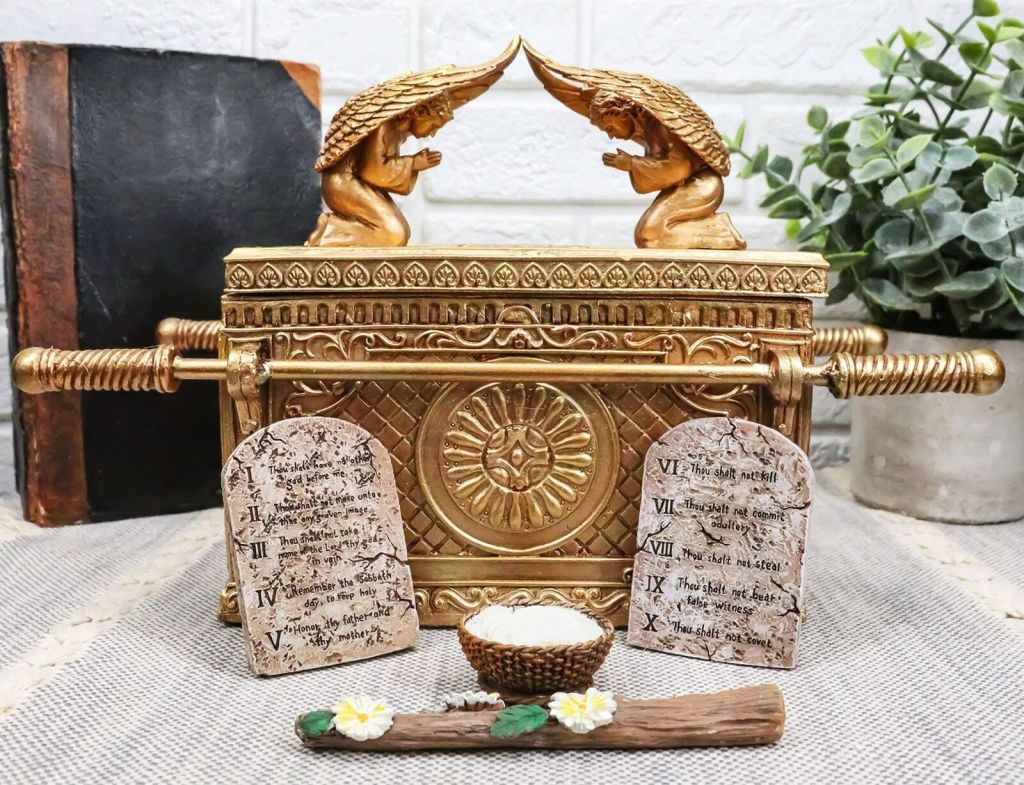
In the Hebrew, the “circumcision of the tongue” is fluency in speech i.e., the highest speech, “prophecy”, the ability to pre-dict. We consider science as our “highest speech” because of its ability to predict outcomes and so we, currently, “bow down to” science. This fluency of speech is a gift through the mediation or parousia of God in His creation. Without this presence, we would know nothing. The two Cherubim on the Ark of the Covenant were said to be the source of all prophecy, but God is the third who speaks through the Cherubim who are the mediators: “There I will meet with you, and from above the mercy seat (Jakim, the ark cover), from between the two cherubim which are upon the ark of the testimony I will speak with you”. (Exodus 25:22) The two Cherubim on the Ark represent the two faces of Logos and Eros. When the Cherubim were removed from the Ark with the destruction of the First Temple, prophecy is said to have ceased to exist.

The circumcision of the sexual organ is the recognition that one can be empowered to have control over the urges that create strife in the human body and soul, one of the most dominant being the sexual urge. (This could be seen as an example for justifying the Strength card as #8 in Tarot since this is the step beyond the Chariot card and the strife between the two sphinxes represented in that card. The figure’s easily closing the jaws of the lion representing the passions would suggest this. The Justice card, however, suggests the need for control on the social plane, the higher demand to be just to each human being. It is the urges, the needs, that we have which create injustice in human relations. But they also create Justice…The Tree of Life seems to suggest that the individual is on the right side and the social is on the left side and there is the constant crossing over via the paths.)

The two covenants spoken about here would suggest the two faces of Eros and the Logos, the voice and the flesh, the spirit and the body, which shall be discussed in more detail as we proceed further into the texts of the Sefer Yetzirah and “The Thirty-two Paths of Wisdom”.

The Sefer yetzirah 1:4

1.4 Ten are the numbers of the ineffable Sephiroth, ten and not nine, ten and not eleven. Learn this wisdom, and be wise in the understanding of it, investigate these numbers, and draw knowledge from them, fix the design in its purity (“make each thing come to stand in its essence”), and pass from it to its Creator seated on his throne.

Alt. Trans. Ten are the numbers of the ineffable Sephiroth, ten and not nine, ten and not eleven. Learn this wisdom, and be wise in the understanding of it, investigate these numbers, and draw knowledge from them, fix the design in its purity, and pass from it to its Creator seated on his throne.

Wescott Trans: 1.4. Ten is the number of the ineffable Sephiroth, ten and not nine, ten and not eleven. Understand this wisdom, and be wise by the perception. Search out concerning it, restore the Word to its creator, and replace Him who formed it upon his throne. (12)

Wescott’s Notes:

12. Rittangelius gives “replace the formative power upon his throne.” Postellus gives “restore the device to its place.”

Commentary 1:4

Was God’s creation an act of will or an act of love? God in His withdrawal, His allowing something to be other than Himself, provides us with the perfect path or example for our own existence. (As the French philosopher, Simone Weil, once said: “If we forgive God for not existing, He will forgive us for existing”.) Is the withdrawal of the great artist from his work an act of will or an act of love? The artist can choose to withdraw or not; the artist can choose to bring forth that which inspires her or not. The common view is that it is an act of will rather than an act of love which brings forth great art; but an artist who withdraws through the will does not produce ‘great art’.

Both God and the Sephirot are “ineffable” and cannot be described through the use of language. But to see God as pure Will moves too close to Nietzsche for my liking (the eternal recurrence of the Same). The Sephirot are emanations of God and are, therefore, used to describe God. But God is beyond the Sephirot (Plato: “The Good is beyond Being”), just as the rose itself is beyond the emanation of its odour. The Sephirot themselves are inadequate representations of the Good. We could equate them with the “ideas” of Plato.

The Sephirot are one of the ways used to attempt to describe God, ways that human beings can comprehend the qualities of God or the predicates of God. All cultures attempt to describe God with the things that are ready-to-hand for them. God is One and ineffable. The attempts to proselytize the “true religion” without first learning the nature of the religion of those that one is attempting to convince that it is the “true religion” is akin to madness, an error and misunderstanding of the directive to “Go forth and make disciples of all nations”. A “disciple” is a “friend”, one with whom one can engage in friendly conversation i.e., dialectic. The proselytizing spirit should have been an exercise in communication and unification but, unfortunately, it was not. It became, and remains in most cases, an exercise in power, an exercise in evil.

This passage of the Sefir Yetzirah deals with the first three Sephirot: Keter, Chakmah, and Binah: The Crown, Wisdom, and Understanding. As discussed earlier, Wisdom is knowledge of the whole, which is difficult if not impossible to attain since we ourselves are part of the whole; however, this does not deter the quest for such knowledge, and as long as there are human beings, such a quest will continue.

Understanding precedes knowledge in that understanding is the sensory awareness of the presence-at-hand of things as well as their possible readiness-to-hand for ends that we determine. To make things stand in their essence is to reveal them in their truth. From this revealing of things in their truth, one passes from them to their Creator. One examines all things and determines which Sephirot relates to them (“Examine with them”). “Probe from them”: the Sephirot are not contemplated in themselves but are used to develop an insight into the things of the world. (Plato’s ideas are numbers, but they are not the numbers of arithmos or calculation. One uses them to gain knowledge of the things of the world and to recognize the things as “shadows”.) This “probing” brings a thing to a stand so that it will step forth and show itself as a “this” and not “that”. To let a thing be in its essence is to go beyond viewing the thing as something which is of possible use for our ends.

Here is thought understood as dianoia and diaresis, with knowledge as the outcome. The Sephirot themselves are reached through the “paths of Wisdom”; the paths are the “pure design” which is the product of Understanding (the limits placed on the Unlimited). The “design” is the Law of Necessity. The “examining” of things with the Sephirot is the determination of how the things in their essence belong to, or are possessed by, the Sephirot to which they belong or are possessed. The “probing” of things is the determining of the essence of the thing, the determining of the truth of the thing and the revealing of the thing for what the thing really is. This revealing “elevates” the thing from the shadows into its true reality. Examining and probing are part of questioning. This elevating of the thing is the “restoring” of the original Word to its Creator. We participate in the creation of the world by decreating ourselves by mirroring God’s act of withdrawal.

The four universes of the Sefer Yetzirah are: 1. Atzilut (Nearness, Emanation, the parousia of the Divine); Content: Sephirot; Level: No-thingness; 2. Beriyah (Creation); Content: the Throne (the Creation itself as the “lowering” of God, and the vehicle through which He expresses His care and concern through the Beauty of the world); Level: Something from No-thing, ex nihilo; the Sephirot of ‘no-thingness’; 3. Yetzirah (Formation); Content: Angels/Cherubim, products of the spirit, mediators; Level: Something from Something, “in another for another”; 4. Asiyah (Making, Action); Content: Shadows of the physical; Level: Completion (the work, the artifact, from dynamis potential to energeia the completed work). More will be said about the four universes later.

The Sefer Yetzirah 1:5

1.5 These Ten Numbers, (beyond which is the Infinite one), have the boundless realms, boundless origin and end, an abyss of good and one of evil, boundless height and depth, East and West, North and South, and the one only God and king, faithful forever seated on his throne, shall rule over all, forever and ever.

Alt. Trans. These Ten Numbers, beyond the Infinite one, have the boundless realms, boundless origin and end, an abyss of good and one of evil, boundless height and depth, East and West, North and South, and the one only God and king, faithful forever seated on his throne, shall rule over all, forever and ever.

Wescott Trans: 1.5. The Ten ineffable Sephiroth have ten vast regions bound unto them; boundless in origin and having no ending; an abyss (13) of good and of ill; measureless height and depth; boundless to the East and the West; boundless to the North and South; (14) and the Lord the only God, (15) the Faithful King rules all these from his holy seat, (16) for ever and ever.

Wescott Notes:

13. Abyss; the word is OUMQ for OMQ, a depth, vastness, or valley.

14. My (Case’s) Hermetic rituals explained this Yetziratic attribution.

15. The Lord the only God. The words are ADUN IChID AL, or “Adonai (as commonly written) the only El.”

16. Seat. The word is MOUN, dwelling, habitation, or throne.

Commentary 1:5

The text here deals with Space. God, the infinite One, is the “Former” (Yotzer), “the one who forms”. He is the Demiourgos of Plato’s Timaeus. The distinction between “formation” and “creation” is important. Here, the formation occurs within that which is boundless. The boundless is the “unlimited”, designated as the water of Chakmah, the khora of Plato’s Timaeus, that which is given limits so that it may be de-fined (“of the limits”) and designated as a particular thing. It is given shape. The boundless is given its limits through language and number, and it is through language and number that things come to stand as ousia, as presence in their particularity in the Now of Time. God as the Former is the Logos of the Greeks (“It is through Him that all that is comes into being, and nothing comes into being except through Him”. John 1: 1-5)

The three lower universes align with the ideas of “to create” (Beriyah), “to form” (Yetzirah), and “to make” (Asiyah). “Wisdom” is to create, “Understanding” is to form, and “knowledge” is to make. The making implies the completion of an action, the pro-duction of a thing such that the thing requires no further action and is complete; it is “perfect” in its emergence into presence.

The Sephirot #9 Yesod has connotations with “binding” and “connecting” and connects the physical world to the world of Yetzirah or the world of the formation which is associated with the angels or mediators, the daemons, and the human soul is considered one of these. It is through the mediation of the angels that the physical world is elevated or lifted up and restored to its Creator. The physical world is “brought to a stand” i.e., elevated, through the use of language and number. This is the covenant of speech. That Yesod is also associated with the sexual organs indicates its relation to the covenant of the flesh, circumcision.

(This is how the Magician #1 card of the Tarot is to be understood: he is not Keter or #1, but rather Malkhut #10. Through the formation of the ready-to-hand physical things of the world (the cups, wands, pentacles, swords), he elevates these things to the level of Yetzirah or “formation” through the mediation of Yesod which is the foundation, or base, of the physical world, what we understand as “metaphysics”. Yesod requires and is associated with sense perception and will (the sexual organ, the “lower” associations with Eros), and these are the initial “mediators” between the soul and the physical world.)

Space, within which the Tree of Life rests, is not a two-dimensional circle but a sphere. The sphere is divided into a five-dimensional continuum. Space is prior to Time, and Time as well as number begins with the being of created things, the physis of the world, its materiality. The infinite One (the Good) is beyond both space and time. The boundaries of space, the limits, are the realm of Necessity. They are indicated by the 10 directions within which space is given.

Three dimensions are “up/down”, “north/south”, “east/west”, and these three dimensions are further defined by the six directions of World as outlined. The Time continuum is defined by two directions, past and future, or beginning and end. This is called “year” and is the fourth dimension. The fifth dimension is the spiritual dimension and is defined by good and evil, and this is called “soul”.

To illustrate these dimensions within the sphere of space using the Tree of Life: 1. Beginning (Chakmah/Wisdom)/ End (Binah/ Understanding); 2. Good (Keter/Crown)/ Evil (Malkhut/Kingship); 3. Up (Netzach/Victory)/ Down (Hod/Splendour); 4. North (Gevurah/Strength)/ South (Chesed/Love); 5. East (Tiferet/Beauty)/ West (Yesod/Foundation).

God, called Elohim, creates the world with 10 sayings or speeches, which is the understanding. (Elohim is the Christ, the Logos, of St. John, but he is not limited to this manifestation only. He could also be considered to be Krishna or any other of the possible names that human beings have come to understand Him in their being-in-the-world). Wisdom as beginning represents the past. Memory is hidden, concealed until it is revealed or re-collected through the understanding (in words or images). The mediation of Wisdom (past) and Understanding (future) conceived as Time is the present. (“The future comes to meet us from behind” as the Greeks would say.) It is in and through Time that things come to be. Wisdom is the no-thing of Being which becomes the some-thing through understanding, through speech and number.

The centre line of the Tree of Life from Keter to Malkhut is called the “Tree of Knowledge”. On a two-dimensional plane, Keter is seen as closest to God while Malkhut is farthest. This is the traditional way of viewing the creation. The centre line is composed of 4 Sephirot: Keter (Good), Tiferet (Beauty), Yesod (Foundation), and Malkhut (Kingdom). (In The Lovers #6 tarot card, Adam stands before the Tree of Life while Eve stands before the Tree of Knowledge, if one wishes to interpret the figures in this way). In the direction of the descent, the Good proceeds to Beauty which provides the Foundation for Kingdom. When the direction is as ascent, Kingdom is the deprivation of the understanding to seeing the Foundation as the manifestation of the Beautiful and the Good.

Since World is a sphere (an infinite sphere? A sempiternal sphere?), the speaking of up and down as far as directions does not make sense. The Sefer Yetzirah speaks of depths. There is a great depth, a chasm, separating the Necessary from the Good. The depths are the “deprivations” of things. The depths are the “need” of things to realize their true substance and to come to their true essence which is their perfection. This possibility of perfection is always present within them. The human being is the ‘perfect imperfection’. Something is absent, missing. For something to meet these needs, a great depth must be crossed. The crossing is done in a series of steps or leaps. (What was understood as Jacob’s Ladder) For God to answer prayers, a great depth must be crossed, the whole of the created World itself, for God Himself is unaffected by His creation. He is beyond both Space and Time. Given what we know about the deep immensities of space, this crossing is not easily accomplished.

Commentary on the Sefer Yetzirah: Chapter One

The Tree of Life from the Kabbalah:

The Tree of Life

What will be shown in this writing is how the letters and the paths associated with the Sephirot of the Kabbalah correspond to the 22 Major Arcana of the Tarot. The emanations of the Sephirot correspond to the symbols and images presented in the cards; that is, the objects and situations that we encounter within our worlds correspond in their true natures to the numbers and images “revealed” in the cards when interpreted correctly. “Interpretation” involves attention, contemplation and reflection. An “emanation” emanates from a source. An emanation is not an expansion of the source but a withdrawal of the source to allow the emanation to be just as, paradoxically, the perfume of a rose is made possible by the rose’s withdrawal and yet is at the same time a stepping forward of the rose itself to manifest its being as a sign of its presence. The presence involves an absence and a hiddenness at the same time.

The Tarot cards, composed of letters and numbers, are intermediaries between the individual and the world we live in. They are what we understand as art. They are tools or equipment to assist in the overcoming of the distinction between mind/body, soul/body, and the self/world. All that is known (the Greek word gnosis) is brought to presence through language and number, or through Word.

Movement is Life. As illustrated through the Tree of Life, movement, kinesis, begins at 1. the Crown (Keter) and flows to 2. Wisdom (Chakmah), then to 3. Understanding (Binah), through to 4. Loving Kindness (Chesed), then to 5. Strength or Force, Power (Gevurah), through to 6. Beauty (Tiferet), then to 7. Victory (Netzach), then to 8. Empathy, Mercy (Hod), from there to 9. Foundation (Yesod), and finally to 10. Kingdom or Sovereignty (Malkhut). The movement is from right to left or East to West. All the Sephirot pass or are channeled through #6 Beauty (Tiferet) with the exception of #10 Kingdom (Malkhut). This is the movement from top to bottom, from the heavens to the earth, or the direction of the primal creation. The movement upwards involves depth, while the movement downwards tends towards the surfaces or the outward appearances of things; and the further one moves down, the further one is away from the reality of things.

A most important point to note is that the creation of the world is not an “expansion” from God but a withdrawal of God. In making the universe, God allows something other than Himself to be and yet, paradoxically, it is at the same time Him since He is One and the Whole. This Otherness and withdrawal of God signifies both His presence and His absence in His creation just as the presence and absence of the rose is revealed by its perfume.

Text of the Sefir Yetzirah with Commentary:

This is a highly recommended text.

The Sefer Yetzirah is written in poetry because philosophy is more akin to poetry than to history, which is more akin to prose. Its narrative is a mythos, a story of the God and His Creation. The exercises and statements made in the text are akin to philosophy for they are attempts to answer the questions of Being and of coming-into-being: the how, what, who, where, when and why of created things. In traditional philosophy this is what is called metaphysics.

The translations here render the original poetry of the Hebrew into current modern English prose. As with all translation, something is lost, but something may also be gained by examining the texts closely. There are many versions of the Sefer Yetzirah, with many additions and retractions occurring throughout the ages. The versions here are an attempt to provide a readable translation through an amalgam of the many versions available. Three different translations are provided here.

1.1 In thirty-two mystical paths of wisdom did JAH the Lord of Hosts engrave his name: God of the armies (hosts) of Israel, ever-living God, merciful and gracious, sublime, dwelling on high, who inhabits eternity. He created this universe by the three Sepharim: Number, Writing, and Speech. (The translation used here is from Rabbi Aryeh Kaplan's Sefer Yetzirah: The Book of Formation which can be found here. This book is highly recommended. 

https://books.google.co.id/books?id=aqc-61vr4q0C&printsec=frontcover&source=gbs_ge_summary_r&cad=0#v=onepage&q&f=false)

Alt. Trans.: In two and thirty most occult and wonderful paths of wisdom did JAH the Lord of Hosts engrave his name: God of the armies of Israel, ever-living God, merciful and gracious, sublime, dwelling on high, who inhabiteth eternity. He created this universe by the three Sepharim: Number, Writing, and Speech.

Wescott Trans: . In thirty−two (1) mysterious Paths of Wisdom did Jah, (2) the Jehovah of hosts, (3) the God of Israel, (4) the Living Elohim, (5) the King of ages, the merciful and gracious God, (6) the Exalted One, the Dweller in eternity, most high and holy−−engrave his name by the three Sepharim (7) −−Numbers, Letters, and Sounds.(8)

Wescott NOTES TO THE SEPHER YETZIRAH CHAPTER ONE

(These notes are provided as an appendum to the Wescott translation and may provide some perspective on how the text was translated.)

The twelve sections of this chapter introduce this philosophic disquisition upon the Formation and Development of the Universe. Having specified the subdivision of the letters into three classes, the Triad, the Heptad, and the Dodecad, these are put aside for the time; and the Decad mainly considered as specially associated with the idea of Number, and as obviously composed of the Tetrad and the Hexad.

1. Thirty−two. This is the number of the Paths or Ways of Wisdom, which are added as a supplement. 32 is written in Hebrew by LB, Lamed and Beth, and these are the last and first letters of the Pentateuch. The number 32 is obtained thus−−2 x 2 x 2 x 2 x 2=32. Laib, LB as a Hebrew word, means the Heart of Man. Paths. The word here is NTIBUT, netibuth; NTIB meant primarily a pathway, or foot−made track; but is here used symbolically in the same sense as the Christian uses the word, way−−the way of life: other meanings are−−stage, power, form, effect; and later, a doctrinal formula, in Kabalistic writings.

2. Jah. This divine name is found in Psalm lxviii. 4; it is translated into Greek as kurios, and into Latin as dominus , and commonly into the English word, Lord: it is really the first half of the word IHVH or Jehovah, or the Yahveh of modern scholars.

3. Jehovah Tzabaoth. This divine name is printed in English Bibles as Jehovah Sabaoth, or as “Lord of hosts” as in Psalm xxiv. 10. TzBA is an army.

4. God of Israel. Here the word God is ALHI, which in unpointed Hebrew might be God, or Gods, or My God.

5. The Elohim of the Living. The words are ALHIM ChIIM. Alhim, often written in English letters as Elohim, or by Godftey Higgins as Aleim, seems to be a masculine plural of the feminine form Eloah, ALH, of the divine masculine name EL, AL; this is commonly translated God, and means strong, mighty, supreme. Chiim is the plural of Chi−−living, or life. ChIH is a living animal, and so is ChIVA. ChII is also life. Frey in his dictionary gives ChIIM as the plural word lives, or vitae. The true adjective for living is ChIA. Elohim Chiim, then, apart from Jewish or Christian preconception, is “the living Gods,” or “the Gods of the lives, i.e., living ones.” Rittangelius gives Dii viventes, “The living Gods,” both words in the plural. Pistorius omits both words. Postellus, the orthodox, gives Deus Vivus. The Elohim are the Seven Forces, proceeding from the One Divine, which control the “terra viventium,” the manifested world of life.

6. God. In this case we have the simple form AL, EL.

7. Sepharim. SPRIM, the plural masculine of SPR, commonly translated book or letter: the meaning here is plainly “forms of expression.”

8. Numbers, Letters and Sounds. The three Hebrew words here given are, in unpointed Hebrew, SPR, SPR and SIPUR. Some late editors, to cover the difficulty of this passage, have given SPR, SPUR, SIPR, pointing them to read Separ, Seepur, Saypar. The sense of the whole volume appears to need their translation as Numbers, Letters and Sounds. Pistorius gave “Scriptis, numeratis, pronunciatis.” Postellus gave “Numerans, numerus, numeratus,” thus losing the contrasted meanings; and so did Rittangelius, who gave “Numero, numerante, numerato.”

Comments on the Text: 1.1

The 32 paths indicated in the Kabbalah are the ten digits of one’s hands and the 22 letters of the Hebrew alphabet. The quantities of things, the physical or material things, are calculated and expressed by number and these are what can be counted on and grasped by the hands, the ready-to-hand things. The qualities of things, the categories we use to describe things, are expressed by language, words formed out of letters. Numbers require plurality and only come into existence with the creation of the physical universe, with space and time. The numbers begin at 4; i.e., the Trinity of God as One and Three, and the physical matter of creation at 4. The Sephirot define the numbers because they first came into creation as emanations of God. All numbers are contained in the Ten, and all Ten are contained in the One and all are emanations of the One.

The 32 paths are the number of times God’s name, Elohim, is mentioned in the account of creation in the Book of Genesis. “God said” appears 10 times i.e., the ten Sephirot starting with “In the beginning God created the heavens and the earth.” Elohim is a plural and so is not actually God Himself. The figure of Elohim shares many of the same characteristics as the figure of Eros, and there is a clear connection between Eros and the Logos or the “sayings of God”.

The other 22 times are the 3 where “God made”, (the three Mother letters of the Sephirot Alef, Mem, Shin which indicate the 4 universes comprising the whole: Atzilut, Beriyah, Yetzirah, and Asiyah and the bridging of those worlds: God Himself, being the first, etc.), the 7 references referring to “God saw”, and the 12 other references of Elohim referring to the remaining 12 letters of the alphabet.

The 32 paths are the channels through which “spirit” (understood as the element of Air, and in other places referred to as Mind or Intellect) influences the body and all physical matter; and for human beings all these channels must go through the heart. The channels operate both ways: up and down, spirit or mind influencing the heart and the heart influencing the spirit or mind. The heart is the causal link between the mind/body and it is connected to the Life force. In the passage from St. John the Evangelist, “In Him life was, and this life was the light of human beings” indicates that truth is not some intellectual abstraction but is the actual or authentic way of human beings’ being-in-the-world. The Sefer Yetzirah calls the heart “the king over the soul”, the soul being the kingdom over which the heart rules. It is the heart which establishes the mood of care/concern for those things which have come to be meaningful for us as human beings.

The number 32 is also 25 indicating that there are 5 dimensions to the visible universe. The visible universe is like an onion or a babushka doll whose layers conceal the hidden mystery within. The 32 paths are referred to as Nativ in the Sefer Yetzirah which means a “private” not a “public” path. Each individual must traverse these paths on their own. The means of ascent or descent along the Tree of Life is through 231 Gates with each Gate bearing a “threshold guardian” of some type (one must assume). Understanding what the nature of these threshold guardians is is very important in travelling along the paths. A teacher for example, if he or she is a proper teacher, is a threshold guardian along one of life’s paths.

The paths are said to be “mystical”. In Hebrew the word mystical (peliyot) has connotations of being hidden, separated from the world at large, “occult”. One can see a relation to this hiddenness from the Greek word aletheia which means “to unconceal”, “to reveal”, “to remove from forgetfulness”, ” to make unhidden” and aletheia is the Greek word for “truth”. The human being as a human being and to be an authentic human being is called upon to reveal truth, and the revealing of truth brings one into strife with that which is hidden and with those who would wish it to remain hidden. This is the primary conflict between the individual and the collective. It is the political conflict.

The 32 paths are said to be the paths to/of “wisdom”. “Wisdom” is said to be knowledge of the whole, the One. The Greek word for this knowledge is gnosis. Wisdom is the knowledge of the Same, that which goes beyond the knowledge of the particulars that compose the physical world. “Wisdom” includes what the Greeks understood as phronesis or “wise judgement”, and wise judgement was understood as one of the four virtues or “human excellences” that lead to happiness. Wisdom is also the seeing of unity in the diversity of particular things. It is seeing the tree that is present in all trees whether oak, elm, or beech. It is also to recognize the deprivations of those things that exist, such as Evil, from their fullness, which is the Good. The Wise are able to see Time in its wholeness and can comprehend past, present and future simultaneously. The whole of the Sefer Yetzirah is an attempt to see the unity amidst the diversity of the things that are in space and time. Those who are able to see the whole are “prophets”. The woman presented in the Tarot card “The World” is a prophetess.

We mentioned that Elohim is God’s name used 32 times in Genesis and this corresponds to the 32 paths that lead to Wisdom. The state of Wisdom is the second Sephirot of the Tree of Life, Chakmah. The third Sephirot is Binah, or Understanding, which is knowledge of particulars. This knowledge of particulars corresponds to our apprehension of the particular objects about us and their possible uses for us.

Elohim is a plural in Hebrew and corresponds, I think, to the Trinity that is present prior to the creation of the physical universe, the Trinity that must be present for the universe to be. Understanding is that knowledge which places the limits on the unlimited, what allows particular objects to come to presence for us. To place limits on is to “de-fine”, and it is this defining of things, of what they are, that allows the things to come to presence and be visible to us as the things they are. They are given boundaries and framing. This “defining” is accomplished through language and number, what we have historically come to call metaphysics. Wisdom itself is beyond language and number. Wisdom is associated with the element water, while Understanding is associated with the elements of Air and Fire. Wisdom is associated with emotions/heart, while Understanding is associated with mind/intellect. How these contraries are connected and brought into harmony is the core of the teaching of the Sefer Yetzirah. It is the understanding of the two faces of the Logos and of Eros.

Wisdom is seen as thought thinking thought, pure thought, the same concept as Aristotle’s understanding of God, the Unmoved Mover or the Uncaused Cause. The concept of thought without words, numbers or images is beyond me, unless it is simply thought as the Life-force itself i.e., thought as pure possibility or potentiality, dynamis. This would suggest that the “cause” of the life force itself is the element air in combination with fire and water. Wisdom would be simple unity, harmony. In Plato’s dialogue Timaeus, she is the khôra or receptacle of all: “So likewise it is right that the substance which is to be fitted to receive frequently over its whole extent the copies of all things intelligible and eternal should itself, of its own nature, be void of all the forms. Wherefore, let us not speak of her that is the Mother and Receptacle of this generated world, which is perceptible by sight and all the senses, by the name of earth or air or fire or water, or any aggregates or constituents thereof: rather, if we describe her as a Kind invisible and unshaped, all-receptive, and in some most perplexing and most baffling partaking of the intelligible, we shall describe her truly.”— Plato, Timaeus, 51a. Here, Plato sees the relation between Wisdom and Understanding, or the Sephirot Chakmah and Binah, as most “baffling” and “perplexing”. The word “intelligible” is one that will come under much discussion and scrutiny as we move through this interpretation of the Sefer Yetzirah. This area could be represented by Da’at, the Void, from out of which the Life- force and beings emerge.

The concept of creation which I mentioned earlier as the “withdrawal” of God to allow something to be other than Himself can be understood from the word “engrave”, when He uses the 32 paths to “engrave” the universe. When we speak of writing, we mean we add ink to paper (expansion). When we engrave, we remove material in a clay tablet (or whatever) as we see in cuneiform writing (withdrawal). The word “engrave” could also indicate the setting of boundaries; the limits placed on the unlimited, and it is the shapes of the letters themselves which establish these limits or boundaries in the written word.

The letter Yud in Hebrew has a numerical value of 10, indicating the 10 Sephirot. The letter Heh has a numerical value of 5, indicating the five fingers on the right hand. In the idea of “making”, the hands are important as they are what we use to grasp the things of the world, the ready-to-hand, the materials we use to make the artifacts that are useful to us. The letters of the Divine Name Yah Heh, are present at the beginning of the Creation and are the essence of the Creation (the Trinity and the concept of the Word as God and with God).

There is some difficulty with trying to interpret the YHVH as “the Lord of Hosts” and of the “hosts” understood as “the armies of Israel”. The Sefer Yetzirah suggests that the “hosts” represent all of the beings created through the 10 Sephirot and how these beings are understood by human beings through numbers, writing and speech. We can understand the “hosts” as that moment when God reveals Himself to human beings through His creation; those beings He created are His “hosts” in the same way we can understand being a host of an event such as a dinner party or a meeting. In Shakespeare’s King Lear, King Lear and Cordelia will act as “god’s spies” i.e. they will be his “hosts” for they will allow Him to see His creation through their eyes (Act 5 sc. iii). YHVH indicates a sort of dualism: the first YH separated by the Vah Heh. But again, they indicate the three-in-one concept which is attempting to be illustrated here: YH is God, VH is His creation and both together comprise YHVH.

The “Living God” is to be understood as the Life-force itself, what we have come to call Nature, and what the Greeks understood as phusis and poiesis. It is the force (dynamis) that causes things to emerge and come to a stand so that they can be known (energeia). The names of God (Elohim) indicate the activity of this force in the downward motion through the Tree of Life. For example, “God saw” is mentioned 7 times and so this should focus our attention on “seeing” when we are attempting to understand the essence of the Sephirot #7 or Netzach (Victory). This should also focus our attention on the element of sight, on how things are perceived, when attempting to understand the Chariot Tarot card.

The word “Holy” indicates that which is separated from the mundane, the common. It is the separation of God from His creation, what is to be bowed down to or looked up to and not to be given an image or named.

The place of the concept of “will” is troubling in our understanding of who and what we are. In the Sefer Yetzirah, will is placed beyond all other forces in its representation in the Sephirot Keter, #1 and in #10 Malkhut. Both are seen as Kingdoms and God is King of the Universe or the Whole. The Ten Commandments are the will of God. Necessity is the will of God. Is will a motivator prior to Love (Eros) or is Love prior to will? This issue will be explored in this interpretation of the Sefer Yetzirah. For the moment we may understand “God’s will” as the Law of Necessity which is embedded and enmeshed in the creation itself. It is the schema or blueprint used by the demiourgos in his making of what is.

The three “books” used for the creation are text (Sepher), number or cipher (Sephar), and communication or the telling (Sippur). All relate to what the Greeks called logos, while the will is associated primarily with eros. They relate to the quality (emanations), quantity (the physical, material things), and the relation to others or the talking to others of that which has been created. The three books relate to Space (Universe), Time (days of the week) and Soul (how these are to be properly understood and interpreted). These relate to the five dimensions of the universe where space is third, time is fourth, and soul is the fifth dimension.

The 32 paths can be represented pictorially as we do with the diagram of the Tree of Life (text), or they can be represented numerically as the sequences of the paths, or they can be represented to each other through our speech as our Understanding of the things that are. Our understanding of what things are is prior to our naming of them and speaking about them. The three books are also represented in the form of the letters themselves as they are written, the numerical value assigned to them, or the sounds that are made through the spoken word. Text as form is space (the res extensa or what we understand as objects); numbers are the sequence of time understood as the week and the year, a sequential series of “nows”; and communication is the continuum of soul. It is from these three that the word Sephirot is derived. It is only through the Sephirot in their three aspects that God can be approached. It is through the Sephirot that God reveals Himself to His creation, and it is through the Sephirot that one can reveal God in His creation. It is only through our particular body that we are able to gain access the whole that is beyond our particular self. Matter, the body, is our infallible judge.

The Sephirot act as intermediaries or daimons through which one can communicate with God and there are some texts that assign an angel to each of the Sephirot. The Sephirot are the messengers (Hermes and Eros of the Greeks, the angels of Judaism and Christianity, etc.) through whom one communicates with God and He communicates to us. (“Jesus said to him, “I am the way, and the truth, and the life. No one comes to the Father except through me.” (John 14.6) Jesus as human being is the highest of these mediators (Metatron in the angel hierarchy.)
Theory of Knowledge: An Alternative Approach

Why is an alternative approach necessary?