The May 2025 TOK Essay Prescribed Titles

A few notes of warning and guidance before we begin:

The TOK essay provides you with an opportunity to become engaged in thinking and reflection. What are outlined below are strategies and suggestions, questions and possible responses only, for deconstructing the TOK titles as they have been given. They should be used alongside and along with the discussions that you will carry out with your peers and teachers during the process of constructing your essay.

The notes here are intended to guide you towards a thoughtful, personal response to the prescribed titles posed.  They are not to be considered as the answer and they should only be used to help provide you with another perspective to the ones given to you in the titles and from your own TOK class discussions. You need to remember that most of your examiners have been educated in the logical positivist schools of Anglo-America and this education pre-determines their predilection to view the world as they do and to understand the concepts as they do. The TOK course itself is a product of this logical positivism.

There is no substitute for your own personal thought and reflection, and these notes are not intended as a cut and paste substitute to the hard work that thinking requires. Some of the comments on one title may be useful to you in the approach you are taking in the title that you have personally chosen, so it may be useful to read all the comments and give them some reflection.

My experience has been that candidates whose examples match those to be found on TOK “help” sites (and this is another of those TOK help sites) struggle to demonstrate a mastery of the knowledge claims and knowledge questions contained in the examples.  The best essays carry a trace of a struggle that is the journey on the path to thinking. Many examiners state that in the very best essays they read, they can visualize the individual who has thought through them sitting opposite to them. To reflect this struggle in your essay is your goal.

Remember to include sufficient TOK content in your essay. When you have completed your essay, ask yourself if it could have been written by someone who had not participated in the TOK course (such as Chat GPI, for instance). If the answer to that question is “yes”, then you do not have sufficient TOK content in your essay. Personal and shared knowledge, the knowledge framework, the ways of knowing and the areas of knowledge are terms that will be useful to you in your discussions.

Here is a link to a PowerPoint that contains recommendations and a flow chart outlining the steps to writing a TOK essay. Some of you may need to get your network administrator to make a few tweaks in order for you to access it. Comments, observations and discussions are most welcome. Contact me at butler.rick1952@gmail.com or directly through this website.

https://drive.google.com/open?id=0B-8nWwYRUyV6bDdXZ01POFFqVlU

sine qua non: the opinions expressed here are entirely my own and do not represent any organization or collective of any kind. Now to business…

The Titles

1. Do historians and human scientists have an ethical obligation to follow the directive: “do not ignore contradictory evidence”? Discuss with reference to history and the human sciences.

Title #1 asks us to discuss whether there are any “ethical obligations” in our study or research of human history (presumably, would we lie about the history of rocks?) and the human sciences, and whether or not these ‘ethical obligations’ involve the consideration of ‘contradictory evidence’ that might arise during that research. It asks the question: what are the ethics of the world of academic research? The title implies that ‘contradictory evidence’ can be, and is, overlooked in many cases in the worlds of the human sciences and history.

The ‘ethical worlds’ of history and the human sciences are shaped by the ‘moral principles’ the individual researchers happen to have. Morals are universals; ethics are particulars. Morals are universal principles based upon a distinction between good and bad (good and evil, if you will) which determine the essence (the ‘whatness’) of the particulars that are the ‘ethical obligations’ or the principles of actions that human beings take in their living within communities by establishing a hierarchy of from bad to good, from worst to best. Morals are of the world; ethics are of the many ‘worlds’ that we as human beings participate in. Morals point to a perfection that human beings in their actions attempt to attain. They are the ‘virtues’ that comprise ‘human excellence’.

In your TOK essay here, you are asked to look at contradictory evidence to the thesis that you are going to propose on the title that you choose. Is this the IB’s attempt to educate you to be “ethical” while developing your critical thinking skills and your research? Why should you/we be ‘ethical’? What does the ‘ethical’ have to do with research and ‘truth’? and what does ‘truth’ have to do with our being human, with our humanity, with our being-with-others? What is the impact of our being ‘untruthful’ on our humanity and on our being-with-others in communities?

“Ethical obligations” are duties imposed on manners or ways of action, the ‘ways and means’ of action, what someone ‘should’ do in their conduct. They are limitations on ‘freedom’. Here, the action being considered is the conduct of research, how the research is to be carried out, and how it is to be reported. In the carrying out of research, ‘contradictory evidence’ “should” be considered. Notice that I am not using the word “must” here. Is the consideration of contradictory evidence a ‘should’ or a ‘must’ for human beings? Are all human actions considerations of the questions of ‘should’ and ‘must’? Such considerations regarding research and its findings involve questions regarding what the nature of truth is (i.e. what is a ‘fact’) and how truth is related to justice ( to our being with others in communities). They are essentially political questions. Why should we as human beings be concerned about truth, especially if and when it is not convenient for us to have such a concern?

An historian’s or social scientist’s findings are not known until they are written down and given some permanence of some kind, until they are “revealed” through shared discourse. “Truth” is a revealing, an uncovering. Until such a time, the findings are only known to the historian or social scientist. The revealing is through a ‘hearing’: we hear what others have said regarding the nature of something. Such a question as the TOK asks here is to look at the grounds of the ‘viewing’ from which the research is undertaken and the purpose as to why the research is undertaken in the first place. This ‘viewing’ first came from a ‘hearing’. These ‘hearings’ determine the manner in which ‘judgements’ will be made regarding what is under consideration. These judgements determine the interpretation of the facts. If there are contradictions to the judgements then we are ‘ethically’ bound to change the manner of the ‘viewing’. It is not sane to continue on knowing that one will make the same mistake over and over again.

Is there a hierarchy in existence in which the importance of the research matters? In cancer research, for example, the vested interests of the researchers will sometimes cause them to overlook the ‘contradictory evidence’ that may be present in their findings, for the consequences of such evidence may result in a loss of prestige or power or money. The ‘vested interests’ predetermine the judgements and thus the manner of ‘viewing’. Cancer is primarily a ‘white’ disease. The same efforts are not given to the eradication of malaria and other diseases that plague the world’s coloured populations.

‘Contradictory evidence’ questions the ‘viewing’ or hypothesis that has been put forward to account for the thing that is being questioned and so questions the interpretation. It questions the grounds. The ‘viewing’ is not whole. The deeper question being asked is whether or not there is such a thing as ‘objective knowledge’ and what is the nature of this ‘objective knowledge’. Is ‘objective knowledge’ possible? Without the inclusion of contradictory facts or evidence then we can be certain that what is being given to us is not knowledge. It is opinion. Does this matter? If the results ‘work’, do we care? Similar questions should be considered regarding Title #5.

The question asks us to distinguish between propaganda and knowledge, particularly with regard to history and the human sciences. In all cases, it involves our being-with-others. An ‘ethical obligation’ is something that binds or obliges a person to do or not do certain things, often based on duty, law, or custom. Duties, laws and customs are things which societies create and develop through their histories. They are based on opinion. All of the concerns regarding obligations involve our being with others in a particular community at a certain time i.e. they concern other human beings and our relations to them. The duty or obligation may differ from community to community depending on how the value of truth is regarded within that community. A tyrannical regime will regard the value of truth differently than a democratic or oligarchic regime. Uttering the truth in a tyrannical regime can sometimes result in prison time or death.

Are there obligations that are binding on the individual that have no political considerations? Do hermits have ethical and moral obligations? There are many who believe that ‘morals’ are ‘subjective’ i.e. they are ‘values’ belonging to the single individual. Such a statement dismisses the notion of good and evil, good and bad, as nothing other than a ‘subjective value’. After all, ‘beauty is in the eye of the beholder’, is it not? Such a belief accounts for the lack of a “moral compass” among many of the so-called ‘educated’ and results in moral obtuseness.

Do I have certain obligations that apply to myself only? We are constantly in a battle not to deceive ourselves when it comes to the meaning of the experiences that we have. “Stupidity” is a moral phenomenon that becomes an ‘ethical’ phenomenon when it involves our being with others. It begins with self-deception and then proceeds to the deceiving of others. There is not such a great distinction between morals and ethics as is commonly made out to be. “Stupidity” is not an intellectual phenomenon. The ignoring of contradictory evidence is ‘stupidity’. We ‘owe’ it to ourselves as human beings not to be stupid. It is human nature to reveal truth. We are not fully human if we do not do so.

This ‘owing to ourselves’ implies a state of ‘indebtedness’. To whom or what is the debt owed? Why? This sense of indebtedness is how we conceive justice. If I am a researcher in the human sciences or an historian, I must first have the desire to reveal truth before I can do so. If I am lacking a ‘moral compass’, my desire or goal may be to obfuscate the truth since there are many times when what the truth reveals is inconvenient for me. There are many examples of whistleblowers that can be used to show researchers who have gone against the prevailing powers that be in order to ‘reveal’ the contradictory evidence that their institutions or corporations wished to hide in order to meet the ends that those institutions or corporations had determined which usually involved money or power. In the USA, racists and bigots promote the idea that Haitian immigrants are eating their dogs and cats. The greater bestiality is in the perpetrator of the lie.

In the arts, do the consequences of contradictory evidence have a significant impact on the community? When critics make judgements regarding the latest film and we find the film not entertaining, are there any consequences involved? Artistic views are simply a matter of taste since art is only concerned with our ‘entertainment’, is it not?

In medicine, on the other hand, the consequences can be quite serious. Nowadays, the purpose of the arts is to entertain. They either do so or they do not. All art is ethical at some point since all art involves an audience of some kind. In the human sciences and medicine, consequences arising from not giving contradictory evidence sufficient attention can be devastating. Think of the opioid crisis as an example. Are there examples of bad works of art killing anyone? (Propaganda, for example?) There are many examples of ‘falsehoods’ resulting in the deaths of human beings. Certainly “the art of rhetoric” has resulted in the deaths of many human beings, both currently and historically. Many concrete examples of such cases can be found. In the USA, the “January 6th Insurrection” is a possible example of contradictory evidence that is overlooked and the overlooking involves the deaths of other human beings.

“Ethical obligations” are restructured under the political regime that happens to be in power at the time. Fascists feel they have an ‘ethical obligation’ to re-write history because the revision of history is necessary for their empowerment, and power is their ultimate end. As George Orwell correctly observed, he who controls the past controls the future. To do so requires the telling of lies, an obligation to ‘intentional ignorance’ when it comes to history. The algorithms of fascism require an interpretation of things that is ultimately a shadow of their reality (Plato’s allegory of the cave). These algorithms determine the design of the plan which in turn determines how things will be arranged in the hierarchy of true or false and, thus, how things will be understood and viewed and then communicated.

2. Is our most revered knowledge more fragile than we assume it to be? Discuss with reference to the arts and one other area of knowledge.

“Our most revered knowledge” is what we bow down to or what we look up to. We could use the word ‘piety’ to describe our relation to this knowledge. Piety is a way-of-being in the world. It is that which encompasses all our thoughts and actions. For the majority of us in the West, technology is what we bow down to or what we look up to, and our “piety” is our technological way-of-being in the world. Is the knowledge embraced by this piety ‘fragile’?

“To revere” is to respect someone or something deeply. This reverence with regard to knowledge is based on how that knowledge reveals truth for us. If that truth is seen as empowerment, what ‘works’, then that which increases our power, our freedom, is what we revere. Technology ‘frees’ us from nature. Our dominance of nature increases our ‘freedom’ allowing us to change that which we see before us. This ‘freedom’ to change is what is revered.

There are many who ‘revere’ the knowledge that is most useful to us in the name of our freedom. For the ancients, the ‘useful’ was considered the ‘good’ of something. For example, many people hold Elon Musk in high esteem for his discoveries based on the applications of the mathematical sciences that are proving useful to human beings’ activities. These activities usually deal with the expansion of the technological itself or the dealing with problems that technology itself has created.

With the development of useful tools which are used to dominate nature comes a corollary tendency to authoritarianism in political thinking. This reverence, the emanation of empowerment, is based on how we represent technology to ourselves as an array of neutral instruments, invented by human beings and under human control. This is considered a common sense view of technology. But this ‘common sense’ view hides from us the very technology we are attempting to represent to ourselves and undermines our efforts to bring it to light. The coming to be of technology has required changes in what we think is good; what we think the good is, how we conceive sanity and madness, justice and injustice, rationality and irrationality, beauty and ugliness. These changes indicate the ‘fragility’ of that knowledge that we revere.

In the past (and in a few places in the present), it was quite easy to recognize what the “revered knowledge” of a community was. One simply had to look for the highest point of that community. In Canada, the steeples of Roman Catholic churches once dominated the villages of the French-Canadians who dwelt within them as one travelled along the banks of the St. Lawrence River. Today, it is the telecommunications tower that is the highest point in those communities. In Thailand, a statue of the Buddha usually dominated the highest point. Once again, a telecommunications tower will always be found towering over the Buddha in many Thai communities today. Clearly “information”, data and its transfer, is what we hold most dear, and the nature and interpretation of “information” is very fragile. Information and data transfer is the life-blood of technology and of the technological way-of-being in the world. Our piety rests in our reverence for this information transfer and the technology and the tools that accompany that technology.

What we conceive and judge our greatest art to be is that art which reveals the truth of human life at its deepest levels. This unconcealment of the deepest levels of our humanity is what we conceive truth to be as it reveals to us our human nature and humanity. In the biological sciences, we hold Darwin’s theory of evolution to be the height of perception of what we are as a species. In our arts, something greater and deeper than the truth of Darwin is given to us about the nature of our humanity.

All societies are dominated by a particular account of knowledge and this account lies in the relation between a particular aspiration of thought (“ends”) and the effective conditions for its realization (“means”). The paradigm for our account of knowledge is that which finds its archetype in modern physics. Our account is that we reach knowledge when we represent things to ourselves as objects, summonsing them before us so that they give us their reasons. This summonsing of the things of the world is what we call “research”. What we call AI is the ‘whole’ of the results of that summonsing applied to the ‘world’ of that type of knowing. This summonsing requires well-defined procedures which we call ‘research’, and this ‘research’ is embedded in the algorithms which carry out the actions of the research in AI.

The word “information” may be defined from its roots: “-ation” is from the Greek aitia “that which is responsible for” > the “-form” > so that it may “in-form”. It is the manner in which the data is gathered and of how the data is uncovered so that it reveals its truth i.e. the form that the data is in. ‘Research’ is not then something useful for some ways of knowing and not for others. It belongs to what we think the essence of knowledge is for it is the effective condition for the realization of any knowledge.
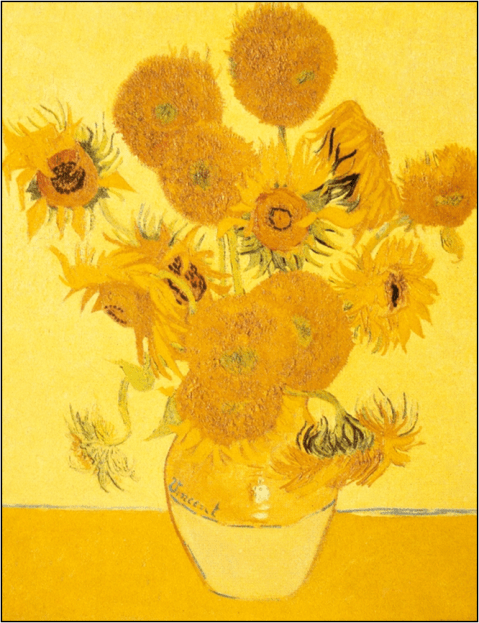
Van Gogh’s Sunflowers: Pb(NO3)2(aq) + K2CrO4(aq) –> PbCrO4(s) + 2 KNO3(aq)

In history and the arts, the past and the ‘work’ of art are represented as objects in which the procedure is to order the object before us to give us its reasons. The past is represented as an object. The difficulty with history and the arts is that when we represent something to ourselves as an object, only as an object does it have any meaning for us. History and the work of art become ‘dead’ for us. We stand above it as “subject”, the transcending summonsers. We guarantee that the meaning of what is discovered is under us and in a very real way dead for us in the sense that what is summoned cannot teach us anything greater than ourselves. The chemical compounds of Van Gogh’s yellow paint are interesting, but they tell us nothing about the truth of the painting “Sunflowers”.

In the Arts, we wish to separate the techniques of Art from the work of Art itself, just as we wish to separate the tools of technology from the technological itself. Shakespeare himself said “The art itself is nature”. Means and ends are not so easily separable. As Aristotle has shown us, the ends are not separable from the means for the ends determine the means.
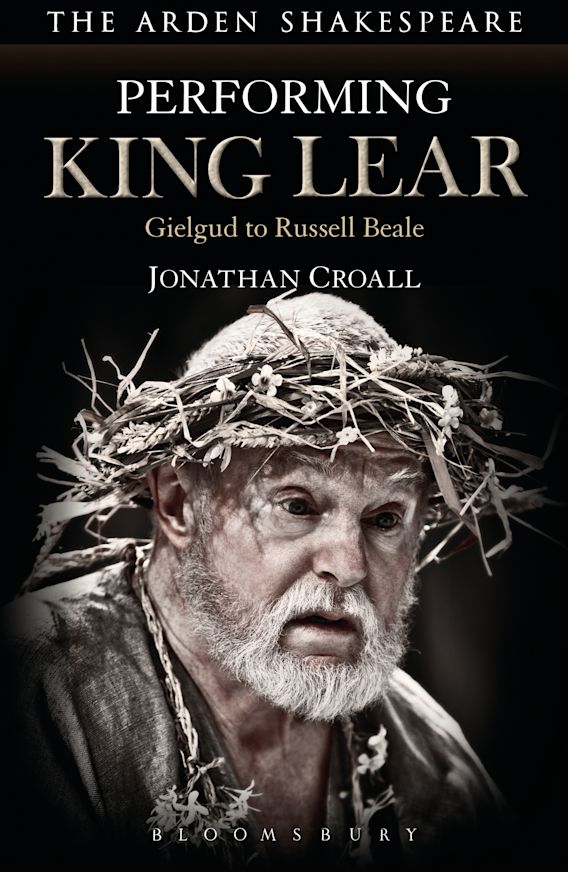
The German philosopher Heidegger has shown that the place experiment plays in the sciences is taken up by a critique of historical sources in the arts. Previous scholarship was a waiting upon the past so that we might find truths which might help us to think and to live in the present. This was why it was once ‘revered’ knowledge. Today, research scholarship in the humanities cannot wait upon the past because it represents the past to itself from a position of its own command. From that position of command you can learn about the past; you cannot learn from the past. The stance of command necessary to research kills the past as teacher. You may watch a performance of King Lear and know all the data that has gone into the production in front of you, but with this knowledge you will not learn anything from the performance in front of you. This is an example of the fragility of our most ‘revered knowledge’: the purpose of the work of art is lost.

3. How can we reconcile the relentless drive to pursue knowledge with the finite resources we have available? Discuss with reference to the natural sciences and one other area of knowledge.

“The relentless drive to pursue knowledge” in today’s world exhibits the sheer ‘will to will’ of a will to power that continues to strive out of the meaningless nihilism of its own making. The questions of “what for?”, “where to?”, and “what then?” are not asked or pondered since the willing itself is all i.e. the ‘relentless drive’. This willing is focused on ‘novelty’, the attempt to bring about the new and the strange.

“To reconcile”  means to restore to friendship or harmony. The “pursuit of knowledge” is our desire to turn the world into “resource” so that we may be able to commandeer those resources to our ends. How are we and nature to be ‘reconciled’? To reconcile this relentless “erotic” drive, our need to pursue knowledge, what forms will the pursuit of this knowledge take? Since the Renaissance, our pursuit has been to change the world to realize the goals that we have set for ourselves as human beings. We have placed ourselves at the centre of the world and have summoned the world to give us its reasons. The remarkable achievements of this summonsing make us reluctant to reconcile ourselves to nature. Climate change is nature’s attempt to fight back at this one-sided view of things.

Another meaning of ‘to reconcile’ is to ‘settle, resolve’, to ‘reconcile differences’. How are we to reconcile the differences between subject/object that is the foundation of our stance in the natural sciences? Is there any desire to do so? The incongruities of any possible reconciliation are political questions: how will the finite resources be allotted and who will get to eat what? Examples from history will help to clarify how these questions have been answered by different political regimes.

If “knowledge” is the finished product that we make through the process of our commandeering the world as resource, we can see this ‘relentless drive’ as the making of the total technological world, the turning of the world of becoming into being. This knowing and making has been called ‘absolute knowledge’ by the philosophers. Technology is the highest form of will to power and empowerment. In this stance, there can be no reconciliation.

“Self-knowledge”, a prerequisite for knowing, appears in the form of ‘wise-uppedness’ today, a cynical ‘know-it-all’ attitude that really knows nothing. 54% of Americans cannot read prose beyond the Grade 5 level according to a 2020 report from its Department of Education , while at the same time countless billions of dollars are spent on conquering space as it is seen as the ultimate site of the warfare of the future. In our arts, ‘novelty’ in the outcomes of the production of a ‘work’ is exalted above all other forms of knowledge (the ‘work’ being what we understand as ‘knowledge’) calling itself ‘creativity’. This ‘novelty’ as ‘creativity’ is part of the ‘knowing’ (techniques) and ‘making’ (the work) that is technology.

Our will to power shows itself in our ‘need’ to dominate and commandeer the world conceived as ‘object’, the world conceived as ‘resource’. The world is a ‘finite resource’. The ‘drive to pursue knowledge’ is what we understand as our eroticism at its deepest level: the “need” to have something to will, to domineer, and to consume. The rich are willing to pay exorbitant sums of money to own a work of art that rightly belongs in the “public domain”. Such a desire for the private “consumption” of beauty is what is meant by eroticism. This is what the myth of the Fall out of Paradise is all about.

Modern science is ‘technological’ because in the modern paradigm, nature is conceived at one and the same time as algebraically understood necessity and as ‘resource’. This algebraic understanding is the root of the algorithms of artificial intelligence. Anything apprehended as ‘resource’ cannot be apprehended as beautiful. I objected quite strongly when my principal (a most well-meaning man) referred to his staff, my neighbours and colleagues, as ‘human capital’. This is just another name for ‘human resources’ and for the viewing of the human beings around you as ‘resources’ that can be commandeered and directed. One can see what has been lost and found in our modern conception of the world through the unthought use of these terms.

As is the case with Titles #1 and #2, Titles #3 and #4 are similar in nature. The ‘finite resources’ are the costs of the ‘tools’ and ‘equipment’ necessary to carry out “research” and the reconstruction of the world. This is seen most clearly in our astrophysics and our health sciences. Because we have such advanced tools and equipment in the areas of health, unnecessary uses of that equipment are impelled on those who possess them in order to cover the costs of the equipment. The equipment must be put to use. This is analogous to the bitcoin and crypto-currency rage at the moment.

Liberal arts programs are being cut back because of their costs in many parts of the world. Truth is “expensive”, especially the conveying of truth into the public discourse. The costs of carrying out research in the sciences (the pursuit of knowledge from title #2) are exorbitant; they need to be met by outcomes that will eventually cover their costs (the exorbitant profits of the drug makers that result from the drugs that are produced). The cost of pharmaceutical products is a concrete example of this. ‘The man of peace’, Elon Musk, is the richest man in the world because his discoveries using algebraic calculation aid in the logistics for the future conduct of war. Musk believes that he is in control of his discoveries, but his ‘common sense’ view of technology does not grasp the nature of the reality of technology itself (see Title #2). In a very real and deep way, Musk’s “thinking” is not thinking, in the same way that ‘artificial intelligence’ is not ‘intelligence’ as the ancients understood this term. What kinds of thinking are required to reconcile these differences?

4. Do the ever-improving tools of an area of knowledge always result in improved knowledge? Discuss with reference to two areas of knowledge.

Title #4 directs us to think about what we call “knowledge” and whether or not knowledge can be improved or is improved through the use of better tools. Our understanding of what tools and equipment are arises out of an understanding and interpretation of our world, and refers to our world as the “ready-to-hand”, that world which has become ‘objectified’ and made to stand as ‘resource’. Different equipment and tools belong to the different ‘worlds’ that human beings have created. This bringing to a stand as resource in those worlds is the end result of what we have called ‘research’ in this writing. The key tool of ‘research’ in the modern is the computer, and the apogee of ‘research’ is artificial intelligence. Artificial intelligence will direct and determine the science of cybernetics, “the technology of the helmsman”. Artificial intelligence as the science of the ‘steersman’ will come to be present in all other sciences.

What is meant here is that the objective arts and sciences come more and more to be unified around the planning and control of human activities within the human sciences. Technology is the pervasive mode of being in our political and social lives, our being-in-the-world and our being in our various ‘worlds’. With the attempt to dominate the logos (language, the word) through the meta-language that is artificial intelligence comes the corollary dehumanization of our being-in-the-world and an inevitable coming forth of tyranny. The future tyranny will be a ‘happy’ tyranny because there will be no thought capable of coming-to-presence to question it. A sign of this is that with the increasing development and sophistication of communication tools, human discourse (or what I refer to as dialectic in other writings on this blog, the conversations between two or three) is weakened and rhetoric (the language of the one thrown to a many) as a means of communication comes to dominate.

“Knowledge” indicates something that has been brought to light, revealed, unconcealed. It is the ‘truth’ of the essence of the thing. That which has been ‘pro-duced’ or brought forth by our making is ‘knowledge’ and we know more about the things we have made than those things which we have not made. We know more about IPhones, for instance, than about the lilies of the field because we have made the IPhone and (as of yet) not made the lily. One of the goals of the bio-sciences is to make the lily as well as other life forms. The things we have made have been ‘brought forth’ or ‘brought forward’ from out of something else and it is in their making that they are known to us, whereas the things from which they have been brought forth remain in the shadows for us.

In our common sense understanding of “improved knowledge”, there is no question that the greater sophistication of our tools and equipment brings to light, ‘reveals’, ‘unconceals’ the historical facts and artefacts of archeology and history with greater clarity. But notice that what we call “knowledge” is associated with “truth”. The revealing and unconcealing of things requires a hierarchy, for there are different levels at which things may be revealed. In the allegory of Plato’s cave, for instance, the firelight of the artisans and technicians reveals the ‘shadows’ of the artefacts of those things which they themselves have made and casts these shadows on the cave’s walls. We know more about the things which we have made than of those things which we have not made. The cave itself is Nature, the cosmos. What is revealed are images, not the reality of the cave itself for the light of the sun is dimly seen. The allegory of the cave is an image of the truth of things and how this truth is revealed.

Today, the widening gyre of technological innovation and novelty is focused upon solving many of the problems that technology itself has created. The internal combustion engine of the automobile will eventually be replaced by the electric vehicle. The rare metals required for the batteries’ construction, the weight of the batteries themselves, etc. are problems that have, as of yet, not been properly thought through in relation to the pollution they will cause, the energy that they will consume in their making, etc. This is but one example of the issues faced when thinking about ‘improvements’ in technological innovation.

5. To what extent do you agree with the claim “all models are wrong, but some are useful” (attributed to George Box)? Discuss with reference to mathematics and one other area of knowledge.

Models are products or the ‘works’ of hypotheses and speculations; that is, they are the products of opinions. They are images; creations of the imagination. Because they are the products of opinion, they may be either true or false; they may be right or wrong. To say that “all models are wrong” is an example of hyperbole. Some models ‘work’ and some do not. The “usefulness” or utility of a model, whether it works or not, is how we judge its “trueness” and its “goodness”: this “truth” is related to its “correctness”, and the “correctness” in this essay title is related to the phrase “to what extent”. When we ask about the “extent” of something, we are asking a mathematical question which will be answered by way of statistics which will be arrived at by calculation. The calculations will be gathered through research. A statistical nexus is a metaphor; it conveys the degree of “truth” that may be contained in a statement or assertion. It relies on the “calculability” of the thing. A model, too, is a metaphor.

In mathematics, an axiom, postulate, or assumption is a statement (logos) that is taken to be true prima facie, “on its face” or its ‘outward appearance’. It is the arche or starting point for further reasoning and arguments. The word comes from the Ancient Greek word ἀξίωμα (axíōma), meaning ‘that which is thought worthy or fit’ or ‘that which commends itself as evident’. “Mathematics” for the Ancient Greeks was “that which can be learned and that which can be taught”. What can be learned and what can be taught is that which is present (ousia) or “what shows itself” to us. What shows itself to us is its ‘face’. It is that which ‘commends itself as evident’.

The truth or falsity of an assertion, which is a statement (logos), was to be found in its ‘fittedness’ or ‘worthiness’. The ‘fittedness’ of something was based on a judgement of the thing: “Yup, these are a good pair of shoes” is a judgement based on a statement of the ‘aptness’ or ‘fittedness’ of the thing to its use. Its ‘fittedness’ was its ‘goodness’. Because they were ‘fit’ for the purposes of what shoes are supposed to do, the shoes were ‘good’. The ‘worthiness’ of the thing was the thing’s ‘value’ or ‘suitability’ related to its intended use. Some shoes are better or more worthy than other shoes and are more expensive. The ‘worthiness’ of a thoroughbred racehorse was in its ability to run fast. It was not ‘worthy’ if it could not. The worthiness of a good meal was the pleasure of its deliciousness and the satisfaction of the hunger of the individual enjoying it. If the meal is not delicious, it is not ‘good’. The ‘worthiness’ of a human being was to live well in communities and to be open to the whole of things. It is this last statement which is gravely under threat at the present time.

Today, the goodness or ‘value’ to be found in a work of art is related to its ‘entertainment’ value, how delightfully it occupies our attention in the present. This is quite different from ancient idea that a ‘work’ of art was meant to be an object of contemplation and reflection so that we might learn from it what was ‘useful’ for our living in the present. Works of art provided the models, the ideals, that the civilization was based on. Think of Achilles and Ulysses in Ancient Greece, Caesar in Rome, Moses in Judaism, Christ and Mary in Christianity, Mohammed in Islam (even though representations of Mohammed are forbidden in Islam. Why?), Michelangelo’s “David” in the Renaissance. What modern figure do we have as a model upon which our civilization can be based? The artists themselves? What ‘fittedness’ applies to modern models in the Arts today?

The confusion over our use of models in the arts is the result of our confusion over the place of morals and ethics in our day-to-day activities. When one looks at discussions regarding ‘designer babies’, the eugenics which will be possible with our discoveries in the biological sciences, Einstein and Mozart are two names mentioned as possible models for these new human beings. The choices clearly indicate that the technological is what we bow down to and what we look up to, the knowing and making of the arts and the sciences. One does not hear the name of Mother Teresa mentioned in these aspirations. Does the world need more Einsteins and Mozarts or more Mother Teresas?

In the West with the arrival of the new sciences, many Christians felt that Roman Catholics were “pagans” in their appearance to worship the idols and icons of Christ and Mary that had been produced by the artists of their times. This “error” in seeing of these critics indicated that a changed vision had arrived over what thinking was and how thinking was to be seen as distinct from what contemplation, prayer and attention were. While the prayer to the realities represented by the icons or images of the statues was that contemplation that looked for guidance and grace as to what to do in one’s daily life, the literal rational thinking of those who changed the view and understanding of what reality was was beginning to dominate what was to be understood as rationality and thought. The models used for an understanding of what human excellence is underwent a great transformation at that point in time in the history of the West.

6. Does acquiring knowledge destroy our sense of wonder? Discuss with reference to two areas of knowledge.

A “sense of wonder” is a pre-requisite and a necessity for thought and thinking. It is “wonder” that gives rise to thought, which begins with the asking of questions. “Wonder” begins with the sense of mystery that arises from our being-in-the-world. In the English language, wonder is associated with the ‘new’. The ‘new’ is that which is strange and unfamiliar. Does the “wise-uppedness” of many today with regard to the ‘new’ and the ‘novel’ indicate a condition of modern democratic nihilism and thus the destruction of the sense of wonder? What sense of wonder do we have regarding the ‘novelty’ of that world which is all around us? What is the ‘novelty’ of our technological society and what does it portend for our future?

The dominance of ‘novelty’ shuts down “wonder”. The achievements of the modern project in science and medicine are a source of wonder. The world as object has given its reasons as it has been summonsed to do. All of us in our everyday lives are so taken up with certain practical achievements in medicine, in production, in the making of human beings and in the making of war, that we are forgetful of the wonder necessary for the realization of what has been achieved. What is referred to as AI, artificial intelligence, is the apogee of that achievement. AI should and must instill in us a great sense of wonder.

 The word ‘novelty’ as a non-countable noun means “the quality of being new, different and interesting”. As a countable noun, novelty means “a thing, person or situation that is interesting because it is new, unusual or has not been known before”. At the same time, a ‘novelty’ is a small cheap object sold as a toy or a decoration. How do we reconcile these opposing meanings of the word? The word itself seems to contain a sense of our being over-satiated by the sheer volume of the novelty that is all about us. We are further from knowledge the more we are overwhelmed with “information” and with the ‘novelty’ of our ‘making’ in our technological way-of-being in the world. If one were to do an illustration of Plato’s allegory of the Cave today, one would have to put laptops and handphones in the hands of the prisoners to indicate a level still further removed from the reality of the good and the beautiful.

When we represent technology as an array of instruments (tools and equipment) lying at the free disposal of the species that creates them, this apparently true account of technology prevents us from experiencing the ‘wonder’ of the novelty of the current situation of our being-in-the-world. Defenders of artificial intelligence, for instance, will make statements such as “artificial intelligence does not impose on us the ways it should be used”, and statements such as these are made by people who are aware that artificial intelligence can be used for purposes which they do not approve, for example, the tyrannous control of human beings. Elon Musk is a primary exponent of such a view.

The ‘should’ of such a statement goes beyond the knowledge of those who are involved in the making of artificial intelligence and of the machines and computers that will drive it. These discussions of artificial intelligence separate means and ends. The “ends” are within the making of the artificial intelligence itself. Because Musk and others like him are aware of the possible good and evil purposes for which artificial intelligence can be used, he and others like him express what artificial intelligence is in a way that goes beyond its technical description: “It is an instrument made by human skill for the purpose of achieving certain human goals. It is a neutral instrument in the sense that the morality of the goals for which artificial intelligence will be used is determined outside of the artificial intelligence itself.”

All of us are aware of the myths of Frankenstein in one form or another. These imaginary myths are part of our sense of wonder. All tools and instruments can be used for bad purposes; and the more complex the capacities of the instrument, the more complex can be its possible bad uses. Artificial intelligence has an infinite potential for both good and evil. The danger involving artificial intelligence is that while we may think that it is a neutral instrument or tool in a long line of neutral instruments and tools which we in our freedom are called upon to control, the liberation of that control to the machine itself means that we are not in a position to rationally come to terms with the potential dangers which this instrument imposes on us. (Think of the examples of Musk’s long line of misadventures with his self-driven cars.)

“A sense of wonder” should be piqued in us when we consider the existence of artificial intelligence and the events which have made its existence possible. Artificial intelligence has been made within the new modern science and its mathematics. This science is a particular paradigm of knowledge that involves the principle of reason (“nothing is without reason”) used to gain ‘objective’ knowledge; and modern reason is the summonsing of anything before a subject and putting it to the question so that it gives us its reasons for being the way it is as an object. With artificial intelligence, we ourselves are the objects of that summonsing. And this should give us cause to wonder…The adjacent emotion to “wonder” is fear and a sense of awe at the ‘terrible’.

From the Online Etymological Dictionary we are informed that the word “monster” is from “early 14c., monstre, “malformed animal or human, creature afflicted with a birth defect,” from Old French monstremostre “monster, monstrosity” (12c.), and directly from Latin monstrum “divine omen (especially one indicating misfortune), portent, sign; abnormal shape; monster, monstrosity,” figuratively “repulsive character, object of dread, awful deed, abomination,” a derivative of monere “to remind, bring to (one’s) recollection, tell (of); admonish, advise, warn, instruct, teach,” from moneie- “to make think of, remind,” suffixed (causative) form of root men- (1) “to think.” A “monster” instills a sense of fear and wonder in us, a warning to us to think and to recollect. The advent of artificial intelligence should make us think, ‘wonder’, but the continuous ‘novelty’ that artificial intelligence inspires prevents such wondering and thought.

Because artificial intelligence uses the false logos of the meta-language which is based on the primordial approach to the world as object (“rationality” understood as the principle of reason where “number” as calculus is prior to “word”) and the “reserve” of the stored information that has been gathered through “research”, the particularities of the objects that are the stored information of AI is abstracted so that they may be classified. “Information” is about objects and comes forth as part of that science which summons objects to give us their reasons. This requires classification.

This requirement for reasons and the classification of objects when directed towards human beings impacts how we will come to understand justice in the future. To relate what is being said here to the Human Sciences of politics and economics: AI can only exist in societies where there are large corporate institutions. AI will exclude certain forms of community and discourse and permit others. The portends for the future, the “monster” that is AI, indicate that AI will require authoritarian, tyrannous regimes where human activities will be dictated by a centralized controlling power. As “wonder” showing itself as questioning and thought will not be present, such dictatorial ruling will be a ‘happy’ tyranny to those who are subject to it. At the present time, we are ‘happily’ giving over our privacy and our freedom.

In the Human Sciences, the questions concerning justice which will arise within the summonsing will be determined within three dominant political regimes: capitalist liberalism, communist Marxism, and national socialist historicism. The account of reason outlined here is that the reason which produced the technologies also produced the accounts of justice given in these modern political philosophies. Our accounts of society came forth from the same account of reason and reasoning that brought forth technology and the technological with AI as its apogee. Our entanglement within this complex nexus should bring forth ‘wonder’: ‘what for?’, ‘where to?’, ‘what then?’. AI and the standards of justice are bound together, both belonging to the same destiny of modern reason understood and realized as AI.

AI is the technology of the helmsman, cybernetics, the unlimited mastery of the mass of human beings by the few. AI will ultimately control human activities gathering them so that they are focused on itself and on the making of the fully technological world. This mastery will be freely given over to the few if the desire for freedom and the wonder of a sense of ‘otherness’ is not present in human beings.
Commentary on the Sefer Yetzirah: Chapter One

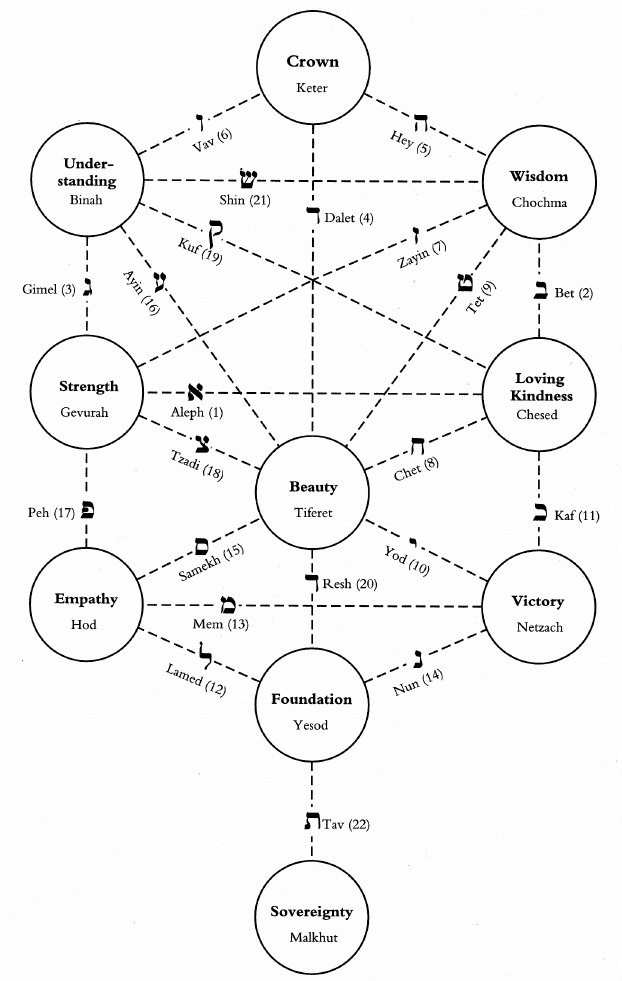
The Tree of Life from the Kabbalah:

The Tree of Life

What will be shown in this writing is how the letters and the paths associated with the Sephirot of the Kabbalah correspond to the 22 Major Arcana of the Tarot. The emanations of the Sephirot correspond to the symbols and images presented in the cards; that is, the objects and situations that we encounter within our worlds correspond in their true natures to the numbers and images “revealed” in the cards when interpreted correctly. “Interpretation” involves attention, contemplation and reflection. An “emanation” emanates from a source. An emanation is not an expansion of the source but a withdrawal of the source to allow the emanation to be just as, paradoxically, the perfume of a rose is made possible by the rose’s withdrawal and yet is at the same time a stepping forward of the rose itself to manifest its being as a sign of its presence. The presence involves an absence and a hiddenness at the same time.

The Tarot cards, composed of letters and numbers, are intermediaries between the individual and the world we live in. They are what we understand as art. They are tools or equipment to assist in the overcoming of the distinction between mind/body, soul/body, and the self/world. All that is known (the Greek word gnosis) is brought to presence through language and number, or through Word.

Movement is Life. As illustrated through the Tree of Life, movement, kinesis, begins at 1. the Crown (Keter) and flows to 2. Wisdom (Chakmah), then to 3. Understanding (Binah), through to 4. Loving Kindness (Chesed), then to 5. Strength or Force, Power (Gevurah), through to 6. Beauty (Tiferet), then to 7. Victory (Netzach), then to 8. Empathy, Mercy (Hod), from there to 9. Foundation (Yesod), and finally to 10. Kingdom or Sovereignty (Malkhut). The movement is from right to left or East to West. All the Sephirot pass or are channeled through #6 Beauty (Tiferet) with the exception of #10 Kingdom (Malkhut). This is the movement from top to bottom, from the heavens to the earth, or the direction of the primal creation. The movement upwards involves depth, while the movement downwards tends towards the surfaces or the outward appearances of things; and the further one moves down, the further one is away from the reality of things.

A most important point to note is that the creation of the world is not an “expansion” from God but a withdrawal of God. In making the universe, God allows something other than Himself to be and yet, paradoxically, it is at the same time Him since He is One and the Whole. This Otherness and withdrawal of God signifies both His presence and His absence in His creation just as the presence and absence of the rose is revealed by its perfume.

Text of the Sefir Yetzirah with Commentary:

This is a highly recommended text.

The Sefer Yetzirah is written in poetry because philosophy is more akin to poetry than to history, which is more akin to prose. Its narrative is a mythos, a story of the God and His Creation. The exercises and statements made in the text are akin to philosophy for they are attempts to answer the questions of Being and of coming-into-being: the how, what, who, where, when and why of created things. In traditional philosophy this is what is called metaphysics.

The translations here render the original poetry of the Hebrew into current modern English prose. As with all translation, something is lost, but something may also be gained by examining the texts closely. There are many versions of the Sefer Yetzirah, with many additions and retractions occurring throughout the ages. The versions here are an attempt to provide a readable translation through an amalgam of the many versions available. Three different translations are provided here.

1.1 In thirty-two mystical paths of wisdom did JAH the Lord of Hosts engrave his name: God of the armies (hosts) of Israel, ever-living God, merciful and gracious, sublime, dwelling on high, who inhabits eternity. He created this universe by the three Sepharim: Number, Writing, and Speech. (The translation used here is from Rabbi Aryeh Kaplan's Sefer Yetzirah: The Book of Formation which can be found here. This book is highly recommended. 

https://books.google.co.id/books?id=aqc-61vr4q0C&printsec=frontcover&source=gbs_ge_summary_r&cad=0#v=onepage&q&f=false)

Alt. Trans.: In two and thirty most occult and wonderful paths of wisdom did JAH the Lord of Hosts engrave his name: God of the armies of Israel, ever-living God, merciful and gracious, sublime, dwelling on high, who inhabiteth eternity. He created this universe by the three Sepharim: Number, Writing, and Speech.

Wescott Trans: . In thirty−two (1) mysterious Paths of Wisdom did Jah, (2) the Jehovah of hosts, (3) the God of Israel, (4) the Living Elohim, (5) the King of ages, the merciful and gracious God, (6) the Exalted One, the Dweller in eternity, most high and holy−−engrave his name by the three Sepharim (7) −−Numbers, Letters, and Sounds.(8)

Wescott NOTES TO THE SEPHER YETZIRAH CHAPTER ONE

(These notes are provided as an appendum to the Wescott translation and may provide some perspective on how the text was translated.)

The twelve sections of this chapter introduce this philosophic disquisition upon the Formation and Development of the Universe. Having specified the subdivision of the letters into three classes, the Triad, the Heptad, and the Dodecad, these are put aside for the time; and the Decad mainly considered as specially associated with the idea of Number, and as obviously composed of the Tetrad and the Hexad.

1. Thirty−two. This is the number of the Paths or Ways of Wisdom, which are added as a supplement. 32 is written in Hebrew by LB, Lamed and Beth, and these are the last and first letters of the Pentateuch. The number 32 is obtained thus−−2 x 2 x 2 x 2 x 2=32. Laib, LB as a Hebrew word, means the Heart of Man. Paths. The word here is NTIBUT, netibuth; NTIB meant primarily a pathway, or foot−made track; but is here used symbolically in the same sense as the Christian uses the word, way−−the way of life: other meanings are−−stage, power, form, effect; and later, a doctrinal formula, in Kabalistic writings.

2. Jah. This divine name is found in Psalm lxviii. 4; it is translated into Greek as kurios, and into Latin as dominus , and commonly into the English word, Lord: it is really the first half of the word IHVH or Jehovah, or the Yahveh of modern scholars.

3. Jehovah Tzabaoth. This divine name is printed in English Bibles as Jehovah Sabaoth, or as “Lord of hosts” as in Psalm xxiv. 10. TzBA is an army.

4. God of Israel. Here the word God is ALHI, which in unpointed Hebrew might be God, or Gods, or My God.

5. The Elohim of the Living. The words are ALHIM ChIIM. Alhim, often written in English letters as Elohim, or by Godftey Higgins as Aleim, seems to be a masculine plural of the feminine form Eloah, ALH, of the divine masculine name EL, AL; this is commonly translated God, and means strong, mighty, supreme. Chiim is the plural of Chi−−living, or life. ChIH is a living animal, and so is ChIVA. ChII is also life. Frey in his dictionary gives ChIIM as the plural word lives, or vitae. The true adjective for living is ChIA. Elohim Chiim, then, apart from Jewish or Christian preconception, is “the living Gods,” or “the Gods of the lives, i.e., living ones.” Rittangelius gives Dii viventes, “The living Gods,” both words in the plural. Pistorius omits both words. Postellus, the orthodox, gives Deus Vivus. The Elohim are the Seven Forces, proceeding from the One Divine, which control the “terra viventium,” the manifested world of life.

6. God. In this case we have the simple form AL, EL.

7. Sepharim. SPRIM, the plural masculine of SPR, commonly translated book or letter: the meaning here is plainly “forms of expression.”

8. Numbers, Letters and Sounds. The three Hebrew words here given are, in unpointed Hebrew, SPR, SPR and SIPUR. Some late editors, to cover the difficulty of this passage, have given SPR, SPUR, SIPR, pointing them to read Separ, Seepur, Saypar. The sense of the whole volume appears to need their translation as Numbers, Letters and Sounds. Pistorius gave “Scriptis, numeratis, pronunciatis.” Postellus gave “Numerans, numerus, numeratus,” thus losing the contrasted meanings; and so did Rittangelius, who gave “Numero, numerante, numerato.”

Comments on the Text: 1.1

The 32 paths indicated in the Kabbalah are the ten digits of one’s hands and the 22 letters of the Hebrew alphabet. The quantities of things, the physical or material things, are calculated and expressed by number and these are what can be counted on and grasped by the hands, the ready-to-hand things. The qualities of things, the categories we use to describe things, are expressed by language, words formed out of letters. Numbers require plurality and only come into existence with the creation of the physical universe, with space and time. The numbers begin at 4; i.e., the Trinity of God as One and Three, and the physical matter of creation at 4. The Sephirot define the numbers because they first came into creation as emanations of God. All numbers are contained in the Ten, and all Ten are contained in the One and all are emanations of the One.

The 32 paths are the number of times God’s name, Elohim, is mentioned in the account of creation in the Book of Genesis. “God said” appears 10 times i.e., the ten Sephirot starting with “In the beginning God created the heavens and the earth.” Elohim is a plural and so is not actually God Himself. The figure of Elohim shares many of the same characteristics as the figure of Eros, and there is a clear connection between Eros and the Logos or the “sayings of God”.

The other 22 times are the 3 where “God made”, (the three Mother letters of the Sephirot Alef, Mem, Shin which indicate the 4 universes comprising the whole: Atzilut, Beriyah, Yetzirah, and Asiyah and the bridging of those worlds: God Himself, being the first, etc.), the 7 references referring to “God saw”, and the 12 other references of Elohim referring to the remaining 12 letters of the alphabet.

The 32 paths are the channels through which “spirit” (understood as the element of Air, and in other places referred to as Mind or Intellect) influences the body and all physical matter; and for human beings all these channels must go through the heart. The channels operate both ways: up and down, spirit or mind influencing the heart and the heart influencing the spirit or mind. The heart is the causal link between the mind/body and it is connected to the Life force. In the passage from St. John the Evangelist, “In Him life was, and this life was the light of human beings” indicates that truth is not some intellectual abstraction but is the actual or authentic way of human beings’ being-in-the-world. The Sefer Yetzirah calls the heart “the king over the soul”, the soul being the kingdom over which the heart rules. It is the heart which establishes the mood of care/concern for those things which have come to be meaningful for us as human beings.

The number 32 is also 25 indicating that there are 5 dimensions to the visible universe. The visible universe is like an onion or a babushka doll whose layers conceal the hidden mystery within. The 32 paths are referred to as Nativ in the Sefer Yetzirah which means a “private” not a “public” path. Each individual must traverse these paths on their own. The means of ascent or descent along the Tree of Life is through 231 Gates with each Gate bearing a “threshold guardian” of some type (one must assume). Understanding what the nature of these threshold guardians is is very important in travelling along the paths. A teacher for example, if he or she is a proper teacher, is a threshold guardian along one of life’s paths.

The paths are said to be “mystical”. In Hebrew the word mystical (peliyot) has connotations of being hidden, separated from the world at large, “occult”. One can see a relation to this hiddenness from the Greek word aletheia which means “to unconceal”, “to reveal”, “to remove from forgetfulness”, ” to make unhidden” and aletheia is the Greek word for “truth”. The human being as a human being and to be an authentic human being is called upon to reveal truth, and the revealing of truth brings one into strife with that which is hidden and with those who would wish it to remain hidden. This is the primary conflict between the individual and the collective. It is the political conflict.

The 32 paths are said to be the paths to/of “wisdom”. “Wisdom” is said to be knowledge of the whole, the One. The Greek word for this knowledge is gnosis. Wisdom is the knowledge of the Same, that which goes beyond the knowledge of the particulars that compose the physical world. “Wisdom” includes what the Greeks understood as phronesis or “wise judgement”, and wise judgement was understood as one of the four virtues or “human excellences” that lead to happiness. Wisdom is also the seeing of unity in the diversity of particular things. It is seeing the tree that is present in all trees whether oak, elm, or beech. It is also to recognize the deprivations of those things that exist, such as Evil, from their fullness, which is the Good. The Wise are able to see Time in its wholeness and can comprehend past, present and future simultaneously. The whole of the Sefer Yetzirah is an attempt to see the unity amidst the diversity of the things that are in space and time. Those who are able to see the whole are “prophets”. The woman presented in the Tarot card “The World” is a prophetess.

We mentioned that Elohim is God’s name used 32 times in Genesis and this corresponds to the 32 paths that lead to Wisdom. The state of Wisdom is the second Sephirot of the Tree of Life, Chakmah. The third Sephirot is Binah, or Understanding, which is knowledge of particulars. This knowledge of particulars corresponds to our apprehension of the particular objects about us and their possible uses for us.

Elohim is a plural in Hebrew and corresponds, I think, to the Trinity that is present prior to the creation of the physical universe, the Trinity that must be present for the universe to be. Understanding is that knowledge which places the limits on the unlimited, what allows particular objects to come to presence for us. To place limits on is to “de-fine”, and it is this defining of things, of what they are, that allows the things to come to presence and be visible to us as the things they are. They are given boundaries and framing. This “defining” is accomplished through language and number, what we have historically come to call metaphysics. Wisdom itself is beyond language and number. Wisdom is associated with the element water, while Understanding is associated with the elements of Air and Fire. Wisdom is associated with emotions/heart, while Understanding is associated with mind/intellect. How these contraries are connected and brought into harmony is the core of the teaching of the Sefer Yetzirah. It is the understanding of the two faces of the Logos and of Eros.

Wisdom is seen as thought thinking thought, pure thought, the same concept as Aristotle’s understanding of God, the Unmoved Mover or the Uncaused Cause. The concept of thought without words, numbers or images is beyond me, unless it is simply thought as the Life-force itself i.e., thought as pure possibility or potentiality, dynamis. This would suggest that the “cause” of the life force itself is the element air in combination with fire and water. Wisdom would be simple unity, harmony. In Plato’s dialogue Timaeus, she is the khôra or receptacle of all: “So likewise it is right that the substance which is to be fitted to receive frequently over its whole extent the copies of all things intelligible and eternal should itself, of its own nature, be void of all the forms. Wherefore, let us not speak of her that is the Mother and Receptacle of this generated world, which is perceptible by sight and all the senses, by the name of earth or air or fire or water, or any aggregates or constituents thereof: rather, if we describe her as a Kind invisible and unshaped, all-receptive, and in some most perplexing and most baffling partaking of the intelligible, we shall describe her truly.”— Plato, Timaeus, 51a. Here, Plato sees the relation between Wisdom and Understanding, or the Sephirot Chakmah and Binah, as most “baffling” and “perplexing”. The word “intelligible” is one that will come under much discussion and scrutiny as we move through this interpretation of the Sefer Yetzirah. This area could be represented by Da’at, the Void, from out of which the Life- force and beings emerge.

The concept of creation which I mentioned earlier as the “withdrawal” of God to allow something to be other than Himself can be understood from the word “engrave”, when He uses the 32 paths to “engrave” the universe. When we speak of writing, we mean we add ink to paper (expansion). When we engrave, we remove material in a clay tablet (or whatever) as we see in cuneiform writing (withdrawal). The word “engrave” could also indicate the setting of boundaries; the limits placed on the unlimited, and it is the shapes of the letters themselves which establish these limits or boundaries in the written word.

The letter Yud in Hebrew has a numerical value of 10, indicating the 10 Sephirot. The letter Heh has a numerical value of 5, indicating the five fingers on the right hand. In the idea of “making”, the hands are important as they are what we use to grasp the things of the world, the ready-to-hand, the materials we use to make the artifacts that are useful to us. The letters of the Divine Name Yah Heh, are present at the beginning of the Creation and are the essence of the Creation (the Trinity and the concept of the Word as God and with God).

There is some difficulty with trying to interpret the YHVH as “the Lord of Hosts” and of the “hosts” understood as “the armies of Israel”. The Sefer Yetzirah suggests that the “hosts” represent all of the beings created through the 10 Sephirot and how these beings are understood by human beings through numbers, writing and speech. We can understand the “hosts” as that moment when God reveals Himself to human beings through His creation; those beings He created are His “hosts” in the same way we can understand being a host of an event such as a dinner party or a meeting. In Shakespeare’s King Lear, King Lear and Cordelia will act as “god’s spies” i.e. they will be his “hosts” for they will allow Him to see His creation through their eyes (Act 5 sc. iii). YHVH indicates a sort of dualism: the first YH separated by the Vah Heh. But again, they indicate the three-in-one concept which is attempting to be illustrated here: YH is God, VH is His creation and both together comprise YHVH.

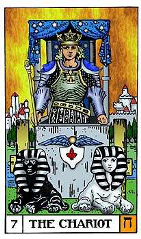
The “Living God” is to be understood as the Life-force itself, what we have come to call Nature, and what the Greeks understood as phusis and poiesis. It is the force (dynamis) that causes things to emerge and come to a stand so that they can be known (energeia). The names of God (Elohim) indicate the activity of this force in the downward motion through the Tree of Life. For example, “God saw” is mentioned 7 times and so this should focus our attention on “seeing” when we are attempting to understand the essence of the Sephirot #7 or Netzach (Victory). This should also focus our attention on the element of sight, on how things are perceived, when attempting to understand the Chariot Tarot card.

The word “Holy” indicates that which is separated from the mundane, the common. It is the separation of God from His creation, what is to be bowed down to or looked up to and not to be given an image or named.

The place of the concept of “will” is troubling in our understanding of who and what we are. In the Sefer Yetzirah, will is placed beyond all other forces in its representation in the Sephirot Keter, #1 and in #10 Malkhut. Both are seen as Kingdoms and God is King of the Universe or the Whole. The Ten Commandments are the will of God. Necessity is the will of God. Is will a motivator prior to Love (Eros) or is Love prior to will? This issue will be explored in this interpretation of the Sefer Yetzirah. For the moment we may understand “God’s will” as the Law of Necessity which is embedded and enmeshed in the creation itself. It is the schema or blueprint used by the demiourgos in his making of what is.

The three “books” used for the creation are text (Sepher), number or cipher (Sephar), and communication or the telling (Sippur). All relate to what the Greeks called logos, while the will is associated primarily with eros. They relate to the quality (emanations), quantity (the physical, material things), and the relation to others or the talking to others of that which has been created. The three books relate to Space (Universe), Time (days of the week) and Soul (how these are to be properly understood and interpreted). These relate to the five dimensions of the universe where space is third, time is fourth, and soul is the fifth dimension.

The 32 paths can be represented pictorially as we do with the diagram of the Tree of Life (text), or they can be represented numerically as the sequences of the paths, or they can be represented to each other through our speech as our Understanding of the things that are. Our understanding of what things are is prior to our naming of them and speaking about them. The three books are also represented in the form of the letters themselves as they are written, the numerical value assigned to them, or the sounds that are made through the spoken word. Text as form is space (the res extensa or what we understand as objects); numbers are the sequence of time understood as the week and the year, a sequential series of “nows”; and communication is the continuum of soul. It is from these three that the word Sephirot is derived. It is only through the Sephirot in their three aspects that God can be approached. It is through the Sephirot that God reveals Himself to His creation, and it is through the Sephirot that one can reveal God in His creation. It is only through our particular body that we are able to gain access the whole that is beyond our particular self. Matter, the body, is our infallible judge.

The Sephirot act as intermediaries or daimons through which one can communicate with God and there are some texts that assign an angel to each of the Sephirot. The Sephirot are the messengers (Hermes and Eros of the Greeks, the angels of Judaism and Christianity, etc.) through whom one communicates with God and He communicates to us. (“Jesus said to him, “I am the way, and the truth, and the life. No one comes to the Father except through me.” (John 14.6) Jesus as human being is the highest of these mediators (Metatron in the angel hierarchy.)

Sketch For A Portrait of Evil: The Essence of Evil: Sections I and II

“If they [Plato and Aristotle] wrote about politics it was as if to lay down rules for a madhouse. And if they pretended to treat it as something really important, it was because they knew that the madmen they were talking to believed themselves to be kings and emperors. They humoured these beliefs in order to calm down their madness with as little harm as possible.”

“We know too little to be dogmatists and we know too much to be
skeptics.”
—Blaise Pascal Pensées

“—and, in fact, the condition of most men’s souls in respect of learning and of what are termed “morals” is either naturally bad or else corrupted,—then not even Lynceus1 himself could make such folk see. In one word, neither receptivity nor memory will ever produce knowledge in him who has no affinity with the object, since it does not germinate to start with in alien states of mind; consequently neither those who have no natural connection or affinity with things just, and all else that is fair, although they are both receptive and retentive in various ways of other things, nor yet those who possess such affinity but are unreceptive and unretentive—none, I say, of these will ever learn to the utmost possible extent.”
1 Lynceus was an Argonaut, noted for his keenness of sight; here, by a playful hyperbole, he is supposed to be also a producer of sight in others.

Section I: General introduction

Two young fish are swimming lazily by when an older fish passes and says “Morning boys, how’s the water”? The two young fish continue to swim on when one turns to the other and asks “What the hell is water”?

This writing will attempt to show the what and the how of the necessity for thinking and the role that thinking plays in our human being-in-the-world and our being-with-others, and how these come together in the strife (polemos) that is our encounter with evil in our lives. That is, it will attempt to show what ‘human excellence’ (arête) or ‘virtue’ as it relates to our human being-in-the-world is. As the examples of the three historical figures chosen illustrate (Meno of Thessaly, Eichmann of Nazi Germany, and Donald Trump of the USA), without thinking there is no moral judgment because reality cannot be critically assessed; and when human beings are unable to grasp the reality of the world in which they live day-to-day, human beings cannot distinguish right from wrong, good from bad. The ability to think and tell right from wrong is what, according to Hannah Arendt (1982), ‘may prevent catastrophes’ when political and social conditions and contexts arise that may bring about catastrophic possibilities.

The conceptualization of evil (and particularly the claim being made here that thoughtlessness constitutes an important pre-condition and source of evil-doing) should encourage educators and students in the IB program overall, and in its Theory of Knowledge component in particular, to examine the contexts of human-being-in-the-world through the exploration of various aspects of contemporary and historical evil. Recognition of these characteristics or aspects of evil can make students aware not only of the dire consequences emerging from an incapacity to think critically, but also of their own possible complicity and responsibility in the emergence of evils, rather than claiming and blaming ‘victimization’ or blaming a single villain or the whole society as is often done nowadays. The three examples provided here are three examples of the concrete manifestations of the aspects of evil (the particular) which, at the same time, reveal evil in its essence (the general).

Through the three historical examples provided here – Meno, Eichmann and Trump – we can gain a view of the characteristics of the “depravity” and “vice” of evil men and of the properties of evil as a psychological and social phenomenon. The lack of depth of evil mirrors the lack of depth in the human soul of the “depraved” man and how this depravity is manifested in their actions. The ancient Greek Meno is a paradigm. All three men show an inability to learn, poor memory, a threatening posture when confronted, speak in cliches and “they said” opinions, and have a vicious quality about them. In the dialogue Meno, the slave-boy demonstrates more arête virtue, “human excellence” and true freedom than Meno himself because the slave-boy is willing to learn.

The three examples provided see, firstly, evil as the Great Beast of the political social collective being-with-others of human beings (being-with-others recognized as being a necessity for human beings) in the writings of Plato and the dialogue Meno in particular. Secondly, characteristics of “the banality of evil” as described by Hannah Arendt in Eichmann in Jerusalem: The Banality of Evil where she indicates that ‘when all are guilty, no one is’ points to more specific historical details of evil’s preponderance. Arendt’s account of the banality of evil and the individual responsibility for it offers opportunities for educators and students in the IB Program (through the critical thinking required in the Theory of Knowledge component that is an important part of the IB Learner Profile i.e. what the IB has come to define as arête or “human excellence”, virtue) to become aware of their own responsibilities as members of a society or social group. The IB Learner Profile is how the IB has come to resolve the knotty question of “what is human excellence?” and whether human excellence or virtue can be taught or learned which is the subject of the dialogue Meno. As the examples of the graduates from the universities that many IB students aspire to have shown very clearly, neither “human excellence” nor thinking is going to be a product of their education should they choose to attend these institutions.

As I am attempting to show here, Arendt’s ‘banality of evil’ might be more properly termed ‘the ubiquity of evil’, for its ‘spreading like fungus’ (as Arendt said of it) appears to be our experience of the phenomenon in today’s world. Through the learning from that history of the past, the modern manifestations of evil today in the right-wing Trumpism of American politics and other neo-fascist, authoritarian leanings in other societies and on other continents can be seen in countries throughout the world. This begs the question: Is the thinking required to resist evil even possible in authoritarian regimes or is it possible in the institutions of higher learning today?

All political action is concerned with preservation and change: “change for the better”; “avoiding something worse”. All political action has as its goal knowledge of the good and the good political society. The “common good”, the “one good”, determines our being-with-others and is our conception of what we think “virtue” or “human excellence” is. What we are witnessing today is the destruction of any notion of a “common good”.

What is evil? This writing will attempt to get at this most elusive of phenomenon. Perhaps it is a quixotic mission. What the essence of evil is is not revealed in the effects that evil brings about or causes, but these must be examined to some extent in order to trace the preliminary outlines that will lead to a sketch for a portrait of evil which will, hopefully, reveal evil in its essence. The difficulty of the task is obvious: evil, by its nature, flees from the light, and light is necessary in order to allow a thing to emerge, to be seen, to allow the truth of something to show itself, and to give us knowledge of that thing. In the Divided Line of Plato, this light is both a metaphor of the Good and Love, and this light is related to both ‘sight’ and to ‘hearing’. From these we can learn that evil is not the opposite of the Good but is the deprivation of the Good.

Arendt once remarked in a letter that evil lacks “depth”, that it is a “surface phenomenon” that “spreads like fungus” over things and over the human interactions with those things. To use the language of Plato, evil is a “shadow” phenomenon that has no being: something which lacks substance or “depth” and is ultimately related to nihilism. To say this is to say something extraordinary and leads one to perplexity. How can something which has no being be so manifestly present to us in our everyday lives?

The relation of evil to “lack of depth” is why Plato’s images of the Divided Line and the Great Beast from Bk VI of his Republic are used here. The Divided Line shows how “thoughtlessness” can come about and, through this “thoughtlessness”, how human beings can succumb to the temptations of the Great Beast. “Thoughtlessness” is related to the phenomenon of “stupidity”, and both are related to the concept of arête or “human excellence” or to the lack of “human excellence”; arête is usually translated as ‘virtue’. These two conceptions of arête are used interchangeably here.

The opposite of thoughtfulness is stupidity, and stupidity is related to the phenomenon of “intentional ignorance”. “Intentional ignorance” and “stupidity” are “moral” phenomenon, not intellectual phenomenon. In this writing, the concept of “opposite” is best seen as a “deprivation” for there are no truly “opposite” things just as there are no truly “equal” things. Intentional ignorance occurs when individuals realize at some level of consciousness that their beliefs are probably false, or when they refuse to attend to speech or information that would establish their falsity. People engage in intentional ignorance because it is perceived as useful. “Stupidity” and “intentional ignorance” are not intellectual but moral phenomena and properties; that is, they do not deal with thinking or the intellect but with actions. Dietrich Bonhoeffer, who was hanged by Hitler in 1945 in one of his concentration camps, once wrote:

“Stupidity is a more dangerous enemy of the good than malice… Evil always carries within itself the germ of its own subversion in that it leaves behind in human beings at least a sense of unease. Against stupidity we are defenseless. Neither protests nor the use of force accomplish anything here; reasons fall on deaf ears; facts that contradict one’s prejudgment simply need not be believed- in such moments the stupid person even becomes critical – and when facts are irrefutable, they are just pushed aside as inconsequential, as incidental. In all this the stupid person, in contrast to the malicious one, is utterly self-satisfied and, being easily irritated, becomes dangerous by going on the attack. For that reason, greater caution is called for than with a malicious one.”

We can see the phenomenon of stupidity described here by Bonhoeffer illustrated in the three examples we have chosen for our sketch: Meno, Eichmann, and Trump; and we can also see it in the quote from Plato’s “Seventh Letter” which begins this writing.

Thinking and self-knowledge are co-related. Where true thought is not present, there is no self-knowledge. Where there is no self-knowledge, there is no sense of “reality”. Where there is no sense of “reality”, there is no knowledge or recognition of good and evil. Where there is no knowledge or recognition of good and evil, there is no possibility of “human excellence” or
arête. Without a sense of “human excellence”, there is no polemos or strife within the individual mind or soul to resist the temptation to succumb to evil actions.

Section II: Evil and the Individual: Thinking and Thoughtlessness

Since we are proposing that thinking is an antidote to the sickness or illness that is evil in the soul, we must try to be clearer on what thinking and thoughtlessness are as they are used here. Science, technology and its apogee, artificial intelligence, does not think, and the “thinking” that is understood in the sciences is not an antidote or solution to the problem of evil. This means that, substantively, sociology, psychology, and political science are, for the most part, “useless” to us and for us as we engage in the strife that is the polemos or confrontation with evil, though they may provide some descriptors or colours for our palette as we journey to sketch our portrait.

One is not thinking if one does not rank the objects of thought in terms of thought-worthiness. This point flies in the face of many contemporary accounts of “rationality”, for they suggest that one can be thinking well as long as one is following the right method. The emphasis today is on the method of what is called thinking. What one thinks about does not provide the standard for the role of such “ratio-inspired” accounts of thinking; indeed, critical thinking has come to mean “critical whatever method-following thinking” instead of “critical whatever essential thinking”. Such “means-ends accounts” of thinking involve and propagate a distortion; a life spent rationally researching the history of administrative memos and emails is not a thoughtful life. We shall see later that Adolf Eichmann did not lead a “thoughtful life” in his seeing himself as “a scheduler of trains”. In rationally pursuing anything and everything we are not thinking.

The experience of thinking in our technological age has been shrunk to that of using a tool to operate within an already-fixed network of ends. This, for example, is the essence of artificial intelligence. This age and the evil concurrent with it, in other words, is more thought-provoking because in it ratio (as one side of a two-faced Logos) has triumphed over legein, the speaking, gathering; thinking has become so severed from the being-thoughtful that the thoughtful being is in danger of being entirely eclipsed. In the Divided Line of Plato, this two-faced nature of Logos is comparable and parallel to the two-faced nature of Eros. The logos associated with number is separated from the logos associated with “speaking”, with word. The arts are distinguished from the sciences as revealers of truth. Human being as the animale rationale, “the rational animal”, has become separated from human being as the zoon logon echon, “the animal capable of discursive speech”.

Because we are “embodied souls”, it is Memory that is associated with our understanding of need, or the urge that is behind the eros of our needs. Our memory retains our immediate experience based on sense perceptions. It is the repository of the knowledge acquired in one’s lifetime and of what was learned during the journey with the god prior to our lifetime (Plato, Phaedrus). It is the source of our desires which depend on previous fulfillment and insight.

Learning is the removal of forgetfulness and is a quest. The journey toward the light cannot be undertaken by “rote learning” i.e. memorization. This merely results in the learning of the opinions of others that result in stock phrases, cliches, the language of the meme. It results in oppression, not freedom. (See the commentary on the Meno in Part II of this writing.) The acquisition of skills, the gathering of information of all kinds, the convictions and practices which govern the conduct of our lives, all depend on the medium of accepted opinions. Our memory is the repository of those opinions. The action of learning conveys the truth about learning. It is not a “theory of knowledge” or “epistemology” but the very effort to learn itself.

In the works of Plato, the purpose of education is the formation of character. Institutions and their accompanying bureaucracies are secondary. Without evil or vice there is no higher development of human beings. The danger of evil and the action (or inaction) against evil contribute to the development of human beings, and this is our “excellence”, our “virtue”. Mere innocence is incompatible with the higher development of humanity. Self-knowledge and its acquisition (or lack thereof) is at the root of all thoughtlessness, and thoughtlessness contributes to the degeneration of human beings making them less humane.

Lack of self-knowledge and its relation to thinking is “thinking that one knows what one does not know”. This lack of self-knowledge is sometimes manifested in those who believe they are in possession of the truth, those that we would call ‘fanatics’ and ‘gaslighters’ today. Self-knowledge is tied with our knowledge of good and evil, better and worse, what we have come to call our “values”. These supposed “values” have been given to us from the historical knowledge of the society, the historical opinions, of which we happen by chance to be members. This historical knowledge involves “memory”. The “orthodoxy” of the historical opinions we have inherited becomes the dogmatism of the present.

Because we are “embodied souls”, beings in time, memory holds us in our essential nature as human beings. If the battle against evil most requires thought, we are experiencing a turning away from thought and seeing a subsequent rise in evil’s pervasiveness and perseverance in our being-with-others and in the “inner” worlds of our being with and within ourselves, our own self-knowledge. This is partially due to the destruction of memory. To learn means to respond to the most important and pressing things that address us at any given moment. The rise of evil is one of these most pressing things.

As Martin Heidegger once said, “Science does not think: and this is its blessing.” If science actually thought, we would cease to have science as we know it. And if this should happen, we would no longer have clean toilets, penicillin, and all of the wonderful discoveries of science. The type of
thinking that science does is an absolute necessity for our lives today. The type of thinking that science does accompanies ‘common sense’, and both are necessities in the conduct of our day-to-day lives. Science does not think because, if we look at Plato’s Divided Line, the grounding of science is in a faith: its belief, its trust, in that what is “real” is what it reveals. Science is the theory of the ‘real’.

Thinking is an action that can only be done by doing it. We shall never learn “what is called swimming”, for example, or “what calls for swimming” by reading a book on swimming. Only a leap into the deep end of the pool will tell us what is called swimming and what calls for swimming; action or praxis, conduct is key. The question of what thinking and thoughtfulness are can never be answered by proposing a definition of the concept “thinking”. As Plato makes clear in his Seventh Letter, thinking cannot be brought to language; if it could be, he would have done so.

Rene Descartes

In the West, the thought about thinking has been called “logic” based on the principle of reason (“Nothing is without reason”). This “logic” has received its flowering in the natural and human sciences under the term “logistics”. Logistics, today, is considered the only legitimate form or way of knowing because its results and procedures ensure the construction of the technological
world. Logistics is an interesting word in that its use as a noun implies “symbolic logic” (mathematical algebraic calculation) and it is also related to the conduct of warfare. Its use as mathematical calculation is found in what is called logical positivism which is a recent branch of the branch of philosophy that was previously known as empiricism. The thinking in logical positivism is the thinking expressed as algebraic calculation: only that which can be calculated
can be known and is worth knowing. To elaborate how this has come to be the case would require an analysis of 17th century philosophy and mathematics beyond what we intend in this writing. Suffice it to say that this is part of our inherited shared knowledge, our historical knowledge or memory that we have received from the philosopher Rene Descartes.

Today we think that thought is the mind working to solve problems. We can see this in many of the quotes that are looked to as words of inspiration for young people. Thought is the mind analyzing what the senses bring in and acting upon it. Thought is understanding circumstances or the premises of a situation and reasoning out conclusions, actions to be taken. This is thinking, working through from A to B in a situation. In Plato’s Divided Line, thoughts are
representations of the world (real or not doesn’t matter, only the mind’s action does), or considerations about claims or representations (knowledge issues or questions), and the conclusions or judgements that are made. We think we know exactly what thought and thinking are because they are what we think we do. And as the animal rationale, the “rational animal”, how is it possible for thinking to be something we can fly from as it is our nature? It must be
remembered that in our flight from our nature, we become less humane.

When we use the word ‘thinking’, our thought immediately goes back to a well-known set of definitions that we have learnt in our lives or in our studies, what we have inherited from our shared or historical knowledge, what is stamped in our memories. Definitions provide the limits to things, their horizons, so that they can be known to us. These limits we call “meaning”. To us thinking is a mental activity that helps us to solve problems, to deal with situations, to
understand circumstances and, according to this understanding, to take action in order to move forward. It is algorithmic. Thinking for us also means to have an opinion, to have an impression that something is in a certain way. Thinking means reasoning, the process of reaching certain conclusions through a series of statements. Thinking is “a means of mastery” or control over the ‘problems’ which confront us and stand as obstacles in our achieving our ends.

Martin Heidegger

The German philosopher, Martin Heidegger, once wrote: “Thoughtlessness is an uncanny visitor who comes and goes everywhere in today’s world. For nowadays we take in everything in the quickest and cheapest way, only to forget it just as quickly, instantly. Thus one gathering follows on the heels of another. Commemorative celebrations grow poorer and poorer in thought. Commemoration and thoughtlessness are found side by side.” (Discourse on Thinking. Trans. John M. Anderson and E. Hans Freund. New York: Harper and Row 1966, p. 45) That the greatest thinker of the 20th century could succumb to the evil that was National Socialism and who implicitly approved of the gas chambers of the Holocaust (since he concluded that there were simply some human beings to whom no justice was due) indicates the difficulty of the task that the polemos against evil presents to us. For Heidegger, thoughtlessness is nihilism. (A fictional parallel to Heidegger’s historical failure can be seen in Frodo Baggins’ failure to destroy the Ring of Sauron in Tolkien’s The Lord of the Rings. In both cases, it is difficult to rush to the judgement of final condemnation when discussing both their failures.)

If we view our current thinking and approach to thinking in the light of Plato’s Divided Line and his Allegory of the Cave, we can see that the risk for humanity in our current approach to thinking is to be uprooted not only from our reality, from our world, but also from ourselves and from our natures as human beings. With this, the destruction of any possibility for self-knowledge occurs. If we think ‘poetically’, however, we allow ourselves to be aware of the risk implied in the technological age and its usefulness and we can, hence, act upon it. We can experience some of the freedom which is spoken about in Plato’s allegory when we are brought out into the Open where the light of the Sun shines and things are shown to us in their own being as they really are.

We recognize that in today’s world technological machineries and devices are indispensable. We need just think of computers and hand phones and their usage in our daily activities to be convinced, beyond any doubt, that “we depend on technical devices”. By thinking calculatively, we use these machineries and devices (tools, equipment) at our own convenience; we also let
ourselves be challenged by them and shaped by them, so that in this challenging we are urged to develop new devices that will be more suitable for a certain project or more accurate in the carrying out of certain research.

In Plato’s Republic, Socrates states that philosophers are quite “useless” to the city as the city is the polis of artisans or technites, those who are concerned with knowing (in their way) and making. When we hear the word “acting”, we immediately relate it to a familiar concept of action, such as the one that thinks of action as that which produces some kind of result, which means that we understand action in terms of cause and effect, and that action is the product of
agency.

In the “Letter on Humanism”, Heidegger defines the essence of action as
“accomplishment”, and he unfolds the meaning of accomplishment as “to unfold something into the fullness of its essence, to lead it forth into this fullness – producere”. It is the action that nature carries out when it brings a rose to blossom. This “accomplishment” in our actions is close to what is meant by arête or “human excellence” in this writing. “Higher acting” is not, therefore, an undertaking towards a practical doing, but is a ”higher acting” as accomplishment, in the sense of the leading forth of some thing into the fullness of its essence, including ourselves. Thinking is but one aspect of the fullness of the essence of human beings, and the leading to thought is a ‘natural’ activity for human beings.

“Thought” to us today usually means having an idea, a view, an opinion or a notion. Pascal, the French mathematician and contemporary of Descartes, in his journals given to us as Pensées,
searched for a type of “thinking of the heart” that was in conscious opposition to the mathematical thinking prevalent in his day. Thought, in the sense of logical-rational representations (concepts), was thought to be a reduction and impoverishment of the word “thinking”, just as “chemistry” was a reduction of the thinking occurring in “alchemy” and
“astronomy” of “astrology”. Thinking as it is understood here is the giving of thanks for the lasting gift which is given to us: our essential nature as human beings, which we are gifted through and by thinking for being what we essentially are. It is this gift that we are in danger of giving away, for in our thoughtlessness we are gradually becoming less humane.

To sum up what has been said so far, in the works of Plato, the purpose of education is the formation of character toward thoughtfulness. Without evil or vice there is no higher development of the souls of human beings. The danger of evil and the action (or inaction) against evil contribute to the development of human beings, and this development is human beings’ “excellence”, their “virtue”. Mere innocence is incompatible with the higher development of humanity. Self-knowledge and its acquisition (or lack thereof) is at the root of all thoughtlessness, and thoughtlessness contributes to the degeneration of human beings, making them less humane. Lack of self-knowledge and its relation to thinking is “thinking that one knows what one does not know” since this contributes to their illusion of control. This lack of self-knowledge is sometimes manifested in those who believe they are in possession of the truth, those that we would call ‘fanatics’ today. Self-knowledge is tied with our knowledge of good and evil, better and worse, what we have come to call our “values”. These supposed “values” have been given to us from the historical “knowledge” of the society, the historical opinions, of which we happen by chance to be members. This historical knowledge involves “memory”. The “orthodoxy” of the historical opinions we have inherited becomes the dogmatism of the present, and this dogmatism becomes rooted in an intolerance of the opinions of others in our being-in-the-world. Both those on the right and the left in their political leanings are guilty of this intolerance.

The lack of self-knowledge results in the lack of a “moral compass”. Our “moral compass” is, presumably, pointed toward the good; but if the good is “subjective”, then the “moral compass” will, by extension, be “subjective” also; it will become a “value” which we create in our day-to-day lives which will ultimately succumb to the urges of power and its attainment. This “subjectivity” results in moral weakness and allows one to easily succumb to the machinations of evil and evil-doers. Because the individual lacks self-knowledge, they act out of “duty” or “conformity”. They look to “belong” to a group, a clan, a nation, a political party which they believe is in possession of the truth. Within this sense of belonging, the evil that we do seems to be something simple, natural. “Only following orders”, working behind a desk as a “scheduler of trains” (Eichmann), it is the sense of duty that compels us to evil actions at times. In our actions, we have no comprehension that what we are
doing is “evil” as long as the actions we are doing are done efficiently and effectively i.e., they produce the desired results. Evil, when we are in its power, is felt as a necessity, a duty, not evil.

The individual who lacks self-knowledge does evil “unknowingly”, for “no one knowingly does evil”, as Socrates asserts in the dialogue Gorgias. When we do evil, we do not know it because evil flies from the light. Evil requires opaqueness, obfuscation and illusion. Evil deals with shadows, illusions, and delusions. The individual is a threat to evil if he or she thinks. But from where and from what do these appearances of evil arise? The evil that we do seems to be an illusion or is analogous to an illusion. When we are the victims of an illusion, we do not feel it to be an illusion but reality.

An example of the difficulty of bringing evil to light so that its essence and its truth may be seen both in the individual and the collective is found in the myth of the Ring of Gyges from Book II of Plato’s Republic. When given a ring, a shepherd named Gyges becomes invisible and anonymous. Through his invisibility he seduces a queen, kills her king, and takes over the kingdom. The argument is made that the Ring of Gyges – invisibility and anonymity- is the only barrier between a just and an unjust person. We are “just” out of fear of the laws and that it is only the laws which make us virtuous or “good” human beings. We are in fear of being exposed to the law because we have and retain some sense of shame. The master criminal is the person who is never suspected, the most respectable man in the community, the pillar of society.
Gyges’ ring finds other literary and mythical equivalents in the Ring of Sauron from The Lord of the Rings, the cloak of invisibility from the Harry Potter series, and the supposed “anonymity” of the internet (which accounts for the intolerance and violence prevalent among the trolls there). The myth and its implications say a great deal regarding the distinction between the ‘private’ and the ‘public’ spheres.

The Gyges myth and its mythical equivalents illustrate how the belief in anonymity skews the “moral compass”, the ability to distinguish good from evil, good from bad of individuals when they become “followers”. The act of setting aside, setting oneself aside, from the crime or evil one commits (sin) and not establishing the connection between the crime or action and its
results is at the root of much of the evil that occurs in our being-with-others in our being-in-the-world. This false anonymity is an “empowerment” that allows the individual to deny responsibility for the acts which they commit as they are directed toward the attainment of power in the belief that power is the dynamis (the “potentiality”) which allows them to attain the “good things” of life, one of which is that power or control itself. The “good things”, however, are susceptible to corruption because they are not the good itself. The connection between the evil and its result can only be made with thought and thinking. Thoughtlessness is essential to the proliferation of evil.

The desire for anonymity is the evil ersatz form or appearance of the mystery that is the destruction of the self (ego) in its desire to become one again with the whole of things. This destruction is best shown to us in Shakespeare’s King Lear where the once proud, tyrannical king is brought low to a “no-thing”. The play shows us that the tempests of Nature are not “evil”, but are deprivations of the good, ‘necessity’s harsh pinch’. The “evil” present is demonstrated in the machinations of human beings, and by the end of the play all truth, goodness, and justice have been destroyed (with the exception of the character Edgar, who must cloak himself in anonymity through disguise in order to survive). The two plots of the play, the Lear and Gloucester plots, parallel the “double” viewing that will be discussed in other parts of this writing. Today, we refer to human beings as “persons” or “personalities”, a term derived from persona, a mask used in ancient theatre. The term indicates that we view human beings as “surface phenomenon”, as objects, and not as “embodied souls”

The ultimate end of technology is the effacement of human beings, and this may be one of the reasons why anonymity has come to the fore in our age. We rightly abhor the killing of innocents by terrorists face-to-face and yet seem somewhat indifferent to the “collateral damage” enabled by the individual who sits behind a desk and pushes an enter key that sends a missile directed towards a target in which innocents are killed: there is a disinterested dehumanizing evil prevalent here, somewhat akin to the Ring of Gyges. Evil as the requitement
for evil does not produce the good, nor is evil to be seen in terms of “magnitude” just as the Good cannot be understood in terms of magnitude. The stories of “The Princess and the Pea” and The Lord of the Rings illustrate that the greatest good can be found in the “smallest” of things.

Theory of Knowledge: An Alternative Approach

Why is an alternative approach necessary?