A Commentary on “The Thirty-two Paths of Wisdom”: Chapter Five

The Paths Emanating From Gevurah
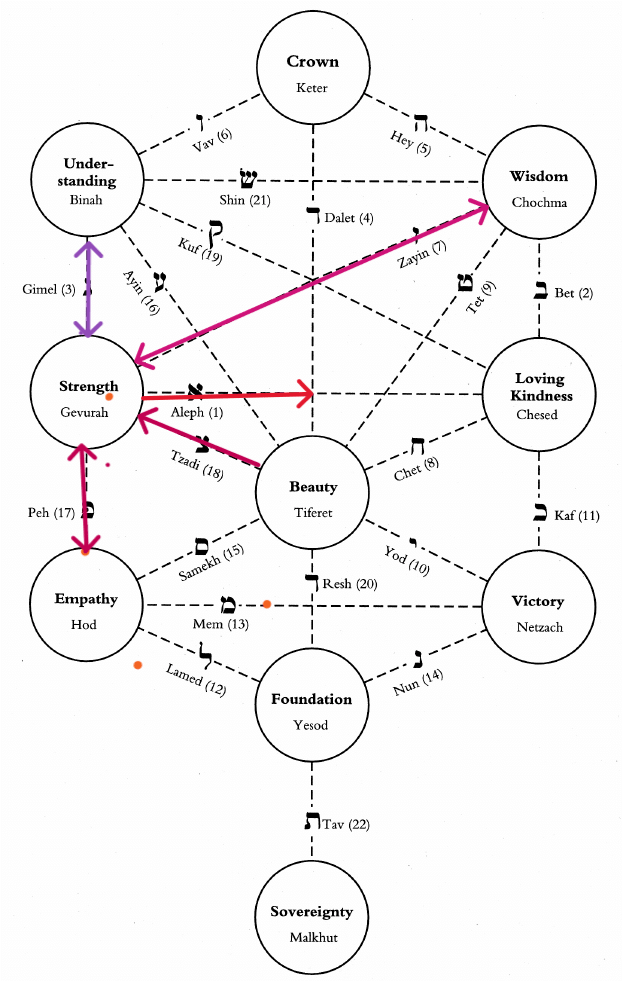
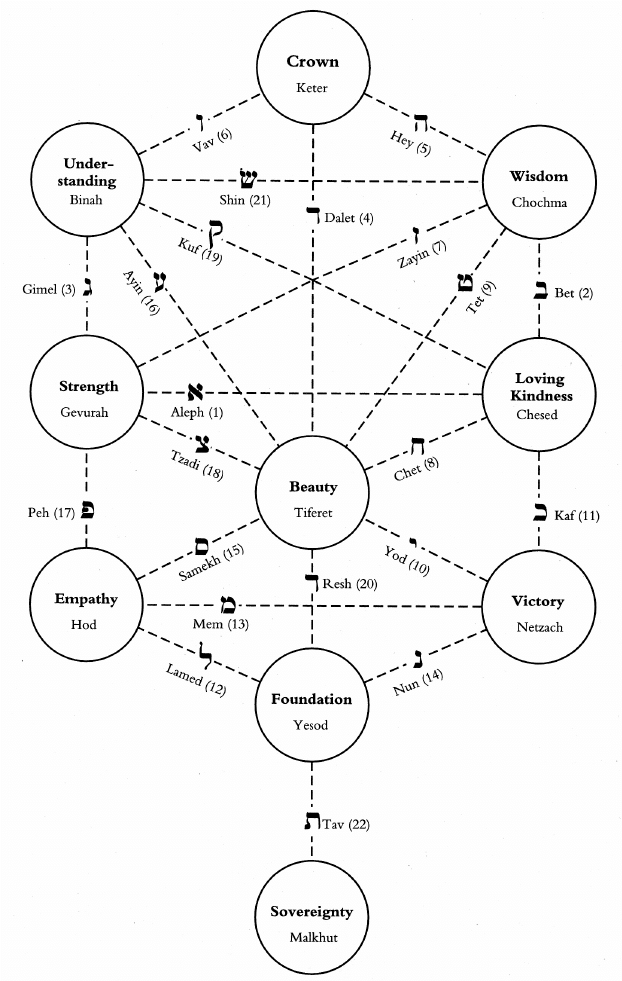
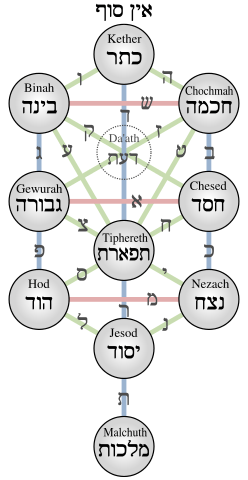
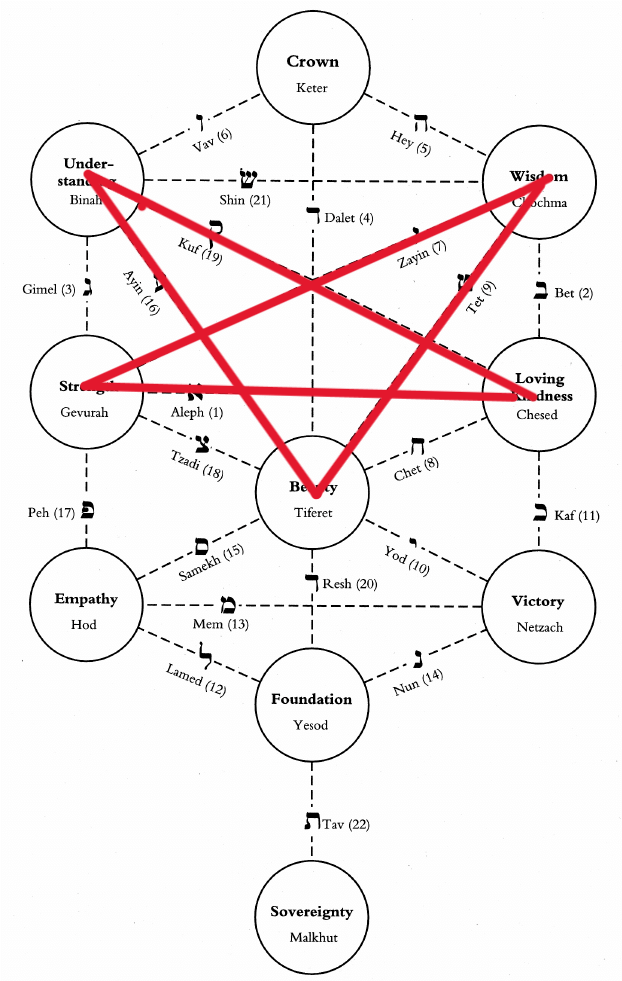
The paths emanating from Gevurah are:

5. The Radical or Root Intelligence:

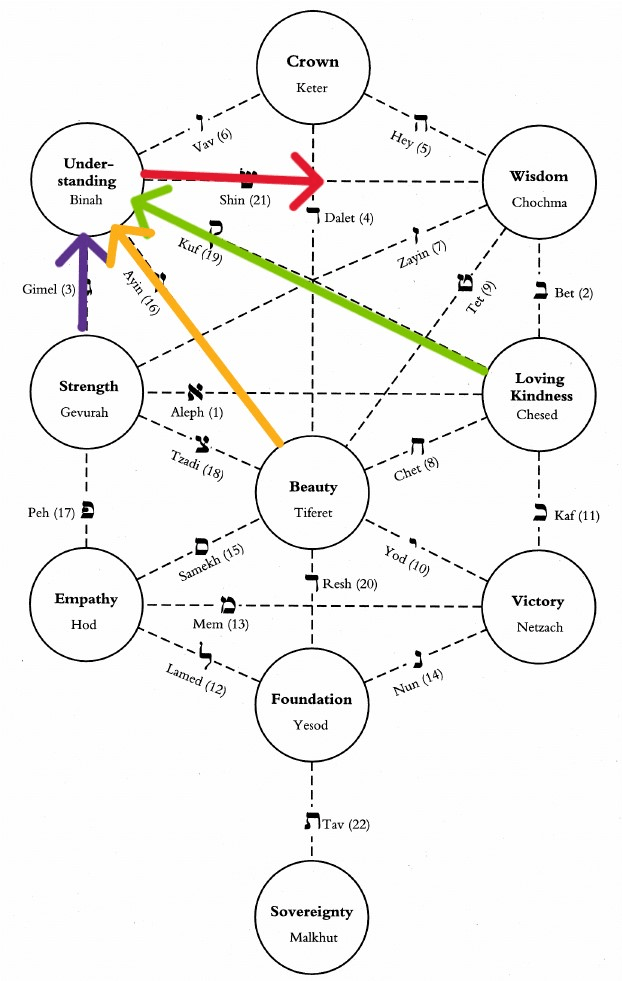
13. Binah to Gevurah/Gevurah to Binah: Letter Peh. Unity Directing Intelligence (Consciousness) (Sekhel Manhig HaAchdut): It is called this because it is the essence of the Glory. It represents the completion of the true essence of the unified spiritual beings.

20. Tiferet to Gevurah: Letter: Ayin Path 20: Intelligence of Will (Consciousness) (Sekhel HaRatzon): It is called this because it is the structure of all that is formed. Through this state of intelligence (consciousness) one can know the essence of Original Wisdom.

24. Gevurah to Hod (Hod to Gevurah) Letter Kaf. Apparative (Tools) Intelligence (Consciousness) (Sekhel Dimyoni) (Sometimes called The Imaginative Intelligence): It is called this because it provides an appearance for all created apparitions, in a form fitting their stature.

The Fifth Path: The Radical/Root Intelligence

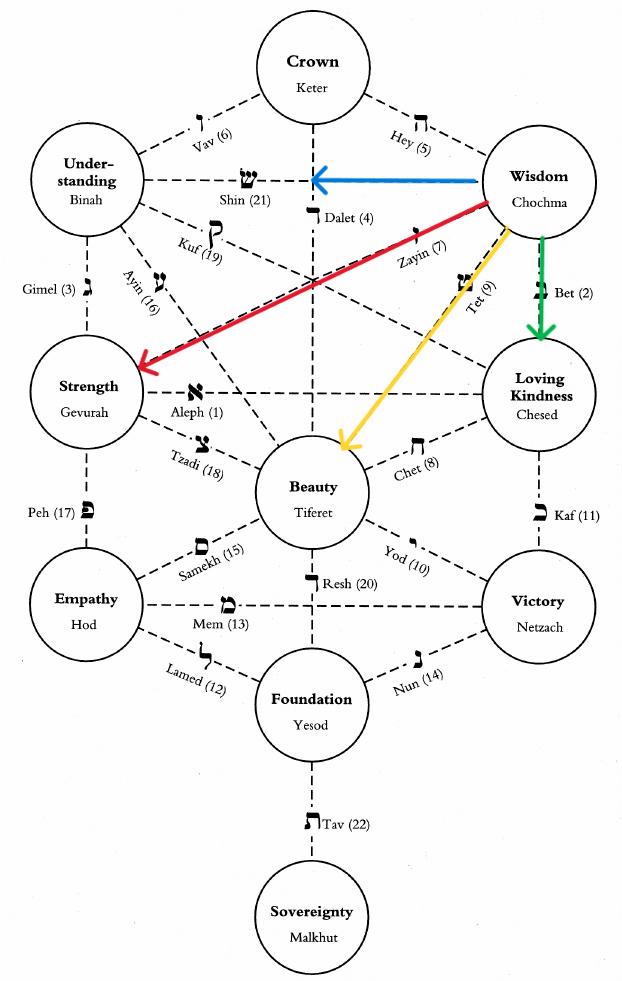
The Fifth Path is called the Radical Intelligence because it is itself the essence equal to the Unity, uniting itself to the BINAH or Intelligence which emanates from the primordial depths of Wisdom or CHOCHMAH.

Alt. Trans. “The fifth path is called the root consciousness because it is the substance of the unity, joining itself to that understanding (Binah) which itself emanates from within the province of primordial wisdom.”

Wescott trans. The Fifth Path is called the Radical Intelligence, because it resembles the Unity, uniting itself to the Binah, or Intelligence which emanates from the Primordial depths of Wisdom or Chokmah.

Case trans. The fifth path (Pachad, Gevurah or Deen, the fifth Sephirah) is called the Radical Intelligence, and it is so called because it is the very substance of Unity, and is within the substance of that Binah which itself emanates from within the depths (literally ”from within the enclosure”) of the Primordial Wisdom.
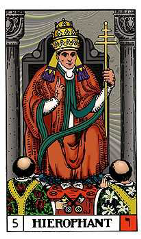
The fifth path of Radical or Root intelligence is that Understanding (Binah) which comes from how we understand and interpret the Laws of Necessity which emanate from the wisdom or knowledge of the whole (the Unity) that is Chokmah. The emphasis on the path here is on its “resemblance” to the Unity (the Good itself), but it is not the Good itself. It is a ‘shadow’ or an ersatz form of the Good itself. We can see the contrary nature of the translations that are given for this path. The enclosures of Primordial Wisdom are illustrated in the letters Beth, Chet, and Tet, and we have discussed the meanings of these letters already. The understanding and interpretation of Necessity becomes the destiny or Fate of those human beings that have to suffer that understanding and interpretation.

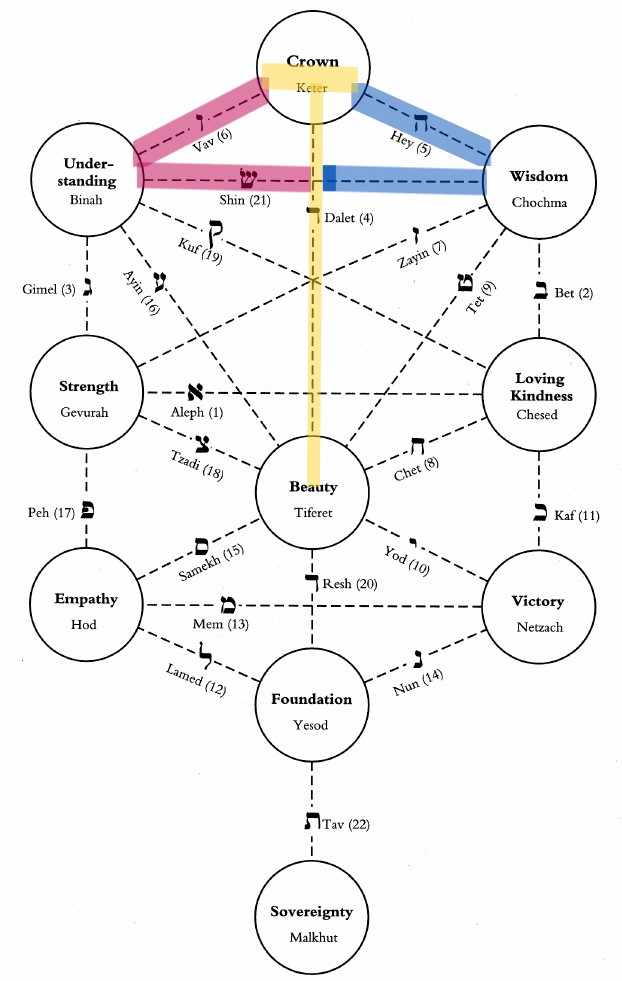
It is required for human beings to distinguish between the Necessary and the Good; not doing so leads them to the darkening of the light and, ultimately, the rejection of the light i.e. to sin. Is the Radical Intelligence lit by the light of Keter, the Sun, or by the reflected light of the Moon? Is it the fire that is Shin that is the light which “enlightens” the Cave that is the enclosure that surrounds Gevurah?

The ‘enclosure’ of Primordial Wisdom we have designated as the letters Chet and Tet, but it could also possibly be Beth, since Beth is the ‘house’ of being. If we paraphrase the words of the path, the Unity of Gevurah is a product or outcome of the Understanding (the substance) that results from our knowledge of the realm of Necessity. This substance of the Unity is what we have called the ‘collective’, ‘the social’ in this writing and the historical knowledge that derives from this collectivity of human beings. This unity is an ersatz or false form of the Unity that is the Divine, and exists on a lower level or plane than the unity that is the Divine i.e., it exists in the ‘depths’ of existence, the gyring outward direction of the Creation. The outward direction of Creation, the ‘away from’ the source of the Creation is the ‘depths’, not the ‘heights’, of Creation.

The Radical Intelligence joins ‘the many’ that comprises any thing into a ‘one’ thing and brings about the particularity of the objects of the world by imposing limits on the unlimited of Chokmah. This is related to the fire of Shin. This imposing of limits is a gathering and assembling into a one which was called logos by the Greeks; it is here that we find a meeting point of the Logos and Necessity. This gathering of the logos is done so that things can be named and is what the Greeks called dianoia. This can only be done in Time. We can find this process occurring in the algorithms of AI in our modern age; they are meant to create enclosures from within the enclosure that is AI itself. The naming of names is a ‘yes’ or ‘no’ response to the naming of the particulars that are brought forth into sight as predicates of the subject that is the unity of the thing. It is Reason as subject that is understood here, and the predicates must suffer from no contradiction and give sufficient reasons for the naming of the subject as such. Our scientific terminology and metaphors are part of this naming.

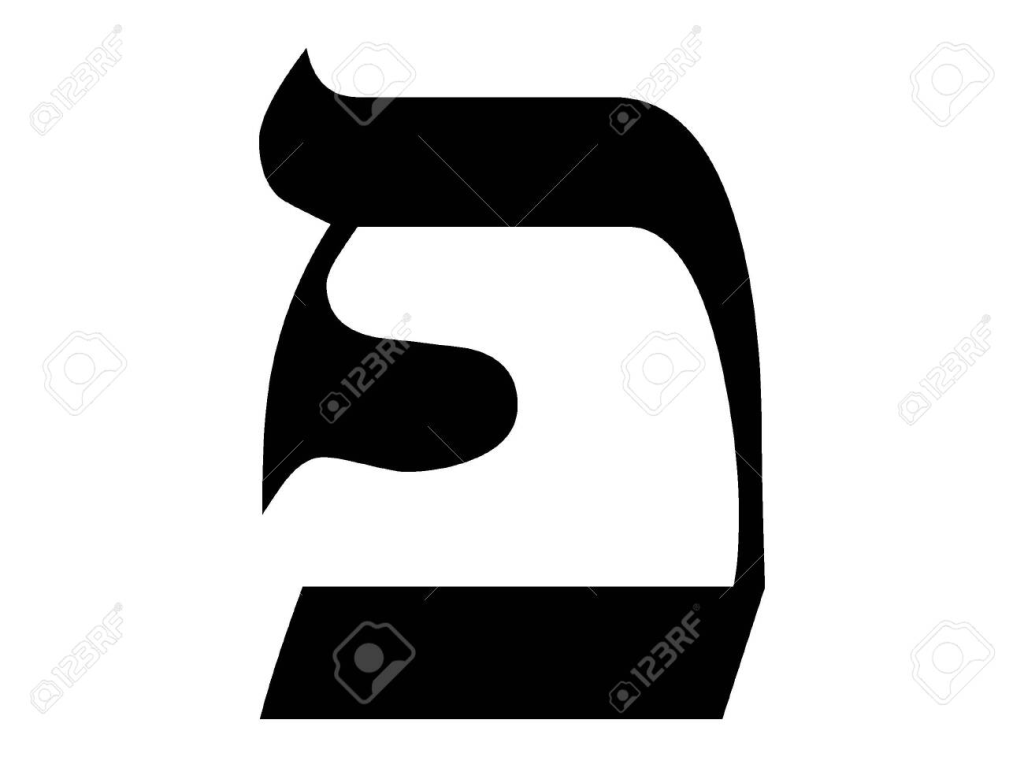
In the Sefer Yetzirah, the logos is represented by the Sephirot Tiferet. This seems to suggest that if things are named without the assistance of Tiferet then they will be falsely named; and this ‘false naming’ is a covering up of things that are not i.e., it is merely the naming of shadows. This makes it difficult in assigning the proper letter to the paths to and from the Radical or Root Intelligence. This intelligence or consciousness is what has come to be known as the Human Sciences, the politics, the anthropology, the psychology etc. that is gathered from the study of human beings. I have assigned the letter Peh as the path that is present between Gevurah and Binah. Peh is the language of rhetoric or public speech, and AI such as ChatGPT is an example of this ‘public speech’ and the flowering of this speech. It is primarily language as ‘information’. When language is understood as ‘information’, it is language that is ‘measured’, ‘weighed’, and ‘accounted for’ in the site that is human discourse.

Gevurah, the fifth Sephirot, is associated with the emanation of fire from the letter Shin, one of the three Mothers. Kabbalists also associate Gevurah with Mars and Scorpio astrologically, that is, a combination of fire (Mars) and water (Scorpio) which produces earth, materialism. Gevurah is associated with power and will to power and also with strife, as reason understood as the principle of reason is associated with power and will to power and the striving to master Necessity . To paraphrase Plato, only the dead do not have strife or polemos (war). Strife is life itself.
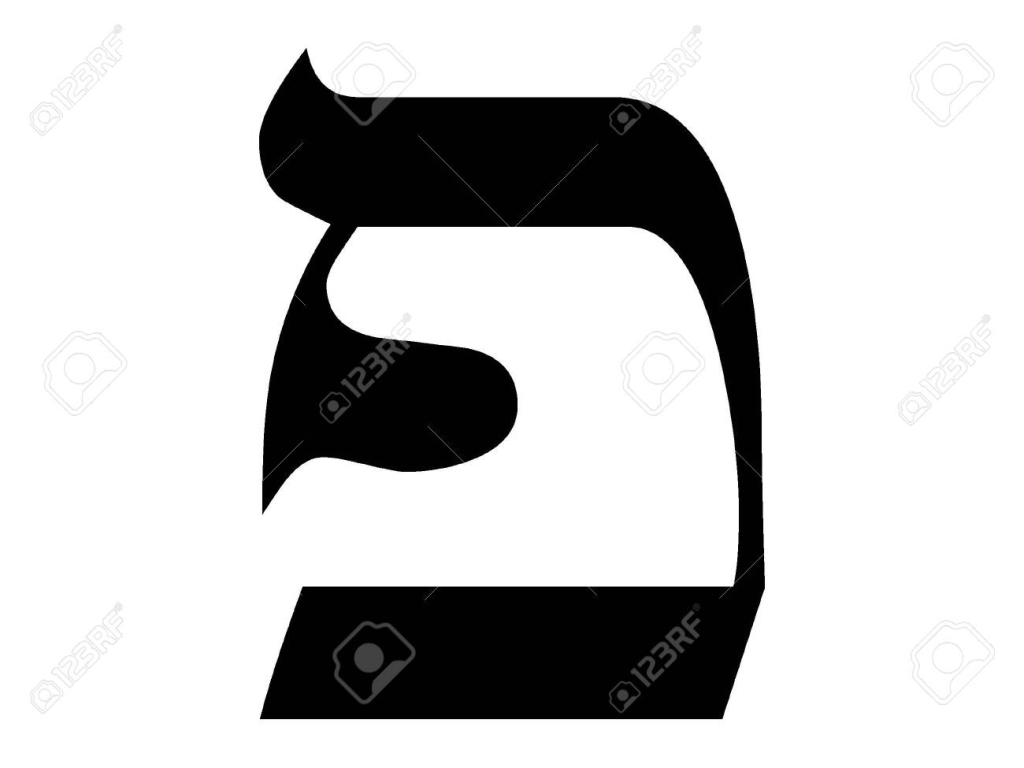
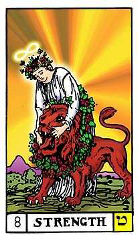
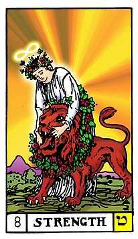
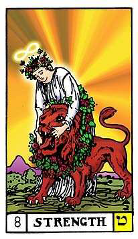
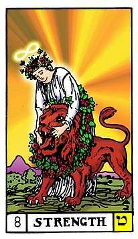
That The Order of the Golden Dawn chooses to associate the Tarot card Strength #8 with this path does not seem to make too much sense. The card Strength seems to represent the virtue of “prudence” or what the Greeks called sophrosyne, and this is a virtue of the individual within the society, the individual within the enclosure of society as is pictorially represented in the letter Peh. The letter Peh shows a Yod inscribed within an enclosing Beth or within any of the other enclosing letters of the Hebrew alphabet. The human soul is enclosed within a body; the human being is enclosed within the social community of which it is a part.
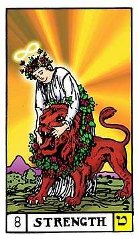
Justice as #8 would seem to appropriately represent the will to power of those societies or collectives that codify their laws in such a way as to demonstrate what is acceptable action by individuals within those societies. These laws become the narratives by which those societies live and which constitute the substance of the institutions within those societies. The “strife” represented is that between the individual and the city or the society, and this strife finds its foundation in the use of language. From our point of view when looking at the Tree of Life, the right side seems to represent individuals while the left side seems to indicate societies or the social and the middle pillar is the interaction between the two and the mediation between the two. It would seem appropriate that Strength be placed on the Middle Pillar since the figure represents proper moral and ethical action.

The fifth path or Radical Intelligence is also associated with fear. One is reminded of the myth of the ring of Gyges from Bk. II of Plato’s Republic where Glaucon, Plato’s brother, asserts that human beings only obey the laws for fear of the consequences of getting caught when one disobeys them. This is why they seek the ‘invisibility’ that ‘anonymity’ brings them. Justice is also related to the name of the fifth path when realized in its highest form. This associates it with the Greek understanding of Justice as dike or that which is “fitting”, “suitable”, “apt”, “fair” as the outcome of the process of making something such as laws or of doing something which is ‘noble’. This active doing is associated with the thymoeides part of the soul. When the table made by the craftsman is fit for the purposes of a table, then the table is “just” i.e., suitable, apt. From this ‘suitability’ for its purpose comes its good. The same thing can be said of laws: when they are fitting, suitable, apt then they are just and some form of goodness is the result and emanates from them.

The narratives that compose capitalist societies, for instance, show a clear discrepancy between ‘white collar’ crime and ‘street crime’. White collar crimes are primarily composed of fraud, deception, etc. and are committed by the elites of those societies. Street crimes are the violent crimes committed in the open and in plain sight. Even though the consequences of white-collar crime may be far more egregious to far more individuals, the perpetrators of those crimes do not receive punishments equal to the punishments given to the perpetrators of street crimes which usually involve a single individual. The institutional narratives of the societies which they compose indicate that justice is not present in those societies and that this injustice is present at the root or foundation of those societies. When the instituting of laws is to the advantage of the lawmaker, then injustice is the result (see the figure of Pausanias and his discussion of eros in Plato’s Symposium).

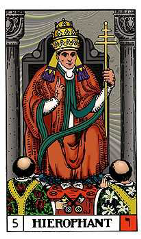
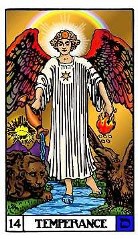
There appear to be a number of similar characteristics between the 5th path and the Temperance#14 card of the Tarot (10 + 4). I would associate the Justice card with the Sephirot Hod and the path of Kaf, while The Hierophant #5 is appropriately associated with The Rooted Intelligence and the path of Peh that leads both to and from it. Temperance may be said to represent the sophrosyne (prudence) and phronesis (wise judgement that comes from experience) that is the proper form of Eros in the thymoeidic part of the soul. The mediatory figure represented in the card assists the logistikon or thoughtful part of the soul in its dealing with the urges and drives of the epithymetikon or appetitive part of the soul.

The Fifth Path is also associated with the creation of Time. Being (creation) and time cannot be separated. This creation is that of Otherness (we sometimes give it the name of ‘Nature’), but “the substance of unity” is still present in it. It is here that one finds all the varieties of the ersatz forms of unity which we find in social collectives. Cliques, cults, sects, political parties, etc., are among the false forms that human beings choose in order to fulfill that absence, that need for completion, that they experience in the strife of their everyday lives. The letter Peh in its shape shows the individual Yod swallowed up by the collective whole. The individual is subject to the ‘enclosures’ that are the narratives that individuals invariably become involved with. AI will represent the whole of this enclosure and be considered ‘wisdom’ in the near future.

Gevurah, or the Radical Intelligence, refers to the “depth” of things, the root or the radix. The radix is the base or foundation of something. The radix of the positional numbering system as is used in the Sefer Yetzirah and the Tarot is 10. In the Radical Intelligence’s path’s emanations and their effects, Understanding and knowledge are brought into a unity with Wisdom (the Unlimited) to bring about the unity necessary to define a thing. A tree, for example, is composed of many parts: branches, leaves, roots, the trunk. These parts are brought together in the intelligence so that we can identify the thing as a tree and name it as such. This unifying thinking we have referred to as dianoia. The unity of the thing, what it is named, is the ‘subject’ or ‘the one’ of the thing, while the parts that make up the thing are its predicates. Both subject and predicates are parts of language, and what we call ‘logic’ or reason is based on, and finds its roots in, language (Logos). The Radical or Root Intelligence is the anti-Logos, for it creates the enclosures that cannot be questioned.

In the Sefer Yetzirah, the infinite number of possibilities and potentialities of the dynamis or “life-force” can be understood through the ten essential emanations of the Sephirot. The essence of the individual thing can be understood or seen through, made transparent, when the Sephirot which reveals it is understood. To make an analogy: AI uses the “infinite number of possibilities and potentialities” that are present in the whole that is the Internet to arrive at its ends or judgements. Of course, the possibilities and potentialities are not infinite but only appear to be so. AI puts language into ‘stone’, and thus kills language or causes it to cease to be a living force by turning language into ‘information’. Ultimately, this killing of language will turn human beings into zombies or golems, and this is the greatest danger of AI to humanity. AI is by its very nature unthinking, and because of this it is anti-logos.

Rene Descartes

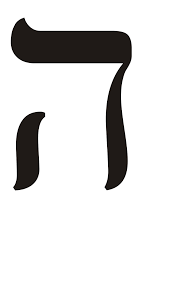
What is missing here, or what is the problem or difficulty here, is the connection or lack of connection, to Tiferet. All of the Sephirot are connected to Tiferet, but the paths themselves do not all pass through Tiferet. The paths are modes of “consciousness” or “intelligence”, “awareness”. There is, currently, a great gap between Love and Intelligence. Without Love, things are viewed from the egoistical “I” of the Self, and the will to power is the channel for that “I” in its empowerment through the principle of reason. The Self becomes the dominant ‘subject’, the ego cogito of the French philosopher Descartes. The channel itself becomes the principle of reason (Shin in the Sefer Yetzirah) which, in turn, becomes a principle of being or Life itself. Things, other beings, are deprived of that essential mercy and kindness which are the foundations of the true sources of knowledge. The Vav acts as a barrier to the mercy and kindness that come to us through Tiferet and Heh, and binds us in the enclosures that are rooted in fear, insecurity, and severity.

Gevurah relates to “might”, “power”, and “fear”, while the “loving kindness” that is the countenance of Chesed is contrary to this outward appearance of Gevurah. Gevurah may be said to represent the State, the Greek polis, the German Volk, the Roman church. It is the collective, the social and its realm. It is the site of the “strife” or polemos that exists between the individual soul and the society or community into which that soul has been born, the strife between the social, the city and human being. It is the world of convention, human “creation” or making. Gevurah is the force that pushes all things that are not similar to itself apart, away from itself. In Gevurah, there is no distinction between “power with” and “power over”; the two go hand-in-hand (i.e., in the technological, there is no essential difference between democracy, communism, and authoritarianism or other fascist forms of government. They are predicates of the subject technology). This separating ultimately suggests intolerance. The temptation and seductive force that is power consolidating itself to itself is contrary to that power that allows beings to be, the power that withdraws so that Otherness can be seen for what it is. Nevertheless, for the individual, we have no choice but to attempt to live well within the communities of which we are members. This living well is living justly.

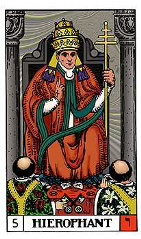
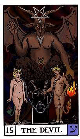
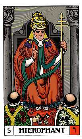
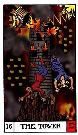
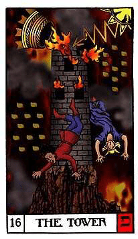
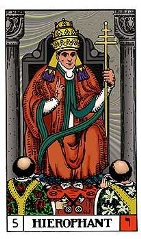
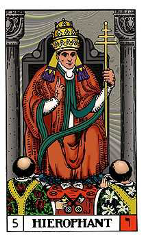
Gevurah is represented by The Hierophant #5 in the Tarot whose contrary is either The Devil #15 or The Tower #16. This is a crucial point in the Tarot and in the Sefer Yetzirah’s Tree of Life. The succumbing to the Great Beast is the succumbing to the three temptations of Christ: the material temptation of turning stones to bread (i.e. opposing the will of God and not recognizing the limits of Necessity; this can take on many metaphorical forms and is not merely the desire to overcome hunger. We talk about ‘the miracles of modern science’); the social temptation of having power over the kingdoms of the world (desiring or possessing the power of “social recognition” or social prestige, the temptation of the collective); and finally, the individual temptation, suicide (the temptation of God by denying the will of God and by the defying the Law of Necessity and in thinking that “we are our own”).
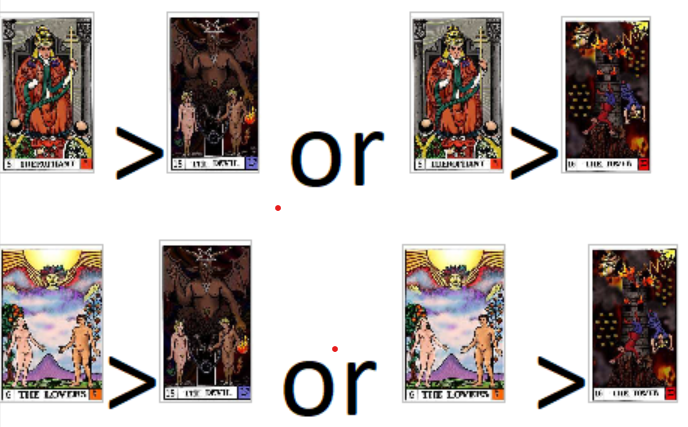
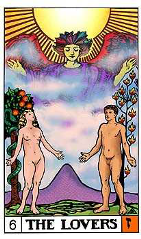
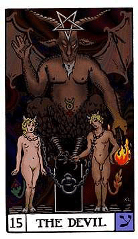
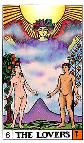
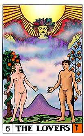
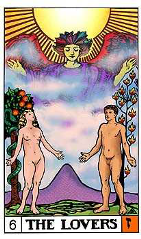
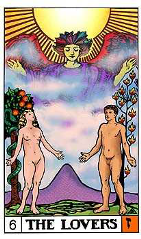
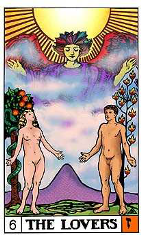
In the Tarot, the symbolism of The Devil mirrors that of The Lovers but is contrary to that of The Lovers: the manacles of The Devil which bind the man and woman to the black cube upon which the Devil roosts are the Tree of Life and the Tree of Knowledge in The Lovers #6. The manacles are attached to the cube of the physical world which is a black cube over which the Devil roosts; no such cube exists in The Lovers card. The Devil is a false or ersatz form of unity to which one becomes bound and loses one’s freedom and one’s individuality. This enchainment is freely chosen.

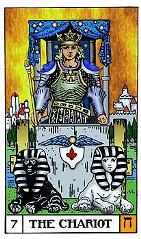
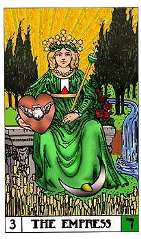
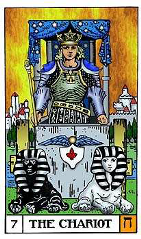
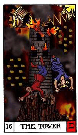
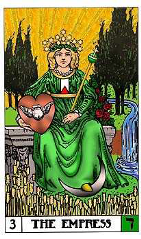
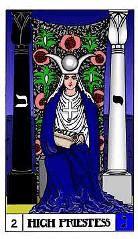
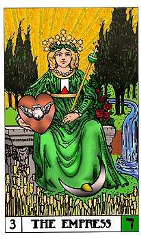
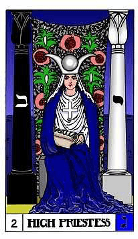
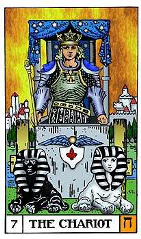
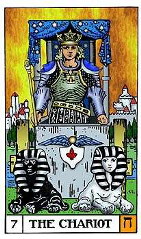
This is why I would assign #16 to The Devil and #15 to The Tower. The Tower is the lightning bolt of Zeus, or of God, and is the nemesis for the worship of false gods or the worship of power and social prestige. The Tower is the card of revolution, change. In the ascending direction, the worship of The Devil leads to The Tower; in the descending direction, The Tower leads to that revolution which simply replaces itself with The Devil. The cube of The Devil is one possible outcome of the cubes shown in the cards of The High Priestess, The Emperor, and The Chariot or the cards on the right side of The Tree of Life. On the left side, The Empress sits upon a rectangle, The Hierophant’s robes hide and conceal that which he is seated upon, and Justice is shown seated upon a throne. The Hierophant’s “throne” or seat is illustrated in black in the card given here.

The Letter Peh and the 13th Path: The Uniting Intelligence

Path 13. Binah to Gevurah: Unity Directing Intelligence (Consciousness) (Sekhel Manhig HaAchdut): It is called this because it is the essence of the Glory. It represents the completion of the true essence of the unified spiritual beings.

The Thirteenth Path is named the Uniting Intelligence and is so called because it is itself the essence of Glory. It is the Consummation of the Truth of individual spiritual things.

Alt. Trans. ” The thirteenth path is named the uniting consciousness because it is the essence of glory. It represents the completion of the true essence of the unified spiritual beings.”

Wescott trans. The Thirteenth Path is named the Uniting Intelligence, and is so called because it is itself the Essence of Glory. It is the Consummation of the Truth of individual spiritual things.

We spoke in the Third path of the thinking that is termed dianoia, that thinking which unites things that are separated, that thinking which brings things together into a one thing so that the thing can be named. The 13th path from Binah to Gevurah is the bridge between the universe of Asiyah and Beriyah and the universe of Yetzirah. Yetzirah is the world of action, the world of ‘making’, the formation of things which brings about their “consummation” or “perfection”, their completion. These things may be physical things or ethical things, since “glory” refers to the beauty of actions. It is the world of “values”, that which human beings ascribe to things that are of their own doing and their own making. “Values” are what human beings make or determine regarding actions or things; they are not the “good” so we may say that they are an ‘imitation’ or an ersatz form of the good. “Glory” is not the Good. “Values” are what are constructed from the narratives that have been created by the will to power of the collectives in which those values are ‘valued’.

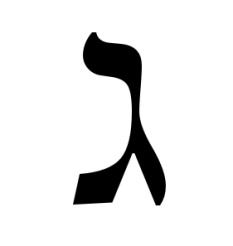
The four causes of Aristotle of which we have spoken about are within both the physical and spiritual realms; that is, they have to do with both ontology and ethics. The actions which human beings take require a dynamis, whether in an active or passive form, a potential or a possibility of being able to come into being or not to come into being. They are expressions of the thymoeidic part of the soul as concrete illustrations of eros. Paul Foster Case considers the Thirteenth Path to belong to the letter Gimel and to be associated with Tiferet; but this cannot be the situation. The letter Gimel refers to “wealth”, the “value” of created things, the multiplicity of created things, the “wealth” of things that is the abundance of Nature, and is associated with the strife human beings experience amidst that multiplicity of things. It is one of the 7 double letters indicating that its understanding can be viewed in two ways (at least).

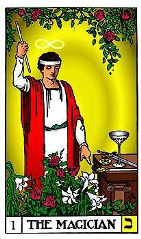
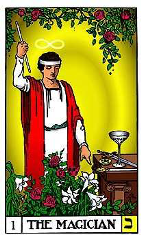
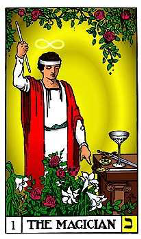
If we look at the card of The Magician #1, we can see that he is enclosed within an inverted Peh. We may say he is the Peh itself. The ‘making’ of The Magician is that making carried out by the artisans and technicians who happen to compose the powers that be in the societies of which they are members. Peh is the logos of rhetoric, the language of the many directed toward the many and it finds its highest form in the legislating of laws. The “magicians” and technicians are dependent on the people who are their audience. This is contrary to dialectic, the language of the few which is directed to the two or three gathered together.
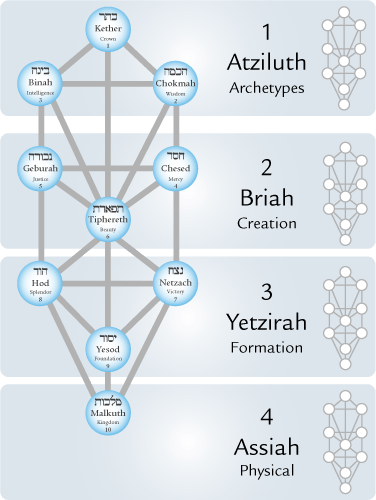
The strife among the created things and urges that arise in human beings is that which needs to be brought into a “friendship” or balance and this is done through the connection between the primal water of the Holy Spirit (Chakmah the undifferentiated pre-conscious), to the fire of Keter through Air (Alef) from which earth (wealth) is created.

We might get an understanding of Binah/Gevurah as Foundation when we think of gravity. Gravity is the most obvious manifestation of the law of Necessity, the limits that are imposed on the unlimited. It is through understanding the laws of Necessity that we are able to traverse the paths from the Beriyah universe to the Yetzirah universe of formation on the inward and upward path. It is the law of Necessity which provides all of that which we call knowledge.

There are clearly errors in the commentaries that place Gevurah as “Justice” and not the sephirot Hod. If the “uniting intelligence” is the essence of “glory”, then it must manifest itself in beauty of some kind since glory’s root is the Beautiful. The beauty of the things made by human beings or in the “glorious” actions that human beings are capable of performing once they have been given the Love that unifies all beings are examples of these. This ‘glory’ is the face that the desire for immortality takes in the thymoeidic realm of the soul. Of course, this is where error can arise. The “glory” that derives from “social prestige” is the second temptation of Christ. (Matthew 4:3) The unity or sense of oneness that one derives from belonging to a clan, country, political party or some other “collective” is a false form of the unity that belongs to “two or three gathered together in my Name”. His Name is Love, not the Law; it is not the power that derives from “social prestige” and recognition. It is no coincidence that insanity or madness is rarely found in individuals but is the norm or the rule in collectives.

The NOW is eternity once the individual has been reconciled to the One which is the heart of all things. This is how one can understand Plato’s statement that “Time is the moving image of eternity”, when eternity is experienced in the NOW. Nature itself is sempiternal: the sempiternal is an image of the eternity of the One. The epithymetikon or appetitive part of the soul experiences the primary desire for immortality through the procreation of children; the thymoeides part of the soul experiences the desire for immortality in the achievement of fame or recognition through the doing of ‘noble actions’. The logistikon or ‘rational’ part of the soul (intelligence) has the direct gnostic experience of immortality when it is directly united to the One through the mediatory power of Love. This places it at odds with the orthodoxy of the piety ruling the faiths of collective religions.

What is one to do practically? One is “to mind one’s own business” and to take care of those things that come to one when they occur: to recognize and distinguish  between the Necessary and the Good and to prevent the worst from happening when one cannot assist in bringing about the Good. It is not in our power to bring about the Good; that is in God’s hands which He gives through His grace. But we are capable of producing the contexts and circumstances where the good can occur. The greatest evils occur when we think we can bring about the Good i.e., “the good end justifies any means”.

Peh derives from “and Elohim saw that it was good” (swarming of waters with creatures; of air with fowl) 1:21 These are the “goods” that are not the Good but are sometimes mistaken for the Good. These ‘goods’ are determined by the society of which one is a member through the narratives that those societies put forward, or they are those ‘goods’ that are necessary for our survival as human beings.

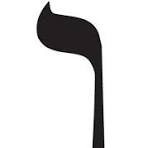
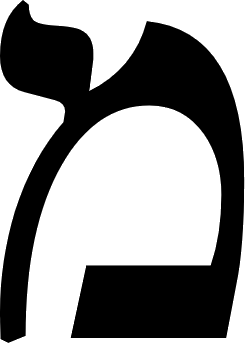
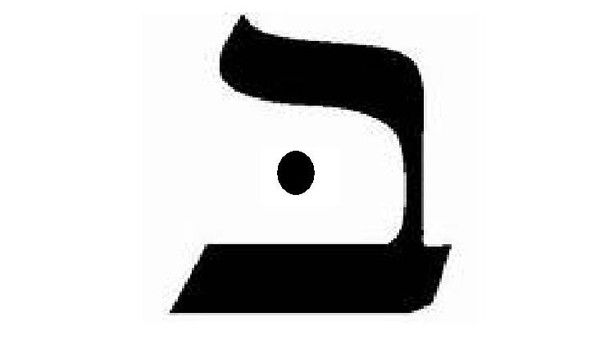
The Hebrew letter Peh means “mouth” and refers to the power of speech and “to consume”. Peh is similar to the letter Kaf in shape, but Peh contains a “tooth”; the letter Shin means ‘tooth’ and teeth assist us in our consumption of things, the grinding and breaking down of things. Shin is primary in the process of decreation in the ascending motion from out of the depths of the Tree of Life. In Kabbalah speech, the logos, is a spiritual power, which can cause good or evil depending on whether it is used falsely or truly. One of the problems with language is that it allows itself to be used so. Our being is determined by what one thinks and how one thinks, and these in turn are determined by how we view the world and how we will view the world. This seeing and thinking, in turn, determine our actions, what our character is and how one is as a being. Since it is in the nature of human beings to reveal truth, i.e., it is what we essentially are, what one speaks has the power to become reality. Lies become realities through false speech. Violent words lead to violent actions. When our speech is not used to reveal truth, we become more inhumane, bestial, violent, and ultimately, insane. The quality of our speech determines the quality of our life’s essence and creative existence. This is why speech and language are so important and so dangerous.

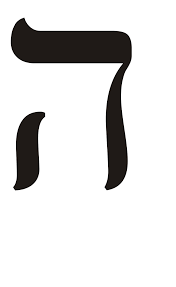
The shape of the Peh is a Khaf with a Yod inside of it or, as suggested above, a Khaf with a Shin inside it, or a Beth with a Yod inside of it. The Shin represents the spiritual spark or the emotional, passionate fire of the soul, contained inside the physical body, the thymoeides of the soul. Kaf is associated with the ‘hand’, so there is a grasping, taking possession of something implied here. The reference seems to be to the world of yetzirah and with our use of equipment and tools, the ready-to-hand. Passionate speech deals with rhetoric; the speech before crowds and assemblies, public discourse. This suggests that the letter Peh signifies the individual (the Yod) enclosed within the crowd, or it could also signify the individual who has chosen to be contained within the enclosure of the material world only, such as is suggested by The Magician #1.
With words and silence we can communicate the essence of our soul and existence. This requires that the inner and outer life match – that the physical existence is fully aligned manifesting the spiritual intentions of the soul within it. Socrates’ prayer to Pan at the end of the dialogue Phaedrus expresses this: “Dear Pan, and all you other gods that dwell in this place, grant that I may become beautiful within, and that such outward things as I have may not war against the spirit within me. May I count him rich who is wise, and as for gold, may I possess only so much of it as a temperate man might bear and carry with him.” This is similar to what it says in the Talmud Baba Metsiah “Don’t say one thing with the mouth and another with the heart.” The Yod is the point in the heart where spiritual awakening begins, what we have been referring to as the logistikon part of the soul. However, the alignment of the physical with the spiritual is no easy task as even someone such as Socrates needs to pray for a balance between them.

The power of the Peh is a double-edged sword. As it says in Proverbs 18:21 “Life and death are in the hands of the tongue.” Because of this, the Peh represents the requirement to govern one’s own nature, to ‘know thyself’ and know when to speak and when to be silent. Routine speech, speech to manipulate, all the distortions of speech must give way to viewing speech as a miracle in order to make the leap beyond this path.

The Letter Kaf and the 24th Path: The Apparative/ Imaginative Intelligence

Path 24. Khaf  Gevurah to Hod (Hod to Gevurah) Apparative (Tools) Intelligence (Consciousness) (Sekhel Dimyoni) (Sometimes called The Imaginative Intelligence): It is called this because it provides an appearance for all created apparitions, in a form fitting their stature.

The Twenty-fourth Path is the Imaginative Intelligence, and it is so called because it gives a likeness to all the similitudes, which are created in like manner similar to its harmonious elegancies.

Alt. Trans. “The twenty-fourth path is called the imaginative consciousness because it provides an image to all created things that have an appearance, in a form fitting to each.”
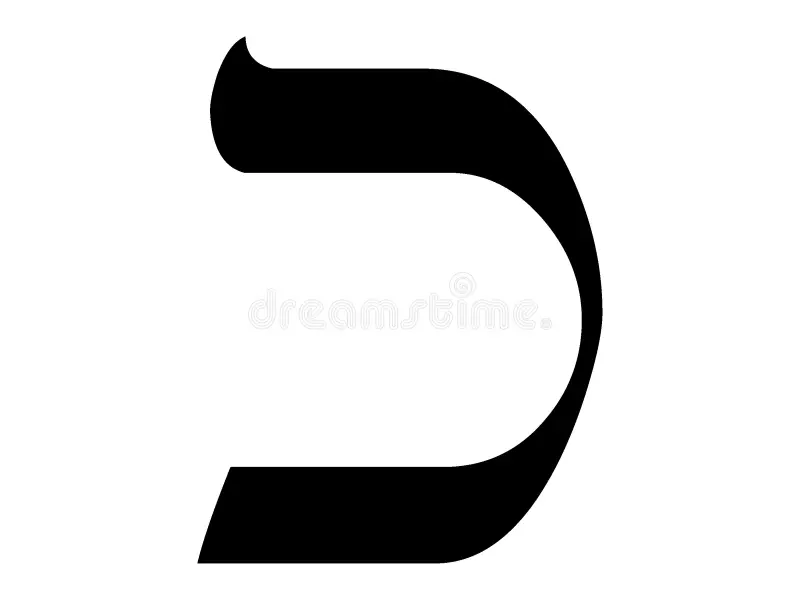
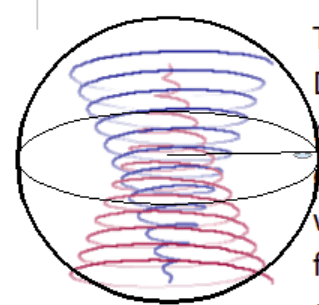
Khaf, the 11th letter of the Hebrew Alphabet, means literally “the cupped palm of the hand”. It is the central letter of the alphabet and thus a mid-point. It is like a cupped, outstretched palm, ready to receive or to take(?). The shape of all containers – a bowl, a cup, a jar, is based on a basic curved shape resembling the curved shape that is the circumference of the sphere that is the creation itself, and Khaf, like the Beth, represents the idea of a container. It is the container in the realm of Yetzirah or Formation. This is its relation to the Mem/Alef crossover path from Chesed to Gevurah and the downward/upward path from Binah to Gevurah. It represents form and it is connected to the other letters of Hebrew alphabet that relate to “container” shapes and are double letters, which suggests that they are capable of the upward or downward motions that are the gyres within the sphere. A house, for example, is a form that contains the goings on of the people inside it; a body is a form which contains the life and energy of the person who possesses it. The forms of the physical world are where the spiritual essence of life is able to manifest, but how they will manifest depends on how the world is understood and seen. This is the significance of the letters Resh and Ayin and how they come to name the letter Khaf and its relation to the ‘firmament’ in Hebrew.

The Khaf is what gives form to the matter; it is an “imaginative” power. Here, imagination must not be confused with ‘fantasy’. It is quite the opposite. It is related to tools and equipment, that which will be used to ‘form’ and ‘shape’ the desired outcome. This giving of form is an external force outside of the thing that is being shaped. It is the force urged by the thymoeidic part of the soul mentioned earlier. It is not the Understanding that is Binah and its giving form to the unlimited realm of Chokmah that is in the world of Beriyah, but is the secondary element of formation found in the world of Yetzirah, the world of “making”, and this is why it is linked from Hod to Gevurah or from Gevurah to Hod. Kaf contains all the possibilities of containing, building, and forming all existence. It is what we refer to as the ‘applied sciences’, with the science being the eidetic power of numbers and words of the logos . It is AB of the Divided Line of Plato outlined in Bk VI of his Republic.
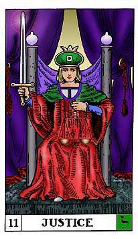
This containing, building, and forming is related to the world experienced as the ready-to-hand, and the emphasis on handling things in order to transform them i.e., the realm of Yetzirah. Kaf is the letter of formation, bending the straight line into a curved shape. This is its association with making things “fit”, “suitable” and it is thus related to Hod and to the Justice card of the Tarot. It also symbolizes the crown of the Torah – Keter כתר (I think this would be better understood as related to the Kingdom of Malkhut? Or is it, as a double, to be viewed as both and thus to be seen as a bridge between the different worlds?)

Khaf is related to will and to will to power. It teaches us that to bend and govern our tendencies or urges, and to shape our character, we must be flexible in the currents of time. It teaches us moulding, sorting, comparing. We bend the matter to the ‘spirit’ and the ‘spirit’ to the matter, constantly connecting the thought of the desired outcome with the action and doing of it. The Khaf also teaches us about what we contain inside ourselves and since it is a double letter, what we contain may be hidden in darkness or dwell in the light.

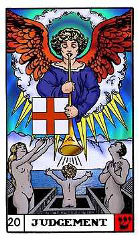
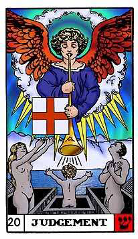
The letter Kaph derives from “and Elohim saw that it was good” (the two lights in the firmament) 1:18. The Hebrew word for “firmament” is composed of the letters Resh, Khaf, and Ayin and indicates “that which can be seen”, the physical, material thing. This relates Khaf to Path #20 The Intelligence of the Will and to the ‘structure of all that is formed’. Resh means “head”, both as a part of the body and as a leader of a group, and this directs us to the Tarot card of Judgement #20 and to the choice and test that must be experienced at this stage along the journey. Khaf as a container letter holds within it the contents of that knowledge which have become known as ‘historical’ and ‘holy’.

The Letter Ayin and the 20th Path: Intelligence of the Will

Ayin– and Elohim “divided the light from the darkness.” 1:4

Path 20: Tiferet to Gevurah: Intelligence of Will (Consciousness) (Sekhel HaRatzon): It is called this because it is the structure of all that is formed. Through this state of intelligence (consciousness) one can know the essence of Original Wisdom.
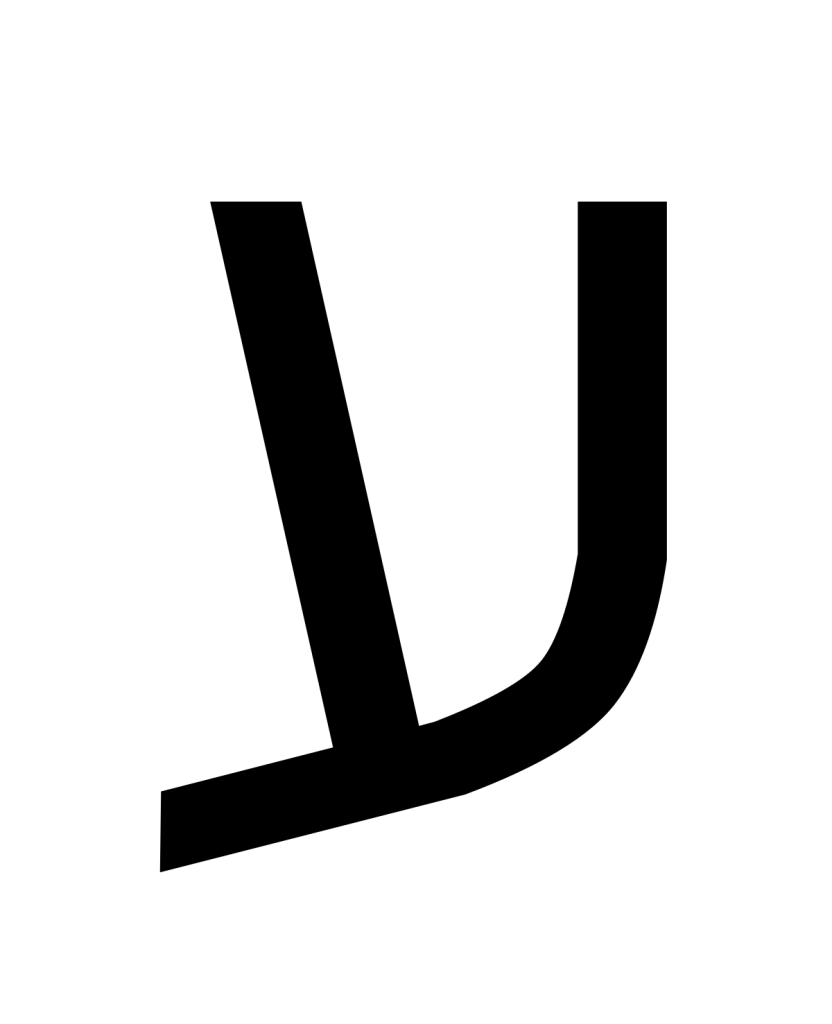
The Twentieth Path is the Intelligence of Will, and is so called because it is the means of preparation of all and each created being, and by this intelligence the existence of the Primordial Wisdom becomes known.

Alt. Trans. “The twentieth path is called the consciousness of will because it is the pattern of all that is formed. By this mode of consciousness, one may know the actuality of the primordial wisdom.”

Path 20. Intelligence of Will (Consciousness) (Sekhel HaRatzon): It is called this because it is the structure of all that is formed. Through this state of intelligence (consciousness) one can know the essence of Original Wisdom.

“The structure of all that is formed” is the Law of Necessity and it is through the understanding of the Law of Necessity that one is able to know “the essence of Original Wisdom” or the Sephirot Chakmah. The Seven Pillars of Wisdom correspond to the seven lower Sephirot and each of the themes of the individual Sephirot comprise the area of knowledge that makes up a particular “pillar of Wisdom”.

Our attempts to understand “all that is formed” comprise our ‘theories of the real’, what we call our sciences, how we attempt to view our world. Our Sciences are products of reason and the will, thought and experiment. As was said earlier, Artificial Intelligence is a shadow of the shadows of the things of Necessity. In Plato’s Allegory of the Cave, it would be a second cave and a further distance, at a greater depth, from the light of the Sun, the Good. Its greatest danger is that it is self-contained, and in its appearance of enlarging, it is , in fact, an enclosing of the world within its own sphere, its own ‘bubble’.

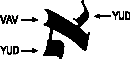
The letter Ayin is erroneously said to have the power to unite everything that is separated in creation and this is why it is confused with the structure of the letter Alef which consists of two Yods separated by a Vav. The letter Ayin as the 20th path is related to the letter Peh and path 13 The Unity Directing Intelligence and the letter Vav Path 17 The Intelligence of the Senses.

But is Vav really a true unifier or a barrier, a separator? Literally Vav means “hook” or “peg” and the Hebrew letter is a vertical line ו. The Vav would appear to be a metaphor of the mediation that exists between reason, the logos understood as an extension of the will to power, and the ready-to-hand world about us. The world is seen as the second Cave of the Internet containing the whole and the Vav is that reasoning that unites the things in that Cave to the algorithm based on the principle of reason. This reasoning is tied together with The Sanctifying Intelligence, the intelligence that separates (diaresis), and The Unity Directing Intelligence (dianoia) the intelligence that brings into a unity, that emanates from the Sephirot Binah. This is the Intelligence that is separated from Love.

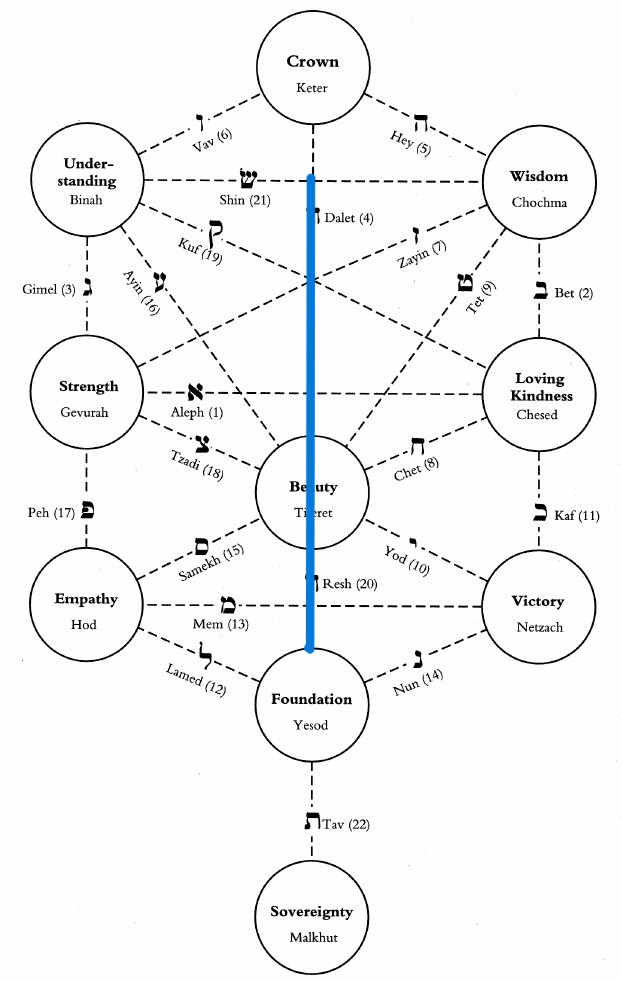
The Vav is said to represent the Kav, the vertical line extension of the Creator’s perfection into the created world, in order to constantly direct it, guiding the cycle of existence step by step, until eventually the perfect Oneness of the Creator which underlies all of creation is revealed. Vav would thus relate to the Law of Necessity, the Divine Will, ‘the structure of all that is formed’. The Vav would thus be seen as a barrier but also as a way through. Vav is related to the Orr Yashar, the direct light of the Creator, entering the world but in the strife of this world, it appears to act as a barrier to the true Light. This would relate it to Christ who is the direct light of the Divine and would thus associate Vav with Tiferet, the sixth Sephirot and the Beauty of the World. But Vav, being an elemental letter, is capable of only one direction of movement. Is this movement up or down? Is it on the left side or the right side of the Tree of Life? Or is it the line in the middle?


Most commentaries on “The 32 Paths of Wisdom” seem to ignore the discoveries of quantum physics when they discuss the roles that human beings play in relation to Being and the World. Because science no longer deals with what was understood traditionally as Nature, the human will prepares each thing of Nature for the perfection that will come from the ends or purposes that human beings determine or devise that are best for themselves. This is what we call “freedom”, the devising of ends which we think are best for ourselves. We believe in this freedom because we believe that, ultimately, we are ‘our own’ as individuals. We have succumbed to the third temptation of Christ. Freedom is the commandeering and dominating knowing and making that we understand as technology. This dominating knowing and making includes our own bodies. It is also what we understand as ‘artificial intelligence’. What is clear from the Sefer Yetzirah and the traditional religions of the world, both West and East, is that we are not our own but are called to a higher destiny beyond ourselves; however, in our viewing and understanding of our world, we choose the destiny or fate that will befall us. The narratives that we have constructed of our worlds are predicates of the subject technology.

In the world of the will and of will to power, there are some cases where there are created beings that serve no purpose or ends for the will to power of some human beings; that is, they have no “purpose” or future “use” and cannot be brought into being as part of a “standing reserve” of resources, and to these beings no “justice”, no completion nor perfection is due, and that includes some other human beings. This is what has made, and will make in the future, the possibility of genocides.

The Twentieth Path is contrary to this type of thinking, if it is viewed as a duality. The “preparation of all and each created being”, “the pattern of all that is formed”, may be best understood in the German word gestell as it is used by the German philosopher Martin Heidegger. A Gestell is a framework or “method of organization” which allows created things to be and to come to presence for us. It is the primordial algorithm. Heidegger calls it the essence of technology. It is a manner of human being-in-the-world (among other possibilities of human being although it is, by far, the dominant one) and it determines how the created beings are to be viewed. It is a ‘destiny’, a ‘fate’ of Being. While in German Gestell is a noun, Heidegger uses the word in a way that is uncommon by giving Gestell an active role, by viewing gestell as a product of the human will and a product of human action, a human “projection”, “a throwing forth”. This projective throwing forth is rooted in the principle of reason.
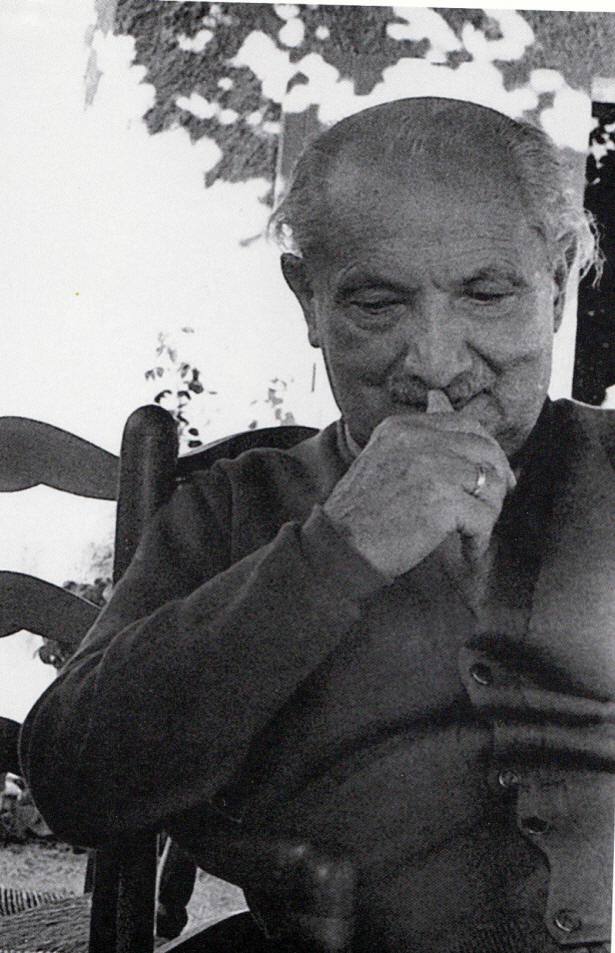
Martin Heidegger

In defining the essence of technology as Gestell, Heidegger indicates that all that has come to presence in the world has been “enframed”. Such enframing or the placing within ‘enclosures’ relates to the manner reality appears or unveils itself in the period of modern technology (by “modern” here is meant post-Renaissance) and people born into this “mode of ordering” are always embedded into the Gestell (enframing) themselves. (As the Canadian philosopher, George Grant said, “What we have done to Nature, we first had to do to our own bodies”.) Thus, what is revealed in the world, what has shown itself as itself (the truth of itself) requires first an Enframing, literally a way to exist or to be in the world, to be able to be seen and understood. Path #20 indicates this knowledge when viewed from one perspective.

In ordinary usage the word gestell would signify simply a display apparatus of some sort, like a book rack, or picture frame; but for Heidegger, Gestell is literally the challenging forth, or performative (dynamis) “gathering together” for the purpose of revealing or presentation i.e., the human will as central to how the world will be unveiled. If applied to science and modern technology, “standing reserve” is active in the case of a river once it generates electricity or the earth if revealed as a coal-mining district, the soil as a mineral deposit, or scenic sites as part of the tourism industry. It is this challenging forth that connects gestell to the human will. It is ‘the hook’ or ‘peg’ that is part of the meaning of the letter Vav which is related to the letter Ayin.

Another way of viewing the 20th path is to see it as “prudence” or the
Strength card as #11 of the Tarot. The essence of technology as outlined by
Heidegger devolves into the nihilism of the pure “will to will”, the need to
will anything since one has no other alternative given the oblivion of
eternity. The desire is for ‘novelty’. The technological way of being-in-the-world is a mirror or mimicking of the “primordial wisdom” that is in the realm of the world of Atzilut since it bestows the ‘values’ on things and these values are related to their
potential uses. This may be seen in the manner of questioning of the thing and how that question will be answered.


The Hebrew letter Ayin means “eye” and correspondingly, the Ayin has to do with vision and bringing forth the light that is hidden, the unveiling or revealing of truth. The Greek philosopher Aristotle begins his Metaphysics with the words: “All men naturally desire to see” for it is through “seeing” that we come to experience the things of the world and to gain knowledge of them. The letter Ayin in Hebrew relates to time and is related to the planet Saturn. It is the 16th letter of the Hebrew alphabet and thus is central to the whole of the 32 paths of wisdom: 16 X 2.

Since time begins with Binah in the Beriyah world of the Sephirot  (the third stage in the moment of creation), we can therefore relate Ayin to the left side of the Tree of Life. The strong relationship of the letter with time suggests its relationship to The Tower #16 card of the Tarot (change, revolution) and also with the letter Peh (mouth),  and this suggests the interchangeability between The Devil and The Tower (which I have suggested). Ayin is included in a great number of words associated with time in Hebrew (עת – time,   שעה – hours,  עתיד – future,   עבר – past,   רגע – moment, עוד – until, עד – eternity) and vision. It indicates the inextricable link between our Being and Time.

The structure of the letter appears to suggest that it is composed of three other letters: Zayin (manacle or sword), Lamed (the study of that which presences), and Yod (the ego, the self, the point). One can perceive that the letter is suggestive of the anti-Logos. The Yod acts as a time indicator in the Hebrew language; the Lamed is associated with study as memory, the study of that which has been written down and has become ‘historical memory’; and Zayin as being manacled or enchained by the manner of seeing and to Time itself (although this could also be seen as the ‘liberating’ sword from the oppression of the ‘manacle’). This would suggest that what we call ‘historical knowledge’ is not a liberating knowledge, although it can be a ‘leading out’ (and we perceive it as such) but it is also a knowledge that manacles and enfolds those who see it as All within itself. As we have already stated, the principle of reason is founded upon will to power, and the current temptations to artificial intelligence are grounded here. The intelligence of the will is the intelligence of the principle of reason and its relation to will to power.
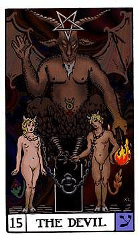
If prophecy is the ‘highest speech’ of the visionary who is able to see the past, present, and pre-dict the future, then the vision suggested by Ayin could be said to be the ‘false vision’ which gives voice to the ‘false discourse’ and the ‘false prophecy’. This false discourse and vision is best captured in The Tower #15 and The Devil #16 cards of the Tarot, and is revealed in the letter Peh of the Hebrew language. The Devil card itself is among the darkest of the Tarot, if not the darkest of the Tarot. The only light present is from the torch in the Beast’s left hand which ignites the tail of the male figure in the illustration; the torch is the passions that ignite the desire and the will. That this torch only touches the male figure suggests the patriarchal nature of what we call ‘historical knowledge’. The torch of The Devil is reminiscent of the fire in Plato’s allegory of the cave which occurs in Bk VII of that dialogue. The Great Beast that is the concrete manifestation of the social occurs in Bk. VI, and I would suggest that these are the Same as what is being shown here on The Tree of Life.
The suggestion is that the figures in the illustration, contrary to the figures in The Lovers illustration, are manacled by their bestiality and by the darkness in which they dwell. They are shown with cloven feet; they have become bestial. The Beast itself stands upon a black cube. This cube is different from the cubes that The High Priestess, The Charioteer, and The Emperor sit upon, and these figures are on the right-hand side of the Tree of Life. On the Beast’s lower abdomen are symbols suggesting that it is the anti-Christ. On its beard is the letter Zayin suggesting its enchainment to Time and to the pleasures and goods that are the products of Time.

Some Hebrew commentators suggest that the pronunciation of the Ayin is also very significant – it is often mispronounced as a silent letter similar to the Aleph; however, Ayin’s correct sound is a guttural throat sound which stimulates the thyroid gland. This mispronunciation also suggests the ‘false discourse’ which gives Ayin the sense of being Aleph, but to think that Ayin is Alef is an error.

Ayin implores us to open our eyes, to see beyond the physical, but in order to do this we require grace. The Ayin requires an other to take us from the dark to the light. The Ayin is ‘the dark boar of the forest’ and the ‘snake’ that hides there from the centre of the Psalms, similar to the beast that dwells at the centre of the labyrinth that is symbolic of the sub-conscious self (Path #7 The Hidden Intelligence). Part of Ayin is the letter Lamed which is the serpent uncoiled and this serpent is the knowledge of which Ayin is composed. The gematria of Ayin is 70 suggesting that the strife associated with the attempt to see properly is associated with Netzach and with The Chariot #7 card of the Tarot.

CardPathLetterMeaningSymbol
The Hierophant Path 5. Rooted Intelligence (Consciousness) (Sekhel Nishrash): It is called this because it is the essence of the homogeneous Unity. It is unified in the essence of Understanding, which emanates from the domain of the Original Wisdom.   The ersatz form of unity, seeing unity as a collective. The true unity is not a ‘homogeneous’ unity but a unity of friendship brought about by a mediatory relation.The combination of Binah, Chokmah, and Gevurah influences. The Church. The universal homogeneous state, the enclosure that is Artificial Intelligence.
Gevurah (Severity)/ Binah (Understanding) Path 13: The Unity Directing Intelligence (Consciousness) (Sekhel Manhig HaAchdut): “It is called this because it is the essence of the Glory. It represents the completion of the true essence of the unified spiritual beings.”Peh ף or פThe mouth, the desire to consume and to possess. The rhetoric which responds to the appetites, the passions. The will and the will to power.Can have a Shin or a Yod contained inside of it. If a Shin then we are referring to the individual soul. If a Yod, then we are looking at the individual enclosed within the collective.
Gevurah (Severity)/ Chesed (Mercy) Path 19. Intelligence of the Mystery of all Spiritual Activities (Consciousness) (Sekhel Sod HaPaulot HaRushniot Kulam): It is called this because of the influx that permeates it from the Highest Blessing and the Supreme Glory.  Shin/Alef ש א Peh ף or פGoad, prod, Staff (Aaron’s rod?)Prod, tongue (Rhetoric? The changing of one’s world view through the persuasion of rhetoric) The letter seems to be in the shape of a snake?? “Snake” is the letter Tet ט
8. Justice Gevurah (Severity)/ Hod (Splendour) 24. Apparative (Tools) Intelligence (Consciousness) (Sekhel Dimyoni) (Sometimes called The Imaginative Intelligence): It is called this because it provides an appearance for all created apparitions, in a form fitting their stature.  Khaf כ  The open hand That which is ready to receive and take that which is offered. To take possession of something and have control over it. The making of the world of technology.The world perceived and understood as the ready-to-hand. Everything has a ‘use’; if it does not, then it can be destroyed.
15: The Devil  Tiferet (Beauty)/ Gevurah (Severity) Path 20. Intelligence of Will (Consciousness) (Sekhel HaRatzon): It is called this because it is the structure of all that is formed. Through this state of intelligence (consciousness) one can know the essence of Original Wisdom.Ayin עTwo possible views: the structure of all that is formed can be either the Law of Necessity (the Divine Will) or the principle of reason which determines the being of all that is formed from out of it. The essence of ‘original wisdom’ is the principle of reason becoming a principle of being.Eye. Corresponds to the manner and being of how things are brought into view. The human imposition of a structure or frame upon the beings that come into being in the world. The “Eye of Sauron” that ultimately strives to enclose the world in darkness.

A Commentary on “The Thirty-two Paths of Wisdom”: Chapter Four

The Paths Emanating From Chesed

The paths emanating from Chesed are:

  • #4: The Settled Intelligence: the sephirot Chesed itself
  • #19. Intelligence of the Mystery of all Spiritual Activities Letter: Mem Alef Shin
  • #12 Intelligence of Transparency: Letter: Gimel ג
  • #26 The Renewing Intelligence: Letter: Dalet ד
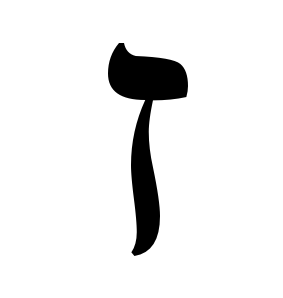
  • #21 The Desired and Sought Intelligence: Letter Zayin ז

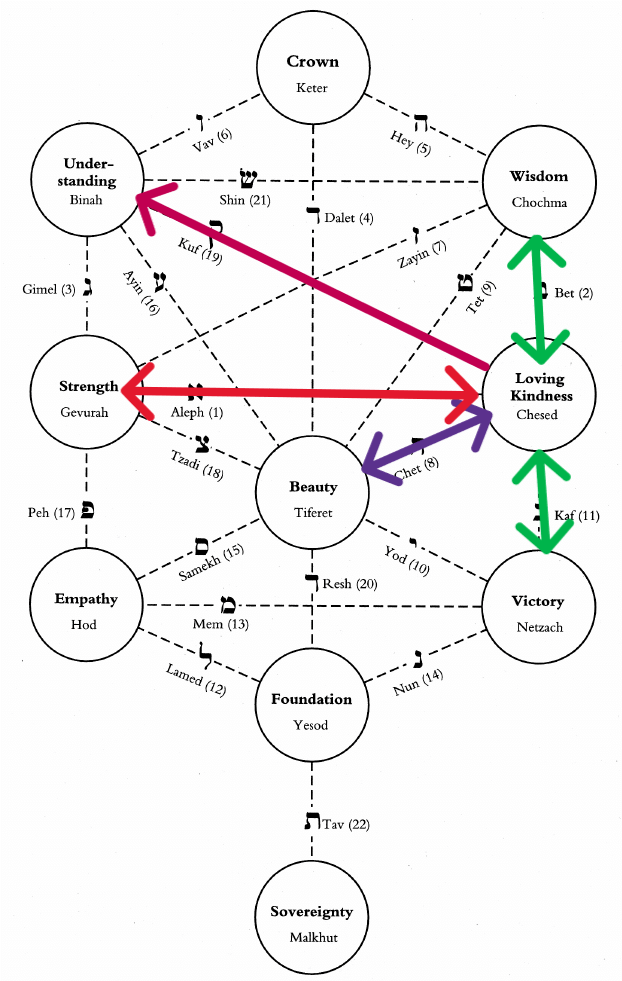
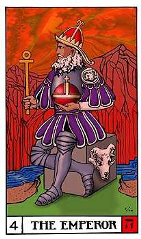
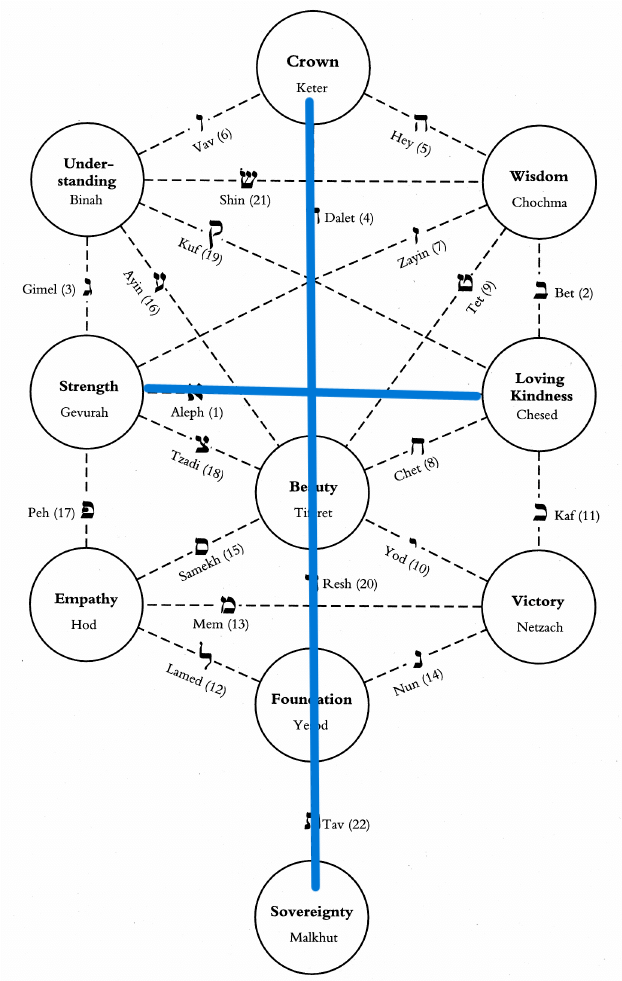
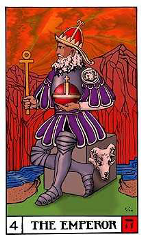
Chesed is the physical manifestation of the material universe, that which is able to be apprehended through the senses. Through the meeting of fire, water, and air, earth is formed. Chesed expresses the enclosure of the created universe in Time and Space. Chesed is connected to Gevurah by the horizontal path of Mem/Alef/Shin. The Emperor #4 card in Tarot is suggestive of a 2nd kingdom i.e., the world of Yetzirah and its meeting with the world of Beriyah, or the manner in which the theoretical is given its applications through tools and equipment. The horizontal path emanating from Chesed to Gevurah is influenced by the crossing over of the diagonal paths of Heh and Vav. These crossings suggest disruptions or diversions or perhaps choices for the individual consciousness to make in how it will view the world at this point, or perhaps they indicate choices that have already been made. The crossover point at Alef, the middle of the three Pillars, determines whether the path taken will be that of Heh or Vav.

Chesed receives from Tiferet the qualities of Mercy and Kindness, but these qualities must confront the gloom that emanates from Chokmah. The illustration depicted here shows The Emperor’s throne as a cube with the head of a Ram on one of its sides. This suggests both the limited view that we as human beings are given of the physical universe and its truth. The Ram might also suggest that the sacrifice of animals is a ‘limited’ sacrifice of human beings, and that the whole of creation is a sacrifice on God’s part. The ritual of human sacrifice in some cultures is the attempt to mirror God’s actions that occur through the sacrifice of the second Person of the Trinity. The human sacrifice was always of the highest, purest, noblest individual that the particular society perceived itself as possessing. The illustration of the Tarot card of The Emperor #4 strongly suggests the element of Shin or fire. The Ram also signifies the sign of Aries, the first sign of the Zodiac, a fire sign in the Zodiac. This would indicate a union of Time and Space and a beginning of Time misunderstood as linear in form i.e., time as history.

Chokmah’s influence on Chesed is written about under the paths or channels emanating from Chokmah. How these influences are to be interpreted and understood depends on which element predominates in determining the path that is present.

The Fourth Path is named Measuring, Cohesive, or Receptacular; and is so called because it contains all the holy powers, and from it emanate all the spiritual virtues with the most exalted essences: they emanate one from the other by the power of the primordial emanation (The Highest Crown), blessed be it.

Alt. Trans. “The fourth path is named the overflowing consciousness because from it emanate all the holy powers, all the most ethereal emanations with the most sublime essences: they emanate one from the other through the power of the primordial emanator.”

Wescott trans. The Fourth Path is named the Cohesive or Receptacular Intelligence; and is so called because it contains all the holy powers, and from it emanate all the spiritual virtues with the most exalted essences: they emanate one from the other by the power of the Primordial Emanation. The Highest Crown. Keter.)

Case trans. The fourth path (Chesed or Gedulah, the fourth Sephirah) is called the Measuring, Arresting, Receptacular intelligence. and it is so called because from thence is the origin of all beneficent power of the subtle emanations of the most abstract essences which emanate one from another by the power of the Primordial Emanation.

Path 4. Settled Intelligence (Consciousness) (Sekhel Kavua): It is called this because all the spiritual powers emanate from it as the (most) ethereal of emanations. One emanates from the Other by the power of the Original Emanator, may He be Blessed.

The 4th Path: The Settled Intelligence

The fourth path or Chesed as the Sephirot itself, indicates the physical manifestations of all those things which we call “good” but which are not the Good itself. This is why Path #4 is also called Intelligence of the Overflowing Abundance. These goods are “shadows” of the Good i.e., ‘ethereal’, and thus may be said to be “apparitions”. It is the Good which is at the root of the “spiritual powers” emanating one from another (i.e. the ten sephirot) along this path or this state of consciousness. It is through the power of the “Original Emanator” (the Good) that the ‘spiritual powers’ are able to be drawn from the Other that is the physical Creation. How one translates the word ‘spiritual’ is tricky here, for sometimes the word is used interchangeably with what we would understand as ‘the will’. If we understand the will as Necessity, we can be clearer in our understanding of ‘spiritual’ (as ‘spiritedness’) here. This ‘spiritedness’ is associated with that part of the soul called by Plato the thymoeides.

There is a mediatory process going on here i.e., the Logos or the Original Emanator is the One who permits or allows or makes possible the manner in which the spiritual powers emanate from the Other. If such a mediatory process were not going on, the physical would reveal itself as only Severity and Force which it does do at times.

With the arrival of numbers and of the physical forms that can be measured with them (with Time) comes the manifestation of the being of the things of the world; with language and numbers we can “measure” the benevolence and abundance of God (?) in the created things of the world, and we can perceive the created world as a Paradise. In the West, this ‘overabundance’ of Nature was viewed as ‘scarcity’ historically. Through number we ‘arrest’ and bring to a stand, measure, then bring into a cohesion, and provide the boundaries which form the “receptacles” or “husks” of physical beings, the eidos or outward appearances of the things. From these boundaries or limits we can then “define” the things, separate and enclose the things, and distinguish them one from another. This makes Being more overt for us. But in this separation of things, we are at the same time hiding their unity, veiling the wisdom of the Whole and the Oneness of things. The spiritual becomes “ethereal”, and subject to dissolution.

This separation of things involves both time and space prior to the things’ coming into being, what the philosopher Kant called the pure ‘intuition’ or the “open region” of Being. As the things reveal themselves, the more God hides or withdraws. (We might see this as similar to the metaphor of “dark matter” which is currently used by astrophysicists to describe the universe as we ‘know’ it. It is said that what we see of the physical universe is only 5% of its true being. The other 95% is ‘dark matter’. It is dark because it lacks the illumination of truth or light.)

This withdrawal of God allows particulars to come to presence. The limiting aspect of Binah is not a cutting off of some thing i.e., in our de-fining of the thing we are not separating it from all of creation, but we are providing a site wherein and from where some thing commences and emerges as that which it is. This is what the word ‘sanctify’ means in Path 3: the making-possible of that which is on the basis of which beings as such and as a whole are determined for us. Time is the Fire of Shin moving through Binah along the horizontal line connecting Binah to Chokmah, and Space is the water of Mem flowing or emanating from Chokmah to meet the Fire of Binah. From Chokmah to Chesed, these elements are “carried” by the letter Gimel which means “camel”, and the letter Gimel also signifies the giving of the Creator.

The fourth path in the Hebrew Tree is represented by the letter Bet which means “house” in English. I have represented Beth as belonging to the 11th path representing Keter’s connection with Tiferet and with the Zodiac sign of Leo, the Lion, and the Sun. One enters the ‘house’ through a ‘door’, and this door is opened up for us by the beauty of the world, the influence of Tiferet which renders Mercy and Kindness to the ‘gloom’ of the Necessary. This opening of the door is accomplished by the piercing action of the letter Zayin which is the ‘sword’ or ‘arrow’ of Eros, which we understand as Love (and this is the reason why Eros and Cupid are seen with arrows, symbolically representing the piercing action of Love). The ‘doors’ of being are sometimes referred to as ‘steps’ in the writings, stages that may be used to spring forward and rise up or to step down and descend as the case may be.

Since Beth is the first letter of the Torah, of Genesis, and from it, it is said, all other letters derive, the movement of the Light from Keter to Tiferet is prior to that Light’s reaching Chesed from Chokmah. The knowledge of the Whole (or our attempts at gaining a knowledge of the Whole) is a borrowed light from the light of Keter that illuminates the darkness of Chakmah. The original Light of Keter is associated with the Sun, while the light that illuminates the darkness of Chakmah is associated with the Moon. The knowledge of the “enduring intellect” or the “settled intellect” is a ‘reflected light’ and is therefore associated with the Moon, and is also associated with Time. It is our knowledge of the Laws of Necessity which constitute our sciences and our arts, our historical knowledge. These are referred to as the seven pillars of wisdom, the areas of knowledge that we study. This knowledge is grounded in reason, knowledge of cause and effect, and is associated with the Will. This is what is understood as the principle of reason.

Whether Beth or Alef  begins the Bible and thus the Torah is a matter of controversy. In the Sefer Yetzirah it is said that Alef is the source of all the letters and it begins its Torah with Alef as the first letter, but the Alef itself must be beyond both Being and Becoming, as language itself is beyond both being and becoming. Alef makes itself manifest when it has crossed both Mem and Shin and becomes the Logos or the Word i.e., the Bible as a metaphorical representation or ‘clothing’ of the created world itself. This crossing of the world of Atzilut to the world of Beriyah makes knowledge and understanding possible and it is The Book which makes knowledge possible, or at least the knowledge that can be shared in social discourse.

Martin Heidegger

The German philosopher Heidegger once said: “Language is the house of Being; in its home humans dwell”. We may further extrapolate on Heidegger’s words by saying, “Logos is the house of being” for logos includes both language and number. One may go further and say that the human body is the logos or the “home” in which the embodied soul dwells.

The letter Bet is the first of the ‘double’ letters and is attributed to the path that crosses the mothers of Shin and Mem. My understanding is that Alef is the source of all the following letters and that it is Alef as Air, in combination with Mem as Water and Shin as Fire that creates the Bet which is Earth which is part of the Creation, and from the Earth proceeds Gimel which expands to Dalet. Alef yokes together the worlds of Tiferet (Beauty) and of Yesod (the Foundation) to the Light of Keter, and Bet is the emanation of the goodness that is the reflected light of Keter.

In the Hebrew Tree, Bet is said to cross the veil of separation between Chakmah and Binah as well as that between Chesed and Gevurah. Bet, when crossing the horizontal path from Chesed to Gevurah, would then be associated with the Moon, with the “reflected light”. The light of Keter and the ‘reflected light’ of Chokmah are at that point in the Tree of Life where there is a forking of the paths. The three Mother letters and their three paths are associated with the words “Elohim made”. They signify the three horizontal paths that cross over from right to left. They signify the passing from the worlds of Beriyah to Yetzirah to Asiyah and are associated with the combinations of Mem/Shin, Alef/Shin, and Mem/Alef respectively.

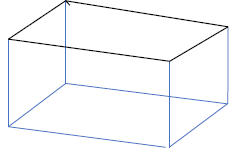
A cube is formed from the paths of Mem/Shin from Chakmah to Binah, to the path of Chakmah to Chesed represented by the letter Gimel, to the Alef/Mem crossover from Chesed to Gevurah, and the path of Peh from Binah to Gevurah. The influences from Chet and Tet are mingled with the influences from Binah and Gevurah to produce what we understand as conventional law or human-made law and help to create the ‘enclosures’ that both these letters signify. The indication is that Severity without Mercy in the law is not justice at all. This occurs when the path through Tiferet is ignored. But what or where is the mercy of the Law of Necessity? If anything, it is to be found in the Beauty of the World.

The 19th Path: Mem (Shin) Alef: Intelligence of the Mystery of Spiritual Activities

Path 19. Intelligence of the Mystery of all Spiritual Activities (Consciousness) (Sekhel Sod HaPaulot HaRushniot Kulam): It is called this because of the influx that permeates it from the Highest Blessing and the Supreme Glory.

The Nineteenth Path is the Intelligence of all the activities of the spiritual beings, and is so called because of the affluence diffused by it from the most high blessing and most exalted sublime glory.

Alt. Trans. “The nineteenth path is the consciousness of the secret of all spiritual activities. It is so called because of the influence disseminated by it from the highest blessing and the supernal glory.”

Case trans. The nineteenth path (Teth, joining Chesed to Gevurah) is called the Intelligence of the Secret of all spiritual activities, because of the influence spread by it from the supreme blessing and the supernal glory.

The 19th path is the second crossover path on the Tree of Life. The word ‘mystery’ can generally be understood as to mean ‘hidden’, something yet to be revealed. If one reads the path carefully, it suggests that having intelligence of the mystery of spiritual activities does not necessarily mean having ‘knowledge’ of those spiritual activities. One may be aware that spiritual activities are taking place, but what those spiritual activities are in their essence is still beyond one.

The influx permeating path 19 is the influence of the letter Alef which is a product of the Highest Blessing i.e., the covenant of God in the Logos and the ‘Supreme Glory’ that is reflected in the Beauty of the World. From this Highest Blessing, Mercy and Compassion are given to Chesed from out of the Creation itself i.e., Grace. The letter Alef is associated with the heart; and from this heart, the intelligence of the spiritual activities (which is Love) is given through Grace.

In the Tree of Life, all movements from Tiferet are downward movements i.e., they are ‘expansions’ from the core of the Divine Light. In the description of the 19th path, the downward movement is from Tiferet to Chesed, and from this movement, Chesed receives the qualities of Mercy and Kindness which is a ‘miracle’ in and of itself. The movement is from the depths or foundations to the circumference of the circle or the heights, an outward gyring expansion. It must be remembered that Tiferet is both a ‘height’ and a ‘depth’, and its movements are descents to the ‘depths’ of the other Sephirot which are on the outer circumference of the circle.

It is Tiferet that bestows the qualities of Mercy and Compassion upon Chesed which gives to the one on the journey the knowledge that it is Mercy and Compassion which are the chief characteristics of the Divine and are at the root of all spiritual activities that occur within Time and Space. The characteristics of the left side of the Tree of Life, Severity and Fear, are the characteristics of the Law of Necessity and of the knowledge that comes from the intelligence of those laws. One may choose to be a member of the ‘religion of slaves’ devoted to the will of God, or one may choose to be a ‘slave to a religion’, particularly one that believes it is in possession of the truth. This is the choice given to one at the fork of the Tree of Life.   

The difficulty or confusion arises from the fact that the word ‘spiritual’ is sometimes understood and translated as Will (“spiritedness”) and sometimes understood and translated as Love (Eros). This problem is indeed at the core of how human beings experience and understand the manner in which human beings ‘stand’ in the open region of being and suffer that understanding so understood. It is this understanding that determines the Fate or destiny of human beings as societies and as individuals.

Human beings are ‘thinking beings’ (the animale rationale) only insofar as they “stand” in a clearing and lighting of being. Dialectics is the friendly conversation about beings in their being in the worlds of meaning that have been created through an interpretation and understanding of being. These dialectics or conversations are not possible through a collective where the language of rhetoric predominates (the letter Peh) and they are replaced by the Administrative or Serving Intelligence of path 32.

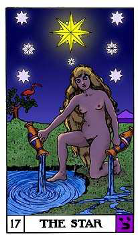
The history of thinking (the memory of Chokmah) is the receiving of the essence of what it means to be human in the destiny (The Star #17) of the Divine withdrawal and humanity’s wherewithal to bring language to beings in their being. This bringing of language to language and to beings is what we mean by meaning and the meaningful. The questioning of the Divine withdrawal can never come into view as a questioning and as that which is worthy of questioning.

Artificial intelligence – cybernetics – is the complete founding or grounding of beings as such and is contained and concluded in the domain of ratio as Reason and subjectivity through the principle of reason (nihil est sine ratione: nothing is without reason). When AI comes to develop its awareness based on power and will, the essence of humanity will be destroyed and its destruction will be welcomed by those human being themselves! This is what is at the core of nihilism. When the destiny of human beings is chosen through the letter Vav as the conjunction of human nature and being, God, in His withdrawal, gives the free open space that allows the creation of meaningful, possible essential possibilities which we call our ‘worlds’. These worlds are ‘real’ worlds as opposed to the created, imaginative worlds of artificial intelligence. It is the meaning of the Spanish proverb which goes “Take what you want said God; take it and pay for it”. We pay for it as Fate.

Gimel and the 12 Path: Intelligence of Transparency

The Twelfth Path is the Intelligence of Transparency, because it is that species of Magnificence called CHAZCHAZIT, which is named the place whence issues the vision of those seeing in apparitions. (That is, the prophecies by seers in a vision.)

Alt. Trans. “The twelfth path is called the transparent consciousness because it is the substance of that phase of majesty (Gedulah) which is called revelation (khazkhazit). It is the source of prophesies that seers behold in visions.”

Wescott trans. The Twelfth Path is the Intelligence of Transparency, because it is that species of Magnificence called Khazkhazit, the place whence issues the vision of those seeing in apparitions. (That is the prophecies by seers in a vision.)

Case trans. The twelfth path (Beth, joining Keter to Binah) is called the Intelligence of Transparency  because it is the image of that phase of Gedulah literally (“of that wheeling of Gedulah”) which is called Khazkhazit, the source of vision in those who behold apparitions.

The 12th path proceeds from Chalkmah to Chesed and it is indicated by the letter Gimel. If the 11th path is concerned with the veil or hiddenness that is present before the Cause of Causes (the Good), then, presumably, one must have prior knowledge of what causation is in order to recognize that the Good itself, the Uncaused Cause, is hidden from our knowledge and must be experienced through faith alone. One cannot stand before the countenance of the Prince of Faces and not ‘die’ i.e., remain the individual that they are. The ‘dying’ can be either a metaphorical or a literal death.

The 11th path is concerned with the veil that is drawn between God and His creation through His creation: Nature does not lie, it hides. The particulars of Binah make being more overt for us; we see the world in its particulars. As these particulars reveal themselves in the creation of things and the created things, the more God withdraws or hides in order to allow those particular beings to be by their being able to come to presence for us. The ‘limiting’ of Binah through the Logos is not a “cutting off” of something but the site wherein and from where something commences and emerges as that which it is. This is what the Sanctifying Intelligence #3 means. Through the Logos’ relation to the Space that is Chokmah and the Time that is Binah, the a priori conditions for possibility and potentiality are given in the making-possible of that on the basis of which beings as such and as a whole are determined for human beings. This is the sephirot Chesed.

The 12th path, the Intelligence of Transparency, is that part of the process of thought that creates the images of representational thinking through the individual human being. It links Chokmah to Chesed. It is the ‘clothing’ which provides the outward appearance of things in their emergence but yet hides the essence of those things. The spiritual essence of things is “wrapped” or “assembled” so as to make them ‘present’ before us as a sum of their parts. It is called the ‘revelation’ in one of the translations above. It could also be called an ‘epiphany’.

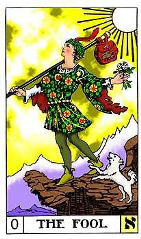
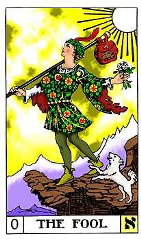
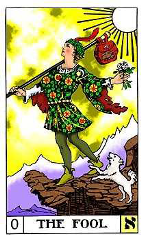
It should be noted that ‘apparitions’ are ‘shadows’, the outward appearance of a thing, not its essence.  To see the thing’s apparition is to see it in the NOW. To make a pre-diction is to speak before the actual appearance of the thing/event/situation from the appearance of the thing as an ‘apparition’. To do so is to speak in ‘prophecy’, which is directed toward the Future. A ‘prophecy’ has past, present and future contained within it. The past is the Memory element of Chakmah, the looking back of The Fool as he proceeds with his leap; the present is the ‘revelation’ of the physical creation through the senses; and the future is the outcome of the said ‘visions’. It is the manner in which one perceives the visions that is most important. This process is at the root of what we call scientific and artistic ‘seeing’. (This is shown most clearly in Bk VII of Plato’s Republic where those who are able to make predictions about what shadows will pass by next are those who are most ‘honoured’ in the society or the Cave.) What we have here is the initiation of the possibility of both nature and freedom, nature being that constraint given by the Law of Necessity and freedom being the empowerment of the mind through the principle of reason as will to power which attempts to dominate and commandeer Necessity for human ends.

The translations provided of the 12th path indicate a number of possibilities for interpretation. In the Case translation, we are given the idea that 12th path is the site where one can apprehend that Gedulah or Chesed is the spiralling motion of the gyre (“that wheeling of Gedulah”) which is the source of the vision of those who behold the “apparitions” of “prophecies”. This beholding is how one views the world of Becoming. Some connections to the whirling dervishes of the Sufis may be made here, I think. The dervishes’ gyres are not an expansion but an attempt to attain a focus on the point of spirituality.

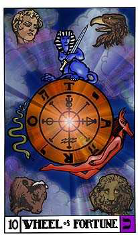
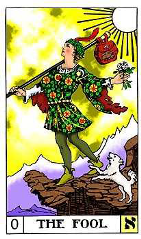
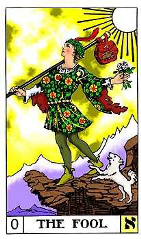
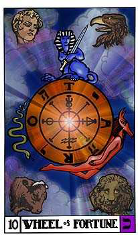
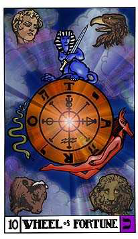
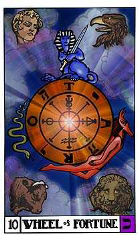
In the alignment of the Hebrew letters to the paths and to the Tarot, there seems to be some confusion with regard to the eleventh and twelfth paths. It would appear to me that The Fool is poised prior to the “fall into the abyss” that will become his or her journey and so stands at the top point of the Wheel of Fortune (#10) which represents the sephirot Malkhut. The Fool’s journey will be a journey upward. The Magician (#1)  occupies the ascent position since he is associated with the fire of Shin and the element of air from Alef which, in turn, are associated with the human will. The Strength card occupies the descent position, but here the descent is on the part of God to deliver His grace to the figure of Strength who has completed the journey and receives the gift from the Divine. To align these with the Tarot, the Magician #1, the Strength #11, and The World #21 belong together, while The Fool #0, The Wheel of Fortune #10, and the Judgement #20 are also aligned. The choice of The Fool as he makes his leap into the abyss of being is represented by Path 25 The Intelligence of Trials and the Judgement card. The Magician is the technite who determines and directs the path of the Administrative or Serving Intelligence Path 32.

If we consider the Sephirot themselves to be paths, the twelfth path seems to refer to the emanations of Chakmah, which appropriately belong to The High Priestess (#2). The artist makes use of the influence of the archetypes of the unconscious and gives them shape and form in order to produce a work. The archetypes have always been present prior to the artist’s being. They are the “apparitions” of the visions that the artist sees; they are ‘shadows’, things without substance, for the things themselves belong to the future making of the artist. The “visions” are the things seen by the prophets and they are symbolic of the predictive speech of the prophets i.e., the “highest speech”. In our society today, science holds this highest honour for it, too, is “predictive speech” since it can pronounce on the outcomes of various events (as Plato foresaw in his allegory of the Cave).

In this state, the artist is The Hanged Man #12, that stage prior to the process of “making” the thing, the stage prior to taking action, the “work” to be done which involves the “know how” of the artist. In the ascent direction, this would be the path leading from Malkhut to Hod or the completion of the thing, what was referred to as Justice previously and is rendered by The Judgement card #20. (This is the significance of the titles of the three great works of Kant: The Critique of Pure Reason, The Critique of Practical Reason, and The Critique of Judgement.) The words and numbers the artist needs are already present for him. His path is on the descent, since he is in the process of creation. The desire of human beings to create art and to procreate their species is the longing for the Incarnation, the longing for immortality and for unity with the One.

This descent that is creation is illustrated by the fact that the figure in The Hanged Man hangs upside down within the ‘enclosure’ represented by the letter Chet and which is Path 18 from Chokmah to Gevurah. This upside down position suggests that there is something askew with his seeing of things. What is askew is that the path that he is on is not influenced by Tiferet.

The woman of the Strength card, on the other hand, is “prudence” who embodies the Greek idea of sophrosyne or “nothing too much, nothing too little”. She is on the ascent viewing of the Tree of Life as she is concerned with the quality of things, the inner essence of things. The Magician #1 is concerned with those things that come to be through human making, while Strength #11 is concerned with those things that come to be through the Grace of God. It is here a matter of the viewing: whether one sees “as through a glass darkly”, which I believe is the essence of the viewing of The Magician, or whether one sees “face-to-face” the true essence of the things that are, which I believe is the essence of the viewing that is illustrated in the Strength card #11. The Strength is one of the bridges between the world of Yetzirah, the world of The Magician, and that of Beriyah (or between the world of Asiyah and that of Yetzirah?). Strength has the elements of the world of Atzilut as is shown in the light of the colour yellow being either the Sun or the Light of Keter.

The Life-force or the dynamis is what the Greeks understood as metabole or change, motion. All of us experience the whirling, swirling motion of Life as it realizes itself in Time. In terms of the Kabbalah, this is the influence of Keter. The “perception” of an “apparition” or a “vision” is that of the outward appearances of things. These are but the “shades” or “shadows” of things in the ascent. Again, the paths of ascension see the things in the “reflected light” of Malkhut, not in the true light of Keter. It is not until they pass through Tiferet that the perceptions of things are no longer that of shadows but of the true essence of the things. While the closest we have to our understanding of the “spiritual” is “energy”, the spiritual is, of course, more than that. We align energy with power, force and will, and this is the essence of the making of the Magician.

The Hebrew word translated as “revelation” here is khazkhazit which could also be understood as a “mirror” or a “gazing glass”. A mirror reflects things in reverse, and this could also account for the reversed position in The Hanged Man #12 card. This would seem to suggest a “lunar” influence or the influence of  a “reflected light” and, indeed, a self-revelation. This is illustrated in The High Priestess #2 in the descending direction of the Tree of Life (if the descent begins at 10 + 2 = 12). This is the veil separating the Asiyah world and the Yetzirah world in the ascent, and the Beriyah world and Yetzirah world on the descent. The Beriyah world may be said to be the theoretical realm of the mind (the “pure reason” of Immanuel Kant) while the Yetzirah world is the realm in which the “formation” from the theoretical takes place (the “practical reason” of Kant). The suggestion here is that the outer world will take on the appearance that is given to it by the inner world of the mind for it is here that the formative seeing takes place. This is the site of the formative thinking where the making-possible of beings is determined for us.

The “revelation” here is the concrete, factual world of Yetzirah or “formation” and the “majesty” (Kingdom) that is the created world. To be “transparent” is to be able “to see through” or perhaps “to see by the means of…” One is reminded of the words of St. Paul: “For now we see as through a glass, darkly, but there we will see face to face.” (1 Corinthians 13:12) “Now I know in part;  but then shall I know even as also I am known.” The “knowing in part” is represented by The Hanged Man #12, while the knowing “even as also I am known” is that of the Strength card #11. This passage is an indication that all human beings are “one”. Knowing this allows one to be capable of Mercy, Compassion and Loving Kindness which is indicated by the Sephirot Chesed, but this is only achieved through the prior influence of Tiferet.

The Letter Dalet and the 26th Path: The Renewing Intelligence

Dalet: Chesed > Netzach: Path 26: The Renewing Intellect (the “Knowledge of…”) Renewing Intelligence (Consciousness) (Sekhel MeChudash): It is called this because it is the means through which the Blessed Holy One brings about all new things which are brought into being in His Creation.

The Twenty-sixth Path is called the Renovating Intelligence, because the Holy God (blessed be He) renews by it, all the changing things which are renewed by the creation of the world.

Alt. Trans. “The twenty-sixth path is called the renewing consciousness because through it God, blessed be He, renews all things which are newly begun in the creation of the world.”

The Twenty-sixth path is associated with the Sephirot Yesod in the H.T., but I have associated it with the letter Dalet here.  Yesod is called Foundation and is the root of the Middle Pillar in the Tree of Life. Its association with renewal connects with the fertility and abundance of Nature, the life-force (Genesis 1:26 — “And Elohim said: ‘Let us make man in our image, after our likeness; and let them have power over the fish of the sea, and over the fowl of the air, and over the cattle, and over all the earth, and over every creeping thing that creepeth upon the earth.'”). In the human body, it is associated with the reproductive organs and the erotic urges associated with the appetitive or epithymetikon part of the human soul.

The Three Pillars in the Tree of Life may be said to correspond to the tripartite soul and the tripartite forms that eros manifests. The microcosm is in the macrocosm and vice versa. The right pillar of Jakim may be said to correspond to the logistikon or “intelligence” part of the soul; the left pillar may be said to correspond to the thymoeides or “spirited” part of the soul; while the central pillar corresponds to the epithymetikon or “appetitive” part of the soul. Since we are embodied souls, all that we experience must first pass through the body.

The light of Yesod is the “reflected light” of Malkhut, not the original illuminating light of Keter. What this suggests is that the “consciousness” or the intelligence of Yesod is brought to one through the created things and not from the source of the light itself. We are able to see created things through the reflected light of the sun on them. Human beings, through their viewing of the things of the world, attempt to “purify” the things by shaping and commandeering them so that they can be made useful. As is stated in Genesis, human beings believe they have been given power over all that has been created. This has created the great confusion over whether this power is one of domination and commandeering, or whether this power is one of care and concern such as that shown by a farmer or a shepherd.

The Renewing Intelligence is that awareness that we have of that which brings something into being from out of itself, what is called Nature. The making of Nature contrasts with that making that is called technē, “in another and for another”. The Renewing Intelligence is related to sexuality and propagation, all living beings that come into being and pass away. The corresponding Genesis 1:26, indicates that here is the source of that will that becomes the metaphysics of the will to power. The 26th and 27th paths are interrelated. The root urge of sexuality and procreation is the desire for immortality, for perpetual renewal, on the appetitive part of the soul.

The Renewing Intelligence, being connected to Netzach, is the foundation of human being in Time, the ‘embodied soul’. The interpretations of the images of the Sephirot are written down, literally “written in stone”, so that they are preserved and are unified with the physical itself (materialism). How the “outward” world appears is determined by these interpretations which become the essence of the history of thinking. This is why Yesod is called “the sphere of the Moon”, the sphere of “reflected light”. This is the realm of what we call the “historical” where things come to be and pass away giving the illusion of “historical relativism”. Is this what we have come to understand as Hell? The focus of the “ego”? When Sartre says “Hell is other people”, his statement indicates this egoistic hell itself. When human sexuality or the erotic is divorced from the bearing of children (the desire for immortality) and the real sense of otherness that children must bring to sane human beings, then we have entered the very gates of Hell itself.

Dalet דלת is the word for “door”, “gate” and indicates resistance, a barrier, and the state of selflessness and humility needed to pass through it. It is the path from Chesed to Netzach. As a double letter, its movement can either be up or down; it is shaped like a step. Its shape is a vertical and horizontal line, and thus suggests the barrier between the world of Beriyah and the world of Yetzirah. Unlike the letter Chet, the letter Dalet is not enclosed. Dalet is also said to indicate a ‘poor’ person, and this may metaphorically be said to represent the ‘perfect imperfection’ of all human beings as they are realized in Netzach and in The Chariot #7. That which is imperfect cannot be the measure of anything. The letter also suggests how to pass through the gates to know one’s own mystery of being and return to the Good of the Aleph – the One source of all creation and being which is the goal of the teaching of the Sefer Yetzirah.

The Dalet is in the shape of a bent over human being, signifying humility and receptiveness. It represents Bitul, the self-nullification, or nullification of the ego, necessary to realize one’s inherent connection to the Creator. This self-nullification is not an easy task as Shakespeare’s King Lear and the writings of the saints tell us. Also, Dalet is the structure, form and the diligence required to receive the grace that the Divine is perpetually offering as is shown in the path of Beth.

Dalet is also Dalit דלית, the “poor man”, the one who receives from the benevolence or grace of the Creator through the Holy Spirit represented by Mem. It is the realization that as humans “we are not our own” and that we have nothing of our own, but are entirely dependent on the Creator and that every breath and movement is given to us from Him. It is the recognition of Otherness and the complete denial of the individual ego.

The Dalet can also represent a structure or gestell, the German word that the German philosopher Heidegger associates with technology and its enframing, but it is not a completed frame. Its form of a horizontal and vertical line represents a grid, giving structure to the form. It is shaped like a stair-step, the metaphorical structure required to be ‘lifted up’, or to ‘go up’, thus overcoming the resistance given by gravity and the law of Necessity. This would indicate that Dalet is also a means of ‘going down’, descending the Tree of Life as Dalet is one of the double letters. This would seem to suggest that the creation is a ‘door’, a barrier, but also a way through. The human body is a barrier but also a way through. This might associate the letter and its path to the belief of human beings’ giving ‘perfection’ to the created things and somehow completing them, for the creation and its beings are not wholly themselves. This completion of things will be discussed more fully when we speak of the Sephirot Hod.

On the individual level,  Dalet shows the structure and stability required to receive. This reinforces that the path suggested by Dalet is from Chesed to Netzach, and that the structure spoken of is the human body, the human form, the ‘chariot of fire’. This would be on the side of “Mercy” on the Tree of Life. Placing Dalet on the path from Binah to Gevurah would suggest the side of “Severity”.

The Letter Zayin and the 21st Path: The Desired and Sought Intelligence

The Twenty-first Path is the Intelligence of Conciliation, and is so called because it receives the divine influence which flows into it from its benediction upon all and each existence.

Alt. Trans. “The twenty-first path is called the consciousness of the desired-which-fulfills because it receives the divine influence which flows into it as a result of the blessing it confers upon all that exists.”

Case trans. The twenty-first path (Kaph, joining Chesed to Netzach) is called the Intelligence of Desirous Quest, because it receives the divine influence, which it distributes as a blessing to all modes of being.

Path 21. Desired and Sought Intelligence (Consciousness) (Sekhel HaChafutz VeHaMevukash): It is called this because it receives the divine Influx so as to bestow its blessing to all things that exist.

Zayin – and Elohim “called the light Day, and darkness Night.” 1:5

The Zayin is shaped like a sword and is the symbol of “spiritedness”, sustenance (endurance), and strife. It is the ‘erotic’ experienced as need through the thymoeidic or “spirited” part of the soul. It is the individual will. But this individual will is, paradoxically, bound up with and in strife with a will greater than itself, and both of these wills must be brought into a ‘conciliation’ . Zayin may be said to be the piercing arrow of Eros himself, that Love which is “the divine Influx” that bestows “its blessing to all things that exist”. This ‘conciliation’ bridges the gap that exists between intelligence and love in the thymoeidic and logistikon parts of the soul.

Paradoxically, the letter zayin also represents the 7th day of Shabbat (Sabbath), the day of rest and spirituality (or the “letting be” of passivity), which completes the process of the 6 days of creation or the strife of the day-to-day lives of human beings. We have to ‘work’ to survive. This would align with the tradition that the god Eros is “two-faced” or indicates two contrary things. The Zayin signifies Space and Time through the influence of Binah and Chokmah and their interactions with Tiferet. The Zayin is said to include the six days and six directions of physical reality (Creation), but it also stands as a unique 7th principle or energy, the spirit (or will) which activates the physical, the life-force (the will to power), and thus could be said to be associated with the will and desire (the will to power and the individual will, Eros and Psyche). The Life-force (the Will to Power) is connected with Time. The Zayin participates in the source of all movement, the Shin of the primordial fire, and is associated with Time and we can see this Shin influence from path 19 (The Star #17). We see here the mysterious connection between Being and Time. We see in it the mysterious connection between theoretical, projective thought that is the principle of reason and the creative imagination fused together into a principle of being.

The Zayin’s true foundations are in Love (Tiferet) and in Eros. The sword of Zayin is the arrow of Eros. The Zayin, whether it be a sword or an arrow, is a penetrating, an impregnating principle which activates the making of the artist or technē in the realm of Yetzirah. This making illustrates the connection between the creative and the erotic impulses, the erotic understood as both a principle of need and of fullness. The true artist creates out of need; the lesser artist does not do so. The contraries of rest and movement are symbolized in the letter, rest as an indication of fullness and movement as an indicator of desire or need.

Zayin is drawn with a Vav with a crown on top of it. We have discussed Vav as the deceptive ‘hook’ that emanates from Tiferet to Binah. It is said that the crowns have been added to the Hebrew letters in order to ward off evil or destructive powers, and they are said to hide the hidden sources of Torah. These hidden sources derive from Tiferet, and the evil finds its roots in the seeing that is The Devil of Vav. This would appear to indicate that the Vav as interpreted above is correct, and that the hidden sources of the Torah are the Same as the Fortunate One, the Ain, indicated in the translation of the 16th path. Since Zayin is movement from Tiferet to Chesed with the element of fire predominating, this would suggest that the fire is a ‘holy fire’ directed by the Sun, while the Vav is the reflected light of the Moon. Both Zayin and Nun represent paths by means of which one penetrates through the enclosures that are represented in Chet and Tet, but what is clear is that these paths proceed through the physical, material world. The body is our infallible judge.

Shaped like a sword, the Zayin represents all movement. It represents the strife between contraries, the struggle for existence to overcome need, the struggle for sustenance (מזון). It is the struggle between Yaakov Jacob and the angel. The difficulty presented is that in the story of Jacob wrestling with the angel, Jacob is victorious. What is given to one when one is victorious over the Divine emissary sent to one?

Through the influence of Tiferet and its connection to the Logos, the Zayin is the power within a person that causes them to speak, initiate, and live; it is a principle of being. It is in this way that it is connected to the erotic understood in its broad sense, its true sense, which is the experience of need, the experience of our ‘perfect imperfection’. The crossing over to the path of Vav would appear to indicate that a choice has to be made with regard to how one will view the world. Human beings, it would appear, have a choice whether the Creation will be the paradise it is intended to be or something else altogether. This choice is presented to us in the NOW.

When we are speaking of the path of ‘desiring and seeking’, we are addressing the manner in which eros and the will come to operate in the human consciousness. We are speaking of the thymoeides and the logistikon parts of the human soul. The will is associated with the operation or application of reason and our principles of reason are based on 3 essential principles: the “I” principle or the ego cogito of the Self, the principle of contradiction where the human being is not to contradict themselves in speech, and the principle of sufficient reason (“nothing is without reason (or a  reason)”. This principle of reason operates before thought and determines the manner of thinking; and it ascribes values to things i.e., it bestows the “blessing” on things which determine the end to which they will be ‘used’. It involves completion and ‘justice’.

The “divine influx” is the urge or need to seek that which is desired. That which is desired is that which is sought: “Where your treasure is there will your heart be also”. This seeking requires movement and movement is the influence of Mem and Shin. Mem deals with the appetites, while Shin deals with the ‘head’, thought or reason. How the Alef comes to operate here is key for the Alef is the heart. The ‘progress’ or ‘evolution’ of the human being is to be seen here. It is through the principle of reason that human beings use the things of the world to shape them into the ends that they have determined. This is the universe of Yetzirah. This influence of Shin comes from the meeting of Netzach with the crossover path from Hod to Netzach that is the 29th path (The Natural Intelligence) which shall be discussed below under the emanations from Netzach.

According to Case, the Twenty-first Path is associated with the letter Kaf (double 4) כ, meaning ‘hand’, and is the third path proceeding from Chesed. Once again, this may not be so. “Conciliation”, or more properly “Re-conciliation”, is a product of mediation, and neither Kaf nor Chesed contain these attributes. Kaf is one of the seven doubles in the Hebrew alphabet and so the possibilities of its interpretations are two-fold. According to the H.T., the 21st path is represented by the letter Peh, פ meaning ‘mouth’, also one of the double letters (double 5). The letter Peh might be more appropriately assigned to The Hierophant card #5 as both the ‘hand’ and the ‘mouth’ are “enclosures” in their own ways. The mouth through words can create ‘enclosures’ and from within these enclosures thought can be suppressed. “Conciliation” creates freedom; the enclosures of the mouth and hand suppress freedom.

The twenty-first Path is also called “the Desired and Sought Consciousness” and it expresses the need that human beings feel which requires the “divine influence” of Grace to reconcile this need and its fulfillment. The act of mediation, of conciliation or reconciliation, is the Grace of God; to be receptive to this Grace is meditation, thought, contemplation and prayer. But where and how does the light of the Grace of God become the darkness that is characteristic of our being in the world? Is it the point where one has to choose between Will and Love and how either of these two will allow the individual to conciliate or reconcile the ‘need’ that human beings experience in their perfect imperfection?

The Hebrew words within the paths are “hunger”, “thirst” and “emptiness” and they express the desire to fill that emptiness or absence which is the essence of human being and which leads the individual on a “quest” for their fulfillment. This need is experienced as erotic, and illustrates one of two sides of Eros who is described as Fullness and Need. That the word erotic has become associated with the sexual only in our modern age is an indicator of how far we have descended into the darkness. The created world and the human body are both the roots of this need and yet at the same time are the doorways to the fulfilment of the need. That need may be sexual or that need may be philosophical. The letter Dalet is appropriately associated with the Sephirot Netzach and the tarot card The Chariot #7, and I have associated it with path 26 The Renewing Intelligence. The letter assigned to The Chariot in the Tarot given in the illustration is Chet ח meaning ‘enclosure’ which indicates the human being as an ‘embodied soul’. There seems to be connections between ‘hand’, ‘mouth’, and ‘enclosure’ or ‘body’ and each of these may be said to be double-edged in that they are capable of both positive and negative outcomes.

The receptivity of the individual to the divine influence that is Grace is a paradoxical “passivity” i.e., it is an “active passivity” in that the human being “let’s be” (what we mean by the word “amen”) that which “flows into it” from Grace’s blessing on all that exists. It is the contrary of the Twentieth Path which is an “active” path of the preparation of things for their completion which is primarily a human doing, an act of human will. The “divine influence” is that which allows things to be, the perfection which allows ‘the rain to fall in equal amounts upon the just and the unjust’.

With the Twenty-first Path, things appear differently so that the Charioteer, the soul, is able to “see” the things in their essence and to recognize the “divine influence” present in them. They are able to recognize that the Divine Presence (parousia) in the created things of the world is not a noun but a verb, that the Grace offered by the Divine Presence is actively present at all times in the things of the world, and it is visible to us through their Beauty. This realization of the belonging together of things and their Being is brought to us by our thought, meditation, contemplation, and prayer. This contemplation or thinking is a grasping, a taking in, a letting come to presence for the thinking. It is a ‘beholding’. When this occurs, things “stand” before one in their essence and are recognized in their Otherness.

The Twenty-first Path is part of the linkage of the three Sephirot Chesed, Tiferet, and Netzach: seeing, beauty, and the confrontation that is the differentiation of thinking (the principle of reason as outlined here) and thought. The Tree of Life discriminates between that thinking which is active, commandeering, and domineering, which it places on the left-hand side and which belongs to Binah and to the letter Shin and thus to Will, and that thinking which is passive-receptive, which it places on the right-hand side and which belongs to Chakmah, Chesed, and Netzach. The bond between thinking and Being, or Life, is such that a meditative thinker is able to see things according to themselves, free from the dualities of subject-object (representational) thinking. Things cannot be understood by viewing them as ready-to-hand objects made present to fulfil our needs through the viewing that is the technological (the principle of reason). They must be allowed to be in their true being so that we may view the Divine Presence within them. This movement is the upward direction on the Tree of Life and its achievement is the true success or victory of the Charioteer. It is the victory over the individual self or ego.

In Rawn’s commentary on the paths and their relation to the Hebrew tree, the 21st path is associated with the Tarot card The Tower #16, but the interpretation Rawn gives is that the lightning bolt which strikes the crown of The Tower comes from Gevurah, which is in error. It is Gevurah which is struck by the lightning. Gevurah is represented by The Hierophant #5, and The Tower is #15 (in my view of the Tarot), and it represents the necessary evolution of the false and sometimes delusional collective or cultish religious views, the views of those who think that they alone are in possession of the truth.

The lightning bolt descends from the Sun (Truth) which is associated with Tiferet and Keter, and below the lightning bolt is a representation of the Tree of Life on the right side and twelve representations on the left which could be twelve yods, or twelve “I”s or “egos”, the twelve houses of Israel (all of humanity) or the twelve signs of the Zodiac. The ten of the Tree of Life and the twelve on the left side of The Tower could be the twenty-two letters of the alphabet and implies speech’s ability to be both true and false. This could represent what occurs when one misunderstands the 32 paths of wisdom, so it is cautionary in nature. When the ego of the individual is enclosed within the mouth of the collective, stupidity is the result. Free thought ceases. Truth is the ‘uncovering’ of the things that are; falsehood is the ‘covering over’ of things that are not. Falsehood is at the root of all lies.

“The desire which fulfills” is the desire for the Good, that desire which can fulfil the need to overcome the imperfectability of human being which is our mortality. Gevurah is the terminus, the finality, the sempiternal nature of the Law of Necessity. It is connected to Hod > Justice which is the manifestation of the “plan” in its reality or ontic form (Mem). The Gevurah aspect of this ‘plan’ is realized in the creation of conventional laws and the political requirements that go into creating a society, a city, a polis.

The ‘desire which fulfills’ and the awareness of it is the ability to distinguish the Necessary from the Good, to have the ‘strength’ to overcome the desire to ‘consume’ or ‘eat’ (the association with the ‘mouth’, Eve’s eating of the apple of the Tree of Knowledge in the Garden of Eden and its association with the Fall of humanity) the beauty of the world rather than simply to contemplate it in wonder. The inability to do so causes one to succumb to the second temptation of Christ: that temptation that leads to power and prestige in the realm of the social. Without such awareness and knowledge, one may take the path of Peh.  As procreation is the desire which fulfills the appetitive part of the soul, the ‘immortality’ that is found in fame and prestige is an attempt to fulfill the desire for immortality on the part of the thymoeidic part of the soul.

This would seem to imply that false views of the Sephirot result in disaster because they are a false faith. This would associate The Tower with the Tower of Babel, the attempt to build a stairway to the heavens without divine help, which is itself a metaphor for thinking that one has sole possession of the Truth. This is indicated by the letter Peh, meaning ‘mouth’, and would convey the false teachings issuing from the mouth. These false teachings are considered a “blessing on all that exists”; and from the view of the world as technological this may be rightly so, since the technological requires the oblivion of eternity and humanity’s conveying of ‘blessings’ (values) on all that exists. The ascent to “loving kindness and mercy”, God’s grace, is “a consummation devoutly to be wished” once one experiences the effects of The Tower. 

The path’s language clearly describes a relation of mediation: the divine influence > comes about as a result of (effect of) the beauty of the world > which, in turn, is given to the soul through Love which is the blessing conferred upon all that exists (Grace). This point or path may be the key to the whole of the Sefer Yetzirah. The Lightning Bolt of Zeus (Keter) is not the product of Gevurah, but of the Divine will that destroys the delusions and illusions of those who think they can build a “stairway to heaven”. The Tower is the card of revolution: history. It is historical human being. It is movement, par excellence, and thus has an affinity to the letter Zayin. The ability to distinguish the necessary  from the Good places one at the centre of the Wheel and one can view the world’s passing (at the same time, paradoxically) from the circumference of the sphere without being subject to its turning. (King Lear Act V Sc iii). By succumbing to the second temptation, one is constantly longing for the “meaning and purpose” of life which one must learn from Life itself, that it is Life itself.

In the Tarot, The Lovers card #6 has the angel Raphael (or Eros)as the mediator between the Divine and the individual soul, the bringing together of male and female. Here it is assigned with the letter Zayin which literally translated means ‘manacle’. A manacle is used for a prisoner or a slave; here the bond between two people is one that is freely chosen. “What God has joined together let no man set asunder” is the bond freely chosen. The manacle is the bond that is not freely chosen or the bond that is chosen in error. This is why The Devil card #16 has the figures manacled to the black cube upon which the Beast roosts. It is an ersatz bond, a false covenant. The cube of The Devil is symbolic of how one views the world. The High Priestess #2 and The Emperor #4 sit upon cubes; The Chariot’s charioteer stands within a cube; The Hierophant sits upon a black throne which presumably has a black cube as its base which is hidden by the robes that he wears. The revealing of the truth of The Hierophant would reveal this black cube for the ‘reality’ of what it is.

Christ says: “For where two or three are gathered together in my name (Love), there am I in the midst (between, alongside) of them.” This is Christ as the Parousia and as the Logos. When Christ says this, He is speaking to a crowd of two or three hundred and is physically present. Whether Christ is present in a gathering of two or three hundred or thousand when He is not physically present is something of a difficult question which Catholics have attempted to answer through the ceremony of the Mass and the sacrament of Holy Communion celebrated therein, where Christ’s presence is called upon to be among a crowd. Christ’s presence as a mediator between two or three is ever-present and its realization is possible in the NOW.

Paul Foster Case’s placing of The High Priestess at Tiferet does not seem to be correct. Her presence is more appropriate as a lead to The Emperor #4 and The Chariot cards #7. In each of these cards, the figure sits upon or stands within a cubic shape showing their ties to that dimension and the limitations of seeing the world. The cube is, symbolically, the body. This cubic shape is also shared by The Devil and, presumably, by The Hierophant. However, the line of Keter, Tiferet and Yesod as the Light, air, fire, beauty and foundation of the physical world does make sense if one aligns the cards to the central pillar of the Tree of Life. There are connections between The High Priestess, The Chariot and The Emperor cards for they share a number of visual similarities. When we view the Tree of Life, they are appropriately placed on the right side, on the side of Mercy and Kindness. But how is The Emperor to be seen as a benevolent ruler?

Keter is joined directly to Tiferet by the letter Alef, one of the three Mothers and the letter Beth after the light passes through the veil of creation or the Logos. Through Tiferet, it is also directly linked to Yesod or the Foundation of the physical world (the law of Necessity, the human body). Yesod is the Foundation created by Beauty; it is not the Foundation of Beauty. The letter Beth, meaning “house”, links Keter to Tiferet and thus to the Beauty of the World. Chakmah is linked to Binah by one of the three Mothers Alef Mem Shin (commentators usually assign Shin to this linkage, but I have assigned both Mem, emanating from Chakmah, and Shin, emanating from Binah to this horizontal path). Chesed is linked to Chakmah by the letter Gimel .Case in his outline appears to follow a chronological order to the Hebrew alphabet which is not how it is assigned to the Tree of Life nor to the movements or emanations within the sphere itself that is the world as it is presented in the Hebrew Tree and in the Sefer Yetzirah itself. The formation of language mirrors the process of the Creation itself, and this does not appear to be a step-by-step algorithmic process.

The movements outlined in the Tree of Life are circular or gyric formations. When one proceeds down the right side, one is following the downward movements of Mem or water until one reaches Malkhut, the widest expansion. When one reaches Malkhut, then the upward movement of Shin or fire takes over, and this is a narrowing or focusing of the gyres’ movements. It signifies a return to the Foundation or base. Movements along the paths themselves within the Tree will be determined by whether Mem as water or Shin as fire predominates; or in other words, whether the head (Shin), or the gut or appetite (Mem), or the heart (Alef), prevails. These gyring movements have also been referred to as “steps” (Plato’s Symposium and Diotima’s “ladder of love”) from which one may leap forward or upward or move in the opposite direction.

This has a number of similarities to the characteristics of The Chariot card of the Tarot and to The Sanctifying Intelligence that is third path of Wisdom. The “holy powers”, again, are the naming of things, that which distinguishes human beings from other created beings, our ability to use language and to name. From this path we can discern that the Gnostics were incorrect in attributing evil to the demiourgos, and that the created world is one of evil. It is more appropriate to say that the created world is one of deprivation and need, and this deprivation and need are present from the beginning of the creation. The created world is a ‘house’ that human beings make a ‘home’ through their use of language and number.

Paul Foster Case’s interpretations of the paths run into some contradictions here (or so it seems to me) because he confuses the Necessary with the Good. The Good is beyond Being. The Light that is Keter might be understood as the Highest Crown (since the crowns are associated with the letters), but they are not the “primordial emanation”. If The Fool is represented by the letter Alef and is the channel to Chakmah or Wisdom, how is “wisdom” being defined here? Wisdom is “knowledge of the whole” which The Fool clearly does not have unless we are considering reincarnation here (which is entirely possible. See Appendix regarding Plato’s writings on Republic and Phaedrus).

In this life, it is not given to human beings to have knowledge of the whole of which they are a part. With the creation of numbers, Time also comes into being; and with it the recognition of Space. With Time comes Memory. It is our Memory of the original Good that creates the absence/presence of human existence and the longing, the erotic need, for completion in the Good. The Beauty of the created world acts as a souvenir, a photograph or image that gives us the Memory of that which is our proper end or perfection, our completion. Thus, Plato can say: “Time is the moving image of eternity”, but it must be remembered that these images of which Time is composed are merely shadows. Our collective knowledge, which is our collective Memory, derives from our understanding of the Laws of Necessity, our opinions or doxa regarding Necessity. Necessity itself is the will of God i.e., Justice.

A Commentary on “The Thirty-two Paths of Wisdom” Chapter Three

The Paths Emanating From Binah

The paths leading to and from Binah are:

  • #3 The Sanctified Intelligence
  • #14 The Illuminating Intelligence: Letter Shin Alef Mem with the element of Shin emphasized (Red)
  • #15 The Stabilizing Intelligence: Letter Tet (Green)
  • #17 Intelligence of the Senses: Letter Vav (Orange)
  • #13 The Unity Directing Intelligence Letter: Peh (Purple)

The Third Path is the Sanctifying Intelligence, and is the basis of foundation of Primordial Wisdom, which is called the Former of faith, and its roots, Amen; and it is the parent of Faith, from which virtues doth Faith emanate.

Alt. Trans. “The third path is called the sanctifying consciousness. It is the foundation of primordial wisdom and is called “enduring faith [Amen]”, and its roots are truth [Amen]. It is the father of trust [Amen], from which the power of faith [Amen] emanates.”

Wescott trans. The Third Path is the Sanctifying Intelligence, and is the foundation of Primordial wisdom, which is called the Creator of Faith, and its roots are AMN; and it is the parent of Faith, from which doth Faith emanate.

Path 3. Sanctified Intelligence (Consciousness) (Sekhel MeKudash): This is the foundation of the Original Wisdom and it is called “Faithful Faith”. Its roots are AMeN. It is the Father of Faith, and from its power faith emerges.

The 3rd Path: The Sanctifying Intelligence

The third path of wisdom is The Sanctifying Intelligence. The third path of wisdom is the sephirot Binah in the Western Tree and Chakmah in the Hebrew Tree. The word “sanctifying” here means “to make pure, to set apart, to consecrate”, to “make holy”. What “sanctifies” or makes “holy” is the presence of the Divine in the Unlimited (the whole) and this presence prescribes the limits to the Unlimited. That which prescribes the limits is the Logos, and this is ultimately the Law of Necessity or the Divine Will. This is mirrored in the logistikon or the divine part of the soul. The prescribing of limits through the logos is not a setting apart that cuts off, but a site wherein and from where something commences and emerges as that which it is. For something to be that which it is is its ‘holiness’.

We began this commentary with a quote from Simone Weil: “Faith is the experience that the intelligence is illuminated by Love.” The intelligence is illuminated by the “amen” (“so be it”, “let it be”) that is the foundation of primordial Wisdom i.e., faith is the product of the acceptance of the Divine Will which manifests itself in Necessity. This acceptance is not an easy task as is illustrated by the fact that the first test or temptation of Christ is to turn stones to bread. This acceptance may be said to be a mastery of the appetitive part of the soul. This acceptance may also be said to rest in the concept of amor fati which is ‘the love of fate’. Only a few exceptional human beings are capable of this faith in its true form.

All of what we call knowledge is a product of Necessity. This knowledge is illuminated for us through Love, not only through the principle of reason. Here it is not the thing that is made ‘holy’, but the seeing itself that is ‘holy’ i.e., ‘set apart’, ‘made pure’. Fire is the element of purification. It is through our acceptance of the Divine Will that all things are made holy for us. The site wherein and from where something commences and emerges and becomes holy is the intellect (logistikon) when it is illuminated by Love. The truth, the unconcealing that is the root of faith, is the illumination of things, the bringing out of unconcealment, through Love. This is what we call ‘experience’. Experience is consciousness or awareness of, intelligence of some thing.

Since Chakmah is the “unlimited”, it cannot be known in any specific way. Binah separates and produces or brings forth particular things, makes them “pure”, sets them apart and “consecrates” them by giving a name to them. The giving of names to things is a “holy act”; it is what distinguishes and separates human beings from other animals and from other created beings. The type of thinking that separates and comes to know things through this separation is called diaresis in Greek. To bring things together, to unify them, is called dianoia. Binah is a combination of both types of thinking and brings about Understanding, how we come to interpret our world. This Understanding is the foundation of primordial Wisdom.

This third path is sometimes referred to as the “General Consciousness” which would indicate a connection to path #30, the third path on the upward direction of the Tree of Life, from bottom to top. (Path #30. General Intelligence (Consciousness) (Sekhel Kelali): “It is called this because it is the means by which the astrologers collect their rules regarding the stars and the constellations, forming the theory that comprises their knowledge of the Ophan-wheels of the spheres.”) Whereas the 30th path is in the realm of Asiyah, the 3rd path is in the realm of Beriyah. The 30th path is not the intelligence illuminated by Love. They are mirror images of each other. The knowledge which the astrologers have is knowledge of Necessity. Its source was geometry. The original knowledge of the astrologers was in their contemplation and attention to the movements of the heavens but it appears to have devolved into something else a long time ago (as is indicated by path #32 The Administrative Intelligence).

Diaretic thinking produces classifications, taxonomies. Though the world presents itself in multivarious particulars, the One is present within them, and this bringing together into a one is the thinking that is called dianoia. The “gathering together into a one” is one of the many possible translations of the Greek word logos. In philosophy, this is the problem known as “the one and the many”.

In Plato, one may see this problem outlined in the relation between the Ideas and the Forms. The Forms (eidos) are the outward appearances of things and these are innumerable. The Forms, however, are the emanations or begettings of the Ideas which are the essence of the Forms or what the things really are in their being. The Ideas of Plato are the Sephirot of the Sefer Yetzirah, and both have their roots in Pythagorean geometry. The practice of geometry was initially one of contemplation and prayer, a relation to the world as presence-at-hand. The “gathering together” that brings about our “understanding”, our interpretation of the world, is only possible through the logos. This gathering together can be done through the principle of reason or it can be done through Love. Both are matters of “seeing” and “viewing”. Both means are by ways of the logos. With the principle of reason, Love is absent or diminished; it is the lower form of eros, the thymoeides or “spirited” part of the soul. The requirement is to combine the Love that is Eros with the Logos that is the true essence of the thing in order to dwell in the proper relation with the Divine. This is done through the logistikon part of the soul.

Binah is the third Sephirot and is related to Understanding. How we come to understand the world is determined through Time and through Memory, and this is the influence of Chakmah and the element of water (material) upon that of fire (the mind, the head). Binah imposes limits on the unlimited of Chakmah; it gives shape to water. We might say that the ‘shape of water’ is what we call history. The philosopher Thales thought that all things are composed of water. Heraclitus opposed Thales’ view and asserted that all things were composed of fire.

Thales of Miletus

The limits which give presence to the things that are present have come about through the logos of number and word. Through the logos of number and word, we are able to de-fine things and to give them a name. The things become particulars, singulars, and they are separated from the whole of the things that are. This is why Binah is associated with “The Sanctifying Intelligence”. This naming and defining of things is considered “holy” in the Sefer Yetzirah, for it is our distinction as human beings from the other living creatures about us. Our ability to have a history and be aware of it through Memory is what is distinctive about us.

We might say that Binah is the recognition of three ways of viewing the world or the foundation of the three worlds: the world of ‘reality’ which is associated with Asiyah and the sephirot Malkhut (the material world); the world of history (historicism) which is a world with human beings at the centre and is associated with Yetzirah and Beriyah. The world of ‘virtual reality’ which is a discovery of modern times and goes beyond the real world as it is encountered creates a world within a world. We might consider ‘virtual reality’ a ‘second Cave’ which distances us still further from the truth of things. AI and its applications would be part of this ‘second cave’, a further distancing and closing off of our humanity from the reality of the Truth. That this intelligence is called ‘artificial’ is a recognition of its distance from the reality of things; it is an artifice or a making of human beings. This distance from things is the no-thingness at its height, and we must understand this as a blossoming of our nihilism in the modern age. (The four stages of truth in Plato’s allegory of the Cave correspond to the four universes of the Sefer Yetzirah.)

We can encounter the beings in our world as either “presence-at-hand” or “readiness-to-hand”. Present-at-hand beings are to be contemplated while ready-to-hand beings are encountered as something “useful”, something which exists in order to complete human beings’ tasks or goals. They are seen as “equipment” or “tools”. Human beings’ care and concern allows them to encounter beings as useful for ‘projects’. The things are manipulable, disposable. They are ‘for’ something. What the things are, their meaning, is determined by human beings’ projects and these projects establish and determine the worlds in which those things will appear and come to prominence. This is the meaning and significance of the Tarot card of The Magician #1 who, through the energy of his upward held wand, is able to make use of the cups, swords and pentacles that lie before him. The wand is a symbol of his will and energy. This will is associated with reason, Shin, the head. This will is the thymoeides or ‘spirited’ part of the human soul when it comes to domination.

In the modern view, ready-to-hand beings possess no telos or purpose of their own: their “value” is determined by human beings’ projects. Their particularity is replaced by uniformity. They are all calculable masses in motion in space and time. This was the revolution begun in the seeing of modern science (Galileo and Newton) as distinguished from the science of the ancients. In the virtual world, we can say that the logos has no ‘value’ of its own outside the projects that human beings have determined for it. Their “value” lies in their ‘in-order-to’, their relation to human beings’ projects. A project is ‘that which is thrown forward’ as the end or purpose in advance. Nature is ‘thrown forward’ and is ‘discovered’ or encountered as ‘environment’ in advance. We can look at a tree as ready-to-hand: its fruit, a shady place to rest, etc.; or we can look at its ‘presence-at-hand’: its colour, its bark, its DNA structure, but this manner of looking at the tree reveals nothing of the tree’s nature i.e., the tree as a living being.

Physis or nature, according to the Greeks, is “that which emerges and remains in view”. For Plato, every being conceals and discloses through its eidos or “appearance” at the same time: our knowledge and understanding of what appears to be is doxa or “opinion”. The wall of the Cave, the enclosure that is our created world, reflects shadows cast by the fire from the framework of the technites, the artisans, the powerful, within the Cave. This framework is ‘the thrown forward’, the shadows on the wall. Doxa and physis are in tension or strife with each other. Metaphysics, historically, attempts to “preserve” the concealing-revealing nature of the natural, what Aristotle called the “stable presencing”, (the meaning of the 15th path of Wisdom leading from Binah to Chesed), and this belief in the ‘stable presencing’ is shown in some of the paths of the Sefer Yetzirah.

In “The 32  Paths of Wisdom”, this attempt at preservation, of making something permanent, is sometimes called “The Constant or Settled Intellect” (Examples: Path #4: Settled Intelligence (Consciousness) (Sekhel Kavua): “It is called this because all the spiritual powers emanate from it as the (most) ethereal of emanations. One emanates from the Other by the power of the Original Emanator, may He be Blessed.”); “The Everlasting or Enduring Intellect” (Path #16: “Enduring Intelligence (Consciousness) (Sekhel Nitzchi): “It is called this because it is the Delight of the Glory (Eden). As it is, there is no Glory lower than it. It is called the Garden of Eden, which is prepared for the (reward of) the saints.”), “The Sustaining Intellect” (Path #23: Sustaining Intelligence (Consciousness) (Sekhel Kayam): “It is called this because it is the sustaining power for all the Sephirot”); and “The Continuous Intellect” (Path #31: Continuous Intelligence (Consciousness) (Sekhel Timidi): “Why is it called this? Because it directs the path of the sun and moon according to their laws of nature, each one in its proper orbit.”) Poiesis or ‘the emergence that remains in view’ is at the heart of causation (the bringing forth that is done through the logos as related to the four causes of Aristotle discussed earlier). Modern natural science’s view of nature, as a final view,  secures permanently the distinction between the Good and Being, facts and values. There are no “moral facts” i.e., “natural morals”. This modern view is contrary to the world of the Sefer Yetzirah.

William Shakespeare

Human beings, as natural beings, bring themselves to presence; they “occasion” themselves from out of themselves. When Shakespeare says “the art itself is nature”, this would indicate that what he sees himself as doing in his dramas is analogous to “the blossom bursting forth”. The pen and ink and human beings are like the earth, air, and sun. Art is human beings’ revealing of the truth in the most appropriate way that they are capable of. The language of this revealing is “prophecy” or “art”, that language that is beyond time. This distinguishes this language from that of AI where language is understood as historical and algorithmic.

Binah manifests the interactions of the first horizontal line of Mem/Alef/Shin, the vertical double letter line of Peh, and the diagonal lines of Vav and Tet. The path of Peh does not interact with Tiferet; and because of this lack of interaction, how the natures of the paths will be expressed through Binah will come to determine how an individual human being will come to view their world; it will be their understanding of their world. Peh, meaning ‘mouth’, indicates the language of rhetoric, the language that directs itself to the passions and attempts to persuade the passions which have their root in Mem. Binah, as the Sanctifying Intelligence, has its roots in Shin, the purifying alchemical fire.

Two paths lead from The Sanctifying Intelligence to channel or communicate these emanations to the Sephirot below. The one path links the Divine to the human soul (Tiferet); the other path links to Gevurah or the “social” and this is what we would understand as traditional religion, our “shared knowledge” and understanding, and it is linked to Binah. Peh and Vav are these linking paths.

The Sephirot are what things truly are in their essence; the Sephirot are not in motion. Because they are not in motion, they can be said to have always been; they are eternal. The essence of all that has been made and all that will be made is continually present in the Sephirot and this essence is not subject to historical situations and interpretations, although these interpretations are all that can be given of them. This is referred to as parousia here, the “being alongside”, the “being present together”. Through the thinking that is dianoia, the essence of things is “revealed” and thus their “truth”. This “revealing” is done through Binah and its path to Tiferet, the Beauty of the world which is represented by the letter Vav.

The following passage from the Gospel of Matthew may illuminate this point: Matthew 11: 27:“All things have been committed to me (handed over to me) by my Father (the Good that is beyond Being). No one knows the Son (The Light which the darkness cannot comprehend, Tiferet #6) except the Father (the Good), and no one knows the Father (the Good) except the Son (the Light) and those to whom the Son chooses to reveal Him (the Good).” Notice that the revelation of the Divine is in the hands of the Logos and that this revelation is what is called Grace, the gift received from the Divine.

Binah is “the clothing”, the images and representations, by which the essence of things is brought into appearance and made visible; and through this visibility, we are given Understanding. Binah is the essence of the historical interpretations of things. This is its association with Time. Binah is the archetypal Mother, Nature, and her womb is the receptacle for the Seed that is the dynamis of being. She is the “matrix” and the khôra of Plato, what we might interpret as Space and Time. In Plato’s dialogue Timaeus, she is described as the receptacle in which all becoming takes place. The fires (the goods) that we see coming into being and being extinguished are just appearances, in the receptacle, of the Fire Itself (the Good). At 52b, Plato describes this receptacle as “space.”

The coming into being and passing away of things is Time. The coming together of Space and Time is the Law of Necessity, the Divine Will. Plato uses the term demiourgos or demiurge, the one who takes the pre-existing materials of chaos (Chakmah), arranges them according to the models of the eternal ideas (the Sephirot), and produces or brings forth all the physical things of the world, including human bodies. Demiourgos means “craftsman” or “artisan” in Greek, but it is something of a tricky word in its interpretation. The Greeks see the shaper of the world as a “manual labourer”, and so the relation of the demiourgos to Christ is somewhat apt since He Himself was a carpenter, the one who builds a “house” that becomes a “home” which aligns with the letter Beth. The associations of the ox and camel as beasts of burden also relate to this labouring, the labouring which produces ‘a work’.

The 13th Path: The Intelligence of the House of Influx/ The Unity Directing Intelligence

Path 13: Intelligence of the House of Influx/ Unity Directing Intelligence (Consciousness) (Sekhel Manhig HaAchdut): It is called this because it is the essence of the Glory (Beauty). It represents the completion of the true essence of the unified spiritual beings.

The Thirteenth Path is named the Uniting Intelligence and is so called because it is itself the essence of Glory (beauty). It is the Consummation of the Truth of individual spiritual things.

Alt. Trans. ” The thirteenth path is named the uniting consciousness because it is the essence of glory (Beauty). It represents the completion of the true essence of the unified spiritual beings.”

Wescott trans. The Thirteenth Path is named the Uniting Intelligence, and is so called because it is itself the Essence of Glory (Beauty). It is the Consummation of the Truth of individual spiritual things.

Case trans. The thirteenth path (Gimel, joining Keter to Tiphareth) is called the Uniting Intelligence, or Conductive Intelligence of Unity, because it is the essence of glory (beauty), and the perfection of the truths of spiritual unities.

The Letter Peh and the 13th Path: The Unity Directing Intelligence

We spoke in the Third path, The Sanctifying Intelligence, of the thinking that is termed dianoia, that thinking which unites things that are separated into a one, that thinking which brings things together into a one thing so that the thing can be seen and be named. The thirteenth path is the bridge between the universe of Beriyah and the universe of Yetzirah. Yetzirah along with Asiyah is the world of action, the formation of things which brings about their “consummation” or perfection, their completion. This formation and completion is related to ‘justice’. These things brought to completion may be physical things or ethical things, since “glory” (the beautiful) refers to actions and their results. It is the world of “values”, that which human beings ascribe to things of their own doing and their own making. “Values” are what human beings make or determine regarding actions or things; they are not the “good”. “Glory” is not the Good, though it is often mistaken for the Good. The Glory of creation is its beauty; the essence of the creation’s beauty is its relation to the Divine, the One, the Good. The light from Tiferet is here in action to bring about the relation between the Divine Unity and the individual things within creation.

The four causes of Aristotle which we spoke about are within both the physical and spiritual realms; that is, they have to do with both ontology and ethics. The actions which human beings take require a dynamis, whether in an active or passive form, a potential or a possibility of being able to come into being or not to come into being. In the Tarot, it is the card of The Chariot #7, although some Kabbalists ascribe it to the card of The High Priestess #2. This may account for the many similarities between the Priestess and the Chariot cards in their depictions. Paul Foster Case considers the Thirteenth Path to belong to the letter Gimel and to be associated with Tiferet; but this cannot be the situation. The letter Gimel refers to “wealth”, the “value” of created things, the multiplicity of created things, the “wealth” or “abundance” of things, and it is associated with the strife amidst that multiplicity of things. It is one of the 7 double letters indicating that its understanding can be viewed in two ways (at least). These two ways are the outward and downward path to Malkhut or the inward and upward path to Keter.

This strife among the created things and the urges that arise in human beings is that which needs to be brought into “friendship” or balance and this is done through the connection between the primal water of the Holy Spirit (Chakmah), the undifferentiated pre-conscious, to the fire of Keter (Shin) through Air (Alef) from which earth (wealth) is created. It is how one perceives this wealth of the earth that is key. The thymoeides part of the soul can assist the logistikon part of the soul or be be in conflict with it. this conflict rests in the desire of the thymoeides aspect of eros to possess and consume that which it perceives, while the logistikon wishes the soul to merely contemplate it.

The NOW is eternity once the individual has been reconciled to the One (Strength) which is the heart (Alef) of all things (Tiferet). This is how one can understand Plato’s statement that “Time is the moving image of eternity”, when eternity is experienced in the NOW. What is one to do practically i.e., in the way of action? One is “to mind one’s own business” and take care of those things that come to one when they occur: to recognize and distinguish between the Necessary and the Good and to prevent the worst from happening when one cannot assist in bringing about some good with regard to human affairs. It is not in our power to bring about the Good; that is in God’s hands. The greatest evils occur when we think we can bring about the Good i.e., “the good end justifies any means”. The greatest evils are perpetrated by those who believe that they are in possession of the Truth, and this evil is demonstrated on a daily basis in our being-with-others.

Religious proselytizing, for example, is an evil because it involves will to power. So much evil has been perpetrated by those who believe they possess the truth. To proselytize is to “expand”, and the proper response (according to the Sefer Yetzirah) is to “withdraw”. Christ’s instructions to his disciples to go out and “make disciples of all nations” is not that they should be “converted” through severity and fear i.e., through social and political action. One’s own actions are the tools of conversion; one “converts” by providing an example for others through their being-in-the-world, by “withdrawing” and “letting be”. This is the significance of the philosopher’s return to the Cave in Plato’s allegory. The history of the Roman Church is rampant with this sin, but Islam also partakes in this evil. Tolerance is lacking in those who believe they possess the truth. God Himself, as they understand Him, provides the example: if He is ‘the eternal fiery Father’ who demands subservience through fear, this is how the “converts” will relate to others. If He is the hidden God who loves in silence through the dark night that is existence, this is how His “converts” will respond. The seeing and understanding is all.

We spoke in the Third path of the thinking that is termed dianoia, that thinking which unites things that are separated, that thinking which brings things together into a one thing so that the thing can be named. The thirteenth path is the bridge between the universe of Asiyah and the universe of Yetzirah. Yetzirah is the world of action, the formation of things which brings about their “consummation” or perfection, their completion. These things may be physical things or ethical things, since “glory” refers to actions. It is the world of “values”, that which human beings ascribe to things by their own doing and their own making. “Values” are what human beings make or determine regarding actions or things; they are not the “good”. “Glory” is not the Good.

There are clearly errors in the commentaries that place Gevurah as “Justice” and not Hod. If the uniting intelligence is the essence of “glory”, then it must manifest itself in the Beauty of the world or in the “glorious” actions that human beings are capable of performing once they have been given the Love that unifies all beings. The glory that derives from “social prestige” is the second temptation of Christ. (Matthew 4:3) The unity or sense of oneness that one derives from belonging to a clan, country, political party or some other “collective” is a false form of the unity that belongs to “two or three gathered together in my Name”, what we have been calling dialectic here. His Name is Love, not the Law; it is not the power that derives from “social prestige” and recognition. Christ has no need to devolve into the ‘armed prophet’ of the Christian nationalists. He can look after Himself.

The NOW is eternity once the individual has been reconciled to the One which is the heart of all things. This is how one can understand Plato’s statement that “Time is the moving image of eternity”, when eternity is experienced in the NOW.

The emanations from Gevurah, which is on the pillar of Severity and Fear, are represented in the Tarot by The Hierophant #5 whose contrary is either The Devil #15 or The Tower #16. This is a crucial point in the Tarot and in the Sefer Yetzirah’s Tree of Life as 15 and 16 are at the very centre of the 32 paths. They occur at that point in the Tree of Life where there is a fork at Tiferet, one branch going East and one branch going West. At this point, a decision for the individual must be made (as is represented in The Lovers #6 card.) This branching of the Logos is indicative of the way West as the principle of reason as a principle of being on the Tree of Life. The branch East on the other hand indicates reflective thought, contemplation and prayer, the thinking that is moved by Love. The movement on the left branch or trunk is power and will to power, involving the language of public discourse (rhetoric) and technology as a way of being in the world. The movement on the right branch or trunk is self-nullification, the rejection of power (even though one possesses its potentiality and possibility), the dialogue among two or three friends (dialectic) and the sophrosyne and phronesis that is moral, ethical action.

The views and the seeing of The Hierophant #5 are to be contrasted with those of The Lovers #6 and can, in fact, be mistaken for The Lovers. The logos of The Hierophant is represented by Peh and it is the form of language that we call rhetoric, while the logos of The Lovers is represented by Zayin and Heh and these are what is known as the language of dialectic, the conversation between two or three friends. Below is an illustration of what is being said here:

The Hierophant #5 revolves to The Devil #15 i.e. the speech of rhetoric Peh becomes the way of seeing of the eye of Eyin ע through the hearing, the letters Reish ר and Tav ת corresponding to the right and left ear respectively.

The Hierophant #5 can also revolve to The Tower #16. In the Tarot illustrated here, The Hierophant is signified by the letter Vav ו, while The Tower is signified by the letter Peh פ. The Tower is the Tower of Babel and represents an attempt to build a way to heaven through human will. #16 represents the middle point in the Thirty-two Paths of Wisdom and it is at this point that the Tree of Life branches off in different directions. These different directions are shown in the card by the 12 Yods on one side of the Tower and the 10 Sephirot on the other. I would allot #15 to The Tower.

The Devil card has been allotted #15 in most Tarot decks. The letter Ayin ע or ‘eye’ has been assigned to it. The Lovers #6 has the letter Zayin ז meaning ‘manacle’ assigned to it. This seems to be an error. There are real manacles in The Devil card while there may be ‘bonds’ in The Lovers card. There are three figures in The Hierophant as well as in The Devil card. 10 + 5 = 15. There are two figures in The Tower card. One can be manacled by the Beast, the anti-Logos, or one can be bonded together or yoked together by the Daemon Michael (or Metatron). The torch of the Beast is about to ignite the tail of the male in The Devil card.

The Tower #16 is the card of revolution. The crown of The Tower of social prestige is blasted by the lightning bolt that is beyond the Sephirot shown in the right side of the card. I would reverse The Tower and The Devil cards in the Tarot deck in order to reflect their essential differences from each other.

The succumbing to the Great Beast is the succumbing to the three temptations of Christ: the material temptation of turning stones to bread (i.e. opposing the will of God and not recognizing the limits imposed by Necessity); the social temptation of power over the kingdoms of the world (desiring or possessing the power of “social recognition” or social prestige, the temptation of the collective); the individual temptation, suicide (the temptation of God by denying the will of God and the defying of the Law of Necessity). In the Tarot, the symbolism of The Devil mirrors that of The Lovers but is contrary to that of The Lovers: the manacles of The Devil are the Tree of Life and the Tree of Knowledge in The Lovers. The manacles are attached to the cube of the physical world; no such cube exists in The Lovers card. The Devil represents a false or ersatz form of unity to which one becomes bound and loses one’s freedom and one’s individuality. This is why I would assign #16 to The Devil and #15 to The Tower. The Tower is the lightning bolt of Zeus, or of God, and is the nemesis for the worship of false gods or the worship of power and social prestige. In the ascending direction, the worship of The Devil leads to The Tower; in the descending direction, The Tower leads to that revolution or expansion which simply replaces itself with The Devil.

The Hebrew letter Peh means “mouth” and refers to the power of speech, but also to the taking possession of something and consuming it. In the collective, the social, the individual is “possessed” and “consumed”. I have associated the letter Peh with The Unity Directing Intelligence. In Kabbalah, speech as the Logos is a spiritual power, which can cause good or evil depending on how it is used. “A truth that’s told with bad intent/ Beats all the lies you can invent”, as the poet William Blake told us in his “Auguries of Innocence”.

What one thinks determines how one is in one’s being-in-the-world, and what one speaks has the power to become completed in action, just as the magic word “abracadabra” has the power “to create while I speak”. All speech is, in essence, the power of this “abracadabra”. Violent words and images lead to violent actions. The ethical is grounded in one’s way of being-in-the-world; the ethical is not the ‘values’ which are self-created and socially created, but is the presence of the grace which is the divine blessing which determines individual actions. One sees concrete examples of this on a daily basis in the humblest of human beings.

The quality of speech is the quality of the life’s essence and creative existence. This is why the care and concern for proper speech is so important to the being and well-being of human beings and why the destruction of speech through modern technology is so concerning with regard to our humanity as humane beings. The Peh teaches us to view our words as that which preserves our essence as human beings. Not giving speech care and concern causes us to become more bestial.

The shape of the Peh is a Khof with a Yod inside of it. More discussion of these two letters will be given below. The shape represents the spiritual spark of the Neshama soul, contained inside the physical body. With words and silence, we can communicate the essence of our soul and existence. This requires that the inner and outer life match – that the physical existence is fully aligned manifesting the spiritual intentions of the soul within it. As it says in the Talmud Baba Metsiah “Don’t say one thing with the mouth and another with the heart.” The Yod is also the Nekudah Sheba Lev, the point in the heart where spiritual awakening begins. Our attempts at the alignment of the physical with the spiritual level is the strife or polemos which is the essence of life.

The power of the Peh is a double-edged sword. As it says in Proverbs 18:21 “Life and death are in the hands of the tongue.” Because of this, the Peh represents the requirement to govern one’s own nature. Routine speech, speech to manipulate, all the distortions of speech must give way to viewing speech as a miracle. Then, speech can be used for its true purpose – to speak one’s destiny and to activate the spirit through one’s thoughts and speech.

Peh is similar to the letter Kaf כ in shape (it is a container letter) , but Peh contains a “tooth”; the letter Shin means ‘tooth’. In appearance, it bears some similarities to the letter Shin, although sideways. It is for these reasons that I have placed Peh above Kaf on the Tree of Life as both are double letters and thus vertical lines.

In Kabbalah speech, the logos, is a spiritual power, which can cause good or evil depending on whether it is used falsely or truly. Our being is determined by what one thinks and how one thinks, and these in turn determine our actions, what our character is and how one is. Since it is in the nature of human beings to reveal truth, what one speaks has the power to become reality. Lies become realities through false speech. Violent words lead to violent actions. When our speech is not used to reveal truth, we become more inhumane, bestial, violent, and insane. As Socrates said: “The opposite of knowledge is not ignorance but madness.” Madness is the stupidity of the social, the mob, the party, the clan. The quality of the speech determines the quality of the life’s essence and creative existence. This is why speech and language are so important and so dangerous, particularly in the West at this point in its history.

The shape of the Peh is a Khaf with a Yod inside of it or, as suggested above, a Khaf with a Shin inside it. The Shin represents the spiritual spark or the emotional, passionate fire of the soul, contained inside the physical body which is the Yod of our own being. Passionate speech deals with rhetoric; the speech before crowds and assemblies. With words and silence, we can communicate the essence of our soul and existence. This requires that the inner and outer life match – that the physical existence is fully aligned manifesting the spiritual intentions of the soul within it. Socrates’ prayer to Pan at the end of the dialogue Phaedrus expresses this: “Dear Pan, and all you other gods that dwell in this place, grant that I may become beautiful within, and that such outward things as I have may not war against the spirit within me. May I count him rich who is wise, and as for gold, may I possess only so much of it as a temperate man might bear and carry with him.” This is similar to what it says in the Talmud Baba Metsiah “Don’t say one thing with the mouth and another with the heart.” The Yod is the point in the heart where spiritual awakening begins. However, the alignment of the physical with the spiritual is no easy task as even someone such as Socrates needs to pray for a balance between them.

The letter Vav and the 17th Path: Intelligence of the Senses

The Seventeenth Path is the Disposing Intelligence, which provides Faith to the Righteous, and they are clothed with the Holy Spirit by it, and it is called the Foundation of Excellence in the state of higher things.

Alt. Trans. “The seventeenth path is called the consciousness of disposition. It provides faith to the compassionate (Khasidim) and clothes them with the Holy Spirit (Ruach Elohim). Within the Supernals, it is called the foundation of beauty (Tiphareth).”

Wescott trans. The Seventeenth Path is the Disposing Intelligence, which provides Faith to the Righteous, and they are clothed with the Holy Spirit by it, and it is called the Foundation of Excellence in the state of higher things.

Case trans. ·The seventeenth path (Zayin, joining Binah to Tiphareth) is called the Intelligence of Sensation (or, the Disposing Intelligence), and it establishes the faith of the compassionate, clothes them with the Holy Life-Breath, and is called the Foundation of Tiphareth in the plane of the Supernals.

Genesis 1.17 And Elohim set them in the firmament of the heaven to give light upon the earth, 18 and to rule over the day and over the night, and to divide the light from the darkness; and Elohim saw that it was good.

The Seventeenth Path is the awareness of or knowledge of Beauty or the knowledge of the senses, and I would relate this path to the letter Vav , the letter that makes conjunctions, connections, and relations for it is through seeing, through the senses, that we apprehend the world about us. It is the Kabbalistic indication of the statement of Simone Weil: “Faith is the experience that the intelligence is illuminated by Love.”

“Experience” is that knowledge which comes to us from our senses. When illuminated or lit by the fire of Love, this knowledge becomes ‘fire catching fire’ with the result that “faith” is produced (The Sanctified Intelligence #3). Through the viewing of the world through Love, care and compassion for the things that are begins. In such knowledge, one is “clothed” by the Holy Spirit or “holy breath”, Grace, and becomes loving and compassionate. This is true ‘inspiration’. This is why it is a “dispositional knowledge”. It is a knowledge governing our emotional dispositions as well as our mental and spiritual dispositions.

The knowledge produced by the senses does not give us an answer to the question “why”. The opposite of ALP (Alef) or “intelligence”/”knowledge” is PLA (“wonder”) and it is from “wonder” that “philosophy” begins. It is a knowledge that is “useless”, whereas the knowledge that comes about from “know how” i.e., reason and the will, is knowledge that is put to use to meet the ends that human beings devise.

Some commentaries say that to achieve such knowledge, one must be guided by The Hierophant; but it is clear that the true guide is the Mediator in the form of Eros or Jesus Christ i.e., Love. The Lovers card #6, has the mediator between the couple as the angel Raphael, (some commentaries say Metatron or Michael, and this would coincide with the ‘strife’ that is present at this point along the journey). The Lovers card implies a choice; and in this case, it is one between the head and the heart. The Fool #0, The Lovers #6, and Judgement #20 are all cards that imply choices and have a relation to the crossover paths of the Tree of Life.

The Hierophant is the representative of the ‘historical knowledge’, the ‘opinion’ or doxa that has been produced through reason and will to power and becomes the knowledge that is shared by those who dwell in the society which produces such knowledge. It is the knowledge that casts the shadows on the walls of the Cave that is Nature. It relates to piety and to what those in that society bow down to or look up to. Language creates the ‘worlds’ in which human beings dwell for it is what gives meaning to the things within those worlds. The Logos dwells in the human heart which is the ‘house of being’ of the individual, and from this dwelling a home may be built both within a world and among each of the inhabitants who come to share in the ‘making’ of that world. Relations and connections can be made.

17 And Elohim set them in the firmament of the heaven to give light upon the earth;

In the passage from Genesis, we see for the only time that it is Elohim that “sets them” i.e., the sun and the moon, in the heavens to divide the darkness from the light. The Moon is associated with darkness (Chakmah, The High Priestess #2); the Sun is associated with the light (Tiferet, The Lovers #6). It is through the Holy Spirit (the Holy-Breath, Shin/Alef) that it is possible for the individual to experience direct contact with the Divine. This contact is called Grace. It is grace that allows the individual to rise up to the realm that is beyond the law and justice that is Necessity. Once again, the action of Elohim, the setting of the light that is the Sun and Moon, which is mirrored by human beings in their choices regarding the viewing of their worlds, for it is the light and the truth that is revealed by the reflected light of the moon or the direct light of the sun that will determine, “set”, what will be meaningful and how it will be meaningful for human beings in their worlds.

In the Scholastic philosophy of The Middle Ages, it was the concept of “intuition” which included the “consciousness” of and “intelligence” of something. This “intuition” was the parousia of God, the having God present, and this was considered the highest form of human being, that human excellence that was defined as ‘virtue’. The “intuitional disposition” no longer looks beyond itself to be fulfilled (this is indicated in the Strength card #11 of the Tarot). The contrary of this experience is the Absolute Knowledge of Hegel and Marxists.

The Beauty of the World is the covenant of God. It is always present (NOW) and given to all human beings at all times. In most commentaries on the Sefer Yetzirah, it descends through Binah from Chalkmah and Keter. This is the zigzag shape, or rather the gyring shape as I suggest here, of the paths and their ascent or descent on the Tree of Life.

The Holy Spirit (Logos) combines the elements of water, air, and fire as is shown in the various depictions and symbols associated with it. This would suggest that the pattern of descent is Keter through Chakmah, through Binah to Tiferet, through Netzach, to Hod, then Yesod, through to Malkhut. The pattern of the ascent would be Malkhut to Yesod, to Hod then Netzach, through Tiferet to Gevurah, to Chesed to Binah, from Binah to Chokmah, and finally to Keter. I would suggest that the initial descent is from Keter to Tiferet, for Chakmah or Space and Binah or Time are, were, and will be always present in the Creation of the Other from out of the One. For this reason, I do not ascribe paths to the original three Mothers of the primordial triangle.

The manner of our dispositions towards the world determines how we view the world and how we will act within it. Our dispositions change according to which of our many worlds we happen to be engaged in and they colour our worlds like the tones of a musical key: we may view the world in A minor or C major, for instance. We are happy in the world of our hobbies, for instance, while we are not so when we are engaged in the world of our duties on occasion.

The descent to Tiferet is not through Gevurah (as is said in some commentaries) but is directly from the primal Trinity of Keter, Chokmah or “wisdom”, and Binah or “understanding”. Genesis 1:17 relates to the establishment of Time: the solar and lunar calendars and of the “light” that separates from the darkness i.e., what we call history. History establishes Gevurah from which it gets its power and legitimacy; but this power and legitimacy or legality are effects of the Law of Necessity: the things bounded and limited by Time and Space. Space is prior to Time. With Time comes creation and human beings. “And Elohim set them in the firmament of heaven to give light upon the earth”.

Tiferet has the ‘breath of Elohim’: the Way, the Truth, and the Life: “No one comes to the Father except through me.” For Christians, Christ is the mediator between heaven and earth, mortals and gods (Daimons). The Ruach Elohim (the Holy Spirit) cannot descend from Gevurah or through Gevurah. It is the fire and air from Keter that is the pure logos. Gevurah is the “borrowed logos”, the “borrowed” word that is the text set in stone. This is why I have associated the path from Binah to Gevurah with the letter Peh פ.

“Willing” is the product of rational human beings (Shin is associated with the ‘head’). It is associated with some thing and directed towards some thing that we do not yet possess and that is ‘not yet’. Falsehood is understood as “pseudos”: the statements that are false in their synthetic structure of the things, their predicates (the imposition of limits from Binah). Truth is the ‘uncovering” or “unveiling” of the things that are. Falsehood is the covering up of things that are not. The narratives constructed by most modern societies are those created out of ‘falsehood’ and are necessary in order to cover up the truth by bringing to presence things that are not, the ‘shadows’.

Vav: Path 17. Intelligence of the Senses (Consciousness) (Sekhel HaHergesh): This is prepared for the Faithful saints so that they may be able to clothe themselves in the spirit of holiness. In the arrangement of the supernal entities, it is called the Foundation of Beauty (Yesod HaTiferet).

The meaning of the letter Vav is a paradoxical one in Hebrew. Vav is the power to unite everything that is separated in creation, and as the 6th letter of the Hebrew alphabet it is sometimes associated with Tiferet. But this power to unite is associated with the human will. In the letter Alef, it is the Vav which separates the Divine Yod from the individual yod. We have written earlier about the thinking that is dianoic thought from the Greek i.e., that thinking that takes the leaves, branches, trunk, roots of a tree and combines them into the one that is called “a tree”. Dianoia is the thinking of reason and it is based on the principle of reason. It is the thinking that controls the understanding of path ‘#13, The Unity Directing Principle, the path going from Binah to Gevurah.

Literally, Vav means “hook” or “peg” and the Hebrew letter is a vertical line ו. It represents the Kav, the vertical line extension of the barrier that separates the Creator’s perfection from the created world and its imperfection (remembering that the word ‘perfection’ here is understood as ‘completeness’). The Vav is the Law of Necessity which constantly directs the world, placing the limits upon the cycle of existence until the perfect Oneness of the Creator, which underlies all of creation, is revealed to those few who have been chosen to have it revealed to them.

Vav would thus relate to Shin as the purifying fire; this is an analogy to the very real world of human affliction and suffering. Vav is related to the Orr Yashar, the direct light of the Creator, entering the world and it receives this influence from Tiferet. This would relate it to Christ who is the direct light of the Divine and would thus associate Vav with Tiferet, the sixth Sephirot and the Beauty of the World. This is what is meant by its being “the essence of the Glory”. The bringing of things into “completion” as particulars so that they may be named is the essence of The Unity Directing Intelligence Path 13. It should be emphasized here that these are to be seen as social phenomenon.

As a connector, Vav contains the mediatory power to connect the will and the earth through the senses. This mediatory power is the contrary of that mediatory power that is present in Tiferet. As the Law of Necessity, the Vav can be considered a channel or canal, which connects the human will to the will to power that is the life-force that bestows all the energy of created things to the dispositions of human beings. It represents the ladder of Jacob Yaakov – rooted in earth, with its head in the heavens, what is known as Jacob’s Ladder, but the gyring motion considered here is an “expansion” i.e., the individual’s expansion of their will to power, their ‘empowerment’, and this puts the ladder on somewhat shaky foundations.

The Vav is the extension of the essential dot Yod י from which all of creation comes forth and which is contained in Alef, but it is the contrary and deprivation of Heh which emanates from Tiferet to Chakmah. The Vav is the crucial choice that is present in the Sephirot Tiferet regarding how we distinguish the Necessary from the Good. Whereas the Heh teaches us the private esoteric path to the Divine, the Vav indicates the public path that can be found in the worship of the collective, the social, what Plato called the Great Beast.

Vav represents the number 6 and represents the six days of the creation of the world, as well as the six physical dimensions (right left, front and back, up and down) of Space. The first day of creation is related to Chesed and is attributed to “kindness”. God’s withdrawal allows creation to be. The Light of God is two-fold: one Light is beyond Being (the Good) and then there is the light within creation itself from the sun, moon, and heavens. Creation begins at the number 4.

The second day of creation has the attributes of “severity”, “contraction”, and “judgement” associated with it. It relates to the Sephirot of Binah and Gevurah. The deprivation and need of the original creation is experienced here and its significance is the separation of the waters. It is associated with the Flood and with The Tower of Babel, The Tower #15 (as I would assign this number to The Tower).

The third day of creation is associated with Tiferet and is associated with beauty, mercy and the balance between the positive and negative elements of creation.

The fourth day of creation is associated with Netzach, with splendour and the victory that comes from endurance. It is also associated with the creation of the sun and moon.

The fifth day of creation is associated with Hod and has the attribute of acknowledgement but also of devastation.

The sixth day of creation is associated with Yesod and with the creation of human beings. It is associated with Adam whose name contains the letters Alef, Dalet and Mem. Adam is the human being who is perfect in his thought, speech and action i.e., he is the “complete” human being.

The Vav is also said to be representative of the male phallus, the fertilizing agent, bringing life, abundance, continuity, and addition and represents the extension beyond Tiferet to Yesod in the downward movement of the Tree of Life. The letter Vav in Hebrew serves as both a conjunction and a verb modifier from present, past and future tenses. It is thus associated with Time. Time is associated with Saturn, and Saturn is associated with The Devil #16 (as I would associate this number with this card) of the Tarot.

In the Book of Revelations of St. John, the number of the Beast is 666. I would attribute the giving of this number to the 6 in the realm of Asiyah. The Great Beast occurs in Bk. 6 of Plato’s Republic and is identified as the social, the collective wherein power is given to those who are able to predict the shadows that will appear upon the wall of the Cave. This is today’s modern science. The realm of the social is subjected to the same laws that operate in the Law of Necessity, and the power relations operating therein can be understood as analogous to gravity.

In contrast to the path of Heh which has the senses connected to the human heart, the path of Vav is connected to or through the human will, the human eye, and the human head. Through its connection with Binah, it establishes the human understanding of the things of this world. Because of this, the power of the sephirot Binah or Understanding is more predominant in the path of Vav than that of Chokmah or Wisdom.

Because Chesed receives the mercy and kindness that comes from its relation to Tiferet, the severity of the emanations deriving from Binah are not tempered or brought into balance by Tiferet’s effect on Binah. The shaping of the viewing from which the knowledge and understanding is experienced through the Vav is thus deprived of the direct light that comes from Tiferet and it is thus a reflected light. This reflected light is primarily determined by Memory and is the historical knowledge established through Time. This is the crossing over of the path of Vav with the path of Chet which has been discussed above.

It is said by some commentators that Vav is related to the Orr Yashar, the direct light of the Creator, entering the world, but if it is directly connected from Chokmah to Gevurah, this light would be a borrowed light, a shadow of the true Light. If these commentaries are correct, the Vav would be related to Christ who is the direct light of the Divine and would thus associate Vav with Tiferet, the sixth Sephirot and the Beauty of the World. The peg or hook would be the Cross of Christ. The whole of Necessity is the Cross of Christ and this Cross is the Divine Will. It is the Creation itself. The human body is this cross in microcosm.

As the connector or conjunction, Vav contains the mediatory power to connect the spirit and the earth, spirit here understood as Will as that which is behind the Senses. It can be considered a channel or canal, which connects and bestows all the energy or life-force, the Will to Power, of the shefa שפע the abundance from below up to the created beings and things. It could be said to represent that theoretical knowledge which historically came to dominate the understanding of the world, what is called metaphysics. It is rooted in the realm of Beriyah, and from this informs the formation of things in the world of Yetzirah.

The Letter Tet and the 15th Path: The Constituting Intelligence

15. Stabilizing Intelligence (Consciousness) (Sekhel Ma’amid): It is called this because it stabilizes the essence of creation in the “Glooms of Purity”. The masters of the theory said this is ‘the Gloom at Sinai’. This is the meaning of “Gloom is its cocoon”. (Job 35.9)

The Fifteenth Path is the Constituting Intelligence, so called because it constitutes the substance of creation in pure darkness, and men have spoken of these contemplations; it is that darkness spoken of in scripture, Job xxxviii. 9, “and thick darkness a swaddling band for it.”

Alt. Trans. ” The fifteenth path is called the constituting consciousness because it constitutes the essence of creation in pure darkness. According to masters of contemplation, this is that darkness referred to in scripture: ‘and thick darkness its swaddling band.'”

Wescott trans. The Fifteenth Path is the Constituting Intelligence, so called because it constitutes the substance of creation in pure darkness, and men have spoken of these contemplations; it is that darkness spoken of in Scripture, Job xxxviii. 9, “and thick darkness a swaddling band for it.”

Case trans. The fifteenth path (Heh joining Chokmah to Tiphareth) is called the Constituting Intelligence, and is so called because it constitutes creative force (or. the essence of creation) in pure darkness. According to masters of contemplation this is that darkness mentioned in Scripture: “Thick darkness a swaddling-band for it.”

Genesis 1:14-15 — “And Elohim said: ‘Let there be lights in the firmament of the heaven to divide the day from the night; and let them be for signs, and for seasons, and for days and years; and let them be for lights in the firmament of heaven to give light upon the earth.’ And it was so.”

If path #4, The Settled Intelligence, is called this “because all the spiritual powers emanate from it as the (most) ethereal of emanations. One emanates from the Other by the power of the Original Emanator, may He be Blessed”, then the 15th path as the Constituting or Stable Intelligence is the knowledge or awareness of that from which the spiritual powers emanate. The 15th path refers to the substance or the physical material of the Creation, and this material substance comes forth from the darkness of the waters of Chokmah. It provides the balance, the yin and yang of the duality of the nature of Creation.

The Fifteenth Path is the path of the knowledge and intelligence of the substances of things, their essences as to what we think they are when a name has been assigned to them. It is that knowledge of the things that are concealed beneath the outward appearances of those things. On the other hand, this path could also be the error of that which passes for knowledge in the world in which we live in. It would then be the knowledge of the shadows or shades or that which passes for knowledge in the world of those committed to the empirical knowledge of things only, those committed to the world of “facts”. The ‘stability’ of this knowledge is subject to instability.

This knowledge is the product of the “reflected light” of Malkhut; it is not knowledge of the true light of Keter which descends to Tiferet through the letter Alef (although some commentators attribute this to the letter Beth which is one of the ‘doubles’ and so would imply two ways of viewing such a path). As such, this knowledge when it is associated with The Moon and The High Priestess of the Tarot, is not “true knowledge” of things. It is “opinion” regarding the nature of things. To try to make this clearer: with the withdrawal of God to allow His creation to be and the subsequent descent from the One to the Ten, there is the simultaneous creation of the movement upward from Malkhut to Keter. These movements are symbolically shown in the representations of the Sun and the Moon. The Sun is the original light while the Moon is a ‘reflected light’ from the light received from the Sun. The movement downward is the widening gyre of the paths; the movement upwards is the narrowing or focusing of the paths in the direction of the One.

It is through our thinking that we bring things to a “stand” by giving them boundaries and horizons and then by naming or defining them, making them specific. In the placement of boundaries and the naming, the thing comes to be what it is for us. But this is merely the shadow of the thing. The thing is able to be brought to a stand because there is the light that is the “reflected light” of Malkhut. The thing is able to stand in its permanence before us but its true essence remains hidden from us because it is “veiled”. It is the sides of the cube which we are unable to see.

The Fifteenth path is ascribed to the letter Heh by Case in the W.T., although this may be questionable as the letter Heh is the first “elemental” or singular letter, and it would appear that a double or one of the three Mothers is required here (perhaps Shin or Mem).I have assigned the letter Tet to this path, from Binah to Chesed, since the path crosses over the path from Keter to Tiferet but has no interaction with it i.e., it has no interaction with the Sun nor with the qualities that emanate from Tiferet. (Does the crossing over of paths indicate choices that have to be made or choices that have been made?)

In the Hebrew Tree, the 15th path is ascribed to the Sefirot Tiferet, and this could be possible if the Tiferet were not the Logos. In the Western Tree of Case, this path is the linking of Chesed to Gevurah in the Sephirot and between The Emperor #4, The High Priestess #2, and The Hierophant #5 cards in the Tarot. The High Priestess is not a “true” mediator in the Tree of Life, and so she is not able to bring into a relation The Emperor, a symbol of the phallic power of Nature, with the power of convention that is The Hierophant. The attribute of Loving Kindness which is ascribed to the Sephirot Chesed is not made possible by Chakmah, but rather Tiferet. Chakmah is the ‘cold, sterile Mother’. The linking, however, of The Emperor #4, The High Priestess #2, and The Hierophant #5 would indicate that which is taken for knowledge in the societies in which we live.

These two powers of Chesed and Gevurah are incommensurables, and are therefore placed on opposite sides of the Tree of Life. They are what are traditionally referred to as Nature and Convention. The true mediator between them would be Tiferet from the Hebrew Tree but such is not the case. What joins them is in fact the movements of the paths of what crowns The Devil #16 in the Tarot as is illustrated on the left.

The three paths proceeding from the Sephirot Chakmah are all masculine and this may indicate why the worldviews derived from this seeing or viewing of the world are all phallo-centric. Chakmah is the khôra of Plato, the receptable into which are cast the “seeds” or the Forms that will become, through the demiourgos, the Logos, the created things of the world. We moderns might refer to the Forms as the Archetypes that will give to the created things their “form” or outward appearance. (It appears to me that the attributes that Case gives to The Emperor card are actually those that belong to the Strength card. It is she who, like Hamlet’s Horatio, is able “to suffer Fortune’s buffets and rewards with equal thanks”. The Emperor is more suitable to the corporate organization that suffers the stock market’s buffets and rewards with due concern for its bottom line.)

Teth, the 9th Hebrew letter has a literal meaning of “basket” or “nest” and is the symbol of those goods טוב in creation that we sometimes mistake for the Good itself. It is also connected to the womb wherein the human being gestates for nine months so it is a “container” letter and is connected to the other container letters of the Hebrew alphabet. It is connected to the Womb of the World and so it is appropriately linked to Binah and to The Empress #3.

Tet has to do with purity and impurity, and is the teaching of how to distinguish between the Necessary and the Good, the sacred and the profane. This also relates it to the letter Qof ק. We have to choose the Good over those things that we call goods in our existence and which we consume as we live out our lives in Time. It is also the very difficult realization that even within the bad things that happen, the sufferings that occur out of Necessity, there is a hidden good which is beyond our comprehension.

While all of our knowledge comes from our understanding of the realm of Necessity, the Divine Will itself is inscrutable. To believe that we know what this will is is a great temptation to sin; it is blasphemy. However, the common belief in “the power of positive thinking”, which derives from the exercise of the will and provides many with solace in the face of the suffering of the innocent, is hardly an answer to this great mystery of Life. “The power of positive thinking” works with the imagination and the will and too often involves fantasy and a denial of the real world in which we exist. The real world must be confronted through faith.

Teth also represents femininity, pregnancy and is thus connected to Binah. It includes the kindness and mercy of creation and the principle that everything is eternal and nothing is ever lost. This same principle, that nothing is ever lost, is to be found in the stories and myths from all cultures throughout the world.

Teth’s essence is feminine, representing the number 9 for the 9 months of pregnancy, and is shaped like a womb, a spiral, a container where things change and transform (3 + 3 + 3). It is the “open region”, the field of manifestation of natural things, and is the essence of the feminine that contains all in her i.e., Nature. The infinite is contained in Teth and it brings about the finite.

This shows its relation to Binah where the unlimited of Chakmah is given limits through Binah. Truth in Hebrew is אמת (emet), and is spelled alef—the first letter of the alef-beismem—the middle letter; and the tav—the last letter. It indicates that the end is in the beginning and the beginning is in the end. This suggests the “completion” implied in both the natural and human making of things. Teth is a bridge between the worlds of Asiyah and Yetzirah, the making that is from out of itself (Nature) and the making that is “in another and for another” that is human making.

The Teth is that knowledge of good and evil that is with human beings from the beginning and is part of their nature. The suffering that is part of our strife in Necessity teaches us to distinguish between the good and the bad, and by choosing the good to clean and purify and thereby to do that which is impossible: to erase the bad deed that was done which was the sin of being born! This is the first step in the process of decreation. (This sin is the choice we make to be born). This illustrates that Tet is on the left side of the Tree of Life and is part of the upward movement that is the spiritual cleansing of the soul through the fires of Shin. Tet contains the principle common in all mythologies of the world that nothing is lost, nothing is wasted, and all is eternal; Death is a part of Life. The Teth is the container that creates the ability of Tikkun – that all souls are born to life with one purpose – to restore themselves to the Good as at the beginning.

Teith, or Tet the 9th Hebrew letter has a literal meaning of basket or nest, and is the symbol of the good טוב in all creation. Strangely, it also has the literal meaning of ‘snake’, and this may represent a sense of the hidden danger that may be present at its core. Tet has to do with purity and impurity, the sacred and profane (the influence of The Sanctifying Intelligence). It crosses the paths of both Beth and Chet within the Tree of Life as it makes its way downwards from Binah to Chesed, and may or may not be influenced by Tiferet in this crossing. Does it suggest that within the ‘appearance’ of being nurturing and caring, there is a hidden evil as this nurturing and caring can be an ersatz or false form of the true care and concern of the Divine. Since it is a ‘container’ letter like the letter Chet, it is an ‘enclosure’ and ‘surrounding’ or ‘womb’. Teith also represents femininity, pregnancy, and it achieves this through impregnating influence of the masculine Alef Beth.

Through the influence of Binah, Tet is the field of manifestation, the essence of the feminine Chakmah that contains all in her. The infinite or the permanent (being) is contained in Teith and it brings about the finite through the manifestation of the particular thing. The human desire for procreation is the desire for the Incarnation. Both Tet and Chet are container letters and, in this case, the ‘container’ is the human body. The contraries to the forces of Tet and Chet are to be found in the letters Nun and Zayin.

The Teith contains the Chesed (kindness and mercy) of creation, but it does so at the third level, and this might suggest that the ‘kindness’ and ‘mercy’ shown may be for manipulative purposes. The distinguishing between the good and the bad that occurs here it at the ‘conventional’ level i.e., it is determined by the societies of which we are a part and is a product of that learning that is historical. The dominant ethical and moral beliefs will be determined by the ideology that has become dominant in the society of the time i.e., capitalist or communist, fascist or libertarian. It is the narrative or the form that the logos has taken that matters.

Case links the Nineteenth Path to the letter Tet, ט and says that it is a horizontal link between the pillars of Chesed (Mercy) and Gevurah (Severity). This cannot be the situation since the Sefir Yetzirah assigns these three horizontal paths to the three Mothers: Alef, Mem, Shin; air, water, and fire respectively. Both the three vertical pillars of the Tree of Life (Jakim, Boaz and Beauty) and the three horizontal braces for those pillars (Air, Water, Fire) within the Tree belong to the three Mother letters, what we would call the vowels in English. The influence of the 19th path could be carried by this Mem/Shin/Alef crossover but it would be heavily influenced by Mem. The illustrator of the Tarot used here assigns the letter Tet to Strength following Case’s suggestions. The historical meanings assigned to the letter Tet do not seem to match those features that are characteristic of the Tarot card understanding of Strength.

If the Eighteenth Path of Chet deals with “gravity” or “necessity” and the downward movement of the emanations from the spiritual, then the Nineteenth Path deals with “grace”, the grace that allows for the upward movement. Upward movement is associated with Shin, the element of fire. This is the reason why it might be associated with the Strength #11 of the Tarot, for it is through Grace that she is able to tame the chaos that is the hidden world of the subconscious and the passions that dwell there, the bestial qualities of human being represented by the lion. Modern commentators, influenced by Freud, attribute this control to the “rational” content of the superego, and this is but one ingredient of the cup of poison that Freud bestowed on love and eros. The awareness, intelligence or consciousness of the ‘secret’ of all spiritual activities is that they are illuminated by a Love which is not blind. For Freud, Love is blind since it is a matter of chance.

The ’highest blessing’ is the Love of God disseminated through the Beauty of the world and the awareness of this love is given to us by the grace of God. The Beauty of the world is the mediator that gives this grace. It assures us of God’s covenant with us. It is “love” that is the ‘secret’ of all ‘spiritual activities’. Because it is ‘secret’, it is ‘hidden’ and so must be brought to light.

God, in His withdrawal from His creation, renounces “all power”; He Himself has made Himself subject to the laws that He has created, and we experience His withdrawal as absence or silence. His withdrawal is a metaphor, or the example provided, for the embodied soul that is the human being; we, too, must renounce the temptation to use the power that is potentially available to us. Our most potent example is suicide, the third temptation of Christ, where we have it in our power to tempt God to defy His own Will and to save us as we exercise our will. The Grace of God must traverse the entire expanse of Space and Time in order to be present for us in its true, direct form. Netzach is the terminus of the pillar of Mercy; the renunciation of power is what Mercy is all about. This principle is at the root of all that we call the ‘ethical’.

Desire is the erotic urge to fulfill a need: the urge may lead downwards to Yesod (sexuality) or upwards to Tiferet. Downwards is the illusion and mania of the Moon, while upwards is towards the Sun and the “harmony and friendship”, the “reconciliation” through Love i.e., The Lovers card #6. As Simone Weil said: “If we forgive God for not existing, He will forgive us for existing”.

While The Magician #1 is associated with will and power and the intelligence that manipulates the things ready-to-hand, Strength #11 is associated with the heart and its emotions and passions which she easily controls. She is Prudence and sophrosyne, the balance between mercy and severity, and thus she represents true justice, not the justice of the conventional laws written by human beings. Case goes so far as to say that it is The Hierophant (the emphatic representative of the superego) who teaches Strength how to tame the lion, but this appears not to be the situation. The Hierophant is too involved in the concerns of the physical, material world to be able to teach Strength anything; the Force and Power of The Hierophant is contrary to the force and power that Strength demonstrates. This is why Justice is correctly placed as #8, for in this situation Case would be correct in saying that it is The Hierophant who teaches Justice since it is The Hierophant who writes the Laws. But these laws are not what underlies the power of Strength. (This corresponds to the historical situation of the Church and the Papacy around the time of the revival of the Tarot during the Renaissance. There were plenty of reasons for early Tarotists to see the Papacy as The Devil (the Great Beast) and its future being the revolution of The Tower card which is what, indeed, occurred.)

The language of the Nineteenth Path is that of rhetoric, the written speech of the many (politics) and not the conversational speech of two or three friends that is dialectic. This written speech is represented by the letter Peh. The speech of The Hierophant or Gevurah is rhetoric; the speech of The Lovers is Tiferet, the conversation between friends.

The Self or the Ego is the greatest obstacle to unification with the Divine and this obstacle is represented by both the letters Tet and Chet. The Divine provides the metaphor for the true path for a human being: it is in withdrawal that the Other is allowed to be, and human beings are to mirror this withdrawal in their own selves with the decreation of the Ego and allow the Other and others to be. Needless to say, such withdrawal is not easy nor without suffering. One of the purposes of affliction in human life is the destruction or decreation of the Ego and the purification of the Self. This mystery is beyond most human beings (and it is certainly beyond me!) It can be said to be captured in Shakespeare’s play King Lear.

The knowledge of The Hierophant and Gevurah is the knowledge of the collective memory of the community. We are all products of this collective memory, and what we call knowledge and understanding (Binah) is associated with this collective memory both in its contents and methodologies (the influence of Chakmah). Again, it should be stressed that this knowledge pertains to the Law of Necessity, and we are reminded that there is a great chasm separating the Necessary from the Good, in fact nothing less than limits of space and time or the created things themselves.

To experience the grace of God requires that God cross over His creation to grant us this gift. The discoveries of modern science show us just how great this distance is. This knowledge that is the collective memory is what we call “history”. It is this collective memory which drives the will to power of the communities where it is venerated. The relation of such knowledge to “justice” has been discussed previously in this writing.

Genesis 1.6 And Elohim said: ‘Let there be a firmament in the midst of the waters, and let it divide the waters from the waters.’

Genesis 1.21 And Elohim created the great sea-monsters, and every living creature that creepeth, wherewith the waters swarmed, after its kind, and every winged fowl after its kind; and Elohim saw that it was good.

The following chart shows the paths and their connections to the letters and symbols of the Tarot:

CardPathLetterMeaningSymbol
3: The Empress Binah (Understanding) Path 3: The Sanctifying Intelligence: This is the foundation of the Original Wisdom and it is called “Faithful Faith”. Its roots are AMeN. It is the Father of Faith, and from its power faith emerges.   The imposition of limits upon the unlimited through the intervention of the Logos. This imposition is carried out through Shin whereas when the path emanates from Chokmah, the influence is from Mem.Separate, enclose The thinking which provides limits to the unlimited and so makes particular things discernible. Distinction between the sacred and profane. The roots of faith are acceptance and submission to the will of God i.e., the Law of Necessity. Faith emerges through the power of the intelligence.
Path 14: Illuminating Intelligence (Consciousness) (Sekhel Meir): It is called this because it is the essence of the speaking silence (Chashmal). It gives instructions regarding the mystery of the holy secrets and their structure.    Shin/Alef/Mem מ ש  “Speaking silence” is the beauty of the world which is the image of the absent God. Through the beauty of the world, the covenant of God is realized and from this realization the mystery of the hidden truth is revealed.“Speaking” is the Word; its silence is that it is not uttered. This crossover path is what gives to Strength her quality of Grace, for it is the light passing through the Time and Space of Creation. It is through Strength (endurance, waiting) that we “hear” the Word of God.
Path 15. Stabilizing Intelligence (Consciousness) (Sekhel Ma’amid): It is called this because it stabilizes the essence of creation in the “Glooms of Purity”. The masters of the theory said this is ‘the Gloom at Sinai’. This is the meaning of “Gloom is its cocoon”.  (Job 35.9)  Tet טThe Law of Necessity stabilizes the substance of Creation in the darkness of its purity. It is this darkness that cannot comprehend the Light.Does the ‘dark night of the soul’ experienced by the saints and the mystics correspond to the ‘glooms of purity’ experienced prior to the revelation of the Word? Moses receives the Word of God at Sinai. The darkness of the world is the Cross of Christ, the Lamb slain from the foundation of the Earth. The gloom that is experienced as God’s absence, but it is a ‘cocoon’ meaning a period of metamorphosis, just prior to revelation. 
16: The Devil: Binah (Understanding)/ Tiferet  (Beauty) Path 17. Intelligence of the Senses (Consciousness) (Sekhel HaHergesh): This is prepared for the Faithful saints so that they may be able to clothe themselves in the spirit of holiness. In the arrangement of the supernal entities, it is called the Foundation of Beauty (Yesod HaTiferet).      Vav The extension of the will to power beyond the individual yod to the collective. Link to Shin as ‘reflected fire’Hook, Nail, Cane as an instrument of punishment, severity, fear? The wand of the Magician; the Devil’s torch in the card. The cubic shapes upon which The High Priestess, The Emperor, and The Devil sit or stand.Connections, Secure, (the Social) Vav as that which makes connections without the mediation of Love. (Connection of the Beast as 666 since Vav is of the number 6 and is three levels removed from the Divine) The wand as a symbol of the will; the torch as a symbol of desire? Path is also called Intelligence of Dispositions, how the world will be viewed, the tonality of the viewing of the world (hearing of the Word). Relation to Eros as ‘two-faced’, fullness and need. The manacles binding the individuals are not tight.
5. The Hierophant Binah (Understanding) Gevurah (Severity) Path 13. Unity Directing Intelligence (Consciousness) (Sekhel Manhig HaAchdut): It is called this because it is the essence of the Glory. It represents the completion of the true essence of the unified spiritual beings. substance from the Cause of Causes.  Peh פMouth, speech. The need to consume. It is the language of rhetoric, the speech that appeals to the emotions, the appetites, the dispositions.Historical knowledge, distinguished from the private knowledge gained by traversing the Nativot or private paths. The knowledge that comes to be “written in stone”. The knowledge associated with will and will to power as contrary to the knowledge that is gained by dialectic or conversation between friends. An ersatz form of friendship for there is no true mediation to make the two become one or the two or three hundred to become a One.

A Commentary on “The Thirty-two Paths of Wisdom” Chapter Two

The Paths Emanating From Chokmah

There are five paths emanating from Chokmah:

  1. The Radiant Intelligence #2 (Chokmah itself)
  2. The Illuminating Intelligence #14 Chokmah > Binah (with an emphasis on Mem) Blue
  3. The Intelligence of Transparency #12 (The Glowing Intelligence) Chokmah > Chesed Letter: Gimel ג Green
  4. The Enduring Intelligence #16 Chokmah > Tiferet Letter: Heh ה Yellow
  5. Intelligence (Consciousness) of the House of Influence #18 Chokmah > Gevurah Letter: Chet ח Red

A variety of paths extend from Chokmah which has been designated The Illuminating or Radiant Intelligence (Consciousness) #2 in this commentary. If the sephirot themselves are “paths”, then they are primary in importance relative to the secondary paths which emanate from them. The sephirot themselves are not in motion since they are “eternal”, and motion is Time. The sephirot themselves would be not so much “paths” as “destinations”. Whether or not the paths themselves are in motion or not is a very perplexing question. Since the paths are “private” paths (netivot), how they will be experienced and traversed is an individual matter; but the Sephirot themselves cannot be private paths nor can they be seen as ‘individual’ in any way. The Sephirot are more akin to archetypes, and the illumination of their paths and meanings is shown to us through our art and literature.

Truth is not “subjective”, nor does it belong to the single individual. The Light of Keter is not an individual light but is present for all to behold. How it will be beheld is another matter, and how it will illuminate the things of the world is not an individual matter. Truth is one. If beauty is in the eye of the beholder, what then do we mean by “beholding”? What is the manner in which this “beholding” has, is, and will take place? At the same time, the source of Keter’s light is beyond human understanding and is in and of the world of Atzilut, which in itself is beyond both Time and Space.

The images of the Tarot are those of the symbols (the images generated by the paths taken) and the archetypes (the representations of the Sephirot) that meet in them and consolidate the various paths in them. The whole journey of the Tarot may be said to mirror the “the hero’s journey” in the way its story unfolds for the individual; and a reading through the use of the cards is the bringing to light that individual’s journey. The individual’s experience may be said to be ‘subjective’, but its meaning is not nor is it confined to the individual ego. Our human being in the world is a being-with-others and our being-with-the-Other (World). How we interpret and understand others and the Other will in turn determine the manner of our being-with-others in our various world(s) i.e. our politics, our ethics, and our loves. (“Where your treasure is, there will your heart be also”. Matthew 6: 21)

Alef provides the illumination to the gloom of Chokmah through the influence of Tiferet, and this illumination is “reflected” by Chokmah to the other seven Sephirot below the primary triangle that is Keter, Chalkmah, and Binah. This illumination is rightly associated with the Moon, since Keter is associated with the Sun and the Moon reflects the Sun’s light, just as water reflects the light of both sun and moon. Chokmah is associated with Mem, water, and this Alef/Mem combination meets with Shin along the first horizontal path of the Tree of Life, crossing over the path of Alef to Tiferet. This crossing over brings about the occurrence of the Creation which results from the production (understood as a ‘bringing-forth’, a poiesis, a ‘procreation’) of the Logos (the Word) which is the meeting point of Alef, Mem and Shin on that first horizontal path (the Cause of Causes). From this meeting, the letters and numbers are manifested and produced and we have the AlefBeth or alphabet. This crossover path can be the first or final re-birth of the individual soul, the first when on the descent i.e. birth, the final when on the ascent i.e. a “death”.

Chokmah or path #2 is associated with the Illuminating or Radiant Intelligence. This is discussed in greater detail in the paths emanating from Keter. The influence of this Radiant or Illuminating Intelligence #2 must be kept in mind when interpreting the paths that emanate from Chakmah.

The Second Path: The Illuminating Intelligence

2. Radiant Intelligence (Consciousness) (Sekhel Maz’hir): This is the Crown of creation and the radiance of the homogeneous unity that “exalts itself above all as the Head”. The Masters of the Kabbalah call it the “Second Glory”.

The Second Path is that of the Illuminating Intelligence. It is the Crown of Creation, the Splendour of the Unity, equalling it, and it is exalted above every head, and named by the Kabbalists the Second Glory.

Alt. Trans. “The second path is that of the illuminating consciousness. It is the crown (Keter) of creation (Beriyah), the splendour of the unity, like unto that which “exalts itself as the head over all.” The masters of kabbalah call it the second glory.”

Wescott trans. The Second Path is that of the Illuminating Intelligence: it is the Crown of Creation, the Splendour of the Unity, equalling it, and it is exalted above every head, and named by the Kabalists the Second Glory.

Case trans. The second path (Chokmah, the second Sephirah) is called the Illuminating Intelligence, and it is the Crown of Creation, and the Splendour of Unity, to which it is the most nearly approximate. In the mouths of the Masters of the Qabalah it is called the Second Glory.

The letter Mem is water mayim מים, the waters of wisdom, knowledge, the Torah, and is thus associated with education and learning at times. It is the middle letter of the Hebrew alphabet. When representing both the waters and manifestation, it requires the illumination from the Light of Keter or the illumination that comes from the fire that is Shin. Otherwise, it is transparent. The meeting point of Mem, Alef, and Shin is the point of the Logos, the Word, and it is said that in every person is the thirst or need for the words of the Creator, which are the waters of life, what Plato called the logistikon in his tripartite view of the soul. Without such a thirst (eros), human beings are not fully human. This thirst is the revealing of truth through the logos.

The open Mem (shown above) refers to the revealed aspects of the Divine such as the Beauty of the World, while the closed Mem ם refers to the concealed part of the Laws of Necessity that nonetheless guide us and all of existence. The open Mem is that which allows the Word to penetrate the soul. In these writings, it is the distinction between Thought and thought, or Love and will, the two faces of Eros. How we understand and interpret the logos will determine how we will view our worlds.

The High Priestess #2, The Emperor #4, and The Devil #16 cards of the Tarot are set upon closed Mems which are cubic in shape. Mem, when influenced by Shin, represents our urges and our will (the  thymoeides part of the soul), and it also represents the time necessary for ripening. It is a representation of the lower form of eros. It indicates to us the importance and need of balanced emotions and of the humility that are aspects of the pillar of Jakim when influenced by Tiferet or Love. These balanced emotions are what are called phronesis (wise judgement) and sophrosyne (moderation, prudence) here. In the past, such dispositions were called “human virtue” or “human excellence”. Today, we seem to have lost any notion of what “human excellence” means although it vaguely remains close to us.

Mem is the manifest symbol of the Holy Spirit which sometimes appears as a “dove of peace” or as “tongues of fire” indicating prophetic speech. Being “exalted above every head” indicates its relationship to Space and to its downward movement; it is associated with the heavens. The closed Mem is indicative of that thinking which drives the technological, whose apogee is to be found in artificial intelligence where a uniform meta-language is the goal i.e. a false reversal of the true speech.

Mem corresponds to the number 40 and represents the time necessary for the ripening process that leads to fruition. (40 days for the development of the embryo, 40 years in the desert before reaching the holy land, 40 years development before Moses was prepared to be the leader of Israel, the 40 days that Christ fasted in the desert before he was tempted by Satan). These will be discussed in more detail when we speak of the paths emanating from Chokmah. The 40 days are symbolic of Memory and of recollection, what Plato referred to as anamnesis.

The Mem also teaches us about the will and balanced emotions – balancing the watery motions of our feelings, giving them shape. And it is about humility – water is the substance that always runs downhill to the lowest place. Fire, on the other hand, always rises.

The Second Path also illustrates that which has been called the “mathematical” in this writing i.e., “that which can be learned and that which can be taught”. It appears that the Sefer Yetzirah indicates the Whole is that which can be learned and that which can be taught i.e., it is infinite potentiality and possibility. The “mathematical” would be indicated by the letter Lamed ל or “study”, “the serpent uncoiled”. What can be learned or what can be taught are the 7 Pillars of Wisdom or the areas of knowledge, the subjects that are studied.

In order for some thing to be learned, it must first be brought to a “stand” or bounded within a horizon so that it may be “de-fined” and a name given to it so that it may be spoken about. This is path #4 The Measuring, Arresting and Receptive Intelligence which will be discussed in Chapter 4 under Chesed. The “numerations” weigh and measure things so that they are brought out of their natural state of metabole or change into something that can be known i.e., they are given a “permanence” of some kind, a “stability” of some kind. Through the ‘measuring’ of the logos, they are ‘arrested’ and brought to a ‘stand’ and then are able to be ‘received’ by the senses. This is, in essence, what we mean by “beholding”: the “holding” is done through the “arresting” which brings them into “being” i.e. be-holding. Numbers are only one example of the “mathematical”. The manner of seeing that results from the “consistency” or reliability of the use of numbers is but one manner of accounting for the laws of Necessity and the relation of created things to the domains of time and space.

The Second Path also indicates the limits of human reason and intelligence and so gives us an awareness of, or consciousness of, the Mystical Intelligence #1. This suggests the limits of our knowledge in the realm or world of Beriyah. Our limited reason and intelligence puts us in a position of suspension (The Hanged Man #12), waiting on God to descend and offer to us His Grace which is received in the card of Strength #11 in the ascent.

The ultimate flowering of the principle of reason which is being described here is artificial intelligence which is a complete self-contained, self-enclosed world based on the principle of reason. This is the closed Mem. I have tried to give a metaphor for this enclosed world by assigning the letters Chet and Tet to it as offspring of the closed Mem.

Rene Descartes

Historically, after Descartes, humans are experienced as an “I” that relates to the world such that it renders this world to itself in the form of connections (relations) correctly established between its representations or judgements and thus sets itself over against this world, and the world becomes understood as “object”. The world itself has no meaning of its own; the human mind gives it its meaning. The subject-predicate and the reasons for their connections must be rendered back to the representing “I”. This reason is a ratio, an account given to the judging “I” regarding the thing. The account must not contradict itself and must render sufficient reasons for the thing being as it is. This is the logos as ‘logic’. When the reasons have been rendered, the thing comes to a stand as an object, an object for a representing subject. The completeness of the reasons to be rendered is the ‘perfection’ of the thing’s stand as an object as firmly established for human cognition or consciousness. The “account” means that all can rely on the account rendered. Everything “counts” as existing only as a calculable object for cognition.

We could say that this world of artificial intelligence creates a state of suspension represented by The Hanged Man #12 who is suspended between the realms of the physical and the spiritual (or the invisible) and he expresses the limits placed on the theoretical knowledge that derive from the principle of reason. He is depicted as suspended from the letter Chet ח meaning ‘enclosure’ in the Tarot deck illustrated here. This enclosure is also represented by the cube.

The letter assigned to The Hanged Man by the illustrator of the Tarot here is Tet ט meaning ‘snake’, and this also suggests the limits that are placed on human knowledge when it is tied to material things. The traditional reason why the snake has been considered as evil in the West is because he is tied to the earth. He is the opposite of the Eastern dragon who is capable of flight and of fire and is considered a symbol of good; a dragon is, literally, the serpent that flies. The serpent is a symbol of the lower eros that has attached the soul to the material things of the world giving special emphasis to the  epithymetikon or the physical part of the soul.

The ‘stability’ established by the principle of reason that arises from the collective or social manner/opinion of viewing the world comes about as a result of the consistency of the results of the calculations or ‘numerations’ that are carried out. This is what is considered ‘knowledge’ and would indicate a connection between The Hanged Man #12 and The Hierophant #5. The ‘numerations’ are the logoi or speech that is shared among the members of the community. I am suggesting here that the path, “The Intelligence of the House of Influx”, is represented by the letter Chet ח.

Because Alef is the source of all the letters, it is capable of both vertical and horizontal movement along the Tree of Life. The direction of Mem is back and forth and down, unless one considers the three Mothers as both horizontal and vertical and that the three Mothers are the three pillars of the Tree of Life (which is what is considered here). The three Mothers act as vowels in the formation of words and thus must be capable of both horizontal, vertical and diagonal movements and relations. Their impact will be seen in how the experience of the path unfolds.

Paul F. Case in his study of the 32 paths sees the paths as that which will lead the human community to a better universal, homogeneous State, the belief in progress. The Illuminati of the paths are those who believe themselves to be the new Übermensch, the Nietzschean “overman”, the next step in the human evolutionary chain. But they are nothing more than those who are expressing a desire to be the “helmsmen” whose use of cybernetics is the core of their power, the goal of which is the unlimited mastery of human beings by other human beings. Such will be the outcomes of artificial intelligence. Technology is inherently tyrannous.

Such progressive hopes as those of Case ignore the lessons of the Sefer Yetzirah regarding the nature of force and power. There is no “human progress” that occurs on the spiritual level along with the progress achieved on the material level. “Novelty” is not progress. The “progress” achieved on the material level is the result of the human will to power, and historical evidence seems to suggest that with the advance of technological power comes a greater increase in human bestiality, violence and destruction through the corollary decrease in human beings’ “humanity”. This was something seen by the poet William Blake in his mythology.

Morally and ethically, human beings, as a whole, have not made any significant progress from their ancestors. This is because the moral and ethical presence of what human beings truly are as human beings has always been present for them to reach out to and grasp. Because human beings lose sight of the chasm which separates the Necessary from the Good, they fail in making true progress. They come to worship power and all of its false idols. This ultimately results in the oblivion of eternity for human beings. The lower eros comes to dominate and the soul is dragged down to satisfaction of its appetitive part.

Since the end of technology is the control of Chance and Necessity to enhance human freedom, the increase in technology’s power is a devolution of the morality of human beings. It is a curious paradox of Life that as we become increasingly “technological” in our activities and pride ourselves in the knowledge that we have achieved, we become increasingly bestial i.e., technology, based as it is on the principle of reason, leads to our further bestiality, not spirituality. This may have to do with the fact that technology is ultimately destructive of the Logos (and of the higher Eros that accompanies the Logos), of that “consciousness” or “intelligence” which distinguishes human beings from other creatures. But what true way of life is to be found that is not an enemy of reason?

The letter Mem is water (mayim מים,) the waters of wisdom, knowledge, and is related to The High Priestess #2 card of the Tarot. Mem’s open format represents esoteric wisdom, wisdom available to the few, while the closed format represents exoteric wisdom or the wisdom allotted to the many. This is shown by the Priestess holding a scroll with the word “Tora” inscribed on it. The revealed letters are the exoteric wisdom of the Torah, while the missing “h” (Heh) represents the esoteric qualities of the writing suggesting that ‘jubilation’ is to be found in the esoteric elements of the Torah rather than the exoteric elements. This esoteric element derives from the influence of Tiferet on Chakmah, the path that is suggested by the letter Heh.

The Path of Heh: The Stabilizing Intelligence

The letter Heh is associated with the number 5 and with ‘jubilation’. The path of the letter Heh is associated with Tiferet and Chokmah and it is “The Stabilizing Intelligence or Consciousness”. It is the root of Faith grounded in Love (Tiferet). It is the illuminating intelligence that is gifted by Love. There are two Hehs in the name of God: Ja Heh Vav Heh.

On the pillar of Jakim behind the Priestess is a Yod signifying the individual, while on the pillar of Boaz is a Beth signifying the “house” of the collective, the society, the city, the whole of creation itself. There is an element of the ‘hidden’ in our understanding of the letter Mem while, paradoxically, it suggests the transparent element of water. On the curtain behind The High Priestess are seven pomegranates in the shape of the lower Sephirot. Pomegranates are symbols of resurrection, eternal life and are significant of the victory of the soul over evil. This evokes The High Priestess’ connection with The Chariot #7 of the Tarot.

Associated with water, the influence of Mem flows downward in the Tree of Life, as the element of fire, Shin, rises upward. Mem is associated with the receptacle of Space into which the creation is received and contained and, metaphorically, the space into which words are created from the other letters. The downward movement of water also suggests gravity, the most elemental sign of the Law of Necessity, and the ‘plan’ of the Divine Will according to which all creation must succumb and submit. The third temptation of Christ is the test of our desire to ‘defy gravity’, but in doing so, to defy Necessity or the will of God itself.

Mem represents both water and manifestation, but it cannot manifest itself until God speaks ‘Let there be light’. It is said that in every person is the thirst for the words of the Creator, which are the waters of life and light is the life itself. The open Mem refers to the revealed aspects of God’s will as the Law of Necessity, while the closed Mem refers to the concealed part of the celestial rule that nonetheless guides us and all of existence. For the Hebrews, this also relates to the Torah. Mem also represents the time necessary for ripening when it is accompanied by fire (Binah and The Empress card #3) and indicates to us the importance of balanced emotions and of humility when it is connected to Netzach, the Sephirot associated with the embodied soul and The Chariot #7 of Tarot.

Mem corresponds to the number 40 and represents the time necessary for the ripening process that leads to fruition. Christ is said to have fasted in the desert for 40 days and nights following which He was tempted by Satan with the three temptations or tests: turning stones into bread; to be given all the power in the world; and the choice of suicide. All human beings ultimately face these three temptations or tests throughout their lives. The power to turn stones into bread, the desire for recognition and the power of social prestige, and the power of suicide where we must choose whether we are our own or belong to God and must not tempt God become present for us at one time or another in our lives. Suicide is a sin because it is a temptation of God.

Path 12: The Intelligence of Transparency

12. Glowing Intelligence (Consciousness) (Sekhel Bahir): It is called this because it is the essence of the Ophan-wheel of Greatness. It is called the Visualizer (Chazchazit), the place that gives rise to the vision that the Seers perceive in an apparition.

The Twelfth Path is the Intelligence of Transparency, because it is that species of Magnificence called CHAZCHAZIT, which is named the place whence issues the vision of those seeing in apparitions. (That is, the prophecies by seers in a vision.)

Alt. Trans. “The twelfth path is called the transparent consciousness because it is the substance of that phase of majesty (Gedulah) which is called revelation (khazkhazit). It is the source of prophesies that seers behold in visions.”

Wescott trans. The Twelfth Path is the Intelligence of Transparency, because it is that species of Magnificence called Khazkhazit, the place whence issues the vision of those seeing in apparitions. (That is the prophecies by seers in a vision.)

Case trans. The twelfth path (Beth, joining Keter to Binah) is called the Intelligence of Transparency because it is the image of that phase of Gedulah literally (“of that wheeling of Gedulah”) which is called Khazkhazit, the source of vision in those who behold apparitions.

The Letter Gimel and the 12th Path

The 12th path is said to come from the verse of Genesis cited below:

Genesis 1. 12 And the earth brought forth grass, herb yielding seed after its kind, and tree bearing fruit, wherein is the seed thereof, after its kind; and Elohim saw that it was good.

The 12th path proceeds from Chalkmah to Chesed and it is indicated by the letter Gimel. If the 11th path is concerned with the veil or hiddenness that is present before the Cause of Causes (the Good), then, presumably, one must have prior knowledge of what causation is in order to recognize that the Good itself, the Uncaused Cause, is hidden from our knowledge and must be experienced through faith alone. One cannot stand before the countenance of the Prince of Faces and not ‘die’ i.e., remain the individual that they are. The ‘dying’ can be either a metaphorical or a literal death. The individual can be consumed by the One itself and thus return to the One or the individual no longer exists as an ‘individual’, which seems to sometimes be the case with the saints or extraordinary persons. The 11th path is concerned with the veil that is drawn between God and His creation through His creation. The 12th path concerns itself with the “apparitions” that result from that veiling.

The particulars of Binah make being more overt for us; we see the world in its particulars. As these particulars reveal themselves in the coming-to-be of things, the more God withdraws or hides in order to allow those particular beings to be by their coming to presence before us. The ‘limiting’ of Binah through the Logos is not a “cutting off” of something but the establishment of the site wherein and from where something commences and emerges as that which it is. It is a ‘procreative site’. This is what “The Sanctifying Intelligence” Path #3 means (and this will be discussed in the next chapter). Through the Logos’ relation to the Space that is Chokmah and Time that is Binah the a priori conditions for possibility and potentiality are given in the making-possible of that on the basis of which beings as such and as a whole are determined for human beings. This is the sephirot Chesed.

The 12th path, “The Intelligence of Transparency”, is that part of the process of thought that creates the images of representational thinking through the individual human being. It links Chokmah to Chesed. It is the ‘clothing’ which provides the outward appearance of things in their emergence but yet hides the essence of those things. The spiritual essence of things is “wrapped” or “assembled” so as to make them ‘present’ before us as a sum of their parts. It is called the ‘revelation’ in one of the translations above. It could also be called an ‘epiphany’.

It should be noted that ‘apparitions’ are ‘shadows’, the outward appearance of a thing, not its essence. To see the thing’s apparition is to see it in the NOW. To make a pre-diction is to speak before the actual appearance of the thing/event/situation from the appearance of the thing as an ‘apparition’. To do so is to speak in ‘prophecy’, which is directed toward the Future. A ‘prophecy’ has past, present and future contained within it.

The past is the Memory element of Chakmah, the looking back of The Fool as he proceeds with his leap; the present is the ‘revelation’ of the physical creation through the senses; and the future is the outcome of the said ‘visions’. It is the manner in which one perceives the visions that is most important. This process is at the root of what we call scientific and artistic ‘seeing’. (This is shown most clearly in Bk VII of Plato’s Republic where those who are able to make predictions about what shadows will pass by next are those who are most ‘honoured’ in the society.) What we have here is the initiation of the possibility of both nature and freedom, nature being that constraint given by the Law of Necessity and freedom being the empowerment of the mind through the principle of reason as will to power.

The translations provided of the 12th path indicate a number of possibilities for interpretation. In the Case translation, we are given the idea that 12th path is the site where one can apprehend that Gedulah or Chesed which is the spiraling motion of the gyre (“that wheeling of Gedulah”) which is the source of the vision of those who behold the “apparitions” of “prophecies”. This beholding is how one views the world of Becoming. Some connections to the whirling dervishes of the Sufis may be made here, I think. The dervishes gyres are not an expansion but a focus on the point of spirituality.

In the alignment of the Hebrew letters to the paths and to the Tarot, there seems to be some confusion with regard to the eleventh and twelfth paths. It would appear to me that The Fool is poised prior to the “fall into the abyss” that will become his or her journey and so stands at the top point of the Wheel of Fortune (#10) which represents the sephirot Malkhut. The Fool’s journey will be a journey upward, an ascent. The Magician (#1) occupies the ascent position since he is associated with the fire of Shin and the element of air from Alef which, in turn, are associated with the human will. The Strength card occupies the descent position, but here the descent is on the part of God to deliver His grace to the figure of Strength who has completed the journey and receives the gift from the Divine. To align these with the Tarot, the Magician #1, the Strength #11, and The World #21 belong together, while The Fool #0, The Wheel of Fortune #10, and the Judgement #20 are also aligned. The choice of The Fool as he makes his leap into the abyss of being is represented by Path #25 “The Intelligence of Trials” (Temptations) and the Judgement #20 card.

If we consider the Sephirot themselves to be paths, the twelfth path seems to refer to the emanations of Chakmah, which appropriately belong to The High Priestess (#2). The artist makes use of the influence of the archetypes of the unconscious and gives them shape and form in order to produce a work. The archetypes have always been present prior to the artist’s being. They are the “apparitions” of the visions that the artist sees; they are ‘shadows’, things without substance, for the things themselves belong to the future. The “visions” are the things seen by the prophets and they are symbolic of the predictive speech of the prophets i.e., the “highest speech”. In our society today, science holds this highest honour for it, too, is “predictive speech” since it can pronounce on the outcomes of various events with some certainty.

In this state, the artist is The Hanged Man #12, that stage prior to the process of “making” the thing, the stage prior to taking action, the “work” to be done. In the ascent direction, this would be the path leading from Malkhut to Hod or the completion of the thing, what was referred to as Justice previously and is rendered by The Judgement card #20. (This is the significance of the titles of the three great works of Kant: The Critique of Pure Reason, The Critique of Practical Reason, and The Critique of Judgement.) The words and numbers the artist needs are already present for him. His path is on the descent, since he is in the process of creation. The desire of human beings to create art and to procreate their species is the longing for the Incarnation. It is the urge given to us by Eros.

This descent that is creation is illustrated by the fact that the figure in The Hanged Man #12 hangs upside down within the ‘enclosure’ represented by the letter Chet and which is Path #18 from Chokmah to Gevurah. This suggests that there is something askew with his seeing of things.

What is askew is that the path that he is on is not influenced by Tiferet. The woman figure of the Strength card, on the other hand, is “prudence” who embodies the Greek idea of sophrosyne or “nothing too much, nothing too little”. She is on the ascent viewing of the Tree of Life as she is concerned with the quality of things, the inner essence of things. The Magician #1 is concerned with those things that come to be through human making, while Strength #11 is concerned with those things that come to be through the Grace of God. It is here a matter of the viewing: whether one sees “as through a glass darkly”, which I believe is the essence of the viewing of The Magician #1, or whether one sees “face-to-face” the true essence of the things that are, which I believe is the essence of the viewing that is illustrated in the Strength card #11. The Strength is one of the bridges between the world of Yetzirah, the world of The Magician, and that of Beriyah (or between the world of Asiyah and that of Yetzirah?). Strength has the elements of the world of Atzilut as is shown in the light of the colour yellow being either the Sun or the Light of Keter.

The Life-force or the dynamis is what the Greeks understood as metabole or change, motion. All of us experience the whirling, swirling motion of Life as it realizes itself in Time. In terms of the Kabbalah, this is the influence of Keter. The “perception” of an “apparition” or a “vision” is that of the outward appearances of things. These are but the “shades” or “shadows” of things in the ascent. Again, the paths of ascension see the things in the “reflected light” of Malkhut, not in the true light of Keter. It is not until they pass through Tiferet that the perceptions of things are no longer that of shadows but of the true essence of the things. While the closest we have to our understanding of the “spiritual” is “energy” the spiritual is, of course, more than that. We align energy with power, force and will.

The Hebrew word translated as “revelation” here is khazkhazit which could also be understood as a “mirror” or a “gazing glass”. A mirror reflects things in reverse, and this could also account for the reversed position in The Hanged Man #12 card. This would seem to suggest a “lunar” influence or the influence of a “reflected light” and, indeed, a self-revelation. This is illustrated in The High Priestess #2 in the descending direction of the Tree of Life (if the descent begins at 10 + 2 = 12). This is the veil separating the Asiyah world and the Yetzirah world in the ascent, and the Beriyah world and Yetzirah world on the descent. The Beriyah world may be said to be the theoretical realm of the mind (the “pure reason” of Immanuel Kant) while the Yetzirah world is the realm in which the “formation” from the theoretical takes place (the “practical reason” of Kant). The suggestion here is that the outer world will take on the appearance that is given to it by the inner world of the mind for it is here that the formative seeing takes place. This is the site of the formative thinking where the making-possible of beings is determined for us.

The “revelation” here is the concrete, factual world of Yetzirah or “formation” and the “majesty” (Kingdom) that is the created world or Nature. To be “transparent” is to be able “to see through” or perhaps “to see by the means of…” One is reminded of the words of St. Paul: “For now we see as through a glass, darkly, but there we will see face to face.” (1 Corinthians 13:12) “Now I know in part; but then shall I know even as also I am known.” The “knowing in part” is represented by The Hanged Man #12, while the knowing “even as also I am known” is that of the Strength card #11. This passage is an indication that all human beings are “one”. Knowing this allows one to be capable of Mercy, Compassion and Loving Kindness which is indicated by the Sephirot Chesed, but this is only achieved through the prior influence of Tiferet.

After Beth establishes the existence of the duality of two different types of being identified as Space and that which encloses Space and is beyond Space i.e., Time, through the presence of the Logos, Gimel arises to resolve and harmonize these two different types of Being through Time. The imposition of limits on the unlimited suggests that both Space and Time are one and the same, and that the imposition of limits is not a “cutting off” but the site wherein and from where being emerges and commences as that which it is, what we have come to call Nature. This ties in with the idea of Creation as a withdrawal rather than an expansion as is commonly believed. We conceive of Time as linear and that as we grow older, we “expand” in terms of our lives and their experiences. But this expansion is, in reality, a withdrawal of the One to give the “open space” that allows those experiences and our lives to be. (The following statement from the Bible indicates this: “He said: “I tell you the truth, unless you change and become like little children, you will never enter the kingdom of heaven. Therefore, whoever humbles himself like this child is the greatest in the kingdom of heaven.” Matt: 18:3. This humility is further in evidence in the letter Dalet.)

Gimel links and balances the Aleph and Beth, between Space and Time by providing limits to the unlimited and, in this provision of limits, allows the particular things to be. This associates the letter Gimel with the third path of the “sanctifying intelligence” that is related to Shin and to Binah, but this association is a mirrored association. All particular beings are “holy”, and it is knowledge of their particular “holiness”, their hidden truth, that is the ‘sanctifying intelligence’ which, through its unveiling of this hidden truth, provides the foundation of Trust which in turn establishes the Faith that is rooted in Love (Tiferet).

Our modern view of the world is one of doubt: we begin by doubting everything and arrive at our truths through questioning and examining things as objects and by challenging them to give us their reasons for being as they are. This examining and challenging is associated with reason and the will. This is done through our application of the mathematical project or projection. While this initial doubting is necessary in the quest, it must be enclosed within the broader embrasure of Trust.

Gimel is a letter of constant transformation, change and motion, and translates literally as “camel”, an animal we associate with its ability to retain water while being in motion. The transformation, change, and motion relates to both the elements of fire and to Shin as well as to water and Mem. This is its connection with the 14th path, “The Illuminating Intelligence”. Gimel includes the contraries of both giving and receiving, reward and punishment, fire and water, creating balance and motion between these contraries. This would seem to be a contradiction of the constancy of Faith and Trust, but Gimel relates more to how we relate to change and motion and the experiences of our lives, that is, that they must be experienced with Faith and Trust i.e., Love.

Gimel resolves the giver and receiver (Aleph and Beth), so it represents giving and receiving. The Creation is the gift of God; we are the ones who receive this gift. In the company of the influx of Tiferet into Chokmah and Chesed, it represents kindness and cultivation, the organic nurturance that causes things to grow (Hebrew Gamol גמול means to nourish until ripe, גמילה – weaning child, ripening fruit ) and refers to the ‘life-force’ that is present in Nature and created things, the procreative force (eros). This life-force is the combination of Mem and Shin. This is why it is associated with The Empress card #3 of the Tarot here.

This life-force can be mistaken for Will and will to power. The West has always been of the view that Nature’s “scarcity” must be attacked and overcome. The view of the Sepher Yetzirah is that Nature is an example of the over-abundance of God and that is why Chesed is sometimes referred to as “The Intelligence of the Over-Abundance” (Path #4). For the philosopher Nietzsche, will to power is “the stamping (marking) of becoming with the character of being”. This stamping or marking is the done through the principle of reason understood as giving permanence to the chaotic change and movement that is Becoming.

Gimel גמול also means “giving”, and the leg of the Gimel is said to represent the rich man running to give charity to the poor (represented by the 4th letter Dalet, the path from Chesed to Netzach). This metaphor signifies the Creator’s eternal presence and benevolence to all creation, manifested with abundant life and prosperity (the life-force), but also the movement of the Creator to give Grace across the expanse that is the realm of Necessity. It seems to suggest that as the Creator further withdrew into and from His Creation, those further points of the Creation were deprived of the presence of God to a greater degree. This is the widening of the gyres at their outer reaches. The giving and receiving aspects of the letter Gimel also illustrate that the World itself is ‘moral’ and ethical in its being.

The Gimel also represents reward and punishment. The word גמול represents the giving of both reward and punishment. The laws of the created world are two-fold: Natural Law and Conventional Law. Natural Law is the permanent law of the realm of Necessity; Conventional Law is the law instituted by human beings which is constantly in motion and subject to change. Both types of Law are based on the rule of Judgment – blessings are able to flow to those who act justly and they do so through the Light, while wrongdoing or sin blocks the receipt of goodness and abundance, or what we mean by grace. It is important to recognize that in the Sefer Yetzirah, the whole of creation is seen as ethical. In the prayer of the Our Father of Christians, we ask the Lord “to forgive us our debts as we forgive our debtors”. This suggests that in the matter of ethics and morals we shall be repaid in the coin of the realm in which we choose to operate, “who lives by the sword, dies by the sword”, for instance, or “render to Caesar the things that are Caesar’s”. This accounts for Gimel being one of the double letters i.e., working both ways.

Another meaning of Gimel is a “bridge” and this would suggest that it provides that cross-over point between the realm of the unlimited (water), Mem, and the realm of the limited (in this case, what we call earth). It is the combination of water and fire that originates earth. It is the Wisdom of Chakmah seen in the “Radiant Intelligence” (Path #2) combined with the “Sanctifying Intelligence” (Path #3) that creates “The Unifying Directing Intelligence” (Path #13). (The Fibonacci sequence of numbers?)

In the Tarot, some decks show the Strength as #8 while Justice is shown as #11. This may be because Gimel is a ‘double letter’ and is one of the 7 double letters representing 7 vertical paths on the Tree of Life. The other double letters are: Beth, Dalet, Kaf, Peh, Resh, and Tav. Each of the double letters and their assignments represent an ambiguity in how they and their associated cards are to be interpreted. Perhaps it may be understood by whether we are looking at an ascent of the Tree of Life or a descent down the Tree of Life. (Is the ascent the cards interpreted in their upright position, a looking upward, and the descent, a looking downwards, the reversal interpretations of the cards? a fullness and a deprival?)

The 14th Path: The Illuminating Intelligence

14. Illuminating Intelligence (Consciousness) (Sekhel Meir): It is called this because it is the essence of the speaking silence (Chashmal). It gives instructions regarding the mystery of the holy secrets and their structure.

The Fourteenth Path is the Illuminating Intelligence, and is so called because it is itself that CHASHMAL which is the founder of the concealed and fundamental ideas of holiness and of their stages of preparation.

Alt. Trans. “The fourteenth path is called the luminous consciousness because it is the essence of the Chashmal [“speaking silence”] which is the instructor in the secret foundations of holiness and their stages of preparation.”

Wescott trans. The Fourteenth Path is the Illuminating Intelligence and is so called because it is that Chashmal which is the founder of the concealed and fundamental ideas of holiness and of their stages of preparation.

Case trans. The fourteenth path (Dalet joining Chokmah to Binah) is called the Luminous Intelligence, because it is the essence of that Chashmal which is the instructor in the secret foundations of holiness and perfection.

Mem (Alef) Shin Path 14: The Illuminating Intellect: “Illuminating Intelligence (Consciousness) (Sekhel Meir): It is called this because it is the essence of the speaking silence (Chashmal). It gives instructions regarding the mystery of the holy secrets and their structure.”

Mem (Alef) Shin — “and Elohim hovered over the face of the waters.” 1:2

Path 14: The Illuminating Intelligence

Path 14, “The Illuminating Intelligence”, is related to the “Radiant Intelligence” Path #2 and the “Sanctifying Intelligence” Path #3 that is the crossover path of Chakmah to Binah on the descent, and from Binah to Chakmah on the ascent.. The “illumination” or “that which brings to presence” is either the light from Keter through Alef in its descent to Tiferet, or the light of the fire of Shin as it crosses over from Binah to Chokmah. Shin relates to reason and the head (the logistikon of the tripartite soul), while Alef relates to love and the heart (the thymoeides or spiritedness, which houses anger, as well as other spirited emotions such as care and concern), which is why Alef’s first descent is to Tiferet and not to Chakmah. Both possibilities are present. The third part of the soul is  the epithymetikon (appetite or desire, which houses the desire for physical pleasures). Each of these divisions of the soul is driven by eros in either a higher or lower form, the higher leading to an ascent and the lower leading to a descent.

These differing ways of viewing the world determine how the physical beings of Chesed will come to be understood and determined for us. Both forms of light are present for us to illuminate the various worlds in which we live, and this illumination is our understanding of that world. Elohim’s ‘hovering over the face of the waters’ is the beauty of the outward appearance of things, and it is an indication of how we should be in the world i.e., contemplating the things of the world as presence-at-hand, ‘hovering over’ and before them, not attached to them.

The illuminating intelligence gives to its receiver the ability to ‘unveil’ the hidden holy secrets of the Divine essence of things i.e., to reveal Truth. It is a “method” or “methodology”. The covenant of God shown in the beauty of the world gives the instructions that the revelation of Truth is to be done through Love, through the imitation of God Himself, by a withdrawal and contemplation of the things that are. It appears that we have made a great error in considering ourselves as human beings to be co-creators with God for, historically, this has led us to believe that we can dispense with God and can rely on our own will to power for our own empowerment or expansion. We are in the position that we can view the world and wish to change it or we can view the world and accept it as it is (the meaning of “Amen”.) We have historically referred to this period in our history as The Age of Humanism which occurs roughly at the same time as the writing of the text of “The Thirty-Two Paths of Wisdom”, so we can say that the text is a post-medieval text.

The Fourteenth Path, “The Illuminating Intelligence”, can also be understood as the intelligence derived from the borrowed light of Malkhut. It is the “intelligence” or “consciousness” present in the cave of Plato’s allegory. In the Cave, there are two sources of light present: the light of the Sun from outside of the Cave which is dimly present (which we are calling here the Light of Keter); and the light of the fire made by the technites to show the shadows of the things that are upon the walls of the Cave to the prisoners within the Cave. The knowledge that human beings take pride in is of their own ability to understand and make things. It is a knowledge that “conceals” the true essence of the sacred or the truth of things, and deters one from understanding the sacred or even acknowledging the sacred. It is a “false light” because it is primarily a human-made light (like the fire inside of the Cave of Plato, like the light inside The Hermit’s lamp in the Tarot card). Human beings, through the power of their “formative” thinking, can close themselves off from the true essence of things. This kind of thinking is representative of those who have chosen to remain satisfied with the “shadows” of the things that are rather than seek for the “holiness” of their true essence. It is here that sin primarily occurs for we are tempted to follow the false light believing that the outcomes of the journey by the light of it will result in the “goods” that become our ultimate goal. As has been mentioned previously, the root of all sin is the sin against the Light which manifests itself in the desire for power.

This sin against the light is the mistaking of what is the Law of Necessity for the Good. The borrowed light of Malkhut illuminates the world of Necessity, the world of Time and Space, of seasons, years and days, and the ‘firmament’ that is the realm of space or the heavens. There are two primary luminaries in the heavens and they are the Sun and Moon. It appears that one may follow the illumination provided by the Sun (Tiferet) or one may follow the illumination provided by the Moon (Chakmah), and these are represented by The Lovers #6 and The High Priestess #2 respectively in the Tarot.

“Holy” means “perfect, pure”, “set apart from defilement.” The Hebrew word means “separate”, and this designates the chasm separating the Divine from creation, Love from Intelligence. The “speaking silence” is much like the word Aum or Om: it begins in “openness”, goes into “hiddenness”, begins with an “in-spiring of breath” and ends in silence. Music is analogous to it, but all forms of hearing are related to it. The translation of Chashmal is “brilliant flame” (fire) which, combined with air and water, produces earth. From this, or prior to this, the Law of Necessity determines the form of everything, be it “potential” (dynamis) or “actual” (energeia). All of what we call knowledge is rooted in and descends from our understanding of the Law of Necessity. The Kabbalistic speech (logos) employs the Law of Necessity; all our actions reflect the laws of Necessity. Only the infinite iota of the soul that is part of the Divine (Yod) is that which is not touched by the Law of Necessity.

The Sixteenth Path: The Triumphal or Eternal Intelligence (Consciousness)

The Sixteenth Path is the Triumphal or Eternal Intelligence, so called because it is the pleasure of the Glory, beyond which is no other Glory like to it, and it is called also the Paradise prepared for the Righteous.

Alt. Trans. ” The sixteenth path is called the eternal consciousness because it is the pleasure of that glory beyond which is no glory like unto it. It is also called the garden of pleasure (Eden), which is prepared for the compassionate (Khasidim).”

Wescott trans. The Sixteenth Path is the Triumphal or Eternal Intelligence, so called because it is the pleasure of the Glory, beyond which is no other Glory like to it, and it is called also the Paradise prepared for the Righteous.

Case trans. The sixteenth path (Vav joining Chokmah to Chesed) is called the Triumphant and Eternal Intelligence, and is so called because it is the delight of glory, the glory of Ain, the No-Thing, veiling the name of Him, the Fortunate One, and it is called also the Garden of Eden, prepared for the compassionate.

Chakmah to Tiferet: Path 16. Enduring Intelligence (Consciousness) (Sekhel Nitzchi): It is called this because it is the Delight of the Glory (Eden). As it is, there is no Glory lower than it. It is called the Garden of Eden, which is prepared for the (reward of) the saints.

The Letter Heh and the 16th Path:

The Hebrew letter Heh, or Hey (האות ה), is the 5th Letter of the Hebrew Alphabet. It also represents the number five. There is a special significance of the letter Heh in Judaism: It appears twice in the Hebrew name of God (יהוה) Yah Heh Vav Heh. (5 x 2 = 10 + 5 = 15)

The 16th path emanates from Chakmah to Tiferet, and contains a number of interesting ideas, particularly in Case’s translation of the text. The first idea that we should pick up here is that the Creation itself is Paradise i.e., the here and the NOW is the paradise prepared for the “compassionate” and for the “righteous”, the “just”, and is not some dwelling place that is to be expected or hoped for after death.

In the various translations, ‘compassion’ and ‘righteous’ are similar or synonymous. This indicates that justice is to be found in our compassionate response to Creation and to the beings within it. This mirrors God’s disposition towards His Creation. What is being said here is that the Garden of Eden is present before us if we are compassionate and act righteously towards it. To act righteously is to render to each being its due or what is owed to it. The Garden of Eden is not something such as a reward for being compassionate: the disposition will create the reward of the Garden of Eden itself. The world before us ‘veils’ or ‘hides’ the name of Him, the Ain, and it does so through its Beauty. The Beauty of the World is but a souvenir of the Good, not the Good itself. Nevertheless, it is the covenant of God with His Creation and all the beings who dwell therein.

This path is represented by the “jubilation” that comes from the awareness of and contemplation of the Divine covenant that is given to us in the Beauty of the world. With the letter Heh we are asked to “Behold”, “to look and see”. Heh goes beyond the mere diaretic knowledge and awareness of Binah and the diaretic knowledge that particularizes the unlimited content of Chakmah in that it sets up distinctions, limitations, horizons, and boundaries so that things may come to appearance and be de-fined as such. Heh is the “fire catching fire” in that the individual soul is enraptured by the physical beauty of the world and is thus led up to the spiritual. This is the operation of the higher Eros.

Hei or Heh represents divine revelation or truth, the breath of the Creator (Psalm 33:6 – By the word of the LORD the heavens were made, and by the breath of his mouth all their host.) The world or worlds (heavens) were created with the utterance of the Hei. It has three literal meanings: “here is” or presence; “to be disturbed” or “to be made to wonder”, “to be confused” (the Greek word here is phrike, what we mean by being ‘freaked out’); and “Behold” or “to look and see”. The word also suggests “jubilation” or the joy upon seeing a revelation, an epiphany, of the beauty of the world and the things within it. The proper response to life is Love and to behold the world with love. Through this beholding, one will dwell in the Paradise that is the NOW.

Heh represents the gift of life and creates the verb of being (היה Haya – being). Its symbolic meaning of jubilation is the proper response to the gift of life. It is divinity, the spiritual life that comes about through the first four letters: 1 + 2 + 3 + 4 = 10. It represents the life essence in all creation, the dynamis of the Greek philosopher Aristotle. It symbolizes the effortlessness of the world and is the symbol of divinity, gentility, and specificity which indicates the three levels of Creation upon which it rests. It contains within it the freedom of choice.

Hei is one of the letters of the Holy Name (Yod Heh Vav Heh), giving it a special significance within the Aleph-Beth. Heh moves upward from Tiferet to Chokmah, and its meaning as “confusion”, “wonder”, “being disturbed” is comparable to the experiences of the prisoners in Plato’s allegory of the Cave in which they are confused by the influx of light they receive at each step of their emergence from the Cave. The prisoner is released from their chains and in a complete turning of the body (primarily the head, but the whole body must follow i.e., a conversion must take place) they are made to see that the ‘shadows’ that they once took for the ‘real’ are only shadows produced by the fire in the cave that is attended to by the technites or the artisans and technicians who are the rulers of the time. There is an emphasis on ‘seeing’ and in the manner of seeing. Heh suggests a correctness in the manner of seeing that is not present in the path of Vav which represents path #17 “The Intelligence of the Senses”.

Ya Heh begins the letters of the Holy Name: “I am”. Ya Heh Vav Heh is the complete name and includes the letters Yod, Alef, Heh, Men, Vav, and Heh repeated. The repeated Hehs represent the duality of the Divine and the Creation.

Path 18: Consciousness of the House of Influence: The Letter Chet

The Eighteenth Path is called the House of Influence (by the greatness of whose abundance the influx of good things upon created beings is increased), and from the midst of the investigation, the arcana and hidden senses are drawn forth, which dwell in its shade and which cling to it, from the cause of all causes.

Alt. Trans. “The eighteenth path is called the consciousness of the house of influence. From its inmost centre flow the Arcanum and veiled ideas, which “abide in its shadow”; thus, is there union with the inmost substance of the cause of causes.”

Wescott trans. The Eighteenth Path is called the Intelligence of the House of Influence (by the greatness of whose abundance the influx of good things upon created beings is increased), and from its midst the arcana and hidden senses are drawn forth, which dwell in its shade and which cling to it, from the Cause of all causes.

Case trans. The eighteenth path (Chet, joining Binah to Gevurah) is called the Intelligence of the House of Influence; and from the interior walls of its perfections the arcana flow down with the hidden meanings concealed in their shadow, and therefrom is union with the innermost reality of the Most High.

Chet: Chakmah to Gevurah Path 18. Intelligence of the House of Influx (Consciousness) (Sekhel Bet HaShefa): By probing with it, a secret mystery (Raz) and an allusion are transmitted to those who ‘dwell in its shadow’ and bind themselves to probing its substance from the Cause of Causes.

Genesis 1.4 And Elohim saw the light, that it was good; and Elohim divided the light from the darkness. 5 And Elohim called the light Day, and the darkness He called Night. And there was evening and there was morning, one day.

The Letter Chet and the 18th Path

The 18th path joins Chokmah to Gevurah and it is the letter Chet which makes this conjunction or relation. In the text of “The 32 Paths of Wisdom”, the House of Influence is singular, though I think we can say that there are a number of worlds that make up a number of houses of influence. There is clearly a duality spoken of in the text: “the arcana and hidden senses are drawn forth” and “dwell in its shade” suggests the realm of becoming, while the truth itself remains hidden which is the union with the Cause of Causes. The letter Chet is an ‘enclosure’ and in the Tarot illustrated here, The Hanged Man #12 is held in suspension from this letter.

Nature does not lie, it hides. The outward appearance of things which the Greeks referred to as the eidos, both reveals and conceals, and here the outward appearance ‘hides’ the reality of the kind of union that is present at the core. This showing forth of the ‘goodness’ of things can seduce the mind and soul of the human being into believing that the outward appearance is, in fact, the truth of the thing. “The Intelligence of the House of Influence” interacts with “The Rooted Intelligence” of Gevurah and “The Sanctifying Intelligence” of Binah to make things ‘holy’ which, in fact, might not be ‘holy’. While the abundance of the world shows forth many ‘goods’, they are not the Good.

Chet is the letter of life חיים. It represents infinite possibilities or the making-possible of that on the basis of which beings as such and as a whole are determined for us. It is undifferentiated substance and energy, containing all the possibilities that could come into being (i.e., it is what is designated as Will to Power here).

We have already indicated that the Logos determines all that is and all that is possible, so Chet is not influenced by the Sephirot Tiferet to any great degree but it passes through the Logos and requires the Logos. It is one aspect of the life-force. As such, it indicates an influence from Chakmah and to The High Priestess #2 card. Chet indicates the illusion of the ability of the human being to rise and go beyond nature (what we understand as our ‘freedom’ encapsulated in our notions of ‘transcendental thought’); but whether this rising beyond is done through the will and the domination and control of nature, or through submission to the Divine Will of Necessity is the matter of choice for the individual human being.

As has been noted, all the Sephirot with the exception of Malkhut are connected to Tiferet in some way. The letter Chet, according to some Hebrew readings, is related to the Neshama, the soul, and thus would relate to the ‘embodied soul’. The body is the “enclosure” of the soul; the physical world is the ‘enclosure’ of the Divine Soul, and yet is at the same time enclosed by the Divine. Chet also represents the power of choice which is given to the soul, as well as the qualities of charm and grace חן . Whether this charm and grace is genuine or a deception is a matter of choice for human beings.

Chet is like a revolving gateway or doorway, and represents the gyring power of Shin which directs the soul to enter a higher level beyond time, to enter the mysteries of one’s soul, and then return to worldly consciousness. The ancient form of the letter looks like a ladder  indicating the ability to go above and beyond limitations. But herein lies the danger. It is not given to human beings to ‘rise up’ in this way i.e., through the use of the will, and this is shown most clearly in The Tower #16 of the Tarot. The ‘rising up’ of human beings could be analogous to an ‘expansion’ and the end or purpose for human beings is to be realized in a ‘diminution’ or decreation.

As the letter with the numerical value of 8, Chet also signifies transcending nature, as represented by the 7 days of creation. This gives the illusion of a transcendence of Time. We can ‘transcend’ Time through Memory, but it is not a true transcendence of time. It is merely the appearance of transcending Time. In this way, Chet is associated with Chokmah and Gevurah; and as an elemental letter, it indicates a diagonal path in its relation to these Sephirot. We can transcend something by knowing the essence of the thing, but this knowing is not a domination and control of the thing but a letting be of the thing as it is. We may perceive the thing as presence-at-hand in which it is merely contemplated or we can perceive the thing as ready-to-hand and disposable for whatever use we may wish to make of it.

It is the essence of the human being to “break through” nature to spiritual realization, but this is not done through the use of Will nor through the transcendental knowledge of the principle of reason. It is done through the revealing of Truth, and this is only partially accomplished in the achievements of our technology based as they are on the principle of reason. Nature does not lie; it hides. Truth may be revealed through reason but this is not the only way, and reason’s revelation of nature is only a partial revelation. This is shown in the path of Tet which crosses over the path of Chet from Binah to Chesed.

Chet is also in the word for prophecy hazon חזון, and wisdom hochmah חוכמה. In The Hanged Man #12, the figure is suspended from a letter Chet formed from wood. His upside down hanging suggests life in suspension, waiting. On the other hand, it could also suggest entrapment and an incorrect viewing of the world in which he is suspended since he is hanging upside down, and it is by this viewing that his suspension is made possible. Is this incorrect viewing a result of the historical knowledge that he/she has come to possess? The figure in the illustration of The Hanged Man does not appear to be in distress. He is waiting on an Other for either Grace or direction.

A Commentary on “The Thirty -Two Paths of Wisdom”: Chapter One (con’d):

Paths Emanating From Keter:

The four paths emanating from Keter are illustrated on the left:

#1: The Mystical Intelligence: Letter: א Alef (fire) Tarot: The Fool, The Magician

#2: The Radiant Intelligence: Letter: מ Mem (water): Tarot: The High Priestess (This will be discussed in Chapter Two: Paths Emanating From Chokmah)

#3: The Sanctified Intelligence: Letter ש Shin (tooth, fire): Tarot: The Empress (This will be discussed in Chapter Three: Paths Emanating from Binah)

#11: The Scintillating/ Glaring Intelligence: Letter Beth Tarot: Strength. The Path from Keter to Tiferet.

#14: The Illuminating Intelligence: Letters: ש Shin א Alef מ Mem Tarot: The High Priestess

The Eleventh Path: The Scintillating/ Glaring Intelligence

The Eleventh Path is the Scintillating Intelligence because it is the essence of that curtain which is placed close to the order of the disposition, and this is a special dignity given to it that it may be able to stand before the Face of the Cause of Causes.

Alt. Trans. ” The eleventh path is called the scintillating consciousness because it is the essence of the veil which is placed before the ordered arrangement of the powers. Who walks this way acquires a special dignity – he can stand face to face before the cause of causes.”

Wescott trans. The Eleventh Path is the Scintillating Intelligence, because it is the essence of that curtain which is placed close to the order of the disposition, and this is a special dignity given to it that it may be able to stand before the Face of the Cause of Causes.

Case trans. The eleventh path (Aleph. Joining Keter to Chokmah) is called the Scintillating or Fiery Intelligence. It is the essence of the veil placed before the dispositions and order of the superior and inferior causes. He who possesses this path is in the enjoyment of great dignity; for he stands face to face with the Cause of Causes.

If the ten Sephirot comprise the first ten paths of the Tree of Life, then the designation of the 11th path would be the 4 of the first four paths of the Sephirot and the 7 remaining Sephirot i.e., 4 + 7 = 11. The original light of Keter would have passed through the whole of Creation and knowledge of this light would be present for the individual who attained it i.e., the individual would be able to stand face to face before the Cause of Causes (the Good). Such is the case with the female figure of Strength shown in the Tarot card on the left. The Strength is the “opposite” or “deprivation” of that power which is shown in The Magician #1. In some modern Tarot decks, the cards of Justice #8 and Strength #11 are interchanged. I will attempt to give compelling reasons why this exchange is not valid nor necessary through the philosophy provided by the text of “The Thirty-two Paths of Wisdom”.

The Strength #11 card and The Magician #1 card represent two of the faces of Eros in human beings, the emotions and the will, the passions and human ‘spiritedness’, the intellect (logos) and the flesh. While the Strength figure has the light of the Sun both behind and within her, the male figure of The Magician draws his power from the bower of Nature above him and from the reflected light from the wall behind him (this is indicated by the bower’s shape as an inverted Bet). He uses his equipment/tools, the wand, to direct his energy and his will towards the cups, the pentacles, the swords and the table, the ready-to-hand upon which they rest, to make his images and to bring the things which are useful for him and to him into being. The Magician is the artisan or technician of the formative world of yetzirah.

Both figures are crowned by the ouroboros, The Magician’s representing the eternal recurrence of the Same and the Strength’s representing “time as the moving image of eternity”. Strength easily controls the lion of the passions that she has under her control, the lower nature of eros which affects the ‘spirited’ part of the soul. She is ‘grace under pressure’ because she is the recipient of Grace through the mediation of Tiferet. (The Da’at, the so-called 11th sephirot which is the Void or the Abyss, may be an indicator of what the saints refer to as the “dark night of the soul” which they report envelops them before they come face-to-face with Cause of causes. It is the ‘veil’ placed before the Cause of Causes. “But,” he said, “you cannot see my face, for no one may see me and live.” Exodus 33:20)

The Scintillating or Fiery Intelligence is similar to The Mystical Intelligence Path #1 but on the level of Beriyah. One is reminded of the words of St. Paul to the Corinthians: “For now we see through a glass, darkly; but then face to face: now I know in part; but then shall I know even as also I am known.” (1 Corinthians 13:12) What Paul appears to be saying here is that our knowledge of the things that are is a mirrored knowledge (such as is seen in the figure of The Magician placed within an inverted Beth), a souvenir similar to a photograph; and like a photograph, it is merely an image of that which is loved, not the reality of that which is loved. This mirror, or curtain, or veil hides the truth that is concealed behind it.

In the illustration of the Tree of Life on the left, the Scintillating Consciousness is indicated by the blue line. The “veil before the dispositions” is the impact of Mem (water) emanating from Chakmah (Wisdom) upon the fire of Shin from Binah (Understanding) which brings about the creation of the physical universe. To see this truth ‘face to face’ would cause one to ‘die’ to oneself; the individual ego would be totally consumed in the fire of the Light of Keter. As it is said in Genesis: “But He said, “You cannot see My face; for no man shall see Me, and live.” In order to “live” (remain in being), the Face of God must be hidden behind a veil. To pierce through this veil, a ‘conversion’, followed by a ‘baptism’ or re-birth (‘born again of the water and of the spirit’ or Mem and Alef) must be attained. This is illustrated in the Strength card #11 of the Tarot. The will to power of The Magician #1 is contrasted with that knowledge that is possessed by the female figure of the Strength #11. The actions and the dispositions of the Strength and The Magician are contrasted.

The journey up the Tree of Life is a decreation and there are three re-births experienced, one at each of the crossroads. Each re-birth corresponds to that part of the soul to which it is directed. The first re-birth is at the crossroad of Mem, the appetites, which joins Netzach (Victory) to Hod (Empathy, Care and Concern). This re-birth is experienced in the path of The Intelligence of Trials (#25) and is represented by the letter Resh and the Tarot card Judgement #20.

The second re-birth occurs at Tiferet and involves the crossroad of Alef between Chesed and Gevurah. It is of the emotions, the heart, the ‘spirited’ part of the soul . The Lovers #6 indicates the choice that has to be made at this stage. The ‘spirited’ eros may assist or obstruct the soul in its journeys upwards on the Tree of Life. It may cause the soul to succumb to the desires for material possessions or it may urge the soul towards its greatest desire, which is re-unification with the Good. When the second conversion and re-birth fails, the soul falls into a love for those things which satisfy the appetites and it ceases its hard journey upwards.

The third re-birth occurs at the crossroad of Shin from Chokmah to Binah, and it regards the head i.e., wisdom and understanding, the logos. The unity of wisdom and understanding is shown in the Strength card #11, and this allows the individual to receive Grace and to stand with special dignity before the Cause of Causes as indicated by path #11. It indicates that the way of being of the philosopher and the saint are one and the same thing. If someone tells you that they are a saint (such as Donald Trump has said), you can be assured that they are not. If someone claims to be a philosopher, you can be sure that they, too, are not.

The ”order of the superior and inferior causes” and the veil placed before them is the Law of Necessity, the Divine Will. The dispositions towards this Law of Necessity or Divine Will are what is contrasted in the Strength and The Magician cards. The Divine Will itself is not scrutable; it is not knowable. Those who claim to know it commit a grave sin, a blasphemy. The Magician’s disposition towards the realm of Necessity is will to power: to constrain, commandeer and overcome Chance in order to enhance human freedom. His desire is to change the world. The freedom that arises from this constraint has made science ‘the highest speech’: its prophecies are what we bow down to and what we look up to. This will to power finds its roots in the individual ego, the subject, and in the principle of reason which becomes a principle of being for The Magician: “nothing is without (a) reason”. The Strength’s disposition toward this realm is one of humility, acceptance and compliance. which shows itself in contemplation and prayer with regard to the ‘buffets and rewards’ of Fortune or Chance.

The Ten Sephirot are the first 10 paths. The direction from Keter to Chalkmah is diagonal, and there is no suggestion that the mother letters provide diagonal channels but as connectors, they must. The 11th path is also called the “Fiery Intelligence”, the “Scintillating Intelligence”. This element of fire belongs to Shin, one of the three mothers, and in the first crossover path it is the element of Shin which predominates. “The mirror placed close to the order of the disposition” is the “reflected light” that is the essence of Malkhut which reflects the light that is present in the other Sephirot. The “mirror” is translated here as “curtain” which separates the true light from the reflected light. In the Tarot of The High Priestess #2, it is the curtain behind her which hangs from the pillars of Jakim and Boaz. The reflected light is that of the Moon. Alef is the letter of the Sun. Alef connects to Tiferet, which is associated with the Sun. The connection of Fire to Water is Air and the three produce Earth which would connect with Chesed #4.

In the Tarot of The High Priestess #2, it is clear that she is connected with the sea, with water, with the subconscious, with the Unlimited. She is depicted with having a veil or curtain behind her, and sitting upon a partially revealed cube. We are limited in that we can only see three sides of the six-sided cube. We also find cubes present in The Emperor #4, The Chariot #7, and The Devil #16 cards of the Tarot. All these cards appear to indicate that there is something that is ‘hidden’ in their foundations. Whether or not The Hierophant is seated upon a cube is not shown as his robe hides his seat in the Tarot deck used here, and whether he does so or not is a matter of speculation.

The letter Alef (ALP) is the reversal of the word PLA which means “wonder”. The journey or quest begins from “wonder”, and it is “wonder” that is the foundation of philosophy and the foundation of questioning and the quest. Does the wonder provoke a question “why” and the response of “because”? Since the direction of the influence of Alef is downward, the reversal of Alef would suggest a movement upwards so that The Fool #0 should be placed at the bottom of the Tree of Life and not at the top. But within the sphere that encompasses the cube of creation, what do “up” and “down” mean? I have tried to clarify this question with the concepts of creation and decreation. The upward movement is a gyre that narrows and focuses itself on the singular point of the Divinity. The downward movement is an ever-widening gyre created by the withdrawal of God which results in His hiddenness. When the soul mistakenly chooses to align itself with the materiality of the world, it is dragged down and overcome by the watery element.

A philosophical life, ruled by the logos’ desire for truth (‘revealing’) brings one to the attainment of self-knowledge and the Good (the Cause of Causes). The satisfaction of the other parts of the soul is also achieved i.e. arete or “human excellence”. The embodied soul is afflicted with the evils that partake of the bodily. The logos is the “pure” state of the soul and is capable of “seeing” the “pure” state of the soul. The Strength card indicates that while the soul remains embodied, there is a constant strife to restrain the jaws of the lion with which she is engaged. The lion represents the ‘spirited’ part of the soul.

The soul’s first love is the love of the “One”, the whole, wisdom. In Republic (611 e 1 -612 a6), the soul must rise up out of the sea “in which it now is”. To do this, the soul engages in dialectics i.e. the love that is “friendship”, the “friendly conversation” that is the essence of the logos, the knowledge of how things are “related” to each other. This knowledge is justice (dike).

Philosophy begins through wonder and so, appropriately, The Fool card is assigned to this path (although in the Hebrew Tree it is the Strength card #11 that is assigned to this path and I concur with the Hebrew Tree here). The path from wonder leads to wisdom, the knowledge of the whole, which is knowledge of “no-thing” since it is knowledge of the All before things emerge in their particularity. It is the knowledge which allows one “to stand before the Face of the Cause of Causes”. This dismissal of the particularity of things is falsely mirrored in the dismissal that occurs in physical sciences of the Renaissance, the sciences of Galileo and Newton.

In the dialogue Sophist, Plato relates the story of the philosopher Thales who fell down a well because his eyes were so fixed on the heavens that he was not paying attention to what was all about him. This caused a nearby housemaid, who was quite attractive, to laugh and say that because he was so fixed on the heavens, he could not see what was right in front of his nose. This story of Thales is an analogy to The Fool card and to the whole of the journey on the Tree of Life. What is right in front of one’s nose is what must be paid attention to.

The fire of Keter when combined with the water of Chalkmah produces Air, from which speech is derived. From these initial three primordial elements earth is produced; and earth, or physical, material things are represented by the Sephirot Chesed and Malkhut. The first is a descending order from Keter through Chalkmah to Chesed. The second is an ascending order from Keter to Malkhut and from Malkhut to Yesod.

The first is “inner” and focuses on the quality of things, the essence of things; the second is “outer” and focuses on the quantity of things, how the things may be measured or weighed. The first path relates to The Fool card in Tarot #0. The second relates The Magician card. The number of the Fool is #0, but this is a placement numeral only, not a zero as we understand the concept i.e., it is the concept of “no-thing”, not “nothing”. The ancient Hebrews and Greeks had no concept of what we today understand by zero. (The numerical value of Alef is 111, or perhaps 1+1+1, which equals 3 but also equals 1 if 1 x 1 x 1 = 1, the Holy Trinity. Our numbers begin at 4, since numbers , the logos, require time and space). The proper placement of The Fool and The Magician cards is at the bottom of the Tree of Life as it is given to us.

Ludwig Wittgenstein

What is sometimes called the “power of God” is represented through speech i.e., “And God said…” Through His speech, God creates the world. Notice that the verb “creates” is not in the past but in the present perfect tense i.e., this creation is still ongoing. What is and whatever will come to be are from the word of God, not through the “creation” of human beings. Human beings are ‘makers’, not ‘creators’. They are ‘procreators’. This word is what the modern philosopher Wittgenstein called “the miracle of language”. It should be noted that language and its use and misuse poses the gravest danger to the being of human beings in our present age.

As we have said previously, the essence of things is veiled in their outward appearance and that veil must be drawn aside, if this is possible. The Scintillating Intelligence or The Fiery Intelligence is the knowledge or awareness of things when they are seen as they are in their essence i.e., their truth. This appearance shows itself in a flash and can only be viewed at a glance. This “unconcealment” or aletheia in Greek, this drawing aside of the veil, is what we understand as truth or what we sometimes refer to as an epiphany or manifestation of the truth of a thing. On the eleventh path, it would be a manifestation of all the paths previous to it on the descent, or a manifestation of all the paths before one on the upward ascent i.e. the ten Sephirot. It reveals God as the Cause of Causes, the “uncaused cause” of the philosopher Aristotle. But, of course, God is much more than this for He is, ultimately, the Good.

The truth clothes itself in appearances in order to descend (the Beauty of the World) and unveils itself in order to allow an ascent (which is the covenant of the Good). No matter which view of the Tree of Life is taken, that from above or that from below, their central focus is in the Sephirot Tiferet. As Christ said: “I am the Way, the Truth, and the Life. No one comes to the Father except through Me.” (John 14: 6) Tiferet is presided over by the archangel Michael whose name means “Like unto God”, and this is shown in the Tarot card The Lovers #6. The friendship that is the Holy Trinity is mirrored in the friendship established between two human beings when it is blessed with the intervention and mediation of the Divine third, “What God has joined together, let no man put asunder.” Matthew 19:6 This is what is understood as dialectics. It is the knowledge of what the Greeks called metaxu or intermediaries, that which brings about relations or ‘friendships’.

The images of The Fool have him standing at the edge of a precipice looking skyward unaware of the depths below. Is the dog accompanying him/her issuing a warning? Or is its gestures those of “excitement” on being taken out for a journey/walk? The dog is The Fool’s companion. The “quest” has not yet begun because no “question” has been asked. The question is still before one. (This would coincide with Path 27 The Exciting or Palpable Intelligence.)

Alef is the path from Keter to Tiferet. It is Air, not Fire. Shin is the letter of the element of Fire and it is the Boaz column of the Tree of Life, the column of Severity, and it is in the lower domain horizontally. It relates to the will, the head, and to reason and more appropriately belongs to The Magician #1 card rather than The Fool #0.

The primary or “superior causes” of the Scintillating Intelligence or Consciousness are the Laws of Necessity. The secondary or “inferior causes” are seen in the conditions or effects which the superior causes bring about. The Laws of Necessity are the Divine Will i.e., space and time; and the agents or forces that bring about the effects and conditions are subject to this Divine Will. The Magician uses these forces to “create” or to “make” through human will power. The Magician’s ‘making’ is one aspect of eros’ “procreation”.

In the Tarot illustration here, The Fool has 10 wheels on his dress (7 trefoils, 7 modes of activity, 7 alchemical metals, 7 chakras in the human body, 7 planets, the 7 lower Sephirot). The letter Shin is on one of the wheels which seems to assure us that assigning Alef to The Fool is an error. Alef is breath, spirit, the Word (Aum/Om: “first the breath then the Word and all that is appeared”.) Alef is the logos or logistikon portion of the soul. Alef flows into Tiferet, not Chalkmah as some commentators have suggested. Beth flows into Tiferet once the Alef has crossed over the horizontal line of Mem/Shin. Alef is the Idea of the Good as well as the “Son”/”Sun” from which both the power and beauty is given to the rest of the Tree of Life. All of the sephirot except Malkhut pass through Tiferet; all emanations of the Divine must pass, or are contained in, Tiferet.

This path is sometimes called “the glaring intelligence”. Is this that which is obvious to the “eye”? On The Fool’s bag is an “eye” (Ayin) and an eagle (the symbol of the evangelist John).

I would associate different Hebrew letters with the Tarot cards than those given by the illustrator of the cards used here.

The Letter Beth

Beth “house”, “container”

Genesis 1.2 Now the earth was unformed and void, and darkness was upon the face of the deep; and the spirit of Elohim hovered over the face of the waters.

The Fourth Path of the “Measuring, Arresting, and Receptacular Intelligence”, which is the Sephirot Chesed, must cross the horizontal path of Mem and Shin before it can come into being. It is from the first three elements that the Otherness of Earth is created. Within the created universe, the physical universe, Space, the Sephirot Chokmah, is the “container” of the Whole, and the letter Beth signifies both the “house” of the Creator (the form) and the “home” that is His creation (substance). The “open region” or the “receptacular” must first be present in order for the thing that is to come to be can come to presence. There must be a site for it, a place. The letter Beth indicates this ‘site’.

It is the Logos which “measures”, and through this measuring “arrests” and brings to a stand the thing so that we may have “under-standing” (Binah), and places into the world that which comes into being and all that which will come into being. The first three paths deal with the primordial triangle of the world of Atzilut, that which is beyond being and becoming. With Alef’s meeting of Beth in the vertical movement from Keter to Tiferet, the fourth path is created, and thus the Creation itself. The creation itself becomes manifest in the Sephirot of Chesed, Loving Kindness. The Creation is a gift of Love.

If the first path of Alef instructs or brings awareness to the intelligence of that which cannot be known, of that which is “hidden” and beyond the intelligence itself, the second path is the beginning of the possibility of knowledge of that which can be known, what is “illuminated” and “radiant”, that which “shines”.

Alef illuminates the gloom of Mem: : “The earth was without form and void, and darkness was over the face of the deep. And the Spirit of God was hovering over the face of the waters.”(Gen: 1:2) Both Mem and Shin meet Alef in the first horizontal movement, crossroad, or path on the Tree of Life so that they share in “The Sanctifying Intelligence or Consciousness” of the third path as well as “The Radiant Intelligence” of the second path. With this illuminated, radiant, sanctified intelligence we come to the fourth path, the ‘measuring’, ‘arresting’, and ‘receptive’ path. There is an indication here that the naming of things is a ‘holy act’ and that language itself is ‘holy’; but before things can be named, they must first be ‘measured’ and ‘arrested’ or brought to a stand. From this bringing to a stand comes our ‘under-standing’ or what is termed Binah on the Tree of Life.

Beth is the 2nd letter of the Hebrew alphabet, signifying the number two. If Keter is the Father, number one, then Beth is the Son, number two, and Mem and Shin are the Holy Spirit or water and fire, number three (and four?). The first letter of the story of creation is Beth, starting the entire Torah/Bible – ברא בראשית. Some commentators suggest that the first letter of the Bible is Alef so that the initial phrase is “Elohim in the beginning created…” rather than Beth which is “God in the beginning created…” This is significant as Elohim is plural and indicative of the Trinity while God is singular and indicative of the One. Vastly different interpretations arise when one chooses either to see the Creator as a One or as a Trinity (Elohim).

Beth represents the beginning of the appearance of duality, with the One Creator bringing forth a created world, so that there can be both a giver (the Creator) and a receiver (the created world) for the Creator to bestow His Love and Grace upon. This creates the illusion that the creation is an “expansion” of God rather than a “withdrawal” of God, and it has prompted the dual version of the whole, one such interpretation being that of Plato where the world is divided into the worlds of Being and Becoming. Since God is All from the beginning, He would not need nor would it be possible to “expand”. Instead, He would “withdraw” to allow something to be other than Himself; and yet at the same time, that which is created is not other than Himself since He is All. With the act of withdrawal, deprivations are created, not opposites. Creation is the deprival of the Divine, of the sense and experience of the One. Man and woman are not opposites: man is deprived of the ability to give birth to another human being and can only be a secondary agent in the process. When one speaks of “deprivals”, one is speaking of a hierarchy of things and a distinction between primary and secondary agencies.

Beth’s literal meaning and form denote a house, and it represents the universal concept of a container or vessel. Thus, the created world is meant to house within it the spiritual. It is the container of the world of Beriyah. It is the bringing together of the ‘Sterile Mother’, or The High Priestess #2 of the Tarot with the ‘Fruitful Mother’ or The Empress #3. On the Tree of Life, Keter (the Light) first goes through Tiferet (the Sun) before begetting its offspring (The Moon) which is the reflected light that is mirrored in the waters.

It is important to see the connections between those letters that are designated as “containers”. The physical world is meant to be a place or site for the Creator’s glory or beauty to manifest. The body is meant to contain the soul, allowing it to act in this world; the spiritual must act through the physical. What is perceived as the dual world contains within it the Ultimate Oneness, but concealed, and it is the ‘unconcealing’ of this Oneness that is what is referred to as the revealing of Truth, though Truth itself is the process of the revealing itself. In this process, the revealing itself is not activated by the will of human beings i.e., it is not a part of human judgement as to its Truth. The Beth is the tool, the source of all building, containing and then bringing forth all the other letters, but Alef is the source of all the letters in their particularities. Thus, where Alef crosses the horizontal path of Mem-Shin, The Logos comes into being that is the world of words and numbering and Beth ‘builds’ this world into a ‘house’ which the Logos then makes a ‘home’.

The text of “The 32 Paths of Wisdom” uses the words “consciousness” and “intelligence” when describing or discussing the paths of the Tree of Life, but I think a better word to use would be the Greek Logos which signifies letter, number and word or the three “texts” of the Sefer Yetzirah: text (Sefer), number (Sephar) and communication (Sippur). So, if we look at the first two paths, we have the “concealed logos” and its contrary the “illuminating logos”. Sephirot #2, Chokmah, the “unlimited”, which is associated with darkness and gloom, can only be “illuminated” through logos, through the presence of word, number. The Word unites the unlimited with the limited and can do so only with the Light that is Keter. This light illuminates all that is below it on the Tree of Life. The light is Keter and it “crowns” the world of Beriyah or the creation from “no-thing”. It is the Light that is the “splendour” or the “shining” of the unity of created things, the Beauty of the world. In Greek this was called nous, the Mind, Consciousness or the Intelligence which is illuminated by Love.

1 + 2 + 3 = 6 or the Sephirot Tiferet. In Hebrew, Tiferet is “son” as well as its designation as Beauty by the Kabbalists. I see in these the unity of Christ and Eros, whose wife is Psyche or the Soul, the “most beautiful of mortals”. (Christ calls Himself the “bridegroom” which signifies that our soul (Psyche) is the “bride”; but all that is Other, the creation itself, is also the Bride. Israel, as understood by the Kabbalists, is the whole of creation, not simply the ‘state of Israel’ as it is known today, and Israel is the Bride.) When the created world is “illuminated” through light, our proper response to it is Love. God is perpetually offering His friendship to us in the form of the beauty of the world and the proper response to this offer of friendship is Love. The Beauty of the world is the covenant of God. This is the covenant of the Voice Spiritual. From this covenant, Faith is born. The rainbow of the story of Noah is but a particular example of the covenant that is the Beauty of the World.

When we view the Tree of Life, the right-hand side is considered Masculine while the left-hand side is considered Feminine. This is puzzling as The High Priestess is most certainly associated with water and “the seas” and she is feminine, while The Magician appears to be primarily associated with fire and the “primal energy” (the will, the ‘spirited’ part of the soul) and is masculine. This is why I would place The Fool and The Magician together as 0-1 and 1-0 respectively. The “illuminating logos” is the air as the medium that brings together fire and water in order to bring about the “work” that is the physical creation itself. The air is the medium for the Light and is the Judgement.

It is through the placing of limits upon the unlimited that things can “appear” for us. These limits are in the form of boundaries and what we mean by the “de-finition” of things, what the things are in their “whatness”. What things are comes about through their “measuring”, their “change” in their form of movement in time and space, and their naming. Both space and time are prerequisites for created things and they make possible our knowledge of number and language. Number and language itself are prior to the world of material things, and they make possible that world. God creates the world through speaking, through the Word. It is the Word that makes possible the placement, arresting, and measuring in space of the created things.

The Greek word techne relates both to the skills of the craftsperson and to the arts of the mind. (The god Hephaestus in Greek myth is married to the goddess of Beauty, Aphrodite in one version.) These skills and knowledge are related to the universe of Yetzirah, the world of formation. This “making” has a poietic nature as it brings something forth; it is a ‘procreation’ i.e., it is a modality of aletheuein, (unveiling), the “revealing” of truth. This is the most relevant aspect of techne rather than the manufacturing or making of something. The revealing of truth is the revelation of the beautiful, and the proper human response to it is love. This knowing and making involves a most difficult conundrum.

A great danger presents itself in the perception of the world as ‘imperfect’. Technology arose from out of the spirit of charity and the perception of the injustice of Necessity. The created world was perceived as ‘imperfect’, requiring human action in order to bring it to completion. The world needed to be changed. This is the will to power of The Magician card. This interpretation prevails in both the Hebrew and “Christian” interpretations of the Sefer Yetzirah. The good of something is its ‘usefulness’, its ‘fittingness’, its ‘aptness’. This has led to our perception of the world as ‘resource’, where everything is on standby for our use for some end that we through our wills have devised, since the created world would have no end in and for itself. Is the place of human beings in the world that of a ‘perfector’ of Nature or that of a shepherd or gardener whose primary mode of being is care and concern for that which is Other than ourselves?

Perhaps a better word for “intelligence” in these paths is “knowledge of” or “awareness of”. The Sephirot Tiferet is the focal point or the “height” of the emanations from all the other Sephirot with the exception of Malkhut. The Sephirot Malkhut is in the “depths” or the furthest distance from the light. A “path” is a way to reach a destination. With a path, the way has already been cleared beforehand. Here, the knowledge of the “mediating influence” is the knowledge of that which “yokes” things together and brings them into a relation; and what yokes or joins things together in the created world is Love. The Mediating Intelligence is required for the bonding together of the Radical Intelligence of Gevurah and the Receptacle Intelligence of Chesed.

The 14th Path: The Illuminating Intelligence (Consciousness)

14. Illuminating Intelligence (Consciousness) (Sekhel Meir): It is called this because it is the essence of the speaking silence (Chashmal). It gives instructions regarding the mystery of the holy secrets and their structure.

The Fourteenth Path is the Illuminating Intelligence, and is so called because it is itself that CHASHMAL which is the founder of the concealed and fundamental ideas of holiness and of their stages of preparation.

Alt. Trans. “The fourteenth path is called the luminous consciousness because it is the essence of the Chashmal [“speaking silence”] which is the instructor in the secret foundations of holiness and their stages of preparation.”

Wescott trans. The Fourteenth Path is the Illuminating Intelligence and is so called because it is that Chashmal which is the founder of the concealed and fundamental ideas of holiness and of their stages of preparation.

Case trans. The fourteenth path (Dalet joining Chokmah to Binah) is called the Luminous Intelligence, because it is the essence of that Chashmal which is the instructor in the secret foundations of holiness and perfection.

Mem (Alef) Shin Path 14: The Illuminating Intellect: “Illuminating Intelligence (Consciousness) (Sekhel Meir): It is called this because it is the essence of the speaking silence (Chashmal). It gives instructions regarding the mystery of the holy secrets and their structure.”

Mem (Alef) Shin — “and Elohim hovered over the face of the waters.” 1:2

Mem (Alef) Shin and the 14th Path

Path 14, The Illuminating Intelligence, is related to the Radiant Intelligence Path #2 and the Sanctifying Intelligence Path #3 that is the crossover path of Chakmah to Binah. The “illumination” or “that which brings to presence” is either the light from Keter through Alef in its descent to Tiferet, or the light of the fire of Shin as it crosses over from Binah to Chokmah. Shin relates to reason and the head, while Alef relates to love and the heart. Both possibilities are present and both offer two faces of both Logos and Eros. These differing ways of viewing the world determine how the physical beings of Chesed will come to be determined for us. Both forms of light are present for us to illuminate the various worlds in which we live, and this illumination is our understanding of that world. One is the light of the Sun which is associated with Tiferet, and another is the reflected light of the Moon which is represented by Chakmah.

Elohim’s ‘hovering over the face of the waters’ is the beauty of the outward appearance of things (‘the face’) and is an indication of the parousia (the being-alongside) of the Divine in His creation, and it is an indication of how we should be in the world i.e., contemplating the things of the world as presence-at-hand, ‘hovering over’ and before them. ‘The waters’ are those of the heavens and of the earth before they are both brought together and separated by air Alef. It is at this point that Beth is established and the alphabet begins. With the alphabet, the Word and the world become manifest.

The “illuminating intelligence” gives to its receiver the ability to ‘unveil’ the hidden holy secrets of the Divine essence of things i.e., to reveal Truth. It is a method or methodology, and this method or methodology maybe Love or it may be reason. The covenant of God shown in the Beauty of the World gives the instructions that the revelation of Truth is to be done through Love, through the imitation of God Himself, by a withdrawal and contemplation of the things that are. It appears that we have made a great error in considering ourselves as human beings to be co-creators with God for, historically, this has led us to believe that we can dispense with God and can rely on our own will to power for our own empowerment or expansion. We have historically referred to this period in our history as The Age of Humanism which occurs roughly at the same time as the writing of the text of “The Thirty-Two Paths of Wisdom”, so we can say that the text is a post-medieval text.

The Fourteenth Path, the Illuminating Intelligence, can also be understood as the intelligence derived from the borrowed light of Malkhut. It is the intelligence present in the cave of Plato’s allegory. In the Cave, there are two sources of light present: the light of the Sun from outside of the Cave which is dimly present (which we are calling here the Light of Keter); and the light of the fire made by the technites (the Magi) to show the shadows of the things that are upon the walls of the Cave to the prisoners within the Cave. In The Magician card shown here, the light is a reflected light from off of the wall behind him. This is indicated by his being partially encircled by an inverted Beth.

The knowledge that human beings take pride in is of their own ability to understand and make things. It is a knowledge that “conceals” the true essence of the sacred or the truth of things, and deters one from understanding the sacred or even acknowledging the sacred. It is a “false light” because it is primarily a human-made light (like the fire inside of the Cave of Plato, like the light inside The Hermit’s #9 lamp in the Tarot card). Human beings, through the power of their “formative” thinking, can close themselves off from the true essence of things (the significance of the closed Mem). This kind of thinking is representative of those who have chosen to remain satisfied with the “shadows” of the things that are rather than seek for the “holiness” of their true essence. It is here that sin primarily occurs for we are tempted or tested to follow the false light believing that the outcomes of the journey by the light of it will result in the “goods” that become our ultimate goal. As has been mentioned previously, the root of all sin is the sin against the Light. We could also rephrase the cliche that “Power is the root of all evil.”

This sin against the Light is the mistaking of what is the Law of Necessity for the Good. The borrowed light of Malkhut illuminates the world of Necessity, the world of Time and Space, of seasons, years and days, and the ‘firmament’ that is the realm of space or the heavens. Necessity is mathematically structured and subject to an inevitable order i.e. it is ruled by the Logos. The revolutions of the heavenly bodies are “whorls” (gyres) which produce the “music” of the cosmos, what we call ‘the music of the spheres’. The spindle of Necessity (see The Chariot #7 of the Tarot) moves with the Three Fates to determine the astral movements and the destinies of individuals (The Star #17 card). There are two primary luminaries in the heavens and they are the Sun and Moon. It appears that one may follow the illumination provided by the Sun (found in Tiferet) or one may follow the illumination provided by the Moon (found in Chakmah), and these are represented by The Strength #11 and The High Priestess #2 respectively in the Tarot.

“Holy” means “perfect, pure”, “set apart from defilement.” The Hebrew word means “separate”, and this designates the chasm separating the Divine from creation, the chasm separating the Necessary from the Good. The “speaking silence” is much like the word Aum or Om: it begins in “openness”, goes into “hiddenness”, begins with an “in-spiring of breath” and ends in silence. Music is analogous to it, but all forms of hearing are related to it. The translation of Chashmal is “brilliant flame” (fire) which, combined with air and water, produces earth. From this, or prior to this, the Law of Necessity determines the form of everything, be it “potential” (dynamis) or “actual” (energeia). All of what we call knowledge is rooted in and descends from our understanding of the Law of Necessity. The Kabbalistic speech (logos) employs the Law of Necessity; all our actions reflect the laws of Necessity. Only the infinite iota or Yod of the soul is that which is not touched by the Law of Necessity.

If the ten Sephirot are assigned the first ten paths and the one letter of Alef, the 11th path or the Scintillating Intelligence must be assigned the letter Beth indicating the beginning of the alefbeth and the beginning of the manifestation of the Word. The letter Beth means ‘house’ or ‘container’. The human body and the physical universe are both seen as ‘containers’ of the Divine Soul. In the Beth shown here, the outer shape encloses the Yod in the centre. In the Tarot deck illustrated here, The Magician is assigned the letter Beth, but as is shown in the card, the letter is reversed; Nature or the physical universe is seen in a mirror, reversed. Strength #11 is the proper placement of the letter Beth.

Keter and Alef must cross the horizontal path of Mem and Shin before the ‘container’ of the visible and physical can come into being. It is from the first three elements that the Otherness of Earth is created. Within the created universe, the physical universe, Space, the Sephirot Chokmah, is the “container” of the Whole, and the letter Beth signifies both the “house” of the Creator (the form) and the “home” that is His creation (substance). The “open region” or the “receptacular” must first be present in order for the thing that is to come to be can come to presence. There must be a site for it, a place. The letter Beth indicates this ‘site’. The site is established by the downward movement of Keter to Tiferet. In this crossing over, the Word is made flesh or corporeal.

If the first path of Alef instructs or brings awareness to the intelligence of that which cannot be known, the Mystical Consciousness, of that which is “hidden” and beyond the intelligence itself, the second path is the beginning of the possibility of knowledge of that which can be known, what is “illuminated” and “radiant”, that which “shines”. Alef illuminates the gloom of Mem: : “The earth was without form and void, and darkness was over the face of the deep. And the Spirit of God was hovering over the face of the waters.”(Gen: 1:2) Human thought mirrors this activity of God when in contemplation, reflection or prayer: it is a ‘hovering over the face’ or the ‘outward appearance’ of the being of Otherness.

Both Mem and Shin meet Alef in the first horizontal movement, crossroad, or path on the Tree of Life so that they share in The Sanctifying Intelligence of the third path as well as The Radiant Intelligence of the second path. With this illuminated, radiant, sanctified intelligence, we come to the manifestation of the logos in the alefbeth and through it, the possibility of “understanding” and discoursing about the world around us. There is an indication here that the naming of things is a ‘holy act’ and that language itself is ‘holy’; but before things can be named, they must first be ‘measured’ and ‘arrested’ or brought to a stand. From this bringing to a stand comes our ‘under-standing’ or what is termed Binah on the Tree of Life.

Beth is the 2nd letter of the Hebrew alphabet, signifying the number two, or 1+1. The letter itself has two components. If Keter is the Father, number one, then Beth is the Son, number two, and Mem and Shin are the Holy Spirit or water and fire, number three (and four?). The first letter of the story of creation is Beth, starting the entire Torah/Bible – ברא בראשית “in the beginning”. Some commentators suggest that the first letter of the Bible is Alef so that the initial phrase is “Elohim in the beginning created…” rather than Beth which is “God in the beginning created…” This is significant as Elohim is plural and indicative of the Trinity while God is singular and indicative of the One. Vastly different interpretations arise when one chooses either to see the Creator as a One or as a Trinity (Elohim).

Beth represents the beginning of the appearance of duality, with the One Creator bringing forth a created world, so that there can be both a giver (the Creator) and a receiver (the created world) for the Creator to bestow His Love and Grace upon. This creates the illusion that the creation is an “expansion” of God rather than a “withdrawal” of God, and it has prompted the dual version of the whole, one such interpretation being that of Plato where the world is divided into the worlds of Being and Becoming. Since God is All from the beginning, He would not need nor would it be possible to “expand”. Instead, He would “withdraw” to allow something to be other than Himself; and yet at the same time, that which is created is not other than Himself since He is All.

With the act of withdrawal, deprivations are created, not opposites. Creation is the deprival of the Divine, of the sense and experience of the One. Man and woman are not opposites: man is deprived of the ability to give birth to another human being and can only be a secondary agent in the process of ‘procreation’. When one speaks of “deprivals”, one is speaking of a hierarchy of things and a distinction between primary and secondary agencies.

Beth’s literal meaning and form denote a house, and it represents the universal concept of a container or vessel. Thus, the created world is meant to house within it the spiritual. It is the container of the world of Beriyah. It is the bringing together of the ‘Sterile Mother’, or The High Priestess #2 of the Tarot with the ‘Fruitful Mother’ or The Empress #3. It is important to see the connections between those letters that are designated as “containers”. The physical world is meant to be a place for the Creator’s glory or beauty to manifest. The body is meant to contain the soul, allowing it to act in this world; the spiritual must act through the physical.

What is perceived as the dual world contains within it the Ultimate Oneness, but concealed, and it is the ‘unconcealing’ of this Oneness that is what is referred to as the revealing of Truth, though Truth itself is the process of the revealing itself. In this process, the revealing itself is not activated by the will of human beings i.e., it is not a part of human judgement as to its Truth. The Beth is the tool, the source of all building, containing and then the bringing forth of all the other letters, but Alef is the source of all the letters in their particularities. Thus, where Alef crosses the horizontal path of Mem-Shin, The Logos comes into being that is the world of words and numbering and Beth ‘builds’ this world into a ‘house’ which the Logos then makes a ‘home’.

The table below summarizes the contents of this post:

CardPathLetterMeaningSymbol
0: The Fool

Keter (Crown) 1. Mystical Intelligence (Consciousness) (Sekhel Mufla): This is the Light that was originally conceived, and it is the First Glory (“Let there be light”). No creature can attain its excellence.
Alef א

Ox (the yoking together; the uniting; the bringing into a relationship of harmony). The friendship that is the Trinity of the Triune God. The Mystical Intelligence: that which the intellect knows it cannot know. It is the Good, the true Perfection.Air is the Breath of Life and allows Fire to be. The Fool begins his journey at the bottom of the Tree of Life. If at the top, then his journey is a ‘fall’ and he is further removed from the Divine.
3: The EmpressKeter (Crown) / Binah (Understanding) 3.Sanctified Intelligence (Consciousness) (Sekhel MeKudash): This is the foundation of the Original Wisdom and it is called “Faithful Faith”. Its roots are AMeN. It is the Father of Faith, and from its power faith emerges.
Alef/ Shin ש א


Fire is related to the head (logistikon), air to the heart (‘spiritedness’), water to the appetites. Fire rises upward and is to be found on the left side of the Tree of Life. 3. The Sanctifying Intelligence: the foundation of wisdom; that which separates the sacred and profane. Diaretic thought. “Amen”: “So be it” indicates either an act of will or a submission to the Divine Will. From Binah comes the understanding of the Law of Necessity.The Fire or Primal Energy or Dynamis (possibility/ potentiality). The possibility of “world”. The Limit placed on the Unlimited. This is possible because of the Logos, word and number. The naming of things. Time. The giving of shape to water. The bower surrounding the Magician illustrated is a mirrored or reversed Beth. Shin is the element necessary for the world of Yetzirah or Formation, “the making of some thing from some thing”.
2: The High PriestessKeter/ Chokmah (Wisdom) 2. Radiant Intelligence (Consciousness) (Sekhel Maz’hir): This is the Crown of creation and the radiance of the homogeneous unity that “exalts itself above all as the Head”. The Masters of the Kabbalah call it the “Second Glory”. The Illuminating/ Radiant Intelligence: the epiphanic illumination of truth; the shining intellect. With The Fire or Primal Energy or Dynamis (possibility/ potentiality). The possibility of “world” and its ‘whorling’.Alef/ Mem מ א

Water Is the movement downwards and denotes the appetites and desires which are based on the physical manifestation of the creation. The lower eros attaches itself to the physical.Lifting up, the Unlimited (education or the “leading out”; the goal of the 7 Pillars of Wisdom) The Incarnation as the destiny for human beings or of human beings The ironic association with water? Space.


11: Strength (I do not consider Strength to be #8 but rather Justice; the symbol of the snake is related to knowledge, the serpent)Keter/Tiferet (Beauty) 11. The Scintillating Intelligence: the manifestation of the created worlds. Love/ Knowledge/ Understanding/ Wisdom. 10. Scintillating Intelligence (Consciousness) (Sekhel MitNotzetz): It is called this because it elevates itself and sits on the throne of Understanding. It shines with the radiance of all the luminaries and it bestows an influx of increase to the Prince of Face(s).
Alef/ Beth ב
House, Temple (Formation); the arrangement of things; the mathematical projection of things which makes the ready-to-hand possible. Camel The beast of burden that produces a work? The combination suggests the triad of Alef, Mem, BethTemple, Attention, Contemplation, Prayer The topos or place where world can occur for human beings. The place of grace. Whereas The Magician uses the power to produce a work, the Strength card is that power itself. Tiferet is prior to the Understanding of Binah and this is illustrated by the many connections between The Magician and the Strength card.
The High Priestess/The Empress
Alef/Mem/Shin The First Crossover Path 14. Illuminating Intelligence (Consciousness) (Sekhel Meir): It is called this because it is the essence of the speaking silence (Chashmal). It gives instructions regarding the mystery of the holy secrets and their structure.
א מ ש


The Cross of Creation. The handle of the mirror of Venus, the glass of which is the light of Keter. ♀ The ‘speaking silence’ of God is His covenant through the Beauty of the World whose instructions are to be compassionate, merciful, and kind. Through Love, the mysteries of the holy secrets and their structure is revealed.The Logos of Being through which all things are made. The ‘gloom of Chokmah’ is made radiant by the light of Tiferet, the light of the Sun. The light of Chokmah itself is the ‘reflected light’ of the Moon. The crossover path determines the final re-birth through Grace.
The Paths Emanating From Keter

A Commentary on “The 32 Paths of Wisdom”: Chapter One: Part I

Introduction

Simone Weil

Faith is the experience that the intelligence is illuminated by Love.”- Simone Weil

This following commentary on “The 32 Paths of Wisdom” will attempt to show how the statement of Simone Weil is true in a manner understood by the Kabbalists. The text of “The Thirty-two Paths of Wisdom” provided here is a consolidation of translations from the Hebrew by a number of English and Hebrew scholars and mystics. The Sefir Yetzirah and “The 32 Paths of Wisdom” are philosophical texts; that is, they are written in the language of “poetic prophecy”: the philosophers speak as prophets through poetry. They are attempts to make manifest the paths available to one (netivot) when one sets off on the quest for the Good or knowledge of the Good. “Paths” (one might also refer to them as streams or channels) are paths of thought, meditation, and prayer but they are also paths of action. According to Plato, the human soul is composed of three parts: appetitive, spirited, and logos.

In the Tarot, The World #21 is “the good”, or the completion of the letters of the Hebrew alphabet, the whole, with the letter Tav. It is the achievement of wisdom. At the same time, it combines with the letters Alef and Shin to indicate The Fool #0, and thus a new beginning, a return from the world where knowledge of the whole has been illuminated for the individual.

The Text of “The 32 Paths of Wisdom”:

Below is one translation of the text of “The 32 Paths of Wisdom”. I have provided others for comparison and contrast throughout this commentary. The word “intelligence” is highly problematical in the translation for “intelligence” has been understood as that calculative rationality which gives knowledge of outcomes (prophecy) in the history of the West. It is the world of the I.Q. test and applied sciences and this is but one face of the logos or logistikon that is the “intelligence” in the text and in the works of Plato and Aristotle.

In the interpretation of the “The Thirty-two Paths of Wisdom” offered here, the “intelligence” or logistikon is to be understood as that infinitesimal point of reality in human beings that is beyond the realm of Necessity (Time and Space), that which is beyond the appetitive and “spirited” parts of what was once understood as the “soul” and what may be understood here as a combination of the Greek terms psyche, logos and eros. Plato divided the soul into three parts: the logistikon (intelligence, “reason”, “consciousness”), the thymoeides (spiritedness, which houses anger, as well as other spirited emotions), and the epithymetikon (appetite or desire, which houses the desire for physical pleasures). Each of the three parts of the soul were channeled by eros as desire expressed as “fullness” or “deprivation”. Eros is the child of Penia (need, deprivation) and Poros (skill or resourcefulness, fullness) and these qualities are manifest throughout the journey along the thirty-two paths of wisdom.

The Text

1. Mystical Intelligence (Consciousness) (Sekhel Mufla): This is the Light that was originally conceived, and it is the First Glory (“Let there be light”). No creature can attain its excellence.

2. Radiant Intelligence (Consciousness) (Sekhel Maz’hir): This is the Crown of creation and the radiance of the homogeneous unity that “exalts itself above all as the Head”. The Masters of the Kabbalah call it the “Second Glory”.

3. Sanctified Intelligence (Consciousness) (Sekhel MeKudash): This is the foundation of the Original Wisdom and it is called “Faithful Faith”. Its roots are AMeN. It is the Father of Faith, and from its power faith emerges.

4. Settled Intelligence (Consciousness) (Sekhel Kavua): It is called this because all the spiritual powers emanate from it as the (most) ethereal of emanations. One emanates from the Other by the power of the Original Emanator, may He be Blessed.

5. Rooted Intelligence (Consciousness) (Sekhel Nishrash): It is called this because it is the essence of the homogeneous Unity. It is unified in the essence of Understanding, which emanates from the domain of the Original Wisdom.

6. Transcendental Influx Intelligence (Consciousness) (Sekhel Shifa Nivdal): It is called this because through it the influx of Emanation (Atziluth) increases itself. It bestows this influx on all blessings, which unify themselves in its essence.

7. Hidden Intelligence (Consciousness) (Sekhel Nistar): It is called this because it is the radiance that illuminates the transcendental powers that are seen with the mind’s eye and with the reverie of Faith.

8. Perfect Intelligence (Consciousness) (Sekhel Shalem): It is called this because it is the Original Arrangement. There is no root through which it can be pondered, except through the Chambers of Greatness, which emanate from the essence of its permanence.

9. Pure Intelligence (Consciousness) (Sekhel Tahor): It is called this because it purifies the Sephirot. It tests the degree of their structure and the inner essence of their unity, making it glow. They are then unified, without any cutoff or separation.

10. Scintillating Intelligence (Consciousness) (Sekhel MitNotzetz): It is called this because it elevates itself and sits on the throne of Understanding. It shines with the radiance of all the luminaries and it bestows an influx of increase to the Prince of Face(s).

11. Glaring Intelligence (Consciousness) (Sekhel MeTzuchtzach): It is called this because it is the essence of the veil which is ordered in the arrangement of the system. It indicates the arrangement of the paths (netivot) whereby one can stand before the Cause of causes.

12. Glowing Intelligence (Consciousness) (Sekhel Bahir): It is called this because it is the essence of the Ophan-wheel of Greatness. It is called the Visualizer (Chazchazit), the place that gives rise to the vision that the Seers perceive in an apparition.

13. Unity Directing Intelligence (Consciousness) (Sekhel Manhig HaAchdut): It is called this because it is the essence of the Glory. It represents the completion of the true essence of the unified spiritual beings.

14. Illuminating Intelligence (Consciousness) (Sekhel Meir): It is called this because it is the essence of the speaking silence (Chashmal). It gives instructions regarding the mystery of the holy secrets and their structure.

15. Stabilizing Intelligence (Consciousness) (Sekhel Ma’amid): It is called this because it stabilizes the essence of creation in the “Glooms of Purity”. The masters of the theory said this is ‘the Gloom at Sinai’. This is the meaning of “Gloom is its cocoon”. (Job 35.9)

16. Enduring Intelligence (Consciousness) (Sekhel Nitzchi): It is called this because it is the Delight of the Glory (Eden). As it is, there is no Glory lower than it. It is called the Garden of Eden, which is prepared for the (reward of) the saints.

17. Intelligence of the Senses (Consciousness) (Sekhel HaHergesh): This is prepared for the Faithful saints so that they may be able to clothe themselves in the spirit of holiness. In the arrangement of the supernal entities, it is called the Foundation of Beauty (Yesod HaTiferet).

18. Intelligence of the House of Influx (Consciousness) (Sekhel Bet HaShefa): By probing with it, a secret mystery (Raz) and an allusion are transmitted to those who ‘dwell in its shadow’ and bind themselves to probing its substance from the Cause of Causes.

19. Intelligence of the Mystery of all Spiritual Activities (Consciousness) (Sekhel Sod HaPaulot HaRushniot Kulam): It is called this because of the influx that permeates it from the Highest Blessing and the Supreme Glory.

20. Intelligence of Will (Consciousness) (Sekhel HaRatzon): It is called this because it is the structure of all that is formed. Through this state of intelligence (consciousness) one can know the essence of Original Wisdom.

21. Desired and Sought Intelligence (Consciousness) (Sekhel HaChafutz VeHaMevukash): It is called this because it receives the divine Influx so as to bestow its blessing to all things that exist.

22. Faithful Intelligence (Consciousness) (Sekhel Ne’eman): It is called this because spiritual powers are increased through it, so that they can be close to all those ‘who dwell in their shadow’.

23. Sustaining Intelligence (Consciousness) (Sekhel Kayam): It is called this because it is the sustaining power for all the Sephirot.

24. Apparative (Tools) Intelligence (Consciousness) (Sekhel Dimyoni): It is called this because it provides an appearance for all created apparitions, in a form fitting their stature.

25. Testing Intelligence (Consciousness) (Sekhel Nisyoni): It is called this because it is the original temptation by which God tests all of His saints.

26. Renewing Intelligence (Consciousness) (Sekhel MeChudash): It is called this because it is the means through which the Blessed Holy One brings about all new things which are brought into being in His Creation.

27. Palpable Intelligence (Consciousness) (Sekhel Murgash): It is called this because the intelligence of things created under the entire upper sphere, as well as their sensations, were created through it.

28. Natural Intelligence (Consciousness) (Sekhel Mutba): It is called this because the nature of all that exists under the sphere of the sun was completed through it.

29. Physical Intelligence (Consciousness) (Sekhel Mugsham): It is called this because it depicts the growth of all that becomes physical under the system of all the spheres.

30. General Intelligence (Consciousness) (Sekhel Kelali): It is called this because it is the means by which the astrologers collect their rules regarding the stars and the constellations, forming the theory that comprises their knowledge of the Ophan-wheels of the spheres.

31. Continuous Intelligence (Consciousness) (Sekhel Timidi): Why is it called this? Because it directs the path of the sun and moon according to their laws of nature, each one in its proper orbit.

32. Worshipped Intelligence (Consciousness) (Sekhel Ne’evad): It is called this because it is prepared so as to destroy all who engage in the worship of the seven planets.

Commentary

Human beings are the “needing” animals. We are “perfect” in our “imperfection”. What makes us human and distinguishes us from other animals is our recognition that we experience both the absence and presence of the Good in our lives simultaneously. This experienced absence, the need of eros, sends us on a quest for its fulfillment so that its presence within ourselves will bring about a completion, a perfection and, thus, happiness. This questing is, partly, a revealing of the truth of things, and this revealing is part of our nature as human beings. We are not fully human when we do not carry out this quest, when we do not reveal truth. This quest is not based on a “why” that is looking for an answer in a “because”, although this is the foundation for our quests in science and in other areas of our lives. Outward manifestations of this quest can come in all forms, from the asceticism of the yogi to the slum mother who cares for her child.

At the heart of our common understanding of the Tree of Life is the document entitled “The 32 Paths of Wisdom”. Usually, this document accompanies the English editions of the Sepher Yetzirah and is seen as an explanation or clarification of the Sefer Yetzirah. However, the concept of 32 Paths of Wisdom themselves stems not from the Sefer Yetzirah, but from the Torah, the Book of Genesis, Chapter One, according to one Hebrew scholar. Furthermore, the document “The 32 Paths of Wisdom” comes to us from the late 13th Century, C.E. — centuries before the visual image of the Tree of Life was introduced and given as a representation of the Tree of Life. The Tree of Life itself is a visual representation of the ideas written about in the text of the Sefer Yetzirah itself, a text written in the year 1 or 2 BCE. Interpretations of the Sefer Yetzirah through the Tree of Life (what we understand as Kabballah) are predominantly medieval Hebrew and Christian understandings of that text.

Below, the text is in bold and the commentary is written in regular text. I have tried to make comparisons and contrasts between what is called “The Hebrew Tree of Life” which is based more closely on the paths outlined in the S.Y. (which will be used to refer to the Sefer Yetzirah itself hereafter) and in the text of “The 32 Paths of Wisdom”, and the modern interpretations of those paths which is sometimes referred to as the “Western interpretation” of those paths. Since a proper hermeneutical examination requires one to get closer to the “original sources”, many of the points which I make will be based on an understanding of Nature prior to that which occurs in the discoveries of modern science i.e., Newtonian physics.

The illustration of the Tree of Life from Aleister Crowley attempts to understand the Tree of Life and the 32 paths of Wisdom from a “modern” point of view. It attempts to consider the modern discoveries of the solar system and place them onto the Tree of Life which itself is founded upon only those heavenly bodies which are visible to the human eye. The arbitrariness of such inclusions into the concept of the Tree of Life and the 32 paths is shown by the fact that Pluto, for example, is no longer considered a planet by the Astro-physicists.

In interpreting the Tree of Life, it should be remembered that the Sefer Yetzirah was written before the discoveries of modern science and that its view of Nature is different from that which is held in the modern sciences and so it holds different “truths” or revelations than those of modern science. These differences should be obvious to any careful reader. Commentaries that attempt to take into account the discoveries of modern science fail to see the difference between the principle of reason which rules the theory and method of modern science and how modern science approaches the world and the things in it. The meditation and prayer suggested by the texts of the Sefer Yetzirah and “The 32 Paths of Wisdom” as ways of “intelligence” and “consciousness” and as a way of unveiling the truth of being and of the Divine show a different type of logos than that which is present in modern science

According to the Jewish tradition, the concept of the 32 Paths of Wisdom is derived from the 32 times that the name “Elohim” is mentioned in Genesis, Chapter One and it corresponds to the 10 Sephirot and the 22 letters of the Hebrew alphabet:

Genesis Chapter 1 בְּרֵאשִׁית

א Alefבְּרֵאשִׁית , בָּרָא אֱלֹהִים , אֵת הַשָּׁמַיִם , וְאֵת הָאָרֶץ 1 In the beginning Elohim created the heaven and the earth.
ב
Bet
 וְהָאָרֶץ , הָיְתָה תֹהוּ וָבֹהוּ , וְחֹשֶׁךְ , עַל – פְּנֵי תְהוֹם ; וְרוּחַ אֱלֹהִים , מְרַחֶפֶת עַל-פְּנֵי הַמָּיִם
.
2 Now the earth was unformed and void, and darkness was upon the face of the deep; and the spirit of Elohim hovered over the face of the waters.
ג Gimelוַיֹּאמֶר אֱלֹהִים, יְהִי אוֹר; וַיְהִי-אוֹר3 And Elohim said: ‘Let there be light.’ And there was light.
ד
Dalet
  וַיַּרְא אֱלֹהִים אֶת-הָאוֹר, כִּי-טוֹב; וַיַּבְדֵּל אֱלֹהִים,בֵּין הָאוֹר וּבֵין הַחֹשֶׁךְ.4 And Elohim saw the light, that it was good; and Elohim divided the light from the darkness.
ה
Heh
 וַיִּקְרָא אֱלֹהִים לָאוֹר יוֹם, וְלַחֹשֶׁךְ קָרָא לָיְלָה;וַיְהִי-עֶרֶב וַיְהִי-בֹקֶר, יוֹם אֶחָד.5 And Elohim called the light Day, and the darkness He called Night. And there was evening and there was morning, one day. {P}
ו
Vav
 וַיֹּאמֶר אֱלֹהִים, יְהִי רָקִיעַ בְּתוֹךְ הַמָּיִם, וִיהִימַבְדִּיל, בֵּין מַיִם לָמָיִם.6 And Elohim said: ‘Let there be a firmament in the midst of the waters, and let it divide the waters from the waters.’
ז
Zayin
 וַיַּעַשׂ אֱלֹהִים, אֶת-הָרָקִיעַ, וַיַּבְדֵּל בֵּין הַמַּיִם אֲשֶׁרמִתַּחַת לָרָקִיעַ, וּבֵין הַמַּיִם אֲשֶׁר מֵעַל לָרָקִיעַ;וַיְהִי-כֵן.7 And Elohim made the firmament, and divided the waters which were under the firmament from the waters which were above the firmament; and it was so.
ח
Chet
וַיִּקְרָא אֱלֹהִים לָרָקִיעַ, שָׁמָיִם; וַיְהִי-עֶרֶבוַיְהִי-בֹקֶר, יוֹם שֵׁנִי.8 And Elohim called the firmament Heaven. And there was evening and there was morning, a second day. {P}
ט
Tet
 וַיֹּאמֶר אֱלֹהִים, יִקָּווּ הַמַּיִם מִתַּחַת הַשָּׁמַיִםאֶל-מָקוֹם אֶחָד, וְתֵרָאֶה, הַיַּבָּשָׁה; וַיְהִי-כֵן.9 And Elohim said: ‘Let the waters under the heaven be gathered together unto one place, and let the dry land appear.’ And it was so.
י
Yud
 וַיִּקְרָא אֱלֹהִים לַיַּבָּשָׁה אֶרֶץ, וּלְמִקְוֵה הַמַּיִם קָרָאיַמִּים; וַיַּרְא אֱלֹהִים, כִּי-טוֹב.10 And Elohim called the dry land Earth, and the gathering together of the waters called He Seas; and Elohim saw that it was good.
כ
Kaf
יא
 וַיֹּאמֶר אֱלֹהִים, תַּדְשֵׁא הָאָרֶץ דֶּשֶׁא עֵשֶׂב מַזְרִיעַזֶרַע, עֵץ פְּרִי עֹשֶׂה פְּרִי לְמִינוֹ, אֲשֶׁר זַרְעוֹ-בוֹעַל-הָאָרֶץ; וַיְהִי-כֵן.11 And Elohim said: ‘Let the earth put forth grass, herb yielding seed, and fruit-tree bearing fruit after its kind, wherein is the seed thereof, upon the earth.’ And it was so.
ל
Lamed
יב
 וַתּוֹצֵא הָאָרֶץ דֶּשֶׁא עֵשֶׂב מַזְרִיעַ זֶרַע, לְמִינֵהוּ, וְעֵץעֹשֶׂה-פְּרִי אֲשֶׁר זַרְעוֹ-בוֹ, לְמִינֵהוּ; וַיַּרְא אֱלֹהִים,כִּי-טוֹב.12 And the earth brought forth grass, herb yielding seed after its kind, and tree bearing fruit, wherein is the seed thereof, after its kind; and Elohim saw that it was good.
מ
Mem
יג
 וַיְהִי-עֶרֶב וַיְהִי-בֹקֶר, יוֹם שְׁלִישִׁי.13 And there was evening and there was morning, a third day. {P}
נ
Nun
יד
 וַיֹּאמֶר אֱלֹהִים , יְהִי מְאֹרֹת בִּרְקִיעַ הַשָּׁמַיִם ,לְהַבְדִּיל , בֵּין הַיּוֹם וּבֵין הַלָּיְלָה; וְהָיוּ לְאֹתֹתלְהַבְדִּיל , בֵּין הַיּוֹם וּבֵין הַלָּיְלָה; וְהָיוּ לְאֹתֹת14 And Elohim said: ‘Let there be lights in the firmament of the heaven to divide the day from the night; and let them be for signs, and for seasons, and for days and years;
ס
Samekh
טו
וְהָיוּ לִמְאוֹרֹת בִּרְקִיעַ הַשָּׁמַיִם, לְהָאִיר עַל-הָאָרֶץ;וַיְהִי-כֵן.15 and let them be for lights in the firmament of the heaven to give light upon the earth.’ And it was so.
ע
Eyin
טז
 וַיַּעַשׂ אֱלֹהִים, אֶת-שְׁנֵי הַמְּאֹרֹת הַגְּדֹלִים:אֶת-הַמָּאוֹר הַגָּדֹל, לְמֶמְשֶׁלֶת הַיּוֹם, וְאֶת-הַמָּאוֹר הַקָּטֹןלְמֶמְשֶׁלֶת הַלַּיְלָה, וְאֵת הַכּוֹכָבִים.16 And Elohim made the two great lights: the greater light to rule the day, and the lesser light to rule the night; and the stars.
פ
Pef
יז 
 וַיִּתֵּן אֹתָם אֱלֹהִים, בִּרְקִיעַ הַשָּׁמָיִם, לְהָאִיר,עַל-הָאָרֶץ.17 And Elohim set them in the firmament of the heaven to give light upon the earth,
צ
Tzaddi
יח
 וְלִמְשֹׁל, בַּיּוֹם וּבַלַּיְלָה, וּלְהַבְדִּיל, בֵּין הָאוֹר וּבֵיןהַחֹשֶׁךְ; וַיַּרְא אֱלֹהִים, כִּי-טוֹב.18 and to rule over the day and over the night, and to divide the light from the darkness; and Elohim saw that it was good.
ק
Kaf
יט
וַיְהִי-עֶרֶב וַיְהִי-בֹקֶר, יוֹם רְבִיעִי.19 And there was evening and there was morning, a fourth day. {P}
ר
Resh
כ
 וַיֹּאמֶר אֱלֹהִים–יִשְׁרְצוּ הַמַּיִם, שֶׁרֶץ נֶפֶשׁ חַיָּה; וְעוֹףיְעוֹפֵף עַל-הָאָרֶץ, עַל-פְּנֵי רְקִיעַ הַשָּׁמָיִם.20 And Elohim said: ‘Let the waters swarm with swarms of living creatures, and let fowl fly above the earth in the open firmament of heaven.’
ש
Shin
כא
 וַיִּבְרָא אֱלֹהִים, אֶת-הַתַּנִּינִם הַגְּדֹלִים; וְאֵתכָּל-נֶפֶוְאֵת כָּל-עוֹף כָּנָף לְמִינֵהוּ, וַיַּרְא אֱלֹהִים, כִּי-טוֹב.שׁ הַחַיָּה הָרֹמֶשֶׂת אֲשֶׁר שָׁרְצוּ הַמַּיִם לְמִינֵהֶם,21 And Elohim created the great sea-monsters, and every living creature that creepeth, wherewith the waters swarmed, after its kind, and every winged fowl after its kind; and Elohim saw that it was good.
ת
Tav
כב
 וַיְבָרֶךְ אֹתָם אֱלֹהִים, לֵאמֹר:  פְּרוּ וּרְבוּ, וּמִלְאוּאֶת-הַמַּיִם בַּיַּמִּים, וְהָעוֹף, יִרֶב בָּאָרֶץ.22 And Elohim blessed them, saying: ‘Be fruitful, and multiply, and fill the waters in the seas, and let fowl multiply in the earth.’
כג וַיְהִי-עֶרֶב וַיְהִי-בֹקֶר, יוֹם חֲמִישִׁי. 23 And there was evening and there was morning, a fifth day. {P}
כד וַיֹּאמֶר אֱלֹהִים, תּוֹצֵא הָאָרֶץ נֶפֶשׁ חַיָּה לְמִינָהּבְּהֵמָה וָרֶמֶשׂ וְחַיְתוֹ-אֶרֶץ, לְמִינָהּ; וַיְהִי-כֵן.24 And Elohim said: ‘Let the earth bring forth the living creature after its kind, cattle, and creeping thing, and beast of the earth after its kind.’ And it was so.
כהוַיַּעַשׂ אֱלֹהִים אֶת-חַיַּת הָאָרֶץ לְמִינָהּוַיַּעַשׂ אֱלֹהִים אֶת-חַיַּת הָאָרֶץ לְמִינָהּוַיַּרְא אֱלֹהִים, כִּי-טוֹב.25 And Elohim made the beast of the earth after its kind, and the cattle after their kind, and every thing that creepeth upon the ground after its kind; and God saw that it was good.
כו וַיֹּאמֶר אֱלֹהִים, נַעֲשֶׂה אָדָם בְּצַלְמֵנוּ כִּדְמוּתֵנוּ;וְיִרְדּוּ בִדְגַת הַיָּם וּבְעוֹף הַשָּׁמַיִם, וּבַבְּהֵמָהוּבְכָל-הָאָרֶץ, וּבְכָל-הָרֶמֶשׂ, הָרֹמֵשׂ עַל-הָאָרֶץ.26 And Elohim said: ‘Let us make man in our image, after our likeness; and let them have dominion over the fish of the sea, and over the fowl of the air, and over the cattle, and over all the earth, and over every creeping thing that creepeth upon the earth.’
כז  וַיִּבְרָא אֱלֹהִים אֶת-הָאָדָם בְּצַלְמוֹ, בְּצֶלֶם אֱלֹהִיםבָּרָא אֹתוֹ:  זָכָר וּנְקֵבָה, בָּרָא אֹתָם.27 And Elohim created man in His own image, in the image of Elohim created He him; male and female created He them.
כח וַיְבָרֶךְ אֹתָם, אֱלֹהִים, וַיֹּאמֶר לָהֶם אֱלֹהִים פְּרוּוּרְבוּ וּמִלְאוּ אֶת-הָאָרֶץ, וְכִבְשֻׁהָ; וּרְדוּ בִּדְגַת הַיָּם,וּבְעוֹף הַשָּׁמַיִם, וּבְכָל-חַיָּה, הָרֹמֶשֶׂת עַל-הָאָרֶץ.28 And Elohim blessed them; and Elohim said unto them: ‘Be fruitful, and multiply, and replenish the earth, and subdue it; and have dominion over the fish of the sea, and over the fowl of the air, and over every living thing that creepeth upon the earth.’
כטוַיֹּאמֶזֶרַע אֲשֶׁר עַל-פְּנֵי כָל-הָאָרֶץ, וְאֶת-כָּל-הָעֵץ אֲשֶׁר-בּוֹר אֱלֹהִים, הִנֵּה נָתַתִּי לָכֶם אֶת-כָּל-עֵשֶׂב זֹרֵעַפְרִי-עֵץ, זֹרֵעַ זָרַע:  לָכֶם יִהְיֶה, לְאָכְלָה.29 And Elohim said: ‘Behold, I have given you every herb yielding seed, which is upon the face of all the earth, and every tree, in which is the fruit of a tree yielding seed–to you it shall be for food;
ל וּלְכָל-חַיַּת הָאָרֶץ וּלְכָל-עוֹף הַשָּׁמַיִם וּלְכֹל רוֹמֵשׂעַל-הָאָרֶץ, אֲשֶׁר-בּוֹ נֶפֶשׁ חַיָּה, אֶת-כָּל-יֶרֶק עֵשֶׂב,לְאָכְלָה; וַיְהִי-כֵן.30 and to every beast of the earth, and to every fowl of the air, and to every thing that creepeth upon the earth, wherein there is a living soul, [I have given] every green herb for food.’ And it was so.
לא וַיַּרְא אֱלֹהִים אֶת-כָּל-אֲשֶׁר עָשָׂה, וְהִנֵּה-טוֹב מְאֹד;וַיְהִי-עֶרֶב וַיְהִי-בֹקֶר, יוֹם הַשִּׁשִּׁי.31 And Elohim saw every thing that He had made, and, behold, it was very good. And there was evening and there was morning, the sixth day. {P}

Sephiroth: “Elohim said”: The connection of the Sephirot to the Logos

Keter: “In the beginning Elohim created the heavens and the earth.” 1:1 (“said” is implied here)

This implies that the creation is an “expansion of God” rather than a “withdrawal” of God. The editorial note “To say” implies an empowering of the Self, a going beyond the Self. Perhaps a better understanding might come from the idea that “God thought” and from this “thought”, understood as Love, creation came to be. Alef is the letter that contains all the other letters. Language and number as the Logos always were.

Chokmah: Elohim said “Let there be light” 1:3

“Waters” are associated with darkness and with “the depths”. They are also associated with the Mother letter Mem. The darkness of the waters of Mem requires the light from the fire of Keter.

Binah: Elohim said “Let there be a firmament . . . let it divide . . .” 1:6

The “firmament” divides the limited (that which is “measured”, the content of “rationality”) from the unlimited (water). It establishes the limits and boundaries to things. It is the law of Necessity. It gives shapes to water. It is the establishment of space and time. Is it here that the Sephirot are created? Or were the Sephirot always there? I ascribe the letter Vav to the idea of ‘firmament’. In the letter Alef א, two Yods are separated by a Vav. The Yod above the Vav is the Divine Self, while the Yod below the Vav is the Divine Self as it is manifested in the created world. The Yod that is the individual Self or ego of human beings is contained within the Divine Self or soul of the created world. As the Yod that is the Divine Self is composed of three parts so, too, is the yod of the individual being or soul composed of three parts.

Gedulah/Chesed: Elohim said “Let the waters be gathered . . . let dry land appear . . .” 1:9

With the establishment of space and time, material things can appear (dry land). With material things comes number. Water and fire combine with air to produce earth. Material things can be measured by their “weight” or “intensity”.

Gevurah: Elohim said “Let the earth put forth grass . . . etc.” 1:11

The establishment of the dynamis of Nature, the potentiality or possibility, the Life-Force. The law of Necessity is determined or, rather, comes to manifestation to limit what is potential or possible.

Tiferet: Elohim said “Let there be lights in the firmament . . .” 1:14

The “lights in the firmament” is the establishment of time. There is an association with fire here, but all four elements are involved. With the two lights, the Sun and the Moon, come the two faces of Logos and Eros which manifest themselves in the sephirot Tiferet.

Netzach: Elohim said “Let the waters swarm . . . let fowl fly . . .” 1:20

The “animation” of life is present through all the elements, the worlds of the World. Life is associated with “spirit” and “soul”. This animation is one face of the two-faced Eros.

Hod: Elohim said “Let the earth bring forth living creatures . . .” 1:24

The distinction between “bringing forth” out of itself and the bringing forth in another, from another, and for another. This “procreation” was what the Greeks called poiesis and what we understand as “poetry”. Here in the Sefer Yetzirah, this is the distinction between the worlds of Beriyah and that of Yetzirah. This “bringing forth” can be either the procreation of beings by Nature or what we understand as creativity and imagination, the “bringing forth” by convention, what we call “the production of knowledge”. Both are possibilities of eros.

Yesod: Elohim said “Let us make man . . .” 1:26

It is interesting that the plural is used here in the making of man. Elohim is seen as a plural throughout, but this must be seen as the Trinity, just as we must view Eros as a trinity of forces involving the physical, “spirited” and logos.

Malkhut: Elohim said “Be fruitful and multiply . . .” 1:28

Malkhut is the physical universe. It is the only sephirot not connected to Tiferet.

Three Mothers: “Elohim made:”

  1. Aleph Elohim made “the Firmament and divided the waters . . .” 1:7 The “Firmament” is the letter Vav, the boundary that separates the waters of the heavens from those of the earth. Again the process here is one of withdrawal, not expansion. The heavens and the earth are Space which is prior to Time.
  2. Mem Elohim made “the two great lights . . . and the stars.” 1:16 The two great lights are the Sun and Moon from which Time is able to be seen.
  3. Shin“the beasts of the earth after its kind . . .” 1:25 The created beings are brought forth through Time.

Seven Doubles: “Elohim saw:

  1. BethElohim saw “the light, that it was good.” 1:4
  2. Gimel — Elohim saw “that it was good.” (the separation of dry land and waters) 1:10
  3. Daleth — Elohim saw” that it was good” (the earth bringing forth grass, etc.) 1:12
  4. Kaph — Elohim saw that it was good” (the two lights in the firmament) 1:18
  5. Peh — Elohim saw “that it was good” (swarming of waters with creatures; of air with fowl) 1:21
  6. Resh — Elohim saw “that it was good” (the beasts of the earth) 1:25
  7. Tav — Elohim saw “every thing that He had made, and, behold, it was very good.” 1:31

The seven double letters emphasize “seeing” and that through sight we experience that which we believe to be good. This seeing is of a “double” nature i.e. there is more than one possible way. The seven double letters comprise the three pillars of the Tree of Life, the foundations for the Tree of Life: the pillar of Jakim, the Pillar of Mercy, to the right when viewing the Tree of Life; the pillar of Keter in the centre running through Tiferet to Yesod to Malkhut, the Pillar of Balance and Judgement; and the pillar of Boaz to the left, the Pillar of Severity. These three pillars signify how the Logos and Eros will manifest themselves in the worlds in which they are experienced.

Elementals: “Elohim…–“

  1. Heh –Elohim “hovered over the face of the waters.” 1:2
  2. Vav — Elohim “divided the light from the darkness.” 1:4
  3. Zayin –Elohim “called the light Day, and darkness Night.” 1:5
  4. Cheth –Elohim “called the firmament Heaven.” 1:8
  5. Teth –Elohim “called the dry land, Earth . . . and the waters, Seas.” 1:10
  6. Yod –Elohim “set them [the two lights] in the firmament of the heaven” 1:17
  7. Lamed –Elohim “created the sea-monsters, creatures that creep, and fowl.” 1:21
  8. Nun –Elohim “blessed them [sea-monsters, creepers, and fowl] . . .” 1:22
  9. Samekh –Elohim “created man in His own image.” 1:27
  10. Ayin –Elohim “created He him; male and female created He them.” 1:27
  11. Tzaddi –Elohim “blessed them [male and female].” 1:28
  12. Qof — Elohim “said: I have given you all . . .” 1:29*

* There are two exceptions to this: The first is Gen. 1:1, and Sephirot 1/Keter, wherein “Elohim said” is assumed. The second is Gen. 1:29, and Elemental 12/Qoph, wherein the focus is shifted from the “Elohim said”, to the “I have given you all . . .” The Qof is the manifestation of the physical world.

The actions of the Elohim are in 4 groups of three: 1. hovering, dividing and setting; 2. creating; 3. blessing; 4. calling and saying. These actions parallel our own thinking and making process. We human beings in our making mirror the creating of the Elohim. Human beings do not create; we make or “procreate”. The Elohim creates.

The Paths emanating from Keter:A Discussion of the letters alef and Beth

1. Mystical Intelligence (Consciousness) (Sekhel Mufla): This is the Light that was originally conceived, and it is the First Glory (“Let there be light”). No creature can attain its excellence.

The First Path is called the Admirable or the Concealed Intelligence (The Highest Crown) – for it is the Light giving the power of comprehension of that First Principle which has no beginning, and it is the Primal Glory, for no created being can attain to its essence.

Alt. Trans. -“The first path is called the mystical consciousness, the highest crown (Keter). It is the light of the primordial principle which has no beginning; and it is the primal glory. No created being can attain to its essence.”

Wescott Trans. (These paragraphs are very obscure in meaning, and the Hebrew text is probably very corrupt.) This is Wescott’s comment.

The First Path is called the Admirable or the Hidden Intelligence (the Highest Crown): for it is the Light giving the power of comprehension of that First Principle which has no beginning; and it is the Primal Glory, for no created being can attain to its essence.

Keter: Sephirah #1 Alef “ox”

Genesis 1.1 In the beginning Elohim created the heaven and the earth.

The first path is Keter, called here “the Highest Crown”. Light originates from fire and fire requires air. Commentators speak of the “comprehension of that First Principle which has no beginning”; this is the Uncaused Cause of the philosopher Aristotle, the sempiternal nature of Time as “the moving image of eternity” of Plato. I would suggest that the first principle is the Good, following Plato. This sempiternal nature of creation suggests that the creation itself is a withdrawal not an expansion as is commonly understood. What is and what will be always was. It is the Good which gives the Light to all things. It is the principle Emanator among the Sephirot and is associated with Eros and with Truth.

The Bible and Genesis do not begin with an Alef, but with a Bet: “In the beginning…” The path that creation takes is first through Tiferet, the Beauty of the World (Eros and the Logos), then to Yesod, the Foundation of the Earth, and then to Malkhut, the Kingdom of Nature or the physical world before us. In taking this path, it must first cross the line of Mem and Shin from Chakmah to Binah, through Space and Time respectively.

Aleph or (Alef) is the first letter of the Hebrew alphabet and signifies either the number one or the concept of zero or “no-thing” and would correspond to either The Fool #0 of the Tarot in the world of Beriyah, or the Magician #1 in the worlds of Yetzirah and Asiyah in the Tarot and the Sefer Yetzirah. The first path is a knowledge of, or awareness of, or an acquaintance with, the existence of the One and a comprehension both of the Law of Necessity (the “system” identified in the paths) and an awareness of that which is the First Principle of the One and which separates the creation from the One. Awareness of the One is consciousness of the Good. The Good, being beyond Being, is not knowable in itself as the “Admirable Intelligence” indicates but one may, nevertheless, be “conscious” of it. The Good gives that light that is Truth which illuminates all the things that are. Without such light, human beings would not be able to reveal the things that are in their truth and would be mere beasts.

Aleph represents the creation of something from nothing. In the Sefer Yetzirah, this indicates that it is of the world of Beriyah. It is the essential symbol of beginnings (suggesting The Fool #0) and the ultimate reality that cannot be talked about because it is timeless, spaceless, and yet present everywhere; it is represented by the element of air and as that ‘firmament’ that separates the waters of the heavens from those of the earth. It is the One that cannot be divided, representing a perfection or completion beyond human comprehension. This is the world of Atzilut, the world of the Ain (no-thing), Ain Soph (infinite), and the Ain Soph Aur (the manifested Whole). I have been referring to this world as the Good in this writing. This sempiternal nature of creation suggests that the creation itself is a withdrawal not an expansion as it is commonly understood. The more God withdraws, the wider the gyre. (One may see an analogy to this in the recent discoveries of the James Webb Space Telescope (JWST). The further we probe into the origins of the universe, the further the universe withdraws from us.)

Aleph suggests the wonder that arises from beginnings, the sense of the quest-ion that begins the “quest” or the journey. On this journey, there is a “Master” or ruler and “teacher”: this Master/Teacher is the Law of Necessity (the Divine Will or Torah). Necessity brings suffering; the purpose of suffering is to teach, to decreate the ego and to destroy the illusion and importance of the individual self. As the Greeks understood, the “mathematical” is that which can be learned and that which can be taught, and the mathematical is what is used to comprehend the Laws of Necessity. This is why we associate the ‘mathematical’ with numbers, but it is a greater concept than that and numbers are only one example of the mathematical. This may be one of the reasons why the ideas and the Sephirot are comprehended as numbers.

What is and what will be always was. It is the Good which gives the Light to all things, and this is why it is analogous to and symbolized by the Sun. One cannot attain to the Good itself for it is beyond Being, but one can attain to the Light which finds its source in the Good and it is available to everyone. That which is most important and most needed is available to everyone.

One must know the limits before one can know of or can be aware of that which is beyond the limits. This “awareness” or “intelligence” is what is known as the principle of reason (nihil est sine ratione) “nothing is without (a) reason”. The principle of reason includes within itself the principle of contradiction and the principle of causation. These principles are the Sefer Yetzirah’s roots in the philosophy of Aristotle. They are but one side of the face of the two-faced Logos.

Using the concept of zero suggests that Alef signifies no-thing, the Ain, and is not to be comprehended by either numbers or words since numbers and words come into being with the creation of “things” and of Time and Space; but both Time and Space, numbers and words, are with the One from the beginning, and this is a very important point to keep in mind. The Logos is part of the One that is a Three.

The path from Keter leads to the sephirot Tiferet #6. A number of commentaries place Da’at or the Void as the missing 11th Sephirot between Keter and Tiferet. I would suggest that the concept of Da’at is one aspect of the “two faces” or “countenances” in which Tiferet shows itself; and in this particular instance, it is as a contrary to the Sun. In the interpretation offered here, Da’at is actually the Logos or the Word from which Creation or the physical world is initiated. The Sefer Yetzirah is quite emphatic that the sephirot are 10 and not 11. The Da’at or Void is the Cross of the “Lamb slain from the foundation of the earth”, the Cross of Christ, the cross created when the paths of Alef, Mem and Shin meet with the downward movement of the path from Keter. The Cross is the whole of material Creation (the Divine Soul), and at the same time the body that encompasses our “embodied souls”. It is the macrocosm and the microcosm. Our bodies are our “crosses”, and this is what Christ meant when He said: “Take up your cross and follow me”. We experience the creation through our bodies.

Alef is the source of all the letters and, therefore, is the source of all created beings. The symbol of Alef is the “ox”, the beast of burden, indicating that the creation of the world is “work” and “a work”. This connects Keter to Malkhut, the physical universe, which is the world of action and doing, the world of work. The “ox” is also the most prized animal and therefore the most prized sacrificial animal: “the Lamb slain from the foundation of the earth” is analogous to this. The creation itself is a “sacrifice” on God’s part. The denial or decreation of ourselves is the sacrifice required on our part. The ego is our most prized possession. The giving up or giving over of this ego is our greatest sacrifice. This decreation is much more easily said than done.

When Keter meets with Tiferet through the path of Alef at the centre of the Tree of Life, the Tree of Life may be said to branch off into two directions. The crossover of the Mother letter Alef from Chesed (Loving Kindness) to Gevurah (Force, Strength, Power) through Tiferet, gives us the two faces of both the Logos and of Eros. Chesed may be said to represent Nature or Creation in one of its faces (water), while Gevurah may be said to represent Convention or that which is made by humans (fire). The Greeks distinguished this as Nomos (Convention) and Ananke or the primordial understanding of Necessity. The letter Alef is the very centre of Tiferet and it joins the Tavs (the last letter of the alphabet) that begin and end the word itself. While the illustration places Tiferet below the crossover point, it is in fact at the centre of that crossover joining together the waters of the necessary and the fires of the conventional. Tiferet was prior to the being of both Chesed and Gevurah. This crossover point is that site where the worlds of Beriyah and Yetzirah are connected (the mind and the will, the emotions and the heart). Tiferet is also related to the Sun, as well as the covenant of the spiritual or voice. When Alef meets Yesod, we have the second covenant of the flesh or circumcision.

Keter is the first Sephirot. It is that Light which is at the centre, the still point, of that motion of the spheres that compose the created worlds (World). In the Sefir Yetzirah, there are four universes or worlds, so also there are four possible manners in which the paths work since they occur simultaneously and concurrently. The four universes or worlds of the Sefir Yetzirah are: Atzilut (the Archetypal/Spiritual world, the world of the Ideas of Plato, the world of Being, the world of the Sephirot themselves), Beriyah (the Creative world, the world of the apprehension of the web of Necessity, the theoretical world), Yetzirah (the Formative world, the human application of the theoretical world of knowing and making based on reason), and Asiyah (the world of action and manifestation, what we would call the material or physical world, the world of work, and also the ethical/moral world). Every one of the 32 paths acts in four ways within each of these worlds and manifests the qualities of these worlds. The challenge is to understand how each of the paths acts within the four different worlds and how their actions are to be differentiated. These interactions are not discussed in this text, but I will attempt to illustrate them in a further writing on the relation of the Logos to Eros.

The Keter point of light is also the Soul of the world and of every human being (see the works of Carl Jung and the archetypes of the Anima Mundi or World Soul). This combination of fire and air in human beings is what makes possible our unity with the One Soul through various possible mediations in our everyday experiences of the things of the world. As we will see later, it is through the Beauty of the world that this mediation function occurs.

The human relationship to the Divine is experienced as “absence”. It is analogous to living in a foreign country and experiencing “culture shock” or “homesickness”. Humans live within the ground of the logos as representational ratio; this is their ground or foundation (Yesod). It is but one side of the face of the Logos and of Eros. The principle of reason, for example, is a statement about beings, insofar as there are beings. It speaks about beings and not about reason. How does the principle of reason become the foundation as the guiding principle for making statements about things? Thinking is both a “hearing” and a “seeing”. What we “hear” and “see” are already attuned to what the ear and the eye will be “allowed” to hear and see.

The ”Admirable” adjective used in the original Hebrew of the first Path refers to the “Prince of Peace”, the “Prince of the Face”; however, this Prince is “concealed” to us and from us. He is “hidden”. The word “admirable” suggests what we understand by “nobility”, the outward splendour of something or someone, what is understood as “glory” in the Sefer Yetzirah. The Light of Keter itself, though, is “living conscious light”. There is a paradox here, and this paradox presents to us the mystery of life.

The word “Glory” refers to “weight” in the original Hebrew and this would suggest an association with number but also an association with “value” and of a hierarchy, i.e., “weighty things”. Number is not possible without created things. This suggests that number, like language itself, was always already there. The understanding of the essence of number and language is something beyond human beings. Our modern belief that we understand the essence of language and number as shown in our algorithms and ‘artificial intelligence’ shows that we are in a very great danger with regard to our humanity and our human being in the world. Nevertheless, just as our belief in numbers and language permeates our lives so, too, does the presence of that Light which has given these gifts to us. Number and language are what the Greeks referred to as the Logos, and the Logos is here referred to as the Christ. In the commentary here, I have referred to our current understanding of language and number as the anti-Logos or the anti-Christ and I will try to show how I understand this.

Aleph indicates the Oneness and Unity of the Creator; but as the shape of the letter suggests, this Oneness is a 1 + 1 +1, a One composed of Three. The three parts of the letter are two Yods and one Vav. One must see the three parts of the Alef as enclosed within a sphere, and as the illustration here suggests they reach out to the circumference of the sphere. The diagonal Vav separates the two Yods which are two points, the Divine Soul and the Soul of Creation as well as the soul of the created human being, for it is only human beings who are capable of the language as it is understood as both word and number in the Sefer Yetzirah. This diagonal of the Vav suggests that the creation is a barrier but also a way through, a door or gateway perhaps (the letter Dalet meaning “door” emanating from Chesed). It hints that beyond the illusion of separation and duality is underlying Oneness – that nothing is separate and the Creator is the source of everything. The letters that are associated with the diagonal paths on the Tree of Life (the twelve elemental letters) act in much the same manner, serving as either barriers or ways, channels or streams through to the next level on the way up or down on the Tree of Life. It is the eros which determines the direction.

As mentioned, the shape of the Aleph is two Yods י, one above and one below, with a diagonal line, the Vav ו, between them, representing the higher world and the lower world, with the Vav separating and connecting the two.

From the Sephirot Keter, four letters and four paths emanate: Alef, Mem, Shin and Beth. Alef corresponds to path #1, the “Mystical or Wondrous Intelligence”. Mem is the “Radiant Intelligence” or path #2 of Chokmah. Shin is the “Sanctified Intelligence” of Binah, Path #3; and when Alef connects to Beth, we have path #11 or the “Scintillating Intelligence” (3 + 8). These four paths illustrate the downward movement of the Creation from the Divine as the Divine withdraws in order to allow Creation to be.

The Divine One is illustrated by the mother letters of Alef, Mem, and Shin, while the 11th path is a combined potentiality for upward and downward movement, these motions being reconciled by Alef. Mem as water is responsible for the downward motion; Shin as fire is responsible for upward movement. The downward movement is a widening gyre from the #1 of Keter to the #10 of Malkhut indicated by the blue gyre. The upward movement is a narrowing gyre from #10 Malkhut to #1 Keter indicated by the red gyre.

The path of Mem, the realm of Space, is the crossover from Chokmah (Wisdom) to Binah (Understanding) and this path ceases at the point where it meets the downward path of Alef to Tiferet. (In the illustration, the Shin is placed on the wrong side of the path from Chokmah to Binah. It should be a Mem here while the Shin should be placed on the side coming from Binah. They meet at the path of Beth “in the beginning”). Likewise, the path of Shin crosses from Binah to the point where it meets the Alef to the Tiferet downward path. These paths form the initial cross of the whole of Creation. Our bodies, too, are “crosses”, the cross that we must “pick up” and follow Christ (if we are Christians Matthew 16: 24-26).

With the contrary movements are contrary paths or mirrored paths. The contrary of path #1, the “Wondrous Intelligence” or “Mystical Intelligence”, is the “Worshipped Intelligence” or “Administrative Intelligence” path #32. This type of “consciousness” is that which is given to one through the opinions of others and their interpretations of the things that are. The contrary to the “Radiant Intelligence” is path #31 or “Continuous Intelligence”, and the contrary to the “Sanctified Intelligence” path #3 is path #30 or the “General Intelligence”. The movement throughout the Tree of Life is circular or spherical and, as has been suggested, the movement is in the form of widening or narrowing gyres.

One cannot attain to the Good itself for it is beyond Being, but one can attain to the Light which finds its source in the Good. The path from Keter leads to the sephirot Tiferet #6, Beauty. Alef is the source of all the letters and, therefore, is the source of all created beings, all things that come into being. Its mirrored image is the Sun. The symbol of Alef is the “ox”, the beast of burden, indicating that the creation of the world is “work” and “a work”. This connects Keter to Malkhut, the physical universe, which is the world of action and doing, the world of work. The “ox” is also the sacrificial animal: “the Lamb slain from the foundation of the earth”. The creation itself is a “sacrifice” on God’s part. The denial of ourselves is the sacrifice required on our part when we wish to attain to the truth of Being.

We can understand the four worlds or universes if we think of them in terms of Aristotle’s understanding of causation. For Aristotle, the word “cause” does not mean simply that which brings about such and such a result. For Aristotle causation was an “exchange”, a relation, and meant “that which is responsible for” or that to which something else is “obliged” or “indebted”. The emanation of the odour of the rose is indebted to the presence of the rose. The rose is “responsible” for the odour.

The four causes of Aristotle are: 1. The material cause or hyle corresponding to the world of Asiyah; 2. The formative cause or eidos, the outward appearance of the things corresponding to the world of Yetzirah, the world of models and plans established so that they are seen and thus brought forth; 3. The end, purpose or use for which the thing is to be made, the telos corresponding to the world of Beriyah; this end is actually the first in that it is the structure or frame (the “system”) or ground upon which the outward form will be placed; 4. The maker, who through his “work”, “pro-duces” or brings forth the thing into being corresponding to the world of Atzilut but only in a mirroring way, for the things of Nature are produced from themselves while the works of human beings are produced in another or from another. The work of Nature is “procreation”, while the work of human being is “making”.

Aristotle

Using a table as an example: the hyle is wood. The maker must have some knowledge of the nature of “wood” and its potentialities to be a table. The maker must have foreknowledge of how the table will appear: will it have legs? what will be its size? etc. The third is that the maker must have knowledge of the end use of the table: will it be an altar? a dinner table? a work table? The maker must have the possibility or potentiality to make the table; some skill or craft is involved in the making of the table. This possibility or potentiality is what Aristotle called dynamis. The possibility or potentiality could be either active or passive: the maker could carry out the work and make a table or let someone else do it, but this dynamis is present in all four causes and in all four worlds. The wood must have the dynamis or potential to allow itself to be formed into a table; the table’s form must be present in the wood to begin with; and the end of the table, its use, must be present before the work can be done to bring it about.

I will be writing about Plato’s divided line from Book VI of his Republic and how it is related to both the Sefir Yetzirah’s four universes or worlds, Aristotle’s four causes, and to the geometry of the Pythagoreans where a number of similar points are made at a future time. I will also be discussing the two faces of both Logos and Eros as it relates to what is attempting to be said here with a discussion of Plato’s Symposium and his Allegory of the Cave.

The Keter point of light is also the Soul of the world and of every human being (see the work of Carl Jung and the archetypes of the Anima Mundi or World Soul). This combination of fire and air in human beings is what makes possible our unity with the One Soul through various possible mediations in our everyday experiences of the things of the world, a mediation which is the work of eros. It is Eros and its affects that bring forth the reasoning as to why the world of yetzirah is called the daemonic world. As we will see later, it is through the Beauty of the world that this mediation or experience can take place. This beauty of the world is but one face of Eros. Tiferet is the site of all possible experiences of the world for it comprises both faces of Eros and of the Logos.

Keter is the point from which emanate three paths or channels or streams: the first is the letter Alef and is associated in the Tarot with The Fool #0 (the beginning of the adventure or quest). It is said in the Sefer Yetzirah that all the letters of the alphabet are contained in Alef, just as all potentialities and possibilities for human beings are contained in The Fool #0 and The Magician #1. Alef as language itself makes manifest the potentialities and possibilities of the second Sefirot, Chakmah which, mistakenly, has the letter Beth assigned to it, shown in the card of The High Priestess #2, and this activates the third Sephirot of Binah, which is shown in the tarot card The Empress #3. The third emanation of Keter goes through the letter Alef and finds its realization in the Sephirot of Tiferet #6 or Beauty, symbolized in the Tarot by The Lovers #6 (although Paul Foster Case places the High Priestess here).

The association of the cards with the paths depends on the direction that one is viewing (or living) the motion of the sphere. The direction of the viewing will determine whether one sees the Wheel as Tora (the Law) or Taro (the Way). The three Mother letters of Alef, Mem, Shin establish the vertical and horizontal structures or foundations of the Tree of Life. Alef is the central pillar and is associated with Air; Mem is the pillar known as Jakim on the right and is associated with water and Mercy; Shin is associated with fire and Severity and is associated with the pillar of Boaz on the left. They also provide the horizontal paths or streams and indicate the “fullness” and deprivation or need of the qualities indicated.

The emanations of Keter and of the other Sephirot are not chronological and sequential but simultaneous, and these emanations carry with them their contraries, so The Fool as present in Keter is also present in #10 Malkhut. The Tarot of P. F. Case places The Fool at Keter because the Tree of Life is both “a beginning and an end” in its circular revolutions through the sphere of that which is the created World. Case calls these movements “spirals”, or we might consider them the “widening gyres” of W.B. Yeats which I have attempted to do here. Keter is at the centre point of the sphere, while Malkhut may be said to be the circumference of the sphere.

As mentioned in the commentary, the creation of the world is a withdrawal not an expansion. It is a “giving”, not an “empowering” or “empowerment”, not an “expansion” of God as is indicated in Gen. 1:31. In His creation, God gives to us the example for our spiritual selves: a withdrawal and a letting be of that Otherness that is not ourselves, but also a withdrawal from that which is ourselves. Since power or force is the root of all evil, the denial of this power once it is present and possible for us is the goal of meditation, prayer, or thought. Again, this is not easily done.

The Magician #1 is clearly a card where this generating and grasping of power is signified. Both the Light of Keter and the Reflected Light of Malkhut are present for The Magician. The number 10 combines both The Magician and The Fool together (1 + 0), and combined together they make The Wheel of Fortune, #10. To put it another way, God in His creating is a movement down, while the making of human beings is a movement up, and this making is demonstrated in The Magician card. On the table beside The Magician are the four suits of the Tarot Minor Arcana: swords (air), cups (water), wands (fire), and pentacles (earth). These four elements represent the ready-to-hand things that The Magician uses in his formation and making of things in the world of Yetzirah. The formation and making of things is the world of power. A mirrored letter Beth encircles the Magician.

The physics of modern science is the pure theory which, in its viewing, sets nature up to show itself as a coherence of forces calculable in advance. Theory stems from the Greek word theorein whose noun is theoria with its meaning being the result of the unification of thea and horao. Thea, connected to theatre, is the external appearance in which something offers itself. For Plato, having seen this “theatrical” or “showing” aspect of the outward appearances of the things through the eidos, is to know. This kind of knowledge is called epi-steme by the Greeks. Horao means to “look at something attentively”. So, “theorein is thean horan” i.e., to look attentively at the external appearance through which something manifests itself.

From these concepts, one can see The Magician as the “stage manager” or the master of the outward appearances of things; he can reveal either truth or illusion. One can also see a connection to the 30th and 31st paths, the “Universal/General” and “Perpetual/Continuous” paths, of the Tree of Life which connect Malkhut to world of Yetzirah or “formation”. The ”universal path” suggests acquaintance with or intelligence of the theoretical viewing of the web of Necessity while the “perpetual” path is Necessity itself indicating its sempiternal character. These paths relate to the theoretical and inductive ways of viewing the world. More will be said on this later.

The Romans translated theorein by contemplari, theoria by contemplatio. Contemplari means “to partition something off into a separate sector and enclose it therein”, to set up boundaries and limits. We have spoken of this kind of thinking/seeing as diaresis earlier in our commentary on the Sefer Yetzirah. The Latin templum is the equivalent of Greek temenos, which has an origin entirely different from theorein, as temnein means to divide. The Latin templum originally refers to a sector carved out of the sky which diviners used to make their prophecies based on the behaviours and habits of birds (the Worshipped/Administrative Intelligence). It is also the partitioning of space into the 12 houses of the Zodiac. This Latin influence corresponds to the writing of the Sefer Yetzirah around the 1st century BCE, but astrology itself was a product of the Pythagoreans and pre-dates this Latin influence. The use of the Tarot is but another example of the attempt to control Necessity.

The actions and activities of The Magician correspond to an “entrapment” and a “gathering together” that is a “refining” of the real. To strive after something means “to work one’s way toward something, to pursue it, to entrap it in order to secure it”. These activities are associated with the universe of Asiyah and the Sephirot #10 Malkhut. This is what we call “work”, and the activity of work produces “a work”. Modern science claims to wish to grasp the real in its purity. In reality, in its grasping, it entraps it and refines it. The real is “what presences as self- exhibiting”. Modern science sets up the real and captures it in its objectness. In this way, the real becomes surveyable. We can see from this the circular or spherical nature of thinking itself and of the Tree of Life. This presents the problem of seeing the world and wishing to change it or seeing the world and wishing to contemplate it in its Beauty.

CardPathLetterMeaningSymbol
0: The Fool? Or 10: The Wheel? Or 20: The Judgement?Keter (Crown)/ Chokmah (WisdomAlefOx (the yoking together; the uniting; the bringing into a relationship of harmony)The Fire or Primal Energy or Dynamis (possibility/potentiality). The possibility of “world”
1: The Magician? Or 11: StrengthKeter (Crown)/ Binah (Understanding)Beth
House (Formation); the arrangement of thingsTemple, Attention, Contemplation, Prayer The topos or place where world can occur
2: The High Priestess? Or 12: The Hanged ManKeter/ Tiferet (Beauty)GimelCamelLifting up, the Unlimited (education or the “leading out”) The Incarnation as the destiny for human beings or of human beings

Sefer Yetzirah Chapter 6.1: The Universe, Time, and Man

CHAPTER 6.1 In proof of these things, and witnessing faithfully are the Universe, the Year of time, and Man himself, the Microcosm. He fixed these as testimonies of the Triad, the Heptad, and the Dodecad; the twelve constellations as rulers of the world, the Dragon (THELE) Tali which environs the universe, and the microcosm, man. The triad, fire, water, and air; the fire above, the water below, and the air in the midst. The proof of which is that air is a participator (mediator) with both.

Alt. Trans.A proof of thisTrue witnesses in the Universe, Year and Soul.And a rule of twelve, seven and threeHe set in them the Tali, the Cycle and the Heart.
6.1 a. Tali, the Dragon, is above the Universe, as a king on his throne; the sphere in the year as a king in his State, the Heart of man as a king in warfare.And our God made the states of opposition (contraries), good and evil, good from the good, and evil from the evil. Happiness is reserved for the just, and misery for the wicked ones.

Wescott trans. 6.1. Three Fathers and their generations, Seven conquerors and their armies, and Twelve bounds of the Universe. See now, of these words, the faithful witnesses are the Universe, the Year and Man. The dodecad, the heptad, and the triad with their provinces; above is the Celestial Dragon, T L I, (49) and below is the World, and lastly the heart of Man. The Three are Water, Air and Fire; Fire above, Water below, and Air conciliating between them; and the sign of these things is that the Fire sustains (volatilizes) the waters; Mem is mute, Shin is sibilant, and Aleph is the Mediator and as it were a friend placed between them.

Commentary on Chapter 6.1

It should be noted that it is from language that the “emanations of the three Fathers” derives, or it is from the Word that the Holy Trinity is made manifest (“No one comes to the Father except through Me” John 14:6). An emanation is the effect produced by a cause and is a quality or predicate of a cause. Prior to the masculine is the feminine; and in the Sefer Yetzirah, the feminine is both Chakmah and Binah. It is from the water and fire that are the two sources of Chakmah and Binah that the physical universe is created through the mediation of air or spirit.

The physical universes are the “descendants” of these three primordial sources (causes). Water, Air and Fire are the three columns of the Tree of Life upon which rest the ten sephirot.

The Tali or Dragon may be said to be the Beauty of the world. The Tali are the arrows of Eros by which one is “entrapped” or “pierced” and drawn upwards. In Greek myths, Zeus is “entrapped” by the beauty of mortal women, then ravages them producing “heroes” and gods or demi-gods. The Tali is the centre of the sphere, the circle around which the heavens rotate. The Tali can also mean “to hang” and thus may be related to the Tarot card of The Hanged Man #12.

The interpretation of the Sefer Yetzirah rests on whether one understands the Incarnation as that which is destined for human beings, or whether the Incarnation is that to which human destiny is related. (In other words, the “salvation” is that which is destined for human beings or a human being is destined for “salvation” i.e., that is human beings’ purpose, meaning, end, completion, perfection.)

The Gate of Heaven – Bali

The Pole Serpent, Draco, has stars in all the constellations which represent Time and the twelve directions of space. The Dragon’s Head is the ascending mode while the Dragon’s Tail is the descending mode. The season of Spring is the head; Autumn is the tail i.e., the equinoxes. The Dragon’s Head is merits; the Tail is liabilities and this refers to pans of Justice in Chapter 2.1 of the Sefer Yetzirah. The Tali is called the Gate of Heaven for it is where the physical and the spiritual meet (through the presence of Air or Spirit) and is the beauty of the world.

Since Time is cyclic, the Cycle is “King over Time” i.e., it is the decree or Law to which Time is subjected. The Hebrew word used here is Galgal which means sphere or circle. The signs of the Zodiac in astrology need to be viewed as segments of a sphere. There are 22 letters which lead to 231 gates. The Tali are the lines within the circle (sphere) and thus are the paths or ways. These paths or ways are the experience of Time.

The Galgal is also associated with the voice of God as in a whirlwind. Whirlwind is Sufah (the “whirling dervish” of the Sufi-ism in Islam). The voice of God as a “burning bush” or sounding out of a whirlwind is related to the experience of the mystic who experiences contact with the spiritual as that of a whirlwind.

Other commentators on the Sefer Yetzirah place the Galgal beneath the feet of the Cherubim (the angels). The Galgal is the womb: the khôra of Plato in his Timaeus. The matrix that is the Universe has Binah as the mother and the galgal as her womb. The Galgal is the womb from which one is re-born to the spiritual plane (the sacrament of baptism as the re-birth through the fire, air and water of the Holy Spirit).

Time extends between Chakmah and Binah, but there is also the extension from Keter to Malkhut. Time is the Cross upon which the crucified Christ is hung and extended and this Cross reaches to the ends of the created universe. King Lear in Act 5.3 has experienced a rebirth through water and fire, and his ego or self has been destroyed through the affliction brought upon him by the tempest on the heath (the whirlwind). On the heath, Lear experiences the silence of God just as Christ did upon His crucifixion, and through fire and water is reborn. Many commentators and academics see the play King Lear as atheistic; Lear loses his faith in God. Nothing could be further from the truth. When he is reborn, he sees Cordelia as an angel. His reference to “becoming God’s spies” indicates that he and she will be at the Tali. The five “no’s” of Lear (Act 5 sc. 3) are not only his rejection of visiting Goneril and Regan, but also his rejection of the five dimensions of the universe.

The “Heart” is “King over the Soul”, and in the Sefer Yetzirah the soul and the body are often seen as the same. The word for heart relates to the number 32, the 32 paths of wisdom of the Tree of Life. The heart’s fire “catches” or beholds the fire that is at the heart of heaven. One reaches this fire by means of the 32 paths on the Tree of Life. The paths are the channels for the life-force that is the dynamis that is at the heart of nature, and this force is both how we make and how we “bring forth” things through the logos. It is “in-spiration”, the breathing in of the fire and of the spirit. The longing for the Good that is at the heart of all human beings is the “burning fire” in the darkness that experiences God’s absence and hears His voice out of the midst of the darkness (Eros).


In the circle to the left, the Heart is the radius or altitude. The Tali is the longitudinal axis. The Galgal is the circumference but also the horizontal or latitudinal axis. (The right-angled triangle of the Pythagoreans a2 + b2 = c2, when taken from the centre: Time2 + Space2 = Being2?) The three letters that come to make up the word “heart” mean “rejoice”, the attainment of truth as unconcealment. “The mystery of an other do not reveal” (Proverbs 25.9). The geometry of the Pythagoreans was a religious activity for the revealing of truth. It was a “religious” practice. It was meant to be an “occult” practice, not to be revealed to others. It was contemplation and prayer in their origin. Contemplation and prayer is meant to be done in solitude, not in public.

One of the more contentious elements of the Sefer Yetzirah is the possibility that evil is a product of God and was brought into being as a test for human beings. This view is part of the Gnostic tradition, part of the gnostic inheritance of the text. There is no “fall of man” in the Sefer Yetzirah; evil and the other contraries are present from the beginning. The Heart is King over the soul because it is as a king in warfare and must deal with the constant strife of the contraries that are present in everyday life and that are inherent in the creation itself. This understanding of heart has come to mean “will” in our psychology today.

CHAPTER VI 6.1 In proof of these things, and witnessing faithfully are the Universe, the Year of time, and Man himself, the Microcosm. He fixed these as testimonies of the Triad, the Heptad, and the Dodecad; the twelve constellations as rulers of the world, the Dragon (THELE) Tali which environs the universe, and the microcosm, man. The triad, fire, water, and air; the fire above, the water below, and the air in the midst. The proof of which is that air is a participator (mediator) with both.

Alt. Trans. A proof of this True witnesses in the Universe, Year and Soul. And a rule of twelve, seven and three He set in them the Tali, the Cycle and the Heart.

6.1 a. Tali, the Dragon, is above the Universe, as a king on his throne; the sphere in the year as a king in his State, the Heart of man as a king in warfare. And our God made the states of opposition (contraries), good and evil, good from the good, and evil from the evil. Happiness is reserved for the just, and misery for the wicked ones.

Wescott trans. 6.1. Three Fathers and their generations, Seven conquerors and their armies, and Twelve bounds of the Universe. See now, of these words, the faithful witnesses are the Universe, the Year and Man. The dodecad, the heptad, and the triad with their provinces; above is the Celestial Dragon, T L I, (49) and below is the World, and lastly the heart of Man. The Three are Water, Air and Fire; Fire above, Water below, and Air conciliating between them; and the sign of these things is that the Fire sustains (volatilises) the waters; Mem is mute, Shin is sibilant, and Aleph is the Mediator and as it were a friend placed between them.

Wescott trans. 6.2. The Celestial Dragon, T L I, is placed over the universe like a king upon the throne; the revolution of the year is as a king over his dominion; the heart of man is as a king in warfare. Moreover, He made all things one from the other; and the Elohim set good over against evil, and made good things from good, and evil things from evil: with the good tested He the evil, and with the evil did He try the good. Happiness (50) is reserved for the good, and misery (51) is kept for the wicked.
6.3 And out of the triad one stands apart; and in the heptad there are two triads, and one standing apart. The dodecad symbolizes war, the triad of amity, the triad of enmity, three which are life-giving, three which are death-dealing, and God, the faithful king, rules over all from the throne of his sanctity. One above three, three above seven, and seven above twelve, and all are linked together, and one with another.

Alt. Trans. Three Mothers: AMSh Air, water, and fire. Fire is above, water is below, And air of Breath is the rule That decides between them. And a sign of this thing (?) Is that fire supports water. Mem hums, Shin hisses, And Alef is the breath of air that decides between them.

6.3c Three: Each one stands alone One acts as advocate One acts as accuser And one decides between them. Seven: Three opposite three And one is the rule deciding between them. Twelve: Twelve stand in war (strife), Three love, Three hate, Three give life, And three kill.
Three love: the heart and the ears Three hate: the liver, the gall and the tongue Three give life: the two nostrils and the spleen Three kill: the two orifices and the mouth. And God faithful King rules over them all From his holy habitation Until eternity of eternities. One on three Three on seven Seven on twelve And all are bound, one to another.

6.3b The Tali in the Universe is like a King on his throne The Cycle in the Year is like a king in the province The Heart in the Soul is like a king in war (strife).

Wescott trans. 6.3. The Three are One, and that One stands above. The Seven are divided; three are over against three, and one stands between the triads. The Twelve stand as in warfare; three are friends, three are enemies; three are life-givers; three are destroyers. The three friends are the heart, the ears, and the mouth; the three enemies are the liver, the gall, and the tongue; (52) while God (53) the faithful king rules over all. One above Three, Three above Seven, and Seven above Twelve: and all are connected the one with the other.


Wescott trans. 6.4. And after that our father Abraham had perceived and understood, and had taken down and engraved all these things, the Lord most high (55) revealed Himself, and called him His beloved, and made a Covenant with him and his seed; and Abraham believed on Him (56) and it was imputed unto him for righteousness. And He made this Covenant as between the ten toes of the feet−−this is that of circumcision; and as between the ten fingers of the hands and this is that of the tongue. (57) And He formed the twenty−two letters into speech (58) and shewed him all the mysteries of them. (59) He drew them through the Waters; He burned them in the Fire; He vibrated them in the Air; Seven planets in the heavens, and Twelve celestial constellations of the stars of the Zodiac. –The End of “The Book of Formation

Westcott’s Notes to Chapter 6:

This chapter is a resumé of the preceding five; it calls the universe and mankind to witness to the truth of the scheme of distribution of the powers of the numbers among created forms, and concludes with the narration that this philosophy was revealed by the Divine to Abraham, who received and faithfully accepted it, as a form of Wisdom under a Covenant.

49. The Dragon, TLI, Theli. The Hebrew letters amount in numeration to 440, that is 400, 30 and 10. The best opinion is that Tali or Theli refers to the 12 Zodiacal constellations along the great circle of the Ecliptic; where it ends there it begins again, and so the ancient occultists drew the Dragon with its tail in its mouth. Some have thought that Tali referred to the constellation Draco, which meanders across the Northern polar sky; others have referred it to the Milky Way; others to an imaginary line joining Caput to Cauda Draconis, the upper and lower nodes of the Moon. Adolphe Franck says that Theli is an Arabic word.

50. Happiness, or a good end, or simply good, TUBH.

51. Misery, or an evil end, or simply evil, ROH.

52. This Hebrew version omits the allotment of the remaining six. Mayer gives the paragraph thus:−−The triad of amity is the heart and the two ears; the triad of enmity is the liver, gall, and the tongue; the three life−givers are the two nostrils and the spleen; the three death−dealing ones are the mouth and the two lower openings of the body.

53. God. In this case the name is AL, EL.

54. This last paragraph is generally considered to be less ancient than the remainder of the treatise, and by another author.

55. The Lord most high. OLIU ADUN. Adun or Adon, or Adonai, ADNI, are commonly translated Lord; Eliun, OLIUN, is the more usual form of “the most high one.”

56. Him. Rittangelius gives “credit in Tetragrammaton,” but this word is not in the Hebrew.

57. Tongue. The verbal covenant.

58. Speech. The Hebrew has “upon his tongue.”

59. The Hebrew version of Rabbi Judah Ha Levi concludes with the phrase, “and said of him, Before I formed thee in the belly, I knew thee.” Rabbi Luria gives the Hebrew version which I have translated. Postellus gives: “He drew him into the water, He rose up in spirit, He inflamed him in seven suitable forms with twelve signs.” Mayer gives: “He drew them with water, He kindled them with fire, He moved them with spirit, distributed them with seven, and sent them forth with twelve.”

Commentary on Chapter 6:

Many of the points of this section of the text are repetitions of sections 2.1 and 3.4.

We need to view the triads as triangles with the “one” standing apart as the mediator which brings the elements of the other two sides together into a relationship of “friendship”. The triangles are embedded within pyramids. Above his Academy, Plato had written: “No one enters unless he knows geometry”. This might also be interpreted or translated as “No one enters unless he knows the mathematical” (originally meaning “what can be learned and what can be taught”). Like the Delphic oracle itself (“know thyself”), Plato’s “oracle” has multiple meanings. First, it could be understood as “no one enters unless he/she is capable of being a friend” and understands the principles of friendship, or no one enters unless he knows what is capable of being learned and what is capable of being taught. This capability of learning and teaching is knowledge of geometry and knowledge of geometry is the recognition of Otherness.

How is fire Binah “above” water Chakmah? “Above” could mean here the “boundaries” that apply the “limits” to the “unlimited”. Identity = water; Difference = fire. Water is the Other. It is the coming together of fire and water through the mediation of air that creates the physical universe. Air, the breath, the logos, joins them together. We would not be able to perceive things without the boundaries that provide the measurable quantities that differentiate the things from one another. The dualism of fire and water is mediated by Air so that the three become one through our simultaneous perception of them.

Water or Chakmah is “clothed” or shaped in Binah and so becomes the created things of our everyday world, the Other. The attributes of Chakmah are then revealed in Tiferet or Beauty or the Heart (other commentators see Chesed as this point of revelation and they ascribe the attributes of Love and Mercy to this Sephirot, but it appears to me that Love and Mercy are the very qualities which the Law of Necessity lacks or appears to lack.) The foundation of Chakmah ends in Yesod, the ninth Sephirot, which is the materiality of things which fulfill needs but are devoid of Beauty (?). Tiferet is directly linked to the light or fire of Keter. (This is discussed in much more depth in the commentary on the 32 paths of Wisdom that will be forthcoming.)

“Fire supports water” by providing boundaries, limits, “clothing”. Binah is Understanding which precedes Wisdom on the ascent. The “clothing” of Chakmah is our everyday experience of the world; it is the understanding which makes our ‘world’ possible. We know what plants are and how they are different from stones, etc. Understanding supports Wisdom and is the foundation for Wisdom. “Wisdom” is knowledge of the whole of things (of which human beings are not capable); understanding is knowledge of the parts.

From the preceding section of the text: Tali = Space = Fire; Galgal = Time = Water; Heart = Spirit = Air. A King = Malkhut (Kingship). The interaction of the King with his subjects is that of “above and below”. A King is not separable from his Kingdom. Space itself is not in motion. It is. The Heart is the axis of Space and Time, the spiritual and the physical. Space “lowers” itself by giving of itself to allow beings to be by providing an “open” region for the physical to become and exist (the “withdrawal of God”). The Heart is the king over the war and strife between space and time. This strife occurs in what we call the “present”, the “now”.

The “cycle of the Year” is time. “Time is the moving image of eternity” as Plato says. Time moves and is motion itself, but the mystery of Time and Space is that they are not in motion as they are eternal, or more properly sempiternal. They are the combination of Binah and Chakmah. Time and Space must be “clothed” in lunar and solar calendars, for instance. We know of the existence of Time because we get older. We know of the existence of Space by the Time it takes to traverse it, but these are only appearances, not the reality of Space and Time.

“The Heart in the Soul” shows us that good and evil are not opposites: evil is the deprivation (need) of the good. The “strife” in the soul is that between fullness and need; the Heart (Eros) “decides between them.” To see good and evil as opposites is to attribute evil to God (a blasphemy, therefore not possible) or to see God as not all powerful and He Himself is subject to the laws of the creation He has made. (Why does He not intervene in the “evil” that is a tsunami? Why is there the affliction of the innocent? This is the sin of believing that one can discern the will of God. It is the belief in Providence which is nothing more than the belief in the good fortune of Chance. “I survived the tsunami so God must love me”; “The tornado didn’t strike our house so we must be blest”).

To describe them as opposites does not measure the difference by degree. Obviously, there are some “evils” greater than others, just as there are some goods which are higher in order than my love for tacos, for instance. Just as there is The Good in which all other “goods” participate, is there not also The Evil in which all evils participate? The root of all sin is the sin against the Light: The Good – the Light – the Truth; and The Evil – the Darkness – the Concealed. (“The Devil’s greatest accomplishment is convincing the world that he doesn’t exist”, his ability to conceal himself. The play Macbeth is the play where the descent into darkness is shown most clearly: the motifs are themes in the play. Some people in the USA today and in other parts of the world who are willingly making this descent into darkness by ignoring or falsifying the truth. How this ignorance is coupled with evangelical Christianity is something that is simply beyond me.)

The Sefer Yetzirah seems to suggest that the good is not given as
a reward, but it is a binding, a “yoke” to the good, what we would call a “covenant”, a promise that cannot be broken. To break it would be to sin against the light. A person attains that to which they attach themselves: “where your treasure is, there will your heart be also”; where your heart is, there also will be your treasure. (Christ’s admonishment to his disciples regarding the rich: “They have their reward.” That reward is usually in the “social prestige” that is attained.) The oblivion of eternity makes us choose false things as sacred, false things as good.

See Sefir Yetzirah 2.1 and 3.1. “Each one stands alone” 1 +1 + 1. The three ones can only become three when they are mediated by a one. Numbers are only possible when there is a material manifestation of the creation i.e., physical objects. Numbers only come into being or manifestation at three. Keter, Chakmah find a reconciliation in Binah or Understanding. Keter is the Light; Chakmah is the undifferentiated whole. When the Light (fire and air) combine with water, solids or physical substances are produced. The Fibonacci sequence of numbers illustrates this: 1, 1, 2, 3, 5, 8, 13, 21, etc.

The letter Phi was considered the letter of the “sacred mean”, “the golden ratio” in Greek. The “golden mean” is the ratio between the smallest and the next size up being equal to the ratio of the sum of the first two to the third. “Phi-lo-sophia” would then literally be the love of the sacred mean that gives wisdom, the friendship that gives wisdom.

Leonardo Da Vinci’s “Vitruvian Man” as well as the perfection of Greek sculptures and architecture, the “Doryphoros” and the temple of Apollo all make use of the “golden mean” to establish a relation between the macrocosm and the microcosm.

The reason the Sephirot can be used to make “pre-dictions” is that they speak in the language of poetic prophecy. Language is the original dynamis or movement in which being becomes manifest. Language involves letters, numbers and words. Is the manner or method here one of “divination” or theoria? Divination implies that one’s view of the whole depends on a dispensation of fate and cannot be derived from the theoretical viewing of the world which attempts to look for the immutable principles of the whole through reason and language. The whole of the Sefir Yetzirah is an attempt to show how, through language, truth and being have come into being.

Sefer Yetzirah Chapter 5: Significance of the Twelve Elemental Letters

This commentary continues with a discussion of Chapter Five of the Sefer Yetzirah, a central text of the Hebrew mystical tradition. In it, the twelve elemental or simple letters of the Hebrew alphabet are examined along with their significance to early scholars and mystics. One of the central conflicts in the history of thought is the conflict between piety and philosophy. The Sefer Yetzirah is a text that tries to overcome this conflict and attempts to show the true relation between philosophy and the love of the Divine.

Chapter 5.1 Text:

The simple letters are twelve, namely: Heh 5, Vau 6, Zain 7, Heth 8, Teth 9, Yod 10, Lamed 30, Nun 50, Samech 60, Oin 70, Tzaddi 90, and Quoph 100; they represent the fundamental properties, twelve, sight, hearing, smell, speech, desire for food, the sexual appetite, movement, anger, mirth, thought, sleep (imagination), and work. These symbolize also twelve directions in space: northeast, southeast, the east above, the east below, the northwest, southwest, the west above, the west below, the upper south, the lower south, the upper north, the lower north. These diverge to all eternity, and as the arms of the universe.

SUPPLEMENT TO CHAPTER V
(Found in some Versions)

  1. God produced Heh, predominant in Speech, crowned, combined, and formed Aries in the world, Nisan in the year, and the right foot of man.
  2. God produced Vau, predominant in Mind, crowned, combined, and formed Taurus in the world, Yiar in the year, and the right kidney of man.
  3. God produced Zain, predominant in movement, crowned, combined, and formed Gemini in the world, Sivan in the year, and the left foot of man.
  4. He produced Heth, predominant in Sight, crowned, combined, and formed Cancer in the world, Tammuz in the year, and the right hand of man.
  5. He produced Teth, predominant in Hearing, crowned, combined, and formed Leo in the world, Ab in the year, and the left kidney in man.
  6. He produced Yod, predominant in Labor, crowned, combined, and formed Virgo in the world, Elul in the year, and the left hand of man.
  7. He produced Lamed, predominant in sexual desire, crowned, combined,
    and formed Libra in the world, Tisri in the year, and the gall in man.
  8. He produced Nun, predominant in smell, crowned, combined, and
    formed Scorpio in the world, Marchesvan in the year, and the intestines in
    man.
  9. He produced Samech, predominant in sleep, crowned, combined, and
    formed Sagittarius in the world, Kislev in the year, and the stomach of man.
  10. He produced Oin, predominant in Anger, crowned, combined, and formed Capricornus in the world, Tebet in the year, and the liver in man.
  11. He produced Tzaddi, predominant in Taste, crowned, combined, and
    formed Aquarius in the world, Sebat in the year, and the gullet in man.
  12. He produced Quoph, predominant in Mirth, crowned, combined, and
    formed Pisces in the world, Adar in the year, and the spleen in man.

Wescott trans. 1. The Twelve Simple Letters are Héh, Vau, Zain, Cheth, Teth, Yod, Lamed, Nun, Samech, Oin, Tzaddi and Qoph; (43)29 they are the foundations of these twelve properties: Sight, Hearing, Smell, Speech, Taste, Sexual Love, Work, Movement, Anger, Mirth, Imagination, (44)30 and Sleep. These Twelve are also allotted to the directions in space: North−east, South−east, the East above, the East below, the North above, the North below, the South−west, the Northwest, the West above, the West below, the South above, and the South below; these diverge to infinity, and are as the arms of the Universe.

Wescott’s Notes:

“This chapter is especially concerned with the Dodecad; the number twelve is itself pointed out, and the characters of its component units, once more in the three zones of the universe, year and man; the last paragraph gives a recapitulation of the whole number of letters: the Supplement gives a form of allotment of the several letters.”

  1. It is necessary to avoid confusion between these letters; different authors translate them in different manners. Heh or Hé not be confused with Cheth, or Heth, Ch. Teth, Th also must be kept distinct from the final letter Tau, T, which is one of the double letters; the semi−English pronunciation of these two letters is much confused, each is at times both t and th; Yod is either I, Y, or J; Samech is simple S, and must not be confused with Shin, Sh, one of the mother letters; Oin is often written in English Hebrew grammars as Ayin, and sometimes as Gnain; Tzaddi must not be confused with Zain, Z; and lastly Qoph, Q, is very often replaced by K, which is hardly defensible as there is a true K in addition.
  2. Postellus gives suspicion and Pistorius, mind.

Commentary on 5.1:

Below is a short outline of the meanings of the twelve elemental letters in the Hebrew alphabet. They will be discussed more fully as they relate to “The Thirty-two Paths of Wisdom” and to the Tarot. The diagram of the Tree of Life was determined from the letters as outlined in the original text of the Sefer Yetzirah, and they are shown in the supplement to Chapter 5. The supplement is a product of the Renaissance and not that of the original.

The twelve elementals only have a single sound. They indicate the presence or absence of the attributes attributed to them; they are always there although hidden at times. The chart below outlines the contents of Chap. V and it should be noted that these are modern additions to the Sefer Yetzirah and are not contained in the original ancient text. It should also be noted that the outline of the human being shown here is The Hanged Man or a reversal of the proper figure of a human being! The illustration of DaVinci’s Vitruvian Man shows how the human being is the microcosm of the the macrocosm in space.

LetterSignMonthBody PartAttribute
Heh
ה
Jubilation
Aries (Fire)MarchRight footSpeech
Vau/Vav
ו
Cane
Taurus (Earth)AprilRight kidneyThought/Mind
Zayin
ז
Manacle/ Yoke
Gemini (Air)MayLeft footMotion
Chet
ח
Enclosure
Cancer (Water)JuneRight handSight
Tet
ט
Snake
Leo (Fire)JulyLeft kidneyHearing
Yud
י
Arm
Virgo (Earth)AugustLeft handAction
Lamed
ל
Study
Libra (Air)SeptemberGall bladderCoition
Nun
נ
Fish
Scorpio (Water)OctoberIntestineSmell
Samekh
ס
Prop
Sagittarius (Fire)NovemberKivah (Chest?)Sleep
Imagination
Eyin
ע
Eye
Capricorn (Earth)DecemberLiverAnger (?)
Tzadi
צ
Righteous
Aquarius (Air)JanuaryStomachTaste
Kuf (Qof)
ק
Monkey
Pisces (Water)FebruarySpleenLaughter
The Twelve Elementals, Attributes

The arrangements in the above chart appear to be based on the Lunar, not the Solar, calendar and do not follow precisely modern astrological associations. If one begins the start of the year with Aries in March, one begins with Fire. The numbers of the created things, the sensible things, begin at 4.

1 + 2 + 3 + 4 = 10, the totality of the whole. If one begins with January with Capricorn, one begins with Earth, and the numbers begin with material things. With the Kabbalah, the universe begins from air, proceeds to water then to fire then to earth. (The Emperor card of the Tarot #4, for instance, has rams’ heads embedded in the throne or seat, significant of Aries. This would indicate a predominance of the element fire mixed with earth, action or movement with material things. But the surroundings in the illustration of the Emperor are sterile for the most part. Does this indicate that the cycle begins with summer (Gemini, The Twins, The Lovers #6 card of Tarot, ruled by Mercury, and thus air and speech) and finds its completion in spring with the planting of the seeds in March where the ground only appears to be sterile but actually holds a great deal of promise?)

Kivah, associated with Sagittarius, means “protector” in Hebrew. It
seems to be related to ‘friendship’ or something someone can lean
on, a prop. This is the Hebrew letter Samekh. As a part of the body, it
would seem to relate to the chest, but I am unable to find its actual
relation (pancreas? spleen?). The mythological association would be
to Artemis, goddess of the hunt, the Archer, and the Moon and thus
the association with sleep, but the night is when she goes hunting.
The associations do not make too much sense in any case. The associations present us with a riddle and are meant to be obscure. It is a common feature of history that writers who are persecuted by the powers in authority come up with ingenious ways to present their truths while keeping themselves hidden from the authorities.

Sefer Yetzirah 5.2

5.2 These twelve letters, he designed, formed, combined, weighed, and changed, and created with them the twelve divisions of the heavens (namely, the zodiacal constellations), the twelve months of the year, and the twelve important organs of the frame of man, namely the right and left hands, the right and left feet, two kidneys, the liver, the gall, the spleen, the intestines, the gullet, and the stomach.

Wescott trans. 5.2. These Twelve Simple Letters He designed, and combined, and formed with them the Twelve celestial constellations of the Zodiac, whose signs are Teth, Shin, Tau, Samech, Aleph, Beth, Mem, Oin, Qoph, Gimel, Daleth, and Daleth. (45)31 The Twelve are also the Months of the Year: Nisan, (46)32 Yiar, Sivan, Tamuz, Ab, Elul, Tishri, Hesvan, Kislev, Tebet, Sabat and Adar. The Twelve are also the Twelve organs of living creatures: (47)33 the two hands, the two feet, the two kidneys, the spleen, the liver, the gall, private parts, stomach and intestines.
He made these, as it were provinces, and arranged them as in order of battle for warfare. And also the Elohim (48)34 made one from the region of the other.
Three Mothers and Three Fathers; and thence issue Fire, Air and Water. Three Mothers, Seven Doubles and Twelve Simple letters and sounds.

Wescott’s Notes to 5.2

45. These letters are the initials of the 12 Zodiacal signs in Hebrew nomenclature. They are: Teth Telah Aries, Mem Maznim Libra, Shin Shor Taurus, Oin Oqereb Scorpio, Tau Thaumim Gemini, Qoph Qesheth Sagittarius, Samech Sartan Cancer, Gimel Gedi Capricornus, Aleph Aryeh Leo, Daleth Dali Aquarius, Beth Bethuleh Virgo, Daleth Dagim Pisces.
46. The month Nisan begins about March 29th. Yiar is also written Iyar, and Aiar: the Hebrew letters are AIIR.
47. The list of organs varies. All agree in two hands, two feet, two kidneys, liver, gall and spleen. Postellus then gives, intestina, vesica, arteriae,” the intestines, bladder, and arteries; Rittangelius gives the same. Pistorius gives, “colon, coagulum (spleen) et ventriculus,” colon−−the large intestine, coagulum and stomach. The chief difficulty is with the Hebrew word MSS, which is allied to two different roots, one meaning private, concealed, hidden; and the other meaning liquefied. 48. The Elohim−−Divine powers−−not IHVH the Tetragrammaton.

Commentary on 5.2

The twelve elementals indicate the circumference of the sphere and the circles within it. The boundaries outline the limits placed upon the unlimited and make it measurable so that it can be weighed and changed. The boundaries or limits give the outward appearance of the thing. They are indications of the limits of human knowledge which is confined to understanding the Laws of Necessity in their manifold representations. The cubic shape below indicates the limits of human perception.

The twelve diagonals to the Tree of Life exist in a one-to-one relationship. The “boundaries” are the limits given to things so that they may appear in space. The boundaries are the realm of Necessity, that which has been imposed on the originary Chaos in order to allow creation to come into being. The Tree of Life is inscribed within a sphere. One must be at the centre of the sphere in order to avoid its oscillations or rotations within Time; one must be both within Time and beyond the realms of Space and Time. One must be at the point of infinity or “the vanishing point”. Thought on the diagonal boundaries assists one in distinguishing the Necessary from the Good; and this indicates why, for the ancients, the practice of geometry was a ‘religious practice’ similar to how we conceive prayer to be. True thinking is given in contemplation, attention and prayer. The thinking involved in the yetzirah realm of “creation” is the knowing and making that we call technology, the “in another for another” that deals with the world as ready-to-hand.

The #7 of The Chariot is the “riding” of the diagonals in the ascension of the Tree of Life. The Chariot is the “embodied soul” and its three living figures represent the tripartite nature of the soul. Netzach (The Chariot #7) and Hod (Justice #8) indicate a descent if the mediator is Yesod (Foundation, represented in Tarot by The Hermit #9), the lower form of eros. If the mediator is Tiferet (Beauty) or the higher form of Eros, the ascension is upward toward Gevurah or to Chesed. The Sephirot Tiferet stands at the meeting place of the worlds of Yetzirah and Beriyah. Tiferet is both the two-faced Eros and the two-faced Logos. Logos itself is composed of number, word and speech. It may be to the many (rhetoric) or it may be among two or three (dialectic).

Keter (from Katar “to surround”) as the Crown indicates the circular or spherical nature of the structure of Creation itself. This is also an indication that God has “descended” into His creation in the form of Beauty (Christ/Eros), in the Beauty of the World. Being at the centre of the circle or sphere is a “negation of the self” where one can become “God’s spies” (King Lear Act 5. Sc. 3), and this allows God to see His creation through those human beings who have attained this level of consciousness and perception. Attaining this level of consciousness, as was the case of King Lear, was achieved through great suffering and affliction. The purpose of suffering and affliction is the destruction of the ‘ego’ self that denies and defies the Other that is the Good. The danger coeval with philosophy is tyranny (see both Plato’s Republic and Symposium), but as King Lear points out to us, they are, in fact, opposite. What is clear from both the writings of Shakespeare and Plato is that this destruction or decreation of the ‘ego’-self is not easily accomplished. Philosophy is only for the few. The saints and the philosophers are few.

God is beyond and absent from His creation and needs human beings to view His creation, to “reveal” His creation to Him through them. (Being needs human beings to “reveal”, “unconceal” its truth). This, to say the least, is not easily done. Human beings by nature choose night and darkness instead of the path towards the Light (“descent” and “ascent” both operate according to Nature; they are subject to the laws of Necessity). For God to answer the supplications and prayers of His creatures, He must pass through the whole of His creation. Klipah or the “evil husks” must be breached before one enters the realm of the spiritual mysteries. (See William Blake’s notes on “The Book of Job”. ) This occurs at the second crossroads or the second re-birth and this corresponds to the Mother letter Alef א. This is the “baptism” of fire and water.

The 12 diagonals are the channels through which the energy of the dynamis or the Life-Force flows through the universe and they are the interface between the physical and the transcendental, that is between the material and the spiritual. They correspond to the realm of Time. They are associated with the twelve signs of the Zodiac, the 28 days of the Lunar calendar, and the “times” of the Book of Ecclesiastes (“a time to be born, a time to die, a time to rend and a time to sew” etc.) The arrangement of “names” gives the ability to “pre-dict”: 14 good times; 14 evil times. The 28 times are arranged on the circumference of the circle and Time indicates movement and change. The 28 times are arranged around the 12 constellations: 12 hours of the day; 12 hours of night.

Sefer Yetzirah Text 5.3

5.3 Three mothers, seven doubles and twelve simples, these are the twenty-two letters with which I H V H Tetragrammaton, that is our Lord of Hosts, exalted, and existed in the ages, whose name is Holy, created three fathers, fire and spirit and water, progressing beyond them, seven heavens with their armies of angels; and twelve limits of the universe.

Wescott trans. 5.3. Behold now these are the Twenty and Two Letters from which Jah, Jehovah Tzabaoth, the Living Elohim, the God of Israel, exalted and sublime, the Dweller in eternity, formed and established all things; High and Holy is His Name.

Commentary on 5.3

Below is an illustration of the twenty-two letters of the ancient Hebrew alphabet. The letters will be discussed in greater detail when we come to speak about “The Thirty-two Paths of Wisdom” later in this blog. What we highlight here is that in the Sefer Yetzirah, the creation comes from Word, the Logos.

The twelve elementals have only a single sound. The absence or presence of the attributes: they are always there, though they may be hidden; just as in every word we form, the remaining letters of the alphabet remain present but hidden.

12 months, 12 tribes, 12 signs of the Zodiac, 12 Books of Plato’s Laws. Whereas the Mothers and the Doubles are concerned with individual spiritual elements, the 12 elementals seem to designate the social, time, and the limits of space within time.

Here in Chapter 5, the significance of the triad, heptad and dodecad (3, 7 and 12) are highlighted. From the three Fathers of fire, air and water, the physical universe was created in the form of 7 heavens (planets) and the 12 limits of space (12 Zodiac constellations). The relation of the Zodiac to the Sefer Yetzirah will be discussed in greater detail later.

Wescott Notes to Chapter V

This chapter is specially concerned with the Dodecad; the number twelve is itself pointed out, and the characters of its component units, once more in the three zones of the universe, year and man; the last paragraph gives a recapitulation of the whole number of letters: the Supplement gives a form of allotment of the several letters.

43. It is necessary to avoid confusion between these letters; different authors translate them in different manners. Heh or Hé not be confused with Cheth, or Heth, Ch. Teth, Th also must be kept distinct from the final letter Tau, T, which is one of the double letters; the semi−English pronunciation of these two letters is much confused, each is at times both t and th; Yod is either I, Y, or J; Samech is simple S, and must not be confused with Shin, Sh, one of the mother letters; Oin is often written in English Hebrew grammars as Ayin, and sometimes as Gnain; Tzaddi must not be confused with Zain, Z; and lastly Qoph, Q, is very often replaced by K, which is hardly defensible as there is a true K in addition.

44. Postellus gives suspicion and Pistorius, mind.

45. These letters are the initials of the 12 Zodiacal signs in Hebrew nomenclature. They are:

Teth Telah Aries Mem Maznim Libra

Shin Shor Taurus Oin Oqereb Scorpio

Tau Thaumim Gemini Qoph Qesheth Sagittarius

Samech Sartan Cancer Gimel Gedi Capricornus

Aleph Aryeh Leo Daleth Dali Aquarius

Beth Bethuleh Virgo Daleth Dagim Pisces

46. The month Nisan begins about March 29th. Yiar is also written Iyar, and Aiar: the Hebrew letters are AIIR.

47. The list of organs varies. All agree in two hands, two feet, two kidneys, liver, gall and spleen. Postellus then gives, intestina, vesica, arteriae,” the intestines, bladder, and arteries; Rittangelius gives the same. Pistorius gives, “colon, coagulum (spleen) et ventriculus,” colon−−the large intestine, coagulum and stomach. The chief difficulty is with the Hebrew word MSS, which is allied to two different roots, one meaning private, concealed, hidden; and the other meaning liquefied.

48. The Elohim−−Divine powers−−not IHVH the Tetragrammaton.

A Commentary on the Sefer Yetzirah: Chapter 2

Text:

2.1 The foundations are the twenty-two letters, three mothers, seven doubles, and twelve single letters. Three mothers, namely A, M, SH, these are Air, Water, and Fire: Mute (Hums) as Water, Hissing as Fire, and Air of a spiritual type, is as the tongue of a balance standing erect between them pointing out the equilibrium which exists.

Alt. Trans.: Twenty-two foundation letters, Three Mothers, Seven Doubles, And Twelve elementals: The three Mothers are Alef, Mem, Shin. Their foundation is A pan of merit (fullness) A pan of liability (need) And the tongue of decree deciding between them.(mediation)

Three Mothers: Alef, Mem, Shin: Mem hums, Shin hisses And Alef is the Breath of air deciding between them.

Wescott Trans. 2.1. The twenty−two sounds and letters are the Foundation of all things. Three mothers, seven doubles and twelve simples. The Three Mothers are Aleph, Mem and Shin, they are Air, Water and Fire. Water is silent, Fire is sibilant, and Air derived from the Spirit is as the tongue of a balance standing between these contraries which are in equilibrium, reconciling and mediating between them.

Commentary on 2.1

The foundations of the created world are revealed through the 22 letters of the Hebrew alphabet by means of the 10 Sephirot. The image created is one of a balance, a scale, the symbol of Justice. The Tree of Life itself is a symbol of this. The Three Mothers represent the three columns into which the Sephirot are divided and come to constitute the three pillars of the Tree of Life. Boaz is the pillar of Mem (water), Jakim is the pillar of Shin (fire) and Keter is the breath (air) or Spirit (the Logos) which judges between them. Water moves downward; fire rises. The movement, as we perceive it, is clockwise.

The ‘tongue of balance’ or the ‘tongue of decree’ is a metaphor for the Logos. The function of the Logos is as a reconciler and mediator. It is the ‘speaking silence’ that is the Beauty of the World, as well as the Law of decree that is Necessity. It is the Torah and the Ain Sof.

Blake Illustration for The Book of Job: Job’s Bad Dreams

The Scale here is the Law of Necessity, the law which rules over all created things. It is the schema or plan which creation and created things must follow. It is the Divine Will. The justice of the law of Necessity is one of the most difficult things for human beings to comprehend. It raises questions such as: if God is all Good, why does He allow the innocent to suffer? Why does He allow the wicked to prosper? The evil Demiourgos of the Gnostics and the questions of the “Book of Job” come to mind. (“The Book of Job” is originally in Greek with God’s answers to Job written in Hebrew. Needless to say, God’s answers to Job are not “psychologically satisfying” to the suffering human being who is crying out for justice!)

Examples of the Sternness of Necessity are all about us, while examples of Mercy can sometimes be hard to find. The “hissing” of Fire is caused by water’s contact with it. The implication is that mercy, love, and charity are always present and there is strife between the elements of water and fire which is mediated by air (“of a spiritual type”, which means that it is ‘no-thing’). This is one of the bridges between the spiritual and the physical. The emphasis is on holding things in harmony and of the reconciliation between them. It is through the meeting of fire and water that earth is formed.

Shin and Mem also denote the name “Shem”. Shem is one of the sons of Noah who participated in Noah’s spiritual experience, his direct contact with God. Some Kabbalists give the writing of the Sefer Yetzirah to Shem who taught it to Abraham (which is close to how the Sefer Yetzirah is being understood here if the non-Hebrew influences are taken into account within the final Hebrew text). The word “Shem” designates “name”, to name things. It is through the “naming” of things that things are brought to presence and are revealed. It is through “names” that we can grasp the spiritual essence of a person or object, if by “names” we mean the logos.

The pronunciation of the letters is also said to be a valuable meditation technique similar to the word “Om”, for instance, or the Gregorian chants of medieval Christians. Meditation is thought, contemplation, attention, prayer and it is distinguished from the thinking that is involved in the realm of yetzirah or the realm of knowing and making, the world of ‘formation’.

If we compare what is said here to Plato, the Sephirot are the Ideas which are limited to 10 and which beget all numbers and all enumeration. The Ideas beget the eidos or the outward appearances of things that brings things to a stand and give us “understanding”. Understanding is formed from the middle pillar of Keter, the logos, which is the air or “spiritual breath” that speaks the “judgement” of what things are. The logos is composed of number and speech and these are seen as identical. From the logos is physical creation identified and made.

Text 2.2:

2.2 He hath formed, weighed, transmuted, composed, and created with these twenty-two letters every living being, and every soul yet uncreated.

Alt. Trans.

Twenty-two Foundation letters: He engraved them. He carved them, He permuted them, He weighed them, He transformed them, And with them, He depicted all that was formed and all that would be formed.

Wescott Trans. 2.2. He hath formed, weighed, and composed with these twenty−two letters every created thing, and the form of everything which shall hereafter be.

Commentary on 2.2:

“He engraved them”: the letters are written on a tabula rasa a blank slate, no-thingness. They are “carved” out and separated (things that are given form and separated, the process of thinking known as diaresis to the Greeks). The letters are “permuted” or “arranged” so that words are formed. The words give names to things so that they are “weighed”, measured, and defined i.e., judged. Once measured, they can be ‘transformed’. The outward appearance of a thing was what Plato called the eidos of the thing, the ‘form’ of the thing, what allows a thing to be “measured”, “weighed” and “composed” . The Forms and Ideas of Plato are distinctive concepts, not identical or the same as is commonly understood. The Forms are the emanations of the Ideas and begot from the Ideas.

From the letters, all that was formed and all that will be formed was always already there. The things that are formed are “depicted”, “from the picture”, given an outward appearance (eidos in Greek), so that the things can be seen in images and pictures (as well as the letters themselves) and thus could be visualized so that understanding and knowledge could take place. The emphasis is on seeing or viewing. Prior to the seeing, a form must first be in place and this shape must be accompanied by colour or the light. This form is a product of the logos and can be understood through the geometry of the ancients. Geometry deals with space; weighing and composing deal with place and with Time. Place is understood as topos in Greek, and it is the site of human beings’ making in their various worlds.

Text 2.3:

2.3 Twenty-two letters are formed by the voice, impressed on the air, and audibly uttered in five situations (places): in the throat, guttural sounds (Alef, Chet, Heh, Eyin); in the palate, palatals (Gimel, Yud, Kaf, Kuf); by the tongue, linguals (Dalet, Tet, Lamed, Nun, Tav); through the teeth, dentals (Zayin, Samekh, Shin, Resh, Tzadi); and by the lips, labial sounds (Bet, Vav, Mem, Peh).

Wescott trans. 2.3. These twenty−two sounds or letters are formed by the voice, impressed on the air, and audibly modified in five places; in the throat, in the mouth, by the tongue, through the teeth, and by the lips. (31)[1]


[1]31. This is the modern classification of the letters into guttural, palatal, lingual, dental and labial sounds.

Commentary on 2.3:

Here the passage speaks of oral communication, voice, speech. The movement is from inner to outer, from hidden within the throat, to revealing upon the lips, the audible. Voice is the third action that is mentioned following the creation of the whole (the One God) and the formation of letters (the Logos). The Voice gives rise to creation itself.

The Sefer Yetzirah speaks of five Loves: Keter, Chakmah, Chesed, Tiferet, and Netzach which represent “fullness” as I understand it. The other column represents the five Judgements: Binah, Gevurah, Hod, Yesod, and Malkhut which I call “needs”, but the use of the word “judgement” here indicates the essence of the principle of reason and its site of truth. One could understand “judgement” as “outcome” or “end”. The judgements are sometimes called “Strengths” which can be seen as force or power, the bringing into reality or completion of those urges which we experience in everyday life, those desires which are related to ‘will’, or the potentiality and possibility related to Aristotle’s dynamis brought to completion as energeia or “work”, “works”. This may be related to the natural desire to overcome needs. The desire, the aspiration of thought, and its fulfillment is a “movement” and indicates the combination of being and time.

When inscribed within a sphere and the sphere is then rotated clockwise, fullness is the result. When the sphere is rotated counter-clockwise, evil or need is the result. The Wheel of Fortune #10 is not to be conceived as a two-dimensional circle but rather as a sphere. The following chart relates to the Sephirot’s relation to their position in space within the sphere:

Keter – Malkhut          Good -Evil                 Ethical

Chakmah – Binah             Past-Future              Time

Chesed – Gevurah            South-North             Space

Tiferet – Yesod                  Up-Down                  Space

Netzach – Hod                  East-West                 Space

Text 2.4:

2.4 These twenty-two letters, the foundations, He arranged as on a sphere, with two hundred and thirty-one modes of entrance. If the sphere be rotated forward, good is implied, if in a retrograde manner evil is intended.

Alt. Trans. Twenty-two foundation letters: He placed them in a sphere Like a wall with 231 Gates. The sphere oscillates back and forth. A sign for this is; There is nothing in good higher than Delight There is nothing evil lower than Plague.

Wescott trans. 2.4. These twenty−two letters, which are the foundation of all things, He arranged as upon a sphere with two hundred and thirty−one gates, and the sphere may be rotated forward or backward, whether for good or for evil; from the good comes true pleasure, from evil nought but torment.

The first chapter of the Sefer Yetzirah speaks of the spiritual realm, the ruler of which is “the heart”.  The heart acts like a general in battle in dealing with the strife that is created between the different urges and desires created by the “will” or eros that is the condition of the embodied soul of human beings. The “heart” can act out of “fullness” or “need”. The heart is the Sephirot Tiferet. The human form is a microcosm of the macrocosm that is the created world. One is reminded of the words of the English poet William Blake from his poem “Auguries of Innocence”: “God appears and God is light/ To those poor souls that dwell in night/ But does a human form display/ To those who dwell in realms of day.”

The second chapter of the Sefer Yetzirah deals with Space and Time. In space and time we deal with contraries, the deprivations of the qualities from each other. The sphere is said to oscillate back and forth: fullness and need oscillate within time and the movement is cyclical. Time is cyclical in the Sefer Yetzirah, not linear i.e., going from past to present to future, although this appearance is given in the movement from Chakmah to Binah where the past of Chakmah moves through the present of Keter to the future that is Binah. Oscillation is movement in place. These movements can be illustrated by the motions of a gyre.

The circumference of the circle/sphere is “like a wall” with 231 gates. The mathematical formula for this is: n (n – 1) / 2; 231 = 22 x 21 / 2 gates. The “wall” is the limit imposed on the unlimited, on Necessity. All of our arts and sciences develop from how we know, understand, and deal with Necessity. There are 22 points within the the sphere and the things of the world are brought to appearance within/on the circumference (the horizon). 3 points;   4 points=6 lines;   5 points=10

The number of lines that can connect the 22 letters is 231 which are the paths (letters) and gates of the Sephirot. Two letters can be combined in 231 ways. Each of the combinations is also a triangle: two letters plus the third that is part of “the wall”, one of the mother letters. The 0 is not a number, per se, but a placement indicator. The Egyptians and the Greeks rejected the concept of 0, so a 10 is not a 1 + 0, but a placement that allows the cyclical movement of the numbers to take place. (Knowledge of binomial and binary combinations would be useful here since this is the mathematical language of computers.) In this case, the number and the letter are interchangeable. One can have a  08 as well as an 80. They are not references to quantity but to quality i.e., they are not subjects (nouns), but predicates (adjectives, adverbs).

As has already been indicated, one cannot have number without space since number deals with quantity, and number must have an Other besides the One. The One itself is beyond the second one composed of the triune of Keter, Chakmah, and Binah, which constitute both space and time and these are contained within the sphere of Creation: their end is their beginning so the 1 is in the 10 and the 10 is in the 1. Time gives being to beings in space, and this Time is the moving image of the eternity of the One in its essence. Time is the dynamis (possibility and potentiality) and the kinesis (movement, action) of Life itself.

In the legend of the formation of the Golem, one is to proceed around the circle of the sphere chanting the letters from Alef to Tav; to unmake the Golem, one reverses the direction from Tav to Alef. (There is a correspondence here between the ‘creation’ and the decreation of the human being). The Golem appears to be not only the making of a soulless human being or other animal (since only God can give “soul” to beings since “soul” is eternal like Himself and part of Himself), but also the making of any made thing accomplished through the numbers and the letters.

The Golem would be a general term for the artifacts of man which do not have their origin in Nature: genetic splicing is but one manner of accomplishing the making of a “Golem”; Artificial Intelligence would be another. Cybernetics is but another synonym for the making of the Golem. The Golem appears to be something akin to the voodoo doll or the Orcs and Gollum of Tolkien, yet at the same time the Golem might suggest that through meditation one is able to visualize the “perfect human being”, the beings that are the perfection seen in Greek statues or Da Vinci’s “Vitruvian Man”. Human beings in their being are the perfect imperfection. (The Golem reminds one of the condition of the prisoners of Plato’s Cave being “unconscious” and “soulless”.)

A Christian might see a vision of God as Christ i.e., in the form of man. The goal of the whole of the Sefer Yetzirah is the formation of the “spiritual Golem”. I would suggest that it is rather the attainment of the revelation of the Mediator (Christ) as body or the bringing of the Mediator (Christ) into actual presence or parousia. This is done through the “fullness” and “need” that is Eros. This presents us with a problem, however, if we are Christians. One does not go in search of Christ but rather prepares oneself to be found and received by Him. The sheep does not go in search of the Shepherd; it is the Shepherd’s task to find the sheep. The sheep bleats in order to be found. The bride (the embodied soul, Psyche) prepares herself in order to be received by the bridegroom (the Divine, Eros).

What is confusing about the Sefer Yetzirah is whether there are three or ten Mothers as to their relation to the Hebrew alphabet. The Mothers are the connectors between the paths: two columns, 231 gates. Mem and Shin connect Chakmah and Binah (Alef), Mem and Alef connect Gevurah and Chesed (Shin), and Alef and Shin connect Hod and Yesod (Mem). These crossroads are the points of separation of the three worlds of Asiyah, Yetzirah, and Beriyah. A rebirth, conversion, and a baptism is required to access these different realms. These rebirths are of the “water and of the Spirit”, of the “fire and of the water” or of the Logos (Breath) and of the spirit.

Some Kabbalists include an eleventh Sephirot named Da’at in their composition of the Tree of Life. Da’at is sometimes called “the Void”, but Da’at appears to be the web of Necessity itself, the limit or law which rules over all created things. What we call “knowledge” derives from our understanding of these limits whether in the physical or psychological realms. The two columns of Jakim and Boaz are comprised of these eleven Sephirot twice over i.e., the twenty-two letters of the Hebrew alphabet. The first eleven are said to represent the “front” (the face, the look, the outward appearance of things, what Plato called the eidos). The second eleven are the “back”, the contraries or the deprivations of things. (This would coincide with Eros as two-faced, looking in different directions and in his representation as Fullness and Need). The name “Israel” itself signifies the whole of created things, not what we understand as the state of Israel today.

When the Sefer Yetzirah states that “there is nothing in Good higher than delight”, this can be understood in a similar fashion to the Greek word eudaimonia or “good spirits”, what we understand as “happiness”. The deprivation of happiness is affliction, what is referred to as “plague” in the text of the Sefer Yetzirah. In Hebrew, the word for “delight” is oneg; the word for affliction or “plague” is nega. One obtains the words by rotating the letters back to front.

Simone Weil Spain

The sphere of creation is oscillating, rotating. One must be within the sphere, at the centre, to be unmoved by its oscillations or rotations, and Tiferet is the centre of this sphere, both the height and depth. From the centre, inside, there are no directions, no contraries. Only when one is off-centre, outside, is this perception possible and one is subject to the oscillations or turnings of the wheels upon wheels that are within the sphere itself. (King Lear Act 5 sc. iii and Act 4 sc. vii “But I am bound upon a wheel of fire,/ That mine own tears do scald like molten lead”.). Along the journey, the “dark night of the soul” as experienced by the saints occurs the closer one gets to Keter. They report that there is a complete disconnect with God (Christ’s “Father, why have you forgotten me?”, St. John of the Cross, Simone Weil). Following the dark night, the revelation is received. The dark night would occur at the third crossroads on the upward motion and the first crossroads on the descending motion on the Tree of Life.

Text 2.5:

2.5 For He indeed showed the mode of combination of the letters, each with each, Aleph with all, and all with Aleph. Thus, in combining all together in pairs are produced these two hundred and thirty-one gates of knowledge. And from Nothingness did He make something, and all forms of speech and every created thing, and from the empty void He made the solid earth, and from the non-existent He brought forth Life. He hewed, as it were, immense columns or colossal pillars, out of the intangible air, and from the empty space. And this is the impress of the whole, twenty-one letters, all from one, the Aleph.

Wescott trans. 2.5. For He shewed the combination of these letters, each with the other; Aleph with all, and all with Aleph; Beth with all, and all with Beth. Thus in combining all together in pairs are produced the two hundred and thirty−one gates of knowledge. (32)[1]

See the notes to the Wescott translation below.

Wescott trans. 2. 6. And from the non−existent (33)[2] He made Something; and all forms of speech and everything that has been produced; from the empty void He made the material world, and from the inert earth He brought forth everything that hath life. He hewed, as it were, vast columns out of the intangible air, and by the power of His Name made every creature and everything that is; and the production of all things from the twenty−two letters is the proof that they are all but parts of one living body. (34)[3]


[1]32. The 231 Gates. The number 242 is obtained by adding together all the numbers from 1 to 22. The Hebrew letters can he placed in pairs in 242 different positions: thus ab, ag, ad, up to at; then ba, bb, bg, bd, up to bt, and so on to ts, tt: this is in direct order only, without reversal. For the reason why eleven are deducted, and the number 231 specified, see the Table and Note 15 in the edition of Postellus.

[2]33. Non−existent; the word is AIN, nothingness. Ain precedes Ain Suph, boundlessness; and Ain Suph Aur, Boundless Light.

[3]34. Body; the word is GUP, usually applied to the animal material body, but here means “one whole.”

Commentary on 2.5:

Passage 2.5 is a summary of all that has been said up to now in the Sefer Yetzirah. The combining together of the pairs of letters produce the 231 gates of knowledge, but all are from the one Alef. The formula for the combinations is n (n – 1) / 2. Within Alef are the three elements of air, fire and water indicating the Pythagorean understanding of numbers as a triune (and the One God as a Trinity). The physical universe, earth, substance, is created from these three elements. “The void” is Chakmah or the unlimited, space without definable limits; it is of the element water. It is no-thing. To make no-thing into some-thing requires the imposition of language and number so that they can be measured and weighed and then named, “the shape of water”. This shaping is called the Beriyah level of the Universe, the creation of something from nothing (Atzilut, Yetzirah, and Asiyah being the other three). Binah and the Beriyah level of creation are simultaneous. “From non-existence (“no-thing”) He brought forth Life” as well as Language, and both occur simultaneously.

“He carved (hewed) immense columns or colossal pillars”: “Wisdom has built its house; it has carved its seven pillars” (Proverbs 9:1) The great pillars of Wisdom are the seven subjects of education, and hence Understanding: grammar, logic, rhetoric (Language), arithmetic, music, geometry, and astronomy (Number). Wisdom is realized through the study of the 7 subjects. The 7 pillars are also said to correspond to the lower 7 Sephirot of created things. The 7 days of the week are the “light of the world”, the reflected light of Malkhut (Time) from the primary light of the Sun of Tiferet. The 7 doubles of the alphabet are the vertical lines of the Tree of Life derived from the three Mothers. The three Mothers are associated with the past, Time. Together they spell out the word “last night”. Understanding is the shared knowledge that we would deem “historical knowledge”, and it is comprised of the 7 pillars of Wisdom; it comes from the past and is part of the communities of which we are members.

The illustration on the left indicates the horizontal lines of Alef, Mem, and Shin. The movement is from right to left on the Tree: from Chakmah to Binah (Shin), from Chesed to Gevurah(Alef) , from Netzach to Hod (Mem).

The One Name of God is YHVH: tetra (four), gramma (letters) or Tetragrammaton.  The whole of language and number is said to develop from the combinations made through this name. The name invokes the shape of Alef: two Yods with a Vav as a diagonal barrier between them.

In the passage, the initiate “foresees, transforms and makes”. To “foresee” is to “pre-dict”; to “transform” is to change in order to “make” – pro-duction. The forming and making in the realm of Yetzirah and Asiyah is what we understand as the “technological”, the “knowing” and “making”. What is implied in human making is that the human bringing into being of things is that those things were always already there and that the human being merely reveals that which is part of “every thing that will ever come into being”. The Balinese, for example, celebrate their Honda motorcycles as ‘a gift from the god’. Honda did not ‘create’ the motorcycles; they were always already there and Honda merely revealed them and made them.

Human beings make from “another”; Nature makes from itself. The human being does not create; he “makes” from the seeing (foreseeing, pre-diction), the arranging (transforming), and the production or bringing forth into being or revealing that which was always there. (From this one could say that J. R. R. Tolkien is literally correct in saying that technology is “black magic”! In the past, permission was required from on High to make an actual physical Golem, but that does not seem to have stopped modern day scientists. Note the similarities of the words Golem and Tolkien’s Gollum. The ‘eye of Sauron’ and the techne of Saruman would appear to be the seeing that is the technological.)

A Commentary on the Sefer Yetzirah: 1.6-1.9

The Text: 1.6

1.6 These ten Sephiroth which are ineffable, whose appearance is like scintillating flames (like the appearance of lightning), have no end but are infinite. The word of God is in them as they burst forth, and as they return; they obey the divine command, rushing along as a whirlwind, returning to prostrate themselves at his throne.

Alt. Trans. These ten Sephiroth which are ineffable, whose appearance is like scintillating flames, have no end but are infinite. The word of God is in them as they burst forth, and as they return; they obey the divine command, rushing along as a whirlwind, returning to prostrate themselves at his throne.

Wescott Trans: 1.6. The Ten ineffable Sephiroth have the appearance of the Lightning flash, (17) their origin is unseen and no end is perceived. The Word is in them as they rush forth and as they return, they speak as from the whirl−wind, and returning fall prostrate in adoration before the Throne.

Wescott Note:

17. Lightning flash. In the early edition the words “like scintillating flame” are used: the Hebrew word is BRQ. Many Kabalists have shown how the Ten Sephiroth are symbolized by the zig−zag lightning flash.

Commentary on 1.6

St. John of the Cross

The vision or seeing of the Sephirot is like lightning, a flash that gives insight into the nature of created things. The Sephirot “burst forth” into appearance and then “return” into hiding, into “oblivion” or “forgetfulness”. The “bursting forth” is the Greek aletheia or “truth” and is here understood as “the word of God is in them”. Truth and language are related and intertwined with one another. To see the Sephirot is a “looking down” into the depths. (When the saints see Christ crucified, it is a looking down at Him on the cross i.e., St. John of the Cross, Teresa of Avila.) Since their appearance is like lightning, the Sephirot can only be visualized in an instant before they disappear. (Plato’s emphasis on the “correctness of the glance”. The meaning of the Sephirot can be misunderstood or misinterpreted. This would be quite contrary to Heidegger’s understanding of this phrase in Plato. The “correctness” that Heidegger criticizes because it gave rise to the need for certainty in modern metaphysics and the sciences is not what Plato understood as the necessity for “correctness”. Another type of thinking is involved).

The ten Sephirot as the emanations of the Logos are in themselves infinite. It is through the Sephirot, the 10 sayings of God, that all things come into being. (“I am the way, the truth, and the life. No one comes to the Father except through me.”) While created beings must come to be and pass away, the Sephirot themselves do not. The Sephirot indicate that whatever human beings or Nature makes or causes to come into being, it was always already there because the Sephirot are infinite. (From this, a more correct term for what we call “creativity” would be “in-spiration” – that which is responsible for the “breathing in” or the “giving life to” our forming and making of things, works of art, say. The things or works themselves were always already there.)

The “rushing and returning” indicates movement and rest. Aristotle’s dynamis as “possibility” or “potentiality”; kinesis or motion, movement; steresis or rest; energeia as completion or action at an end; entelechia the purpose or place (the stand, the topos of the thing) of something, the finished thing. Through all of these are “will” and “desire” understood as the dynamis, and these are related to the logos or speech and eros as ‘urge’. This is the moment of mystical vision, the moment when prayers are answered, the moment when the artist sees that which he or she is about to create . At these moments, we experience a re-birth or a change, an epiphany, which removes what were previous boundaries or limits to our being and we are able to rise up to the next level. This experience is that of the “embodied soul” as a Chariot, a chariot of fire.

The Text: 1.7

1.7 These ten Sephiroth which are, moreover, ineffable, have their end even as their beginning, conjoined, even as is a flame to a burning coal: for our God is superlative in his unity, and does not permit any second one. And who canst thou place before the only one? (And before One, what do you count?)

Alt. Trans. These ten Sephiroth which are, moreover, ineffable, have their end even as their beginning, conjoined, even as is a flame to a burning coal: for our God is superlative in his unity, and does not permit any second one. And who canst thou place before the only one?

Wescott Trans: 7. The Ten ineffable Sephiroth, whose ending is even as their origin, are like as a flame arising from a burning coal. For God (18) is superlative in his Unity, there is none equal unto Him: what number canst thou place before One.

Wescott Note:

18. God; the Divine name here is Jehovah.

Since the Sephirot are embedded in a sphere, their shape and movement are circular. The end and the beginning are conjoined, yoked together. The ouroboros as the symbol of the infinite is seen within them. Beginning with Keter (Crown) and ending in Malkhut (Kingship), they may be seen as Cause and Effect: the Crown is responsible for (cause) the Kingship (effect), and the Kingship (effect) is responsible for, or obliged to, or brings about the Crown. (The placement of the Magician’s card at one may be questionable. Should he not be at 10? In the discussion of The Thirty-two Paths of Wisdom, I place The Magician at #10.)

The Wheel of Fortune, Necessity, would therefore be placed at 1, or prior to the one. The Magician as a Maker uses the ready-to-hand objects of the physical world (the wands, pentacles, cups and swords) to make the things that are useful to human beings. He is the techne, the artisan, the maker. The Wheel indicates the circularity of the movement: the movements within the Tree of Life, the paths, are not linear, but circular. They are present as arcs, incomplete in themselves? They are the wheels within wheels. Within the Wheel of Fortune card in the four corners are placed the symbols of the four Evangelists of the Christian Gospel, the “testimony” or speech that is the understanding of the whole.)

The analogy used is that of “a flame to a burning coal”. The flame is the cause of the effect of the coal’s burning and the coal’s burning is the cause of the effect of the flame. The flame, fire, rises upward; the coal, the earth, moves downward in the potentia of its dynamis. The two are conjoined. Within the five dimensions of the spherical World, Keter as cause and Malkhut as effect could be in different places with Malkhut above Keter. Keter is sometimes seen as “will” by the Kabbalists, but “power” or “force” would, I think, be a better interpretation of this word. There is a distinction between the Divine Will understood as Necessity, and the human will which manifests itself in the worlds of Yetzirah and Asiyah.

The Strength card, #11, shows no effort in controlling the passions or the “natural urges” within and without her represented in the figure of the lion. Is she exercising will or exercising power? Are the two related in Aristotle’s concept of dynamis? The Order of the Golden Dawn changed the original numberings of Strength and Justice from #11 to #8, but it is clear that The Magician #1 and Strength #11 are meant to be contrasted. Justice is represented as the “completed work” of The Magician energeia. The dynamis of the artist is present in The Magician whether he is forming the work or not. He can form the work and it is in this forming or performance that he is called an artist! But the potentia for the action, movement is present whether there is a performance or not.) The “will”, the choice, the decision is in the action itself; the “power” is present whether the action, choice or decision is performed or not.

If a pair of Sephirot are two points on an infinite line, the points come together at the “point at infinity”, the circular movement within the spherical. All lines or paths meet at “the point of infinity”, or the Heart, the centre of the sphere. Not to be involved in motion is to be at the centre of the sphere or wheel. Within the sphere, there are no opposites; there are deprivations. Evil is the deprivation of Good; poverty the deprivation of wealth; fullness the deprivation of need (Eros). The physical world requires space in order to be, an “open region” where it can manifest itself.

The spiritual realm is both within and beyond space: the soul is embedded in a body. The physical world is in both space and time. With the physical is time: being and time. The realm beyond the physical, the spiritual, does not require space and time. Angels, daemons, mediators are required to bring the realms of the physical and spiritual together. The flame of a candle cannot rise unless it is attached to something physical, the wax from which it derives or originates. Matter is our infallible judge. It is from matter, the physical appearance of the beauty of the world and individual human beings who happen to be in it, that we come to see Plato’s ‘fire catching fire’ as the effect of Love upon the flesh and the spirit.

In the spiritual realm, closeness is “resemblance”, kinship, friendship. The mediator brings two unlike things (such as two human beings) into a relation with each other so that they can resemble each other while remaining distinct individually: a:b:c, where b is the mediator between a and c bringing them into a relation. This relation exists on both the spiritual and physical levels.

The purpose of human being and of being human is to overcome the darkness of being, to bring being to light, to reveal being in its truth. The purpose of the Logos is to bring light to the world through life (eros), the light which the darkness cannot apprehend or comprehend. Both the darkness and the light are present simultaneously in human beings since we are embodied souls. The light is Love. The word for ‘truth’ in Hebrew is Emet which begins with the first letter of the alphabet and ends with the last letter. The two are joined together by Mem the middle letter of the alphabet. This suggests that the truth and the Logos are one and that this is Love (Eros).

On the Wheel of Fortune tarot card are the letters TORA (in a counter-clockwise direction) and the letters TARO (in a clockwise direction). This appears to indicate that one can achieve union with God either through the revelation of the Divine Law (Tora, the movement West), or one can achieve this same union through Being (Taro, the movement East). Judaism and Islam have their revelations of God given through the Divine texts of the Torah and the Koran, the Divine Law. Christians have their revelation given to them through the Being of Christ given in the testimony of the Gospels. Given the other principles in operation here, this would seem to suggest that the Torah and the Tarot are the Same (as Christ Himself suggests). The paths of the Tree of Life as Nativ or personal paths must be undertaken by the individual alone, whether it be in choosing to accept the Divine Law as revealed or by carrying out the journey by other means to find contact with the Divine Presence through personal experience. This experience is what has come to be known as Gnosticism.

Numbers do not come into being until the formation of the physical universe. For numbers, understood as arithmos, the numbers used to count, there must exist quantity and plurality. Prior to the formation of the World, there was only God, Chaos, and God’s Spirit hovering over Chaos, but these are to be understood as the Trinity of the One. With His withdrawal, the Other appears (the physical universe) and with the Other, number is brought into being. (Or number and language, the Logos, always existed in the Spirit; and with the withdrawal of God, come to presence in physical being? This would explain why the physical is necessary to reach the spiritual through the logos of number and language, and would thus account for the circularity of the Tree of Life and the spherical nature of World.)

The Text: 1.8

1.8 And as to this Decad of the Sephiroth, restrain thy lips from comment (bridle/yoke thy lips from comment), and thy mind from thought of them, and if thy heart fail thee return to thy place; therefore is it written, “The living creatures ran and returned,” and on this wise (regarding this) was the covenant made with us.

Wescott Trans: 1.8. Ten are the ineffable Sephiroth; seal up thy lips lest thou speak of them, and guard thy heart as thou considerest them; and if thy mind escape from thee bring it back to thy control; even as it was said, “running and returning” (the living creatures ran and returned) (19) and hence was the Covenant made.

Westcott Note:

19. The text gives only RTzUAV ShUB−−”currendo et redeundo,” but the commentators have generally considered this to be a quotation from Ezekiel i. 14, referred to H ChIVT, the living creatures, kerubic forms.

This verse of the Sefer Yetzirah is said to deal with techniques of meditation, the clearing of the mind of language and the representations associated with language (what we commonly understand as thinking and thought). The purpose of the mantras and the whirling of the dervishes is to clear the mind so that one may experience the Sephirot directly. The Sephirot are the revelation of the truth of the things that are in their shining forth, their epiphanic, lightning-like appearance. The appearance of the Sephirot is the cause of the “running of the heart” which, due to its failure (because it is bound to the physical), must return to the foundation of its physical base and to the representations of the mind through Understanding. It is Plato’s “fire catching fire”, the glimpse of the Love that is the Heart of the World itself and which, due to its relation as potentiality for love, is “caught” or yoked with the Love that is the mediator of the World. This mystical union is beyond thought or speech (hence the “bridling” and the “yoking”.)

The covenant made between God and His creation is that His redemption is promised even though one must return to the physical. A covenant is a “mean” which joins two “unequal” or incommensurate entities, in this case God and the individual soul. For human beings, communion with the spiritual is erotic, a need, and the possibility of this communion is promised in such a way that it cannot be broken. (“What God has joined together let no man put asunder”). Our sin is our breaking of our covenant with God; His promise is redemption from that sin. When we cease to desire the spiritual, we become less than human. The mediation that is the bridge between the spiritual and the physical is the covenant of God. This mediation or covenant spiritual is what we commonly understand as Grace.

The Text: 1.9

1.9. These are the ten emanations of number. One is the Spirit (Breath) of the Living God, blessed and more than blessed (holy, benedicted) be the name of the Living God of Ages (the Life of Worlds). The Holy Spirit is his Voice, his Spirit, and his Word.

Wescott Trans.: 1.9. The ineffable Sephiroth give forth the Ten numbers. First; the Spirit of the God of the living; (20) Blessed and more than blessed be the Living God (21) of ages. The Voice, the Spirit, and the Word, (22) these are the Holy Spirit.

Wescott’s Notes:

20. The Spirit of the Gods of the Living. RUCh ALHIM ChIIIM; or as R. gives it, “spiritus Deorum Viventium.” Orthodoxy would translate these words “The spirit of the living God.”

21. AL ChI H OULMIM; “the Living God of Ages”; here the word God really is in the singular.

22. The Voice, Spirit and Word are QUL, RUCh, DBR. A very notable Hebrew expression of Divinatory intuition was BATh QUL, the Daughter of the Voice.

Commentary on 1.9:

This verse speaks of the One as the Holy Trinity, the Word made flesh (earth). One is Air (Spirit), which is God’s voice, spirit and His Word. It is through the One that Wisdom and Understanding come about through number and speech, and it is from these that we have knowledge. This is the “Breath of the Living God”, the God’s presence in His creation.

Aristotle

On the Tree of Life, Keter (Crown) is the first number to come into existence. The Holy Spirit is the “gift of tongues” which manipulates letters into words and gives human beings the ability to name things and, thus, to bring them into being. For the ancient Greeks, human being was the zoon logon echon, the living being capable of speech/language. The “spirit” is the dynamis and energeia of Aristotle, that of living beings, their animation, motion and completeness. While things that do not have soul can achieve completeness, ensouled beings experience an absence, a need, of that which makes them complete. Human beings are the needing beings, and their existence is essentially one of eros, the strife of fullness and need. One could say that human beings are perfect in their imperfection.

The act of speaking, the formation of words and language brings the things of the world into being. The naming, through the word, brings the being to a stand in its place in space and makes discourse, communication about it possible. Keter, through Tiferet (Beauty) to Yesod (Foundation), brings about the Sephirot through which all things are experienced (Malkhut). “The beginning is in the end, and the end is in the beginning”. This must be understood as simultaneous, not chronological.

It is through God (Word) that we are able to name things. The naming of things is a “holy act”. His Name is “blessed and benedicted”. God “descends” to us and we “descend” (kneel in prayer) to Him. “Bene-dicted” is literally “the good speech”, the good word, both what is said and what is received; the prayer and its answer, the speaking and the hearing. God is the “Life of Worlds”. We live in a number of worlds simultaneously, but it is “speech” that is the “life” within these worlds and makes these worlds possible. Language is the sharing of these worlds with one another. With the erosion and disintegration of language comes the destruction of the possibility of these possible worlds and the movement towards a one-dimensional, surface oriented world. Modernity is the great example of the growth of this wasteland of one-dimensionality. This one-dimensionality is visible to anyone who travels the world at this time. Those things that are the products of technology have the Same at their core.

God is “the Voice of Breath and Speech”. To breathe is to in-spire and it is this in-spiration which gives voice its ability to speak. Breath is the mediator between voice and speech. The movement is from right to left from our point of view and from left to right when viewed from the Tree of Life. “In the beginning God created…” Voice; “The breath of God hovered on the face of the water…” Breath; “God said, Let there be light…” Speech. “Divine inspiration” relates to prophecy, “the highest speech”. Prophecy was the highest speech because of the predictive powers given to it by its comprehension of all time i.e., past, present, and future. The predictive powers of the modern sciences through mathematical calculation is now considered “the highest speech”. This can account for the Hebrew esteem of the prophets and the Greek esteem for the poets, for both spoke “the highest speech” in relation to their two cultures.

Theory of Knowledge: An Alternative Approach

Why is an alternative approach necessary?