
The Paths to and from Tiferet (Part One)
“To those who are superficial and in a hurry, no less than to those who are deliberate and reflective, it must look as though there were no mystery anywhere.” MARTIN HEIDEGGER, “A DIALOGUE ON LANGUAGE”
“If the bleak days scare away all shining radiance, and if all breadth shrivels into the paltriness of narrow conventionality, then the heart must remain the source of what is light and spacious. And the most solitary heart makes the broadest leap into the middle of beyng, if on all sides the semblance of nonbeings stops its noise.” MARTIN HEIDEGGER, PONDERINGS V
In the first part of our discussion of the paths emanating to and from Tiferet, we shall look at Path #6 Intelligence of the Separative/Mediating Influence, Path #16 The Triumphal or Eternal Intelligence, Path #17 Intelligence of the Senses, and Path #20 The Intelligence of the Will. These paths are, I believe, central to understanding the whole of “The Thirty-two Paths of Wisdom” and to understanding the Tree of Life and Kabbalistic philosophy as a whole. They are central to the text and to the journeys outlined in the text through the various paths.
Path Six: Intelligence of the Separative/Mediating Influence
6. Transcendental Influx Intelligence (Consciousness) (Sekhel Shifa Nivdal): It is called this because through it the influx of Emanation (Atziluth) increases itself. It bestows this influx on all blessings, which unify themselves in its essence.
The Sixth Path is called the Intelligence of the Mediating Influence, because in it are multiplied the influxes of the emanations; for it causes that affluence to flow into all the reservoirs of the Blessings, with which these themselves are united.
Alt. Trans. “The sixth path is called the mediating consciousness because through it the emanation of atziluthic influence is increased. It causes that influence to flow unto all those so blessed as to be united to its essence.”
Wescott trans. The Sixth Path is called the Mediating Intelligence, because in it are multiplied the influxes of the emanations, for it causes that influence to flow into all the reservoirs of the Blessings, with which these themselves are united.
Case trans. The sixth path (Tiphareth, the sixth Sephirah) is called the Intelligence of Separative Influence, and it is so called because it gathers together the emanations of the archetypal influence, and communicates them to all those blessed ones who are united to its essence.
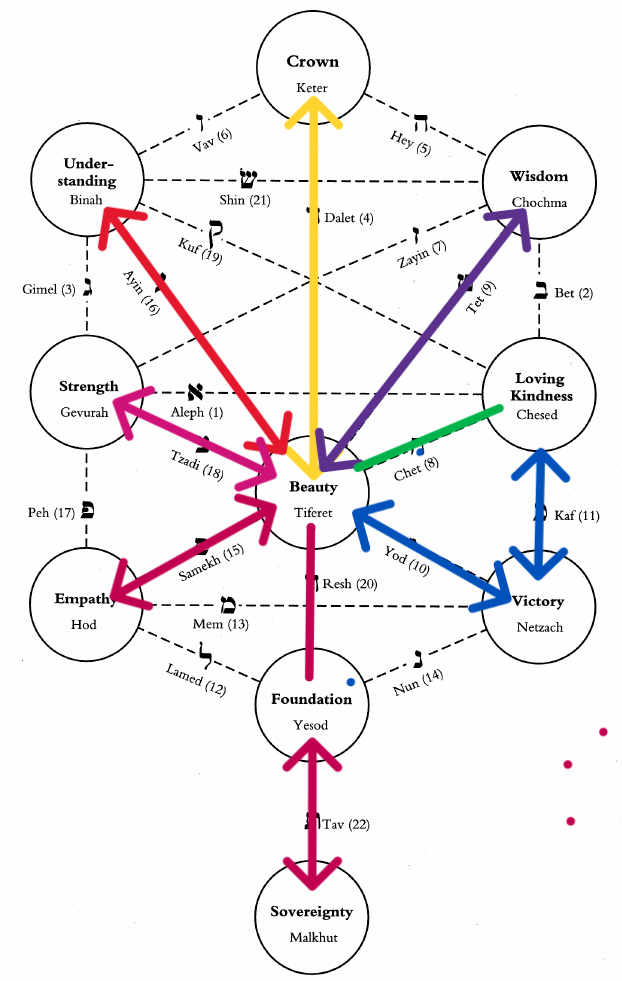
Since all the Sephirot are linked to Tiferet (with the exception of Malkhut), we shall use this section to summarize what has been discovered up to now. Tiferet in Hebrew means Beauty. Tiferet derives its beauty from the Light of Keter and, thus, from the light of the Sun. Its mediating influence can be an atziluthic influence, and it is this influence which is part of the deep mystery of life itself, the erotic that is life, the need that is life. It unites the souls of human beings to the Divine One. Just as the letters Alef, Mem and Shin are united into a one and are present and operating at all times in all the paths of wisdom, Tiferet reflects the ‘friendship’ of this Holy Trinity (the Father, the Son, and the Holy Spirit or the Ain, Ain Sof, and Ain Sof Ur) in the physical manifestation of the Creation. Tiferet is the daimonic realm, the realm of mediation and “messaging”.
One aspect of this mediation is the “friendship” manifested in the letter Samekh which is the path from Netzach to Tiferet. Tiferet is the manifestation of God’s covenant with human beings that is shown in the Beauty of the World. This covenant or bond is mirrored in “the miracle of friendship” between human beings and in the miracle of friendship between God and human beings. The light of the Sun is the metaphor for this mediation of “friendship” or Love, and this light “illuminates” the “intelligence” in its discernment of those things which are “goods” and those which are not. This is the site of the ethical or moral in our human being-in-the-world. The ethical and the intelligible are indiscernible and inseparable in our being-in-the-world.
Tiferet is at that point in the Tree of Life where the Tree of Life manifests itself in two branches. These two branches are the two faces of Eros and of the Logos. The two faces of Eros and Logos provide the various ways and means in which human being can relate to the Otherness that is being-in-the-world. It is that site where, potentially, there is no gap between “intelligence” and Love in the complete human being. There is no gap because of the presence of beauty. Love and beauty are one and the Same.
Other aspects of the mediation through Tiferet are between the Self and the Other, or the subject/ object dualism of modern Western metaphysics where Mind (thinking) understood as rationality (the Latinate interpretation of our understanding of logos) overcomes or rises above, ‘leaps’ ahead of the other through either Love or Will and commandeers and “projects” that other in order to determine what ends that other will serve. This is the Mind’s connection with the lower form of eros. This is “intelligence” understood as techne or “know how”.
The second is that mediation that brings into a unity the individual soul and the Divine One. After the Great Flood detailed in the story of Noah (Genesis 6-9), God’s covenant with human beings was a rainbow. The rainbow is a singular or particular manifestation of the beauty of world which is constantly present and which is the covenant of God. This covenant is the paradoxical conjunction of being and no-thingness and of no-thingness and being.
In the Christian Bible, Jesus said that God’s actual heavenly presence was arriving on Earth through Him (and not merely present as the Beauty of the World which acts much like a photograph of a loved one) and He often likened this to a huge tree, growing and spreading: (He told them another parable: “The kingdom of heaven is like a mustard seed, which a man took and planted in his field. Though it is the smallest of all seeds, yet when it grows, it is the largest of garden plants and becomes a tree, so that the birds come and perch in its branches.” Matthew 13:31-32). Jesus claims to be a tree of life, the whole, a vine that offers God’s life to the world (“I am the vine; you are the branches. If you remain in me and I in you, you will bear much fruit; apart from me you can do nothing. John 15:5). The presence/absence of God in His creation is the why I have used the metaphor of the beauty of the world as being an image or photograph of God i.e., it demonstrates the paradox of being/no-thingness that is the creation.

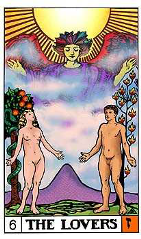
The figures in The Lovers card of the Tarot stand before two trees: The Tree of Life and The Tree of Knowledge of Good and Evil; and these two trees have been placed in the Garden of Eden which is understood here as the whole of Creation itself, and this garden is capable of being experienced in the NOW. Both Life and Good and Evil are the primordial elements of human existence. The Garden of Eden is here in the ever-present NOW. It is worth repeating the words of William Blake from “Auguries of Innocence” to illustrate the point: “God appears and God is Light/ To those poor souls that dwell in night/ But does a human form display/ To those who dwell in realms of day.” The two trees show that the intelligence and Love are inseparable, although in the human condition they have become separated.
In the Sefer Yetzirah and “The Thirty-two Paths of Wisdom”, the human form or body is a microcosm of the macrocosm of the whole of Creation. The human body is “the cross of Christ” and this is the meaning of Christ’s words: “Take up your cross and follow me”, for we experience the afflictions and sorrows of being alive as well as the pleasures, joys and triumphs through the mediation of the human body.

Tiferet is the path that allows one to look inward towards themselves and outward towards other human beings and to recognize and experience the sense of Otherness in their being-in-the-world. From it, the “loving kindness” of Chesed is realized through an awareness of the “friendship” that exists between the Divine Trinity and the created things shown in the Beauty of the world. It is through this loving kindness that is the emanation of the Divine in created things shown in their Beauty that one is able to know the “essence” of things, including one’s own self as part of that Divine creation and part of that which is Divine. From this knowledge and experience, one can have faith. “Faith is the experience that the intelligence is illuminated by love”, as Simone Weil says. The “intelligence” or “consciousness” of the whole of the 32 paths is illuminated by Love. This experience of faith is not brought about through reason and its applications, but through a consciousness of, an awareness of, the Love of God as present in His Creation. This awareness is given to one by Grace, the Divine Mediation, and is traditionally said to be given to one through the angels or daimons as His messengers. It is a product of the heart as well as the mind.
All of the Sephirot, with the exception of Malkhut, are influenced by the emanations that flow from Tiferet. How these influences come to be interpreted and understood is the essence of the teaching of the Kabbalah. The Atziluthic influence spoken of in this path is The Good which manifests itself in those things we call “good” in our lives, and it shows that that which we call ‘good’ has, as its essence, that which is The Good. To be able to perceive this good is due to the influx of the mediative forces of the spiritual. There are many passages in the New Testament in which Christ speaks of Himself as this Mediative influence, the parable of the vine and the branches already mentioned being one of them. Through this mediative influence, “the blessed ones” become united to its essence (the One), which is the Good.
The Constituting Intelligence belongs to Chakmah #2 which is the primordial life-force ‘swaddled in darkness’. This primordial life-force is the Will to Power. The ‘hiddenness’, the mystery of the life-force, is that Chaos that is the receptacle or enclosure of all things that are and that will come to be. We have spoken of these enclosures as manifested in the paths of Chet and Tet.
Tiferet belongs to the Sun, not to the darkness. The High Priestess card #2 cannot be placed here i.e., Tiferet, as Case proposes. The Lovers card #6 is properly placed here. As “that which constitutes the essence of creation in pure darkness”, it could be “the Lamb slain from the foundation of the world”, and the darkness is that darkness which is unable to comprehend the Word or the Light which descends into it. This darkness is present in both the realms of Beriyah and of Yetzirah. Creation is both the Beauty of the World and the Cross of Christ and both represent the presence of the Divine in His Creation even though they are contraries. Beauty is the height and the Cross is the depth of that Creation.
Tiferet is “beauty” in Hebrew and this “beauty” and its “light” is the covenant of God. Response to this covenant is Love and Faith, which give hope. From and within this perspective, one is able to recognize that other human beings are those to whom justice is due, and it is here that ethical actions, “right and wrong”, find their root. It is a paradox in that at this stage where one realizes oneself as a complete human being, one feels one’s self as most “individual” and yet, at the same time, as one individual among many others. It is the experience of ‘freedom’ in being most bound. It is the opposite of the “egotism” which relies on the calculations and machinations of the “personality” to achieve its own particular selfish ends. The true individual is the free individual, and this freedom has nothing to do with the exercise of the will or the ‘freedom’ to exercise that will that results in the ‘empowerment’ of the individual ego.

From this position, one can understand the vision of the saints who see “downward” upon the crucified Christ i.e., the paradoxical covenant of God: the beauty of the world as its height, and the crucified Christ as its depths; the light of God amidst the darkness of creation that is the crucified Christ. Most depictions of the crucified Christ are a ‘looking up’ at Him.
Tiferet is the only Sephirot below the primordial Trinity which receives the light of Keter directly through the channels of the letters Alef and Beth (Alef is the light of the Sun in a descent; Beth is the light of the Moon in an ascent?). The light of Beth is that light within the world of Yetzirah. The letter Beth is that from which all of the other letters are pro-duced or ‘brought forth’. The individual self is not the “personal ego” that is dominated by the “social” and its goal of “recognition” and “social prestige”, the world of power and money. Access to knowledge of “past incarnations” is that knowledge that is available from one’s culture, from history, since all humanity was, is, and will be One. The individual is not the re-incarnation of Helen of Troy or the village idiot from 15th century Leicester but all of these and more. As individuals, we are re-incarnations of all who have come before us since the individual becomes part of the One upon their death and their goal is to become themselves when they come to be.
The first letter assigned by Case to Tiferet is Gimel, but this might be an error. Tiferet is linked directly to Keter through the letters Aleph and Beth. This is why the reference to Tiferet is “the son”, directly linked to the Father. Since the Father is the whole and has created the whole through a withdrawal, not an expansion, the Son is the link between the Father and His creation. The Son is “the Lamb slain from the foundation of the earth”, and from this one can come to understand the Sefir Yetzirah’s references to the parts of the sacrificial animal and to the human body and its form as microcosms of the Creation itself.
The Sephirot Tiferet is the mediation of all of the other emanations or influences that come from the other Sephirot. It is this mediation which has the ability to bring two things which are incommensurate with each other into a relation of harmony or friendship. The Sephirot are all One, and they are ones individually, linked together by the letter Alef (the light of Keter, the element of Air) and by the “mediating influence” of Tiferet or Beauty. “The reservoirs of the Blessings” are those things which we call “good” in the world and they are “containers”, receptacles, or storage places for the blessings which are all united and share in the One Good. They are referred to as ‘husks’ in the Sefer Yetzirah. The husks are the containers which must be pierced so that their inner essence will come to light.
The 16th Path: The Triumphal or Eternal Intelligence: The Letter Heh
The Sixteenth Path is the Triumphal or Eternal Intelligence, so called because it is the pleasure of the Glory, beyond which is no other Glory like to it, and it is called also the Paradise prepared for the Righteous.
Alt. Trans. ” The sixteenth path is called the eternal consciousness because it is the pleasure of that glory beyond which is no glory like unto it. It is also called the garden of pleasure (Eden), which is prepared for the compassionate (Khasidim).”
Wescott trans. The Sixteenth Path is the Triumphal or Eternal Intelligence, so called because it is the pleasure of the Glory, beyond which is no other Glory like to it, and it is called also the Paradise prepared for the Righteous.
Path 16. Enduring Intelligence (Consciousness) (Sekhel Nitzchi): It is called this because it is the Delight of the Glory (Eden). As it is, there is no Glory lower than it. It is called the Garden of Eden, which is prepared for the (reward of) the saints.

Heh: Tiferet to Chakmah: Path 16: The Eternal Intelligence The second path linked to Tiferet is the letter Heh (but then how does one assign Gimel to its path since the letter is called “king over wealth”? Surely this must be associated with Chesed or Binah which is the physical world and The Emperor #4 card of the Tarot which is associated with wealth and fire, unless one considers the word “wealth” to mean “abundance” in the sense of one’s “cup running over”, the “reservoir” or container of those blessings that are given by God in friendship? This might suggest an association with Binah. The true “abundance” of the world is its Beauty; the true “need” of the world is the Light; and God is perpetually offering His love and friendship in abundance through the Beauty of the World and all those things in the world which we consider ‘beautiful’ and ‘good’. This is how Eros is to be understood.) It is through the Beauty of the World that the “emanations” of the “atziluthic influences” are increased, and “blessed are those” who are united to the cause of the Beauty of the World, the Divine Creator, the Good. The word ‘glory’ and the word ‘beauty’ are synonymous in “The 32 Paths of Wisdom”.
The several paths converging in Tiferet do not influence Tiferet but are influenced by and through Tiferet. Just as the light of Keter is not influenced by the other Sephirot but gives to those Sephirot their presence and ability to be Tiferet, too, determines the nature or the essence of things in their being. Tiferet influences Justice (Necessity) so that its severity and power is balanced and tempered with Mercy and Kindness. The canonical law that is the knowledge and understanding of Gevurah is brought into balance and tempered through the Being in the world of the parousia that is the Son. Our experience of our “need” as human beings urges and prods us to seek for that which will fulfil the absence of that perfection, the completion that we seek.
For human beings, our love of the beauty of the world begins with our love for the beauty of each other through the mediating influence of the light cast upon things which allows us to see them in their outward appearance. We feel the urge of sexual desire, the erotic, through the foundation that is Yesod, the foundation of the physical. We become “friends” through speech, and it is through this speech that we can attempt to become one with the other. While the word of God is perfect speech, our own speech is incomplete and imperfect. When God joins the two together, they then become one.
The Tarot cards associated with Tiferet illustrate the contraries (with the exception of Temperance) to those blessings associated with Tiferet. The speech between “two or three” friends (dialectic) becomes the speech that is to two or three hundred, the rhetoric of those who seek power over others. The experience of love becomes the “hard experience” of The Tower #15 and the knowledge derived from such experience. The cards of The Tower #15 and The Devil #16 are cards without light.
That which endures is Nature. Nature is sempiternal. Consciousness of this is the “Enduring Intelligence”. “Time is the moving image of eternity”, as Plato said. That which endures is Nature; that which passes away is also Nature. In its passing it moves, but in its moving it is ever the Same in its place. The Creation that is is the Garden of Eden which is experienced in the NOW, not at some future point in time. The saints enjoy life as the creation enduring in the NOW. They experience the world of the here and now as Eden.
The Letter Vav and the 17th Path: Intelligence of the Senses
Path 17. Intelligence of the Senses (Consciousness) (Sekhel HaHergesh): This is prepared for the Faithful saints so that they may be able to clothe themselves in the spirit of holiness. In the arrangement of the supernal entities, it is called the Foundation of Beauty (Yesod HaTiferet).
The Seventeenth Path is the Disposing Intelligence, which provides Faith to the Righteous, and they are clothed with the Holy Spirit by it, and it is called the Foundation of Excellence in the state of higher things.
Alt. Trans. “The seventeenth path is called the consciousness of disposition. It provides faith to the compassionate (Khasidim) and clothes them with the Holy Spirit (Ruach Elohim). Within the Supernals, it is called the foundation of beauty (Tiphareth).”
Wescott trans. The Seventeenth Path is the Disposing Intelligence, which provides Faith to the Righteous, and they are clothed with the Holy Spirit by it, and it is called the Foundation of Excellence in the state of higher things.

The Vav is said to represent the Kav, the vertical line extension of the Creator’s perfection into the created world in order to constantly direct it, guiding the cycle of existence step by step, until eventually the perfect Oneness of the Creator which underlies all of creation is revealed. Vav thus relates to the Law of Necessity, the Divine Will, ‘the structure of all that is formed’. The Vav could thus be seen as a barrier but also a way through.
Vav is related to the Orr Yashar, the direct light of the Creator, entering the world; but in the strife of this world, it appears to act as a barrier to the true Light. This would relate it to Christ, the Ain Sof, who is the direct light of the Divine and would thus associate Vav with Tiferet, the sixth Sephirot which is the Beauty of the World. But Vav, being an elemental letter, is capable of only one direction of movement. Is this movement up or down? Is it on the left side or the right side of the Tree of Life? The two sides of the Tree of Life should be viewed as the two faces of Eros, the front (right) and back (left), the two faces of the Ain Sof, or the mirror of the right and the left sides.
As a connector, Vav contains the mediatory power to connect heaven (mind, reason) and earth. It can be considered a channel or canal, which connects and bestows all the energy of the shefa שפע abundance from above down to the created beings. This suggests that its movement is downwards, and appears to imply that all creation is a movement downwards. A more proper direction might be said to an “away from”. The Vav is said to represent the ladder of Jacob Yaakov – rooted in earth, with its head in the heavens, what is known as Jacob’s ladder. But if this is the case, then it is upside down (as is suggested by the tarot The Hanged Man#12). The Vav is the extension of the essential dot Yod י, but this extension is an expansion indicating its relation to the will to power and its relation to the physical body. God’s withdrawal is that from which all of creation comes forth and it is contained in Alef. It is the contrary of will to power; it is a denial of power and an expression of Love.
Vav represents the number 6, 1 + 2 + 3, and represents the six days of the creation of the world, as well as the six physical dimensions (right and left, front and back, up and down) of Space. The first day of creation is related to Chesed and is attributed to “kindness”. God’s withdrawal allows creation to be, but the Mercy and Kindness of God are present prior to their manifestation in the physical world of creation and the act of ‘giving’ that is the Creation. The Light of God is two-fold: one Light is beyond Being (the Good) and then there is the light within creation itself from the sun, moon, and heavens. Creation begins at the number 4, Chesed.
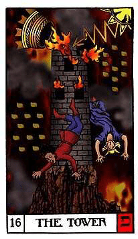
The second day of creation has the attributes of “severity”, “contraction”, and “judgement” associated with it, the binding of things in enclosures; it is the Law of Necessity. It relates to the Sephirot Binah, as well as to Gevurah and Hod. The deprivation and need of the original creation is experienced here and its metaphorical significance is the separation of the waters. It is associated with the Flood and with the Tower of Babel i.e., The Tower #15 card of tarot.
The third day of creation is associated with Tiferet and is associated with beauty, mercy and the balance between the positive and negative elements of creation (although, as is suggested here, these elements are prior to the Creation itself). The fourth day of creation is associated with Netzach, with splendour and the victory that comes from “endurance” (but why is this prior to the creation of human beings? One plausible answer is that the heavens and the earth are sempiternal and that one of the chief virtues for human beings is “endurance”). It is also associated with the creation of the sun and moon. The fifth day of creation is associated with Hod and has the attribute of acknowledgement but also of devastation. The sixth day of creation is associated with Yesod and with the creation of human beings. It is associated with Adam whose name contains the letters Alef, Dalet and Mem. Adam is the human being who is perfect in his thought, speech and action i.e., he is the “complete” human being: the first human being is the complete human being and he is referred to as the Adam Caedmon. That he is brought into being on the sixth day shows the association of human beings with Tiferet. But how is it that human beings other than Adam come to be the “perfect imperfection”?
The Vav is also representative of the male phallus, the fertilizing agent, bringing life, abundance, continuity, and addition and represents the extension below Tiferet to Yesod. This is our first experience of eros.
The Intelligence or Consciousness of the Senses is that manner of seeing which allows the saint to become a saint and allows them to view the world as it is, that is, as a Garden of Eden. This viewing is the reward for their saintliness. In doing so, they are ‘clothed’ in the ‘excellence’ that is what we understand by virtue. They achieve what the Greeks called arete. This is the highest form of human being. The ‘courage’ shown by human beings is in their ‘endurance’ of the experience of creation. It is the denial of the third temptation of Christ.
The highest form of human being is shown through their actions. The saint (or philosopher) shows, through their example, what human excellence is. There is no need for proselytizing. “To make disciples of all nations” (Matthew 28: 19-20) is to show by example what the purpose of the journey is. To those whose god is a dispenser of power and fear, they will also be dispensers of power and fear in their spreading of what they conceive the truth to be. The greatest sins are committed by those who believe they are in possession of the truth. ‘Christian nationalism’ and other “-isms” that purport to be the ‘word of God’ are, at best, mistaken in their understanding of Christ’s message, and at worst, blasphemers. One is reminded of the line from W.B. Yeats’ poem “The Second Coming”: “The best lack all conviction/ While the worst are filled with passionate intensity”.
The letter Vav in Hebrew serves as both a conjunction and a verb modifier from present, past and future tenses. It is thus associated with Time. Binah is the Sephirot associated with Time. The mediation of Vav is thus associated with Time and is the influence of Will upon the ready-to-hand of the world. This is why I have associated Vav with the path that extends from Tiferet to Binah.
Because science no longer deals with what was once understood traditionally as Nature (and, thus, reality), the human will prepares each thing of Nature for that completion or perfection that will come from the ends or purposes that human beings determine or devise that are best for themselves. This is what we call “freedom”, the devising of ends which we think are best for ourselves. We believe in this freedom because we believe that, ultimately, we are ‘our own’ as individuals. Freedom is the commandeering and dominating knowing and making that we understand as technology. This dominating knowing and making includes our own bodies. It is also what we understand as ‘artificial intelligence’. What is clear from the Sefer Yetzirah and the traditional religions of the world both West and East is that we are not our own but are called to a higher destiny beyond ourselves.
In the world of the will and of will to power, there are some cases where there are created beings that serve no purpose or ends for the will to power of some human beings; that is, they have no “purpose” or future “use” and cannot be brought into being as part of a “standing reserve” of resources, and to these beings no “justice” nor perfection is due, and that includes some other human beings. This is what has made, and will make in the future, the possibility of genocides and these genocides will be much greater than those that have occurred in the past.
The Letter Ayin and the 20th Path: Intelligence of the Will
Ayin– and Elohim “divided the light from the darkness.” 1:4
Path 20: Tiferet to Gevurah: Intelligence of Will (Consciousness) (Sekhel HaRatzon): It is called this because it is the structure of all that is formed. Through this state of intelligence (consciousness) one can know the essence of Original Wisdom.
The Twentieth Path is the Intelligence of Will, and is so called because it is the means of preparation of all and each created being, and by this intelligence the existence of the Primordial Wisdom becomes known.
Alt. Trans. “The twentieth path is called the consciousness of will because it is the pattern of all that is formed. By this mode of consciousness, one may know the actuality of the primordial wisdom.”
The Twentieth Path, the Intelligence of the Will, is the understanding of the “preparation of all and each created being”, “the pattern of all that is formed”, and may be best understood in the German word gestell as it is used by the German philosopher Martin Heidegger. A Gestell is a framework or “method of organization” which allows created things to be and to come to presence for us. It is the primordial algorithm and taxonomy. Heidegger calls it the essence of technology. It is a manner or disposition of human being-in-the-world (among other possibilities of human being, although it is by far the dominant one) and it determines how the created beings are to be viewed. It is a ‘destiny’, a ‘fate’ of Being that has been given to human beings. While in German Gestell is a noun, Heidegger uses the word in a way that is uncommon by giving Gestell an active role, by viewing gestell as a product of the human will and a product of human action, a human “projection”, “a throwing forth”.
In defining the essence of technology as Gestell, Heidegger indicates that all that has come to presence in the world has been “enframed”. Such enframing or the placing within ‘enclosures’ relates to the manner reality appears or unveils itself in the period of modern technology (by “modern” here is meant post-Renaissance) and people born into this “mode of ordering” are always embedded into the Gestell (enframing) themselves. (As the Canadian philosopher, George Grant said, “What we have done to Nature, we first had to do to our own bodies”.) Thus, what is revealed in the world, what has shown itself as itself (the truth of itself) requires first an Enframing, literally a way to exist or to be in the world, to be able to be seen and understood. Path #20 indicates this knowledge when viewed from one possible perspective.
In ordinary usage the word gestell would signify simply a display apparatus of some sort, like a book rack, or picture frame; but for Heidegger, Gestell is literally the challenging forth, or performative (dynamis) “gathering together”, for the purpose of revealing or presentation i.e., the human will as central to how the world will be unveiled. If applied to science and modern technology, “standing reserve” is active in the case of a river once it generates electricity or the earth if revealed as a coal-mining district, the soil as a mineral deposit, or scenic sites as part of the tourism industry. It is this challenging forth that connects gestell to the human will. It is ‘the hook’ or ‘peg’ that is part of the meaning of the letter Vav.
We can see here again the connection between the passages from Genesis related to the coming-to-be of human beings and the coming-to-be of technology in our modern age. Human beings are given the central role in creation; and all that has been created or will be created is given over to them for their disposal. The world itself, created beings themselves, do not reveal themselves in their essence without the aid of human willing. The act of revealing is, literally, a one-way path or a one-way street from this particular viewpoint. This is the way of viewing the world when the Strength card is seen as #8 and that it is connected to Gevurah and Chesed by the paths and when one assigns the letter Tet ט to it.
Path #17 The Intelligence of the Senses and Path #20 The Intelligence of the Will indicate that point where The Tree of Life branches off or becomes two-limbed. This branching occurs when the manner of perceiving the world is determined. It may be determined either through Will or through Love. Will and Love determine the two faces of Eros and of the Logos: the lower eros and the higher Eros on the one hand, and rhetoric and dialectic in language. This determination occurs within the world of Beriyah and it can be distinguished by that thinking which is done by the artisans and technicians and that thinking which is done by the saints and the philosophers. This bifurcation determines the world as ‘standing reserve’ and disposable, or it can view the world as a Garden of Eden.
Another way of viewing the 20th path is to see it as “prudence” or the Strength card as #11 of the Tarot. The essence of technology as outlined by Heidegger devolves into the nihilism of the pure “will to will”, the need to will anything since one has no other alternative given the oblivion of eternity and replaced that eternity with the eternal recurrence of the Same. The technological way of being-in-the-world is a mirror or mimicking of the “primordial wisdom” that is in the realm of the world of Atzilut since it bestows the ‘values’ on things and these ‘values’ are related to their potential uses. This may be seen in the manner of questioning of the thing and how that question will be answered.
“The structure of all that is formed” is the Law of Necessity and it is through the understanding of the Law of Necessity that one is able to know “the essence of Original Wisdom” or the Sephirot Chakmah. Our attempts to understand ‘all that is formed’ comprise our ‘theories of the real’, what we call our sciences, how we attempt to view our world. Our sciences are products of reason and the will. As was said earlier, Artificial Intelligence is a shadow of the shadows of the things of Necessity. In Plato’s allegory of the Cave, artificial intelligence would be a second cave and a further distance, at a greater depth, from the light of the Sun, the Good. Its greatest danger is that it is self-contained and represents the greatest enclosure.

The letter Ayin is erroneously said to have the power to unite everything that is separated in creation and this is why it is confused with the structure of the letter Alef which consists of two Yods separated by a Vav. The letter Ayin as the 20th path is related to the letter Peh and path 13 The Unity Directing Intelligence and the letter Vav Path 17 The Intelligence of the Senses. But is Vav really a true unifier or a barrier, a separator? Literally Vav means “hook” or “peg” and the Hebrew letter is a vertical line ו. The Vav would appear to be a metaphor of the mediation that exists between reason, the logos understood as an extension of the will to power, and the ready-to-hand world about us.
The world is seen as the second Cave of the Internet containing the whole and the Vav is that reasoning that unites the things in that Cave to the algorithm based on the principle of reason. This reasoning is tied together with The Sanctifying Intelligence, the intelligence that separates (diaresis), and The Unity Directing Intelligence (dianoia) the intelligence that brings into a unity, that emanates from the Sephirot Binah. Are these manifestations of the Logos or the Anti-Logos?
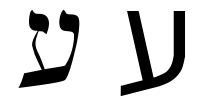
The Hebrew letter Ayin means “eye” and correspondingly, the Ayin has to do with vision and bringing forth the light that is hidden, the unveiling or revealing of truth. The Greek philosopher Aristotle begins his Metaphysics with the words: “All men by nature desire to see” for it is through “seeing” that we come to experience the things of the world and to gain knowledge of them. The letter Ayin in Hebrew relates to time and is related to the planet Saturn. It is the 16th letter of the Hebrew alphabet and thus is central to the whole of the 32 paths of wisdom: 16 X 2. Since time begins with Binah in the Beriyah world of the Sephirot (the third stage in the moment of creation), we can therefore relate Ayin to the left side of the Tree of Life. The strong relationship of the letter with time suggests its relationship to The Tower #16 card of the Tarot (change, revolution) and also with the letter Peh (mouth), and this suggests the interchangeability between The Devil #15 and The Tower #16 (which I have suggested). Ayin is included in a great number of words associated with time in Hebrew (עת – time, שעה – hours, עתיד – future, עבר – past, רגע – moment, עוד – until, עד – eternity) and vision. It indicates the inextricable link between Being and Time and our inextricable link to Being and Time through seeing and hearing.
The structure of the letter Ayin appears to suggest that it is composed of three other letters: Zayin (manacle or sword), Lamed (the study of that which presences), and Yod (the ego, the self, the point). One can perceive that the letter is suggestive of the anti-Logos. The Yod is a time indicator in the Hebrew language; the Lamed is associated with study as memory, the study of that which has been written down and become ‘historical memory’; and Zayin as being manacled or enchained by the manner of seeing and to Time itself (although this could also be seen as the ‘liberating’ sword from the oppression of the ‘manacle’). This would suggest that what we call ‘historical knowledge’ is not a liberating knowledge, although it can be a ‘leading out’ (and we perceive it as such) but it is also a knowledge that manacles and enfolds those who see it as All within itself. As we have already stated, the principle of reason is founded upon will to power, and the current temptations to artificial intelligence are grounded here. The Intelligence of the Will or path #20 is the intelligence of the principle of reason and its relation to will to power.
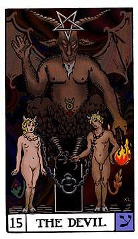
If prophecy is the ‘highest speech’ of the visionary who is able to see the past, present, and pre-dict the future, then the vision suggested by Ayin could be said to be the ‘false vision’ which gives voice to the ‘false discourse’ and the ‘false prophecy’. This false discourse and vision is best captured in #15 The Tower and #16 The Devil cards of the Tarot, and is revealed in the letter Peh of the Hebrew language. The Devil card itself is among the darkest of the Tarot, if not the darkest of the Tarot. The only light present is from the torch in the Beast’s left hand which ignites the tail of the male figure in the illustration; the torch is the passions that ignite the desire and the will. That this torch only touches the male figure suggests the patriarchal nature of what we call ‘historical knowledge’, the patriarchal narrative. The torch of The Devil is reminiscent of the fire in Plato’s allegory of the cave which occurs in Bk VII of that dialogue. The Great Beast that is the concrete manifestation of the social occurs in Bk. VI, and I would suggest that these are the Same as what is being shown here on The Tree of Life.
The suggestion is that the figures in the illustration, contrary to the figures in #6 The Lovers illustration, are manacled by their bestiality and by the darkness in which they dwell. They are shown with cloven feet; they have become bestial. The Beast itself stands upon a black cube. This cube is different from the cubes that The High Priestess, The Charioteer, and The Emperor sit upon, and these figures are on the right-hand side of the Tree of Life. On the Beast’s lower abdomen are symbols suggesting that it is the anti-Christ. On its beard is the letter Zayin suggesting its enchainment to Time and to the pleasures and goods that are the products of Time. It can be said to be the overpowering of the influence of Zayin, the influence that shackles or manacles.
Some Hebrew commentators suggest that the pronunciation of the Ayin is also very significant – it is often mispronounced as a silent letter similar to the Aleph; however, Ayin’s correct sound is a guttural throat sound which stimulates the thyroid gland. This mispronunciation also suggests the ‘false discourse’ which gives Ayin the sense of being Aleph, but to think that Ayin is Alef is an error. They are two contrary forces.
Ayin implores us to open our eyes, to see beyond the physical, but in order to do this we require grace. The Ayin requires an other to take us from the dark to the light. The Ayin is ‘the dark boar of the forest’ and the ‘snake’ that hides there from the centre of the Psalms, similar to the beast that dwells at the centre of the labyrinth that is symbolic of the sub-conscious self (Path #7 The Hidden Intelligence). Part of Ayin is the letter Lamed which is the serpent uncoiled and this serpent is the knowledge of which Ayin is composed. The gematria of Ayin is 70 suggesting that the strife associated with the attempt to see properly is associated with Netzach and with The Chariot #7 card of the Tarot. This will be discussed later.
 Theory of Knowledge: An Alternative Approach