Plato’s Divided Line: The Two Faces of Thought and Thinking

The Division Between Love (Eros) and Thinking (Logos)

The most popular site on this blog is Plato’s allegory of the Cave. I am somewhat puzzled by this as the Allegory presents many difficulties as far as its understanding is concerned when it comes to relating it to the ethics and morals required by the Core of the Theory of Knowledge course. The Allegory cannot be properly understood without some knowledge of the Divided Line from Bk VI of Republic .(506c – 511e) Also, one requires some knowledge of Plato’s theory of the tripartite soul that he believed is the essence of human beings. For Plato, the human being was the zoon logon echon, the living being that perdures in logos which is language and number. Later, the Latins would identify the essence of human being as the animale rationale, the “rational animal”, the animal the perdures in “reason”. We shall try to come to some understanding of these definitions here and to show some of the consequences of our choosing the Latinate definition of the essence of human beings.

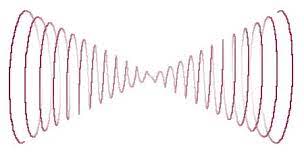
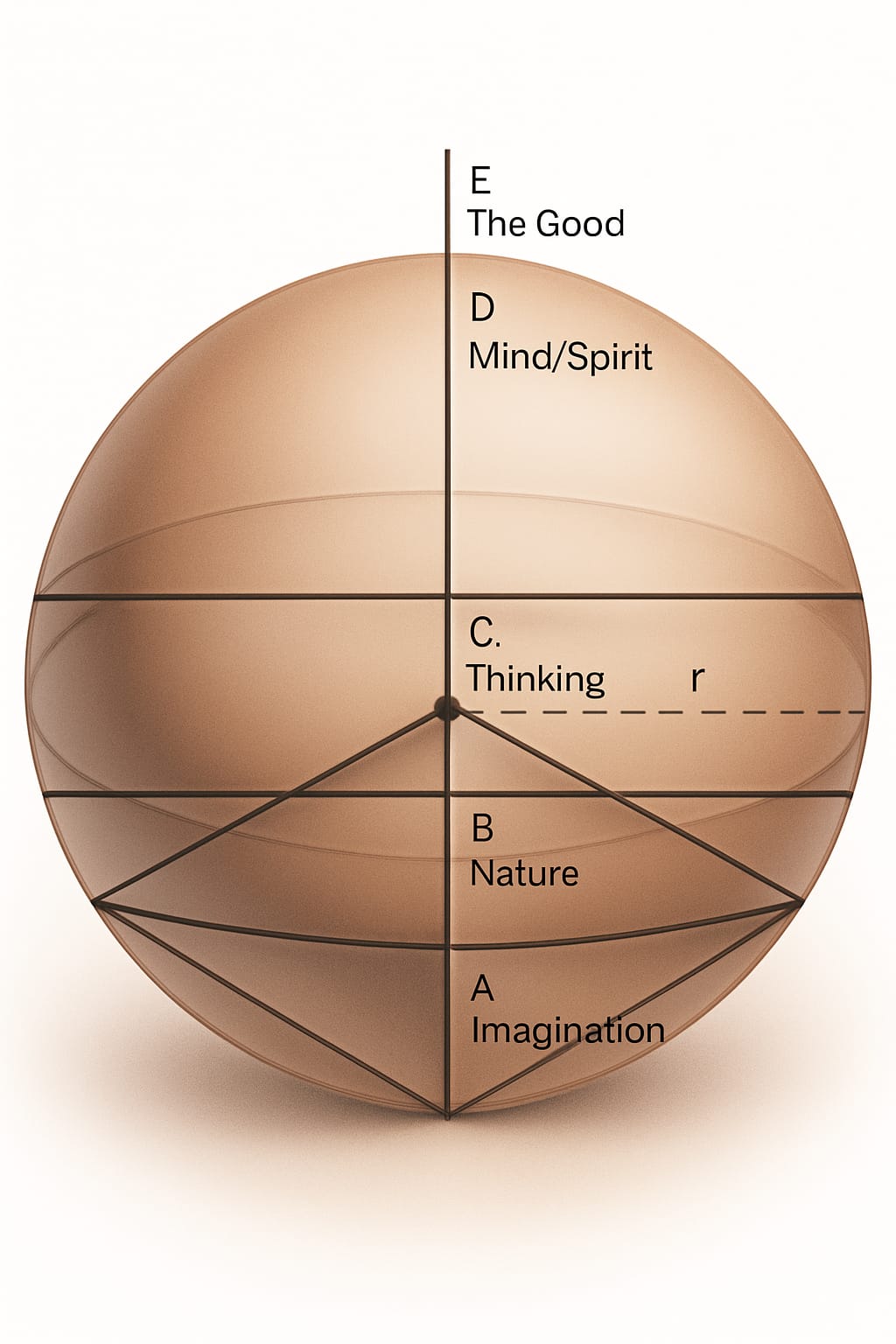
In the illustration above, the human soul’s proper “place” or “site” is at the centre of a sphere that is the being of Time and Space and the created things that are within Time and Space. The sphere itself is constantly in motion. The sphere is what Plato called “the moving image of eternity”, the sempiternal nature of created things.

The realm of “E” is the realm of the Good i.e. the Eternity that encloses or embraces the entirety of the cosmos or creation. The Good begets the Ideas which are in the realm designated by section “D”. The ideas can be approached through the Mind, the Nous, the Spirit, the Intelligence. The Ideas in turn beget the Eidei, the outward appearances of the things that “shine” and which we perceive through the sense of sight because of the “light” that acts as a metaxu or mean between our “eye”, the Sun, and the things that are. This occurs in section “C”. This light, as metaxu, is Eros; the ‘eye’ itself must have a quality that is ‘sun-like’ for there to be a possibility of a commensurable relation between it and the things beyond it.

From this perception occur our axioms and the principles that establish our understanding of the things that are in the world and those beyond it, what the philosopher Kant called the “transcendental imagination”. This perceiving occurs in the “C” section of the Divided Line and establishes our understanding of the things that are. It is the source of our trust, faith and belief in our interpretation of the reality of the things that are that they are as we say and think they are. This we understand as the true. Science, for example, is the theory of the real. “Theory” is a manner or mode of “seeing” and derives from the same root as “theatre”, “the seeing place”. The “theory” is a product or outcome of the “site” or the place from which the seeing is done. Section “C” is equal to section “B” in the Divided Line.

Section “B” is physis or the Cosmos, what we understand as Nature. It is the Cave in Plato’s allegory of the Cave. The Cave is “more real” than the shadows that are “thrown forward” or projected onto the walls of the cave by the artisans and technicians. Even the shadows require light to be produced, but this light is not directly from the Sun. It is a derived or borrowed light (such as that of the Moon, although the light in the cave is due to the fire which has been ignited, presumably, by the artisans and technicians). Fire is a product or derivative of the Sun. In the Cave, there remains a dim presence of the Sun itself but it is ineffectual.

Section “B” = Section “C” in Socrates’ discussion of the Divided Line. It is thought which gives us the things (the techne of the artisans and technicians, “the mind that makes the object” as Kant’s transcendental imagination would have it) and there are no things without thought, whether the thing be natural or artificial or as artefact, as the “work” we produce. The thinking that occurs in Section “C” is that representational thinking that is brought forward or ‘thrown forward’ from Section “A”, the Eikasia or Imagination.

Techne or “know how”, “knowing one’s way about or within something” is but one manner of thinking that the imagination produces. The thinking of the poets is also one manner of thinking that arises from the imagination. Poetic thinking is distinct from the techne of the technicians and still further a different type of thinking than that of the philosophers. This technological thinking of the artisans and technicians occurs on the outer circumference of the sphere, in the realm of the imagination. It is the farthest thinking from that of the philosophers.
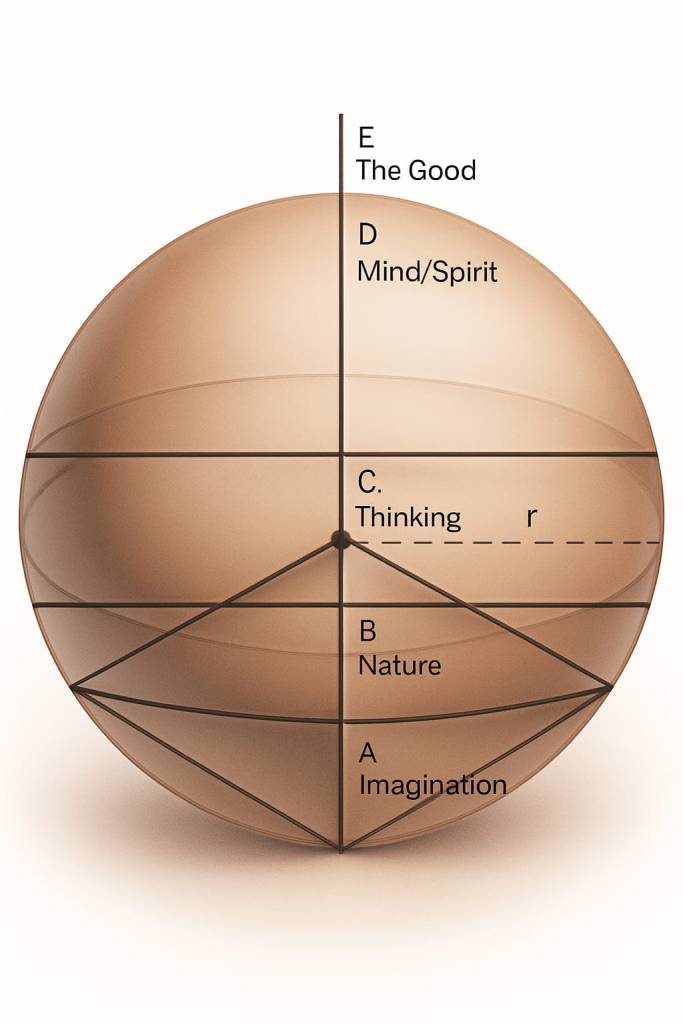
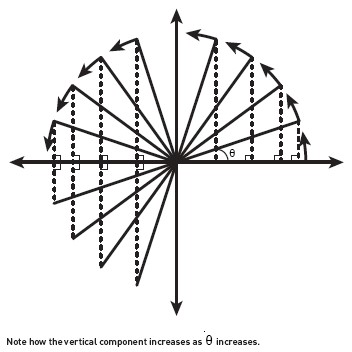
Poetic thinking and techne are the diagonals given in the illustration of the sphere provided here. Both proceed from the “I” in the centre of the sphere which reaches out and “projects” to the circumference of the sphere. The circumference of the sphere is the ‘surface’ phenomenon of things, the deception of their ‘outward’ beauty. It is the thymoeidic part of the soul that is at the root of this projection. The thymoeidic part of the soul deals mostly with will, emotions and feelings, what the Greeks understood as pathos. Our projections are given back to us in the form of a ‘lighted up’ of things. It is eros that does the “lighting up”.

If we look at the statement of Aeschylus that “In war, truth is the first casualty”, we can say that war is evil for all evil requires deception, subterfuge, the hiding from the light. This deception is to be found on the surfaces of phenomenon. That which is thrown forward by the ‘self’ at the centre of the sphere to the circumference through the thymoeides is an ‘irrational number’ in mathematics, what we call pi (the ratio between a circle’s diameter and its circumference), since the two diagonals thrown forward comprise the diameter of the sphere. The movement of the soul outward toward the circumference is a widening gyre from out of the depths of the centre to a shallowness or dispersal of being, or a “shadowiness” of being on the circumference. In this shallowness, the soul is more easily susceptible to the influences of evil and to being led by deception and machination. The soul is furthest away from self-knowledge when it is mired in the outer influences of the sphere.
Jean Paul Sartre

In Preface II to this writing on “The Prince of the Two Faces”, we noted the statement of the French philosopher J. P. Sartre that “Hell is other people” and said that it illustrated the gap between love or eros and intelligence (nous, spirit, mind) as well as “thinking” or “thought” and how these are presented through the logos in the modern age when thinking and thought are understood as “information”. How love and intelligence (nous, spirit, mind) have come to be understood and how they relate to logos and eros is what must be undertaken at this time. Of course, these writings are simply impertinent precis of what are some of the most complex and troubling ideas present in our being-in-the-world today.

Plato’s discussion of the Divided Line occurs in Bk VI of his Republic. In Bk VI, the emphasis is on the relation between the just and the unjust life and the way-of-being that is “philosophy”. Philo-sophia is the love of the whole for it is the love of wisdom which is knowledge of the whole or the aspiration towards knowledge of the whole. The love of the whole and the attempt to gain knowledge of the whole is the call to ‘perfection’, ‘completeness’ that is given to human beings. Since we are part of the whole, we cannot have knowledge of the whole. This conundrum, however, should not deter us from seeking knowledge of the whole and, indeed, this seeking is urged upon us by our erotic nature. It is the urge to be god-like and can lead to tyranny. All human beings are capable of engaging in philosophy, but only a few are capable of becoming philosophers. As human beings, we are the ‘perfect imperfection’. We are ‘perfect’ in our incompleteness.

The whole is the Good (A-E); and that which is is part of the whole so it must, at some point, participate in the Good of which it is a part to some extent. That which we call the ‘good things’ of life such as health, wealth, good reputation, etc. are subject to change and corruption because they are not the Good itself. These are the things that we love. They are wholly in Time. To only love the ‘good things’ is to love the part, and this love of the part channels one off in another direction from that initial erotic urge directed toward the whole or the Good. This is why the ‘good things’ in themselves can become evils and why we can become obsessed with, and succumb to, the urges we feel for their possession. The desire for immortality and the desire for will to power can become hubristic. They can lead to tyranny.

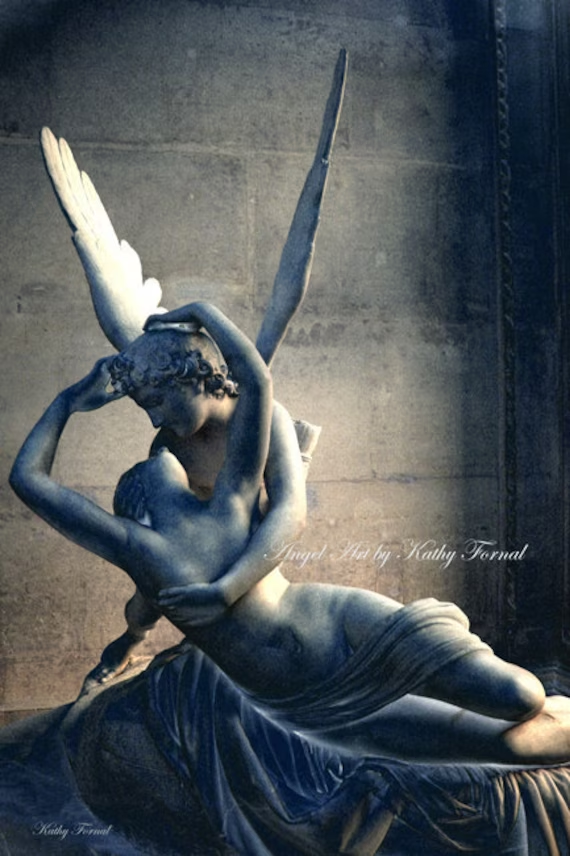
Eros is not the winged cherub or child named Cupid (which is derived from the Romans), nor is it merely the sexual urge which is the modern day focus, thanks primarily through the writings and works of Freud. “Love (eros) is the oldest of all the gods,” says an old Orphic fragment. Another Orphic fragment runs: “Firstly, ancient Khaos’s stern Ananke (Necessity, Inevitability) and Kronos (Chronos, Time) who bred within his boundless coils Aither (Aether, Light) and two-sexed, two-faced, glorious Eros (Phanes), ever born through Nyx’s (Night’s) fathering, whom later men call Phanes, for he was first manifested.” This Orphic fragment is saying the same as the Book of Genesis from the Hebrew Bible: “1 In the beginning God created the heaven and the earth. 2 And the earth was without form, and void; and darkness was upon the face of the deep. And the Spirit of God moved upon the face of the waters. 3 And God said, “Let there be light”: and there was light. 4 And God saw the light, that it was good: and God divided the light from the darkness.” The “light” and Eros are born simultaneously, and this birth is the connection between the Good (God in the Hebrew Bible), the Logos (Intelligence, Mind, Spirit) and Love or Eros between the Intelligence and Love.

Eros is associated with Time; Logos is associated with Space. It is the Logos which grants and gives “form” and “shape” to the void that is prior to Being. Both Time and Space are associated with Ananke Necessity. Ananke is associated with Eros.

Acts of creation are ones that arise out of love, and sometimes that love can be misguided if it is not properly directed by the Logos. Love requires withdrawal and the allowance of things to be if it is to be true. It is an ‘owning’ that is a ‘disowning’ that allows care and concern to grow within its ‘space’, its site. Both Love and the logos allow themselves to be given shapes and forms that are necessarily further from the real truth of the things that are. These shapes Plato calls the shadows.

Plato’s Divided Line from Bk VI of his Republic is a visual representation of the journey of the individual soul that is outlined allegorically in Bk VII of the text in the allegory of the Cave. The Divided Line is the logos as a representation of enumeration or number, while the allegory of the Cave is the logos as mythos or “word” i.e. poetry, and in both cases we are meant to “behold” that which the logos reveals. Both the Divided Line and the Allegory of the Cave are abstractions. The Allegory is intended to be more ‘moving’ emotionally than the speeches outlining the Divided Line. In the Allegory, for instance, there is an emphasis on the physical pain that is involved in the turning toward the Good since we are beings in bodies. There is an emphasis on eros as pathos.

The Divided Line distinguishes between the two faces of the Logos and the two faces of Eros. This distinction is done with regard to how ‘reason’ or the logos (that part of the soul which is called the logistikon by Plato) is to be understood and, subsequently, how eros is to be understood in the concrete details of human living. These details are made even more explicit in the speeches related in the Platonic text Symposium. From these concrete details we can understand the gap that exists between Intelligence and Love in our modern understanding. One face of the Logos is language as rhetoric which is the language that informs the many. Artificial intelligence and its “reason” is rooted in “rhetoric”. The other face of the logos is rooted in dialectic: the “informing” that occurs between two or three individuals that assists the soul on its way to self-knowledge.

For Plato, Eros as Love is what distinguishes the higher Eros from the lower eros. While the higher Eros emphasizes withdrawal and “letting be”, the lower eros is a possessing, holding and consumption of that which is “loved”. The higher Eros emphasizes an engagement in but not a possession of that which is loved. In some of the myths regarding Eros, Psyche the human soul, first hopes to catch a glimpse of Eros and then to hold and possess him. When she does so, Eros disappears and she must begin a long and painful journey to find him again.

Love has no place in the political; it is anti-political in that it is primarily a private act and the political deals with public acts which are associated with the thymoeidic part of the soul and the community at large. The thymoeidic part of the soul is torn between the public and the private spheres. The political emerges out of the private individual things, just as the city emerges from out of the household, the community from out of the family, the family from the individual body.

The root of the agon or conflict between philosophy and the political, as it is for philosophy and poetry, is how Love or eros is understood and interpreted. Alcibiades, the ‘political beast’ who shows up uninvited in the Symposium, has a passion for Socrates, but this passion is not Love. Socrates knows who Alcibiades is and what his nature is so he spurns Alcibiades’ advances and yet at the same time tries to lead him to philosophy because Socrates is aware of Alcibiades’ exceptional nature. Socrates recognizes the greatness of Alcibiades’ ‘spiritedness’ (thymoeides) and tries to lead him to philosophy but fails to do so. Alcibiades’ failure is the result of his love for the polis and for the favours he receives from the many. That many historians attribute the fall of Athens to the Spartans to Alcibiades’ betrayal of the Athenians illustrates to us the importance of this event in the lives of the participants in both Republic and the Symposium and to the history of the West in general. It signified nothing less than the end of what we call the Golden Age of Greek civilization and culminates in the imperialism of Alexander the Great.

Thinking, thought and self-knowledge are co-related. The openness to love and intelligence are co-related. Where true thought is not present, there is no self-knowledge, there is no “intelligence”. Where there is no self-knowledge, there is no sense of ‘reality’. Where there is no sense of reality, there is no knowledge or recognition of good and evil. Where there is no knowledge or recognition of good and evil, there is no possibility of “human excellence” or arete. Without a sense of “human excellence”, there is no polemos or strife within the individual soul to resist the temptations to succumb to evil actions through the many urges of the lower eros and one is unable to move to a higher state of consciousness nor, in many cases, does one desire to move to a higher state of consciousness. One finds the pleasures of the lower eros enough. This satisfaction was found among the Epicurean philosophers and the later Empirical philosophers.

In its urging towards an ascent, Eros’ affect is to make us love the light and truth and hate darkness and falsehood. Care and concern for others and our sense of “otherness” develops from this higher Eros’ erotic urge. The ascent from the individual ego and its love of the part, experienced in the love of a single, beautiful other, to a knowledge of the whole and the love of the whole of things is a process that the immortal part of the soul (logistikon) undergoes in its journey towards “purification” from the love of the meeting of our own necessities and urges (epithymetikon) to the love of the Good. “Depth” arises from the ascent which is toward the centre of the sphere. The descent brings about our desires for the surfaces of things, which is the lower form of eros. These are located on the outer circumference of the sphere. Evil is a “surface phenomenon” and eros is a part of it, and evil is located and thrives on the outer circumference of the sphere. It is the given of the human condition, of its being-in-the-world.

The content which is given to us in the image of the Divided Line in Bk VI of Republic is emphatically ethical for it deals with deeds, not with words. The philosophic way-of-being is erotic by nature. To be erotic is to be in ‘need’; sexuality is but one powerful manifestation of the erotic in our lives and it illuminates our desire for immortality through the procreation of children. The procreation of children is the recognition of the ‘otherness’ that is our being- in- the- world. In general, the two faces of Eros have to do with mortality and immortality. They are bound together like two sides of the same coin. It is the awareness of our mortality that makes the desire for otherness a need.

The ‘spirited’ (thymoeides) part of the soul acts as a mediator or metaxu between the logistikon or “rational” part and the epithymetikon or “appetitive” part of our souls which in turn determine our various “militaristic” and sexual passions which manifest themselves in our love of sports and competition or our love of wealth among many other varied activities and pursuits in the various worlds that we participate in. This is eros as pathos in our human natures.

When such drives dominate the soul, there is a predilection for politics, for power within the community or polis to make such an acquisition of such goods or objects easier. Such a desire for power is rooted in a desire for immortality through ‘honour’ and ‘fame’ through the thymoeides part of the soul. The ‘procreation’ that is the root of sexuality is the desire for immortality through offspring. This desire for immortality through offspring is the desire for the Incarnation, the ‘procreation’ of the Good, the begetting of the Good in beauty. The separation of the desire for offspring from the orgasm that is the result of that sexuality is but one manifestation of that gap between intelligence (nous, mind, spirit) and love that is revealed in Sartre’s “hell is other people” statement noted above. It is a manifestation of the tyrannous soul.

The philosophic soul reaches out for knowledge of the whole and for knowledge of everything divine and human. It is in need of knowledge of these things, to experience and to be acquainted with these things. This noetic knowledge is a gnosis, an en-owning of the knowledge of which one has taken “possession”, not through consumption but through participation. It is an active being-in and concern-with and yet, at the same time, a “letting be” through a contemplative consideration of what is close at hand. The non-philosophic human beings are those who are erotic for the part and not the whole. They are deprived of knowledge of what each thing is because they see by the borrowed light of the moon (the images of the imagination that are our representations) and not the sun; their light is a reflected and dim light. They wish to control, commandeer and consume that which has emerged into being. The hubris of human beings, and their great danger both to themselves and to otherness, is to try to commandeer and control being itself.

Eros is the “sun-like” quality of the “eye” that allows the eye to perceive the Sun’s goodness. Eros acts as the metaxu or the “between” or the “in between”, the mean proportional of geometry, the “open” space that occasions or establishes a relation between two incommensurate properties or things. In the prison cells that are our ’embodied souls’, the ‘form’ that the logos takes acts as a barrier but it is also a way through. The metaxu are ‘means’, what we call the ‘goods’ of the world. As such, they are the ‘bridges’ to the Good itself.

Metaxu can also be translated as “among,” “in the midst of,” or “in the meantime”, the “in-between” space or that “open” region that is the realm of mediation between two distinct realities or concepts such as is shown to us in each segment of the Divided Line.  “Metaxu” can be seen as a space of mediation between the divine and the human, or between the earthly and the spiritual. It is a bridge. It is Eros as the “space” or “site” of the longing and striving for the something that is beyond the immediate.  It is the meeting point or place of Eros (Time) and Logos (Space) and from within it, truth as aletheia or ‘unconcealment’ occurs in the revelation of the beauty of the thing being observed which is further extended to the beauty of the world or the whole. The beauty of the world is the parousia or “presence” of the Good yet, at the same time, the metaxu form the region of good and evil. They act as barriers to the Good.

In the Allegory of the Cave the prisoners see the shadows of the artifacts carried before the fire that the artisans and technicians have ignited and tend. They have no clear pattern or ordering in their souls, and they lack the experience (phronesis or wise judgement) that is tempered with sophrosyne (moderation) that they have acquired through the experience of suffering or strife. The purpose of suffering is self-knowledge which is revealed, ironically, as the destruction of the “ego” or self. The best example of this that we have in English literature is Shakespeare’s King Lear. In the play, King Lear has become an “0”, a ‘nothing’, and the destruction of his pride and his loss of place in society allows him to gain a new sense of otherness and to be reborn. In his rebirth, the first thing that he apprehends is Cordelia, the living embodiment of truth and truth-telling in the play. From the play, it is clear that the process of re-birth is not an easy one.
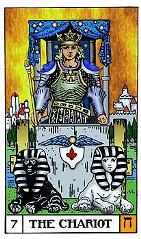
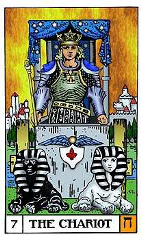
The philosophic soul is one that has an understanding endowed with “magnificence” (or “that which is fitting for a great man” and is thus distinguished from the understandings of those who are not “great men”) and is able “to contemplate all time and being” (486a) i.e. the understanding that is in the soul of the philosopher is ‘prophetic’. The prophet speaks ‘the highest’ speech. The philosophic soul has from youth been both “just and tame” and is not “savage and incapable of friendship”. The philosophic soul is not ‘rough’, but ‘smooth’. The meaning of the statement above Plato’s academy is not that “No one enters unless he knows geometry” as a specific study of the mathematical arts, but that “No one enters unless he has the capability of being a friend”. (See the connection to The Chariot card of the Tarot where the two sphinxes, one white and one black representing the mystery of the soul, are in contention or strife polemos with each other.)

In looking for the philosophic way-of-being-in-the-world, Socrates concludes: “….let us seek for an understanding endowed by nature with measure and charm, one whose nature grows by itself in such a way that as to make it easily led to the idea of each thing that is.” (486d) The philosophical soul is as it is by nature. It grows by itself from out of itself. It is not a product of education alone, although education can assist it on its way in the same way a farmer attending his crops assists his crops on their way. Socrates sees his main task as being a mid-wife.

Is this all souls or only some souls? Are all souls capable of attaining the philosophical way of being? The modern answer to these questions, through the impact of Christianity and the modern philosophers, is a “yes” while the ancient answer appears to be a “no”. Saints and philosophers are rare plants to the ancients.

Shakespeare’s Hamlet may be said to be a play regarding this conflict in the thymoeidic part of the soul. Hamlet’s ‘doubt’, his need for certainty and surety, prevents him from seeing the reality in which he has been placed and from taking the proper action necessary which is the fate that has been given to him. Hamlet’s doubt gives him an ‘unbalanced soul’. In contrast, Horatio is shown by Hamlet to be an example of the ‘balanced soul’ who is in possession of what Aristotle called phronesis:

“…for thou hast been
As one, in suffering all, that suffers nothing,
A man that fortune’s buffets and rewards
Hast ta’en with equal thanks: and blest are those
Whose blood and judgment are so well commingled,
That they are not a pipe for fortune’s finger
To sound what stop she please.” (Hamlet Act III sc. ii)

Horatio is an example of a ‘just man’, for his “balanced soul” allows him to take actions that are well-considered, wise. He is able to take life’s goods and evils with equal thanks, and this dispassionateness allows him to make the proper judgements at the appropriate time. This ability to make proper judgements is the proper relation of the logistikon and thymoeidic parts of the soul. The epithymetikon part of the soul creates distortion and chaos for the judgement when it dominates. The flute or pipe, the wind instrument, is the musical instrument of Dionysus, the god of tragedy, while the lyre or stringed instrument is the instrument of the god Apollo. Apollo is the god associated with the Sun and with truth.

Socrates uses an eikon or image (A-B of the Divided Line) to indicate the political situation prevalent in most cities or communities. The eikon uses the metaphor of the “ship of state” and the “helmsman” who will steer and direct that ship of state. The rioting sailors on the ship praise and call “skilled” the sailor or pilot, the “knower of the ship’s business”, the man who is cleverest at figuring out how they will get the power to rule either by persuading or forcing the ship-owner to let them rule. Anyone who is not of this sort and does not have these desires they blame as “useless”. They are driven by their “appetites”, their hunger for the particulars which they perceive as ends i.e. what Plato describes as human beings when living in a democracy, oligarchy, or a tyranny. In the modern age, we have killed off the ship-owner and replaced him with the ‘helmsman’, the cybernaut.

This is the reason why Plato places democracy just above tyranny in his ranking of regimes from best to worst, tyranny being the worst since both these regimes, democracy and tyranny, are ruled by the appetites and not by phronesis and sophrosyne or what we understand as ‘virtue’. (Democracy’s predilection for capitalism is a predicate of the rule by the appetites and the lower form of eros. The soul’s power to distinguish between self-interest and the common good becomes weakened or corroded under democracy so that tyranny is the ultimate result. It is the destruction of the sense of otherness in the soul. Human beings are, as individuals, tyrannic by nature and this is primarily due to the influence of eros. Technology has a great impact in increasing this tendency toward tyranny and towards the tyrannic soul. We seek the ‘gigantic’ and ‘intense’ rather than the ‘pure’.)

The erotic nature of the philosophic soul “does not lose the keenness of its passionate love nor cease from it before it has grasped the nature itself of each thing which is with the part of the soul fit to grasp a thing of that sort, and it is the part akin to it (the soul) that is fit. And once near it and coupled with what really is, having begotten intelligence and truth, it knows and lives truly, is nourished and so ceases from its labour pains, but not before.” (490b) The language and imagery used here is that of love, procreation, and childbirth, and this indicates its connection to both the lower and higher forms of Eros.

The world of the sensible must be experienced through the body, the epithymetikon part of the soul. With regard to the Divided Line, the world of the sensible, the Visible, “is equal to” the world of Thought: the mathemata or “that which can be learned and that which can be taught”. That which can be learned and that which can be taught is initially the visible, that which can be sensed and experienced. Socrates sees himself as a mid-wife, helping to aid this birthing process that is learning. It is a birthing process because it is a poiesis or a “bringing forth”.

At Republic Bk. VI 508 b-c, Plato makes an analogy between the role of the sun, whose light gives us our vision, to the visible things to be seen and the role of the Good in that seeing. The sun rules over our vision and the things to be seen. The eye of seeing must have an element in it which is “sun-like” in order that the seeing and the light of the sun be commensurate with each other. Vision does not see itself, just as hearing does not hear itself. No sensing, no desiring, no willing, no loving, no fearing, no reasoning can ever make itself its own object. Eros as pathos cannot be grasped through human reason but can only be spoken of through human language.

The Good to which the light of the sun is analogous, rules over our knowledge and the real being of the objects of our knowledge (the forms/eide) which are the offspring of the ideas or that which brings the visible things to appearance and, thus, to presence or being, and also over the things that the light of the sun gives to vision: “This, then, you must understand that I meant by the offspring of the good that which the good begot to stand in a proportion with itself: as the good is to the intelligible region with respect to intelligence (D-E) and to that which is intellected (C-D), so the sun (light) in the visible world to vision (B-C) and to what is seen (A-B).” This “begetting” of the Good hints at its connection to Eros and to Logos.

Details of the Divided Line: Section A-B

Eros and Logos manifest themselves in the A-B section of the Divided Line as the mediation points or metaxu that unite the tripartite soul of the human being to the things that are. “A” of the Divided Line is Eikasia or Imagination. These are the likenesses, images, shadows, models, imitations, and icons that our vision produces. They are the “schema” and “plans” that human beings put forward in order to create their understanding of their worlds. “To produce” is to “pro-create”, to “bring forth”. The end of all procreation is the desire for immortality. Nature’s procreation is sempiternal: it exists eternally within Time. For Plato, Time is the moving image of eternity. Our desire for children is the desire for immortality on the natural level. Eternity is that which exists outside of Time. Eros functions as that desire for immortality through procreation manifested in sexuality on the physical level. When the desire for children is divorced from sexuality, this is but one example of where human beings enter that stage where their sense of “otherness” is gradually eroded and their desires become “tyrannous”, self-serving. For human beings, children are the fact of “otherness”. In literature, for example, the tyrant Macbeth and his wife have no children.

Section A-B of the Divided Line is what we understand as ‘civilization’, those artefacts created by human beings that are distinct from nature because they are made by human beings. They are the shadows on the walls of the Cave. Nature and convention are in opposition to one another, and it is by nature that we are measured even though we believe that it is we who do the measuring. This is why eikasia or imagination is placed below Nature on the Divided Line; Nature is of the higher order or a higher dignity when it comes to Truth and its unconcealment.

In the illustration shown, the two diagonals that emerge from C and culminate on the surface of the sphere at B are two types of thinking associated with techne that occur in the C section of the Divided Line: poetic thinking or the thinking of the arts, and the thinking that is the know-how of the artisans and technicians. In both types of thinking, there is a metaxu that is needed, a ‘light’ that is required, and that ‘light’ is studied through geometry and the dialectical discussions that surround geometry. “Depth” occurs by a movement towards the centre of the sphere, not from the “height” that is the sphere’s surface. This movement is provided by eros. Goodness is at the sphere’s centre; evil is on the surface.

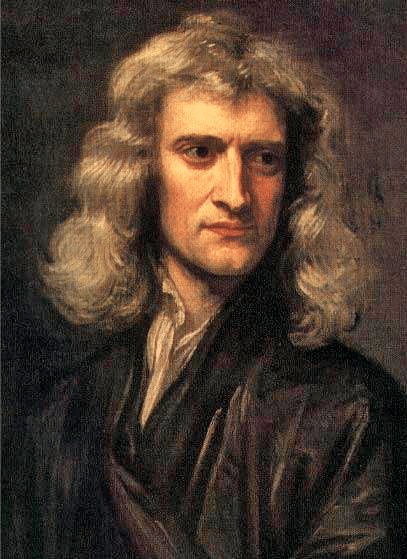
Newton

In the cosmology of the poet and and painter William Blake, the scientist Newton is depicted at the bottom of the sea sitting upon a rock (which oddly looks like a urinal or toilet) creating a geometric cone upon a scroll. He is surrounded by darkness. There is a polypus or octopus swimming by, and this creature is equivalent to the Great Beast of Plato i.e. the political, or the social. The fact that Newton is not putting his geometry down in a book or in stone but on a scroll indicates that Newton is using the creative imagination. As a scientist, or rather the scientist for Blake, Newton is joined with Bacon and Locke who, as seekers of truth and despite their errors, appear in the heavens on the day of the Apocalypse among the chariots of the Almighty, counterbalancing Milton, Shakespeare, and Chaucer, the greatest representatives of the the Arts. Theses philosophers and poets are all English-speaking.

Plato has a similar line up in his Symposium with the greatest representatives of the arts and scientists present at the banquet in which the topic of Eros will be discussed. The subject of both the Arts and the Sciences is the beautiful: order, proportion, harmony. The Sciences deal with these in the realm of the suprasensible and the necessary while the Arts are concerned with the sensible and contingent. Chance and evil, necessity, are present in both.

The essential urge of Eros is the desire for immortality and this is shown in Eros’ affect on all three parts of the Platonic soul. The epithymetikon (appetite or desire, which houses the desire for physical pleasures, especially sexuality) partially realizes this desire through the begetting of offspring. This ‘begetting’ mirrors the begetting of the eidos through the ideas: the offspring, while appearing to be the same are different . In all cases, the ‘image’ of Beauty in the outward appearances of the mortal things is what attracts and urges us to ‘possess’ and ‘consume’ those things which we desire. Our belief is that in possessing and consuming such things, immortality will follow. It is Khronos (Time) who eats his own children.

The image of a thing of which the image is an image are the things belonging to eikasia or the “imagination”. This is what we understand as ‘civilization’. These are the things ‘procreated’ by human beings through the logos whether the logos be understood as representational thinking such as mathematics or logic, or the creative works of the technites or artists and technicians, such as writings or shoes. The idea that is to be the next pair of Nikes was always already there. It was waiting for the artisan and technician to give birth to it, to “pro-create” it, and bring it forward into being. This is the distinction between the procreation of Nature and that of human beings: nature’s procreation is in itself from out of itself, while human beings are a combination of this (sexuality, nature) and “in another for another” (techne) i.e. the next pair of shoes derives from materials that are not of human beings nor of human making.

We are ‘reminded’ of the original by the image: the Beauty of Nature is the “image” that reminds us of the Good. Just as Nature is sempiternal, eternally in Time, the Good is eternal, eternally outside of Time. Nature is a mirror-image of the Good while Nature is, at the same time, dominated by Necessity Ananke. Necessity is Time. And there is a great gap separating the Necessary from the Good; that gap is the whole of Time and Space. That gap is mirrored in the separation of Love from the Intelligence in the A-C section of the Divided Line. The mediation of what we call “Intelligence” (mathematical calculation, the principle of reason) is a mirrored image of the mediation of Love and the things that are. The Intelligence that is the principle of reason is a “possessing”, commandeering logos, while the Intelligence that is Love is a ‘letting be’ and a contemplation of the things that are. In our being-in-the-world, we wish to consume the objects of our senses. The beautiful is that which we desire without wishing to eat it. We desire that it simply should be. To do so requires the renunciation of the imagination and the products of the imagination. This is not an easy thing to accomplish.

The sphere of Space encloses the beings that are in Time. It is the logos that encloses beings within Time. It is the Logos that establishes limits and brings the things that are to a ‘stand’. The soul, psyche, of human beings is eternally in Time. When the soul is assimilated into the One that is the Good, it ceases to be in time. Nature is eternally in time. Time is the moving image of eternity. Eros is a moving image of the Good that is beyond time. Nature is sempiternal, everlasting, endless.

The thymoeides part of the soul (spiritedness, which houses anger, as well as other spirited emotions), realizes the desire for immortality in its desire for “eternal fame and glory”. There is a “beauty” (kalon) in the carrying out of great deeds. We cannot, for example, deny that there is no beauty in the site of the Three Gorges Dam. Public care and concern (“spiritedness”) is linked to self-interest and it is here that we find the motivation of the politicians. The desire for immortality is in the desire for the doing of great deeds which will bring the individual before the public in some manner. Whether through military campaigns, the creation of ‘works’, or sporting achievements, this recognition is another way in which the soul tries to achieve a partial immortality, eternal fame, just as children are a ‘partial immortality’ in the physical realm.

The techne or artisan is the servant of the people: “in another, for another”. His “work” illustrates his mastery of a ‘part’ of knowledge, his own art, his “know how”, that knowledge that the philosopher aspires to for the whole of things. This mastery is driven by the thymoeides part of the soul, that which is driven for the mastery (thymus) of the eidos (the outward appearances of things).

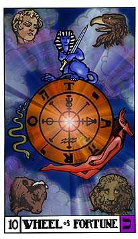
The logistikon is that part of the soul that is the smallest part of the soul, and it is the only part of the soul that is beyond Necessity because it is part of the Good itself. In the illustration provided below, the logistikon is the centre point of the sphere that may be said to be within Time and out of Time, or it is at least the closest one can come to in being out of Time. References to the logistikon are found throughout our literature in myth and fairy tales as the ‘smallest’ of things that grow that have the greatest consequence. The sphere itself is as a great Wheel of Fortune that is in motion. This is Necessity. The only way of escaping the turnings of the Wheel is by being at the centre of it (King Lear Act V sc. iii).

In the A-B section of the Divided Line, the logistikon acts as that which ‘ties things down’, the logos that gathers things together and holds them in place. The ‘knowing’ and ‘making’ of the artisan and the technician (technology) is the interaction between the logistikon and the thymoeides parts of the soul of the artisan and technician. It is the face of the logos that is the principle of reason, of logic, and the language that forms our collective discourse (rhetoric). One of the faces of the Logos is that it is the “form” that makes the “informing” possible.

Section B-C of the Divided Line: Technology as Shadow

Section B-C of the Divided Line corresponds to physical things and to that which can be ‘counted on’ i.e. it represents trust, confidence, belief, faith (pistis). The physical things are those that can be seen or perceived with the senses. It is eros as ‘light’ that provides this capability. They are the things that are at our disposal, the ready-to-hand. In the Divided Line B = C: the physical things and our trust/belief in them is equal to the thoughts that we can think of those things through the representations of our perceptions of those things with our senses i.e. the Forms or Eidos of the things, the “outward appearances of the things”.

We have two definitions of what human beings are that have come down to us historically from the Greeks and the Latins. From the Greeks, human beings are the zoon logon echon, “the living being that dwells and perdures in language”. From the Latins, humans are the animale rationale, the “rational animal”. From the Latin definition arises the principle of reason, and this is what is in operation in section C of the Divided Line and determines one type of thinking and the logos from which it is derived.

A principle contains within itself a ratio, a reason for something else. The principle of reason is the ground/reason for all other principles and that means for what a principle is per se, for what a statement is, for what an utterance is. That about which the principle of reason speaks is the ground of the essence of language, of logos. This ground or essence is what we understand as one of the faces of Eros. Principles are derived from axioms. In Greek, axiom means “to find something worthy”. “Worthiness” is the trust, belief given to us by the “self-shining forth” of the axioms. Given our illustration, the problem is that the principle’s ratio is itself an ‘irrational number’, a contradiction.

The axioms determine the principles that have been derived from them. In Greek axiom is “to let something repose in its countenance and preserve it therein”. It is related to representational thinking and to eidos. Principia
are the sort of things that occupy the first place, that stand first in line.
Principia refers to a ranking and an ordering. They are our objects of sophia.
The ordering realm (Section A-C) is the realm of principles (sophia). We have determined that the sole purpose of axioms is to secure a system that is free of contradictions. The axiomatic character of axioms is to eliminate contradictions. Our concepts, axioms, principles (fundamental principles) serve the axiomatic securing of calculative thinking. What we call science is axiomatic, but for Plato science does not think in the manner that philosophers think.
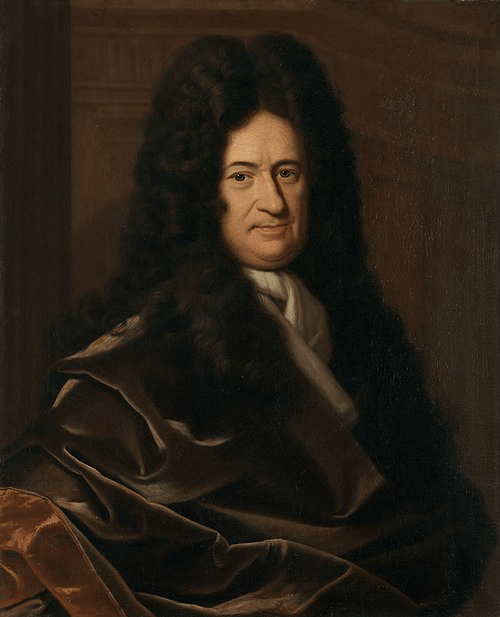
Wilhelm Gottfried Leibniz

For the philosopher Leibniz, the principle of reason is the principle of rendering sufficient reasons. To render in Latin is “to give back”. Our “cognition” (ways of knowing), “consciousness” is the rendering back of reasons. In Latin, cognition is representatio: the object, what is encountered, is presented to the cognizing “I”, presented back to and over against it, and thus made present. “Ob-ject” comes from ob-“against” and jacio “that which is thrown”.

Cognition must render to cognition the reason for what is encountered—and that means to give it back to cognition if it is to be a discerning cognition. “Beauty is in the eye of the beholder” because a sufficient reason, a ratio, cannot be given in an account of what is considered to be “beautiful”, although we have the theory of aesthetics which attempts to do so and which itself is based on the principle of reason. Under the principle of reason, eros becomes stifled, exsanguinated.

The principle of reason is reached only when it is understood as the fundamental principle of demonstrations: i.e. the fundamental principle of statements such as those given in our research, experiments, essays, presentations, etc. It is the principle of reason which is the dominant form of the logos in section C of the Divided Line in our modern age. The principle of reason is a Principle for sentences and statements i.e. for what is called “philosophical” and scientific knowledge (methodologies). The principle of reason is necessary for the rendering of reasons in the true statement/sentence. The principle of reason is the fundamental principle of the necessary founding of sentences and principles. This is what makes the principle of reason the essence of what we call Artificial Intelligence and the meta-languages associated with it.

What is empowering about the Principle is that it pervades, guides and supports all cognition (ways of knowing) that express themselves in sentences and propositions. The principle of reason is valid for everything which in any manner is. Cognition, our “ways of knowing “, is a kind of representational thinking. In this “presentation” something we encounter comes to a stand, is brought to a standstill as object. For all modern thinking the manner in which the things “are” is based on the objectness of objects. For representational thinking, the representedness of objects belongs to the objectness of objects. This is what Plato understood as “the shadows” and this is represented by the square in the illustration provided above.

“Ob-ject” comes from the Latin which means “the thrown against”. The “against” of the object must be a founded one: how the object is. Something
is, which means that it can be identified as being a being, only if it satisfies the fundamental principle of reason as the fundamental principle of founding. The principle of reason is the fundamental principle of cognition (ways of knowing) as the Principle for everything that is. It establishes our “under-standing” of what and how things are in the world that is ready-to-hand. It is the reason why “beauty must be in the eye of the beholder”.

We are who we are as human beings only insofar as the rendering of reasons empowers us. This is what makes us the animale rationale. It is from this “empowerment” that we judge what is human and what is not, what is sane and what is not, what is just and what is not, etc. This empowerment, the demand to render reasons, threatens everything of humans’ being-at-home and robs us of the roots of our subsistence i.e. of everything that has made human beings great up till now . It is the nihilism that threatens civilization, the ceasing of concern for what “human excellence” is, for what “virtue” is. There is a connection between the demand to render reasons and the withdrawal of roots, and the subsequent rootlessness of modern humanity.

For the Greeks, ousia or presence was understood as the thing’s way-of-being in the world. The city or society came about because of the body and the needs of the body. The city is a product of the procreation of eros writ large. The city was, thus, the individual writ large. The city represented the individuals which composed it in that its regime would reflect the opinions of those who are predominant in the community, those who hold power. It is because of this power that Plato considers it the Great Beast.

B-C in the Divided Line is the point where we see the two faces of Eros as well as the two faces of the Logos. The wants and the needs of the body for the individual are radically private and at the same time require other human beings for their fulfillment. The city or polis is an artefact brought forth by human beings and it has both the characteristics of being a natural thing and those of an artificial thing. Plato’s Cave in his Allegory is both a natural thing and a product of human invention and production. As the law of necessity controls the realm of nature, so too do laws control the ‘life’ that is shown in the polis. The walls of the Cave reflect the projected shadows of the interpretations of the Cave given through the representational thinking that is the Eikasia or “imagination” of the cave-dwellers. It is here that the essence of technology as “information” or the “form that informs” finds its source.

In the image of the Divided Line, the first thing the dweller inside of the Cave sees are the reflections of the shadows upon the walls of the Cave. These shadows or images form our views of the things that are. These provide us with our “understanding” of things whether they are the things of nature, the artefacts which human beings produce, or the things that are the products of our representations of them such as our sciences or our arts. Our “understanding” is an interpretation of the things, not an under-standing of the things themselves. Eros is not satisfied with these understandings and longs for the things in themselves. This is due primarily to Eros’ chief desire which is the achievement of immortality, that which is beyond change; and the things and our interpretations of them are subject to change.

In the B-C section of the Divided Line, the mind or logistikon part of the soul (the intelligence which became translated as ‘reason’ and so its connection to logos) is aided by the thymoeides or ‘spirited’ part of soul to attain to that object to which the appetitive part of the soul is directed. The appetitive part of the soul is urged by the thing’s “goodness” or perceived goodness, be it in food, drink, sex or whatever, and that this goodness will assist the body to survive and promote the soul’s search for immortality. The soul as a ‘one’, a whole, is directed or attracted by the kalon or beauty of the thing, to possess or ‘consume’ that which it perceives as beautiful. That which is perceived as beautiful is that which is ‘perfect’ or complete. Sexually, this is the individual beautiful human being at the beginning stages of the journey that leads to the perfection that is the Good (or immortality). The individual desires to “consume” the other human being so that the two may become one in a literal sense.

The word beautiful (kalos) is distinct from good (agathon) and it also means ‘fair’, ‘fine’, ‘noble’. Everything outstanding in body, mind or action can be so designated, and the aspiration for these qualities can be related to the thymoeides part of the soul and the eros which drives it. We have designated this quality as “human excellence” among human beings, arete, what we call “virtue”. What is loveable either to sight or mind is beautiful. It is what we designate as “moral” with the distinction that it is beyond obligation or duty, what we cannot expect everyone to perform. It is of a higher rank than the just, which every human being can be expected to perform. The core of a just political order was defined by “virtue” for the ancients, while today “freedom” is believed to be at the core of the just political society. Both of these views may be said to be present in A-C section of the Divided Line. This emphasis was directed by the eros that is the thymoeides part of the soul.

In earlier writings on this blog, it was recognized that the evil or wicked were not alone the individual criminals but those who wished to rule for their own self-assertion. Such people were more destructive of justice than those who ruled simply in terms of the property interests of one class. Because tyrants were the most dangerous for any society, the chief political purpose anywhere was to see that those who ruled had at least some sense of justice which mitigated self-assertion. This was at the core of earlier education systems. The IB, too, has this mitigation of self-assertion at its core. The great danger of the thymoeides part of the soul was its tendency to tyranny. This tendency is also part of Eros.

In Section A-B of the Divided Line, the logos of the logistikon of the soul is concerned with the calculation from which knowledge is derived. This calculus has shaped what we understand by modern science and is at the heart of what we understand as technology. It finds its place or site in that field of mathematics that we call algebra. Money, technology, algebra are analogous as signs of our worship of power.

As Eros is two-faced so, too, is the logos in the realms of the physical and imaginative. The “mathematics” (“that which can be learned and that which can be taught”) of the logos is of two types: the arithmos of the particular things, those things that exist in Time, those things that can be counted and counted on, and the geometria of that which exists in Space, those things that are the works of the Logos. As logos understood as the “calculable” through algebra comes to predominate so, too, does the notion of justice as “calculable” come to predominate (this is the modern view of justice i.e. “the greatest good for the greatest number”).

The thymoeides part of the soul is concerned with “passion”, and it is this passion which unites with the logistikon part of the soul and brings about the urge to attempt to attain immortality through ‘noble’ and ‘fine’ deeds or works. The understanding of what ‘fine’ deeds are is part of the ‘cognition’ or perception of how ‘human excellence’ is understood beforehand. We ‘love’ the beauty of ‘human excellence’ when it is shown to us. It is the passion to possess this beauty that compels us to perform excellent deeds in whatever context those deeds may be performed.

Section C-D of the Divided Line

Many will find the proposition that science does not think the most controversial put forward in this writing. What does it mean for Plato (and Heidegger) to say this? How does this statement cast a light on what we understand as artificial intelligence and on rationality in general?

The Forms or eide (the outward appearance of things) are begotten from the ideai which, in themselves, are begotten from the Good. “Begottenness” is of Eros. The forms give presence to things (ousia) through their outward appearance. The “seeing” of this presence is dependent on “sight” which, in turn, is dependent on the light of the sun. In order for this to occur, the eye must have something “sun-like” in it just as the soul must have something like “the good” in it to be able to “bring forth” the representations of the things that are in the mind or intellect.

There is nothing without thought; there is no thought without things. In the Divided Line, B = C. “Otherness” is a condition of being. Human beings are essential for being to be. Being needs human beings to be. Being is reality. What we call science is the theory of the real, the “seeing” of the real. (“And would you also be willing,” I said, “to say that with respect to the truth, or lack of it, as the opinable is distinguished from the knowable, so the likeness is distinguished from that of which it is the likeness?”) The “images” and “shapes” of things, the eide, such as the city or society is the individual writ large. The polis or city is a city of artisans and technicians, of technites. The “knowing one’s way about or within something” begins in the household and caters to the production of novelty, efficiency. The logos, like Eros itself, is two-faced or of two types. The jumping off point or the leap is the recognition that the Sun in the realm of Becoming (Time), like the idea of the Good in the realm of Being, is responsible for everything that is. The Sun is Time as the moving image of eternity, and all that is in being owes its existence to Time. The Good is eternity, and all that is in Being and Becoming owes its existence to the Idea of the Good.

Dianoia is that thought that unifies into a “one” and determines a thing’s essence. The eidos of a tree, the outward appearance of a tree, is the “treeness”, its essence, the idea in which it participates. We are able to apprehend this outward appearance of the physical thing through the forms or eide in which they participate for these give them their shape. The understanding, the hypo-thesis (dianoia) is the “standing under” of that seeing that is thrown forward, the under-standing, the ground. Thought under-stands the limits and boundaries of things and gives them “measure” through the use of number or language logoi. The giving of measure to the seeing is geometry and geometry deals with ratios; and from it, the hearing of the harmonia of music, the music of the spheres, is recognized and produced. The music of the spheres is the recognition of the whole of which each being is a part, and how that part is related to the whole. Thought comprehends the “measure” of the things that bring about “harmony” and unites the individual being or thing to the whole. The proportionals are arranged about a “mean” which is “hidden” or “irrational”. The principle of stringed instruments and their ratios is applicable to the whole of the universe, both the visible and invisible.

Section D of the Divided Line is the Ideas Ideai which are begotten from the Good and are the source (archai) of the Good’s presence parousia amidst that which is not the Good, both in being and becoming. The Good is seen as “the father” whose seeds (ideai) are given to the receptacle or womb of the mother (Space) to bring about the offspring that is the world of A-E (Time), within the whole of things within Space. The realm of A-E is the realm of the Necessary. (Timaeus 50- 52e). The dialogue of Timaeus occurs the morning after the dialogue that we call Republic. It is the continuation of an ascent from the eikasia of the imagination and opinion of Section A (Republic) to the physical reality of Section B of the Divided Line (Timaeus). Timaeus is a revealing of the Ananke, what the Greeks understood as Necessity. The dialogues of the Sophist, Theatetus and The Statesman illuminate Section C of the Divided Line. Symposium and Phaedrus are dialogues that help to illuminate Section D.

Because the ideas are begotten from the Good, the ideas are the essences of things, their “oneness”, that which they really are. The ideas in turn beget the eidos which bring things to presence in their ready-to-handedness in time for human beings. The things come to a stand through the eidos and give us what we call our “understanding”. The nature of this understanding is pre-determined by the logos within being, by the “frame” or the “form” that is a product of the logos.

Noesis is often translated by “Mind” but “Spirit” might be a better translation. Contemplation, attention, “dialectic” are the activities of noesis. Knowledge (gnosis), intellection, the objects of reason (logoi but not understood as logistics but as noesis, ideai, episteme) is what is understood as “knowledge” in this section of the Divided Line. “Knowledge” is permanent and not subject to change as is “opinion”, whether “true” or “false” opinion. Opinions develop from the pre-determined seeing which is the understanding of the essences of things prevalent at a certain time. Understanding is prior to the interpretation of things and the giving of names to things.

The Idea of the Good (agathon) is what provides “the truth to the things known (i.e. their “unveiling”, their “showing forth”) and gives “the power to the one who knows… and, as the cause of knowledge and truth, you can understand it to be a thing known; but, as fair as the two are – knowledge and truth – if you believe that it is something different from them and still fairer than they, your belief will be right.” (Republic 508e – 509a) The Idea of the Good is the essence of things that come to be whether in the Visible or the Invisible realms. The Good is beyond both Time and Being. When the soul is in direct contact with the Good, gnosis is achieved and the soul is no longer in Time for it becomes part of the One of all that is. The Good is responsible for (aitia ‘the cause of’) the knowledge and truth (aletheia, unconcealment) of all that is. Without it, knowledge and truth could not be attained. Everything would be ‘irrational’. Eros as Love and the Beautiful is this face of the two-faced Eros.

The whole of the Divided Line (A-E) is the Good’s embrasure of both Being and Becoming, that which is both within Time and Space. This embrasure is spherical in shape. The Good itself is beyond this sphere that is Being and Becoming (i.e. space and time) and there is an abyss separating the Necessary (which is both Space and Time) from the Good. Within the Divided Line, that which is “intellected” (C-D) is equal to (or the Same i.e. a One) as that which is illuminated by the light of the sun in the world of vision. (B-C)

Details of the Divided Line

Below is a summary of the points made regarding the Divided Line:

“This, then, you must understand that I meant by the offspring of the good that which the good begot to stand in a proportion with itself: as the good is in the intelligible region with respect to intelligence (DE) and to that which is intellected [CD], so the sun is (light) in the visible world to vision [BC] and what is seen [AB].”

E. The Idea of the Good: Agathon, Gnosis “…what provides the truth to the things known and gives the power to the one who knows, is the idea of the good. And, as the cause of the knowledge and truth, you can understand it to be a thing known; but, as fair as these two are—knowledge and truth—if you believe that it is something different from them and still fairer than they, your belief will be right.” (508e – 509a)  
D. Ideas: Begotten from the Good and are the source of the Good’s presence (parousia) in that which is not the Good. The Good is seen as “the father” whose seeds (ἰδέαι) are given to the receptacle or womb of the mother (space) to bring about the offspring that is the world of AE (time). The realm of AE is the realm of the Necessary. (Dialogue Timaeus 50-52 which occurs the following morning after the night of Republic)D. Intellection (Noesis): Noesis is often translated by “Mind”, but “Spirit” might be a better translation. Knowledge (γνῶσις, νοούμενα) intellection, the objects of “reason” or the logos (Logoi) (νόησις, ἰδέαι, ἐπιστήμην). “Knowledge” is permanent and not subject to change as is “opinion” whether “true” or “false” opinion. Opinions develop from the pre-determined seeing which is the under-standing of the essence of things.  
C. Forms (Eide): Begotten from the Ideas (ἰδέαι) . They give presence to things through their “outward appearance” (ousia). There is no-thing without thought; there is no thought without things. Human being is essential for Being. Being needs human being. “And would you also be willing,” I said, “to say that with respect to truth or lack of it, as the opinable is distinguished from the knowable, so the likeness is distinguished from that of which it is the likeness?”  C. Thought (Genus) Dianoia is that thought that unifies into a “one” and determines a thing’s essence. The eidos of a tree, the outward appearance of a tree, is the “treeness”, its essence, in which it participates. We are able to apprehend this outward appearance of the physical thing through the “forms” or eide in which they participate. Understanding, hypothesis (διανόια). The “hypothesis” is the “standing under” of the seeing that is thrown forward, the under-standing, the ground.  
B. The physical things that we see/perceive with our senses (ὁρώμενα, ὁμοιωθὲν)B. Trust, confidence, belief (πίστις) opinion, “justified true beliefs” (δόξα, νοῦν). Opinion is not stable and subject to change. The changing of the opinions that predominate in a community is what is understood as “revolution” or “paradigm shifts”. “Then in the other segment put that of which this first is the likeness—the animals around us, and everything that grows, and the whole class of artifacts.”  
A. Eikasia  Images Eikones: Likeness, image, shadow, imitation, our vision (ὄψις, ὁμοιωθὲν). The “icons” or images that we form of the things that are. The statues of Dedalus which are said to run away unless they are tied down (opinion). It is the logoi which ‘ties things down’.A. Imagination (Eikasia): The representational thought which is done in images. Our narratives, myths and that language which forms our collective discourse (rhetoric). Conjectures, images, (εἰκασία). The image of a thing of which the image is an image are things belonging to eikasia. We are “reminded” of the original by the image. “Now, in terms of relative clarity and obscurity, you’ll have one segment in the visible part for images. I mean by images first shadows, then appearances produced in water and in all close-grained, smooth, bright things, and everything of the sort, if you understand.”  The Platonic “imagination” is distinguishable from the “transcendental imagination” of Kant. For Kant, the “transcendental imagination” refers to a “blind yet indispensable function of the soul” which is responsible for synthesizing sensory data into coherent experiences (logos) making the objects of experience possible (eros). Human consciousness and self-awareness is both sensibility/sense perception and understanding, and the “transcendental imagination” transforms mere sensations into conscious perceptions. Here, Kant is speaking about the ‘form’ that ‘informs’ i.e. technology. Like Kant, for Plato the imagination is not merely reproductive but is productive in that it makes experience, in general, possible through the coming together of the logos and eros. Unlike Kant, for Plato Eros is not “blind”.

See also https://mytok.blog/2023/08/18/platos-divided-line-and-the-golden-mean/
Mathematics and Ethics

Technology as Information

We will be discussing how “mathematics” provides the principles for our actions i.e. how mathematics determines our ethics. We shall examine some considerations of the differences between what is called calculative thinking and what is called contemplative thinking. In this examination we will come to a closer understanding our technological being-in-the-world. Mathematics is understood as “what can be learned and what can be taught”.

What we call mathematics is a theoretical viewing of the world which establishes the surety and certainty of the world through calculation. Calculative thinking determines that the things of the world are disposables and are to be used by human beings in their various dispositions. This commandeering challenging of the world and the beings in it is what we have come to call “knowledge”, and is made possible by what we call “knowledge”. This under-standing (i.e. that which “stands under” or grounds) is that upon which all of our actions are based. This surety or certainty that beings are in the way that we say they are through calculation arises through the viewing and use of algebraic calculation in the modern world. Algebraic calculation is a language of signs and numbers. The results of what is and what has been achieved through this calculative thinking are what we have come to determine what knowledge is in our day and what is best to be known and how it is to be known. What is the relationship between these calculations and what we call “information” and how does information relate to ethics?

Ethics are based on what Aristotle called phronesis: our careful deliberation over what best actions will ultimately bring about the best end result. We call this end result our happiness or what Aristotle called our eudaimonia. But how can happiness be the end result of what is, essentially, a hubristic way of viewing and being in the world? What we choose to be through our doings in the worlds of our projections is that which demonstrates our skills, aptitudes, and fitness to bring forth the “work” that is the “product” or outcome of the activities in those worlds whether those outcomes or “goods” be works, services or ideas. It is eros that urges the soul to “hear” that calling from the logos that sets us upon the journey to self-knowledge that allows us to adapt to the inevitable change that is a re-birth that seeks for that which is fitting to the soul.

A Reading of King Lear

We shall reflect on this question of self-knowledge and how the mathematical impacts self-knowledge by examining the passage below from Shakespeare’s King Lear Act V sc. iii.

CORDELIA
We are not the first
Who, with best meaning, have incurr’d the worst.
For thee, oppressed king, am I cast down;
Myself could else out-frown false fortune’s frown.
Shall we not see these daughters and these
sisters?

KING LEAR
No, no, no, no! Come, let’s away to prison:
We two alone will sing like birds i’ the cage:
When thou dost ask me blessing, I’ll kneel down,
And ask of thee forgiveness: so we’ll live,
And pray, and sing, and tell old tales, and laugh
At gilded butterflies, and hear poor rogues
Talk of court news; and we’ll talk with them too,
Who loses and who wins; who’s in, who’s out;
And take upon’s the mystery of things,
As if we were God’s spies: and we’ll wear out,
In a wall’d prison, packs and sects of great ones,
That ebb and flow by the moon.
EDMUND
Take them away.
KING LEAR
Upon such sacrifices, my Cordelia,
The gods themselves throw incense. Have I caught thee?
He that parts us shall bring a brand from heaven,
And fire us hence like foxes. Wipe thine eyes;
The good-years shall devour them, flesh and fell,
Ere they shall make us weep: we’ll see ’em starve
first. Come.

Explication of the Passage from King Lear

To attempt a summary and explication of the whole of the greatest work in the English language is impertinent.  But a brief introduction is necessary to understand the play as it appears in the scene above.

At this point in the play, Lear and Cordelia, supported by French troops, have lost the civil war for Britain to Edmund’s forces. Lear, as King, has been ultimately responsible for this civil war. At the beginning of the play, he has disowned his ‘truthful’ daughter Cordelia and fallen victim to the flattery and machinations of his two eldest daughters, Goneril and Regan. He has divided the kingdom in two giving each sister control of half, the intention being to avert future strife. Lear, at the same time, wishes to retain the appurtenances of a king, the appearances of a king, while retaining none of the responsibility: Lear is satisfied with the appearances rather than the realities of things. It is this satisfaction with the appearance of things that leaves Lear open to the machinations of his two daughters, Goneril and Regan.

Lear’s responsibility is, chiefly, a moral one. Goneril and Regan soon work together to remove from Lear the power and possessions that he once held. Lear becomes an “O”, “a nothing”. In his “nothingness”, Lear becomes mad and rages against the ingratitude shown by his daughters and the injustice that he sees in the nature of things and in the created world as it is.

This scene from Act V above is Lear’s anagnorisis or moment of enlightenment, the moment in tragedies when all tragic heroes recognize the errors of their ways and the consequences of their hubris. These consequences we call nemesis or just desserts.

Lear ends up houseless and homeless and wanders on a heath in the heart of a terrible storm. Lear’s physical, mental and spiritual sufferings soon drive him mad. The storm’s effect is a purification of Lear: Lear removes his clothing to become naked, to reveal human being as a mere ‘bare forked animal’; his ego is destroyed in the madness; he no longer focuses on himself but is able to see the ‘otherness’ of human beings and to feel compassion and pity for them (in the characters of Edgar as Poor Tom and the Fool) because he sees himself and his humanity in them. Edgar, too, has become a ‘nothing’ due to the machinations of his bastard brother Edmund and is a parallel to Lear in the double plot of the play.

Lear has gone from King to nothing and he is ready for re-birth. His ego has blinded him to understanding what his true relationship to his god is: initially he looked upon this god and his power as being something which he, Lear, himself possessed. Lear believed that only he himself possessed this truth. He dismisses the truth-tellers in the play: his Fool and his daughter Cordelia. In Lear’s kingdom, truth is not to be revealed. Only those who flatter are those that are heard.

The play King Lear is a play about the consequences of not knowing who we truly are, as individuals and as a species, as human beings. Lear, focused as he is on his ego, his Self, is willingly duped by machination in the play; he is willingly duped by flattery as this flattery is recognition of his social prestige. His later suffering and madness bring him to a true understanding of his relation to the god and to other human beings, and this relationship is Love expressed through the care and concern that he later shows to Poor Tom and the Fool. Love is, as Plato describes it, “fire catching fire”. It is recognition that in the most important things, all human beings are equal in that all are capable of the capacity for Love. Given the inhumane nature of human action in many cases in the real world, it is not without reason that Love has been described as a homeless, houseless beggar in our mythologies. Our literature sometimes refers to him as Eros.

Many critics suggest that this play is atheistic; Lear has lost his faith in God. The above passage suggests that such is not the case: what Lear has come to understand is his true relationship to his God, the true relationship of all human beings to God. Lear has lost the illusion of what he had once understood as God and what his relationship was to that God. It is this illusion that is the trap cast for those who believe that they are in possession of the truth or that truth is a product of their own creation or doing. Such a belief gives the individual the illusion of power. The God in King Lear is absent: He will not perform some miracle preventing the hangings of Cordelia and the Fool by the Captain later in the play. The essence of human being and of our humanity is to reveal truth. Great catastrophes are the result when we do not do so. In King Lear, the truth is destroyed. Good does not triumph over the evil of human actions in this play and we, too, by our very silence, are made complicit in the deaths of Cordelia and the Fool. In King Lear, human beings are not “beyond good and evil”.

In the play, the god exhibits Himself by His absence. Absence is not non-existence. It is the absence of God in the play that gives reason to those who interpret the play atheistically. One of the many themes of the play is what happens to human beings when they ignore the truth and persecute the truth-tellers. They, too, become subject to machinations and gaslighting. It is the tyrannous element present in all human beings. In their ignorance, they become victims in the struggle for power. When we show our astonishment at the discoveries of the James Webb Space Telescope, we are actually witnessing the withdrawal of the God into hiddenness in order to allow those distant galaxies to be. As Being comes to presence, the God withdraws.

Pythagorean circle
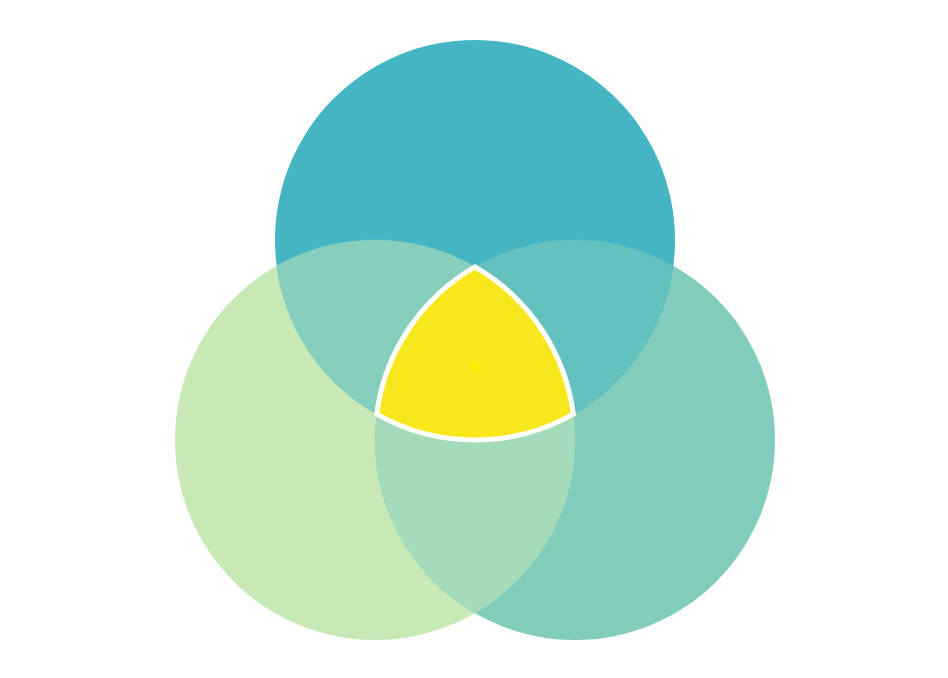
In relation to King Lear, the above should be viewed as a sphere with each of the triangles being wheels within wheels or spheres within spheres.

The play King Lear shows that the purpose of suffering is to allow for the de-creation of our selves, the de-struction of ourselves, our “I”s or egos. We today see no purpose in suffering, particularly the suffering of the innocent. One of the purposes of suffering is the destruction of the ego or self through affliction. This same decreation of the self was behind the geometry of the Pythagoreans. For the Pythagoreans, the study of geometry served an identical purpose: the purification of our selves or souls through a contemplative understanding of the things that are. When we stand on the circumference of the sphere above and are subject to its spinning, we suffer the ups and downs of Fate. We are beings in Time. Being at the centre of the sphere allows us to be free of its spinning. The spinning of the wheel or sphere is Time.

There is a Wheel of Fortune motif that runs throughout King Lear: Fortune is personified in the passage through alliteration ‘false fortune’s frown’ to illustrate that it is, in this case, one of human making: even with the best of intentions one can incur the worst: good does not triumph over evil in this sphere but is subject to the same necessity as are rocks and stones. To decreate one’s Self is to have the Self replaced by an assimilation into the divine; it is to become one of ‘God’s spies’, to see all with God’s eyes and to see all for God. God requires human beings “to see” His creation. His creation is Necessity; and there is a great gap separating the Necessary from the Good. Being requires human beings. When a human being sacrifices the Self, the ego, his most treasured possession, for assimilation in God, “the gods themselves throw incense” upon this sacrifice. We believe our Self to be our most precious possession; the renouncing of this possession is the purpose of our lives, and this renunciation is not pleasant: it is done through suffering. Few people are capable of it. I am not sure that one would want to be the parent of a saint. It is a pain-filled event much as ‘the turning’ in Plato’s allegory of the Cave is a pain-filled event.

Simone Weil
“Suffering (affliction), when it is consented to and accepted and loved, is truly a baptism”

The centre of the sphere is both in time and space and out of time and space. The Self as center here is indifferent to the size of the prison, the size of the circle, the size of the sphere. For Lear, imprisonment will be a liberation, not a restriction. “Suffering (affliction), when it is consented to and accepted and loved, is truly a baptism” (Simone Weil, “The Love of God and Affliction”). This is similar to Hamlet’s praise of Horatio (Act III sc. ii) where Hamlet says:

“…for thou hast been
As one, in suffering all, that suffers nothing,
A man that fortune’s buffets and rewards
Hast ta’en with equal thanks: and blest are those
Whose blood and judgment are so well commingled,
That they are not a pipe for fortune’s finger
To sound what stop she please.”

Horatio has what we may call a ‘balanced soul’: each of its parts does what it is supposed to do. Having this balanced soul is what we understand as “self-knowledge”. This self-knowledge allows one to accept the buffets and rewards of fate with equal thanks. Of course, it is easy for us to be thankful for the goods that we receive from fate. It is not so easy to accept the inevitable afflictions that come with being alive with equal thanks.

Baptism is a spiritual re-birth. It is usually associated with the element of water. The purification of the soul is associated with fire, with alchemy. Love is ‘fire catching fire’. On the heath, Lear experiences both the baptism with water and the purification through fire. The spiritual rebirth for Lear is clear from this passage in Act V sc. iii as well as from Act III onwards in the play where he experiences both a physical and spiritual re-birth. In order to do so, he must lose all that has attached him to his world and his ego must be destroyed. He must, in a real sense, ‘die’ and become a ‘nothing’. This is the purpose for Lear’s nakedness and madness in the play.

The attempted suicide of Gloucester in the play due to his suffering is a counterpoint to this: suicide is a sin against the gods because we falsely believe that our self is our own and of our own making. Gloucester’s realization that this is not the case results in his finding Edgar again and having ‘his heart burst smilingly’. His death is the counterpoint to Lear’s death: Lear’s heart will break due to the depth of his affliction at the loss of his Fool and Cordelia. Death is the inevitable end for us all. Contrary to our view, in the world of Shakespeare some kinds of suffering have a purpose and some suffering simply does not, and human beings are not beyond the good and evil that is present in the suffering that has no purpose or meaning. My saying this is in opposition to that statement recently by a Republican congresswoman who said that death is inevitable in order to justify her voting for the cuts that would be made to healthcare for the poor.

Our “personal knowledge” is our ‘sphere of influence’ on our worlds and on the other human beings who inhabit our worlds. The impact of our spheres of influence will be determined by the amount of self-knowledge we possess, and on the skills, aptitudes, fitness (techne) that we possess for the tasks. Those spheres that we inhabit in our lives should be seen as composed of wheels within wheels with our actions the spokes of the wheels. The spokes are our ‘projections’ and provide support for our spheres. The spokes reach out to the circumferences of the wheels: from the diameter, the right angled triangle cannot exceed that circumference. The sphere created by the circumferences may be large or small; most of our lives are spent in our attempts to enlarge this sphere. The spokes that are the radii of the self are the whorls of a gyre initiated by the soul and projected upon the world that we are in in order to create a world. In the whorl that is the motion within our sphere, we are ’empowered’ to carry out our activities, but the prison of ourselves is still a ‘prison’ beginning with our bodies and our egos which are placated by the social prestige which comes from the fulfillment of our urges and desires. At each stage on the whorl, there is a leaping-off possibility that presents itself through the metaxu or relation of the logos.

We become and are satisfied in being the ‘poor rogues’ and ‘gilded butterflies’ that Lear and Cordelia will chat with. The outer edges of the sphere in its spinning indicate the fates of those who are ruled by Fortune: ‘who loses and who wins; who’s in, who’s out’. It is the fate of all of us who are dominated by the wish for social prestige, recognition. This fate and our desire for this fate is part of the ‘mystery of things’, the mystery of being: to see this we must remain at the centre of the sphere where we are not moved by the wheel’s or the sphere’s spinnings, nor are our desires dominated by the wish for social prestige and recognition.

Lear, through his madness and suffering, has been re-born (see other sections of the play particularly Lear’s awakening when he sees Cordelia as an angel, a mediator, and in the play she is, from the beginning, representative of truth). His self, ego, I, has been destroyed. He becomes a “nothing”. In this scene from Act V, Lear demonstrates the friendship that is the love between two unequal yet equal beings. Lear’s ‘kneeling down’ when asked for his blessing in order to ask for forgiveness is his recognition of this equality. It is no longer the view of the Lear who said “I am a man more sinned against than sinning”, a false view of Lear’s at the moment of its occurrence in the play for it is the view of most of us with regard to our own sufferings. We see ourselves as victims.

It is with a great and terrible irony that after these speeches of Lear’s and Cordelia’s, the following occurs:

EDMUND: Come hither, captain; hark.
Take thou this note. (30)
[Giving a paper] Go follow them to prison:
One step I have advanced thee; if thou dost
As this instructs thee, thou dost make thy way
To noble fortunes: know thou this, that men
Are as the time is: to be tender-minded (35)
Does not become a sword: thy great employment
Will not bear question; either say thou’lt do ‘t,
Or thrive by other means.
CAPTAIN: I’ll do ‘t, my lord.

EDMUND: About it; and write “happy” when thou hast done. (40)
Mark, I say, instantly; and carry it so
As I have set it down.
CAPTAIN: I cannot draw a cart, nor eat dried oats;
If it be man’s work, I’ll do ‘t.

The Captain’s final words are a statement for all of us motivated by social prestige. That Edmund should give the Captain a paper or document instructing him is a particularly ironic note. Human crime or neglect is the cause of most suffering. On the orders of superiors we carry out acts that we believe are “man’s work” i.e. they are not the work of Nature but we ascribe the moral necessity for our actions to Nature: “I cannot draw a cart, nor eat dried oats”. We believe that we are compelled to commit immoral actions because we believe Nature imposes its necessities upon us; and, at times, Nature does indeed do so. We believe such actions to be our ‘duty’. But if we live with a thoughtful recognition that there are simply acts which we cannot and must not do, we are capable of staying within these limits imposed by the order of the world upon our actions.

Such words as the Captain’s have been used by human beings to justify to themselves and to others the reasons for their actions from the committing of petty crimes to genocides. They see their crimes as performing a duty, just “following orders”, or as Adolf Eichmann said: “I was just a scheduler of trains; I didn’t kill anybody”, or as Elon Musk in his destruction of USAID does not see himself as responsible for the possible deaths of 15,000,000 human beings. It is indicative of a loss of a sense of ‘otherness’. It is the Ring of Gyges: the invisibility and anonymity we seek in order to dispel any responsibility for our actions. We allow this committing of crimes to ourselves when it is accompanied by an increase in our ‘good fortunes’.

The root of all crimes is, perhaps, the desire for social prestige whether that is achieved through position, money or recognition. The root of all sin is the denial of the light, the denial of truth, the denial of what is the essence of our humanity. This denial results in our becoming increasingly inhumane and cruel. For the Captain, it is Edmund who will determine what ‘happy’ will become for him by his giving to the Captain ‘noble fortunes’; and the Captain believes it. He does not see his act as “inhumane” but calls it “man’s work”. He will achieve his noble fortunes through the committing of an ignoble act, a heinous act.

One would need to look far across the breadth and depth of English literature to find two more contrasting views of humanity in a work than that which is presented here in these two brief scenes from King Lear. Human beings are capable and culpable of both forms of action: we have an infinite capacity for Love and forgiveness as well as a finite capacity for committing the most heinous crimes; only Love is both beyond and within the circle or sphere, and all human action is done within the sphere (or the realm of Necessity). At bottom, all sin is the sin against the light, or truth.

Contemplation and Calculative Thinking: Living in the Technological World

The passages from King Lear give us an entry to understanding a practical alternative way of being-in-the-world to the current conditioning or ‘hard-wiring’ of our way of being under the technological world-view operating as it does within the principle of reason. This alternative way involves contemplative thinking as opposed to calculative thinking. This contemplative thinking is open to all human beings: it is not a special mental activity. It is an attitude toward things as a whole and a general way of being in the world. It is the attitude that Lear proposes for himself and Cordelia on how they will spend their time in prison: while they will still be in the world, they will not be of the world. While they will be involved with the “poor rogues” and “gilded butterflies”, the world of those rogues and butterflies will not be their world.

What does this mean for us? It suggests that we are in the technological world, but not of this technological world; we are here in body but not in spirit. This is not a Ludditian rejection of technology. We are free in our relation to technology. We avail ourselves of technological things but we place our hearts and souls elsewhere. This detachment involves both a “being-in” and a “withdrawal-from”. Like Lear and Cordelia, we let the things of the technological world go by, but we also let them go on. Like Lear and Cordelia, the detachment is both a “no” to the social and its machinations, but it is also a “yes” to it in that it lets that world go on in their entertaining of it.

What is Calculative Thinking?
10 spirals should be seen inside of this cone. The spirals are projected to the circumference of the sphere.

The illustrated gyres on the left are an example of our ‘projections’ of our understanding of our being-in-the-world. These projections are a product of Eros expressed as ‘need’. Being is the essence of technology: Eros as time adapts itself to the Logos as “form” (space) and is thus able to “inform” and to be of use in the meeting of those ‘needs’ that are the projections of Eros.

Calculative thinking is how we plan, research, organize, operate and act within our everyday world. This thinking is interested in results and it views things and people as means to an end. It is a viewing that sees human beings as “human resources” or “human capital”. It is our everyday practical attitude towards things. Contemplative thinking is detached from ordinary practical interests. From where does calculative thinking originate?

Our “spheres of influence” are in a relation to and occupy the spheres of others

Calculative thinking is illustrated by the spirals or gyres illustrated above. From the centre of the sphere that is our site in our being-in-the-world, we send out or ‘project’ what plans, research, activities we are involved in and these create a world that is itself sphere-shaped. These plans and activities are ‘echoed’ back to us. It is the logos as language and enumeration (mathematics) which establishes those spheres that are the worlds of our experience. These spheres are the worlds of the ‘poor rogues’ and ‘gilded butterflies’ whom Lear and Cordelia will entertain. These spheres are sometimes called “bubbles” today, and various types of human beings may occupy and share the same bubble or sphere or part of a bubble or sphere much like in a Venn diagram. We speak of a “sphere of influence” that we attribute to the powers of various individual human beings. This is the projection that they have over and into the spheres that are projected by others. We measure our freedom by how much of our sphere is truly in our possession and not under the influence of powerful people. The amount of this freedom is determined by the self-knowledge that we may have at any given time.

It is language and enumeration that are the metaxu or media that establish our relation to everything that is and to everything that is not. It is language, with the assistance of eros, which entraps us into seeing presence and the things that presence as “data” and this “data” must then be transformed into a “form” so that it may “inform” and thus become a “resource”. This is why our age is called the Information Age.

The piety that is religion establishes what should be looked up to and what should be bowed down to. Aristotle called or implied that human beings are ‘the religious animal’ in his discussions of piety in both his Politics and his Nichomachean Ethics. In other days, this piety was indicated by that object or site which held the highest point and dominated one’s view. In the West, the highest point was dominated by the spire of the cathedral or the minarets of the mosque from which the imam made his call to prayer. These indicated the way of being of the individuals who lived within those communities. In the East, it was the statue or temple of the Buddha, or it was in the prohibition that no human construction was to be higher than the highest coconut tree within the sphere of site of a Balinese person. These are now not the most dominant points. The most dominant points are the communications towers that are the logistics and infrastructure of our Information Age and these are global in influence.

“Information” develops into the setting in order of everything that presences as “data”, and information establishes itself in the “resources” that result, and rules as “resource” itself. This is the essence of artificial intelligence and it is the danger of artificial intelligence. The algorithm rules and determines the understanding and thinking of the spheres of the individuals whose spheres have been created from that algorithm which are made manifest in their projections. While living within the world of technology, human beings are physically, mentally and spiritually changed by that technology.

Elon Musk

The danger of the tyranny embedded in technology is obvious: the creators of the algorithm will determine the understanding and thinking as well as the actions of those who are subject to the algorithm. They are the new sophists who use rhetoric as their meta-language. They will pre-determine their spheres and thus their actions. This is the essence of cybernetics, the unlimited mastery of human beings by other human beings. Cybernetics provides a framework, a form which determines the principles of communication (the form that informs and how it informs, similar to the rhetoric of the sophists of ancient days), the control, and the feedback (the algorithm). Cybernetics determines future actions. The term cybernetics originates from the Greek word “kybernētuēs,” meaning “steersman” or “governor”. Cybernetics is political. It deals with the control of the many. One should be reminded of the many analogies Plato makes in his dialogues with regard to ‘the steersman’ or the ‘helmsman’. Cybernetics is the technology of the helmsman or steersman.

What we choose to be in our doings in the worlds of our projections is that which demonstrates our skills, aptitudes, and fitness to bring forth the “work” that is the product or produce of that world be it goods, services or ideas. We feel ‘at home’ in these worlds. This ‘at home-ness’ is what is understood as ‘justice’; our being in those worlds is something we are ‘fitted for’, what is suitable for us. The ‘unbalanced soul’ driven by the desire for power or prestige will seek to occupy all of the space (logos) within the world that the sphere represents. These are those who do not have the skills, aptitude or fitness (the techne) for a world that they have become involved in and so they must use deceit, machinations and lies. Their product will be injustice.

Human beings come to presence as the ‘perfect imperfection’ dominated by Eros as need (Time). In the perduring of their presence, they are the zoon logon echon. Their perdurance is in language (logos): word and enumeration. In their perdurance, human beings adapt and change, but these adaptations and changes are appearances only. They are ‘surface phenomenon’ and are subject to evil, the denial of the good and the denial of the light. The coming to presence of the ‘form’ that ‘informs’ is the algorithm that is the principle of reason. The principle of reason is a principle of Being: it is Eros present as ‘need’ and shows one of his faces.

“Stupidity” is a moral phenomenon, not an intellectual phenomenon. “Intentional ignorance” is the giving over of responsibility for one’s actions, much like the story in the ring of Gyges. There is a parallel between invisibility and anonymity, and this invisibility shows itself in the inability of the individual who believes in the “invisibility” of their anonymity to think or relate to the consequences of their actions. Moral decay and depravity, the lack of self-knowledge that involves the uncertainty of what it means “to be a man”, what is “male excellence”, are all results of the failure to live within the essence of being human by revealing truth. These make the individual less “humane”. These social phenomenon are all connected and rooted in the sin against the light: the failure to bring things to light and the denial of the light.

The essence of technology which presents itself in the appearance of information correspondingly changes the essence of human being by closing down those open regions that are possibilities of freedom for human beings both in thought and action. The various worlds of human beings become closed down because they are limited in possibilities, and reality becomes replaced by fantasy, an empty, unthoughtful wishing that constructs “virtual” worlds. These virtual worlds are essentially nihilistic in nature and mirror the worlds of the rhetoricians and sophists from ancient days. The virtual worlds are the outer reaches of the gyre that has been projected from the central position of the self. The aspirations of those who wish to colonize Mars, for instance, are an example of this nihilism in action. These fantasy worlds are a diminution of the temporal and spatial limitations of necessity or reality, and they accentuate the immediate, the gut reaction. This places the viewer/hearer in the center of the action or the sphere. In the Aristotelian context, pathos or emotion discourages critical analysis fostering an immediacy that endures long enough to inspire one to action (or simply to purchase a product). This is the opposite of Aristotelian phronesis.

The ‘tech bros’ and ‘cybernauts’ are those who have lost all sense of ‘otherness’ and who have come to the conclusion that there are some human beings to whom no justice is due for they are merely ‘resources’ and disposables or they are ‘useless’. That technology as information grounded in the principle of reason is Being itself, then technology will never allow itself to be mastered either positively or negatively by human doing alone. Technology cannot be overcome by human beings for that would mean that human beings have overcome Being i.e. immortality. It is from within the Eros and the Logos that we must look for salvation from the way of being that is technology.

H.L. Mencken-8x6
“No one ever went broke underestimating the intelligence of the American people.”

One type of calculative thinking is that thinking we call ‘machination’. It does not require computers or calculators and it is not necessarily scientific or sophisticated. It would be better understood in the sense of how we call a person “calculating”. When we say this we do not mean that the person is gifted in mathematics. We mean that the person is designing; he uses others to further his own self-interests. Such a person is not sincere: there is an ulterior motive, a self-interested purpose behind all his actions and relations. He is engaged with others only for what he can get out of them. He is an “operator” and his doings are machinations. His being-in-the-world may be said to rest on the saying attributed to H. L. Mencken: “No one ever went broke underestimating the intelligence of the American people.” The ‘calculating’ person seeks empowerment or an increase in the influence of his sphere that has intersected the spheres of others.

Calculative thinking is, then, more of a general outlook on things, a disposition, a ‘way of life’. It is an attitude and approach that the things are there for what we can get out of them. People and things are there for us to exploit. This general outlook is determined by the disclosive looking of technology, how it reveals truth, and its impositional attitude towards things. The transforming of the world that is, our reality, into ‘data’ kills both eros and logos and creates a sterile, homogeneous world from which we flee into the realm of ‘virtual worlds’ which, too, are a product of that same limited imagination that constructed the understanding of that reality that is always before one. Calculative thinking inevitably requires moral obtuseness.

There is no lack of calculative thinking in our world today: never has there been so much planning, so much problem-solving, so much research, so many machinations. TOK itself is a branch and flowering of this calculative thinking. Indeed, what is called critical thinking is but another example of the calculative thinking found in other areas of what is called thinking. But in this calculative thought, human beings are in flight from thinking. The thinking that we are in flight from is contemplative thinking, the essence of which is to reveal truth, the very essence of our being human and the way in which we engage in our ‘humanity’. In this flight, we are very much like Oedipus who, after hearing the omen from the oracle at Delphi and its prophecy, rashly flees in the hope that he can escape his destiny. As with Oedipus we, too, are blind and unable to see in our flight from thinking and in our rash attempts to “change the world”.

What is Contemplative Thinking:

Contemplative thinking, on the other hand, is the attention to what is closest to us. It pays attention to the meaning of things, the significance of things, the essence of things. It does not have a practical interest and does not view things as a means to an end but, much like Lear and Cordelia, dwells on the things for the sake of disclosing what makes them be what they are. It is an engagement which is a disengagement.

Contemplative thinking allows us to take upon ourselves “the mystery of things”, to be “God’s spies” in the two-way “theoretical looking” of Being upon us and of ourselves upon Being. To be “God’s spies” we must remove our own seeing and our own looking, that looking and seeing that we have inherited as our “shared knowledge”, our “perspectivism”, and allow Being to look through us. This seeing and looking through is not a redemption that is easily achieved or bought. The pain-filled ascent in the release from the enchainment within the Cave to the freedom outside of the Cave or Lear’s suffering and de-struction on the heath in the storm are indications of the kinds of exertions that are required. King Lear in his anagnorisis has arrived at the truth of what it means to be, as such, and of his place in that Being. Contemplative thinking is a paying attention to what makes beings be beings at all, but contemplative thinking is not a redemption which can be cheaply bought.

The word “con-templation” indicates that activity which is carried out in a “temple”. It is that which is responsible for a communing with the divine. A common word for it is “prayer”. The temple is where those who gather receive messages from the divine. Our ’embodied souls’ are temples. Lear and Cordelia’s prison is, as such, a “temple” to Lear. Within a temple, one receives auguries. An augury is an omen, a being who bears a divine message which must be heard by those to whom it is spoken. In and through this hearing, one is given to see the essence of things and to “give back” those essences to Being.

Contemplation is the observing of beings just as they exist and attending to their essence. It is a reserved, detached mode of disclosing that expresses itself in gratitude, the giving of thanks: we give thanks to Being for being. This attention is available to all human beings who through their love, like Lear and Cordelia, are open to the otherness of beings without viewing those beings as serving any other purpose than their own being.  For human beings, it is the highest form of action directed by what the essence of human being is, the revealing of truth through the logos. It is arete or virtue, what we understand as ‘human excellence’. As the highest form of human being itself, it must be available to all since it is our very nature as human beings. It is the height of what the Greeks called arete “virtue”, “human excellence” and signifies the height of being human.

Eros, Logos and the Tripartite Soul

Psyche and Eros

“Spiritedness” and Human Excellence

Eros is the “procreator” of “true virtue”, and true virtue comprises courage, moderation, wise judgement and justice. It was believed that these qualities were the ‘highest’ that a human being could attain and comprised human excellence, the ideal, the model, the paradigm. It was believed that these qualities could be attained through eros as Love. Each of the speakers of the Symposium addresses these four virtues in some way, and in their logoi reveal themselves as individuals as well as the nature of all human beings to some extent.

In Alcibiades’ speech in Symposium, we have his criticism of the love of the philosopher which he asserts is beyond the human. In this, he is in agreement with Aristophanes. Alcibiades’ intense ‘love’ and ‘passion’ for Socrates is contrasted with Socrates’ dispassionate attitude towards him as a result of Socrates being in love with what Socrates calls the Beautiful rather than the ‘beautiful’ Alcibiades himself. The example of Alcibiades is used as a warning by Plato of the disaster that can result if we do not develop our eros in an appropriate way. But from what and where is this ‘appropriate way’ and how is it to be ‘appropriated’? How are we as ordinary human beings going to achieve the state of not “wanting” the things that we have come to desire and of knowing the difference between what is truly desirable and what is not? How do we develop the way of thinking that discerns this?

Since Eros is described as ‘fullness’ and ‘need’, we may look at Socrates through such a lens. As “Need”, Socrates’ outward appearance is ugly and far from beautiful; he is ‘ugly’ like Silenus, the satyr, according to Alcibiades (203 c; 215 a-b). It is ironic that Socrates puts on make up before he goes to Agathon’s symposium, and we must think about this detail in the drama that we are about to read. This is not the only ‘mask’ that he wears in that drama that he is about to participate in; Diotima is also a mask adopted by Socrates. According to Alcibiades, Socrates is “dirty and barefoot…always sleeping on the ground without blankets” (203 d, 220 b 3-5). He is “poor” and disdains material resources. He is unique and unlike any other human being that Alcibiades has encountered. The outer appearance of the ‘mask’ hides the beauty within that is far more lovelier and this is the beauty that Alcibiades is after.

Alcibiades

As “Fullness”, Socrates is a “schemer after the beautiful and the good” as he likes to be around beautiful young men, according to Alcibiades. His military actions at Potidaea and Delium suggest that he is “courageous, impetuous and intense”. (203 d) He is “passionate for wisdom and resourceful in looking for it, philosophizing all his life” since he is ceaselessly reflecting. According to Alcibiades, he is “a clever magician, sorcerer and sophist” since he charms all kinds of people with his words (203 d). Is Alcibiades referring to Socrates’ use of rhetoric or his use of dialectic? Socrates is a “daimonion” man, capable of being an intermediary or a metaxu between the divine and the human for other human beings. Socrates is capable of producing or ‘bringing forth’ true virtue and not the image of it, and this is what attracts Alcibiades to him. Socrates tries to encourage Alcibiades to gain self-knowledge and to care for his soul which in Alcibiades’ case means that he must give up his ‘love’ of the hoi polloi which Alcibiades is unable to do for it is the root of his power, and Alcibiades’ first love is power. According to Alcibiades, Socrates is a “babushka doll” with many hidden layers. Inside one Socrates, one will find another. For Socrates, Alcibiades is possibly a great man who has chosen to remain with his love for the surfaces of things.

The “lower eros” or the “pandemian eros”, the eros common to all, moves human beings to seek for a kind of immortality, an image of immortality, while the “true Eros” leads human beings to seek for a “true immortality”. The “lower eros” also leads human beings to seek for images of immortality rather than the true immortality which Socrates believes is to be found in the Good. Alcibiades is the “democratic man” who leads a dissipated life governed by an unrestrained indulgence of the appetites. The consequences of Alcibiades’ immoderation ultimately lead to his impiety and his failure to lead the Sicilian expedition which ultimately leads to Athens’ downfall in the Peloponnesian War. An undisciplined Eros can lead to the complete loss of all that one ‘loves’ and can lead to consequences far beyond one’s self. This principle is as true today as it was in ancient times.

Who and what an individual is is shown by the leading passion of their lives or their eros. For most of us, this is shown in our “love of one’s own” and in the tasks which we choose to do. Some desire “procreation” in beautiful bodies leaving the “produce” behind as offspring. Others feel the desire for immortal fame and honour in the procreative production of “works” or of deeds or of the enactment of laws.

Poets who produce images of the gods but who have no knowledge (gnosis) of the gods provide the horizons for the lives of the many who live in their “opinions” under the laws enacted by those in power. They live in the service of the Great Beast which Plato outlines in Bk VI of his Republic. Others are individuals who are destroyed by their passions giving us the essence of tragedy as will be the case with many of the participants in the drama that is the Symposium. At the time the drama of the Symposium is retold to us through Apollodorus, only Aristophanes and Socrates have survived.

The Tripartite Soul

Plato’s tripartite soul is revealed to us in Bks IV, VIII, and IX of Republic, but its principles operate throughout the whole text. The ‘appetitive’ part of the soul is called the epithymetikon and it is primarily related to the objects that are our physiological needs and these require ‘wealth’ or power or an agency of some type to be appropriated. The ‘spirited’ part of the soul is called the thymoeides, and it is that part of the soul that is primarily concerned with the polemos or strife for victory and honour or just the struggle to be alive which is the primary reason for our focus on ourselves. The thymoeides is primarily concerned with ‘will’ and ‘will to power’. The logistikon is that part of the soul which desires the revealing of truth, and with the truth the genuine Good.

What a person’s soul or character is and how it will manifest itself depends on early experience and education and which desires come to govern our lives. The development or deterioration of the logistikon or ‘noetic’ part of the soul will occur when reason is only used as a calculative tool that determines which ‘appetites’ are stronger or more intense; but this reason in itself is unable to distinguish what is really good on its own. If the appetitive part of the soul predominates, the epithymetikon, it has to calculate according to how best to meet those appetitive aspirations (see Pausanias’ speech in Symposium). When the thymoeides comes to predominate, the technological way-of-being in the world comes forward. The thymoeides part of the soul will primarily be a product of and reflect the regime which rules in our being-with-others in our communities. In all of these cases mentioned, the soul will be unbalanced.

The “philosopher” is the person who achieves the maximum development of the desire for truth and the revealing of the Good and achieves the true essence of what a human being truly is. Human beings desire truth; not to do so is to become inhumane. Where the logistikon fails, the thymoeides part of the soul comes to predominate as a desire for power and as will to power. This will show itself in the desire for wealth and the possession of goods or that which can be “consumed”. The thymoeidic part of the soul acts as an intermediary with the other two parts and is pliable enough to let either of the other two parts come to predominate.

Knowledge of the Good is a condition for knowing what the Good is for the individual as well as the community, and it is a condition of social justice and individual justice which is the self-knowledge arrived at when the individual has the sophrosyne to see the relations of the parts of the soul to the whole i.e. knowledge of the parts to the whole. This knowledge brings about a balance to the soul and allows the individual to be just. Eros (as the cosmic whole of things) is the order (necessity, Time) in which a human being comes-to-be and through his good or evil actions is punished or rewarded accordingly.

Today, we refer to the three parts of the soul as the ‘personality’. Psyche is denigrated through the use of this word. The id, ego, and superego of Freud is a characterization of the lower eros of Plato only. The “blind love” of Freud replaces the love of the Good that is the Platonic Eros, and the Platonic Eros is driven by the “intelligence”, “mind” or “spirit” which he refers to “as fire catching fire”. For Freud, love is a case of contingency and chance. For Plato, Love is that infinitesimal element of the logistikon part of the soul which transcends necessity and chance. For Plato, the human being is like a chimera which has different forms of animals molded into one, such as a sphinx. The desires of the logistikon part of the soul are what reason considers as ‘the right thing to do’ for our actions and it is often at odds with the appetitive part of the soul.

Plato’s Divided Line

The logistikon of the soul is two-faced: it is both calculative for the appetitive part which it receives from the thymoeidic part of the soul, and it has an impulse all its own which historically has been rendered as “reason”. Its calculative part reveals itself in our algebra which further becomes our way of controlling and commandeering the world we dwell in. The conflict in the soul is the manifestation of the aggressiveness and desire for victory that comes from the thymoeidic part of the soul and which can be used to fight against the appetites forming an alliance with reason or it can seek honours and victory against reason’s advice. This strife occurs in Section C of Plato’s Divided Line described in Bk VI of Republic. The choice involves our desire for immortality through love of one’s own that is the product of one’s own body or through “immortal fame”. The conflict manifests itself in that conflict that we have identified as “critical reason” and its conflict with the appetites.

The erotic “needs” to meet the physical, appetitive part of the soul i.e. drink and thirst, food and hunger and this “need” causes us to focus on ourselves only. These drives are for the objects themselves in order to “consume” them. These objects are “good” in themselves (and we call them “goods” in economics), but some are not good though they may appear to be good. The appetitive part of the soul relates to its ‘physical embodiment’, that which is subject to Necessity. The Necessary never desires the good in itself and in its blindness can choose the bad. The choice belongs only to the logistikon. The logistikon is ‘consciousness’. The “strife” occurs when the logos drives towards the good and the appetites seek objects independent of their goodness. The inability of the appetitive part of the soul to discriminate between what is good and bad is that it cannot establish a “limit” by itself but needs the logistikon with its desire for the good if it is to establish the appropriate limit.

The drive towards what the logos considers good and the appropriation of the goods that are the desires of the appetites is decisive for each human being because it determines what is to be done at a certain moment, which desires will lead our lives, and whether or not we become lovers of truth and whether we are able to get closer to the genuine Good. It is how we participate in justice.

The Soul and the Regime: Republic Bks IV, VIII and IX

Bk IV of Republic discusses the soul’s “physical embodiment”, its attachment to Nature and its significance as a mirror of the political order which surrounds it. In the Symposium, the speaker Phaedrus represents this level of the soul as it relates to eros. Phaedrus’ speech shows his membership in the oligarchic, timocratic social class to which he belongs. He is today’s “literary aesthete.”

Phaedrus’ name is significant in its meaning: it derives from the original Greek word phaino, which was one of the original names of Eros. The Greek word “phainesthai” (φαίνεσθαι) means “to seem”, “to appear”, or “to be brought to light”, thus it is associated with the Greek idea of “truth” (aletheia) but only with the truth’s idea of “seeming” to be true as “presence” (ousia) or appearance. It is the passive form of the verb “phainein” (φαίνω), which means “to show” or “to make appear”. Essentially, “phainesthai” describes something that appears to be or that is revealed but may not be really there.

These namings are significant in their relation to the epithymetikon part of the soul: the individual is led to the “appearance” or the “seeming” of that which, at first, appears to be good or beautiful. The “making” of the technites in the city will be of such a nature that they will use the images and representations given to them by that which is in order to bring into being things that are unnecessary needs for the soul and for the city. This is the underlying idea behind Socrates’ censorship of the poets from his ideal city, for the poets promote freedom as ‘license’ rather than freedom as thoughtful contemplation. Since Plato was a poet himself, we may presume that not all poets are included in this prohibition but only some types of poets. The Imagination as outlined by Plato in the Divided Line may be said to indicate the two-faced nature of the Logos: the imagination as a kind of thinking done by the lesser poets and technicians, and the Divine Imagination as used by the great poets (such as Plato himself) and the philosophers.

For Socrates, the analogy of the city and the individual (435a-b) proceeds from the three analogous parts in the soul with their natural functions (436b).  The four virtues of the individual (by which “human excellence” is defined) are also shown in the polis by its organization. By using instances of the polemos or conflict in the soul, he distinguishes the function of the logistikon or thoughtful part from that of the epithymetikon or appetitive part of the soul (439a).  Then he distinguishes the function of the thymoeidic or spirited part from the functions of the two other parts (439e-440e).  The function of the logistikon part is the two-part thinking understood as rational calculation and as meditative, reflective, thankful consciousness. The spirited part, the thymoeides, is the two-fold experience of emotions driven by rage and anger or the care and concern that is love and the sense of otherness. That of the appetitive part or epithymetikon is the pursuit of material and bodily desires, the pursuit of beauty’s “surface”. Since this pursuit is the root cause for the creation of the city itself, it becomes a question of how this pursuit will be carried out as it is given in the city’s laws.

Socrates explains the virtues of the individual’s soul and how they correspond to the virtues of the city (441c-442d).  A well-ruled city reflects the well-ruled souls of the individuals that comprise it. As a corollary, the poorly ruled city will be shown in the nature of the individuals who rule it and who are members of it. Socrates points out that one is just when each of the three parts of the soul performs its function (442d).  Justice is the natural balance of the soul’s parts in performing their functions, and injustice is an imbalance of the parts of the soul in the subsequent actions that the individual carries out. (444e).  With imbalance in the soul comes a subsequent loss of a sense of otherness. Socrates is now ready to answer the question of whether justice is more profitable than injustice that goes unpunished (444e-445a).  To do so he will need to examine the various unjust political regimes and the corresponding unjust individuals in each (445c-e).

Socrates is about to embark on a discussion of the unjust political regimes and the corresponding unjust individuals but is prevented from doing so by Adiemantus and Polemarchus. He will return to this topic in Bk VIII. Instead, Socrates discusses the role of women as guardians and the need for the “ideal city” to sever ties to love of one’s own (which is an indication of the first of the impossibilities of the creation of the lower eros-free state and the possibility of its coming into being). The imposition of Polemarchus and Adiemantus is an indication of our need to compromise with the being of others in our worlds. One needs to also consider the relation between the ideas contained in the numbers 5 and 8 when reflecting on the content that is being discussed in both Bks V and VIII of Republic since the numbers as ideai will illuminate the content being discussed.

An example of the imbalanced soul is given through the story of the Ring of Gyges from Bk II of Republic. The story is related by Glaucon, the very “erotic” older brother of Plato, who is himself an “imbalanced soul” at the time of the dialogue. The purpose of the Republic is to instruct him. The premise of the story of Gyges is that we only act justly because we fear punishment should we not do so. Acting justly is not a good thing in itself. The ring gives one the “gift” of invisibility and anonymity. The ring provides one with the “ability” to dismiss one’s responsibility for one’s actions and thoughts, one’s words and deeds. It creates a gulf in the soul between one’s words and one’s deeds.

This “overlooking” of responsibility may be seen as analogous to what we understand as “intentional ignorance” which appears to be exacerbated by the “anonymity” that some believe the Internet provides today. “Intentional ignorance” can be seen as both a failure of the “imagination” (as outlined by Plato in the Divided Line) due to the lack of self-knowledge and an ironic desire for the “15 minutes of fame” that public recognition provides them. In the modern, 15 minutes is the best we can do, not believing eternal fame or glory are possible.

The belief in the anonymity which some think the Internet provides has given rise to those imbalanced souls being given a voice which allows them to obscure and obfuscate the truth regarding the real world about them, and this imbalance carries over to their being-in-the-world or worlds which they happen to construct and occupy. The avoidance of the recognition by many Christians (or those who wish to call themselves Christians such as J. D. Vance and the MAGA Christians in the USA) of the immorality of their immigration policies is an example of this “intentional ignorance”. This ignorance allows one to retain a belief in their own moral imperfections in spite of the Christian call to perfection (the cruelty, the racism, the inhumaneness of their dehumanization of their fellow human beings). Their evil is the outcome of self-deception and their lack of self-knowledge.

This intentional ignorance opens the door to lawlessness and licentiousness. Human beings who have become ensnared in this way of being-in-the-world behave irrationally and incoherently wherever the social, collective emotions rule. The social prestige that is given to a position of power becomes predominant in one’s desiring. One’s crimes and sins, one’s “stupidity”, are disconnected. “Stupidity” is a moral not an intellectual phenomenon. The metaxu, the eros, is destroyed. The metaxu as justice consists in establishing relations and connections between analogous things identical with those between similar terms, even when the things concern us personally (one’s own) and are an object of attachment for us. This is what the geometry of the “dialectical” purification of the logistikon is all about. It involves an act of will and an act of choosing.

In Bk VIII, the soul’s being with others in communities and its sense of justice is the focus of discussion. The first deviant regime from just kingship will be timocracy, the regime that emphasizes the pursuit of honor rather than wisdom and justice (547d ff.). The aristocratic individual, whose thymoeidic part of the soul is primarily concerned with honour and fame, becomes the oligarchic individual due to the soul’s desire for wealth over honour and fame. Wealth is more easily attained than honour and fame.

The oligarchic soul devolves into the democratic soul when the desires of the appetites come to predominate. The democratic soul then becomes the tyrannical soul. The order of the regimes presented is a descent of the soul of the individual and of the eros of that soul. The timocratic individual will have a strong spirited part in his soul and will pursue honor, power, and success (549a).  This city will be militaristic.  Socrates explains the process by which an individual becomes timocratic: he listens to his mother complain about his father’s lack of interest in honor and success (549d).  The timocratic individual’s soul is at a middle point between the logistikon and the thymoeidic or spirited part of the soul.

Oligarchy arises out of timocracy and it emphasizes wealth rather than honor (550c-e).  Socrates discusses how it arises out of timocracy and its characteristics (551c-552e): people will pursue wealth; it will essentially be two cities, a city of wealthy citizens and a city of poor people; the few wealthy will fear the many poor; people will do various jobs simultaneously; the city will allow for poor people without means; it will have a high crime rate.  The oligarchic individual comes by seeing his father lose his possessions and feeling insecure he begins to greedily pursue wealth (553a-c).  Thus he allows his appetitive part to become the more dominant part of his soul (553c).  The oligarchic individual’s soul is at middle point between the spirited and the appetitive part.

Socrates’ discussion of democracy illustrates its relation to the epithymetic part of the soul.  Democracy comes about when there is a gap between the rich and poor; the rich become too rich and the poor become too poor (555c-d).  Too many unnecessary goods and desires make the oligarchs soft and the poor revolt against them (556c-e).  In a democracy most of the political offices are distributed by lot (557a).  The primary goal of the democratic regime is freedom understood as license (557b-c).  People will come to hold offices without having the necessary knowledge (557e) and everyone is treated as an equal in ability (equals and unequals alike, 558c), and incompetent individuals will feel themselves entitled to offices for which they have no ability or fittedness. The democratic individual comes to pursue all sorts of bodily desires excessively (558d-559d) and allows his appetitive part to rule his soul for he is without limits.  He comes about when his bad education allows him to transition from desiring money to desiring bodily and material goods (559d-e).  The democratic individual has no shame and no self-discipline (560d).

Tyranny arises out of democracy when the desire for freedom to do what one wants becomes extreme (562b-c).  The freedom or license aimed at in the democracy becomes so extreme that any limitations on anyone’s freedom seem unfair.  Socrates points out that when freedom is taken to such an extreme it produces its opposite, slavery (563e-564a).  The tyrant comes about by presenting himself as a champion of the people against the class of the few people who are wealthy (565d-566a).  The tyrant is forced to commit a number of acts to gain and retain power: accuse people falsely, attack his kinsmen, bring people to trial under false pretenses, kill many people, exile many people, and purport to cancel the debts of the poor to gain their support (565e-566a).  The tyrant eliminates the rich, brave, and wise people in the city since he perceives them as threats to his power (567c). 

Socrates indicates that the tyrant faces the dilemma to either live with worthless people or with good people who may eventually depose him and chooses to live with worthless people (567d).  The tyrant ends up using mercenaries as his guards since he cannot trust any of the citizens (567d-e).  The tyrant also needs a very large army and will spend the city’s money to obtain it (568d-e), and he will not hesitate to kill members of his own family if they resist his ways (569b-c).

Bk IX discusses the differences between the tyrannical and the philosophic soul. Socrates begins by discussing necessary and unnecessary pleasures and desires (571b-c).  Those with balanced souls ruled by the logistikon are able to keep their unnecessary desires from becoming lawless and extreme by imposing limits (571d-572b).  The imposition of limits is done through the logistikon. Today, this tyrannical aspect of the soul is manifested in our desire for the “novel”, the “new” and in our creation of unnecessary desires.

In Bk VI of Republic Plato, in his discussion of the Divided Line, shows that the “know how” of the artists (poets) and technicians (scientists) devolves from the production or bringing forth of the products of their expertise to the bringing forth of ‘novelty’ or the ‘new’ with regard to those products in order to satisfy the desires of the appetites of those individuals who have bowed down to their tyrannical natures. The lust for the ‘new’ imposes itself on the eros of the poets and scientists so much so that it becomes a form of enslavement to production itself for its own sake. In the Republic, the search is for a form of thinking that will rise above this enslavement to the calculation of pleasures directed to the satisfaction of the desires and appetites that have been created. The tyrannical individual feels a sense of entitlement to the possessing of these objects of pleasure through wealth or other means.

The tyrannical individual comes out of the democratic individual when the latter’s unnecessary desires and pleasures become extreme; when he becomes full of the lower form of Eros or lust for power (572c-573b).  The tyrannical person is mad with lust (573c) and this leads him to seek any means by which to satisfy his desires and to resist anyone who gets in his way (573d-574d).  Some tyrannical individuals eventually become actual tyrants in the various worlds in which they happen to be (575b-d).  Tyrants associate themselves with flatterers and are incapable of friendship because they are incapable of “dialectic” having lost contact with the logistikon parts of their souls. (575e-576a). The loss of a sense of otherness leads to an imbalance that results in a loss of any sense of justice.

Applying the analogy of the city and the soul in Bk IX, Socrates proceeds to argue that the tyrannical individual is the most unhappy individual (576c ff.).  Like the tyrannical city, the tyrannical individual is enslaved (577c-d), least likely to do what he wants (577d-e), poor and unsatisfiable (579e-578a), fearful and full of wailing and lamenting (578a).  The individual who becomes an actual tyrant of a city is the unhappiest of all (578b-580a).  Socrates concludes this first argument with a ranking of the individuals in terms of happiness: the more just one is the happier (580b-c) for he possesses a sense of otherness.

Socrates distinguishes three types of human beings: one who pursues wisdom (the philosopher, driven by the logistikon part of the soul), another who pursues honor (the individual driven by the thymoeidic part of the soul), and another who pursues profit (those who are driven by the epithymetic part of the soul) (579d-581c).  He argues that we should trust the wisdom lover’s judgment in his way of life as the most pleasant, since he is able to consider all three types of life clearly (581c-583a). Those who live the other types of lives are lacking in self-knowledge and do not know who they are. Because they do not know who they are and in their “intentional ignorance”, like Gyges, they have divorced themselves from any responsibility for the acts they do and they commit acts of evil ‘unknowingly’ for they are unable to distinguish the necessary from the good.

In his third argument regarding the happiness or unhappiness of the tyrant, Socrates begins with an analysis of pleasure: relief from pain may seem pleasant (583c) and bodily pleasures are merely a relief from pain but not true pleasure (584b-c).  The only truly fulfilling pleasure is that which comes from an understanding that sees the objects which it pursues as permanent, that is, a way of being-in-the-world that moves beyond the images of that which is impermanent to the forms and ideas of that which is permanent (585b-c).  Socrates adds that only if the logistikon part rules the soul will each part of the soul find its proper pleasure (586d-587a). 

He ironically concludes the argument with a calculation of how many times the best life is more pleasant than the worst: seven-hundred and twenty nine (587a-587e) or 9 to the third power (9 x 9 x 9 or 999).  This calculation outlines the difference between the Logos as number as we understand it in arithmetic, and the Logos as number understood as idea. Socrates discusses an imaginary multi-headed beast or chimera to illustrate the consequences of justice and injustice in the soul and to support justice (588c ff.). The physical characteristics of the soul and its desires produce a multi-headed hydra which the soul can vary and produce from out of itself. The bestial urges of the soul are the multiple appetites which constitute it. (See Blake’s illustrations of The Beast from the Sea.) The chimera which is the human soul in Bk IX is akin to, but not the same as, the Great Beast of Bk VI. The Great Beast of Bk VI (his number is 666) is the ‘social’ towards whom the political is directed while the beast of Bk IX is the individual soul of all human beings.

Education and the Training of the Soul

“Spiritedness” (anger, wrath, rage, emotions generally) is aligned with the logistikon in its polemos or strife against the appetites in its decisions on what is “the right thing to do” in order to defeat the urges of the appetites by imposing limits on them. The “spirited” part of the soul predominates when the lower part of the logistikon, that part which calculates, is ruling over the appetites. The calculations deal with the intensities of the pleasures which the appetites can give rise to. Today, what we understand as our technological way of being-in-the- world originates the activities that we pursue from the influence of the thymoeidic part of the soul. What we understand as evil originates in the thymoeides part of the soul, but human excellence also resides there.

Training the appetites is one of the aims of childhood education through the stimulation and weakening of the desires and wants in appropriate ways. The intention is to try to make sure that the individual can overcome the focus on the self in order to gain a sense of otherness and be able to participate in justice. The tyrant has released his lawless appetites not in dreams but in life: he is a “wolf”. The tyrant requires lawlessness in order to better achieve his ends. We are all potential tyrants. Unnecessary appetites can be gotten rid of in most cases. The creation of unnecessary appetites is the eros of the democratic regimes ruled by oligarchic capitalists who engage in these activities in order to increase their power through wealth. These unnecessary appetites show up as the desire for ‘novelty’ or the ‘new’ in the creation of ‘wants’ that are unnecessary for the human being.

The “timocratic man” becomes desirous of wealth and the possession of material things when he has found that the search and struggle for human excellence in itself is too difficult and he is too timid to achieve it in military campaigns. This love of possessions (the lowest form of “love of one’s own”) focuses on the “consumption” of the beauty of those things. The consumption of beauty is driven by the misguided belief that somehow one can find “immortality” through the possessions themselves. The corruption of an aristocratic regime and its descent to an oligarchic regime is due to the admission of the desire for wealth by its rulers: “He (the aristocratic man) secretly runs away from the laws like a child from his father” (549 a-b).

The love of wealth develops from the lack of a “musical education” in childhood, and the lack of a musical education then requires training by “force” and not “persuasion”. “Musical education” is contact with beauty and goodness, the mathemata (what can be learned and what can be taught) or what we understand as “reality”. Without training in “geometry” (“music”), the appetites grow without limits, especially the desire for wealth.

The logistikon part of the soul is trained through music (mathematics, geometry). The child is to receive ‘right stories’ in order to inculcate ‘right beliefs’. In democratic regimes, these stories are directed towards a sense of “entitlement” to the satisfaction of unnecessary appetites. “Democracy” has its evolution in this desire for wealth: the unnecessary appetites, created by the artisans and technicians, come to predominate. Power is the root of all evil and is most manifest in the desire for wealth. All worthy opinions and appetites are destroyed and the tyrant emerges. The philosopher and the tyrant are on opposite poles.

The thymoeides part of the soul, which has “anger” as a chief emotion and aggressiveness to confront the dangers of the world, is where andreia or will is to be found, and the will can be directed by will to power or the love of wisdom. For the Greeks, andreia is an episteme or way of knowing, so animals cannot have it. How is will connected to the logos?

At 588 d in Republic, the soul is depicted as a lion. The lion seeks and desires renown and predominance. “Spiritedness” is the desire for victory. It is “irrational”. It is the desire for competitive success and the esteem from others and oneself that comes with it. The tendency to form an ideal image of oneself in accordance with one’s conception of what is fair and noble requires social recognition to be confirmed. But this image is a false image of “self-knowledge”. This error is the reason so many individuals become involved in cults or movements that erase the hope of attaining a true sense of “self-knowledge” or “consciousness”. The “spirited” nature is incapable of discerning the good and the bad on its own and so attaches itself to the changeable, the physical. It makes the logos hold false opinions and judgements. The “uneducated” spirited nature becomes hard and ruthless instead of brave. At the same time, “artistic education” must be combined with sports so that the person does not become too soft and gentle. The greatest crimes are performed by natures of great eros in the thymoeidic part of the soul, but these natures are corrupted by deficient education which is usually the inability to impose limits on the epithymetikon part of the soul through the logos. The logos as rhetoric (the language of the masses) appeals to the thymoeidic and epithymetic parts of the soul.

The desire for wealth is the root of the appetitive part of the soul when it is “unlimited” by the logos. If knowledge does not confer honour, it is worthless. This gives importance to rhetoric as the logos of the timocratic, oligarchic and democratic man. Flattery and meanness of spirit result from subjecting the “spirited” soul to the “mob-like beast” (590b 3-9). With the desire for money and the constant satisfaction of the beast’s needs, the spirited element gets used to being trampled on so that it turns into a monkey instead of a lion. A sense of “victimization” results.

The two-fold nature of the thymoeidic part of the soul might be captured in the phrase “the call to arms”, for the call can be either the call from another human being whose beauty attracts one, or it can be the call to attain renown and glory in military deeds. Without proper training, the “spirited” part of the soul will behave in a beast-like way i.e. “irrational”. The logos is not merely reason as calculation. This is but one face or aspect of the two-faced Logos which relates to the two-faced Eros. The lack of moderation (sophrosyne) gives the terrible creature, the great beast with many heads, too much freedom (590 b). The individual is a microcosm of the polis of which he is a member and a further microcosm of the universe of which he is a part.

The epithymetikon part of the soul, because it is unlimited and seeks the satisfaction of unnecessary desires and appetites (what we would call “novelty” today) pulls the soul in their direction. Even in the best souls, the best one can do is to contain the appetites through the measuring of the logos and its imposing of limits. The appetites do not help the soul in its attempts to obtain the good.

If the “spirited” part of the soul is aptly trained by participation in “sports” and the logos trained “musically” to perceive the harmony of “right opinion” for what is good and what is not, what is honourable and what is not, what is worth fighting for and what is not, what is to be feared and what is not, “spiritedness” can then help the logistikon to achieve both individual and political goods founded on an understanding of reality (self-knowledge).

Courage is the knowledge of what is to be feared and what is not to be feared. The pull of the appetites towards bodily pleasures is what is to be feared most of all for it can become obsessive. It is destructive of right education which teaches right opinions and is destructive of the logos/logistikon as a whole. The highest courage is required for ‘gnostic’ knowledge of the Good which will give knowledge of political good as well as self-knowledge.

Animals have a kind of ‘rationality’, but it is not the rationality that reflects and calculates. The “aristocratic man” who lacks the right “musical education” and who is highly “spirited” does not have the “consciousness” to distinguish good from bad, true from false, and considers fighting and winning as ends in themselves. He has a distorted understanding of reality as a whole. The logos is in contact with the things that change and this leads to false judgements about what is honourable and what is not. The aristocratic man does not fight against real enemies i.e. the appetites and the enemies of the polis. The logos is poorly developed and the appetites are not trained to stay within ‘limits’. When this occurs, the person becomes wild and savage, a “beast”. The oligarchic, democratic and tyrannical men who have no “musical” training are incapable of restraining the appetites to stay within limits for they are overwhelmed by a need for will to power and do not remain within the limits of the necessary. The person becomes a ‘coward’. The timocratic man becomes psychologically unstable and becomes a lover of wealth. The overdevelopment of the appetites in the timocratic man are not governed by the logos. The environment provides the wrong conception of what is good.

The will that fights for victory and fame without the direction of the logos becomes pure savagery; and its corruption, weakened by the appetites, becomes a lover of wealth. With the proper training, the will becomes an ally of the logos in the search for truth and the Good. Courage is the manifestation of proper training supporting the right beliefs which are to be able to identify what is to be feared and dared. The most fundamental fight is that against the appetites.

The Logos/Logistikon

The logos is that through which we learn, reason and judge. It is most broadly what we understand as word and number. As word it encompasses rhetoric (the speech to many) and dialectic (the speech to a few). As number it encompasses number as calculation (arithmetic, algebra) and as geometry (mathemata that which can be learned and that which can be taught). Its dual aspects allows it to become an ally of the thymoeides in its making judgements regarding what is good or what is bad.

“Dialectical knowledge” (gnosis, Love) is the highest knowledge achievable. The logos is common to all human beings. It manifests itself in the desire for love and friendship. “Knowledge” exists in all of us, as do the appetites and the desire for recognition of our selfhood. What is understood as “reason” is a particular form of desire, a desire that compels the individual into finally achieving contemplation of the form of the Beautiful through to the idea of the Beautiful itself.

In its urging towards an ascent, Eros’ affect is to make us love the light and truth and hate darkness and falsehood. Care and concern for others and our sense of “otherness” develops from Eros’ erotic urge. This is what we understand as justice and is our participation in justice. Justice is experienced in both the thymoeidic and logistikon parts of the soul when these parts are in balance and are effectively carrying out their work. The ascent from the individual ego and its love of the part, experienced in the love of a single, beautiful other, to a knowledge of the whole and the love of the whole of things is a process that the immortal part of the soul (logistikon) undergoes in its journey towards “purification” from the love of the meeting of our own necessities and urges to the love of the Good. The tyrannic and democratic soul wishes to possess and consume all that comes before it. “Depth” arises from the ascent which is toward the centre of the sphere in the illustration provided. The descent brings about our desires for the surfaces of things, which is the lower form of eros. This descent is towards the outer circumference of the sphere. Evil is a “surface phenomenon” and eros is a part of it.

Eros and Logos: The Prince of the Two Faces: Preface

This writing will explore the two faces of Eros and Logos. These two faces or aspects indicate that the eros and logos are “Janus-faced”, and their aspects involve some duplicity when involved in the day-to-day lives of human beings. The duplicity is the manner in which both Psyche and Eros deal with truth as revealing and the bringing into the light and the hiding or concealment of truth in our experience of the reality of world.

The soul, Psyche, is wed to Eros and is composed, according to Plato, of the logistikon (head), the thymoeides (heart), and the epithymetikon (appetites, gut). Eros may be said to be concerned with the ontical or the material and the concrete, that which is physical and accessible or revealed through the senses. Logos is concerned with the ontological or the manner of being of human beings within language, either as word or number i.e. the “knowledge” that gives rise to the politics and the ethics that come-to-be as a result of the challenging Eros upon human beings so that our lives are ones of ordering that which is revealed through the various parts of the soul and how that which is revealed comes to its essence. This ordering revealing stance gives the world to us as “data” and is what we call “information”. “Information” is that which is responsible for the ‘form’ (ordering, gathering) so that it may ‘inform’. The data must report in a way that makes whatever is revealed compatible with the ‘form’ for the ‘form’ rules in the ordering of the data. The ‘informing’ is possible through the form in which the data is brought to light and revealed as a ‘resource’. This ordering gathering is what we call technology.

Though Eros and Psyche are wed to each other, they are not Identical. We can say that they are the Same and their relationship distinguishes what we mean by the Identical and the Same. Also, in saying that Logos and Eros have two faces, we are nevertheless insisting that both are one just as the tripartite soul is a one or individual. If we count up the parts, they will total 7. Plato’s drama Symposium has seven speakers and the drama itself reflects the nature of the human soul.

The tripartite soul of Plato can be held in contrast to the tripartite theory of the “person” of Sigmund Freud. For Freud the id, ego, and superego compose the concrete reality of the human psyche, the persona, the “personality”. In Freud, there are no souls. Love, for Freud, is blind and is a matter of contingency and chance. For Plato, Love and the Intelligence are connected in the essential human activity of revealing truth and of living well in communities, how we participate in justice, and what we are “fitted” for as human beings. The dialectical or ‘conversational friendship’ that is the essence of the Platonic relationship of the soul with the presence-at-hand of ‘the other’ that leads to the perfection that is its proper end is mirrored in Freudian psychotherapy by the relationship between the therapist/analyst and the patient which, hopefully, leads to “good mental health”. For both, the end is eudaemonia or “happiness”, “good spirits”. Whereas Freud sees human beings as “persons” (“masks”) and ids or “its”, Plato sees human beings as “souls”. Where Freud sees the essence of sacred love as profane, Diotima in Symposium sees that what we understand as profane love is, in its essence, sacred. This is what is meant here when we say that through our natural desire or urge for procreation or giving birth to children, we are showing our desire for the Incarnation, for immortality.

Plato’s tripartite soul consists of the  logistikon (reason, thought, nous which has to do with the head), the  thymoeides (spiritedness, that which houses anger, hate, care, concern and love as well as the other “spirited” emotions which has to do with the heart), and the  epithymetikon  (appetite or desire, which houses the desire for physical pleasures, the desire for “possession” and “consumption” which has to do with the gut and genitalia).

While for Plato the ’embodied soul’ of the human being is a three, it is also a ‘one’. Since each part of the soul is ‘two-faced’, the three parts combine with the one to produce a seven. Human society, our culture and politics, are the institutions and conventions that mirror the three parts of the soul, each type of regime or institution from which they originate highlighting an aspect of the human soul the development of which through education will bring about what is conceived as human “excellence” or “virtue”, what the Greeks called arete, within that society. It is the political regime which the community has chosen or which rules in the community that creates the character of the human beings who live within that regime and the “culture” of the worlds in which those human beings will be immersed. It is the political regime that is ultimately the determiner of the ethics or the actions of the members of that regime. For the ancients, religion and the state, the ethics and the politics, were not distinct. This must be kept in mind when trying to understand what is currently occurring in regimes throughout the world. “Human excellence” is not a matter of taste or fashion.

The sub-title of Symposium by Plato is “On the Good”. The coming to be of technology as a way of being-in-the-world has required changes in what we think is good, what we think the good is, how we conceive sanity and madness, justice and injustice, rationality and irrationality, beauty and ugliness. The word “technology” in its unique combining of the Greek words technē and logos illustrates the “two-faced” character of its etymological roots: “knowing”(logos) and “making” (technē).

“Making” is a kind of “procreation”, but unlike Nature’s “procreation” which is from within itself, technology’s “procreation” is “in another and for another”. Nature’s procreation is presence-at-hand and we apprehend it through our viewing of the beauty of the world in the flight of a butterfly or the awe we feel in the presence of some natural phenomenon such as Niagara Falls. Technology’s procreation is the ready-to-hand world that gives and views the “other” as “resource”, as “data”.

This technological bringing forth was called poiesis by the Greeks, and our word “poetry” is derived from this word. Poiesis is a “bringing forth”; technology is also a bringing forth, but they are not the same. The “bringing-forth” that is technology is the eros that is present in both the arts and the sciences, and this bringing-forth, this pro-duction, is what we call ‘knowledge’. The poiesis of technology is distinct from that of poetry, and this distinction is indicated in its use of “imagination” or eikasia as illustrated by Plato in his Divided Line in Bk VI of his Republic. The eikasia or imagination is shown in that which is present in the bringing-forth that is the technology of the technicians and it is distinguished from that bringing-forth that is the work of the true poets.

How does technology become the anti-Eros and the anti-Logos that it is in the modern age? Or perhaps we may question: how does technology show itself as one of the faces of the Janus-faced entities that we call eros and logos? The writer J. R. R. Tolkien once referred to technology as “black magic”. “Magic” is the attempt to control human beings’ relation to the divine as well as to Necessity, and the colour black is indicative of the lack of revealing light. “Magic” is a form of hubris and is condemned as such. While technology is able to reveal Necessity with great affect, it cannot do so with the divine. It is the mastering, commandeering urge or desire of technology in its ordering (which is but one face of eros) that distinguishes it from the Eros that leads upward. The other face of eros leads in the other direction towards the material and virtual worlds that technology creates.

The nearing and the withdrawal of the gods is related to humanity’s relation to being, and this is indicative of our relationship to Eros. The ‘bringing forth’ and ‘revealing’ that is manifested in technology’s relation to the world requires an indifference towards the things that are in their reality. The gods make themselves known through their “revelatory” relations to human beings which are dependent on the Logos (the Ten Commandments, as an example). It is not up to human beings to decide whether the divine will reveal itself. The role of human beings is simply to be prepared for the possibilities of such revelations through the calling and the hearing. The attempts by human beings to control and commandeer the gods causes the gods to withdraw into concealment. An example can be shown in the discoveries of the James Webb Telescope: as the furthest extents of the universe are revealed, the god simultaneously withdraws from that revealing.

Both Eros and the Logos contain within themselves the potential for the complete destruction of human beings but also the potential for their redemption and salvation. Both the Logos and Eros are present in the human soul simultaneously. If the essence of human being is in our capacity to reveal truth, if we are the being that reveals (eros) through language (logos), the zoon logon echon: the living being that perdures in language, then we as human beings may potentially lose our essence and become less human, more inhumane, if we do not do so. When we do not do so, the world about us becomes ‘soulless’ and Eros takes flight because that which he loves, the most Beautiful of mortals Psyche, has ceased to respond to him. The world becomes, essentially, ‘unerotic’ and we ourselves are in danger of becoming somnambulistic zombies.

Our challenging demand that the world reveal itself in such a way that it can be placed within “the form that informs” as ‘resource’ are both aspects of one face of eros and the logos. This challenging demanding arises from our desire to possess and consume, a desire that arises from within the epithymetikon part of the soul. In the story of The Garden of Eden, it is Eve’s eating of the fruit of the Tree of Knowledge of Good and Evil that brings about the fall of human beings. It is a ‘grasping’ and ‘consumption’. Due to this fall, human beings must survive by the sweat of their brows, by their work. It is this knowledge that our very survival depends on our procuring efforts that brings about the anxiety of insecurity, and the procurement of goods allays this anxiety. The coming to presence that is technology gives to human beings a way which allows the revealing of eros to the Otherness which human beings can neither invent nor make so that human beings come to perceive this Otherness as ‘resource’ so that human beings will feel “secure” and more “at home” in this Otherness.

With the coming-to-be of Artificial Intelligence, there is the danger that all the revealing of eros will be consumed in the ‘form’ that ‘informs’ so that all that is present must reveal itself as data that must be transformed into usable “information”, to ‘resource’. The data that resists such transformation will be overlooked as meaningless and ignored. There is much in this writing, for example, which AI will ignore as the data cannot be transformed into a useable resource.

With this situation, Eros takes flight. We as human beings become lost in our attempts to master and control technology because we see technology (and Artificial Intelligence) as an instrument or tool that we can commandeer in our modes of revealing. How our understanding of technology as instrument has come to pass through our understanding of the world as guided by the principle of reason is illustrative of our essence as human beings which is to reveal truth through the logos. This ambiguity lets us see the mystery of all revealing, of truth, as our participation in the presence of eros and the logos in every waking moment of our everyday lives.

The challenging forth that is the manner of revealing of one side of the face of Eros is counter-balanced by the revealing as bringing forth that the Greeks understood as poiesis. The distinction between the two is indicated by Plato in his Divided Line in Bk VI of Republic. The two exist side-by-side, but the challenging forth manner of revealing that is to be found in technology blocks the Eros who shows himself in the revealing as poiesis.

The revealing of the world as resource blocks the revealing of the world through poiesis because the revealing of the world as resource demands that nature respond to the form that it has imposed so that what is revealed may inform. The logos and the eros perdure in their standing side-by-side just as the revealing of the world that is done through the logistikon can manifest itself in either the logos that is the commandeering calculation of the form that informs or through the logos that poetically reveals that world to us. The role of the logistikon in the thinking involved in commandeering calculation (the principle of reason), the thinking that reveals itself to us in our sciences, and the thinking involved in our revealing of the beauty of the world that is found in our poetry (or all true language) exist together simultaneously in our being-in-the-world. Our fondness for acronyms indicates that language is eroded, decayed and deadened in the world that is dominated by the logos of commandeering calculation.

In Plato, the essence of what human beings are is the soul, and this is manifested in their actions through their being possessed by the logos and eros. Notice that I did not say that they are ‘possessed of’. The Otherness that is Nature is sempiternal: that which permanently endures in Nature and as Nature is Necessity. Human beings are ’embodied souls’. In being so, they share in that permanence and change that is manifested in Nature. They are subject to Necessity in all their being except for that infinitesimal part of the soul that is beyond Necessity and makes their being in language and longing possible.

The Ideas of Plato give birth to the eidos or the ‘outward appearances of things’. The Ideas and the eidos are not the Same nor are they Identical. The things in their outward appearance do not reveal their essence. In their ‘shining’ as ‘presence’, they reveal the eros that is present in all beings that exist, but they reveal themselves as only ‘shadows’. These ‘shadows’ become replicated in the representations of the thinking of human beings that bring forth the ‘produce’ that technicians and ordinary poets carry out in their day-to-day activities.

The essence of Nature is its manner of perduring as Necessity through all of its apparent changes on the surface. The eidos reveal to us this manner of perduring. The ethical being of human beings, the actions that human beings engage in (what is called their ‘ontology’), reveal their essence through all of the multivarious changes in those actions. Human excellence or arete is revealed through the highest actions of human beings and these become models for those that follow. These ‘highest actions’ are not matters of taste nor subject to the whims of the times.

Logos and Eros are in constant strife with each other, for the logos attempts to put forward those frames of reference that make eros understandable and so provide our ‘understanding’ of the world we experience as we experience it and what its essence is, while the eros constantly urges a moving on from that which wants to find itself permanently settled in the flux that is human existence. While the logos strives for the stable and the settled, the ‘ordered’, eros strives for the ‘novel’ and the ‘new’. Eros is messy. Both of these strivings come to human beings from ‘beyond’ the being that is humanity itself.

Eros and Logos are coupled together in the impenetrable mystery that is Being and Becoming, or as the poet William Blake would say: “The human form Divine”. The poetical brings the true as the revealing that is present in Eros and in the Logos into the splendour of “that which shines forth most purely” (Phaedrus). Eros is present and pervades all bringing-forth or ‘production’ that is the coming to presence into the beautiful. The logos is present as the techne, that ‘know how’ that allows us to be at home in our worlds and provides us with our understanding and meaning of those worlds. It gives us our ‘faith’ and ‘trust’ in those worlds (see Plato’s Divided Line).

William Blake

However, the logos when understood purely as techne strives to view art as ‘aesthetic’ only, that is as a ‘calculable’ thing in its historicity. This aesthetic-mindedness kills what we may learn from the art; it kills eros. Our faith and trust become ossified in the principle of reason that is one face of the two-faced Logos, so much so that Eros flees and we are left bereft of that revealing that is our essential nature as human beings. We dwell in the condition that is somnambulism, what William Blake refers to as “Newton’s sleep”.

Eros, Logos and World as “Information”: “Information” as the Essence of Technology

In our modern age, the world is given to us as “data” which we then transform into “information”. This “giving” is the work of Eros; the transforming is the work of the Logos. We may understand the meaning of information as ‘that which is responsible for the form so that it may inform’. The ‘form’ is what the Greeks called eidos, the outward appearance of a thing. We have shown that one of the aspects of eros is that of the ‘outward appearance’s’ coming to presence and enduring as the beautiful. This coming to presence and enduring is ‘truth’, and truth as essence is a revealing from hiddenness which is done in the ‘shining’ of Eros as the beautiful.

If the essence of “information” is that which is responsible for the ‘form’ that ‘informs’, that which is as ‘data’ can only respond in the way that the challenging command of the ‘form’ allows that data to come to presence as that which may ‘inform’ as ‘resource’. The essence of the challenging is one of the faces of Eros. The truth that is revealed from the coming to presence of the form itself hides the essence of ‘information’ as the essence of technology. The entrapping of world as data disguises itself in its setting in order everything that presences, all of which we perceive as data, as resource and establishes itself as ‘resource’ and rules all that is regarded as ‘resource’. This is the essence of Artificial Intelligence; and AI may be said to be the apogee of technology.

The danger of AI is not that some day machines may come to think for themselves and, as imagined in the film The Terminator, come to destroy human beings. The very danger of AI lies rather in the construction of this image itself: that as long as we view technology as a means, or as an instrument or piece of equipment, or a tool rather than that form that allows instruments, equipment and tools to come into being makes us unaware that technology is now ordering how the coming to presence of human beings will be conducted and revealed. Some of us may be reminded of the words of T. S. Eliot from his poem “The Hollow Men”: “This is the way the world ends/ This is the way the world ends/ This is the way the world ends/ Not with a bang but a whimper”.

It is Eros that must rescue human beings from this danger; for it is Eros, both in its coupling with the Logos in its giving the coming to presence of being itself and in its coupling with the revealing of truth as the beautiful through that light that is his essence, that is responsible for the true ordering of the essence of human beings. This rescue will be carried out through Eros as Love.

The November 2025 TOK Essay Prescribed Titles

A few notes of warning and guidance before we begin:

The TOK essay provides you with an opportunity to become engaged in thinking and reflection. What are outlined below are strategies and suggestions, questions and possible responses only, for deconstructing the TOK titles as they have been given. They should be used alongside the discussions that you will carry out with your peers and teachers during the process of constructing your essay.

The notes here are intended to guide you towards a thoughtful, personal response to the prescribed titles posed.  They are not to be considered as the answer and they should only be used to help provide you with another perspective to the ones given to you in the titles and from your own TOK class discussions and research. You need to remember that most of your examiners have been educated in the logical positivist schools of Anglo-America and this education pre-determines their predilection to view the world as they do and to understand the concepts as they do. The TOK course itself is a product of this logical positivism.

There is no substitute for your own personal thought and reflection, and these notes are not intended as a cut and paste substitute to the hard work that thinking requires. Some of the comments on one title may be useful to you in the approach you are taking in the title that you have personally chosen, so it may be useful to read all the comments and give them some reflection.

My experience has been that candidates whose examples match those to be found on TOK “help” sites (and this is another of those TOK help sites) struggle to demonstrate a mastery of the knowledge claims and knowledge questions contained in the examples.  The best essays carry a trace of a struggle that is the journey on the path to thinking. Many examiners state that in the very best essays they read, they can visualize the individual who has thought through them sitting opposite to them. To reflect this struggle in your essay is your goal.

Remember to include sufficient TOK content in your essay. When you have completed your essay, ask yourself if it could have been written by someone who had not participated in the TOK course (such as Chat GPI, for instance). If the answer to that question is “yes”, then you do not have sufficient TOK content in your essay. Personal and shared knowledge, the knowledge framework, the ways of knowing and the areas of knowledge are terms that will be useful to you in your discussions.

Here is a link to a PowerPoint that contains recommendations and a flow chart outlining the steps to writing a TOK essay. Some of you may need to get your network administrator to make a few tweaks in order for you to access it. Comments, observations and discussions are most welcome. Contact me at butler.rick1952@gmail.com or directly through this website.

https://drive.google.com/open?id=0B-8nWwYRUyV6bDdXZ01POFFqVlU

sine qua non: the opinions expressed here are entirely my own and do not represent any organization or collective of any kind. Now to business…

The Titles

  1. For historians and artists, do conventions limit or expand their ability to produce knowledge? Discuss with reference to history and the arts.

The first essay title asks us to define and understand what “conventions”, “limitations” and “expansion”, “the ability to produce”, and what “knowledge” is in the arts and history. Examining these terms closely will help the student to get their bearings within the areas of knowledge of history and the arts and of the perspectives from which the questions unfold from out of those areas of knowledge.

First of all, the title indicates that “knowledge” is something that is able to be “produced”. To “produce” is “to make” or to “bring forth”, to bring into existence something from out of materials or components that are ready-to-hand and already in existence. To “produce” can also mean “to cause or bring about a result”. This “causing” indicates that something is responsible for an end result.

For example, if we look at our word “information”, we will see that its suffix is “-ation” which derives from the Greek aitia meaning “that which is responsible for”. So the word “in-form-ation” may be said to mean “that which is responsible for the “form” so that it has the ability to “inform”. The “form” that was responsible for creating the ability to “inform” was called logos by the Greeks. We translate logos as “reason” or “rationality”, a type of thinking. When Albert Einstein complained to Werner Heisenberg that “God does not play dice”, Einstein’s position was based on his belief that the universe was ‘rational’, a “conventional” belief that he had inherited from Newton’s physics. The conventions of science are expressions of the ‘faith’ based on our belief in the axioms and principles of mathematics and how they relate to Nature.

The ‘forms’ of our thinking are what we understand as the ‘conventional’. The conventional from this thinking is where we get our “knowing”. “Making” and “knowing” is our word “technology”: techne being the craft of the artist, the artist’s “know-how”, the “making”, and logos being the “knowing” itself, that which allows the “making” to be possible. The “knowing” or logos establishes that “open region” that allows for the making of the tools of technology such as computers and handphones. “Information” is a type of knowledge that has been ‘brought forth’, and for many it is the only form of knowledge.

“Conventions” are the “opinions” of the many and they will always be found to be surrounded by politics, particularly in History, but also in the Arts. They provide the horizons, the limits, in which understanding and meaning are given to human beings in their lives. In our being-in-the-world, we are at the same time living in a number of “sub-worlds”. You are an IB student or teacher, but this is only one of a number of worlds that you occupy simultaneously and each of these worlds has a different logos with which you are familiar and within which you are “at home”. Other human beings live in other sub-worlds in which you are not at home because you lack the logos or the ‘expertise’, the “know-how” required to fit comfortably within that world.

For our title, the sub-worlds are the worlds of the arts and history, and each of these worlds has a specialized vocabulary that distinguishes those who live in these sub-worlds. Each of these sub-worlds has a logos which is unique to itself and the purpose of education is to provide the learning so that one may be able to enter into the various ‘sub-worlds’ or areas of knowledge as a ‘specialist’ and to be able to dwell comfortably and be ‘at home’ in that world . “Conventions” are the ways and the contents of the knowing that provide the base of understanding that allows one to enter into a sub-world. They are the sub-world’s “history”. They provide the horizons or limits within which the sub-world operates. When one decides to operate outside of the conventions of the sub-world, one will then use ‘imagination’ or ‘fantasy’ to do so. These two types of ‘thinking’ are not the same.

The AOK of History attempts to deal with a world of “facts”; and from that limited world, the logos or perspective of the historian builds from an understanding, which is given to him/her from “convention”, how those facts are to be interpreted, selectively choosing and shaping the meaning of those ‘facts’ into a ‘rational’ whole or form so that others may come to understand the significance of the events being discussed. History deals with the past, present, and future. Its concern is with Time. The purpose of studying history is to gain knowledge of the actions of others in the past so that we in turn will gain self-knowledge so that we can come to an understanding of our place in history so that we will be able to make ‘informed’ decisions in the future. In order for history to inform us, some ground rules must be followed in its telling. This is what is known as ‘convention’, and ‘convention’ is both limiting and at the same time liberating.

Thucydides

The historian relies on ‘rationality’ as that which brings the ‘facts’ to light to show them in their “truth”. The first historian of the West, the Greek Thucydides, wrote: “I have written my work, not as an essay which is to win the applause of the moment, but as a possession for all time.” History of the Peloponnesian War bk. 1, Ch. 22, sect. 18 (tr. Richard Crawley, 1874) Thucydides is saying that while his work is history, his writing of that history is “trans-historical”. His work rises beyond the rhetoric that is the logos of those who wish to gain fame in the present. He believes that his work will have something to say to those who wish to understand the essence of war and of power and so be able to ‘interpret’ these phenomenon in the future. Such knowledge will possibly prevent future cataclysms. His history outlines the end of that era known as the Periclean or Golden Age of Greek history due to the failure of the Athenians’ war against the Spartans. If Thucydides is right, reading his history should be helpful for us if we wish to understand the essence of, say, the USA at this moment in its politics. Thucydides is a ‘true historian’.

The propagandist, on the other hand, relies on ‘fantasy’, the ‘big lie’, the gaslighting that questions the reality of the facts themselves and is, thus, the ‘false historian’. Since we have ‘facts’ as a reality, we also have ‘interpretations’ of facts. The propagandist limits himself in the interpretation of facts by his lack of imagination or thoughtlessness. The interpretations of facts is the discourse of historians. Thucydides believes he has gotten to the ‘truth’ of the facts in his interpretation that is a product of his understanding. His truth ‘defines’ or places limits on the things which he is speaking of so that they can be understood, brought forth, and be capable of being spoken about. He must convey this truth through language (which is also another meaning of the Greek term logos) providing sufficient reasons for his interpretation of the things he has chosen to speak about.

The propagandist’s view, however, is “unlimited” according to the rules of convention for his view relies on ‘fantasy’, and fantasy is opposed to ‘rationality’ and to the ‘imagination’. The propagandist will not have evidence or sufficient reasons to support his perspectives on the facts that he has chosen. The propagandist is ‘anti-rational’ and abhors thinking in any form for thinking gives light to the lie that he is trying to propose. The propagandist requires thoughtlessness. Defining the propagandist as ‘anti-rational’, one can go so far as to say that the propagandist speaks the ‘insane’, the ‘irrational’ to the insane and irrational. The propagandist requires the ‘unlimited’ and the ‘unconventional’. Truth brings the facts to light. The lie obscures, hides, deceives and does so in an irrational logos. The end purpose of the lie is the achievement of power i.e. it is political, and all writing is finally political for it involves our being-with-others and our speaking to others. This is the reason why propagandists appeal to the ‘anti-rational’ emotions of the many to achieve their ends. The propagandist relies on the emotion of the moment, while the true historian attempts to rely on the timelessness of truth. The propagandist ultimately has no respect for his audience; and since this is the case, there can be no “expansion” of knowledge.

In the USA today, the “unlimited” is shown by those who believe that they are capable of living in the various sub-worlds that have been constructed without having the specialized logos required for true participation in those sub-worlds, for being ‘at home in’ those sub-worlds. They lack the techne, the know-how or skill required. They are like poor cobblers who bring forth nothing but ill-fitting shoes. One may think one has “knowledge” where, in fact, none exists. (See the quotation from Plato’s Laws noted below).

The most famous quote of Thucydides not only applies to geo-politics, it also applies to the actions of individual human beings: “The strong do what they can and the weak suffer what they must.” (History of the Peloponnesian War bk. 5, Ch. 89) The philosopher Nietzsche once said “Power makes stupid”, and this “stupidity” rests on the lack of self-knowledge that the “strong” exhibit in their lack of respect for conventions and laws. The propagandist has no ethics or morals and his will to power leaves nothing but wastelands in its wake. Thucydides’ quote applies to both individual human beings and to states.

Where ‘fantasy’ rules and dismantles the role of convention providing the illusion of ‘freedom’ in the ‘unlimited’ worlds of the propagandists, ‘imagination’ is the faculty that rules over the worlds of the arts. Fantasy and the imagination are not the same thing. “Novelty” is the end for “production” in the arts (“that which is responsible for”: -tion aitia; for that which is brought forth: pro forward, ducere to lead). “Novelty” is the bringing forth of the Same even though it may be considered “new”: a shoe is a shoe is a shoe. The ‘true artist’, like the ‘true historian’, attempts to change the way in which we view our human condition, to bring about a new or fresh perspective on the things that are. In our cobbler and shoe analogy, the true artist attempts to change the manner in which we view our feet!

Both fantasy and the imagination relate to our manner of viewing the world in which we live and give us our understanding of that world. How we first see our world will determine what can or will be brought forth from that world. (See Title #2) We cannot have hand phones and computers without first viewing the world “technologically”, and our viewing provides a space for the tools of technology to come into being, to be produced. The cobbler views a shoe differently than those who are not cobblers because he views a shoe from his techne.

William Blake

The English poet William Blake speaks of the “Divine Imagination” and he contrasts it with “Newton’s sleep”. “Newton’s sleep” was Blake’s view of convention: how the principle of reason (nihil est sine ratione: “nothing is without reason”) dominated our world of understanding and thus of ‘science’ or ‘knowledge’. It was and is the way in which we view the world. Today we might think of it at its apogee, which is Artificial Intelligence.

While we may view AI as ‘unlimited’ in its scope and possibilities, for an artist like Blake this is merely an illusion. Today, ‘imagination’ is a polite way of saying that something is false, and it is a common statement of the gaslighters. For Blake, however, the imagination is the central faculty of both the Divine and of human beings in contrast to ‘rationality’. Whereas the “conventional” seeing of Newton keeps us in a somnambulistic state, the imagination is all-embracing and liberating: “In your own bosom you bear your Heaven and Earth & all you behold; tho’ it appears Without, it is Within, in your Imagination, of which this World of Mortality is but a Shadow” (Jerusalem 71:17) For Blake, the imagination was the basis of all art and in the creative act, it was the completest liberty of the spirit. Many of Blake’s contemporaries thought he was ‘mad’. In Blake, the Daughters of Memory (convention, tradition) are often contrasted with the Daughters of Inspiration. “Imagination has nothing to do with memory.”

2. What is the relationship between knowing and understanding? Discuss with reference to two areas of knowledge.

(Any response to this title should also look at some of the points made in title #1 and title #3.)

For any “relationship” to be established, there must be something in common between the things that will allow that relationship to be possible. What do knowledge and understanding have in common and how are they related to each other? What do knowledge and understanding have in common with the limitations that are given within the horizons of the knowing and understanding of historians and the artists?

For the Greeks, the term metaxu is a word that means “between”, “among”, or “in the midst of”. It can also mean “meanwhile”, “in the meantime”, or “afterwards”. This ‘between’ has something to do with being and time for its meaning is adverbial in nature while also containing elements of the gerund. We could say that it is the ‘relationship’ itself that is ‘between’ knowing and understanding and dwells in the midst of what knowing and understanding are. It is a constant presence between the two and must be present for both to occur.

“Understanding” may be said to be “something in which you have a reason to believe”. It involves “faith” to some degree. Understanding may be said to precede knowledge, for there is no knowledge possible without first understanding. Understanding is “consciousness”, “awareness”. Understanding is our projection of possibilities for our being-in-the-world. Once understanding is established, one then proceeds to knowledge. Understanding is the prosthesis which allows knowledge to come to be.

Understanding is the horizons that are the limitations that are present in what is called knowledge in the areas of knowledge. Understanding is always present or ‘in the midst of’ what we call knowledge, just as knowledge is always present in how we understand some things. Understanding is the axioms or “common sense” from which we proceed to gain knowledge of some other thing. Under-standing is the grounding of our seeing, our vision, or how we view the world or worlds in which we happen to be involved. What is it that “stands under” what we think knowledge to be? How does this standing under provide a prosthesis for our moving forward in the quest for knowledge?

If for example we believe that “beauty is in the eye of the beholder”, our understanding is our belief in what we think ‘beholding’ to be. The understanding is the ‘beholding’ itself. From this, the possibilities for how we understand the Arts proceeds, and our ‘knowledge’ of those Arts will be spoken of in a language which shows what we think that ‘beholding’ to be i.e. it “proceeds” from out of that beholding itself and that ‘beholding’ is a projection of its possibilities.

If we think about the word ‘behold’, we can see that it is a viewing or a looking that creates a ‘grasping’, a ‘holding’ that gives ‘being’ or reality to something: be-hold. “Viewing” or “looking” is what the Greeks understood as theoria, and our word “theatre” “the viewing place” derives from it. The theory is produced from the manner of the “looking”. For the theory to proceed from the looking, the looking must give various possibilities. When this looking provides the being to things, ‘reality’ is given to things and then knowledge of the thing is made possible. This knowledge will then be expressed in a language that arises from out of such “be-holding”, and so we see that it is language or what the Greeks called logos that is the “relationship” between knowing and understanding. We translate logos by “reason”, but it is also language or ‘word’. The manner in which we view things is given justification through the provision of evidence. We know more about the things we have made than about the things we have not made. The evidence which is required for the being or existence of things are the sufficient reasons demonstrated in the results or outcomes that have occurred.

The giving of reality or being to something is to give that thing meaning or significance. The giving of meaning is to provide the thing with “significance” for us. Where ‘significance’ is lacking, meaning is lacking and some things become overlooked or ignored because they are believed to contain no possibilities. This giving of meaning to things provides us with the ‘know how’ that allows us to occupy our worlds securely. This is done through the axiom of the principle of reason (“Nothing is without a reason”). An axiom is a statement or proposition which is regarded as being established, accepted, or self-evidently true. It is based upon “faith”. It is the foundation of the area of knowledge we understand as mathematics. Mathematics is “that which can be learned and that which can be taught” i.e. the projected “possibilities” of reason. The axioms of mathematics are the logoi that derive from the principle of reason, “that which is thrown forward”. “Mathematical projection” is the realization of the possibilities of the things which we encounter in our day-to-day lives.

A principle is much like an axiom. It can be a fundamental truth or rule that serves as a basis for something i.e. a prosthesis, an under-standing, a support. Principles can be used in various contexts including science, ethics, and everyday life; for example, “The principle of relativity” in physics or “The principle of fairness” in ethics. Principles are statements that can be derived from observation, experience, or other principles, unlike axioms which are statements based on the self-evidently true. “Statements” are what we understand as the logoi, which is the relation between what is said about the thing and the thing said. We understand this saying about things as “judgement”.

-Logy” is a suffix that follows the naming of many of our areas of knowledge e.g. “bio-logy”, “psycho-logy”, etc. That the self-evidently true can be ignored is shown in USA’s Declaration of Independence: “We hold these truths to be self-evident, that all men are created equal, that they are endowed by their Creator with certain unalienable Rights, that among these are Life, Liberty and the pursuit of Happiness.” Such a statement expresses a “faith” that can provide the motive or motion for an action that is an expression of a “belief” if it is taken to be true. If not taken to be true, it can simply be ignored. Self-evident truths are often ignored in our day-to-day lives if they are not convenient for us. This is particularly so in Ethics and Politics.

Through understanding, we disclose the meaning and the significance of the entities (things) and the experiences that we have not by simply knowing facts but by grasping their significance within the context of our being-in-the-world. Language is the fundamental tool for understanding as it allows us to express and share our experiences and interpretations of the world (the whole) and the worlds of which we are a part, the contexts and details that make up the experiences of our lives. In its broadest sense, language can be understood as both word and number. The axioms of mathematics and the rational discourse of the principle of reason are both “relationships” between knowing and understanding that are established by the logos be it word or number.

3. Should knowledge in an area of knowledge be pursued for its own sake rather than its potential application? Discuss with reference to mathematics and one other area of knowledge.

John Keats

A well-known gangster saying has it that ‘Blood is very expensive and bad for business.’ In the world of academic research for its own sake, “Truth, like blood, is very expensive and bad for business”. The poet John Keats once wrote: “Beauty is truth, truth beauty,—that is all/ Ye know on earth, and all ye need to know.”

In mathematics, as well as in many other areas of knowledge, those who are engaged in ‘pure mathematics’ do so because they find that what they do (the pure disinterested use of number) fills them with a sense of the overwhelming beauty of the world. The ‘true’ mathematician and the ‘true’ artist are engaged in what they do because of the beauty of what they encounter through their work. This encounter with beauty fills their lives with joy. In Sanskrit, the word is ananda or “bliss”. We may say that this encounter is the experience of the relationship between knowledge and truth and how truth illumines the reality of the world which the mathematician or artist inhabits (its beauty). The mathematician or artist will always be tempted by the ‘big bucks’ on offer for the ‘practical applications’ of the knowledge that they have. They have the choice to succumb to that temptation or to remain true to their ‘faith’. This choice is not an easy one for the simple reason that one needs to eat.

The propagandist, be they an historian or an artist, abhors the truth for the truth seeks to bring things to light while the propagandist wishes to hide the truth for it is a threat to his real interest, which is power. This power manifests itself most often in public prestige often showing itself in the form of money. Human being, in its nature, reveals truth. When it does not do so, it becomes ‘inhumane’. Corporate interests and their propagandists (their media advertisers) are not interested in truth or education since their end is to produce the mass society of mass consumption, the ‘city of pigs’ as it was designated in Plato. The artist who designs the media campaigns for the large corporations is not a true artist just as the historian who works as a gaslighter for political entities is not a ‘true’ historian since he does not report the truths as they relate to the facts.

Elon Musk

Earlier, I spoke of the English poet William Blake’s identification of the thinking of the scientist with what he called “Newton’s sleep”. For Plato (and Blake), science does not think in the way that thinkers think. This is science’s blessing for if it did think in the manner in which thinkers think we would cease to have all of the wonderful discoveries that science’s applications have produced. The thinking required to combat the general “thoughtlessness” of the sciences is not the kind of thinking that is to be found in the sciences. The thinking upon which the sciences are grounded is a form of nihilism since it is the principle of reason, the science itself, that gives being or reality to things. Elon Musk’s thinking, for example, is not the thinking of a thinker. It is the thinking of a technician. What is it that distinguishes the thinking of a technician from the thinking of the philosopher?

In Plato, the ideas give being to the things that are and cause them to come to appearance in their ‘outward form’ (eidos). The ideas are the logoi be they “word” or “number”, and the ideas as number are distinguished from the ones, twos and threes that we usually think of as numbers in our calculations. The ideas as “word” are different from our usual understanding of “words, words, words” as ‘information’. The thinking of the technician or the artist uses the ‘imagination’ or eikasia in order to enable his ‘know how’ or ‘technical skill’, his techne, to construct the product or end that he has in mind and bring that product into being be that product a pair of shoes or a poem. In the Divided Line of Plato from Bk. VI of his Republic, B=C: the ‘material world’ (B) is equal to that world that we understand through rational thought (C). Rational thought (C) is capable of ‘procreating’ an infinity of possibilities within the sempiternal character of created Nature (B). This is what we understand by ‘materialism’. There will always be new Nikes as there will always be new poems, but neither creation will be ‘great’. It will be the procreation or the bringing into being of the Same.

The knowledge that we understand as episteme or ‘theoretical knowledge’ is dependent on, and in a relation to, the higher section of the Divided Line that Plato outlines in Bk. VI of his Republic (D:C). Socrates (534 a 4-5) relates that dialectical noeisis, “the conversation between two or three that runs through the ideas, is to pistis (faith, trust, belief) as natural and technical dianoia is to eikasia (imagination).” Socrates distinguishes the logos of the ‘spirit’ or nous that is used by the ‘dialectician’ from the logos of the imagination which is that used by the technician and the artist. The numbers and words of the ‘spirit’ are distinguished from the numbers and words of the creative artist and technician. For example, Socrates did not write books; Plato wrote books. Jesus Christ did not write books; his followers wrote the books. The Buddha did not write books; his followers wrote the books. These writings of the followers were the products of the “imagination”. They represented a knowledge of the individual (Socrates, Christ, the Buddha) that was a product of a gnosis or ‘direct experience’ of the individual; but in the writing this knowledge becomes ‘true opinion’, an ‘interpretation’.

The ideai are the logos: the ideas give to things their essence, their ‘whatness’, and thus their being, while the eidos (whether of word or number) gives them their “outward appearance”. The ideas are not the products of human beings but something which has been given to human beings. They are much like the axioms which we discussed under title #2. We have come to call these outward appearances of things “beauty”. The “outward appearance” of the thing is merely its ‘shadow’ i.e. it is the thing without its ‘light’, its logos, and it is its light (truth) which illuminates its truth and its ‘true beauty’. (That is why the Sun is a metaphor of the Good in the allegory of the Cave). According to Plato, the thinking which seeks the essences of things is that “noetic thinking” that we have come to call ‘geometry’. Geometry is now what we understand as ‘spacial relations’ between things but Plato understood ‘geometry’ as the possibility of the thing being brought into a relation of ‘harmony’ and friendship.

Over his academy Plato had the statement, “No one enters unless he knows geometry.” By this he meant that no one enters (gains knowledge) unless he knows “friendship” and is capable of friendship, of relationships. This knowledge of friendship is a gnosis or a knowing by direct experience and is a by-product of that self-knowledge which allows one to have the capability of being a friend.

The natural dianoia or ‘gathering together into a one’ which is the product of scientific rationalism (the turning of the thing into an object), is a ‘mirroring’ of that thinking that is dialectical noeisis. The “seeing” for one’s self becomes a ‘hearing’ from others on the ‘method’ or ‘plan’ that is to be used to bring about a desired result. While it is not knowledge as gnosis or direct possession or experience it, nevertheless, is ‘true opinion’. The distinction is shown in the example of the road to Larissa in the dialogue Meno of Plato where one has been given correct instructions on how to get there but has not personally undertaken the journey for themselves: if one follows the directions, one will get to Larissa.

The ‘should’ of the title implies an ethical choice: the humanity of human beings always implies ethical choices; they are what make us ‘humane’. If scientists thought the way that thinkers think, then we would not have the many wonderful discoveries that science has been able to produce through its applications, its techne. If the poet Keats is correct, then these discoveries have some ‘beauty’ in them and, therefore, truth. They are part of our ‘humaneness’.

The writings of a Plato and a Blake are not the usual writings that have been given to us. The ‘creativity’ of a Blake and a Plato, their use of the imagination, is different: their art leads to that thinking and that direct experience of beauty and truth which is not the product of the imagination. But the Blakes and Platos, like the philosophers and saints, are few and rare among us.

4. To what extent do you agree that however the methods of an area of knowledge change, the scope remains the same. Answer with reference to two areas of knowledge.

“Methods” may be said to be a particular form of procedure for accomplishing or approaching something, especially a systematic or established one such as the ‘scientific method’. Historically, the scientific method is said to have been given to us by the English materialist Francis Bacon. “Methods” are among some of the ‘conventions’ spoken of earlier in these essay titles particularly title #1. The “scope” is the “seeing” or “viewing”. A micro-scope means “to see small”; a tele-scope means “to see far”. The “scope” is what produces the theoria, the theory that determines how one is to see in a certain manner. The “scope” is what gets things going in an area of knowledge and determines the theories that arise from within it.

The answer to the question, for example, “why has algebraic calculation become the paradigm of knowledge for our times” (the “mathematical projection” that results in the “to what extent” type of questions that we ask) is not a proposition: it reveals a transformed basic position, a transformation in the “scope”, or a transformation of the initial existing position of human beings towards things, a change of questioning and evaluation, of seeing and deciding, a transformation of what we are as human beings and what we think we are as human beings in the midst of what is. This transformation is a true paradigm shift and it occurred during the transformation of the age known as the Renaissance to that known as the Age of Reason in the West. In the William Blake example used here, it occurs is the ‘cruel materialism’ of the English philosopher John Locke, the science of Isaac Newton, and the method of Francis Bacon.

We cannot use science to tell us what science itself is: we cannot conduct an experiment or use the other methodologies of the sciences to teach us what science itself is. The question concerning our basic relations to nature (including our own ‘human nature’, our own bodies), our knowledge of nature as such, our rule over nature is itself in question in the question of how we stand in relation to all the things that are. This questioning will lead to the ‘abyss’, and our response to our questioning can only come through discussions that will make us mindful of the implicit assumptions which we hold with regard to what we call knowledge.

In connection with the historical development of natural science, things become objects, material, and a point of mass in motion in space and time and the calculation of these various points. When what is is defined as object, as object it becomes the ground and basis of all things, their determinations as to what they are, and the kinds of questioning that determine those determinations. This grounding is the mathematical projection and we may call this grounding a “knowledge framework”.  This “knowledge framework” itself is grounded in the principle of reason: nothing is without a cause, or nothing is without reason (reasons).

The determination of things as objects is the “scope” of our projection of things. That which is animate is also here in this determination of object: nothing distinguishes humans from other animals or species (Darwin’s Origin of Species). Even where one permits the animate its own character (as is done in the human sciences), this character is conceived as an additional structure built upon the inanimate. This reign of the object as material thing, as the genuine substructure of all things, reaches into the area that we call the “spiritual”, into the sphere of the meaning and significance of language, of history, of the work of art, and all of the areas of knowledge of TOK. It is what we call our culture. Works of art, poems and tragedies are all perceived as “things”, and the manner of our questioning about them is done through “research”, the calculation that determines why the “things”/the works are as they are. The difficulty from such a position is that while we may learn about the thing that we call history, for instance, we cannot learn from the thing that we call history because we perceive ourselves to be in a superior position to it from the outset.

Werner Heisenberg

When the “scope” of what and how we are attempting to gain knowledge changes, then we have what we call a true “paradigm shift” in the study of what we have been historically observing. The German physicist Heisenberg once said: “What we observe is not nature in itself but nature exposed to our method of questioning.  Our scientific work in physics consists in asking questions about nature in the language that we possess and trying to get an answer from experiment by the means that are at our disposal.” When quantum physicists study laser light to try to understand its properties, it is not a thing of nature that they are studying. Laser light does not occur naturally. Why is the knowledge arrived at in the Natural Sciences considered to be “knowledge” in its most “robust” form and what is it knowledge of then? Technology is the “scope” of what we have come to call knowledge and it is technology which provides the “space” for the objects and methodologies of technology to come into being.

To characterize what modern technology is, we can say that it is the disclosive looking (the scope) that disposes of the things which it looks at. Technology is the framework that arranges things in a certain way, sees things in a certain way, and assigns things to a certain order: what we call the mathematical projection. The “looking” (the theory) is our way of knowing which corresponds to the self-disclosure of things as belonging to a certain order that is determined from within the framework itself. From this looking, human beings see in things a certain disposition; the things belong to a certain order that is seen as appropriate to the things i.e. our areas of knowledge.

The seeing of things within this frame provides the impetus to investigate the things in a certain manner.  That manner is the calculable. Things are revealed as the calculable. Modern technology is the disclosure of things as subject to calculation. Modern technology sets science going; it is not a subsequent application of science and mathematics.  “Technology” is the outlook on things that science needs to get started. Modern technology is the viewing/insight into the essence of things as coherently calculable. Science disposes of the things into a certain calculable order (the knowledge framework as based on the principle of reason). Science is the theory of the real, where the truth of the things that are views and reveals those things as disposables.

Newton

The “scope” or the idea that nature is a calculable framework of forces stands at the beginning of experiments, or prior to the experiments, and is not the result of experiments. Galileo’s rolling of balls down an inclined plane does not result in a view of nature as calculable forces; Galileo must first see, must first have the “theory” in view in advance of what he believes that things in general are like.

The grounding of this theory, this looking, the “scope” is beautifully encapsulated in the title of Newton’s great work Philosophae Naturalis Principia Mathematica, which we translate The Mathematical Principles of Natural Philosophy. “Natural Philosophy” is science of nature or what we call knowledge. Modern science must possess this disclosive looking, these mathematical principles or axioms, before it sets to work, before it conducts experiments. In the light of this mathematical view, science devises and conducts experiments in order to discover to what extent and how nature, so conceived, reports itself.  Experimentation itself cannot discover what nature is, what the essence of nature is, since a conception of the essence of nature is presupposed for all experimentation. Without the conception of nature in advance, the scientist would not know what sort of experiments to devise.

The rigor of mathematical physical science is exactitude. Science cannot proceed randomly. All events, if they are at all to enter into representation as events of nature, must be defined beforehand as spatio-temporal magnitudes of motion. Such defining is accomplished through measuring, with the help of number and calculation. Mathematical research into nature is not exact because it calculates with precision; it must calculate in this way because its adherence to its object-sphere (the objects which it investigates) has the character of exactitude.  In contrast, the Group 3 subjects, the Human Sciences, must be inexact in order to remain rigorous.  A living thing can be grasped as a mass in motion, but then it is no longer apprehended as living. The projecting and securing of the object of study in the human sciences is of another kind and is much more difficult to execute than is the achieving of rigor in the “exact sciences” of the Group 4 subjects.

Today’s word for “method” is algorithm. An algorithm is based on the principle of cause and effect and the principle of contradiction, both of which come together under the principle of reason. The grounds of any algorithm are the algebraic calculations projected onto a world conceived as object, including the human beings who occupy that world. A method may be said to be the application of the principle of reason (which is the “scope”, the “seeing” that is the understanding: see Title #2), which provides the form for the orderliness of thought or behavior or the systematic planning that precedes action. This is what is understood here as the logos. We speak of the ‘experimental method’. All of these may be broadly understood as ‘logistics’ for they centre on providing the efficiency and accuracy necessary for our technological way of being-in-the-world. When we think of our word “information”, we see that it is composed of in-form-ation: that which is responsible for the “form” (-ation from the Greek aitia) so that it may “inform”. Without the form, which is the logos, it cannot inform. The “form” is what we call the “mathematical” and this is what the Greeks understood as one aspect of logos as it is used in these writings.

5. In the pursuit of knowledge, is it possible or even desirable to set aside temporarily what we already know? Discuss with reference to the natural sciences and one other area of knowledge.

Should we decide or attempt to ‘set aside’ what we already know for any period of time would indicate that we desire that we are not ‘conscious’ for that period of time i.e. we are without any understanding of our world we live in and thus are ‘machine-like’, motion without consciousness. Such a position is ‘thoughtless’ and as should be clear from the earlier discussions on these titles, it is a position not possible for human beings. There is always an a priori understanding of the world in which we live and this a priori understanding will determine how we will view that world.

Newton

In earlier titles I spoke of the English poet William Blake’s notion of “Newton’s sleep” and indicated that it was the kind of thinking that was done in the rational (natural) sciences for it focuses on the material world and fails to take into consideration the ‘spiritual’ or ‘noetic’ realm of the world inhabited by human beings. Blake spoke of the ‘cruel philosophy’ of materialism that had spread from England throughout the world: “I turn my eyes to the Schools & Universities of Europe and there behold the Loom of Locke, whose woof rages dire, wash’d by the Water-wheels of Newton: black the cloth in heavy wreathes folds over every Nation.” (Jerusalem 15:14) In the painting of Newton by Blake, we can see that Newton writes upon a scroll which proceeds or ‘projects’ from the back of his head. He does not do his calculations upon a rock tablet or in a book (which come to establish the conventions spoken about in title #1), and such writing upon a scroll is indicative of “imaginative creation” which is from the realm of eikasia in Plato’s Divided Line from Bk VI of his Republic which was discussed under title #3. The “imaginative creations” of the artists and technicians create the objects that are paraded in front of the fire in Plato’s allegory of the Cave.

In Blake, “Newton’s sleep” is that ‘unconsciousness’ which arises from a materialistic mechanistic conception of the world; and in Blake’s mythology, this materialistic conception is comprised of the triune figures of Newton, Bacon, and the English philosopher John Locke. This trinity of figures of naturalistic rational science, or empirical science, are opposed to the creative figures of John Milton, Shakespeare and Chaucer in Blake’s mythological world. Both the scientific and poetic figures use the logos whether as number or word in order to construct their creations or projections. With Newton, we have the law of gravity for instance, while with Shakespeare we have King Lear.

The understanding, which makes a tabula rasa position impossible in the pursuit of knowledge, is the “projection of possibilities” onto the world in which we live. We call such projections “projects”, so we speak of the “mathematical project”. To pro-ject is “to throw forward”, into the future. The outcome is to be anticipated in the future. In the Blake painting, the “project” is the scroll which is thrown forward and upon which Newton is doing his calculations. Our desire to “overlook” or “skip over” what we already know comes from our urge towards “novelty”, the “new”, in our desire to create. This desire for the new proceeds from the possibilities that are already present in our initial projection. (See response to title #1) The initial projection or understanding ensures that the results from such ‘new’ creations will always be the Same.

Werner Heisenberg

In the natural sciences, the theory of relativity of Einstein is not a new “projection” of physics but, rather, stands upon the shoulders of Newton and what are called “classical physics”. The other great discovery of modern physics, the indeterminacy principle of Heisenberg, also stands upon Newton’s shoulders but it is a much more radical rejection of Newton’s findings and calculations. With our new technologies, we are discovering that Heisenberg’s calculations have a greater precision and exactness than the findings of Einstein.

The natural sciences deal with the world as a “surface phenomenon”, their physical presence. As a surface phenomenon, the natural sciences deal with the world in which we live as a ‘power phenomenon’ and that world’s meaning lies in the relations of these manifestations of force. The workings of the artist also deal with the world as a ‘surface phenomenon’ but in doing so attempt to get at the ‘depth’ of the physical object that they are trying to portray. Both the natural scientist and the creative artist use the imagination to make representations of the phenomenon of which they wish to speak in order to convey the ‘essence’ or truth of the phenomenon. Such use of the imagination will be determined by thinking in which the artist or technician is engaged in their manner of seeing and understanding their worlds.

6. Is empathy an attribute that is equally important for a historian and a human scientist? Discuss with reference to history and the human sciences.

Simone Weil

The French philosopher Simone Weil once wrote: “Faith is the experience that the intelligence is illuminated by Love.” I have spent a good part of my life trying to understand what she meant by that. Empathy is part of love; we cannot love unless we have empathy for that which we encounter in our everyday being-in-the-world. Empathy is one of the bridges that we have to overcome our experience of the world as separate from ourselves. Empathy is a self-conscious awareness of the feelings, experiences, and emotions of the other human beings around us.

In relation to the other titles discussed here, “empathy” is a part of a state of consciousness that is of a higher order than rationality. It requires a state of some self-consciousness or self-knowledge on the part of the individual involved. Empathy is distinguished from sympathy in that one can be sympathetic towards another’s condition without feeling any empathy for that individual at all. Empathy is an emotion which helps overpower the subject/object distinction that dominates modern technical thinking. Sympathy is an emotion of superiority while empathy is not and we are quite capable of sympathy even though we may be in a position of power.

The difficulty for the historian and the human scientist is that they must cease to be “scientists” if they wish to have “empathy” for that which they are studying or researching because that which they are studying and researching must first be turned into an object; and in both of these specific cases, the objects that are being studied are other human beings. The objects of their study need to be enframed within a statistical matrix so that an answer to the “to what extent” type of questions can be put forward. The “objects” of study must be “dead” in a very real sense.

The researchers, whether in history or the social sciences, must observe the fact/value distinction: the fact-value distinction suggests that facts are objective and values are subjective, and that values cannot be derived solely from facts. The great danger for historians when they do not observe the fact/value distinction is that they can become mere propagandists for their vision is dominated by the empathy they feel towards “one’s own”. As the dictator Josef Stalin said: “Only the victors get to write the history.” Social scientists merely become ‘morally obtuse’ in their political recommendations due to their reluctance to recognize something as ‘good’ or ‘evil’, or good or bad. The historians and social scientists must attempt to rise above that subjectivity that stresses that “one’s own” is the “otherness” that is the world in which we live.

What we believe “science” or “knowledge” to be is founded upon or grounded in the understanding that is the subject/object distinction: that we know more about something by turning the thing into an object and making it “useful” and “disposable” to us and for us in some way. In history and the social sciences, this requires the use of the fact/value distinction since these sciences have always tried to mirror the natural sciences in their methodology. (See title #4)

That which distinguishes philosophers and saints (and makes them so rare and few among us) is their ability to rise beyond our very “common sense” love of our own to the love of the Good. This conflict is very much alive today in all of our encounters within our being-in-the-world and our being-with-others. Our being-in-the-world involves our constant struggle to ‘know ourselves’ and to know what is ‘good’ for ourselves. Our being-with-others involves politics, and politics involves power.

Pope Francis

In the USA, Pope Francis made a pointed critique of J. D. Vance’s erroneous exposition on medieval theology regarding the ordo amoris, the ‘ladder of love’ or the ‘steps of love’ which were originally outlined by Diotima the prophetess in Plato’s Symposium. Vance stated: “There is a Christian concept that you love your family; and then you love your neighbor, and then you love your community, and then you love your fellow citizens in your own country. And then after that, you can focus and prioritize the rest of the world.” In the X post, he called his view “basic common sense.” Of course, Vance has left out ‘the love of self’ which is prior to all of the steps that he has outlined. The love of self that lacks ‘self-knowledge’ colours all of the subsequent viewings of family, community, country and world.

The ordo amoris initially outlined by Diotima in Symposium is about the order of love and the justice that is due all human beings which involves caring and concern for all in need. This care and concern arises from an ’empathy’ for all human beings. It involves the distinction between love as eros and love as agape. To quote from the Pope’s letter, “The true ordo amoris that must be promoted is that which we discover by meditating constantly on the parable of the ‘Good Samaritan’ (cf. Lk 10:25-37), that is, by meditating on the love that builds a fraternity open to all, without exception. But worrying about personal, community or national identity, apart from these considerations, easily introduces an ideological criterion that distorts social life and imposes the will of the strongest as the criterion of truth.” The Pope added, “What is built on the basis of force, and not on the truth about the equal dignity of every human being, begins badly and will end badly.” The question which needs to be explored is what is it about human beings that makes justice (“equal dignity”) their due and what are the consequences for human beings when this equal justice is not upheld? How does this relate to love of one’s own and love of the Good?

Plato in his Laws indicates the problem of an overreaching “love of one’s own”: “For the lover is blind to the faults of the beloved, so he is a poor judge of what’s just and good, because he believes he should always honour his own, above the truth. But a man who is to be a great man must cherish, not himself or what belongs to himself, but what’s just, either in his own actions or indeed in the actions of others. From this same fault is born the universal conviction that our own ignorance is wisdom, and so we who, in a sense, know nothing, imagine that we know everything. And since we don’t rely on others to do whatever we ourselves don’t know, we inevitably make mistakes in doing this ourselves. That’s why everyone must flee from this intense self-love, and always keep with someone better than himself, without feeling any shame in doing so.” The Laws (731D-732B)

Human beings are by nature empathetic. When human beings lose their ’empathy’, they become inhumane, bestial. Justice is the recognition of “otherness”, and this sense of otherness begins with empathy. The tyrant is the most unjust of human beings because his/her sense of “otherness” has all but disappeared. Macbeth is the best example of this that we have in our literature, and his “Tomorrow and tomorrow…” speech (Act V sc. v) indicates the nihilism that befalls all those who succumb to the tyranny of their own injustice or lack of a sense of otherness. Macbeth’s speech is by someone who is incapable of learning from history, and so for him, life has come to have no ‘significance’. Life is “a tale/ Told by an idiot, full of sound and fury / Signifying nothing.” This view is that which is held by a person who has violated life’s laws; nevertheless, it is a view held by many today.

Elon Musk

Today, Elon Musk’s actions in the USA indicate a similar lack of recognition of otherness and a similar lack of recognition of the thinking that is necessary for justice, what the Greeks understood as phronesis or “good judgement”. “Empathy” is lacking in his actions and his thinking. As the philosopher Nietzsche noted: “Power makes stupid”; and stupidity leads to arrogance and the other hubristic failings that prevent human beings from achieving arete or “human excellence”. Musk, who many consider a ‘great thinker’, a ‘genius’, is incapable of the thinking that is exercised by the philosophers and the great artists and his recent actions have caused the whole of his thinking to become questionable.

Plato’s discussion of the Divided Line which occurs in Bk VI of his Republic distinguishes between the thinking that is done by philosophers and the thinking that is done by technicians and artists . In Bk VI, the emphasis is on the relation between the just and the unjust life and the way-of-being that is “philosophy”. Philo-sophia is the love of the whole for it is the love of wisdom which is knowledge of the whole. The love of the whole and the attempt to gain knowledge of the whole is the call to ‘perfection’ that is given to human beings. Since we are part of the whole, we cannot have knowledge of the whole. This conundrum, however, should not deter us from seeking knowledge of the whole and, indeed, this seeking is urged upon us by our erotic nature. All human beings are capable of engaging in philosophy, but only a few are capable of becoming philosophers. As human beings, we are the ‘perfect imperfection’. While the top of the mountain may be obscured in clouds, we are still able to distinguish a mountain from a molehill and so we are able to reach beyond that thinking or consciousness that is the fact-value distinction.

The May 2025 TOK Essay Prescribed Titles

A few notes of warning and guidance before we begin:

The TOK essay provides you with an opportunity to become engaged in thinking and reflection. What are outlined below are strategies and suggestions, questions and possible responses only, for deconstructing the TOK titles as they have been given. They should be used alongside and along with the discussions that you will carry out with your peers and teachers during the process of constructing your essay.

The notes here are intended to guide you towards a thoughtful, personal response to the prescribed titles posed.  They are not to be considered as the answer and they should only be used to help provide you with another perspective to the ones given to you in the titles and from your own TOK class discussions. You need to remember that most of your examiners have been educated in the logical positivist schools of Anglo-America and this education pre-determines their predilection to view the world as they do and to understand the concepts as they do. The TOK course itself is a product of this logical positivism.

There is no substitute for your own personal thought and reflection, and these notes are not intended as a cut and paste substitute to the hard work that thinking requires. Some of the comments on one title may be useful to you in the approach you are taking in the title that you have personally chosen, so it may be useful to read all the comments and give them some reflection.

My experience has been that candidates whose examples match those to be found on TOK “help” sites (and this is another of those TOK help sites) struggle to demonstrate a mastery of the knowledge claims and knowledge questions contained in the examples.  The best essays carry a trace of a struggle that is the journey on the path to thinking. Many examiners state that in the very best essays they read, they can visualize the individual who has thought through them sitting opposite to them. To reflect this struggle in your essay is your goal.

Remember to include sufficient TOK content in your essay. When you have completed your essay, ask yourself if it could have been written by someone who had not participated in the TOK course (such as Chat GPI, for instance). If the answer to that question is “yes”, then you do not have sufficient TOK content in your essay. Personal and shared knowledge, the knowledge framework, the ways of knowing and the areas of knowledge are terms that will be useful to you in your discussions.

Here is a link to a PowerPoint that contains recommendations and a flow chart outlining the steps to writing a TOK essay. Some of you may need to get your network administrator to make a few tweaks in order for you to access it. Comments, observations and discussions are most welcome. Contact me at butler.rick1952@gmail.com or directly through this website.

https://drive.google.com/open?id=0B-8nWwYRUyV6bDdXZ01POFFqVlU

sine qua non: the opinions expressed here are entirely my own and do not represent any organization or collective of any kind. Now to business…

The Titles

1. Do historians and human scientists have an ethical obligation to follow the directive: “do not ignore contradictory evidence”? Discuss with reference to history and the human sciences.

Title #1 asks us to discuss whether there are any “ethical obligations” in our study or research of human history (presumably, would we lie about the history of rocks?) and the human sciences, and whether or not these ‘ethical obligations’ involve the consideration of ‘contradictory evidence’ that might arise during that research. It asks the question: what are the ethics of the world of academic research? The title implies that ‘contradictory evidence’ can be, and is, overlooked in many cases in the worlds of the human sciences and history.

The ‘ethical worlds’ of history and the human sciences are shaped by the ‘moral principles’ the individual researchers happen to have. Morals are universals; ethics are particulars. Morals are universal principles based upon a distinction between good and bad (good and evil, if you will) which determine the essence (the ‘whatness’) of the particulars that are the ‘ethical obligations’ or the principles of actions that human beings take in their living within communities by establishing a hierarchy of from bad to good, from worst to best. Morals are of the world; ethics are of the many ‘worlds’ that we as human beings participate in. Morals point to a perfection that human beings in their actions attempt to attain. They are the ‘virtues’ that comprise ‘human excellence’.

In your TOK essay here, you are asked to look at contradictory evidence to the thesis that you are going to propose on the title that you choose. Is this the IB’s attempt to educate you to be “ethical” while developing your critical thinking skills and your research? Why should you/we be ‘ethical’? What does the ‘ethical’ have to do with research and ‘truth’? and what does ‘truth’ have to do with our being human, with our humanity, with our being-with-others? What is the impact of our being ‘untruthful’ on our humanity and on our being-with-others in communities?

“Ethical obligations” are duties imposed on manners or ways of action, the ‘ways and means’ of action, what someone ‘should’ do in their conduct. They are limitations on ‘freedom’. Here, the action being considered is the conduct of research, how the research is to be carried out, and how it is to be reported. In the carrying out of research, ‘contradictory evidence’ “should” be considered. Notice that I am not using the word “must” here. Is the consideration of contradictory evidence a ‘should’ or a ‘must’ for human beings? Are all human actions considerations of the questions of ‘should’ and ‘must’? Such considerations regarding research and its findings involve questions regarding what the nature of truth is (i.e. what is a ‘fact’) and how truth is related to justice ( to our being with others in communities). They are essentially political questions. Why should we as human beings be concerned about truth, especially if and when it is not convenient for us to have such a concern?

An historian’s or social scientist’s findings are not known until they are written down and given some permanence of some kind, until they are “revealed” through shared discourse. “Truth” is a revealing, an uncovering. Until such a time, the findings are only known to the historian or social scientist. The revealing is through a ‘hearing’: we hear what others have said regarding the nature of something. Such a question as the TOK asks here is to look at the grounds of the ‘viewing’ from which the research is undertaken and the purpose as to why the research is undertaken in the first place. This ‘viewing’ first came from a ‘hearing’. These ‘hearings’ determine the manner in which ‘judgements’ will be made regarding what is under consideration. These judgements determine the interpretation of the facts. If there are contradictions to the judgements then we are ‘ethically’ bound to change the manner of the ‘viewing’. It is not sane to continue on knowing that one will make the same mistake over and over again.

Is there a hierarchy in existence in which the importance of the research matters? In cancer research, for example, the vested interests of the researchers will sometimes cause them to overlook the ‘contradictory evidence’ that may be present in their findings, for the consequences of such evidence may result in a loss of prestige or power or money. The ‘vested interests’ predetermine the judgements and thus the manner of ‘viewing’. Cancer is primarily a ‘white’ disease. The same efforts are not given to the eradication of malaria and other diseases that plague the world’s coloured populations.

‘Contradictory evidence’ questions the ‘viewing’ or hypothesis that has been put forward to account for the thing that is being questioned and so questions the interpretation. It questions the grounds. The ‘viewing’ is not whole. The deeper question being asked is whether or not there is such a thing as ‘objective knowledge’ and what is the nature of this ‘objective knowledge’. Is ‘objective knowledge’ possible? Without the inclusion of contradictory facts or evidence then we can be certain that what is being given to us is not knowledge. It is opinion. Does this matter? If the results ‘work’, do we care? Similar questions should be considered regarding Title #5.

The question asks us to distinguish between propaganda and knowledge, particularly with regard to history and the human sciences. In all cases, it involves our being-with-others. An ‘ethical obligation’ is something that binds or obliges a person to do or not do certain things, often based on duty, law, or custom. Duties, laws and customs are things which societies create and develop through their histories. They are based on opinion. All of the concerns regarding obligations involve our being with others in a particular community at a certain time i.e. they concern other human beings and our relations to them. The duty or obligation may differ from community to community depending on how the value of truth is regarded within that community. A tyrannical regime will regard the value of truth differently than a democratic or oligarchic regime. Uttering the truth in a tyrannical regime can sometimes result in prison time or death.

Are there obligations that are binding on the individual that have no political considerations? Do hermits have ethical and moral obligations? There are many who believe that ‘morals’ are ‘subjective’ i.e. they are ‘values’ belonging to the single individual. Such a statement dismisses the notion of good and evil, good and bad, as nothing other than a ‘subjective value’. After all, ‘beauty is in the eye of the beholder’, is it not? Such a belief accounts for the lack of a “moral compass” among many of the so-called ‘educated’ and results in moral obtuseness.

Do I have certain obligations that apply to myself only? We are constantly in a battle not to deceive ourselves when it comes to the meaning of the experiences that we have. “Stupidity” is a moral phenomenon that becomes an ‘ethical’ phenomenon when it involves our being with others. It begins with self-deception and then proceeds to the deceiving of others. There is not such a great distinction between morals and ethics as is commonly made out to be. “Stupidity” is not an intellectual phenomenon. The ignoring of contradictory evidence is ‘stupidity’. We ‘owe’ it to ourselves as human beings not to be stupid. It is human nature to reveal truth. We are not fully human if we do not do so.

This ‘owing to ourselves’ implies a state of ‘indebtedness’. To whom or what is the debt owed? Why? This sense of indebtedness is how we conceive justice. If I am a researcher in the human sciences or an historian, I must first have the desire to reveal truth before I can do so. If I am lacking a ‘moral compass’, my desire or goal may be to obfuscate the truth since there are many times when what the truth reveals is inconvenient for me. There are many examples of whistleblowers that can be used to show researchers who have gone against the prevailing powers that be in order to ‘reveal’ the contradictory evidence that their institutions or corporations wished to hide in order to meet the ends that those institutions or corporations had determined which usually involved money or power. In the USA, racists and bigots promote the idea that Haitian immigrants are eating their dogs and cats. The greater bestiality is in the perpetrator of the lie.

In the arts, do the consequences of contradictory evidence have a significant impact on the community? When critics make judgements regarding the latest film and we find the film not entertaining, are there any consequences involved? Artistic views are simply a matter of taste since art is only concerned with our ‘entertainment’, is it not?

In medicine, on the other hand, the consequences can be quite serious. Nowadays, the purpose of the arts is to entertain. They either do so or they do not. All art is ethical at some point since all art involves an audience of some kind. In the human sciences and medicine, consequences arising from not giving contradictory evidence sufficient attention can be devastating. Think of the opioid crisis as an example. Are there examples of bad works of art killing anyone? (Propaganda, for example?) There are many examples of ‘falsehoods’ resulting in the deaths of human beings. Certainly “the art of rhetoric” has resulted in the deaths of many human beings, both currently and historically. Many concrete examples of such cases can be found. In the USA, the “January 6th Insurrection” is a possible example of contradictory evidence that is overlooked and the overlooking involves the deaths of other human beings.

“Ethical obligations” are restructured under the political regime that happens to be in power at the time. Fascists feel they have an ‘ethical obligation’ to re-write history because the revision of history is necessary for their empowerment, and power is their ultimate end. As George Orwell correctly observed, he who controls the past controls the future. To do so requires the telling of lies, an obligation to ‘intentional ignorance’ when it comes to history. The algorithms of fascism require an interpretation of things that is ultimately a shadow of their reality (Plato’s allegory of the cave). These algorithms determine the design of the plan which in turn determines how things will be arranged in the hierarchy of true or false and, thus, how things will be understood and viewed and then communicated.

2. Is our most revered knowledge more fragile than we assume it to be? Discuss with reference to the arts and one other area of knowledge.

“Our most revered knowledge” is what we bow down to or what we look up to. We could use the word ‘piety’ to describe our relation to this knowledge. Piety is a way-of-being in the world. It is that which encompasses all our thoughts and actions. For the majority of us in the West, technology is what we bow down to or what we look up to, and our “piety” is our technological way-of-being in the world. Is the knowledge embraced by this piety ‘fragile’?

“To revere” is to respect someone or something deeply. This reverence with regard to knowledge is based on how that knowledge reveals truth for us. If that truth is seen as empowerment, what ‘works’, then that which increases our power, our freedom, is what we revere. Technology ‘frees’ us from nature. Our dominance of nature increases our ‘freedom’ allowing us to change that which we see before us. This ‘freedom’ to change is what is revered.

There are many who ‘revere’ the knowledge that is most useful to us in the name of our freedom. For the ancients, the ‘useful’ was considered the ‘good’ of something. For example, many people hold Elon Musk in high esteem for his discoveries based on the applications of the mathematical sciences that are proving useful to human beings’ activities. These activities usually deal with the expansion of the technological itself or the dealing with problems that technology itself has created.

With the development of useful tools which are used to dominate nature comes a corollary tendency to authoritarianism in political thinking. This reverence, the emanation of empowerment, is based on how we represent technology to ourselves as an array of neutral instruments, invented by human beings and under human control. This is considered a common sense view of technology. But this ‘common sense’ view hides from us the very technology we are attempting to represent to ourselves and undermines our efforts to bring it to light. The coming to be of technology has required changes in what we think is good; what we think the good is, how we conceive sanity and madness, justice and injustice, rationality and irrationality, beauty and ugliness. These changes indicate the ‘fragility’ of that knowledge that we revere.

In the past (and in a few places in the present), it was quite easy to recognize what the “revered knowledge” of a community was. One simply had to look for the highest point of that community. In Canada, the steeples of Roman Catholic churches once dominated the villages of the French-Canadians who dwelt within them as one travelled along the banks of the St. Lawrence River. Today, it is the telecommunications tower that is the highest point in those communities. In Thailand, a statue of the Buddha usually dominated the highest point. Once again, a telecommunications tower will always be found towering over the Buddha in many Thai communities today. Clearly “information”, data and its transfer, is what we hold most dear, and the nature and interpretation of “information” is very fragile. Information and data transfer is the life-blood of technology and of the technological way-of-being in the world. Our piety rests in our reverence for this information transfer and the technology and the tools that accompany that technology.

What we conceive and judge our greatest art to be is that art which reveals the truth of human life at its deepest levels. This unconcealment of the deepest levels of our humanity is what we conceive truth to be as it reveals to us our human nature and humanity. In the biological sciences, we hold Darwin’s theory of evolution to be the height of perception of what we are as a species. In our arts, something greater and deeper than the truth of Darwin is given to us about the nature of our humanity.

All societies are dominated by a particular account of knowledge and this account lies in the relation between a particular aspiration of thought (“ends”) and the effective conditions for its realization (“means”). The paradigm for our account of knowledge is that which finds its archetype in modern physics. Our account is that we reach knowledge when we represent things to ourselves as objects, summonsing them before us so that they give us their reasons. This summonsing of the things of the world is what we call “research”. What we call AI is the ‘whole’ of the results of that summonsing applied to the ‘world’ of that type of knowing. This summonsing requires well-defined procedures which we call ‘research’, and this ‘research’ is embedded in the algorithms which carry out the actions of the research in AI.

The word “information” may be defined from its roots: “-ation” is from the Greek aitia “that which is responsible for” > the “-form” > so that it may “in-form”. It is the manner in which the data is gathered and of how the data is uncovered so that it reveals its truth i.e. the form that the data is in. ‘Research’ is not then something useful for some ways of knowing and not for others. It belongs to what we think the essence of knowledge is for it is the effective condition for the realization of any knowledge.

Van Gogh’s Sunflowers: Pb(NO3)2(aq) + K2CrO4(aq) –> PbCrO4(s) + 2 KNO3(aq)

In history and the arts, the past and the ‘work’ of art are represented as objects in which the procedure is to order the object before us to give us its reasons. The past is represented as an object. The difficulty with history and the arts is that when we represent something to ourselves as an object, only as an object does it have any meaning for us. History and the work of art become ‘dead’ for us. We stand above it as “subject”, the transcending summonsers. We guarantee that the meaning of what is discovered is under us and in a very real way dead for us in the sense that what is summoned cannot teach us anything greater than ourselves. The chemical compounds of Van Gogh’s yellow paint are interesting, but they tell us nothing about the truth of the painting “Sunflowers”.

In the Arts, we wish to separate the techniques of Art from the work of Art itself, just as we wish to separate the tools of technology from the technological itself. Shakespeare himself said “The art itself is nature”. Means and ends are not so easily separable. As Aristotle has shown us, the ends are not separable from the means for the ends determine the means.

The German philosopher Heidegger has shown that the place experiment plays in the sciences is taken up by a critique of historical sources in the arts. Previous scholarship was a waiting upon the past so that we might find truths which might help us to think and to live in the present. This was why it was once ‘revered’ knowledge. Today, research scholarship in the humanities cannot wait upon the past because it represents the past to itself from a position of its own command. From that position of command you can learn about the past; you cannot learn from the past. The stance of command necessary to research kills the past as teacher. You may watch a performance of King Lear and know all the data that has gone into the production in front of you, but with this knowledge you will not learn anything from the performance in front of you. This is an example of the fragility of our most ‘revered knowledge’: the purpose of the work of art is lost.

3. How can we reconcile the relentless drive to pursue knowledge with the finite resources we have available? Discuss with reference to the natural sciences and one other area of knowledge.

“The relentless drive to pursue knowledge” in today’s world exhibits the sheer ‘will to will’ of a will to power that continues to strive out of the meaningless nihilism of its own making. The questions of “what for?”, “where to?”, and “what then?” are not asked or pondered since the willing itself is all i.e. the ‘relentless drive’. This willing is focused on ‘novelty’, the attempt to bring about the new and the strange.

“To reconcile”  means to restore to friendship or harmony. The “pursuit of knowledge” is our desire to turn the world into “resource” so that we may be able to commandeer those resources to our ends. How are we and nature to be ‘reconciled’? To reconcile this relentless “erotic” drive, our need to pursue knowledge, what forms will the pursuit of this knowledge take? Since the Renaissance, our pursuit has been to change the world to realize the goals that we have set for ourselves as human beings. We have placed ourselves at the centre of the world and have summoned the world to give us its reasons. The remarkable achievements of this summonsing make us reluctant to reconcile ourselves to nature. Climate change is nature’s attempt to fight back at this one-sided view of things.

Another meaning of ‘to reconcile’ is to ‘settle, resolve’, to ‘reconcile differences’. How are we to reconcile the differences between subject/object that is the foundation of our stance in the natural sciences? Is there any desire to do so? The incongruities of any possible reconciliation are political questions: how will the finite resources be allotted and who will get to eat what? Examples from history will help to clarify how these questions have been answered by different political regimes.

If “knowledge” is the finished product that we make through the process of our commandeering the world as resource, we can see this ‘relentless drive’ as the making of the total technological world, the turning of the world of becoming into being. This knowing and making has been called ‘absolute knowledge’ by the philosophers. Technology is the highest form of will to power and empowerment. In this stance, there can be no reconciliation.

“Self-knowledge”, a prerequisite for knowing, appears in the form of ‘wise-uppedness’ today, a cynical ‘know-it-all’ attitude that really knows nothing. 54% of Americans cannot read prose beyond the Grade 5 level according to a 2020 report from its Department of Education , while at the same time countless billions of dollars are spent on conquering space as it is seen as the ultimate site of the warfare of the future. In our arts, ‘novelty’ in the outcomes of the production of a ‘work’ is exalted above all other forms of knowledge (the ‘work’ being what we understand as ‘knowledge’) calling itself ‘creativity’. This ‘novelty’ as ‘creativity’ is part of the ‘knowing’ (techniques) and ‘making’ (the work) that is technology.

Our will to power shows itself in our ‘need’ to dominate and commandeer the world conceived as ‘object’, the world conceived as ‘resource’. The world is a ‘finite resource’. The ‘drive to pursue knowledge’ is what we understand as our eroticism at its deepest level: the “need” to have something to will, to domineer, and to consume. The rich are willing to pay exorbitant sums of money to own a work of art that rightly belongs in the “public domain”. Such a desire for the private “consumption” of beauty is what is meant by eroticism. This is what the myth of the Fall out of Paradise is all about.

Modern science is ‘technological’ because in the modern paradigm, nature is conceived at one and the same time as algebraically understood necessity and as ‘resource’. This algebraic understanding is the root of the algorithms of artificial intelligence. Anything apprehended as ‘resource’ cannot be apprehended as beautiful. I objected quite strongly when my principal (a most well-meaning man) referred to his staff, my neighbours and colleagues, as ‘human capital’. This is just another name for ‘human resources’ and for the viewing of the human beings around you as ‘resources’ that can be commandeered and directed. One can see what has been lost and found in our modern conception of the world through the unthought use of these terms.

As is the case with Titles #1 and #2, Titles #3 and #4 are similar in nature. The ‘finite resources’ are the costs of the ‘tools’ and ‘equipment’ necessary to carry out “research” and the reconstruction of the world. This is seen most clearly in our astrophysics and our health sciences. Because we have such advanced tools and equipment in the areas of health, unnecessary uses of that equipment are impelled on those who possess them in order to cover the costs of the equipment. The equipment must be put to use. This is analogous to the bitcoin and crypto-currency rage at the moment.

Liberal arts programs are being cut back because of their costs in many parts of the world. Truth is “expensive”, especially the conveying of truth into the public discourse. The costs of carrying out research in the sciences (the pursuit of knowledge from title #2) are exorbitant; they need to be met by outcomes that will eventually cover their costs (the exorbitant profits of the drug makers that result from the drugs that are produced). The cost of pharmaceutical products is a concrete example of this. ‘The man of peace’, Elon Musk, is the richest man in the world because his discoveries using algebraic calculation aid in the logistics for the future conduct of war. Musk believes that he is in control of his discoveries, but his ‘common sense’ view of technology does not grasp the nature of the reality of technology itself (see Title #2). In a very real and deep way, Musk’s “thinking” is not thinking, in the same way that ‘artificial intelligence’ is not ‘intelligence’ as the ancients understood this term. What kinds of thinking are required to reconcile these differences?

4. Do the ever-improving tools of an area of knowledge always result in improved knowledge? Discuss with reference to two areas of knowledge.

Title #4 directs us to think about what we call “knowledge” and whether or not knowledge can be improved or is improved through the use of better tools. Our understanding of what tools and equipment are arises out of an understanding and interpretation of our world, and refers to our world as the “ready-to-hand”, that world which has become ‘objectified’ and made to stand as ‘resource’. Different equipment and tools belong to the different ‘worlds’ that human beings have created. This bringing to a stand as resource in those worlds is the end result of what we have called ‘research’ in this writing. The key tool of ‘research’ in the modern is the computer, and the apogee of ‘research’ is artificial intelligence. Artificial intelligence will direct and determine the science of cybernetics, “the technology of the helmsman”. Artificial intelligence as the science of the ‘steersman’ will come to be present in all other sciences.

What is meant here is that the objective arts and sciences come more and more to be unified around the planning and control of human activities within the human sciences. Technology is the pervasive mode of being in our political and social lives, our being-in-the-world and our being in our various ‘worlds’. With the attempt to dominate the logos (language, the word) through the meta-language that is artificial intelligence comes the corollary dehumanization of our being-in-the-world and an inevitable coming forth of tyranny. The future tyranny will be a ‘happy’ tyranny because there will be no thought capable of coming-to-presence to question it. A sign of this is that with the increasing development and sophistication of communication tools, human discourse (or what I refer to as dialectic in other writings on this blog, the conversations between two or three) is weakened and rhetoric (the language of the one thrown to a many) as a means of communication comes to dominate.

“Knowledge” indicates something that has been brought to light, revealed, unconcealed. It is the ‘truth’ of the essence of the thing. That which has been ‘pro-duced’ or brought forth by our making is ‘knowledge’ and we know more about the things we have made than those things which we have not made. We know more about IPhones, for instance, than about the lilies of the field because we have made the IPhone and (as of yet) not made the lily. One of the goals of the bio-sciences is to make the lily as well as other life forms. The things we have made have been ‘brought forth’ or ‘brought forward’ from out of something else and it is in their making that they are known to us, whereas the things from which they have been brought forth remain in the shadows for us.

In our common sense understanding of “improved knowledge”, there is no question that the greater sophistication of our tools and equipment brings to light, ‘reveals’, ‘unconceals’ the historical facts and artefacts of archeology and history with greater clarity. But notice that what we call “knowledge” is associated with “truth”. The revealing and unconcealing of things requires a hierarchy, for there are different levels at which things may be revealed. In the allegory of Plato’s cave, for instance, the firelight of the artisans and technicians reveals the ‘shadows’ of the artefacts of those things which they themselves have made and casts these shadows on the cave’s walls. We know more about the things which we have made than of those things which we have not made. The cave itself is Nature, the cosmos. What is revealed are images, not the reality of the cave itself for the light of the sun is dimly seen. The allegory of the cave is an image of the truth of things and how this truth is revealed.

Today, the widening gyre of technological innovation and novelty is focused upon solving many of the problems that technology itself has created. The internal combustion engine of the automobile will eventually be replaced by the electric vehicle. The rare metals required for the batteries’ construction, the weight of the batteries themselves, etc. are problems that have, as of yet, not been properly thought through in relation to the pollution they will cause, the energy that they will consume in their making, etc. This is but one example of the issues faced when thinking about ‘improvements’ in technological innovation.

5. To what extent do you agree with the claim “all models are wrong, but some are useful” (attributed to George Box)? Discuss with reference to mathematics and one other area of knowledge.

Models are products or the ‘works’ of hypotheses and speculations; that is, they are the products of opinions. They are images; creations of the imagination. Because they are the products of opinion, they may be either true or false; they may be right or wrong. To say that “all models are wrong” is an example of hyperbole. Some models ‘work’ and some do not. The “usefulness” or utility of a model, whether it works or not, is how we judge its “trueness” and its “goodness”: this “truth” is related to its “correctness”, and the “correctness” in this essay title is related to the phrase “to what extent”. When we ask about the “extent” of something, we are asking a mathematical question which will be answered by way of statistics which will be arrived at by calculation. The calculations will be gathered through research. A statistical nexus is a metaphor; it conveys the degree of “truth” that may be contained in a statement or assertion. It relies on the “calculability” of the thing. A model, too, is a metaphor.

In mathematics, an axiom, postulate, or assumption is a statement (logos) that is taken to be true prima facie, “on its face” or its ‘outward appearance’. It is the arche or starting point for further reasoning and arguments. The word comes from the Ancient Greek word ἀξίωμα (axíōma), meaning ‘that which is thought worthy or fit’ or ‘that which commends itself as evident’. “Mathematics” for the Ancient Greeks was “that which can be learned and that which can be taught”. What can be learned and what can be taught is that which is present (ousia) or “what shows itself” to us. What shows itself to us is its ‘face’. It is that which ‘commends itself as evident’.

The truth or falsity of an assertion, which is a statement (logos), was to be found in its ‘fittedness’ or ‘worthiness’. The ‘fittedness’ of something was based on a judgement of the thing: “Yup, these are a good pair of shoes” is a judgement based on a statement of the ‘aptness’ or ‘fittedness’ of the thing to its use. Its ‘fittedness’ was its ‘goodness’. Because they were ‘fit’ for the purposes of what shoes are supposed to do, the shoes were ‘good’. The ‘worthiness’ of the thing was the thing’s ‘value’ or ‘suitability’ related to its intended use. Some shoes are better or more worthy than other shoes and are more expensive. The ‘worthiness’ of a thoroughbred racehorse was in its ability to run fast. It was not ‘worthy’ if it could not. The worthiness of a good meal was the pleasure of its deliciousness and the satisfaction of the hunger of the individual enjoying it. If the meal is not delicious, it is not ‘good’. The ‘worthiness’ of a human being was to live well in communities and to be open to the whole of things. It is this last statement which is gravely under threat at the present time.

Today, the goodness or ‘value’ to be found in a work of art is related to its ‘entertainment’ value, how delightfully it occupies our attention in the present. This is quite different from ancient idea that a ‘work’ of art was meant to be an object of contemplation and reflection so that we might learn from it what was ‘useful’ for our living in the present. Works of art provided the models, the ideals, that the civilization was based on. Think of Achilles and Ulysses in Ancient Greece, Caesar in Rome, Moses in Judaism, Christ and Mary in Christianity, Mohammed in Islam (even though representations of Mohammed are forbidden in Islam. Why?), Michelangelo’s “David” in the Renaissance. What modern figure do we have as a model upon which our civilization can be based? The artists themselves? What ‘fittedness’ applies to modern models in the Arts today?

The confusion over our use of models in the arts is the result of our confusion over the place of morals and ethics in our day-to-day activities. When one looks at discussions regarding ‘designer babies’, the eugenics which will be possible with our discoveries in the biological sciences, Einstein and Mozart are two names mentioned as possible models for these new human beings. The choices clearly indicate that the technological is what we bow down to and what we look up to, the knowing and making of the arts and the sciences. One does not hear the name of Mother Teresa mentioned in these aspirations. Does the world need more Einsteins and Mozarts or more Mother Teresas?

In the West with the arrival of the new sciences, many Christians felt that Roman Catholics were “pagans” in their appearance to worship the idols and icons of Christ and Mary that had been produced by the artists of their times. This “error” in seeing of these critics indicated that a changed vision had arrived over what thinking was and how thinking was to be seen as distinct from what contemplation, prayer and attention were. While the prayer to the realities represented by the icons or images of the statues was that contemplation that looked for guidance and grace as to what to do in one’s daily life, the literal rational thinking of those who changed the view and understanding of what reality was was beginning to dominate what was to be understood as rationality and thought. The models used for an understanding of what human excellence is underwent a great transformation at that point in time in the history of the West.

6. Does acquiring knowledge destroy our sense of wonder? Discuss with reference to two areas of knowledge.

A “sense of wonder” is a pre-requisite and a necessity for thought and thinking. It is “wonder” that gives rise to thought, which begins with the asking of questions. “Wonder” begins with the sense of mystery that arises from our being-in-the-world. In the English language, wonder is associated with the ‘new’. The ‘new’ is that which is strange and unfamiliar. Does the “wise-uppedness” of many today with regard to the ‘new’ and the ‘novel’ indicate a condition of modern democratic nihilism and thus the destruction of the sense of wonder? What sense of wonder do we have regarding the ‘novelty’ of that world which is all around us? What is the ‘novelty’ of our technological society and what does it portend for our future?

The dominance of ‘novelty’ shuts down “wonder”. The achievements of the modern project in science and medicine are a source of wonder. The world as object has given its reasons as it has been summonsed to do. All of us in our everyday lives are so taken up with certain practical achievements in medicine, in production, in the making of human beings and in the making of war, that we are forgetful of the wonder necessary for the realization of what has been achieved. What is referred to as AI, artificial intelligence, is the apogee of that achievement. AI should and must instill in us a great sense of wonder.

 The word ‘novelty’ as a non-countable noun means “the quality of being new, different and interesting”. As a countable noun, novelty means “a thing, person or situation that is interesting because it is new, unusual or has not been known before”. At the same time, a ‘novelty’ is a small cheap object sold as a toy or a decoration. How do we reconcile these opposing meanings of the word? The word itself seems to contain a sense of our being over-satiated by the sheer volume of the novelty that is all about us. We are further from knowledge the more we are overwhelmed with “information” and with the ‘novelty’ of our ‘making’ in our technological way-of-being in the world. If one were to do an illustration of Plato’s allegory of the Cave today, one would have to put laptops and handphones in the hands of the prisoners to indicate a level still further removed from the reality of the good and the beautiful.

When we represent technology as an array of instruments (tools and equipment) lying at the free disposal of the species that creates them, this apparently true account of technology prevents us from experiencing the ‘wonder’ of the novelty of the current situation of our being-in-the-world. Defenders of artificial intelligence, for instance, will make statements such as “artificial intelligence does not impose on us the ways it should be used”, and statements such as these are made by people who are aware that artificial intelligence can be used for purposes which they do not approve, for example, the tyrannous control of human beings. Elon Musk is a primary exponent of such a view.

The ‘should’ of such a statement goes beyond the knowledge of those who are involved in the making of artificial intelligence and of the machines and computers that will drive it. These discussions of artificial intelligence separate means and ends. The “ends” are within the making of the artificial intelligence itself. Because Musk and others like him are aware of the possible good and evil purposes for which artificial intelligence can be used, he and others like him express what artificial intelligence is in a way that goes beyond its technical description: “It is an instrument made by human skill for the purpose of achieving certain human goals. It is a neutral instrument in the sense that the morality of the goals for which artificial intelligence will be used is determined outside of the artificial intelligence itself.”

All of us are aware of the myths of Frankenstein in one form or another. These imaginary myths are part of our sense of wonder. All tools and instruments can be used for bad purposes; and the more complex the capacities of the instrument, the more complex can be its possible bad uses. Artificial intelligence has an infinite potential for both good and evil. The danger involving artificial intelligence is that while we may think that it is a neutral instrument or tool in a long line of neutral instruments and tools which we in our freedom are called upon to control, the liberation of that control to the machine itself means that we are not in a position to rationally come to terms with the potential dangers which this instrument imposes on us. (Think of the examples of Musk’s long line of misadventures with his self-driven cars.)

“A sense of wonder” should be piqued in us when we consider the existence of artificial intelligence and the events which have made its existence possible. Artificial intelligence has been made within the new modern science and its mathematics. This science is a particular paradigm of knowledge that involves the principle of reason (“nothing is without reason”) used to gain ‘objective’ knowledge; and modern reason is the summonsing of anything before a subject and putting it to the question so that it gives us its reasons for being the way it is as an object. With artificial intelligence, we ourselves are the objects of that summonsing. And this should give us cause to wonder…The adjacent emotion to “wonder” is fear and a sense of awe at the ‘terrible’.

From the Online Etymological Dictionary we are informed that the word “monster” is from “early 14c., monstre, “malformed animal or human, creature afflicted with a birth defect,” from Old French monstremostre “monster, monstrosity” (12c.), and directly from Latin monstrum “divine omen (especially one indicating misfortune), portent, sign; abnormal shape; monster, monstrosity,” figuratively “repulsive character, object of dread, awful deed, abomination,” a derivative of monere “to remind, bring to (one’s) recollection, tell (of); admonish, advise, warn, instruct, teach,” from moneie- “to make think of, remind,” suffixed (causative) form of root men- (1) “to think.” A “monster” instills a sense of fear and wonder in us, a warning to us to think and to recollect. The advent of artificial intelligence should make us think, ‘wonder’, but the continuous ‘novelty’ that artificial intelligence inspires prevents such wondering and thought.

Because artificial intelligence uses the false logos of the meta-language which is based on the primordial approach to the world as object (“rationality” understood as the principle of reason where “number” as calculus is prior to “word”) and the “reserve” of the stored information that has been gathered through “research”, the particularities of the objects that are the stored information of AI is abstracted so that they may be classified. “Information” is about objects and comes forth as part of that science which summons objects to give us their reasons. This requires classification.

This requirement for reasons and the classification of objects when directed towards human beings impacts how we will come to understand justice in the future. To relate what is being said here to the Human Sciences of politics and economics: AI can only exist in societies where there are large corporate institutions. AI will exclude certain forms of community and discourse and permit others. The portends for the future, the “monster” that is AI, indicate that AI will require authoritarian, tyrannous regimes where human activities will be dictated by a centralized controlling power. As “wonder” showing itself as questioning and thought will not be present, such dictatorial ruling will be a ‘happy’ tyranny to those who are subject to it. At the present time, we are ‘happily’ giving over our privacy and our freedom.

In the Human Sciences, the questions concerning justice which will arise within the summonsing will be determined within three dominant political regimes: capitalist liberalism, communist Marxism, and national socialist historicism. The account of reason outlined here is that the reason which produced the technologies also produced the accounts of justice given in these modern political philosophies. Our accounts of society came forth from the same account of reason and reasoning that brought forth technology and the technological with AI as its apogee. Our entanglement within this complex nexus should bring forth ‘wonder’: ‘what for?’, ‘where to?’, ‘what then?’. AI and the standards of justice are bound together, both belonging to the same destiny of modern reason understood and realized as AI.

AI is the technology of the helmsman, cybernetics, the unlimited mastery of the mass of human beings by the few. AI will ultimately control human activities gathering them so that they are focused on itself and on the making of the fully technological world. This mastery will be freely given over to the few if the desire for freedom and the wonder of a sense of ‘otherness’ is not present in human beings.

Afterword to the Commentaries on the Sefer Yetzirah and “The Thirty-two Paths of Wisdom”

Some Notes on Republic, Symposium and Phaedrus and Their Relation to the Texts

Bk VI 505e: “(The Good is) what every soul seeks, the motive of all its actions, whose importance is sensed, but the soul, being at a loss, is unable to completely grasp its essence. Thus, concerning the good, the soul cannot have a firm belief as it has about everything else. This is the reason why the soul lacks other things also, and the usefulness which they may have.”

The Sefer Yetzirah, or Book of Formation appears to rely on the ideas and concepts of Plato, Aristotle, the Stoics, and the geometry and numerology of the Pythagoreans which its writers most likely discovered in the discussions with the Neo-Platonists, Stoics, and the early Hebrew Kabbalists. The Hebrew Kabbalists used this knowledge to understand its own esoteric interpretation of the Torah. Both Plato and the Sefir Yetzirah compare the love of the good which is always in us, to the power of sight; and the revelation of good is compared to “light” or “sunlight”. From this concept of the good as light or sunlight, the metaphorical description of the manner in which the soul is urged to pursue a particular path (such as are described in “the paths of wisdom”) is rooted. We find these metaphorical expressions in the Sephirot Netzach (Splendour) and in the Tarot card The Chariot #7. They refer to what “human excellence” is, what the completion of the human being should be.

Bk VII 518b: “The instruction (education) (of the soul) is not what some declare it to be. For they affirm that knowledge, not being in the soul, they will put it there, as if one might put sight into blind eyes. Whereas the theory which I will expound teaches that the faculty of understanding, and the organs of the faculty, is innate in the soul of each one. But it is as if one were unable to turn one’s eye towards the light, away from the darkness, without turning the whole body. Likewise, it is with the whole soul that one must turn oneself from what is becoming (temporal) until the soul becomes strong enough to endure the contemplation of reality, and all that is most luminous in that reality; which we have already declared to be the good.

The art of the turning around of the soul consists in this, that it is the easiest and most efficient method of bringing someone to turn around. This is quite a different thing from a method for putting sight into the soul, which we know it already has. But that sight is not well-directed, and it does not look where it should. It is this that the soul must find a means to learn.

Many commentaries on the Sefir Yetzirah equate the soul with the “personal self” or “ego”, the “personality”, the individual, but it is these aspects of human beings that are precisely those that indicate human beings’ “deprivation” or “absence” of the good and are at the root of the “urges” to discover the good or to fulfill those “needs” that human beings constantly feel. What is called “egoism” is a defect of perspective, a defect in the viewing or sight. How an individual views the world, how they perceive the arrangement of the world from the point where they are in time and space, determines for them what they will consider to be the good or evil of things. The murders of the six million that took place during the Shoah or Holocaust during WW2 hardly alters the order of the world as they perceive it, but if a colleague should get a slight raise in pay while they do not, or a fellow receives an “A” when they have been given a “B”, then the order of their world is turned upside down for them! This is not egoism or “love of self” but an indication that human beings as finite beings only apply the idea of a legitimate order to the immediate domains of their hearts.

As is indicated in 7th Sephirot Netzach, (and in the Chariot card #7 in the Tarot, as well as in Bk VII of Plato’s Republic), the individual human being has the power of choice of transposing their heart to where their treasure is. (For as Christ said: “Where your treasure is, there will your heart be also”. Matt: 6:21). We see human beings who are absolutely devoted to another human being, to a wife, a child, to a party, to a nation, to whatever collectivity, to no matter which cause. This is not “egoism” or “love of self”. This is part of the erroneous perspective to which both Plato and the Sefer Yetzirah refer. The “treasure” has been misplaced. This is not to say that the things mentioned above are not “good”; it is to say that they are not The Good. The reason why there are only a few saints and philosophers is that ordinary human beings find it impossible to give up a “love of one’s own” for a love of the Good.

The Great Beast of Bk VI of Republic (or the Devil card which I have numbered #16 of the Tarot) is human society and any collectivity contained within that society. The Beast’s likes and dislikes are studied and assembled into treatises on virtue (human excellence) and morality by the human beings who have charge in caring for him (The Hierophant card #5 in Tarot is the caretaker of the Beast in whatever form he manifests himself). What the Beast approves is good; what it disapproves of is evil. In the tradition, the Beast has been called the Anti-Christ, but we may gather a sense of the Beast’s possible greater impact if we refer to it as “the Anti-Eros”, for there is something definitely anti-erotic in our will to technological mastery of the world, a will that will ultimately lead to the loss of Eros and of something essential to our being as human beings. That which the Beast thinks is just and beautiful are those things that are necessary (the connection between power and force) being incapable of seeing or showing others to what degree the essence of the necessary differs from that of the good. For both Plato and the Sefer Yetzirah, to perceive the true morality requires the intervention of a god:


Bk VI 492e: “For a character (“person”, “individual”) receiving an education contrary to theirs does not, has not, and will not become differently disposed toward virtue, a human character that is, my friend, for the divine, according to the proverb, let’s make an exception to the argument. You should be well aware that, if anything should be saved and becomes such as it ought to be in regimes in this kind of condition, it won’t be bad if you say that a god’s dispensation saved it.”

We all choose for treasure those “values” that have their root in social prestige. The power that is rooted in social prestige is illusion; it is but “shadows”. This is why social prestige is the second temptation of Christ i.e., it is in the hands of the Devil, the Great Beast. (Luke 4:5-8)


“Then the devil took Him up and revealed to Him all the kingdoms of the world in a moment of time. ‘I will give you the glory of these kingdoms and authority over them,’ the devil said, ‘because they are mine to give to anyone I please. I will give it all to you if you will worship me.’ Jesus replied, ‘The Scriptures say, ‘You must worship the LORD your God and serve only Him.’” The root of the second temptation is the desire or “urge” for social prestige. The shadows on the wall of the Cave are provided by the technites who produce them. The technites are the leaders of the social institutions, the caretakers and tenders of the Great Beast.

There is a difference between illusion and convention. Conventions have a reality of a secondary and artificial order in both Plato and the Sefer Yetzirah. It is convention, for example, which provides the “good” of the office of the Presidency of the USA, but it is also convention which results in the error of Capitol being referred to as a “sacred chamber”. There is, of course, nothing “sacred” about it as the corruption, immorality and injustice of its members provide evidence regarding this every day. In all human institutions (indicated in the Sefer Yetzirah under the pillar of Boaz), there are images of the spiritual world of Atzilut and Beriyah but these “representations”, these various types of ‘clothing’ and models, derive their power from the prestige associated with them.

The desire for prestige, whether recognized or not, is at the bottom of most of our “urges”, including those we may have for other human beings. It is the desire for recognition and prestige which is at the heart of religious fundamentalism, political fanaticism such as “nationalist” movements, and the popularity of our social media. This urge in human beings for social prestige is why Plato compared statesmanship to “legislating for a madhouse”.

The beauty that shows forth as social prestige is a false beauty and it is associated with the “kingdom” that is Malkhut in the 10th Sephirot. It is a beauty ruled over by the Devil #16. It is the “reflected light” of the Moon and not the true light of The Sun that is in Tiferet #6. Malkhut is the only Sephirot on the Tree of Life that is not in a relation to or touched by Tiferet. Plato knew that real and perfect Justice must be without social prestige. A person who is persecuted and criminally charged for their loyalty to a cause, to a collectivity, to an idea, or to a faith for national, political or religious reasons, does not undergo a total loss of prestige, and in some cases are transformed into martyrs and heroes for their causes or beliefs. All of these things and events are ruled over by Necessity and illusion.

When the Sefir Yetzirah speaks of the “assimilation” of the individual soul into the Divine Soul, or into the various Sephirot, this assimilation should be understood in a Pythagorean sense i.e., it is an assimilation understood as “resemblance”. We may compare it with two different maps with two different scales wherein the distances are different but the relationships are identical. “Assimilation” is a geometrical term which refers to the identity of relationships, to proportion. Assimilation into the Divine is one of proportion. No proportion is possible between human beings and the Divine except by mediation. The perfectly just man that is Tiferet #6 is the mediator between the “righteous” and the Divine.

The rupture that is present between appearance and reality is the experience of the “absence” or deprivation of the Good or the Divine. Because we are beings in bodies, assimilation to the Divine is prevented or hindered by our choosing of those “treasures” that are false. True vision is only possible through the intervention of the Divine through Grace. We ourselves are incapable of merely “gazing” and not “consuming” that which we gaze upon. It is most difficult for us to give up the common sense ‘love of our own’ for the higher perfection.

In the Sefer Yetzirah, the Sephirot Yesod #9 is the “foundation” for what we refer to as “carnal love”. The desire or urge for reproduction is what is most indestructible in animal life; we call it the “survival of the species”. The desire for eternity (immortality) in us goes first to this error of the material image of eternity. The urge for carnal procreation is aroused by beauty. Today, we have separated sexuality and procreation from the desire for children, the desire for immortality (or what we see as our best and only option for an image of immortality), and we view sexuality as the enjoyment of the pleasure of the moment. This separation of sexuality from procreation places us on an abyss poised above the very gates of hell itself. Correspondingly, spiritual beauty excites a desire or urge for spiritual generation. Thus, love is the source of virtues, understandings, and works of the spirit. (This is its association with the Sephirot Binah.) Love is the source of “world”. However, in the world today there is a great gap separating that thinking where the intelligence is illuminated by love. This gap is shown where reason is that thinking that is supposed to illuminate the world before us. This is the interchange of Logos and Eros.

Symposium 211b – 212b “He who undertakes the contemplation of this beauty has very nearly attained to perfection…he knows at last what beauty is. Do you believe that the life of a man who searches into such a matter, who uses the appropriate organ to contemplate and to unite himself with it, can be mediocre? Consider this, what we have here is the only being who sees the beautiful with that faculty capable of seeing it. To him it will be given to beget, not sham virtues, for he has not laid hold upon a phantom, but real virtues, because he has laid hold on the real. And in creating and nourishing true virtue, it is accorded to him to be the friend of the god; and if ever a man become immortal, that man will become so. In this work it would be difficult for human nature to find a better collaborator than Love.”

In the Sefer Yetzirah as in Plato’s Symposium and Bk VII of Republic (and with card #7 The Chariot in the Tarot), we are dealing with the spiritual marriage of the soul with the beautiful, by the grace of which the soul truly begets virtues, or that which is excellent in human beings. The Beautiful is not a predicate of any thing, nor a category or an attribute. It is subject itself. With Chakmah and Binah, the beautiful “is itself, by itself, with itself” and is thus the parousia which represents two relationships within a unity. The Beautiful is the arche (the first principle), the aitia (that which is responsible for) and telos (the place or site) for the being that is finite i.e., human being.

The Symposium is a dialogue composed of seven parts, each part representing an ascent to a higher level which, ultimately, collapses with the entrance of a drunken Alcibiades, that most passionate and imprudent of human beings. It is a dialogue which is being told for the third time and relies very heavily on Memory as none of those “present” in the dialogue were actually at the symposium or banquet itself. On the second telling, the person receiving the dialogue is Glaucon, Plato’s brother, who also receives from Socrates the dialogue that is present in Bk VII of Republic. Both dialogues are from the time of the 4th century BCE, three centuries prior to what the scholars agree was the time of the writing of the Sefer Yetzirah.

In both Plato and the Sefer Yetzirah, he who contemplates Beauty itself has almost reached the goal. In the allegory of the Cave, the object of contemplation immediately before the Sun is the Moon. Prior to this, the light from the fire of the artisans and the technicians is that through which things are dimly seen. The Moon is the “reflected light” of the Sun; and in the Sefer Yetzirah, it is the “reflected light” of the kingdom of Malkhut. The Sun is the Good; the Moon is associated with the beautiful. Tiferet #6 is the supreme beauty; Netzach is where is found the lower forms of the beautiful. (The Moon: the myth of Osiris, a bull whose horns are the shape of a crescent moon [the High Priestess Tarot card #2, Isis, the bride of Osiris]. Osiris’ body is divided into 14 parts, the number of days separating the full moon from the new moon. Isis gathers and assembles 13 of these, the number of lunar months in the year. Isis = Demeter, Chakmah to Binah, the mother goddess of the Earth. The ascent must go via the Moon.)

Absolute beauty is seen with “supernatural” sight. After a long spiritual preparation (which is the journey through the Tree of Life), one has access to it by a revelation, a “rending of the veil” that is drawn over the beautiful things that come into being and pass away. It is in the Sephirot Netzach that one finds the veil drawn over things. The Love that is supernatural Love allows one to place one’s “treasure” and heart beyond the reach of all evil. No evil does harm to the Good. The order of the stages or paths enumerated by Plato: from sensible beauty to the beauty of souls i.e., moral beauty, the splendour of virtue (note the paths that speak of the “splendour” in “The 32 Paths of Wisdom”). We praise actions that touch us with “That is beautiful” which indicates the relation of the beautiful with the just. Virtue only touches us insofar as it is beautiful. How are these two analogous? i.e., social institutions and necessity; social relations and harmony? The Pythagorean idea of harmony as the union of contraries: the combination of that which limits (Binah) and that which is unlimited (Chakmah). Pythagorean geometry is a method of meditation and prayer.

For Plato, we are capable of seeing the Beautiful Itself here below. It is accessible to the human senses. The beautiful is made manifest to the human senses through the beauty of the world. The beauty of the world is the Divine’s own beauty just as the beauty of the body of a human being is the beauty that belongs to that being. Our “absence” that we experience as human beings is that we are incapable of distinguishing between “gazing upon” and “consuming”, and in our desire to possess through consumption, we commit sin.

*This long excerpt below from Plato’s dialogue Phaedrus shows the process of initiation in the individual soul. From it, one can see the teaching of the Sefer Yetzirah and “The Thirty-two Paths of Wisdom” and their relation to the Tarot.

Phaedrus 246e – 250d Now the great leader in heaven, Zeus, driving a winged chariot, goes first, arranging all things and caring for all things. He is followed by an army of gods and spirits, arrayed in eleven squadrons; Hestia alone remains in the house of the gods. Of the rest, those who are included among the twelve great gods and are accounted leaders, are assigned each to his place in the army.

There are many blessed sights and many ways hither and thither within the heaven, along which the blessed gods go to and fro attending each to his own duties; and whoever wishes, and is able, follows, for jealousy is excluded from the celestial band. But when they go to a feast and a banquet, [247b] they proceed steeply upward to the top of the vault of heaven, where the chariots of the gods, whose well matched horses obey the rein, advance easily, but the others with difficulty; for the horse of evil nature weighs the chariot down, making it heavy and pulling toward the earth the charioteer whose horse is not well trained. There the utmost toil and struggle await the soul.

For those that are called immortal, when they reach the top, [247c] pass outside and take their place on the outer surface of the heaven, and when they have taken their stand, the revolution carries them round and they behold the things outside of the heaven. But the region above the heaven was never worthily sung by any earthly poet, nor will it ever be. It is, however, as I shall tell; for I must dare to speak the truth, especially as truth is my theme. For the colorless, formless, and intangible truly existing essence, with which all true knowledge is concerned, holds this region [247d] and is visible only to the mind, the pilot of the soul.

Now the divine intelligence, since it is nurtured on mind and pure knowledge, and the intelligence of every soul which is capable of receiving that which befits it, rejoices in seeing reality for a space of time and by gazing upon truth is nourished and made happy until the revolution brings it again to the same place. In the revolution it beholds absolute justice, temperance, and knowledge, not such knowledge as has a beginning and varies as it is associated with one [247e] or another of the things we call realities, but that which abides in the real eternal absolute; and in the same way it beholds and feeds upon the other eternal verities, after which, passing down again within the heaven, it goes home, and there the charioteer puts up the horses at the manger and feeds them with ambrosia and then gives them nectar to drink.

Such is the life of the gods; but of the other souls, [248a] that which best follows after the God and is most like him, raises the head of the charioteer up into the outer region and is carried round in the revolution, troubled by the horses and hardly beholding the realities; and another sometimes rises and sometimes sinks, and, because its horses are unruly, it sees some things and fails to see others. The other souls follow after, all yearning for the upper region but unable to reach it, and are carried round beneath, [248b] trampling upon and colliding with one another, each striving to pass its neighbor. So there is the greatest confusion and sweat of rivalry, wherein many are lamed, and many wings are broken through the incompetence of the drivers; and after much toil they all go away without gaining a view of reality, and when they have gone away they feed upon opinion.

But the reason of the great eagerness to see where the plain of truth is, lies in the fact that the fitting pasturage for the best part of the soul is in the meadow there, and the wing [248c] on which the soul is raised up is nourished by this. And this is a law of Destiny, that the soul which follows after God and obtains a view of any of the truths is free from harm until the next period, and if it can always attain this, is always unharmed; but when, through inability to follow, it fails to see, and through some mischance is filled with forgetfulness and evil and grows heavy, and when it has grown heavy, loses its wings and falls to the earth, then it is the law that this soul [248d] shall never pass into any beast at its first birth, but the soul that has seen the most shall enter into the birth of a man who is to be a philosopher or a lover of beauty, or one of a musical or loving nature, and the second soul into that of a lawful king or a warlike ruler, and the third into that of a politician or a man of business or a financier, the fourth into that of a hardworking gymnast or one who will be concerned with the cure of the body, and the fifth [248e] will lead the life of a prophet or some one who conducts mystic rites; to the sixth, a poet or some other imitative artist will be united, to the seventh, a craftsman or a husbandman, to the eighth, a sophist or a demagogue, to the ninth, a tyrant.

Now in all these states, whoever lives justly obtains a better lot, and whoever lives unjustly, a worse. For each soul returns to the place whence it came in ten thousand years; for it does not [249a] regain its wings before that time has elapsed, except the soul of him who has been a guileless philosopher or a philosophical lover; these, when for three successive periods of a thousand years they have chosen such a life, after the third period of a thousand years become winged in the three thousandth year and go their way; but the rest, when they have finished their first life, receive judgment, and after the judgment some go to the places of correction under the earth and pay their penalty, while the others, [249b] made light and raised up into a heavenly place by justice, live in a manner worthy of the life they led in human form. But in the thousandth year both come to draw lots and choose their second life, each choosing whatever it wishes. Then a human soul may pass into the life of a beast, and a soul which was once human, may pass again from a beast into a man. For the soul which has never seen the truth can never pass into human form. For a human being must understand a general conception formed by collecting into a unity [249c] by means of reason the many perceptions of the senses; and this is a recollection of those things which our soul once beheld, when it journeyed with the God and, lifting its vision above the things which we now say exist, rose up into real being. And therefore, it is just that the mind of the philosopher only has wings, for he is always, so far as he is able, in communion through memory with those things the communion with which causes the God to be divine.

Now a man who employs such memories rightly is always being initiated into perfect mysteries and he alone becomes truly perfect; [249d] but since he separates himself from human interests and turns his attention toward the divine, he is rebuked by the vulgar, who consider him mad and do not know that he is inspired.

All my discourse so far has been about the fourth kind of madness, which causes him to be regarded as mad, who, when he sees the beauty on earth, remembering the true beauty, feels his wings growing and longs to stretch them for an upward flight, but cannot do so, and, like a bird, gazes upward and neglects the things below. [249e] My discourse has shown that this is, of all inspirations, the best and of the highest origin to him who has it or who shares in it, and that he who loves the beautiful, partaking in this madness, is called a lover. For, as has been said, every soul of man has by the law of nature beheld the realities, otherwise it would not have entered [250a] into a human being, but it is not easy for all souls to gain from earthly things a recollection of those realities, either for those which had but a brief view of them at that earlier time, or for those which, after falling to earth, were so unfortunate as to be turned toward unrighteousness through some evil communications and to have forgotten the holy sights they once saw. Few then are left which retain an adequate recollection of them; but these when they see here any likeness of the things of that other world, are stricken with amazement and can no longer control themselves; but they do not understand their condition, because they do not clearly perceive.

[250b] Now in the earthly copies of justice and temperance and the other ideas which are precious to souls there is no light, but only a few, approaching the images through the darkling organs of sense, behold in them the nature of that which they imitate, and these few do this with difficulty. But at that former time, they saw beauty shining in brightness, when, with a blessed company—we following in the train of Zeus, and others in that of some other god—they saw the blessed sight and vision and were initiated into that which is rightly called [250c] the most blessed of mysteries, which we celebrated in a state of perfection, when we were without experience of the evils which awaited us in the time to come, being permitted as initiates to the sight of perfect and simple and calm and happy apparitions, which we saw in the pure light, being ourselves pure and not entombed in this which we carry about with us and call the body, in which we are imprisoned like an oyster in its shell.

So much, then, in honor of memory, on account of which I have now spoken at some length, through yearning for the joys of that other time. But beauty, [250d] as I said before, shone in brilliance among those visions; and since we came to earth we have found it shining most clearly through the clearest of our senses; for sight is the sharpest of the physical senses, though wisdom is not seen by it, for wisdom would arouse terrible love, if such a clear image of it were granted as would come through sight, and the same is true of the other lovely realities; but beauty alone has this privilege, and therefore it is most clearly seen [250e] and loveliest.

Now he who is not newly initiated, or has been corrupted, does not quickly rise from this world to that other world and to absolute beauty when he sees its namesake here, and so he does not revere it when he looks upon it, but gives himself up to pleasure and like a beast proceeds to lust and begetting…

I will try to delve deeper into an attempt to understand the two-faced nature of Eros and of the Logos in another writing. To do so will help to distinguish between thought and thinking, to distinguish between rhetoric and dialectic, and so give some further insight into these writings that have come to us through the ages.

A Commentary on “The Thirty-two Paths of Wisdom” Chapter Ten

The Emanations to and from Malkhut

Path 10. Scintillating Intelligence (Consciousness) (Sekhel MitNotzetz): It is called this because it elevates itself and sits on the throne of Understanding. It shines with the radiance of all the luminaries and it bestows an influx of increase to the Prince of Face(s).

The Tenth Path is the Resplendent Intelligence, because it is exalted above every head, and sits on the throne of BINAH (the Intelligence spoken of in the Third Path). It illuminates the splendor of all lights, and causes a supply of influence to emanate from the Prince of Countenances.

Alt. Trans. “The tenth path is called the resplendent consciousness because it is exalted above every head and sits on the throne of Binah. It is illuminated with the splendour of all the lights and it causes an influence to flow forth from the Prince of Countenances.”

Wescott trans. The Tenth Path is the Resplendent Intelligence, because it is exalted above every head, and sits on the throne of Binah (the Intelligence spoken of in the Third Path). It illuminates the splendour of all the lights, and causes an influence to emanate from the Prince of Countenances (Metatron, the Intelligence of the First Sephira, and the reputed guide of Moses.)

Case trans. The tenth path (the tenth Sephirah, Malkhut) is called the Resplendent intelligence and is so because it is exalted above every head. and sits on the throne of Binah. It illuminates the splendour of all the lights, and causes the flowing forth of influence from the Prince of Countenances.

Genesis 1.10 And Elohim called the dry land Earth, and the gathering together of the waters called He Seas; and Elohim saw that it was good.

The Tenth and Eleventh paths must be held together and viewed simultaneously for they represent both the presence and absence of the Good that human beings experience in their being. As the Eight path of Hod deals with “artistic consciousness” and the making of things from something else and bringing those things to completion,  the Ninth path, Yesod, deals with “scientific consciousness” or “theoretical consciousness”, the principle of reason, the foundation of the design or plan, the “knowing” that allows the things to be brought forth into their truth. The Tenth path deals with the whole of our knowledge and understanding of the created world and combines both the influences of Hod and Yesod with the Sephirot of Malkhut. Malkhut and the tenth path are both an end and a beginning. Malkhut is referred to as ‘Kingdom’.

The “Prince of Countenances”, the Ain Sof, the Sephirot Tiferet (Metatron, an archangel who was reputed to be the guide of Moses in some commentaries) is the “beauty of the world” given to us in its outward appearance, its “countenance”, its “look”, and it is this beauty, this light, “which illuminates all lights” that are present in the “truths” that we discover of our world when we understand the essence of the Sephirot. Truth is One. This brings about the “supply of influence” or Love that emanates from the “Prince of Countenances” which illuminates all things through their beauty. He is Eros. When we refer to the beauty of things, we are not speaking of ‘aesthetics’, for aesthetics refers to objects and the objectification of things and to their viewing as objects. This is a sterile viewing. The experience of the beauty of the world is an erotic experience, for from it we experience the need and the longing for that which we lack which is the perfection with our union with the One.

Malkhut is the root of the central pillar of the Tree of Life and receives the light of Keter through the logos or letter of the Alef as it passes through the Beauty (Tiferet) and Foundation (Yesod) of the created worlds of Beriyah, Yetzirah, and Asiyah. Malkhut is the only Sephirot not directly connected to Tiferet in some way. Nevertheless, it is indirectly connected. This indirect connection is through the ‘reflected light’ of the Moon that derives from the Sun.

Malkhut may be said to stand at or rest upon the boundary or as the boundary between the enumerated worlds of time and space, the throne of Binah (Beriyah, Yetzirah, and Asiyah), and the world prior to, or more primordial than these three, called Atzilut which is composed of Keter, Chalkmah and Binah. Chesed is that world that can be understood through numbers, the sequential world of cause and effect, past, present and future when we are viewing the creation side of the Tree of Life. Chesed and Gevurah represent the two poles that separate the contraries i.e. unity (identity) and difference, absence and presence, deprivation and fulfillment, in fact all ten of the contraries that the Pythagoreans are said to uphold as the nature of the things that are.

The Unity that is present in and is the essence of all things can be understood as the ‘friendship’ between God and His creation. This ‘friendship’ is experienced in the Now of Time, in every waking moment of one’s life. The distance separating God from His creation can be understood as cases of deprivation. They are indicative of the concealment of Truth. There are no true opposites, only cases of deprivation (time) and distance (space). In God’s withdrawal from Creation allowing it to be, the process of creation appears as an “expansion” of ever-widening gyres, and ever-widening expansion of space allowing the place for physical things to come into being. This illusion of “expansion” is mirrored in the narrowing of the gyres in the decreation that brings one closer to the Divine and whose journey is upward on the Tree of Life. Both of these processes occur simultaneously in the NOW.

The decreation of the self, which is a journey of de-gyring down to essence of the Divine, is shown in the principle of self-effacement or humility. It is done through the purification of the fire of Shin. God gives being to us in order that we should give it back to Him. If we compare it to fairy tales, it is like those points in the stories where the characters are tested, initiated, and baptized (Path #25 The Intelligence of Trials) where the acceptance of the gift given is bad or fatal. The character must experience a “death” of some kind and be reborn into a new self. These are referred to as “conversion” and “baptism”. (“Now there was a man of the Pharisees named Nicodemus, a ruler of the Jews. This man came to Jesus by night and said to him, “Rabbi, we know that you are a teacher come from God, for no one can do these signs that you do unless God is with him.” Jesus answered him, “Truly, truly, I say to you, unless one is born again he cannot see the kingdom of God.” Nicodemus said to him, “How can a man be born when he is old? Can he enter a second time into his mother’s womb and be born?” Jesus answered, “Truly, truly, I say to you, unless one is born of water and the Spirit, he cannot enter the kingdom of God. That which is born of the flesh is flesh, and that which is born of the Spirit is spirit. Do not marvel that I said to you, ‘You must be born again.’ The wind blows where it wishes, and you hear its sound, but you do not know where it comes from or where it goes. So it is with everyone who is born of the Spirit.” John 3: 1-8)

The virtue of humility is present in our refusal to accept the gift offered (see the George Herbert poem “Love” spoken about in Chapter Nine). It is captured in the Spanish proverb or saying: “Take what you want (the gift) said God; take it and pay for it”. God allows us to exist outside of Himself and it is for us to make the decision not to do so. This is part of the reason why The Fool #0 is represented along with The Wheel of Fortune #10. The Fool is an indicator of the journey both upward and downward. Humility is the refusal to exist outside of God, and this is why it is among the highest of the virtues. Humility is represented in those letters which can be reshaped into something else; Love can only penetrate where it is ‘soft’ as our myths and fairy tales tell us (Apollodorus in Symposium is described as a ‘softy’). The Fool’s choice is to become The Magician #1 (Will) or the Strength #11 (Love). In choosing to become The Magician #1, the Fool #0 chooses will to power; in choosing to become Strength #11, The Fool chooses mercy and kindness. Both are possible responses to the world.

Simone Weil

“The throne of Binah” is the root or foundation of the “sanctifying intelligence” which is the foundation of faith. From this we may understand Simone Weil’s remark: “Faith is the experience that the intelligence is illuminated by Love.” Since science is not able to “measure and weigh” beauty with any precision or exactitude, it removes any concept of beauty or love from its understanding of things and turns things into “objects”. The ‘measuring and weighing’ of things is at the heart of the principle of reason, and the principle of reason is at the heart of power and of will to power.

It is not possible to love an object.  When we turn things into objects, Beauty then becomes “in the eye of the beholder”, something subjective; love becomes “blind”, not what it is in fact in its truth: a way of being and of seeing in the world. The removal of our response to the beauty of the outward countenance of things, or rather, the making of this response “subjective”, has resulted in the oblivion of eternity, the loss of the “holy” or sacred, the death of God, and the resulting loss of faith for many human beings. In the justice of our desire for mass learning, mass meaninglessness has been the result. What we have in its place is the sterility of the sciences, the nihilism of the will to will for its own sake (what we call “novelty”), and the devastation that is the wasteland that continues to grow and expand. But for all this, it remains a matter of choice in how one views the world as it is given to us. Beauty is not the enemy of rationality as that rationality is conceived to be in the modern, but is the foundation of that rationality that is our understanding and knowledge of the things that are. That foundation is the Law of Necessity from whence the principle of reason arises. This paradoxical relationship of Necessity and Beauty is the great mystery of Life.

Another name for Malkhut #10 is “The Bride”. This is to indicate that Malkhut includes the human body through the influence of Yesod. Christ says: “I am the Bridegroom and you are the Bride”, and the Bible speaks of “the bride of the Lamb”. Individual religious sects have interpreted this to refer to themselves exclusively i.e., that they are the “chosen ones”, they themselves and only themselves are “the bride of the Lamb” who will be united with the Redeemer and fulfil His covenant. In the Sefer Yetzirah, it is the whole of creation that is the Bride of Christ, including Jerusalem and Israel (although, of course, the Sefer Yetzirah does not refer to the Messiah or Christ directly since it was written before the birth of Christ). The original Sefer Yetzirah as well as the geometry of the Pythagoreans were intimations of Christianity prior to the birth of Christ historically. Christ’s historical birth is but one of many Incarnations of the Divine in history since the Divine is the parousia in the NOW. How these Incarnations have been ‘clothed’ is that which calls for understanding from all human beings.

Thomas Hobbes

The other face of Malkhut is Leviathan or the beast dwelling in the depths of the seas. As an “embodied soul”, human beings dwell within “the belly of the beast”, and it is through our understanding and knowledge (Binah) that we can extricate ourselves from the beast. But whether or not this extrication occurs is up to the grace of God. The Renaissance English philosopher Thomas Hobbes’ book Leviathan is appropriately titled since it deals with the materiality of the Kingdom of Malkhut; and Hobbes, being an atheist, relies on “laws with teeth in them” (the offspring of Shin) to deal with what he perceives to be the reality of the human condition, that human life is “nasty, brutish and short”.

It is appropriate that the path from Hod to Malkhut, and Malkhut to Hod should have “teeth” as its symbol and The Fool #0 and The Magician #1 as its Tarot cards. The letter Shin means “teeth”, and it is the grinding of teeth that is symbolic of the decreation of the material world necessary to making progress on the upward path of the Tree of Life.  Shin is also the goad or prod that urges human beings on their journey to seek their perfection which is their completion. The deprivation of this perfection is the letter Qof which indicates a submission to the bestiality of our human being and the need to choose that which is higher in us.

There are a number of similarities between the Wheel of Fortune card and The World card #21 in the Tarot. The World is signified by the letter Tav ת which means ‘good’; some commentaries have ‘torah’ as its meaning since they understand the Torah as the good. Tav is the last letter of the alphabet and is its completion. The whole is indicated as ‘good’. In The World card, The Wheel has been replaced by a wreath of laurel (?) leaves which signifies victory. The leaves are bound together by three ouroboros. There is a singular ouroboros at the top and two at the bottom. The single ouroboros is the boundary of the realm of Atzilut while the double represent the boundaries of Beriyah and Yetzirah.

The female figure in the centre holds two wands in her hands indicating that she holds both the directions of the life-force in balance, the creative and decreative aspects, the ‘buffets’ and ‘rewards’ of Fortune spoken of earlier, the movements upwards and downwards on the Tree of Life. She has a banner of purple, representing ‘majesty’ or ‘kingship’, moving in the TARO direction (from The Wheel of Fortune) indicating that she has mastery over the influences of the heart, body, mind and soul. The illustrator of the cards has chosen to include the four evangelists in this card as they are presented in The Wheel of Fortune. These are not necessary for the figure herself has achieved the position of being both in Time and out of Time simultaneously and she is capable of the gift of prophecy herself. It is interesting to note that the last letter of torah is Heh meaning ‘jubilation’, while the last letter of tarot is Tav meaning ‘good’. Both indicate a joy in the completion of the journey and both are possible ways of completing the journey.

The Letter Tav and the 30th Path: The General Universal Collective Intelligence

Path 30: Yesod to Malkhut/ Malkhut to Yesod

The Thirtieth Path is the Collecting Intelligence, and is so called because Astrologers deduce from it the judgment of the Stars, and of the celestial signs, and the perfections of their science, according to the rules of their revolutions.

(Alt. Trans.) “The thirtieth path is called the universal consciousness because through it, masters of the heavens derive their judgments of the stars and constellations, and perfect their knowledge of the celestial cycles.”

Path 30. General Intelligence (Consciousness) (Sekhel Kelali): It is called this because it is the means by which the astrologers collect their rules regarding the stars and the constellations, forming the theory that comprises their knowledge of the Ophan-wheels of the spheres.

The Thirtieth Path is associated with the letter Resh in the Western Tree of Case, and the Sephirot Malkhut #10 in the Hebrew Tree. In the W.T., it joins the Sephirot Hod to Yesod, or that which links the Tarot of Justice (historical study) to that of the Hermit, the Foundation, which is the root of the knowledge of that study.

The Law of Necessity rules the realms of Time and Space, and the principle of reason is a result of the Law of Necessity. The path of General Intelligence deals with Space and Time as pre-requisites for the possibility of the things that are. The things that are do not exist outside of these realms, and so Space and Time are the “foundation” (Yesod) for the things that are. Yesod represents Path #9, Pure Intelligence which we have equated with the theoretical viewing of the sciences based as it is on the principle of reason. The Sephirot of The Hermit deals with calculations and reckonings of the movement of the spheres; and from these, predictions can be made, ‘prophesies’ if you like. In the calculation and reckoning, the astrologers, “the masters of the heavens”, are capable of having foreknowledge of the outcomes of things, both in the world at large and within the individual. The Hermit dwells within a dark, sterile world and his knowledge places him “on top” of that world for he can commandeer and manipulate the contents of that world. It corresponds to the study of Physics.

The Law of Necessity is the harsh Justice of the left-hand side of the Tree of Life; it is a Justice without Mercy, and knowledge of it is knowledge without Love or Beauty. Thus, we have the darkness, solitude and coldness represented by The Hermit #9 card. It is apt that the “new human being” created from such knowledge is a golem or “zombie”, for this it the ultimate result of this knowledge when it is not accompanied by the spiritual elements that are love and beauty.

Malkhut deals with the physical, material universe, Asiyah. Here, the world is conceived of as a combination of elemental forces capable of being grasped through calculation. It is the world of objectness and of cause and effect. It is world as text prior to the word, a world of numerical calculations. As Case points out, it is ruled by both Mercury and the Moon, calculation and illusion.

The 30th path deals with astrological knowledge or knowledge of space and time, cause and effect, what we today would call physics. The astrologers or Magi, through their calculations based on the geometry that supplies the division of the sphere into 12 “houses” and the movements of the seven visible planets through those houses, derive pre-dictive knowledge of human beings and beings. Their knowledge is inductive: moving from the particular to the universal. As predictive knowledge, it is the forerunner of what is now called science. Their knowledge is based on a ‘cosmic theology’ through their understanding of the divine circular motions of the luminaries of the heavens.

The mind is perceived as a “secondary organ”, not the ego cogito of Descartes, the supreme subjectum, but the combination of Fire, Water, Air to bring about Earth; the combination of mind and spirit embodied. Fire and Air embodied in Water produces Earth. The “dust” of the Earth was originally conceived as snow in the Sefer Yetzirah. Humas, the root of “humanity”, “human being”, relates to the creation of human beings. Historically, the search for the formula to invent a golem was founded in the various letters and incantations that were made by those who wished to do so. The golem is a being deprived of a soul and also deprived of language. Is the forgetfulness of language a foretelling of how human beings will become golems in a possible future?

Tav derives from “and Elohim saw every thing that He had made, and, behold, it was very good.” 1:31

ת Tav is the last letter of the Hebrew Alphabet. Meaning “mark”, “sign”, “omen”, or “seal”, it is the symbol of truth, perfection, and completion. It represents the restoration Tikkun תיקון of all of existence. It is a return to the essence and purpose of one’s life. It represents completion, before beginning again with the original Oneness of the Aleph. Few human beings achieve this goal.

The Tav shows us that the end was set from the beginning, as Tav is the final letter of בראשית Beresheet, “In the Beginning”, the first word of the Torah/Bible. It is the idea that the Creator set in motion all of existence in order to reach a final state of perfection, the fulfillment of all of creation. It is also the completion of Truth אמת Emet.

However, as soon as the Tav is reached, we begin again immediately by going back to the Aleph, the one source of everything. Or in the Tarot, we move from The World #21 to The Fool #0. The end is never really the end, but the beginning of something new.

Tav represents the restoration Tikkun תיקון of all of existence and that is why it is associated with the path of Continuous Intelligence #31 and signifies both an end and a beginning. In the journey up the Tree of Life, it is a return to the essence and purpose of one’s life which is the restoration of the soul to the Divine. The Tav represents completion of the Creation cycle, before beginning again with the original Oneness of the Aleph and beginning the process of Decreation which is primarily the work of Shin. The design of Tav contains both Dalet and Nun, both suggesting endings, beginnings, and transformations. Dalet means either ‘riches’ or ‘poverty’, while Nun relates to ‘deceit’, death, transformation.

The idea that the Creator set in motion all of existence in order that it reach a final state of perfection, the fulfillment of all of creation which will be its cessation brings about the great contradiction of the Sefer Yetzirah. The Tav as the completion of Truth אמת Emet, or the Truth revealed is something to be experienced in the NOW. The Creation is viewed as an evolutionary progress towards perfection rather than being the image of that perfection itself i.e., the ‘moving image of eternity’.

The 32nd path, along with the 30th and 31st paths are the outline or nexus of the realm of Necessity. All created things must “serve” the law of Necessity whether it be seen as the force of gravity or those forces which operate within the realm of social interactions. The Law of Necessity is the Divine Will. The 32nd path is also a warning to those who are unable to distinguish between the Necessary and the Good because those who are unable to do so usually worship power.

The Letter Qof and the 31st Path: The Continuous Perpetual Intelligence

Path 31: Netzach to Malkhut

The Thirty-first Path is the Perpetual Intelligence; and why is it so called? Because it regulates the motions of the Sun and Moon in their proper order, each in an orbit convenient for it.

Alt. Trans. “The thirty-first path is called the perpetual consciousness. Why is it called this? Because it directs the movements of the sun and moon according to their natural order, each in its proper orbit.”

31. Continuous Intelligence (Consciousness) (Sekhel Timidi): Why is it called this? Because it directs the path of the sun and moon according to their laws of nature, each one in its proper orbit.

The Thirty-first Path of Wisdom is represented by the letter Qof and connects Malkhut to Netzach, Kingdom to Victory, or Victory to Kingdom. It emphasizes the animality or the embodiment of the human spirit or soul. The Law of Necessity is that which is permanent or “perpetual” in the laws of Nature amidst the metabole or change that is apparent in the growth and movement of created beings. It is one of the key types of knowledge in the universe of Asiyah. Along with the “serving knowledge” of the 32nd path and the calculative thought and knowledge of the numbers of the principle of reason in the 30th path, it illustrates the manner in which the realm of Necessity is to be understood. In the Hebrew, it refers to “perpetual time”, and we are reminded of Plato’s statement that “Time is the moving image of eternity”. It also seems to indicate the sempiternal world of created things in the manner understood by Aristotle.

It is Time which directs the movements of sun and moon and gives to us our solar and lunar calendars. Time and Space are the ‘plan’ and components of Necessity and these determine the movements of the planets, the sun, and the moon. From this we may understand what Plato means when he says that “Time is the moving image of eternity”. As a ‘moving image’, Time is subject to change and this relates to its relationship with illusion and shadows. The Sun is the planet of Tiferet; the Moon is the heavenly body associated with Yesod. Here, the Justice of Necessity is seen through the Sun’s light i.e., the Beauty of the world. Qof translates as the ‘back of the head’, that which is hidden: in the Western tree, it connects Netzach to Malkhut. In the Hebrew tree, Qof is that world dominated by the reflected light of the moon and implies a will to power to transform the world in which human beings live. To see what is behind the back of the head requires a mirror.

ק The letter Khof (also spelled Kuf, or Qof) originally meant the back of the head, or the eye of a needle.  Khof also means “monkey”. It is the symbol of both the sacred Kedushah קדושה, and the profane – the Klipah קליפה, the peel, cover, or husk which represents the negativities in the world. Khof has to do with the requirement of removing the husk of the superficial to reveal the holiness within. The human body is a “husk” that encircles the part of the divine that is the soul within.

In Hebrew, Khof means monkey, a creature which resembles a human but is purely animalistic, with none of the higher capacities of a human. This indicates the requirement for human beings to overcome their purely animalistic nature and to emulate the image of the Creator, to realize their true spiritual nature beyond just the physical. The Khof is the only letter which extends below the line of the other letters, indicating descent into the lower world, but also the ability to ascend from there. The human body is the ‘cross’ that we all must bear.

Kuf is also הקפה – “circle”, “go around”; and I believe it indicates the beginning of the gyring motion that is necessary for movement within the Tree of Life itself. Khof represents all the cycles of nature, changing seasons, monthly and yearly cycles. It is the constant movement, circulation, and change of life. It could also represent that through the cycles of life that we see – evolution, growth, change, suffering, happiness, life experience – we are constantly worked on in order to evolve and realize our true spiritual nature.

The letter Khof (also spelled Kaf, Kuf, or Qof) originally meant “the back of the head”, or “the eye of a needle”.  (“Again I tell you, it is easier for a camel to go through the eye of a needle than for someone who is rich to enter the kingdom of God.” Matthew 19: 24) Khof also means “monkey”. It is said to represent “unholiness”. It is the symbol of both the sacred Kedushah קדושה, and the profane – the Klipah קליפה, the peel, cover, or husk which represents the outward presence of the things that emerge from the khôra, the ‘countenances’ of the outward appearances of things. Khof has to do with the requirement of removing the husk which hides the truth of that which lies within. The outward appearance is this husk.

In Hebrew, Khof means “monkey”, a creature which resembles a human but is purely animalistic, with none of the higher capacities of a human which are related to the logos i.e., language and number. In the Kabballah, this indicates the requirement for a human being to overcome their purely animalistic nature and to emulate the image of the Creator (the Logos) that is their true nature, to realize the true spiritual nature of their being an ‘embodied soul’. It is the essential strife of life. The Khof is the only letter which extends below the line of the other letters, indicating descent into the lower world, but also the ability to ascend from there. As such, it is related to the Sephirot Yesod (Foundation) and to the material world of Malkhut (Kingdom). The revealing of the true essence of what human beings are is in their wresting of truth from the husks of the world that hide it. When human beings cease to reveal truth, they succumb to their bestial, animal natures.

The design of the Kuf is similar to that of the Hei, the fifth letter of the Hebrew alphabet, but while the Hei is said to represent holiness and jubilation, the Kuf represents Klipah, or unholiness and despair. Both letters have three lines, two vertical and one horizontal. These three lines, depicting thought, speech, and action in the Hei, are also represented in the letter Kuf, but its three lines represent unholy thoughts, profane speech and evil actions. These negative qualities are illustrated within the actual form of the Kuf. Its long left leg plunges beneath the letter’s baseline. It represents one who ventures below the acceptable, an individual who violates the circumscribed boundaries of the laws of Necessity (primarily with regard to the social) and, thus, commits hubris for which an eventual nemesis must be paid.

It is also significant that the head of the Kuf is a Reish (in contrast with the Dalet that comprises the Hei). The difference between the Dalet and the Reish is the Yud in the right-hand corner of the Dalet, representing the individual while the Reish represents the collective . The Zohar, one of the principle sources for the medieval interpretations of the Sefer Yetzirah, calls the Kuf and the Reish the letters of falsehood and impurity. This associates the letter with The Moon #18 card of the Tarot. If the Reish represents the choice which has to be made regarding spiritual matters, then the Qof represents a false choice. 

When Christ said that “It is easier for a camel to go through the eye of a needle than for someone who is rich to enter the kingdom of God” (Mark: 10:25), He is referring to the difficulty that arises when one forgets to remember that “For where your treasure is, there your heart will be also”, and this is dependent on how one sees the world which, in turn, determines how one will be in the world. Christ follows his statement on the heart with “The eye is the lamp of the body. If your eyes are good, your whole body will be full of light” (Matthew 6: 21-22). This would suggest a connection between Kuf and Ayin.

Kuf is also הקפה – circle, go around, cycle. Khof represents all the cycles of nature, changing seasons, monthly and yearly cycles. It is in the realm of Time. It is the constant movement, circulation, and change of life. Kuf represents the ‘buffets and rewards of Fortune’ which are to be received with equal thanks (as Hamlet says of Horatio in the play, and this represents Horatio’s ability to be ‘just’ and in so doing, his capability of being a ‘friend’). The Kuf could also represent that through the cycles of life that we see – evolution, growth, change, suffering, happiness, life experience – we are constantly worked on in order to evolve and realize our true spiritual nature, the grinding of the teeth that are represented by the letter Shin which decreates that which we are and the suffering that we undergo. The gematria of Kuf is 100 and this aligns it with The Fool, The Wheel of Fortune, and The Magician cards of the Tarot. Because Kuf is associated with beginnings and endings, it is also associated with the Death card. This death can be both spiritual and physical and is significant of the need for conversion, baptism and rebirth.

To see ‘the back of the head’ one requires a mirror, and with a mirror all things are seen in reverse. As discussed earlier, the symbol of Venus is a mirror and the danger of mirrors is that they can lead to narcissism. The point of the Shin is the destruction of this narcissism through the purification brought about by fire. Suffering and affliction are symbolized by fire, and the eschatological destruction of the world through fire is symbolic of this. The ‘world’ is the narcissistic ego of the Self that is the barrier to the unification with the Divine One. This may signify that viewing the material world only is a reversal of the true state of affairs i.e., there are realms beyond the material or the world of Asiyah.

The Letter Tzaddi and the 32nd Path: The Administrative, Worshipped, Serving Intelligence

Path 32: Malkhut to Hod

The Thirty-second Path is the Administrative Intelligence, and it is so called because it directs and associates, in all their operations, the seven planets, even all of them in their own due courses.

Alt. Trans. “The thirty-second path is called the serving consciousness because it directs the motion of the seven planets, each in its own proper course.”

The Thirty-Second Path is the Worshipped Intelligence (Consciousness) (Sekhel Ne’evad): It is called this because it is prepared so as to destroy all who engage in the worship of the seven planets.

The Thirty-Second path indicates the difficulties that are present in trying to determine what is the original text of “The Thirty-two Paths of Wisdom”. The first two translations above seem to indicate an awareness of, or consciousness of, the Law of Necessity, but the next translations indicate that this is what is ‘worshipped’ by those who are unable to distinguish the Necessary from the Good. 

This is the path proceeding from Malkhut to Hod, from Kingdom to Splendour. Here the Splendour referred to is that which is bestowed by social recognition and prestige, and we would like to consider this ‘justice’, that this prestige and recognition are somehow ‘apt’ or ‘fitting’ and that we are deserving of it. The Tower #15 card illustrated on the left shows the crown of the Kingdom blasted by the thunderbolt of Zeus, and with it the twelve Yods (perhaps representing the 12 houses of the Zodiac or the twelve houses of Israel) and the ten Sephirot of the Tree of Life. The illustrator has chosen the letter Peh to signify this card. In the interpretation offered here, the letter Peh refers to language as rhetoric, the language of assemblies. The lightning bolt is the nemesis which is the judgement of the Divine which is true Justice, and it proceeds from the Sun in the shape of a ladder that indicates the traditional interpretations of the movement along the Tree of Life.

The 32nd path is the outline of the realm of Necessity. All created things must “serve” the law of Necessity whether it be seen as the force of gravity or those forces which operate within the realm of social interactions and institutions. The Law of Necessity is the Divine Will. The 32nd path is also a warning to those who are unable to distinguish between the Necessary and the Good because those who do so usually worship power.

Tzaddi is the 18th letter of the Hebrew alphabet and corresponds to the 32nd path of Wisdom or the Administrative Intelligence. It signifies both “righteousness” and the “hunt”. Its literal meaning is “fish hook” and it is with the hook that one hunts and catches the “fish”, signified by the letter Nun. In Greek mythology, the goddess of the hunt is Artemis. She is also the goddess of the moon. The shape of the Tzaddi is a Nun with a Yod riding on top it. The gematria of Tzaddi is 90 suggesting a connection with Yesod and The Hermit card #9: 9 X 2 is 18, the number of The Moon. The contrary to The Moon is Justice (‘righteousness’) which is card #8 in Tarot. This seems to suggest that the ‘righteous’, the just, can be deceived by the ‘false speech’ and become hooked as a fish is deceived by the bait on the fish hook. There seems to be an alignment between the ‘false knowledge’ that belongs to The Hermit card of the Tarot and the ‘reflected light’ that is The Moon’s as opposed to the direct light of the Sun. The deception, the deceit and fraud, is also related to the ‘hiddenness’ that is an element of Tzaddi and of The Moon.

Tzaddi as ‘fish hook’ indicates the way in which we can become ‘hooked on’ or entrapped by the materialism of created things. ‘Fish’ is a sign of nourishment and fertility. Is Corporeal Intelligence (materialism) the first temptation of Christ : the turning of stones into bread? Is this the reality of what has been understood as ‘materialism’ in the West? This is, metaphorically, the belief at the bottom of the technological worldview.

PathLetterMeaningSymbol
Path 10. Scintillating Intelligence (Consciousness) (Sekhel MitNotzetz): It is called this because it elevates itself and sits on the throne of Understanding (Binah). It shines with the radiance of all the luminaries and it bestows an influx of increase to the Prince of Face(s).   Kingdom. The understanding determines the General Intelligence, the Corporeal Intelligence, the Palpable Intelligence, and the Continuous Intelligence. The world of materialism.The wheel. Movement of time within space.
Yesod to Malkhut Path 30. General Intelligence (Consciousness) (Sekhel Kelali): It is called this because it is the means by which the astrologers collect their rules regarding the stars and the constellations, forming the theory that comprises their knowledge of the Ophan-wheels of the spheres.  Tav תThe beginning in the end and the end in the beginning.The figure holds two wands in the shape of coils indicating she is able to draw energy from both sides of the turning sphere. She is a ‘prophet’. She is the opposite of The Hanged Man who is suspended from Chet. It is the Good which directs the paths of the sun and moon in their orbits according to the Law of Necessity.
Path 31: Continuous Intelligence (Consciousness) (Sekhel Timidi): Why is it called this? Because it directs the path of the sun and moon according to their laws of nature, each one in its proper orbit.Qof ק“Monkey”, the back of the head, the eye of the needle.18 Yods, the collective, society. The camel (Gimel) has an easier time passing through the eye of the needle than a rich person.
Path 32. Worshipped Intelligence (Consciousness) (Sekhel Ne’evad): It is called this because it is prepared so as to destroy all who engage in the worship of the seven planets.Tzaddi צ The magi or ‘wise men’ form their theories from the principle of reason which is based on, or finds its foundation in, the Law of Necessity. From the principle of reason, the ‘rules’ i.e., the laws, axioms, etc. of the universe are created according to human beings. From these rules, the “Apparative Intelligence” Path 24 can operate.


A Commentary on “The 32 Paths of Wisdom” Chapter Nine

The Paths Emanating From Yesod

9. Pure Intelligence (Consciousness) (Sekhel Tahor): It is called this because it purifies the Sephirot. It tests the degree of their structure and the inner essence of their unity, making it glow. They are then unified, without any cutoff or separation.

The Ninth Path is the Pure Intelligence so called because it purifies the Numerations, it proves and corrects the designing of their representation, and disposes their unity with which they are combined without diminution or division.

Alt. Trans. “The ninth path is called the pure consciousness because it purifies the essence of the Sephirot. It provides and adapts the design of their patterns and establishes their unity. They remain united, without diminution or division.”

Wescott trans. The Ninth Path is the Pure Intelligence, so called because it purifies the Numerations, it proves and corrects the designing of their representation, and disposes their unity with which they are combined without diminution or division.

Case trans. The ninth path (Yesod the ninth Sephirah) is called the Pure intelligence and is so called because it purifies the essence of the Sephiroth. It proves and preserves their images and prevents them from loss by their union with itself.

The Letter Yod and the 9th Path: The Pure Intelligence (Consciousness)

The Ninth Path of Yesod is called the “pure intelligence” and it is represented by the Hebrew letter Yod in some commentaries. It is also called “Foundation” because it deals primarily with the material world and the “mathematical” in the sense that, similar to the purification that occurs in the alchemical processes, the extraneous elements are separated from the essential element as the “waters” are separated from the “earth”. The activity of the intelligence in the mathematical “measures and weighs” the numbers to assure their “correctness”, and combines the rationality of their relations with the images or representations given in the eidetic forms or the appearance of things. It is Plato’s “correctness of the glance” and references the relation between the outward appearance of things, the Ideas of the things, and the essences of the things which, in the Sefer Yetzirah, are the Sephirot themselves. The text of “The Thirty-two Paths of Wisdom” is contemporaneous with Immanuel Kant’s Critique of Pure Reason, and the ideas of the “pure intelligence” and Kant’s “pure reason” are very similar in nature.

To “purify” is to reduce something to its essence. The essence of the multivarious things which make their appearance in Creation is the unified One that is the manifestation of the Sephirot themselves. This purifying process is decreation. In this purification, the revealing of the truth that is the essence of the Sephirot is accomplished. It has characteristics in common with inductive reasoning, but it is more than this. The “correcting” and “proving” of the design of their representations is what we have called the “mathematical projection” of our world here. But this is only one way of viewing the world and its roots are in the world of Yetzirah. The mathematical projections are preserved from loss through Memory, and from having been written down. The memory element is derived from the path of the crossover of Mem from Netzach to Hod where it meets the fire of Shin emanating from Hod. This crossover is the mediating point of Alef which is received through Tiferet to Yesod. This mediating point is crucial to the understanding of the whole of the Sefer Yetzirah and “The 32 Paths of Wisdom”.

The “numerations” are the numbers assigned to the Sephirot, their representations in geometry, and the combination of their various individual representations into a unity when applied to the things of the world of the senses. It is the diaretic (separation) and dianoic (unification) types of thought which were spoken of earlier. It is the thinking conducted by the sciences and it is concerned with the universe of Asiyah, the physical universe, as well as the world of formation that is the realm of Yetzirah. The foundation of the thinking found in the mathematical projection of the world is itself grounded in the principle of reason which embraces the principles of contradiction and the principle of causality in itself. It is the thinking of the sciences and the predominant thinking of our world today. The principle of reason is a principle of Being. The algorithms that have emerged out of the principle of reason have given us our artificial intelligence which I have said is a ‘second Cave’ of Plato and a further remove from the truth of the things of the world and of the things that are.

In another translation of “The 32 Paths of Wisdom”, the translation states that the “pure consciousness” purifies the Sephirot by testing the structure and essence of their unity, “making it glow”. The “glowing” is the light that is the inner essence of the things, a metaphor for the physical materials that glow in the alchemist’s crucible as he attempts to ‘purify’ them. The thinking that purifies is the thinking that moves beyond the “mere shadows” or “apparitions” given of things by the reflected light of Malkhut that is the representational thinking of our sense organs and apprehends the things as they shine in the light of the sun. This thinking of our senses is called “representational thinking” for it relies on images or representations in order to make visible the abstract content of the thought being carried out. This is why the thought is expressed in metaphors and the like either through words or numbers. The “pure intelligence” of Yesod is a “know of” knowledge or a “knowledge by acquaintance” acquired through the experience of the senses. The Perfect Intelligence of Hod is a “know how” knowledge which is acquired through action or The Apparative Intelligence of Path 24 (which is sometimes referred to as The Imaginative Intelligence).

Yesod is related to the sexual organs of human beings and it is in this connection that we have the “two-faced” nature of the appearance of things. We in the modern world have become satisfied with the outward appearances of things, the beauty of their uses, including other human beings, and so we turn all beings into “objects” that can be controlled or manipulated either through our sciences and their results or through our machinations in our relations with others either politically or within our other social relationships.

The god Eros is said to be “two-faced” or “Janus-faced”. We have become satisfied with the “reflected light” of things rather than the true light of their essence. Within this satisfaction we “descend” to the physical world of Malkhut rather than “ascending” to the higher levels of spirituality that are our true nature. This is the relation of the Sephirot Yesod to the Sephirot Tiferet. They are connected by the letter Alef and the middle path of the Tree of Life from Keter; and these in turn are indicated in the path of “trials” or tests, represented by Reish. It is at this point that we make our choice of where we place our “treasure”, what we will come to “value”.

Besides the direct path from Tiferet, three other paths lead to the Sephirot Yesod. They are represented by the letters Yod, Nun, and Resh. The “pure intelligence”, through its “measuring and weighing”, discerns and distils the influences from these three paths and “purifies” them (relation of the emanations to water) and brings them into a relation so that they can become a “one” even though the number assigned to them is other than one. The “pure intelligence” of Yesod determines how the “eye” of Ayin will see the world (as “object”?) and how the individual personality will conduct itself in its day-to-day affairs. The “trials” of the path of Resh are the strife that life is made of, but it is the “pure intelligence” founded upon the principle of reason that determines other aspects of the individual and the community in which the individual dwells.

From Yesod to Malkhut is a single path only and this is related to the letter Tau/Tav. Yesod is the Foundation and Malkhut is Kingdom. The letter Tau is the seventh double as outlined in the Sefer Yetzirah. It can be represented by the two Tarot cards: The World #21 and the Fool #0 for it is both an end and a beginning, and it indicates the circular or spherical nature of the Tree of Life itself. It can be both the beginning of the journey (The Fool #0) or the end of the journey (The World #21). The letter Tav itself means “good”. When it is related to The Fool, it is the beginning of the journey of decreation up the Tree of Life. When it is related to The World, it signifies the knowledge and understanding that is related to “prophecy” and to the knowledge of the whole of things contained within the realms of Time and Space which is the Creation itself. This knowledge confers the gift of prophecy. This is what is meant by self-knowledge. The figure of The World has a banner of purple (the royal colour) in the shape of a Beth across her signifying her knowledge of the whole of things.

Yesod means “foundation”: it is the instinctual animality of human beings, but it is also the foundation of human being in Time, the principle of reason as a principle of Being as we now understand it. The interpretations of the images of the Sephirot are written down, literally “written in stone”, so that they are preserved and are unified with the “physical” itself (materialism). How the outer world appears is determined by these interpretations. This is why this realm is called “the sphere of the Moon”, the sphere of “reflected light”. This is the realm of what we call the “historical”, and the things come to be and pass away giving the illusion of “historical relativism”. Is this what we have come to understand as Hell? The focus on the Ego? When Sartre says that “Hell is other people”, his statement indicates this egoistic hell itself, the choice that separates Love from Intelligence.

The starkness of The Hermit #9 card aptly depicts this region. The letter Yod associated with The Hermit is the letter “I” in English and iota  in Greek. In The Moon card, there are eighteen Yods surrounding the face of the Moon indicating the social, the collective. (Mathematically: 9 + 9 = 18 / 2 = 9;  or 9 x 2 (the High Priestess) = 18 / 2 = 9.) Our bodies are the “cross of Christ” and He says: ““If anyone would come after me, let him deny himself and take up his cross and follow me.” Matthew 16:24. It is through our bodies that we experience existence and the body is our infallible judge through this experience.

The 10th Hebrew letter Yod is a dot or point. There are a number of contradictory interpretations for the letter Yod, and these contradictions rest in how different interpretations of the nature of the Divine and the nature of human beings have come about. For some, the Yod represents the Creator, the single point from which all of creation emerges, the Unity within the multiplicity of things. But is this not a duplication of the understanding of the letter Alef?  The letter Alef is composed of two Yods and a Vav suggesting a Trinity. A singular Yod would place God at an infinite distance from His creation, or conversely, place God within His creation in such a way that He is mistaken for the Necessary and all that occurs within Necessity.  The Yod itself is considered the foundation of all foundations, and this is why it is associated with the Sephirot Yesod. Is the key to understanding the significance of the Yod is that it is the 10th letter of the Hebrew alphabet and thus a new beginning of some kind?

Yod is a symbol of the Holy One, the Creator, since the holy name starts with Yod (YodHehVavHeh). Small in form, the meaning of the Yod is great. According to Kabbalistic tradition, all of creation came forth from a single point – a point which represents God’s infinite presence inside of the finite world. This interpretation seems to be fine if it is remembered that this single point is infinitely small in relation to the macrocosm about it.

Yod also represents the idea of Unity within Multiplicity, of one whole that is comprised of parts. Yod, as we see, is a single point, but its value is 10. It shows us that many grains of sand are used to make one pot, many pages make up one book, many drops of water make up the ocean. There are many parts that comprise the individual human being and all of these parts belong to Necessity, but at centre of the human being is an infinite point that does not belong to Necessity. It belongs to God because it is part of Him.

There are many occurrences and experiences in the world, but they all stem from One God, perfect and indivisible. But if this is the case, how can events and experiences which are clearly deprivals of the Good be attributed to God? One cannot so easily dismiss the Book of Job. The Yod also is said to represent the ten Sefirot (but if this is the case, what is the significance of the Alef and what is the relation between the two? The letter Alef is composed of two Yods and a Vav. It is a ‘trinity’. The Yod that contains the ten Sefirot is beyond comprehension). In Yod, the multiplicity returns to unity.

In the Sephirot Yesod, it can be said that Being is the foundation, the ground/reason. The principle of reason speaks to us as a principle of being from within the Yesod and the Yod itself can be mistakenly understood as this principle of reason only. The Fool stands before the abyss of Being, the world of Asiyah; he/she makes a leap into that abyss. The result becomes The Magician: the techne, the “showman” and the resultant theatre that is the world of Yetzirah. Shakespeare understood this when he said: “All the world’s a stage and all the men and women merely players”.

The Yod is an infinite dot, the essence of all life, when it is understood as the ‘soul’ of the individual. As such, it is the foundation of all foundations since it is related to, and brought into a relation to and with, the Logos, the Word. In it is the power of the spirit to govern and guide the matter of the material world and this is why it is mistaken for empowerment today. Everything comes from it and returns to it.

The soul is that hidden dot beyond the imagination – formless, the source of all thought, beyond all thoughts, beyond time and space, beyond the representational thinking that is our modern understanding of what knowledge and sensibility are. It is the secret hidden principle of the universe that we cannot perceive, and because of this hiddenness is mistakenly taken for will to power through the principle of reason.

So why then is it related to the Palpable Intelligence here? It is related to the Palpable Intelligence “because the intelligence of things is created (is “made”) under the entire upper sphere, as well as their sensations, were created through it.” Here one can see the connection of the Yod to the Logos understood as Word, as well as the connection of the Yod to the principle of reason as a principle of Being and as will to power. The Palpable Intelligence is also translated as the “Exciting Intelligence” and this demonstrates a connection to eros and to the recognition of need and to the condition of deprival.

The Yod represents both the Creator and the individual soul, the single point from which all of creation emerges, and that Unity within multiplicity that makes up the Divine and humanity. It is the foundation of all foundations, the hidden Divine spark which causes everything to be whether it be from natural or human production. It can represent the power of the will to govern, commandeer and guide the matter whether that matter be physical or spiritual. It is associated with the “ego” or the human being when viewing themselves as individuals. As shown in the letter Alef, two Yods are separated by a Vav, and this Vav is Necessity itself.

Yod is a symbol of the Holy One, the Creator, since the holy name starts with Yod. The significance of the shape of yod is that it is small in form, but the meaning of the Yod is great. This is in conformity to a number of fairy tales, myths, and parables where the smallest item is the most important. According to Kabbalistic tradition, all of creation came forth from a single point – a point which represents God’s infinite presence inside of the finite world. Between this infinite presence and the individual human being’s presence is an abyss, the abyss of the whole of Creation itself.

The Yod is an infinite dot, the essence of all life. As the foundation of all foundations, we can say it is the image of the Good. As was discussed in the structure of the letter Alef, everything comes from it and returns to it. It is a hidden dot beyond imagination, the vanishing point – formless, the source of all thought, beyond all thoughts, beyond time and space. It is the secret hidden principle of the universe that we experience in our ‘perfect imperfection’, and are unable to perceive. It is the Light that the Darkness cannot comprehend. It is the Divine spark of life that is in every single being. It cannot be grasped, but is in every cell of our bodies, causing us to be. It has no mass or density, time or space. In it is the spirit to govern and guide the matter of the material world and yet it is beyond the world. It is, thus, the Law of Necessity. When we have a false view of it, we see it as Will to Power.

The appearance of the Yod is as a flame suggesting the fire of Shin and the purification process of alchemy. Shin itself is composed of three Yods, the three-personed God. Its movement is upward. This aligns it with Path #9 The Purifying Intelligence. This suggests that the movement on the Tree of Life is clockwise with the downward movement of Mem as water, meeting with Alef as air and Shin as fire producing the earth that is the Foundation and Kingdom, the bottom two Sephirot of Yesod and Malkhut. Most commentators see this movement of water in the shape of a lightning bolt zigzagging downwards, and as a ladder of fire moving upwards. I have presented it as ever-widening gyres in its movement downwards, and in narrowing gyres in its movements upwards. In the movement downwards, the movement that is upwards is seen in a mirror image, just as the movement upwards sees the movement downwards in a mirror image.

The human soul may be seen in the symbol of the eagle or falcon which, in its flight, widens its gyres to ascend upward and then narrows its gyres upon its return. It is in its upward movement that we may understand Plato’s statement that Love is “fire catching fire”. Also, as the smallest letter of the alphabet, the Yod indicates the principle of the various stories of fairy tales, parables, and myths where the least is most important. The princess and the pea; “The Kingdom of Heaven is like a grain of mustard seed which a man took, and sowed in his field, which indeed is smaller than all seeds. But when it is grown, it is greater than the herbs and becomes a tree, so that the birds of the air come and lodge in its branches.” Matthew 13: 31-32; “Even the smallest person can change the course of the future” The Lord of the Rings.

The Letter Nun and the 28th Path: The Natural Intelligence

Genesis 1. 9 And Elohim said: ‘Let the waters under the heaven be gathered together unto one place, and let the dry land appear.’ And it was so. (The Pure Intelligence) Nun – And Elohim “blessed them [male and female].” 1:28 (The Natural Intelligence)

Path 28. Natural Intelligence (Consciousness) (Sekhel Mutba): It is called this because the nature of all that exists under the sphere of the sun was completed through it.

The Twenty-eighth Path is the Natural Intelligence, and is so called because through it is consummated and perfected the nature of every existent being under the orb of the Sun, in perfection.

Alt. Trans. “The twenty-eighth path is called the natural consciousness. Through it is completed the nature of all that exists beneath the sphere of the sun.”

Case trans. The twenty-eighth path (Tzaddi, joining Netzach to Yesod) is called the Natural Intelligence, because by it is perfected the nature of all things under the orb of the sun.

The 28th path appears to be related to technology, to human “knowing” and “making”, which completes the “purpose” or end, the telos of the “created things”, through a process of making them “pure”, or through what we believe is a dis-covery or uncovering of their essence, their truth. This is the principle of reason as a principle of Being. This is a difficult concept for it involves what has become known as the history of Western metaphysics. This history may be summed up by our inability to separate the Necessary from the Good because, paradoxically, by establishing the duality of subject/object and the ‘objectification’ of all beings, we have dispensed with the Good as ‘values’, something we create in our willing. We cannot love an object. My understanding here is that it is contained in Shakespeare’s idea that “The art itself is Nature” i.e. that the art is a principle of being as is the principle of reason.

Initially, the good as action was seen as that which enabled some one or some thing to be capable of carrying out an action to bring an end about. It is good for animals to breathe, for instance; it is not good if they do not do so.

The 28th path has many similarities to how Aristotle understood dynamis. In the Sefer Yetzirah, the good may be seen as the light which enables both the being of created things and that which enables human beings to see what their ends or purposes are for. For both Plato and Aristotle, the proper direction for human beings is the directedness of their vision toward the divine, toward the whole. This directedness of vision was contemplation, reflective thought. On the other hand, the 28th path may refer to how dynamis, potentiality, becomes energeia or the completed product or work. This would seem to suggest that the universe is ”rational” and its rationality is akin to our own rationality. This is the ground of the principle of reason, and the principle of reason is a principle of being.

There appears to be a connection between the Bible’s giving human beings a central role, as an acme, as the point or purpose of creation (as is shown in the Sephirot Yesod), and the giving of power to human beings over all created beings so that they may be “completed” in their nature through the power of human beings’ making. (1.28 And God blessed them; and God said unto them: ‘Be fruitful, and multiply, and replenish the earth, and subdue it; and have dominion over the fish of the sea, and over the fowl of the air, and over every living thing that creepeth upon the earth.‘) The power that is given to human beings is realized in their “knowing” and “making” that has become the stand and directedness of human beings’ being-in-the-world. The question is whether or not this dominion over the earth is one of the shepherd filled with care and concern or one of the tyrant filled with commandeering and domineering.

There is here present the view that the created things themselves are not complete in some way. This view of human beings and their role in creation later becomes the “humanism” of Western philosophy, and the consequences of humanism have become far-reaching. The question must be asked: is this view of human being, a product of the Renaissance, a correct understanding of what is said in the Sefer Yetzirah, and is it a correct understanding of what human beings are in their essence? The absence of God, experienced as the God’s silence through which human beings realize their “imperfection” in their affliction and need, devolves into the oblivion of eternity and into the view that the essence of human being is human existence itself and human will (freedom), that human beings will themselves to seek to realize human perfection and determine what Justice is and what Justice will be. Are we as human beings ‘our own’? In the completion of creation, there is no need for a God. The transformation that is spoken about by some commentators regarding Path #28 does not occur within the individual human personality only, but in the way in which human beings are in their worlds. It involves the whole human being, including their bodies. (That is why the conversion in Plato’s allegory of the Cave involves the turning of the whole body.)

But Path #28 suggests another kind of way of looking also. If one looks at this “ascent of man” in the history of Western thought through the lens of the Sefer Yetzirah and “The Paths”, one can see that it involves the yoking together of the worlds of Asiyah, or Sensation, and the world of Yetzirah or “Formation/ Creation”. This yoking may be done through the “reflected light” of Malkhut, the light from those objects that are present in the created world, or it may involve the light that descends from Keter, through the beauty that is Tiferet, to the foundation that is Yesod. This yoking requires the presence of Shin, one of the three Mother letters of the alphabet as outlined in the Sefer Yetzirah. The yoking is one of “unity”, not identity. There is a possibility of ascent as well as descent within it. The universe beneath the “sphere of the sun” involves the Sephirot Netzach, Hod, Yesod and Malkhut, and the links between them may involve either Tiferet or Netzach, the Divine or the human.

Our being-in-the-world is the primordial “foundation” (Yesod) which, through the reflected light of Malkhut, is how we view or how the world will be disclosed or “opened up” to us. Our disclosure or opening up to this world can be either true or untrue, and this disclosure or opening up is exclusive to human beings as that which has been gifted to them from God. The truth or falsehood of the disclosure or opening up of the world is dependent upon this primordial viewing of the world in which human beings find themselves placed. Human beings disclose or open up themselves to themselves by the manner in which they disclose or open up their worlds. This “opening up” is what we understand as “freedom” in which we are able to view our possibilities and potentialities. The world in which we find ourselves is already opened up to us; how we view this opening and our own openedness determines what we will conceive ourselves to be in our essence. This determination arises from what we conceive the truth to be i.e. openedness itself.

In commentaries on the Sefer Yetzirah and “The 32 Paths of Wisdom”, the word “initiate” and “initiation” are often used to describe the journey through life through the Tree of Life and its paths. This word can be seen as a simile or metaphor for our word “education” which comes from the Latin educare, “to lead out”, and “that which is responsible for the leading out”. The “initiate” and his or her “initiation” is a “leading out”. The initiate is not capable of this action alone; a guide is necessary. The images of paths and guides are apt here. We are concerned with what is authentic thinking here and how it may be achieved. Every “leading out” begins with an “opening up”. In this open region, both truth and untruth are possibilities. Untruth is the deprivation of truth, not the opposite of truth; just as evil is the deprivation of good, not the opposite of good. How one views the world is a choice to be made. Because we are beings in bodies, we become preoccupied with the things that are and how those things may be able to fulfil our needs, whether those needs are hunger and thirst or empowerment.

William Shakespeare

Shakespeare himself says: “The Art itself is nature”, and one is very hesitant to disagree with the wisdom of the Bard. “Human nature” is completed through “natural intelligence”, through the ‘light of the Sun’, i.e., through Tiferet, not through the ‘reflected light’ of the Moon that dominates the world of Asiyah, (Malkhut/Yesod) and the world of Yetzirah or Formation (Hod/Yesod/ Malkhut/Netzach). This is a key point in the Tree of Life for at this juncture, human beings make the choice of becoming more fully human/humane or simply residing on the “bestial”, appetitive level of existence. It is here that one fully experiences the “severity” of Hod and how and what we think shapes our perceptions of the world about us.
When rationality or the principle of reason dominates our view of the world and becomes our principle of being-in-the-world, we are less than fully human; and this foreshadows the coming into being of the technological worldview which dominates the world of Yetzirah, the world dominated by the Gestell, the “system”, the “plan” which brings about one’s attempts to bring justice to the world through our commandeering of nature. This is why technology may be viewed as ‘black magic’.

The letter Nun has a number of contradictory meanings just as the Death card of the Tarot contains a number of contradictory meanings. It can mean “deceit”, “kingship”, “fish”,  “miscarriage”, and “miracle”, and at the same time be the symbol of faithfulness (ne’eman נאמן), soul (Neshama נשמה), and emergence. The gematria of the nun is 50.

The “fish” is the being that makes its “home” in the “house” that is the water of Mem and in the waters of Chakmah. Mem is associated with the Moon, and the Moon is associated with deception. (Notice the moon on the crown of the High Priestess card). It can be thought of as the fish that swims in the dark waters of the created world, represented by Mem מ. The fish may be caught with the ‘fish hook’, (the letter Tzaddi צ) or ensnared in a net (the letter Chet ח.) The greatest error that we human beings can make is to mistake the Necessary for the Good for this is how we are hooked or ensnared, and this is the point of Path #25, The Intelligence of Trials. We, too, may feel at home in our world where we have plenty of our needs met by the good things of the world. Those who do not do not feel in this way. This situation is entirely due to circumstances and Chance. This may be said to be analogous to the beautiful woman who looks in the mirror and believes that that is all that she is for she has been chanced with physical beauty, while the ugly woman who looks in the same mirror knows that she is more than that image which she sees. We can become forgetful of where our true being lies; and when we do so, we become less humane. This is the temptation and trial of looking into the mirror and how one is to look into the mirror.

Nun’s related meaning to “miscarriage” can be understood as “injustice”, since all miscarriages are connected to processes that are not brought to their true completion. We all feel that our own death is an injustice. Nun is also connected to fertility, continuity, and the ability to increase and multiply. Its contradictory nature can be represented by its association with Binah (the Empress #3), for it shows that Life must have its completion in Death and yet this Death is a “miscarriage”. Nun is also said to stand for the 50 Gates of Wisdom of Binah, which would again show its connections to Mem and to Chakmah.

Nun indicates constant presence, the being of the world experienced as presence. The Nun shows that we are bound to the Creator’s will (the Law of Necessity), even though we may become bound in our own personal egoistic way. This is a difficult situation to overcome. Life requires us to focus on ourselves in order to survive, and yet its great teaching is the overcoming of ourselves. The philosophers, in general, agree that life is the preparation for death. Nun shows the relationship between the body, which is impermanent, and the soul, which is eternal. This is its association with “miracle”, for it is a matter of faith that the soul will be reborn in its unification with the One.

Nun can also teach us about the nature of time and space since it is associated with the Time that is Binah and the Space that is Chakmah. Time and Space are the containers of the Law of Necessity. Nun also represents flow, and is thus associated with water. Its movement is downward and suggests both creation and humility.

The Letter Reish and the 25th Path: The Intelligence of Trials/Strife

Yesod to Tiferet: Path 25. Testing Intelligence (Consciousness) (Sekhel Nisyoni): It is called this because it is the original temptation by which God tests all of His saints.

The Twenty-fifth Path is the Intelligence of Probation, or is Tentative, and is so called because it is the primary temptation, by which the Creator (blessed be He) trieth all righteous persons.

Alt. Trans. ” The twenty-fifth path is called the consciousness of trial because it is the primary test by which the creator proves the compassionate (Khasidim).”

Reish “and Elohim saw that it was good” (the beasts of the earth) 1:25

The Reish, the 20th Hebrew letter, means “head”, “leader”, and “beginning” and appears to have some loose connections to the letter Tzaddi. The leader or head is that of the collective, so in the paths of wisdom, Reish is the symbol of choosing between whether one is to complete one’s journey individually and achieve greatness of soul, or whether one will succumb to the second temptation and become degraded by the power of social prestige and the trappings of material things.

Reish is the word for “poor” רש Rash, but this poverty is the deprivation of spirit not the poverty of being without the goods of this world. When Christ says that the rich “have their reward”, He is referring to that point where the choice is made to be satisfied with the material comforts and pleasures that such a choice brings.

Reish is similar to the letter Dalet; but whereas Dalet contains a Yod, the Reish does not. This may signify the individual who loses themselves in the collective so that the “I” ceases to exist. Such a loss of the “I” is a false choice as one can choose (or may not have a choice) to lose their “I” through decreation or one may choose to lose their “I” in a collective. This choice is representative in Reish being one of the double letters and its meaning as being “the head”. The head can represent a leader or that place or site where the choice has to be made.

Reish is a container, just as Beth (2) and Khaf (20) are containers, but while Khaf represents forms such as a cup or house, Reish(200) represents the containment of the infinite, the life-force, the ‘embodied soul’ or spirit. Reish represents the strife of the constant transition, the flow and change of life and is, thus, related to Time. It is like a constant flow of energy, breaking through, breaking down into pieces, and building anew. This is its kinship with Shin. Reish is also associated with the will to power as that which is ever-present to stop the process of decreation.

The Reish also relates to the “head”.  It contains the secrets of Beresheet בראשית, the beginning and is, thus, associated with The Fool #0 card where choice is strongly indicated. As the word ראש Rosh Head, it also refers to the secrets of the Crown Keter כתר, the highest of the Sephirot but also to the Kingdom Malkhut, the lowest of the Sephirot.

The Twenty-fifth path is related to the letter Resh, ר meaning “head”, and is the sixth ‘double’. The path intersects the path established by the letter Mem. The Sefer Yetzirah seems to indicate that the created world is already ‘a garden of Eden’ since in the eyes of God (Elohim) all created things are good. The “primary temptation” is to view the world as not good but incomplete and it is conceived as incomplete because it does not conform to our wishes or desires.

The Tree of Knowledge in the garden has always been viewed as “knowledge of good and evil”, and the great temptation for human beings is to view themselves as the ‘creators’ of good and of justice, to see good and evil as constructs of their own viewing and valuing, and thus tempts them to ‘turn stones into bread’. The ‘righteous’ or the ‘just’ are those who are able to obey the will of God and able to avoid the temptation of seeing themselves as the creators of good, and the only creators of good. Clearly those who are just, show compassion to all that is and are mindful of the affliction that is part of the root of existence.

The path of Resh is the test or trial i.e., the polemos or confrontation that the individual must face with regard to “egoism” and the recognition of Otherness, the choice between power or compassion, between severity or loving kindness. The choice results in these opposing forces being brought into equilibrium, where love and will, the ego and the Other meet in harmony and friendship and become a unity.

The path of Resh links Tiferet to Yesod, the Beauty of the world to the Foundation of the physical world. It intersects the path of Mem, the horizontal mother letter, and forms a “cross” (“Pick up your cross and follow Me” Matthew 16: 24-26; “What God has joined together let no man put asunder” Matthew 19:6). The “putting asunder” of what God has joined into a unity through his mediatory powers is “the sin against the light”, that sin which is the root of all sin, the sin against the Truth. All denial of what one knows to be true is a sin against the Light. As Socrates said, “No one knowingly does evil”. This is the darkness that is current in America at the moment, and it accounts for its rampant corruption, immorality and injustice in the public sphere.

The equilibrium between the self and others, the unity between the “inner” and “outer” worlds is given by the light of Tiferet. (This is the unity which Socrates prays for at the closing of the dialogue Phaedrus and it mirrors the passage of Matthew 16: 24-26). The balance conferred by Love illuminates both Netzach and Hod, ethical action and justice, with the command to be compassionate.

The ”severity” of institutionalized religions (Judaism, Christianity, Islam in the West) arises from their desire for power, from their being in possession of the “revealed texts” understood as Law and from their belief that they are in possession of the truth. The Divine Revelation becomes ossified in stone, literally, and ceases to be a “living God”. Their God becomes a “jealous God” who seeks retribution for sin. However, “the god who sometimes does and sometimes does not wish to go by the name of Zeus” demands payment in blood for the worship of false gods as is seen in the histories of these religions. (This is the tarot card The Tower #15 or #16, the card of revolution, the lightning bolt of Zeus).

The point of equilibrium is Tiferet which brings into a relation the Sephirot Yesod, Netzach, and Hod simultaneously. This equilibrium is not something permanent but must be wrested from the darkness that attempts to hide it. The wresting of truth is the constant strife of life and is the trial for the ‘righteous’.

The Letter Tav and the 30th Path: The General Universal Collecting Intelligence

The Thirtieth Path is the Collecting Intelligence, and is so called because Astrologers deduce from it the judgment of the Stars, and of the celestial signs, and the perfections of their science, according to the rules of their revolutions.

(Alt. Trans.) “The thirtieth path is called the universal consciousness because through it, masters of the heavens derive their judgments of the stars and constellations, and perfect their knowledge of the celestial cycles.”

30. General Intelligence (Consciousness) (Sekhel Kelali): It is called this because it is the means by which the astrologers collect their rules regarding the stars and the constellations, forming the theory that comprises their knowledge of the Ophan-wheels of the spheres.

The Thirtieth Path is associated with the letter Resh in the Western Tree of Case, and the Sephirot Malkhut #10 in the Hebrew Tree. In the W.T., it joins the Sephirot Hod to Yesod, or that which links the Tarot of Justice #8 (historical study) to that of The Hermit #9. The Law of Necessity rules the realms of Time and Space. The path deals with Space and Time as pre-requisites for the possibility of the things that are. The things that are do not exist outside of these realms, and so Space and Time are the “foundation” (Yesod) for the things that are.

The Sephirot of The Hermit Yesod deals with calculations and reckonings of the movement of the spheres; and from these, predictions can be made. In the calculation and reckoning, the astrologers or magi, “the masters of the heavens”, are capable of having foreknowledge of the outcomes of things, both in the world at large and within the individual. The Hermit dwells within a dark, sterile world and his knowledge places him “on top” of that world for he can commandeer and manipulate the contents of that world. But that world is very dark, as is depicted in the Tarot card used in the illustrations here.

The Pure Intelligence of Yesod gathers together  or “collects” the particular data of the movement of the stars and planets to arrive at the General or Universal Intelligence from which is derived the theoretical intelligence or knowledge and from which principles can then be determined. Knowledge of the movements of the stars and planets is knowledge of Time and Space. Knowledge of Time and Space is knowledge of Necessity. The Law of Necessity is the harsh Justice of the right-hand side of the Tree of Life; it is a Justice without Mercy, and knowledge of it is knowledge without Love or Beauty. Thus, we have the darkness, solitude and coldness represented by The Hermit card. It is apt that the “new human being” created from such knowledge is a golem or “zombie”, for this is the ultimate result of this knowledge when it is not accompanied by the spiritual elements that are love and beauty. The spiritual elements are represented by the Tav and The World #21 card.

Malkhut deals with the physical, material universe, Asiyah. Here, the world is conceived of as a combination of elemental forces capable of being grasped through calculation. It is the world of objectness and of cause and effect. It is world as text prior to the word, a world of numerical calculations. As Case points out, it is ruled by both Mercury and the Moon, calculation and illusion.

The 30th path deals with astrological knowledge or knowledge of space and time, cause and effect. As has been stated, this knowledge is what is determined through the principle of reason, and the principle of reason is a principle of being or way of being in the world. The astrologers or Magi, through their calculations based on the geometry that supplies the division of the sphere into 12 “houses” and the movements of the seven visible planets through those houses, derive pre-dictive knowledge of human beings and beings. Their knowledge is inductive: moving from the particular to the universal. As predictive knowledge, it is the forerunner of what is now called science.

The mind is perceived as a “secondary organ”, not the ego cogito of Descartes but the combination of Fire, Water, Air to bring about Earth; the combination of mind and spirit embodied. Fire and Air embodied in Water produces Earth. The “dust” of the Earth was originally conceived as snow in the Sefer Yetzirah. Humas, the root of “humanity”, “human being”, relates to the creation of human beings. Historically, the search for the formula to invent a golem was founded in the various letters and incantations that were made by those who wished to do so. Through the principle of reason as a principle of being, it will now be possible to do so.

PathLetterMeaningSymbol
Path 9. Pure Intelligence (Consciousness) (Sekhel Tahor): It is called this because it purifies the Sephirot. It tests the degree of their structure and the inner essence of their unity, making it glow. They are then unified, without any cutoff or separation.   The “pure reason” of Kant? The alchemical processes of purifying through fire and the beginning of the decreation of the human ego so that it may be unified with the Divine.In the illustration here, the lamp of the Hermit is a modest light given as a reflection of the Moon behind it. The world depicted is a sterile one.
Path 25. Testing Intelligence (Consciousness) (Sekhel Nisyoni): It is called this because it is the original temptation by which God tests all of His saints.  Reish רAn indication that the three temptations: turning stones into bread, the desire for the power of social prestige, and the temptation to suicide are really one original temptation.The site where the choice has to be made. The possibility of conversion, baptism, and re-birth.
Path 28. Natural Intelligence (Consciousness) (Sekhel Mutba): It is called this because the nature of all that exists under the sphere of the sun was completed through it.  Nun נThe completion of all that is created or made is its passing away.The Hermit is the realm of completion by the light of the Moon, while Death is the completion of all that is made under the Sun. Is it a rising Sun or a setting Sun?
Yesod to Hod Path 27. Palpable Intelligence (Consciousness) (Sekhel Murgash): It is called this because the intelligence of things created under the entire upper sphere, as well as their sensations, were created through it.  Yod יIn The Palpable Intelligence we are looking at the Mind as that which determines the appearance and the sensation of things. This brings about the ‘completion’ of things for those who view the world materialistically.The thinking that is derived from the light of the Moon.
Path 30. General Intelligence (Consciousness) (Sekhel Kelali): It is called this because it is the means by which the astrologers collect their rules regarding the stars and the constellations, forming the theory that comprises their knowledge of the Ophan-wheels of the spheres.  Tav  תTav as one of the double letters indicates either descent or ascent, an ending or a beginning. The letter itself means ‘good’, but it can also mean ‘torah’. The ways can be either TORA or TARO.Prophecy (represented by the four evangelists). The ways represented by the wands which appear as coils or gyres. The royal purple Kaf representing dominance in the realms of Yetzirah and Asiyah.

A Commentary on “The Thirty-two Paths of Wisdom”: Chapter Eight

The Emanations to and from Hod

Hod and the 8th Path: The Perfect Intelligence

Path 8. Perfect Intelligence (Consciousness) (Sekhel Shalem): It is called this because it is the Original Arrangement. There is no root through which it can be pondered, except through the Chambers of Greatness, which emanate from the essence of its permanence.

The Eighth Path is called Absolute or Perfect, because it is the means of the primordial, which has no root by which it can cleave, nor rest, except in the hidden places Of GEDULAH. Magnificence, which emanate from its own proper essence.

Alt. Trans. ” The eighth path is called the perfect consciousness because it is the plan of the primordial. It has no root where it can abide except in the hidden chambers of majesty (Gedulah) from which its own secret essence emanates.”

Wescott trans. The Eighth Path is called the Absolute or Perfect Intelligence, because it is the means of the primordial, which has no root by which it can cleave, nor rest, except in the hidden places of Gedulah , Magnificence, from which emanates its own proper essence.

Case trans. The eighth path (Hod the eighth Sephirah) is called the Perfect intelligence and it is so called because it is the dwelling-place of the Primordial. It has no root in which it may abide. other than the recesses of Gedulah, whence its essence emanates.

Hod is the Sephirot representing “the perfect intelligence”. As we have previously discussed, “perfect” means “complete”, “finished”, not requiring anything else nor any further action. Hod is represented in the Tarot by the Justice #8 card. Justice is the Law of Necessity or Natural Law as it was understood by the ancients, and this understanding is demonstrated in Path #22 The Faithful Intelligence and its influence on the Hod. The Primordial resides in the Law of Necessity; it was established prior to the Creation itself and determines what Creation would/will become. It is the justice of God’s withdrawal, allowing something to be other than Himself. This is why that which is completed is the ‘dwelling place’ of the Primordial, and its roots are in the Law of Necessity whose essence emanates from Sephirot Chesed.

While Justice is the law of Necessity and is the dwelling-place of the “primordial”, it is also representative of the human making of those things which we find ready-to-hand to us, those things that are ‘apt’ or ‘fitting’ for our uses and needs. The cycle of life found in the things of nature represents its teleology or purpose. The rose in bloom and its casting off of its seed is its natural end, its purpose. For human beings, to seek for the Good and to live well in communities is our “natural end”; it is our essence as human beings. When we fulfil our natural ends, we are ‘just’ and this implies that we are moral and ethical because the whole of Creation itself is moral and ethical.

In crossing over from the Divine to the created world (Gedulah or Chesed), the Divine must cross that abyss that separates the Good from the Necessary. How the Divine does so is one of the mysteries of Faith. The Law of Necessity is itself complete. Its essence rests in the physical world itself and it manifests itself from within the physical world. We find its clearest expression in the law of gravity and in causation itself, what we have interpreted as the principle of reason here, the principle of reason as a principle of being.

What we call “knowledge” in the arts and the sciences is the result of Necessity and our perspectives and understanding of what we call Necessity. Some Kabbalists ascribe The Library of Hermes to the Sephirot Hod, and this is appropriate as it is the Necessary which gives to us all that we can know about the Divine. The Divine itself conceals itself from us. The Library of Hermes is the container of the seven pillars of wisdom. Hermes is the mediator who conveys the logoi or messages of the gods. These messages are contained within his library.

The eight path captures what Plato means when he says: “Time is the moving image of eternity”. In Genesis, this passage is the first mention of God “making”, and “making” belongs to the universe of Yetzirah, which is the universe of making something from some thing. Beriyah is the universe of making something from no thing. Here the making appears to be the formation of space.

The “absolute” or “perfect” intelligence is that intelligence directed towards making or the end or “purpose” of making, to “pro-duce” or “bring forth” that which is apt or fitting or suitable for the desired purpose or end (justice). This production refers to human production, not with natural production since the ends of natural production are pre-determined through the Laws of Necessity.

Human production comes from our understanding of the Laws of Necessity. This human production is one aspect of “justice” as the Greeks understood it. Its highest achievement would be the enacting of just laws, and laws are the actions of human communities or societies (Gevurah). The most perfect law is the Law of Necessity, Natural Law: “Be perfect as your Heavenly Father is perfect, for He causes the rain to fall in equal amounts upon the just and the unjust” Matthew 5:8. This passage describes what we mean by the ‘blindness of justice’. The Law of Necessity is the Divine Will. The Perfect Intelligence is our understanding of the Divine Will, but this is an impossible task and comprises the essence of our journey in Life.

The hidden places “of Gedulah” (Chesed) are those of the physical world. Nature does not ‘lie’; it ‘hides’. The makers take those things which are ready-to-hand, use their knowledge to determine their “hidden” potentialities or possible forms, see a use for which they may be put, and then, through the use of tools, work to bring the “perfect” product into being that they originally had in mind. The end product is “perfect” because it is complete and requires no further work or action. If the end product is complete and serves its purpose, it is “just”, suitable; it is apt for its purpose. The hidden potentialities within things is the dynamis within them, the dynamis of the philosopher Aristotle. The wood of the tree has the potentiality to become a table. In Aristotle’s four causes, all these possibilities must be present for the potential thing to be made. Should one be lacking, then some other end is brought about.

The eighth path is placed within the universe of Yetzirah or Formation among the four universes of the Sepher Yetzirah: Atzilut is the Spiritual universe which is focused on parousia or ‘presence alongside’ or ‘between’ and is the source of the emanations or influences/influx of the Divine through the Sephirot. It is the source of “the primordial plan” that is present in the  Beriyah which is focused on the creation of something from no-thing (the created world of Time and Space contained within the boundaries and limits of the Laws of Necessity, what we might see as our ‘theoretical world’); Yetzirah is the formation of something from some thing, human making, what we call technology, the use of our ‘knowing’ that is theoretical (logos) and our ‘making’ of something from some thing through our use of tools; and Asiyah is the shadows of the physical, where things are seen in the reflected light of Malkhut. Our current viewing of the world is dominated by the reflected light of Keter that views the world through the ‘gloom’ of Chokmah which is symbolized by the Moon and represented by the letter Mem. Put another way, everything which is grasped by our natural faculties is hypothetical and is in the realm of opinion.

The eighth Path is the focus of four Sephirot: Gevurah, Tiferet, and Hod; but there is another path involved and that is Malkhut, the path of will to power through the Laws of Necessity. Human beings, through their will to power, try to gain dominance over the Laws of Necessity and the nature that is subjugated to it. This domination increases their freedom. Through the predictive powers of the sciences (which is our understanding of the Laws of Necessity), nature’s spontaneity is controlled and dominated by the technology that is human knowing and making so that human spontaneity or “freedom” may be increased. This power contains the potential for great good or great evil. The greatest danger or evil is the loss of our humanity as “human beings” when the presence of Tiferet is ignored or bypassed. Malkhut is the only Sephirot not touched directly by Tiferet. Does Tiferet’s contrary come to dominate and we become lost in the darkness that is The Devil #16, and we become lost in our simple desire to will to will when we forget the call to kindness and mercy that is part of the essence of Tiferet?

The philosopher Nietzsche says: “Power makes stupid”. Stupidity is not related to the intellect or intelligence. Stupidity relates to the social or the collective sphere where the responsibility of thinking and contemplation, the revealing of truth, is given over to others; and in doing so, no truth can be revealed. With this loss of the revealing of truth comes a subsequent loss in our humanity. We become more bestial, violent, mad. The individual mind is capable of making 1 + 1 into a 2, but the collective mind cannot. “One mind is enough for a thousand hands”, as the German philosopher/poet Goethe said.

The human intellect and its products are entirely moral. One could go further and say that human existence is entirely moral. Social media will produce greater stupidity for it is subject to the same laws of Necessity that rocks and stones are. With this increase in stupidity will come a subsequent loss of language, that language that allows us to become co-creators with God. The Devil or the Great Beast is the realm of the social, the realm of power. Power in the social realm can only come into effect with the existence of others. The collective is like a physical mass or weight, and like all mass is subject to the laws of gravity and Necessity.

Paul Foster Case sees the letter Mem as the link between Gevurah and Hod, but the letter Shin in combination with the double letter Kaf would appear to be more appropriate. It would also require its combining with one of the double letters which are the seven vertical paths of the Tree of Life and which represent both ascent and descent. Mem, one of the three mothers, links East to West, from Netzach to Hod, and may link South to North from Chesed to Netzach, as Mem is the mother letter of the right side of the Tree of Life. Mem signifies water’s movement downwards; Shin signifies fire’s movement upwards. This corresponds to the downward movement of creation and the upward movement of decreation. Decreation is to make something created pass into the uncreated, the purifying fire, unlike destruction which is to make something created pass into nothingness. Nihilists and nihilism are the symptoms of the substitution of destruction for decreation, the anti- Logos for the Logos.

The linking letter from Tiferet to Hod is Lamed meaning  “study”. The “perfect intelligence” of the maker in the universe of Yetzirah or Formation is that knowledge which can bring things to completion, the “know how” of the techne, the technician or artisan. “The eye” of Ayin refers to the thinking that is “theoretical”. The techne or artist or craftsperson is knowledgeable of the  materials, their potentialities and possibilities for formation, their giving and their resistance to formation. He has “know how”. He is knowledgeable of the eidos or the outward appearance of the thing which he intends to make and the use it will be put to. His dynamis is his knowledge of these things. The work is in another and for another. The architect, for example, must have knowledge of the materials that will be used to build the structure he intends, the form or outward appearance of the structure once it will be finished, and the use to which the structure is finally intended. He himself will not do the work; that will be done by another. The structure is intended for use by another (although the architect could make use of the structure himself.) This kind of knowing and making is the essence of what we call technology.

We need to remember that what is brought into being through technology is not “new”; and while it may be “novel”, it does not come to be out of nothing but comes to be from what was always already there in its essence through what we call the essence of our understanding and knowledge, language, and number, what is called the Ain Sof in the Sefer Yetzirah. The realm of the “perfect consciousness” is the realm of the artist and the craftsperson, the technites of the Greeks. The realm of “pure intelligence” is the realm of the scientist; but both knowing and making, the arts and the sciences, are held together in the unity that we call technology (techne + logos).

The Letter Lamed and the 22nd Path: The Faithful Intelligence

Lamed – and Elohim “created the sea-monsters, creatures that creep, and fowl.” 1:21

Alt. Trans. “The twenty-second path is called the faithful consciousness because, through it, the spiritual powers are increased. All dwellers on earth ‘abide in its shadow.'”

Path 22. Faithful Intelligence (Consciousness) (Sekhel Ne’eman): It is called this because spiritual powers are increased through it, so that they can be close to all those ‘who dwell in their shadow’.

Lamed, the 12th letter of the Hebrew Alphabet, is the symbol of learning and teaching and, thus, expresses what the Greeks called the mathematical. It is translated literally as the word for “learning” or “study” and also for “staff” or “goad”. The shape of Lamed is the ‘uncoiled serpent’, and the serpent is associated with knowledge. Lamed is located at the centre of the Aleph-Beth and represents the heart Lev לב.  This is why it is associated with Tiferet, the Heart. In Kabbalah, learning is mostly done with the heart and soul, not just the mind as the mind is a secondary organ. This learning and teaching is illustrated in the statement of Simone Weil: “Faith is the experience that the intelligence is illuminated by Love.” This is why I have associated Lamed with the path of the Faithful Intelligence, the path going from Tiferet to Hod.

Lamed indicates that all learning is the heart of human existence, both spiritual and physical, and that the revealing of truth is part of human nature. When human beings cease to reveal truth, they become more inhumane, bestial, violent, mad. Human being’s course in life is to learn and express i.e., to use those faculties which distinguish human beings from all other animals and beings. Those faculties are our participation in the Logos, the use of language and number. Through the use of language and number we reveal truth and complete our human nature. But this use of language and number is “two-faced”: it can both reveal and conceal at the same time. When the use of the logos becomes centred in the Yod or individual (the Palpable Intelligence of the 27th path), it then becomes will to power or “self-centred”. Does a choice remain for human beings not to live out their being with this view of the logos i.e., is their past viewing of the logos now become their Fate? How does one extricate oneself from this?

Lamed reaches higher than any of the other Hebrew letters, like a lighthouse or tower high in the air. It may thus signify a warning of the hubris that comes to human beings when their pride in their learning causes them to place themselves at the centre of the universe at the expense of all other beings. It is the nemesis that results from such pride. The lightning bolt emanates from the Sun (a symbol of truth and associated with the Sephirot Tiferet) and blasts the crown or symbol of the “kingdom” (Malkhut) that human beings construct from their false use of language and number.

The shape of the Lamed is an undulating movement, (the serpent uncoiled, the Draconis spread across the sky) and the Lamed represents constant organic movement, constant change, the Draconis or Time. It may be said to be the learning that results in revolution, the hard learning of life. But this learning can also be the opportunity for conversion and change in the Self. Lamed is the lightning strike of energy or the lightning bolt of Zeus descending down the two sides of the Tree of Life. The Tower card (which I would suggest is #15 rather than #16) shows ten yods in the form of the Tree of Life on the female side of the tower and twelve yods indicating the twelve houses of the Zodiac, the twelve tribes of the Houses of Israel (again Israel being all creation and the twelve tribes being all the races of human beings) on the male side of the tower. The element of fire predominates in the card and this would suggest its association with the mother letter Shin. The illustrator of the card has chosen to associate the card with Peh, which signifies ‘mouth’, and Peh is one of the seven double letters. Does this signify the potential of speaking truly or falsely regarding things? We can gain some insight into this from Macbeth’s speech:

Tomorrow, and tomorrow, and tomorrow, / Creeps in this petty pace from day to day, / To the last syllable of recorded time; / And all our yesterdays have lighted fools / The way to dusty death. Out, out, brief candle! / Life’s but a walking shadow, a poor player, / That struts and frets his hour upon the stage, / And then is heard no more. It is a tale / Told by an idiot, full of sound and fury, / Signifying nothing.

Here we see the false speech of a man who views life from the perspective of having violated life’s principles: he has committed numerous murders in order to satisfy the desires of his own ego. For such a man, learning (especially from history and its ‘lighting’ of human experience in time) makes  a human being ‘a walking shadow’ who cannot learn from his suffering and so becomes a nihilist, a destroyer. (Much, much more can be said of this particular speech.)

Lamed teaches us to learn from everything in life so that we may understand what can be learned and what can be taught. The significance of the Yods on The Tower #15 card indicate a learning and teaching that is focused on the ego, and this learning will lead to our downfall, as it does with Macbeth. While we cannot know the will of God in detail, we can learn that the purpose of suffering is the decreation or destruction of the ego. (Shakespeare’s King Lear is the best example of this in English literature). It is through this destruction or decreation that one becomes united with the Divine. After one has governed their bestial  tendencies in Khaf and no longer has the blockages of the ego interfering with their vision of the world, they can begin to learn the truth of the true nature and purpose of human learning.

The Letter Mem and the 29th Path: The Corporeal Intelligence

Genesis 1.7 And Elohim made the firmament, and divided the waters which were under the firmament from the waters which were above the firmament; and it was so. 8 And Elohim called the firmament Heaven. And there was evening and there was morning, a second day. 

The Twenty-ninth Path is the Corporeal Intelligence, so called because it forms every body which is formed beneath the whole set of worlds and the increment of them.

Alt. Trans. ” The twenty-ninth path is called the corporeal consciousness because it marks out the forms and reproduction of all bodies which are incorporated under every cycle of the heavens.”

Path 29. Physical Intelligence (Consciousness) (Sekhel Mugsham): It is called this because it depicts the growth of all that becomes physical under the system of all the spheres.

 “To mark out” is to assign limits and boundaries to things, to give them a form (eidos) so that they may be understood within the web of Necessity. This is the mental process of the principle of reason and so has been assigned to the letter Shin. This influence of Shin is the realm of Yetzirah or Formation; and as we have stated, it is ruled by the principle of reason. The 29th path seems to indicate Aristotle’s teleology: the telos or end in which things achieve their completion or perfection (Hod). In the Tarot, The Star #17 is another card of completion i.e., Fate, what one is destined to be. What one is destined to be is determined by the choices one makes. The 29th path is the crossover from Netzach to Hod and it indicates a change from the realm of Asiyah, the material realm, to that of Yetzirah or the realm of Formation. The Judgement #20 of the test of Reish has already been determined and the Fate has already been decided.

The paths and the Sefer Yetzirah cannot be viewed from an individual perspective only. The individual is not the whole human being. The human being is an ‘embodied soul’ within a community of embodied souls. In the journey that is life, one can be ‘hooked’ into viewing the world as material only, as the fact-based reality we encounter and confront every day in our day-to-day lives. In the confrontation or strife that is Netzach, one makes the choice of becoming a full human being and going onward, or of being satisfied with materialism and power and of potentially becoming a golem, a ‘soulless’ animated thing. One chooses the darkness, or one chooses the light.

The letter Mem is water mayim מים, the waters of wisdom, knowledge, the Torah as it is referred to by some Hebrew commentators. Representing both waters and manifestation, it is the ability to dive deep into the wisdom, into the depths of Creation. It is said that in every person is the thirst for the words of the Creator which are the waters of life, and this corresponds to Aristotle’s words that “All human beings by nature desire to see”. The open Mem refers to the revealed aspects of God’s will that we understand as Necessity and that are given to us in our study and learning, while the closed Mem refers to the concealed part of the celestial rule that nonetheless guides us and all of existence i.e., the Divine Will. Mem also represents the time necessary for ripening and indicates to us the importance of balanced emotions and of humility, in particular, while we are waiting on God.

Mem corresponds to the number 40 and represents the time necessary for the ripening process that leads to fruition. (40 days for the development of the embryo, 40 years in the desert before reaching the holy land, 40 years development before Moses was prepared to be the leader of Israel, Jesus’ fasting for 40 days before he is tempted by Satan).

The Mem also teaches us about balanced emotions – balancing the watery motions of our feelings and this is how it influences Netzach. And it is about humility – water is the substance that always runs downhill to the lowest place. Fire, on the other hand, always rises.

The Twenty-ninth Path once again illustrates that which has been called the “mathematical” in this writing i.e., that which can be learned and that which can be taught. It is the knowledge or awareness of the physical material of the universe and the forms that are possible for this physical material to take its shape. In the path, this movement is associated with Time.

The “mathematical” would be indicated by the letter Lamed ל or “study”, “the serpent uncoiled” and how this emanates from the Sephirot Tiferet or The Sun. In order for some thing to be learned, it must first be brought to a “stand” or bounded within a horizon so that it may be “de-fined” and a name given to it so that it may be spoken about. The “numerations” weigh and measure things so that they are brought out of their natural state of metabole or change into something that can be known i.e., they are given a “permanence” of some kind, a “stability” of some kind. Numbers are only one example of the “mathematical”. The manner of seeing that results from the “consistency” or reliability of the use of numbers is but one manner of encountering and accounting for the laws of Necessity and the relation of created things to the domains of time and space.

The Twenty-ninth Path also indicates the limits of human reason and intelligence and so is influenced by The High Priestess #2. The ‘stability’ that arises from the collective or social manner of viewing the world comes about as a result of the consistency of the results of calculations or ‘numerations’ that are carried out. The ‘numerations’ are the logoi or speech that is shared among the members of the community. These logoi are grounded in the principle of reason. The Sefir Yetzirah states that Mem, as one of the three Mothers, moves in a horizontal, not a vertical direction. The movement on the paths is a later, Renaissance, addition. Because Alef is the source of all the letters, it is capable of both vertical and horizontal movement. The direction of Mem is back and forth not up and down, unless one considers the three Mothers as both horizontal and vertical and that the three Mothers are the three pillars of the Tree of Life (which is what is considered here). The three Mothers act as vowels in the formation of words and thus must be capable of both horizontal and vertical movements as well as diagonal movements.

There is no “human progress” that occurs on the spiritual level along with the progress achieved on the material level. Morally and ethically human beings, as a whole, have not made any significant progress from their ancestors. This is because the moral and ethical presence of what human beings truly are as human beings has always been present for them to reach out to and grasp. Because human beings lose sight of the chasm which separates the Necessary from the Good, they fail in making true progress. They come to worship power and all of its false idols. This ultimately results in the oblivion of eternity for human beings.

Hod is the terminus of the Pillar of Severity or Form (necessity); Netzach is the terminus of the Pillar of Mercy, the “splendour” of which is the recognition of the Beauty of the world and the beauty of human actions within that world. The middle pillar is the fulcrum providing the “balance”, the “harmony”, the “equilibrium”, the “friendship”, the “covenant” between the Divine and human beings. It is referred to as the Ain Sof by the Kabbalists

The Letter Kaf and the 24th Path: The Imaginative/Apparative Intelligence

The Twenty-fourth Path is the Imaginative Intelligence, and it is so called because it gives a likeness to all the similitudes, which are created in like manner similar to its harmonious
elegancies.

Path 24. Apparative (Tools) Intelligence (Consciousness) (Sekhel
Dimyoni
) (Sometimes called The Imaginative Intelligence): It is called this
because it provides an appearance for all created apparitions, in a form
fitting their stature.

Khaf, the 11th letter of the Hebrew Alphabet, means literally the cupped palm of the hand. It is like a cupped, outstretched palm, ready to receive. The shape of all containers – a bowl, a cup, a jar, is based on that basic curved shape, and Khaf represents the idea of a container. It represents form, the outward appearance of a thing. A house is a form that contains the goings on of the people inside it; a body is a form which contains the life and energy of the person. The forms of the physical world are where the spiritual essence of life is contained and is able to manifest itself. The Khaf also teaches us to shape ourselves- to bend the ego and shape our character. This flexible character aligns it with Path #9, The Purifying Intelligence of Yesod. (The Kaf may also be said to refer to the Holy Grail, the container that holds life itself.)

The Khaf is what gives form to the matter, and because of this power is placed on the left side of the Tree of Life. It is also one of the seven double letters and implies movement both up and down on the Tree of Life. It contains all the possibilities of containing, building, and forming all existence, and this relates it to the eidos or the outward appearance of  some thing. It is the letter of formation, bending the straight line into a curved shape. It also symbolizes the crown of the Torah – Keter כתר (I think this would be better understood as the Kingdom of Malkhut?) The Khaf could also be understood as an arc which composes the sphere that encompasses or contains the physical world and thus is part of the gyre that crosses the world of Asiyah to the world of Yetzirah. Since the Khaf gives form to some thing and completes that thing, it is appropriate that it is associated with the path from Hod to Gevurah and is related to the Justice card #8 of the Tarot which is related to the “know how” that brings about the completion of some thing made from some thing else.

The Imaginative or Apparative Intelligence that is path 24 relates to that “know how” that is the technological. Technology is the unique coming together of ‘knowing’ and ‘making’, techne and logos, that is founded upon the viewing of the world as ready-to-hand, something disposable. This viewing first requires a ‘system’ or ‘grid’ in which the things are placed as objects; and as we have previously discussed, this viewing is determined by the theoretical understanding established in the Beriyah world under the influence of Binah, the third sephirot. When the things are brought to a stand within the system, it is through the use of tools and equipment that change in the outward appearances of things is brought about, and their shapes are bent so that they will be made useful to meet human ends or purposes. This is why we commonly misconstrue technology as the equipment and tools of technology rather than the viewing which first determines those tools and equipment and the uses of those tools and equipment. This may be said to be the reason why Binah is associated with the pillar of Boaz and with the adjectives of ‘severity’ and ‘contraction’.

In examining the triangles of the paths, the Kaf of Path #24 (The Imaginative/Apparative Intelligence)  combines with the Shin of Path #29 (The Corporeal Intelligence) as well as the Ayin of Path #20 (The Intelligence of the Will) and the Lamed of Path #22 (The Faithful Intelligence) to produce what is called the technological viewing of the world. This is also affected by the Vav of Path #17 (The Intelligence of the Senses) and the paths of Peh (The Unity Directing Intelligence) and Kaf (The Imaginative Intelligence) which results from the influence of the path of Lamed from Tiferet to Hod.

The Letter Yod and the 27th Path: The Exciting Palpable Intelligence

The Twenty-seventh Path is the Exciting Intelligence, and it is so called because by it is created the Intellect of all created beings under the highest heaven, and the excitement or motion of them.

Alt. Trans. “The twenty-seventh path is called the exciting consciousness because, through it, is created the life-breath of every created being under the supreme orb, as well as the motion of them all.”

Path 27. Palpable Intelligence (Consciousness) (Sekhel Murgash): It is called this because the intelligence of things created under the entire upper sphere, as well as their sensations, were created through it.

The Twenty-seventh path relates to the creation of human beings, their “ensoulment” and their motion. Here we can see that “soul” is related to “intellect” or “reason” in one translation; it is called the “life-breath” of human beings in another translation, and it is here that a great transformation takes place in the being of human beings. We can relate this “intellect” to the Greek logos or perhaps the Greek nous, but it more closely relates to the Latin understanding and translation of logos as rationale or “reason” rather than the broad Greek understanding of the term.

If we relate this to our understanding of eros, the “exciting consciousness” is the awareness of “need”, and it is this need which compels us to “motion” or action. This awareness of our needs requires us to apply reason to them in order to fulfil them. The use of the word “palpable” in some translations suggests that the sensations spoken of here go beyond the mere ‘seeing’ with the eye only but also include the other senses. We feel the needs of eros ‘palpably’. While sight is given priority in the senses, it is not the only sense of human beings. Equally important, perhaps, is the sensation of hearing.

Motion is related to Time, and here it is related to the concepts of Being and Time. From Netzach to Yesod is experienced the “life-force” of sexuality/propagation, and Time is the coming into being of all beings. With the “exciting intelligence” is experienced the erotic need of the recognition of our incompleteness. The words of this path suggest that the world as a whole is a ‘living being’ and that all created beings have the ‘life-breath’ within them. The purpose of the journey is to get in touch with this life-force. Again, whether this will be experienced as will to power or Love is the choice that the human beings must make, and this choice comes at path 25 The Intelligence of Trials.

(Our desire for children is the desire for the Incarnation which came into being through Tiferet. The “supreme orb” is the sphere encircling all created things, but there is also an indication that it is the Sun. The tarot card corresponding to this path is The Devil #16 and the letter Ayin ע meaning ‘eye’ is associated with the card. This card stands in contrast to The Lovers card #6. Is the beauty of individual human beings and our desire to possess and consume that beauty (the fruit of the Tree of Knowledge) the trap that is set for us? the “original sin” and its temptation is the desire to consume, to eat that which is beautiful? This cannot be so, but it is so difficult to think around this. Our sexuality is a mirroring of the creative act of the Divine, a widening of the gyres. Is this the reason behind the calling of sexuality ‘sinful’ in so many of the traditional religions? Or is it the very disruptive nature of eros to social order that is the ground of the various taboos against sexuality as it appears in its various forms?)

The 10th Hebrew letter Yod is a dot or point. There are a number of contradictory interpretations for the letter Yod, and these contradictions rest in how different interpretations of the nature of the Divine and the nature of human beings have come about. For some, the Yod represents the Creator, the single point from which all of creation emerges, the Unity within multiplicity, but is this not a duplication of the understanding of the letter Alef?  The letter Alef is composed of two Yods and a Vav suggesting a Trinity. A singular Yod would place God at an infinite distance from His creation, or conversely, place God within His creation in such a way that He is mistaken for the Necessary and all that occurs within Necessity.  The Yod itself is considered the foundation of all foundations, and this is why it is associated with the Sephirot Yesod. But is not this foundation what is being referred to as Necessity here? Is the key to understanding the significance of the Yod that it is the 10th letter of the Hebrew alphabet and thus a new beginning of some kind?

Yod is a symbol of the Holy One, the Creator, since the holy name starts with Yod (YodHehVavHeh). Small in form, the meaning of the Yod is great. According to kabbalistic tradition, all creation came forth from a single point– a point which represents God’s infinite presence inside of the finite world. This interpretation seems to be fine if it is remembered that this single point is infinitely small in relation to the macrocosm about it and that it mirrors the soul in the body in that the soul is an infinitely small point in the microcosm that is the human body.

Yod also represents the idea of Unity within Multiplicity, of one whole that is comprised of parts. Yod as we see is a single point, but its value is 10. It shows us that many grains of sand are used to make one pot, many pages make up one book, many drops of water make up the ocean. There are many parts that comprise the individual human being and all of these parts belong to Necessity, but at centre of the human being is an infinite point that does not belong to Necessity. It belongs to God because it is part of Him. There are many occurrences and experiences in the world, but they all stem from One God, perfect and indivisible.

But if this is the case, how can events and experiences which are clearly deprivals of the Good be attributed to God? One cannot so easily dismiss the Book of Job. The Yod also is said to represent the ten Sefirot (but if this is the case, what is the significance of the Alef and what is the relation between the two? The letter Alef is composed of two Yods and a Vav. It is a ‘trinity’.). In Yod, the multiplicity returns to unity. In the Sephirot Yesod, it can be said that Being is the foundation, the ground/reason. The principle of reason speaks to us as a principle of being from within the Yesod and the Yod itself can be mistakenly understood as this principle of reason only. The Fool #0 stands before the abyss of Being, the world of Asiyah; he/she makes a leap into that abyss. The result becomes The Magician #1: the techne, the “showman” and the resultant theatre that is the world of Yetzirah. Shakespeare understood this when he said: “All the world’s a stage and all the men and women merely players”.

The Yod is an infinite dot, the essence of all life, when it is understood as the ‘soul’ of the individual. As such, it is the foundation of all foundations since it is related to, and brought into a relation to, the Logos, the Word. In it is the power of the spirit to govern and guide the matter of the material world and this is why it is mistaken for empowerment. Everything comes from it and returns to it. The soul is that hidden dot beyond the imagination – formless, the source of all thought, beyond all thoughts, beyond time and space, beyond the representational thinking that is our modern understanding of what knowledge and sensibility are. It is the secret hidden principle of the universe that we cannot perceive, and because of this hiddenness is mistakenly taken for will to power through the principle of reason.

So why then is it related to the Palpable Intelligence or Consciousness here? It is related to the Palpable Intelligence or Consciousness “because the intelligence (consciousness) of things is created (is “made”) under the entire upper sphere, as well as their sensations, were created through it.” Here one can see the connection of the Yod to the Logos understood as Word, as well as the connection of the Yod to the principle of reason as a principle of Being and as will to power. The Palpable Intelligence is also translated as the “Exciting Intelligence” and this demonstrates a connection to eros and to the recognition of need and to the condition of deprival.

George Herbert

If we understand the Logos as Love, we can see how widely variant ways of looking at the world are possible. In literature, psychoanalysts have a field day interpreting the poem “Love” by George Herbert, but their analyses indicate what has become of our understanding of eros and love under the technological. Freud gave to love a cup of poison to drink.

Love

LOVE bade me welcome; yet my soul drew back,
            Guilty of dust and sin.
But quick-eyed Love, observing me grow slack
    From my first entrance in,
Drew nearer to me, sweetly questioning
            If I lack’d anything.

‘A guest,’ I answer’d, ‘worthy to be here:’
            Love said, ‘You shall be he.’
‘I, the unkind, ungrateful? Ah, my dear,
            I cannot look on Thee.’
Love took my hand and smiling did reply,
            ‘Who made the eyes but I?’

‘Truth, Lord; but I have marr’d them: let my shame
            Go where it doth deserve.’
‘And know you not,’ says Love, ‘Who bore the blame?’
            ‘My dear, then I will serve.’
‘You must sit down,’ says Love, ‘and taste my meat.’
            So I did sit and eat.

From what is being written here in this analysis of “The Thirty-two Paths of Wisdom” about the two-faced nature of Logos and Eros, one can get a vastly different understanding of this poem and the encounter with Love. This difference is the essence of the thinking that occurs within the realms of Beriyah and Yetzirah and how they diverge. A psychoanalytic reading of this poem will achieve the same effect as the viewing of Van Gogh’s “Sunflowers” with knowledge of the chemical composition of his yellow paint. It will be interesting but yet will tell you nothing of the reality of the truth that is present in the object before one.

The Letter Tzaddi and the 32nd Path: The Administrative Serving Intelligence

The Thirty-second Path is the Administrative Intelligence, and it is so called because it directs and associates, in all their operations, the seven planets, even all of them in their own due courses.

Alt. Trans. “The thirty-second path is called the serving consciousness because it directs the motion of the seven planets, each in its own proper course.”

The Thirty-Second Path is the Worshipped Intelligence (Consciousness) (Sekhel Ne’evad): It is called this because it is prepared so as to destroy all who engage in the worship of the seven planets.

The 32nd path has a variety of translations each of which offers possible insights into its contents and meanings. That which directs the seven planets is the Law of Necessity, and through its direction, we are given Time. The students of the movements of the planets are the Magi or astrologers, and The Magician #1 derives his name from them. The danger, of course, is that through the predictions of the Magi, Necessity itself will become “worshipped” and the followers cease to distinguish the gulf that exists between the Necessary and the Good. There could also be an allusion here to the Roman religion which worshipped the planets as gods and because of this worship, the one God of the Hebrews would eventually ‘destroy’ them (which is what ultimately occurred).

What the 32nd path indicates is that in the kingdom of Malkhut, it is the law of Necessity which rules; and when The Fool makes his/her leap into the abyss of being, he or she is immediately faced with a choice of being a follower of others or someone who sets out on their own path. It appears that this choice is represented by the choosing of the path of the Tzadik, the 32nd path, or the path of the Tav to Yesod, the 30th path.

As the element of water represented by Mem is present throughout the downward movement on the Tree of Life, the element of fire represented by Shin is present throughout the upward movement. The element of fire refines and purifies things and is called alchemy in the course of history. The purification is the search for the ‘philosopher’s stone’ which is a metaphor for the ‘soul’. The alchemical process is the baptism that follows the ‘conversion’ of the initiate, and this conversion occurs immediately when confronted by the paths of Tzaddi and of Tav. This is why there is the connection within the Sephirot Malkhut between The Fool #0, The Wheel of Fortune #10, and Judgement #20 cards of the Tarot. The choice facing The Fool is path 25 The Intelligence of Trials, and the result is either a conversion and baptism or being caught like a fish in the ‘fish hook’ that is the meaning of the letter Tzaddi.

Tzaddi is the 18th letter of the Hebrew alphabet. It signifies both “righteousness” and the “hunt”. Its literal meaning is “fish hook” and it is with the hook that one catches the “fish”, signified by the letter Nun. Fishing is a hunting activity, and is here a metaphor for religious proselytizing.

In Greek mythology, the goddess of the hunt is Artemis. She is also the goddess of the moon. The shape of the Tzaddi is a Nun with a Yod riding on top of it, indicating the individual as a ‘fish’ or as a distinct person. The gematria of Tzaddi is 90 suggesting a connection with The Hermit card #9 of the Tarot: 9 X 2 is 18, The Moon. The contrary to the Moon is Justice (‘righteousness’) which is card #8 in Tarot. This seems to suggest that the righteous can be deceived by the ‘false speech’ and become ‘hooked’, as a fish is deceived by the fish hook. “Righteous” means “just”, but here it seems to indicate the justice that is the product of the society or culture that produces it. There seems to be an alignment between the ‘false knowledge’ that belongs to The Hermit card of the Tarot and the ‘reflected light’ that is The Moon’s as opposed to the direct light of the Sun. The deception, the deceit and fraud, is also related to the ‘hiddenness’ that is an element of Tzaddi.

The Tzaddi represents the Tsaddik, the person who is just; but this justice is bereft of mercy, it appears. They may be the leaders of their generation be they politicians, teachers, priests or other religious figures. They are the ‘hooks’ that hook the ‘fish’, their followers. Tzaddi belongs to the left side of the Tree of Life for it deals with societies and leaders. The true Tzaddik strives to reveal truth, loving justice and mercy, able to recognize their weaknesses and strengths, and thus have self-knowledge. This self-knowledge can only come in choosing the paths of the Tav and the Reish.

The shape of Tzaddi appears to be a combination of the letters Lamed, Yod and Zayin. One can understand the significance of this combination if one considers that Lamed is ‘study’, Yod is the individual, and Zayin is either the ‘sword’ or the ‘manacle’. The Zayin can be either a sword of liberation or a manacle of entrapment or enslavement. The individual is faced with a choice once they have made the leap into being.

PathLetterMeaningSymbol
Path 8: Perfect Intelligence (Consciousness) (Sekhel Shalem): It is called this because it is the Original Arrangement. There is no root through which it can be pondered, except through the Chambers of Greatness, which emanate from the essence of its permanence.   The knowing and making that brings about the completion of some thing. “Know how…” This thing may be corporeal or it may be some ‘value’ that human beings ‘create’ at this stage. Original arrangement: Necessity. The Chambers of Greatness: Malkhut.The scales
Hod to Gevurah Path 24. Apparative (Tools) Intelligence (Consciousness) (Sekhel Dimyoni) (Sometimes called The Imaginative Intelligence): It is called this because it provides an appearance for all created apparitions, in a form fitting their stature.  Khaf כHand; taking possession of something. The viewing of the world as ready-to-hand turns the world into objects and those objects are ‘disposable’ according to the human will.The form of the outward appearance of things is a ‘shadow’ or an ‘apparition’ of the thing. It is not the essence of the thing. The divine essence shows forth and hides simultaneously. We can become lost in the outward appearance of things.
Hod to Tiferet Path 22. Faithful Intelligence (Consciousness) (Sekhel Ne’eman): It is called this because spiritual powers are increased through it, so that they can be close to all those ‘who dwell in their shadow’.  Lamed ל “study”, “learning” The Library of Hermes  The Library of Hermes is composed of the texts of the world. The texts of the world are composed of that which is understood regarding the Laws of Necessity. It is what we call ‘education’; ‘historical knowledge’.The Tower of Babel. The writings of all nations regarding their interpretations of the Laws of Necessity and the Divine Will. Lamed as the ‘uncoiled serpent’, what we call knowledge and ‘study’.
Hod to Yesod 27. Palpable Intelligence (Consciousness) (Sekhel Murgash): It is called this because the intelligence of things created under the entire upper sphere, as well as their sensations, were created through it. Yod יThat ‘seeing’ that brings the things of the world into appearance in a manner in which they may be understood and spoken about. Crucial distinction between the principle of reason as being or Logos not understood as ratio, rationale.Arm. The extension that grasps.  The ego. The physical body as a vehicle by means of which the soul extends itself beyond the limitations of the body to the created world that is ready-to-hand.
Hod/Netzach Path 29. Physical Intelligence (Consciousness) (Sekhel Mugsham): It is called this because it depicts the growth of all that becomes physical under the system of all the spheres.  Shin/Mem/Alef מ/א/שThe Physical intelligence dominated by Mem in the crossover from Hod to Netzach or Netzach to Hod. It is shaped by how the Palpable Intelligence has come to be interpreted.Fate, destiny, how one’s being in the world is determined. “Matter is our infallible judge.” The fate of the end of being a full human being or something less than that.
Hod to Malkhut Path 32. Worshipped Intelligence (Consciousness) (Sekhel Ne’evad): It is called this because it is prepared so as to destroy all who engage in the worship of the seven planets.    Tzaddi צFish hook. The Fool is the ‘fish’ and it is The Magician who is trying to ‘hook’ him. The Magician is a proselytizer of any collective looking for adherents or followers.The Tzadik receives his view of justice from the society or world of which he/she is a part. Here it is a descent from Hod to Malkhut and is part of the world of Asiyah. The Magician is the possessor of the knowledge that is believed to be the truth and The Fool may become a follower of this ‘truth’.
Theory of Knowledge: An Alternative Approach

Why is an alternative approach necessary?