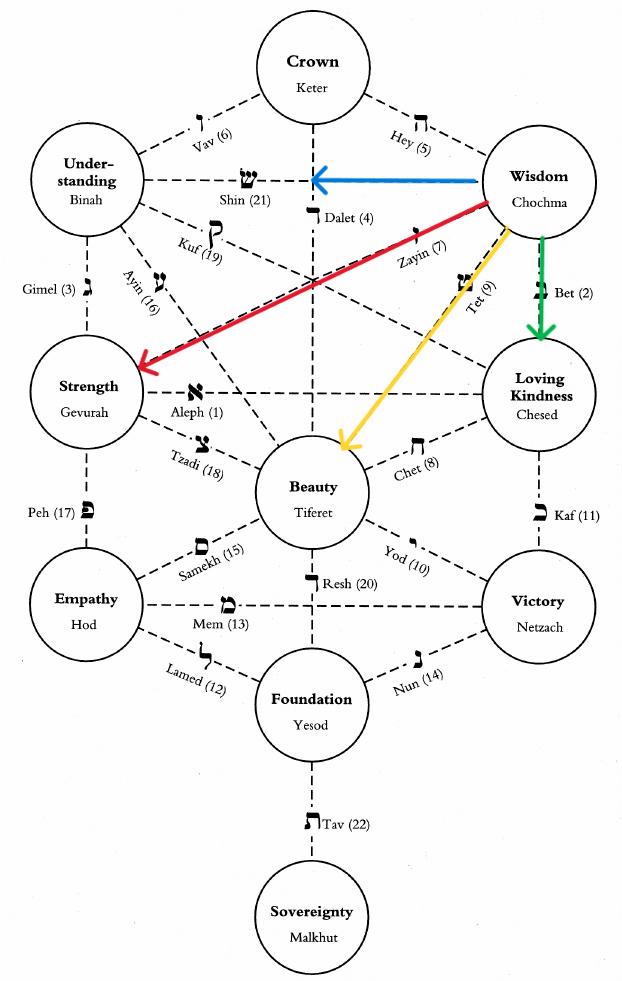
Understanding the Paths Emanating from Netzach: The Spiritual Inward Journey

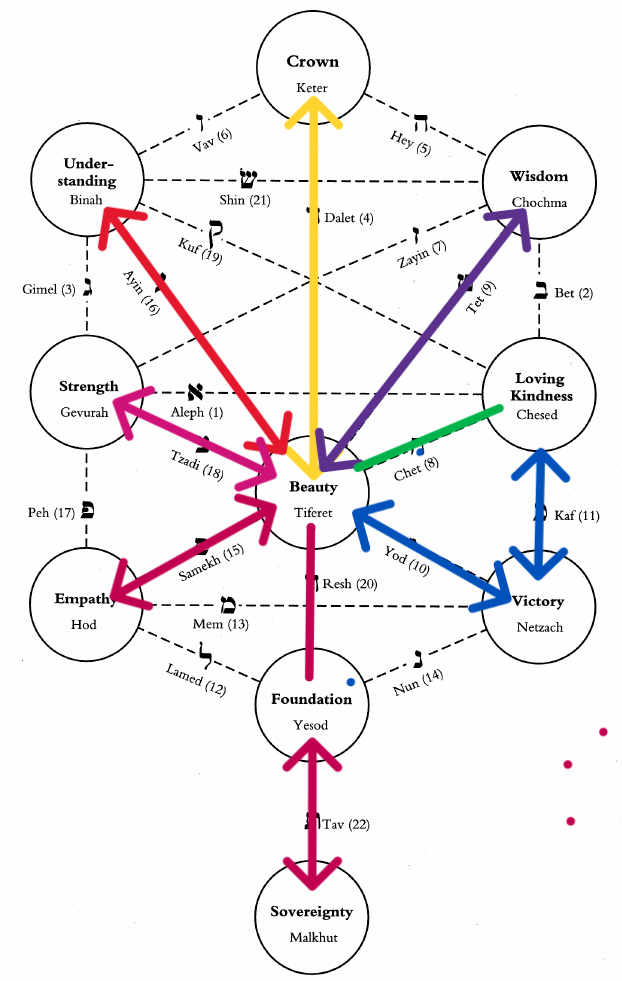
The Paths Emanating to and from Netzach
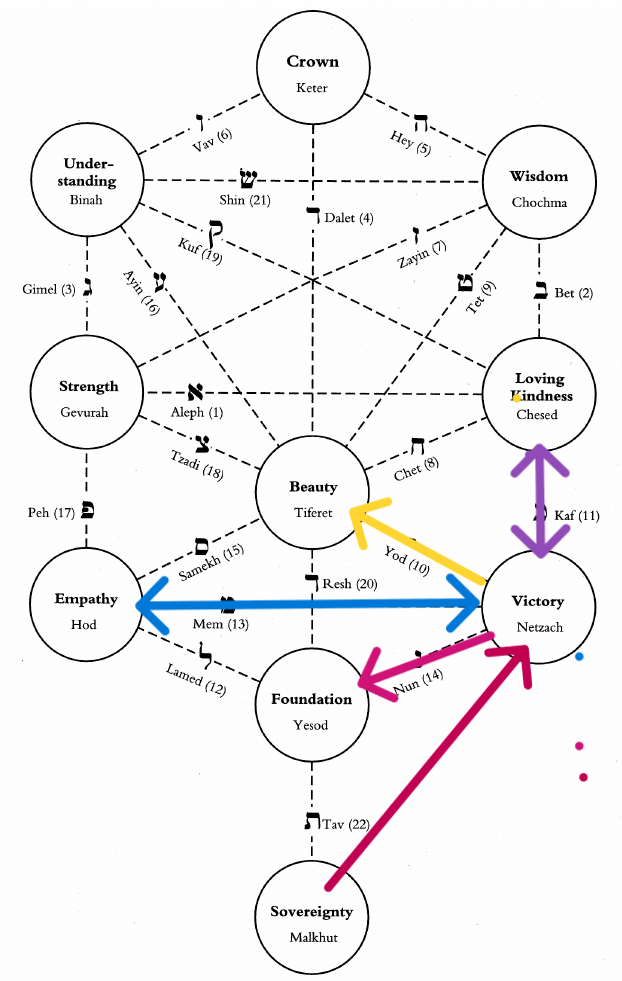
The 7th Path: The Hidden Occult Intelligence

7. Hidden Intelligence (Consciousness) (Sekhel Nistar): It is called this because it is the radiance that illuminates the transcendental powers that are seen with the mind’s eye and with the reverie of Faith.

The Seventh Path is the Occult Intelligence because it is the Refulgent Splendour of all the Intellectual virtues which are perceived by the eyes of intellect, and by the contemplation of faith.

Alt. Trans. “The seventh path is the hidden consciousness because it is the radiance that illuminates all the powers of the mind which are seen with the eye of the intellect and through the contemplation of truth.”

Wescott trans. The Seventh Path is the Occult Intelligence, because it is the Refulgent Splendour of all the Intellectual virtues which are perceived by the eyes of intellect, and by the contemplation of faith.

Case trans. The seventh path (Netzach. The seventh Sephirah) is called the Occult or Hidden Intelligence, and it is so called because it is the brilliant splendour of all the intellectual powers which  are ‘beheld by the eye of understanding and by the thought of faith.

Genesis 1:6 — “And Elohim said: ‘Let there be a firmament in the midst of the waters, and let it divide the waters from the waters.’ “

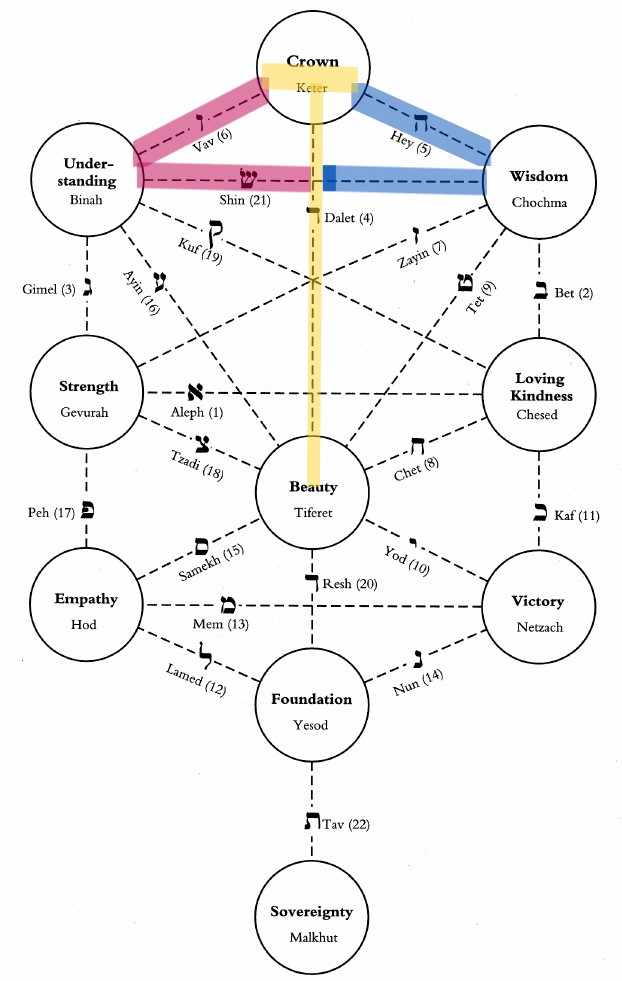
The paths emanating from Netzach are those that illustrate the individual’s experience of the day-to-day world. The Hidden Intelligence or The Occult Intelligence is the knowledge of the unseen theoretical world “which illuminates all the powers of the mind” i.e., the awareness of the principles, laws, and axioms of  the rational mind which determine the understanding of the things that are, as well as a knowledge of the unconscious or the sub-conscious. It is a part of what we understand by self-knowledge. Faith is not a thought but a way of being in the world: “Faith is the experience that the intelligence is illuminated by Love.” It is a way of thinking, and as such is a way of being-in-the-world.

The Greek philosopher Aristotle begins his Metaphysics with: “All men by their nature desire to see”. The translation of “see” into English usually becomes “to know”. The “brilliant splendour” or “glory”, the beauty of the world, that is given to the human intellect is enlightened by Love, and such viewing results in faith. The Hidden Intelligence, Path #7, combines with Path #29, the Corporeal Intelligence, the Palpable Intelligence #27 (Yod), and the Natural Intelligence Path #28, to produce the individual perspective on the presence-at-hand and ready-to-hand world of Yetzirah. This is crucial to how the world is to be apprehended by the human psyche, and the psyche is wed to eros.
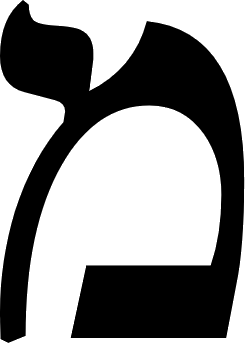
The individual perspective becomes what it is because it is influenced by the Memory of Mem given from Chakmah (Dalet) which shows its concrete manifestation in what are called the 7 Pillars of Wisdom (our “historical knowledge”) which combines with the Alef of the Logos or Ain Sof  (given in the symbols of “tongues of fire” from Tiferet and which gives Intelligence of the Secrets of All Spiritual Activities Path #19) to “clothe” the individual in the images of Path #24, The Intelligence of the “Imagination” or The Apparative Intelligence, and this is the foundation of Beauty. This Beauty is accompanied by the Intelligence of Trials, Path #25, and it represents the “strife” that occurs between Love and Will which is ever-present in the individual human being.

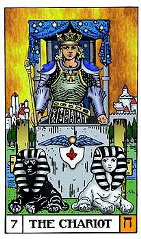
In the Hebrew Tree, the Seventh Path is represented by the Sephirot Binah. In the Western Tree of Case, the Seventh Path is the Sephirot Netzach represented in Tarot by The Chariot #7 card. With the letter Alef, Elohim “made” the firmament, but with Binah Elohim says “let there be a firmament”.
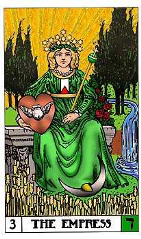
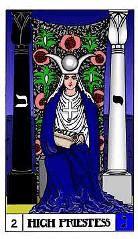
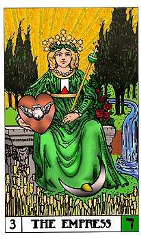
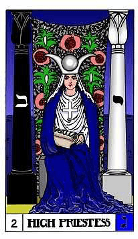
Binah is the potential or possibility of making i.e., it is the dynamis as understood by the Greek philosopher Aristotle. With the Alef present in Tiferet, this possibility becomes energeia, the realization of the work, the work brought to its completion. Binah stands on the contrary pole of the Tree of Life from Chesed. While Chesed is on the pole of Jakim, Binah is on the pole of Boaz. This may account for the assigning of Binah to path Seven as 3 + 4 = 7. This, however, would be contrary to the Pythagorean use or understanding of number. Binah ascribes the limits (potentialities and possibilities) to that which is unlimited. In the Tarot, The High Priestess #2 is rightly referred to as the “dark, sterile Mother”, while The Empress #3 is the “bright fruitful Mother”. Brightness and fruitfulness arise from the imposing of limits.
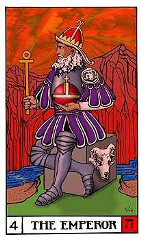
The Emperor card #4 shows the figure seated within a sterile landscape in the Tarot deck illustrated here. Is this a representation of the power of Nature? This would seem to suggest that there is something missing within the sphere represented by The Emperor. The Emperor card is associated with Aries in the Zodiac. Is this an aspect of the “Lamb slain from the foundation of the world” and its association with the creation of Time? Does one need to view the Tree of Life in a mirror i.e., to transpose all statements into their contraries? Or does it mean that one must sustain the contraries in a synthesis? This needs to be explored further.
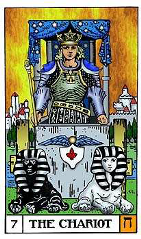
Netzach is the centre of the strife that is being a human being. It is the embodied soul illustrative of the strife that is within eros itself. The human body is “the chariot of fire”; and the fire which it carries is the human soul. The symbols of Venus are prominent in the martial aspect of this card because it is through Ares and Aphrodite and their son Eros that we experience the needs and their fulfillment in our lives. The fire here is the “shadow fire”, the human urges that drive us in each waking moment of our lives, that which is hidden and emerges from the sub-conscious. The “victories” that we may experience take many different forms. Netzach is linked to the letter Dalet and to the path linked to Chesed. This is combined with the influence from Tiferet through the letter Samekh. The illustrator here has chosen to link Netzach with the letter Chet; and since Chet means “enclosure”, it is apt to represent the human body as that which “encloses” the soul.

The word “occult” here means hidden or concealed. We might go back to the quote with which I began this writing: “Faith is the experience that the intelligence is illuminated by Love”. What Weil means by “experience” here is what we perceive with the eyes, what we become acquainted with in our day-to-day experience. Our knowing of these things is “illuminated”, is made clearer, is brought to light, through loving them as gifts. Because of this illumination of the things about us through Love (Tiferet), we may have faith in the experience of God even in His absence as we re-collect His Covenant with us through this Love. Our desires for various goods are a reminder of the Good that awaits us in the fulfillment of our absence, our imperfection. Our absence is experienced as the need for the Good. As Christ said: “Where your treasure is, there will your heart be also” Matthew 6: 21. Temptation rests in our desire to place our “treasure” in false goods and not the Good.

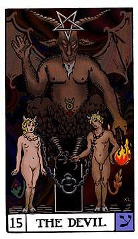
Nature does not lie; it hides. The “occult” or “hidden” aspect of this intelligence or knowledge also refers to the nature of the essence of things: each thing hides within it its contrary. This includes human beings. The goods of the world that we see about us can create obsessions and thus become evils. Illness is part of the nature of things, but within it hides health, that which is natural. In the affliction of despair, hope is hidden. In the darkness that is the false fire and false light of The Devil, there is also the hope for the genuine light and the genuine fire that is the Good.

In the Sefer Yetzirah, all of creation is seen as ‘holy’ and, therefore, we must say that all of creation is seen as moral. “Creation” is perpetual action or movement. This is extremely important in discerning what we think “knowledge” is today. Socrates once said that “the opposite of knowledge is not ignorance, but madness”. We can understand what he is saying when we consider the phenomenon of “stupidity” as a form of madness. Stupidity is a social phenomenon and therefore a moral phenomenon. The German philosopher Nietzsche once said: “Power makes stupid”. “Stupidity” as a collective, social phenomenon is the great danger to the Good. What we call “intelligence”, the mathematical intelligence most admired by society, (that mathematical intelligence and projection exhibited by the AI Chat GPT, for instance) is so because it is an expression of power. Nietzsche also wrote: “In individuals insanity is rare; but in groups, parties, nations and epochs, it is the rule.”

There are many “intelligent” people whose actions are quite evil i.e., Jeff Bezos, Donald Trump, and Elon Musk as examples; and there are many people who are considered not very “intelligent” yet who appear to be in touch with the very purpose of life itself. These men, Bezos, Trump and Musk, have a number of characteristics which they share, not the least of which is that their “accomplishments” are the by-products of the wealth of others. Their desire for further power is expressed in their “creating” their own social media platforms i.e., Musk > Twitter, Trump > Truth Social where their rhetoric will dominate the discourse of the people who follow them, or in paying a billion dollars to acquire rights to popular cultural events (Bezos’ Rings of Power). They are, of course, not interested in “truth” but in making people “stupid”. They show contempt for the laws of their society and this is telling in itself. (The analogy in literature is to Saruman of Tolkien’s The Lord of the Rings. He aspires to overthrow Sauron; but in his overthrow, he will merely replace him. His knowledge of the making of rings comes from Sauron himself.)

Liberation, not instruction, is the only way to overcome stupidity. But of what does this liberation consist? In Plato’s Republic, the prisoner in the cave must be released from his chains first before the paideia, the education, the “leading out”, can take place. In The Lord of the Rings, Frodo must believe that Gollum (notice the similarity to the Hebrew word golem) can be saved, that he can return to becoming a full human being. We, too, must believe that human beings dwelling in the madness of stupidity can be saved either through the grace of God (first) and then secondarily through education. Frodo treats Gollum with mercy and kindness, and he provides an example for us in dealing with those who have succumbed to “stupidity”. Even the great Martin Heidegger succumbed to stupidity during the Nazi regime in 1930s Germany; and it must be remembered that even a character as noble as Frodo fails in his quest to destroy the Ring of Power, the final destruction of which is merely a matter of Chance.

“Stupidity” is not an intellectual defect, but a moral one: there are many intellectually agile people who are stupid, and there are others who appear intellectually dull but who are anything but stupid. People can be made stupid or they can allow stupidity to happen to them i.e., they can choose it. Evil needs the stupidity of others to hide the truth just as the Good needs human beings to reveal the Truth of God’s Creation.

The Letter Dalet and the 26th Path: The Renewing Intelligence

The Twenty-sixth Path is called the Renovating Intelligence, because the Holy God (blessed be He) renews by it, all the changing things which are renewed by the creation of the world.

Alt. Trans. “The twenty-sixth path is called the renewing consciousness because through it God, blessed be He, renews all things which are newly begun in the creation of the world.”

Path 26. Renewing Intelligence (Consciousness) (Sekhel MeChudash): It is called this because it is the means through which the Blessed Holy One brings about all new things which are brought into being in His Creation.
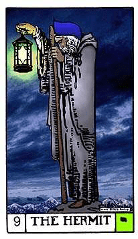
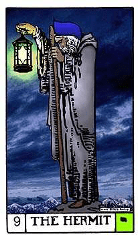
The Renewing Intelligence path (#26) is said to be indicated by the letter Dalet, (the Hermit #9 card has the letter Yod), and relates to the dynamis of procreation, both in nature and in human beings. This renewal is but one aspect of the lower form of eros. Because of the inherent power of sexuality and procreation, many taboos have been instituted against it. Many commentaries on the Kabbalah have attributed this path to Venus, but it does not take much reading to see that Venus is not a particularly pro-creative goddess in and of herself although she does exhibit the isolation of The Hermit. The appropriate goddess is Demeter, or Ceres (The Empress #3 card of the Tarot), the goddess of fertility and grains whose daughter, Persephone, is the husband of Hades, the King of the Underworld, represented by Death #13. Here we see the circle complete. Eros is the off-spring of Aphrodite/Venus, not the goddess herself. Beauty initiates the urge present in eros and leads, ultimately, to procreation and to the bringing forth of beings. The world of The Hermit, on the other hand, is a particularly sterile world.

“Holy” means “perfect, pure”, “set apart from defilement.” The Hebrew word means “separate”, and this designates the chasm separating the Divine from creation. The “speaking silence” is much like the word Aum or Om: it begins in “openness”, goes into “hiddenness”, begins with an “in-spiring of breath” and ends in silence. Music is analogous to it. Chashmal is “brilliant flame” (fire) which, combined with air and water produces earth. From this, or prior to this, is the Law of Necessity which determines the form of everything, be it “potential” (dynamis) or actual (energeia). All of what we call knowledge is grounded in our understanding of the Law of Necessity. The Kabbalistic speech (logos) employs the Law of Necessity; all our actions reflect the laws of Necessity. The danger present is that this knowledge can become “mechanistic”, sterile. The ultimate outcome of a world based solely upon the principle of reason is a world of nihilistic sterility.

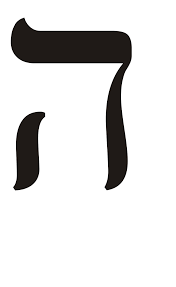
The letter Dalet is one of the seven double letters indicating that movement along it can be either up or down. If The Emperor is said to represent Chesed and he is a very sterile figure, then the Dalet represents a fruitful, procreative figure.

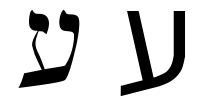
Dalet דלת is the word for door, gate and indicates resistance, a barrier, and the state of selflessness and humility needed to pass through it. Dalet is also said to indicate a ‘poor’ person, and this may metaphorically be said to represent the ‘perfect imperfection’ of human beings. The letter also suggests how to pass through the gates to know one’s own mystery of being (self-knowledge) and return to the power of the Aleph – the One source of all creation and being which is the goal of the teaching of the Sefer Yetzirah.

The Dalet is in the shape of a bent over human being, signifying humility and receptiveness. It represents Bitul, the self-nullification, or nullification of the ego, necessary to realize one’s inherent connection to the Creator. This self-nullification or decreation is not an easy task. In the common visions of the after-life, heaven is seen as a ‘land of milk and honey’, the goods and nourishment of this world, where we will be united with those whom we have loved in the present life. This appears to be a placing of the self before the Divine One who is All Good, and such a temptation is ever-present for all human beings. It is a denial of the First Commandment. In the journey on the Tree of Life, Dalet is the structure, form and the diligence required to receive the grace that the Divine is perpetually offering.

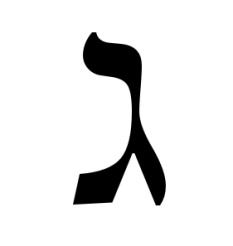
Dalet is also Dalit דלית, the “poor man”, the one who receives from benevolence or grace of the Creator through the Holy Spirit represented by Gimel. It is the realization that as humans “we are not our own” and that we have nothing of our own, but are entirely dependent on the creator and that every breath and movement is given to us from Him. It is the recognition of Otherness and the complete denial of the individual ego.

The Dalet also represents structure or gestell, the German word that Heidegger associates with technology and its enframing, but with Dalet it is not a completed frame. Its form of a horizontal and vertical line represents a grid, giving structure to the form. It is shaped like a stair-step, the metaphorical structure required to be ‘lifted up’, or to ‘go up’, thus overcoming the resistance given by gravity and the law of Necessity. This would also indicate that Dalet is a means of ‘going down’, descending the Tree of Life. This would seem to suggest that the creation is a ‘door’, a barrier but also a way through. This might associate the letter and its path to the belief of human beings’ giving ‘perfection’ to the created things and somehow completing them, for the creation and its beings are not wholly themselves.

On the individual level, it shows the structure and stability required to receive. This might suggest that the path suggested by Dalet is from Chesed to Netzach, and that the structure spoken of is the human body, the human form. This would be on the side of “Mercy” on the Tree of Life. The path from Binah to Gevurah would suggest the side of “Severity”. (One might look at the path from Chakmah to Chesed as also a possibility, but I am unable to connect how this can be associated with the Emperor #4 of the Tarot unless the Emperor is viewed as a ‘benevolent king’).

The fourth path or Chesed indicates the physical manifestations of all those things which we call “good” but which are not the Good itself. They are “shadows” of the Good. With it is the arrival of numbers and of the physical forms that can be measured with them; with language and numbers we can measure the benevolence of God or become aware of the benevolence which is “glaring” or obvious (?). Through number we measure, bring into a cohesion, and provide the boundaries which form the “receptacles” or “husks” of physical beings, the eidos or outward appearances of the things. From these boundaries we can then “define” the things, separate and enclose the things, and distinguish them one from another.

The German philosopher Heidegger once said: “Language is the house of Being; in its home humans dwell”. We may further extrapolate on Heidegger’s words by saying, “Logos is the house of being” for logos includes both language and number and it has been translated as “reason” into English. One may go further and say that the human body is the logos or the “home” of the embodied soul. The letter Bet is the first of the ‘double’ letters and is attributed to the path that crosses the mothers of Shin and Alef. My understanding is that Alef is the source of all the following letters and that it is Alef as Air, in combination with Mem as Water and Shin as Fire that creates the Bet which is Earth. Alef yokes together the worlds of Tiferet and of Yesod to the light of Keter, and Bet is the emanation of the goodness that is the reflected light of Keter. In the Hebrew Tree, Bet is said to cross the veil of separation between Chakmah and Binah as well as that between Chesed and Gevurah. Bet would then be associated with the Moon, with the “reflected light”.

This has a number of similarities to the characteristics of The Chariot #7 just discussed and to The Sanctifying Intelligence, Path #3. The “holy powers”, again, are the naming of things, that which distinguishes human beings from other created beings, our ability to use language and to name. From this path we can discern that the Gnostics were incorrect in attributing evil to the demiourgos and that the created world is one of evil. It is more appropriate to say that the created world is one of deprivation and need and this deprivation and need are present from the beginning of the creation. The created world is a ‘house’ that human beings make a ‘home’ through their use of language and number.

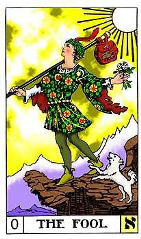
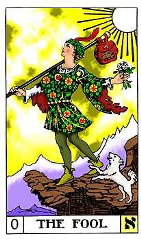
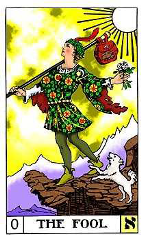
Paul Foster Case’s interpretations of the paths run into some contradictions here (or so it seems to me) because he confuses the Necessary with the Good. The Good is beyond Being. The Light that is Keter might be understood as the Highest Crown (since the crowns are associated with the letters), but they are not the “primordial emanation”. If The Fool #0 is represented by the letter Alef and is the channel to Chakmah or Wisdom, how is “wisdom” being defined here? Wisdom is “knowledge of the whole” which The Fool clearly does not have unless we are considering reincarnation here (which is entirely possible.) In this life, it is not given to human beings to have knowledge of the whole of which they are a part.

With the creation of numbers, Time also comes into being. With Time comes Memory. It is our Memory of the original Good that creates the absence/presence of human existence and the longing for completion in the Good. The Beauty of the created world acts as a souvenir, a photograph or image that gives us the Memory of that which is our end or perfection, our completion. Thus, Plato can say: “Time is the moving image of eternity”, but it must be remembered that these images of which Time is composed are merely shadows. Our collective knowledge, which is our collective Memory, derives from our understanding of the Laws of Necessity. Necessity is the will of God i.e., Justice.

The 23rd Path: The Letter Samekh and The Stable Sustaining Intelligence

Samekh: Tiferet to Netzach: Netzach to Tiferet

Path 23: Sustaining Intelligence (Consciousness) (Sekhel Kayam): It is called this because it is the sustaining (enduring) power for all the Sephirot.

The Twenty-third Path is the Stable Intelligence, and it is so called because it has the virtue of consistency among all numerations.

Alt. Trans. “The twenty-third path is called the stable consciousness because it is the power of sustenance among all the Sephirot.”

Case trans. The twenty-third path (Mem joining Gevurah to Hod) is called the Stable Intelligence because it is the power of permanence in all the Sephiroth.

Samekh is the symbol of support, protection, and memory. It means to “lean upon“, “support”, “uphold”. In gematria its number is 60. The perimeter of Samekh denotes the Creator and its interior denotes His creation, which He constantly supports and upholds and protects. It represents the Orr Makif, the Surrounding Light of the Kabbalah, indicating the general providence of the Creator, surrounding and sustaining all of existence, even as we perceive ourselves as separate and distinct from that Creation. The Samekh is the container of all forms and is, therefore, related to the other container letters including the letter Khaf.
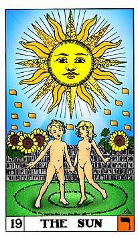
The Sun card is the microcosm of this overall cosmic relationship. Friendship is shown through the love, protection, and keeping in mind through one’s care and concern the interests of the other. Its common symbol is the wedding band which indicates the bond of the relationship. When two people are joined by Love through the mediation of the Divine, they enact a covenant with each other which cannot be broken. (“What God has joined together, let no one put asunder”. Matthew 10:9) Human beings are not always brought together by or through God, however. Other forces are at work here.

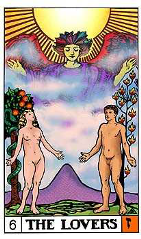
In literature, we see the opposite of this bond in The One Ring of Sauron in The Lord of the Rings. Here the bond is not one of friendship or relationship but one of oppression and dominion. The relationship of Sauron to his followers is contrasted by the relationship of the hobbits in the story, especially that of Frodo and Sam. The figure of Sauron is well-illustrated by The Devil #16 card of the Tarot which is the contrary of The Lovers #6 card and can be said to be contrary to The Sun #19 which is contrary to The Hermit #9 card.

The letter Samekh teaches us that thinking in its rational form is circular. There are no grounds for the principle of reason, although traditionally it has been grounded in and  on the Divine Reason itself (the Uncaused Cause) understood in its Latin translation of the Logos as ratio. Samekh tells us to think for the good of the other, to take care and be concerned with the other, and not just one’s self. This means to be inclusive of everything and everyone as these are part of the One. It is the principle that the wisdom is not contained in just one vessel, in just one person, but is distributed in all beings. This could be why those who believe they are in possession of the truth are, so often, intolerant. Their illusion is their foundation which, of course, is not a solid foundation for it is merely the ‘garments’ that the truth shows itself in its appearance/hiddenness to us. The Samekh teaches us that in order to know our Creator, we have to get out of our limited selves, out of what we think we know and the limitations of the physical, so we can get in touch with our essential inner self. It is the meaning of Christ’s saying that “Unless you become as little children, you cannot enter the kingdom of heaven.“ Matthew 18: 3 It implies a re-birth, and this re-birth is a going in the opposite direction from that suggested by linear time. It is the decreation process that I am speaking about here.

The danger of the Samekh is that we can become totally absorbed with ourselves and not be concerned or care for the other. We must empty ourselves in order to be filled; this “decreation” is much more easily said than done. The first step in the recognition of otherness is given to us by the beauty of the world, and this recognition pierces us (Zayin) and inspires us to love the other. The outer covering or ‘husk’ of Samekh needs to be pierced by the ‘arrow’ or ‘sword’ of Zayin in order for the divine influence to flow into it. (This is the meaning of Jesus’ saying that 34 “Do not think that I have come to bring peace to the earth. I have not come to bring peace, but a sword. 35 For I have come to set a man against his father, and a daughter against her mother, and a daughter-in-law against her mother-in-law. 36 And a person’s enemies will be those of his own household.” Matthew 10 34-36  This suggests the polemos or strife that is at the heart of Life and at the heart of what we conceive to be ‘our own’.)

The combination of Nun (Path #28 The Natural Intelligence) and Samekh נס Nes (Path #23 The Enduring Intelligence) means “miracle”. This miracle is what is called Love here. Once we have learned the lessons of these two letters, we can discover what the miracle really is. It is the ‘friendship’ of the Divine which sustains all the Sephirot, and we as human beings are called upon to mirror that ‘friendship’ in order to sustain that which makes us truly human, to continue to reveal the truth of God’s creation. Frodo’s friend and companion in The Lord of the Rings is appropriately named Samwise and their ‘friendship’ is a manifestation of that miracle. This miracle is “the friendship of Justice” or “the Justice of friendship”, the bringing of two unequal parts or partners into a relationship that makes them “equal” (but not the “equality” that we perceive as the Same). The possibility of friendship is a miracle.

If we look at the combination of Path #6 The Transcendental Influx Intelligence and Path #23 The Sustaining Intelligence, we can see that the combination of the Light of the letter Alef and the “house” of the letter Beth influences how we come to interpret the Sephirot Chesed. It is from Tiferet that Chesed receives the qualities of Mercy and Kindness, and when Chesed is looked upon without the influence of Tiferet, then we have the influence of will to power which is a relationship of commandeering and domination.

The Letter Qof and the 31st Path: The Continuous Intelligence

Qof: Path 31 The Continuous Intelligence: Netzach to Malkhut

31. Continuous Intelligence (Consciousness) (Sekhel Timidi): Why is it called this? Because it directs the path of the sun and moon according to their laws of nature, each one in its proper orbit.

Qooph – Elohim “said: I have given you all . . .” 1:29
Khof is the nineteenth letter of the Hebrew alphabet. The letter Khof (also spelled Kaf, Kuf, or Qof) originally meant “the back of the head”, or “the eye of a needle”.  Khof also means “monkey”. It is said to represent “unholiness”. It is the symbol of both the sacred Kedushah קדושה, the prayer for holiness, and the profane – the Klipah קליפה, the peel, cover, or husk which represents the outward presence of the things that emerge from the khôra. Khof has to do with the requirement of removing the husk which hides the truth of that which lies within. The Khof is that which hides the Divine Unity of the One and illustrates itself as the deception of the outward appearance of the Many. The Qof is at the greatest depth or the furthest away from the primordial Light of the Divine as it descends towards the sephirot of Malkhut.

In Hebrew, Khof means “monkey”, a creature which resembles a human being but is purely animalistic, with none of the higher capacities of a human being which are related to the logos i.e., language and number. In the Kabballah, this indicates the requirement for a human being to overcome their purely animalistic nature and to emulate the image of the Creator (the Logos) that is their true nature to realize the true spiritual nature of their being an ‘embodied soul’. It is the essential strife of life.

The Khof is the only letter which extends below the line of the other letters, indicating descent into the lower world, but also the ability to ascend from there. This extension also suggests “exceeding the boundaries” or the limits placed upon human actions. The elements of hubris and nemesis come into play here, and these are revealed in Path #32 The Administrative Intelligence of Malkhut to Hod. As such,  the Qof is related to the Sephirot Yesod (Foundation) and to the material world of Malkhut (Kingdom). The revealing of the true essence of what human beings are is in their wresting of truth from the husks of the world that hide it. When human beings cease to reveal truth, they succumb to their bestial, animal natures. This is the succumbing to stupidity, which again, is a moral not an intellectual phenomenon.

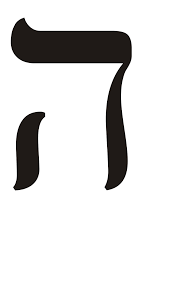
The design of the Kuf is similar to that of the Hei, the fifth letter of the Hebrew alphabet and representative of Path #16 The Enduring Intelligence, but while the Hei is said to represent holiness, the Kuf represents Klipah, or unholiness. Both have three lines, two vertical and one horizontal. These three lines, depicting thought, speech, and action in the Hei, are also represented in the letter Kuf, but its three lines represent unholy thoughts, profane speech and evil actions.

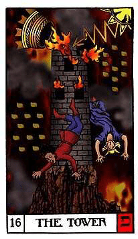
These negative qualities are illustrated within the actual form of the Kuf. Its long left leg plunges beneath the letter’s baseline. It represents one who ventures below the acceptable, an individual who violates the circumscribed boundaries of the laws of Necessity and, thus, commits hubris for which an eventual nemesis must be paid. This nemesis is shown in the Tarot card The Tower #15. As a contrast with the letter Heh, the Paradise of the saints represented in the 16th path is shown as the hell of the 31st and 32nd paths.

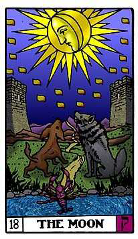
It is also significant that the head of the Kuf is a Reish (in contrast with the Dalet that comprises the Hei). The difference between the Dalet and the Reish is the Yod in the right-hand corner of the Dalet, representing the individual while the Reish represents the collective. While the individual Yod may be capable of passing through the door or gateway (“the eye of the needle”), the collective is not able to do so. The Zohar, one of the principle sources for the medieval interpretations of the Sefer Yetzirah, calls the Kuf and the Reish the letters of falsehood and impurity. This associates the letter with both The Devil #16 and The Moon #18 cards of the Tarot.

When Christ said that “It is easier for a camel to go through the eye of a needle than for someone who is rich to enter the kingdom of God” (Mark: 10:25), He is referring to the difficulty that arises when one forgets to remember that “For where your treasure is, there your heart will be also”, and this is dependent on how one sees the world. Christ follows his statement on the heart with: “The eye is the lamp of the body. If your eyes are good, your whole body will be full of light” (Matthew 6: 21-22). One must see with one’s own eyes, not with the eyes of the collective.

Christ’s statement  may also refer to the path of the letter Gimel which means ‘camel’ as well as ‘wealth and abundance’ (the path from Chokmah to Chesed) and the need to discard the illusion of conceiving or the manner of seeing  where it is believed that the Good rests in material things in order to enter the kingdom of heaven. This erroneous seeing has been a foundation for a number of different Christian sects throughout history and the disburdening of this error is not an easy task. There are also some references to the ‘eye of the needle’ as being the entrance to the fortified city of Jerusalem where all mercantile traffic must pass. For Christ to say that “It is easier for a camel to pass through the eye of the needle than for a rich man to enter the kingdom of heaven” would be a good joke.
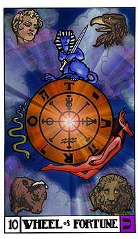
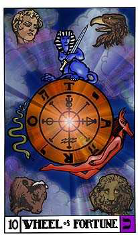
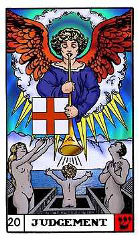
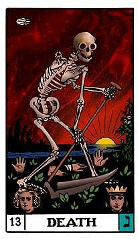
Kuf is also הקפה – to circle, to go around. Since the letter rests at the bottom of the created world, the next step is rise up to the beginning. It thus signifies a new beginning. Shin is the power to rise; Mem is the power to move down to the depths.  Khof represents all the cycles of nature, changing seasons, monthly and yearly cycles. It is in the realm of Time, and this would associate it with The Devil #16 card as well as with the realm of Necessity. It is the constant movement, circulation, and change of life. It is one aspect of the lower form of eros. It also represents that through the cycles of life that we see – evolution, growth, change, suffering, happiness, life experience – we are constantly worked on in order to be purified (the process of Shin, the fire) and to realize our true spiritual nature. The gematria of Kuf is 100 and this aligns it with The Fool #0, The Wheel of Fortune #10, and the Judgement #20 cards of the Tarot. Because Kuf is associated with beginnings and endings, it is also associated with the Death #13 card. This death can be  either or both spiritual and physical.

It should be noted that I am placing the 31st and 32nd paths on the Tree of Life as proceeding from Netzach to Malkhut and from Malkhut to Hod. There are no paths from Keter to Chakmah or from Keter to Binah. The paths of “The Thirty-two Paths of Wisdom” are “personal” paths and the realm of Atzilut is unknowable on the “personal” level. There are no paths there so they must be accounted for in some other way.

The Letter Nun and the 28th Path: The Natural Intelligence

28. Natural Intelligence (Consciousness) (Sekhel Mutba): It is called this because the nature of all that exists under the sphere of the sun was completed through it.

The Twenty-eighth Path is the Natural Intelligence, and is so called because through it is consummated and perfected the nature of every existent being under the orb of the Sun, in perfection.

Alt. Trans. “The twenty-eighth path is called the natural consciousness. Through it is completed the nature of all that exists beneath the sphere of the sun.”

Case trans. The twenty-eighth path (Tzaddi, joining Netzach to Yesod) is called the Natural Intelligence, because by it is perfected the nature of all things under the orb of the sun.
The 28th path appears to be related to technology, to human “knowing” and “making”, which completes the “purpose” or end, the telos of the “created things”, through a process of making them “pure”, or through what we believe is a dis-covery of their essence, their truth. This is a difficult concept for it involves what has become known as the history of Western metaphysics. This history may be summed up by our inability to separate the Necessary from the Good because, paradoxically, by establishing the duality of subject/object and the ‘objectification’ of all beings, we have dispensed with the Good as ‘values’, something we create in our willing. We cannot love an object, and it is through our objectification of the Other that we have created the gap that exists between Love and the Intelligence.

Initially, the good as action was seen as that which enabled some one or some thing to be capable of carrying out an action to bring an end about. It is good for animals to breathe, for instance; it is not good if they do not do so. The 28th path has many similarities to how Aristotle understood dynamis. In the Sefer Yetzirah, the good may be seen as the light which enables both the being of created things and that which enables human beings to see what their ends or purposes are for. For both Plato and Aristotle, the proper direction for human beings is the directedness of their vision toward the divine. This directedness of vision was contemplation, reflective thought. On the other hand, the 28th path may refer to how dynamis, potentiality, becomes energeia or the completed product or work. This would seem to suggest that the universe is ”rational” and its rationality is akin to our own rationality. This is the ground of the principle of reason, and the principle of reason is a principle of being. This principle of poiesis is a principle of “bringing forth”, but it is a distinctive “bringing forth” from that which is found in poetry and the techne of the arts.

There appears to be a connection between the Bible’s giving human beings a central role, as an acme, as the point or purpose of creation (as is shown in the Sephirot Yesod), and the giving of power to human beings over all created beings so that they may be “completed” in their nature through the power of human beings’ making. (1.28 And God blessed them; and God said unto them: ‘Be fruitful, and multiply, and replenish the earth, and subdue it; and have dominion over the fish of the sea, and over the fowl of the air, and over every living thing that creepeth upon the earth.‘) The power that is given to human beings is realized in their “knowing” and “making” that has become the stand and directedness of human beings’ being-in-the-world. The question is whether or not this dominion over the earth is one of a shepherd filled with care and concern or one of a tyrant filled with commandeering and domineering.

There is here present the view that the created things themselves are not complete in some way. This view of human beings and their role in creation later becomes the “humanism” of Western philosophy, and the consequences of humanism have become far-reaching. The question must be asked: is this view of human being, a product of the Renaissance, a correct understanding of what is said in the Sefer Yetzirah, and is it a correct understanding of what human beings are in their essence? The absence of God, experienced as the God’s silence through which human beings realize their “imperfection” in their affliction and need, devolves into the oblivion of eternity and into the view that the essence of human being is human existence itself and human will (freedom), that human beings will themselves to seek to realize human perfection and determine what Justice is and what Justice will be. Are we as human beings ‘our own’? In the completion of creation, there is no need for a God. The transformation that is spoken about by some commentators regarding Path #28 does not occur within the individual human personality only, but in the way in which human beings are in their worlds.

But Path #28 suggests another kind of way of looking also. If one looks at this “ascent of man” in the history of Western thought through the lens of the Sefer Yetzirah and “The Paths”, one can see that it involves the yoking together of the worlds of Asiyah, or Sensation, and the world of Yetzirah or “Formation/Creation”. This yoking may be done through the “reflected light” of Malkhut, the light from those objects that are present in the created world, or it may involve the light that descends from Keter, through the beauty that is Tiferet, to the foundation that is Yesod. This yoking requires the presence of Shin, one of the three Mother letters of the alphabet as outlined in the Sefer Yetzirah. The yoking is one of “unity”, not identity. There is a possibility of ascent as well as descent within it. The universe beneath the “sphere of the sun” involves the Sephirot Netzach, Hod, Yesod and Malkhut, and the links between them may involve either Tiferet or Netzach, the Divine or the human.

Our being-in-the-world is the primordial “foundation” (Yesod) which, through the reflected light of Malkhut, is how we view how the world will be disclosed or “opened up” to us. Our disclosure or opening up to this world can be either true or untrue, and this disclosure or opening up is exclusive to human beings as that which has been gifted to them from God. The truth or falsehood of the disclosure or opening up of the world is dependent upon this primordial viewing of the world in which human beings find themselves placed. Human beings disclose or open up themselves to themselves by the manner in which they disclose or open up their worlds. This “opening up” is what we understand as “freedom” in which we are able to view our possibilities and potentialities. The world in which we find ourselves is already opened up to us; how we view this opening determines what we will conceive ourselves to be in our essence. This determination arises from what we conceive the truth to be.

In commentaries on the Sefer Yetzirah and “The 32 Paths of Wisdom”, the word “initiate” and “initiation” are often used to describe the journey through life through the Tree of Life and its paths. This word can be seen as a simile or metaphor for our word “education” which comes from the Latin educare, “to lead out”, and “that which is responsible for the leading out”. The “initiate” and his or her “initiation” is a “leading out”. The images of paths and guides are apt here. We are concerned with what is authentic thinking here and how it may be achieved. Every “leading out” begins with an “opening up”, a liberation. In this open region, both truth and untruth are possibilities. Untruth is the deprivation of truth, not the opposite of truth; just as evil is the deprivation of good, not the opposite of good. How one views the world is a choice to be made. Because we are beings in bodies, we become preoccupied with the things that are and how those things may be able to fulfil our needs, whether those needs are hunger and thirst or empowerment.
Shakespeare himself says: “The Art itself is nature”, and one is very hesitant to disagree with the wisdom of the Bard. “Human nature” is completed through “natural intelligence”, through the ‘light of the Sun’, i.e., through Tiferet, not through the ‘reflected light’ of the Moon that dominates the world of Asiyah, (Malkhut/Yesod) and the world of Yetzirah or Formation (Hod/Yesod/ Malkhut/Netzach). This is a key point in the Tree of Life for at this juncture, human beings make the choice of becoming more fully human/humane or simply residing on the “bestial” level of existence. It is here that one fully experiences the “severity” of Hod and how and what we think shapes our perceptions of the world about us.

When rationality or the principle of reason dominates our view of the world and becomes our principle of being-in-the-world, we are less than fully human; and this foreshadows the coming into being of the technological worldview which dominates the world of Yetzirah, the world dominated by the Gestell, the “system”, the “plan” which brings about one’s attempts to bring justice to the world through our commandeering of nature. This is why technology may be viewed as ‘black magic’.

The Letter Mem and the 29th Path: The Corporeal Intelligence

The Twenty-ninth Path is the Corporeal Intelligence, so called because it forms every body which is formed beneath the whole set of worlds and the increment of them.

Alt. Trans. ” The twenty-ninth path is called the corporeal consciousness because it marks out the forms and reproduction of all bodies which are incorporated under every cycle of the heavens.”

Path 29. Physical Intelligence (Consciousness) (Sekhel Mugsham): It is called this because it depicts the growth of all that becomes physical under the system of all the spheres.
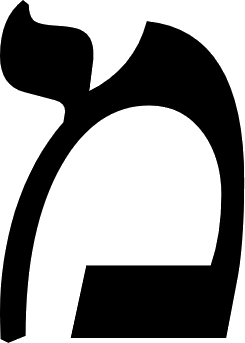
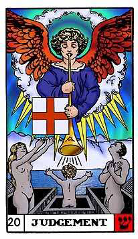
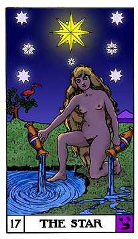
“To mark out” is to assign limits and boundaries to things, to give them a form (eidos) so that they may be understood within the web of Necessity. This is the mental process of the principle of reason and so has been assigned to the letter Shin. This influence of Shin is the realm of Yetzirah or Formation; and as we have stated, it is ruled by the principle of reason. The 29th path seems to indicate Aristotle’s teleology: the telos or end in which things achieve their completion or perfection (Hod). In the Tarot, The Star #17 is the card of completion i.e., Fate, what one is destined to be. What one is destined to be is determined by the choices one makes. The 29th path is the crossover from Netzach to Hod and it indicates a change from the realm of Asiyah, the material realm, to that of Yetzirah or the realm of Formation. The Judgement #20 of the test of Reish has already been determined and the Fate has already been decided.
The paths and the Sefer Yetzirah cannot be viewed from an individual perspective only. The individual is not the whole human being. The human being is an ‘embodied soul’ within a community of embodied souls. In the journey that is life, one can be ‘hooked’ into viewing the world as material only, as the fact-based reality we encounter and confront every day in our day-to-day lives. In the confrontation or strife that is Netzach, one makes the choice of becoming a full human being and going onward, or of being satisfied with materialism and power and of potentially becoming a golem, a ‘soulless’ animated thing. One chooses the darkness, or one chooses the light.

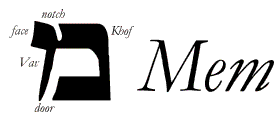
The letter Mem is water mayim מים, the waters of wisdom, knowledge, the Torah as it is referred to by some Hebrew commentators. Representing both waters and manifestation, it is the ability to dive deep into the wisdom, into the depths of Creation. It is said that in every person is the thirst for the words of the Creator which are the waters of life, and this corresponds to Aristotle’s words that “All human beings by nature desire to see”. The open Mem refers to the revealed aspects of God’s will that we understand as Necessity and that are given to us in our study and learning, while the closed Mem refers to the concealed part of the celestial rule that nonetheless guides us and all of existence i.e., the Divine Will. Mem also represents the time necessary for ripening and indicates to us the importance of balanced emotions and of humility, in particular, while we are waiting on God.

Mem corresponds to the number 40 and represents the time necessary for the ripening process that leads to fruition. (40 days for the development of the embryo, 40 years in the desert before reaching the holy land, 40 years development before Moses was prepared to be the leader of Israel, Jesus’ fasting for 40 days before he is tempted by Satan).

The Mem also teaches us about balanced emotions – balancing the watery motions of our feelings and this is how it influences Netzach. And it is about humility – water is the substance that always runs downhill to the lowest place. Fire, on the other hand, always rises.

The Twenty-ninth Path once again illustrates that which has been called the “mathematical” in this writing i.e., that which can be learned and that which can be taught. It is the knowledge or awareness of the physical material of the universe and the forms that are possible for this physical material to take its shape. In the path, this movement is associated with Time.

The “mathematical” would be indicated by the letter Lamed ל or “study”, “the serpent uncoiled” and how this emanates from the Sephirot Tiferet or The Sun. In order for some thing to be learned, it must first be brought to a “stand” or bounded within a horizon so that it may be “de-fined” and a name given to it so that it may be spoken about. The “numerations” weigh and measure things so that they are brought out of their natural state of metabole or change into something that can be known i.e., they are given a “permanence” of some kind, a “stability” of some kind. Numbers are only one example of the “mathematical”. The manner of seeing that results from the “consistency” or reliability of the use of numbers is but one manner of encountering and accounting for the laws of Necessity and the relation of created things to the domains of time and space.

The Twenty-ninth Path also indicates the limits of human reason and intelligence and so is influenced by The High Priestess #2. The ‘stability’ that arises from the collective or social manner of viewing the world comes about as a result of the consistency of the results of calculations or ‘numerations’ that are carried out. The ‘numerations’ are the logoi or speech that is shared among the members of the community. These logoi are grounded in the principle of reason.

The Sefir Yetzirah states that Mem, as one of the three Mothers, moves in a horizontal, not a vertical direction. The movement on the paths is a later, Renaissance, addition. Because Alef is the source of all the letters, it is capable of both vertical and horizontal movement. The direction of Mem is back and forth not up and down, unless one considers the three Mothers as both horizontal and vertical and that the three Mothers are the three pillars of the Tree of Life (which is what is considered here). The three Mothers act as vowels in the formation of words and thus must be capable of both horizontal and vertical movements as well as diagonal movements.

There is no “human progress” that occurs on the spiritual level along with the progress achieved on the material level. Morally and ethically human beings, as a whole, have not made any significant progress from their ancestors. This is because the moral and ethical presence of what human beings truly are as human beings has always been present for them to reach out to and grasp. Because human beings lose sight of the chasm which separates the Necessary from the Good, they fail in making true progress. They come to worship power and all of its false idols. This ultimately results in the oblivion of eternity for human beings.

Hod is the terminus of the Pillar of Severity or Form (necessity); Netzach is the terminus of the Pillar of Mercy, the “splendour” of which is the recognition of the Beauty of the world and the potentiality for the beauty of human actions within that world. The middle pillar is the fulcrum providing the “balance”, the “harmony”, the “equilibrium”, the “friendship”, the “covenant” between the Divine and human beings.

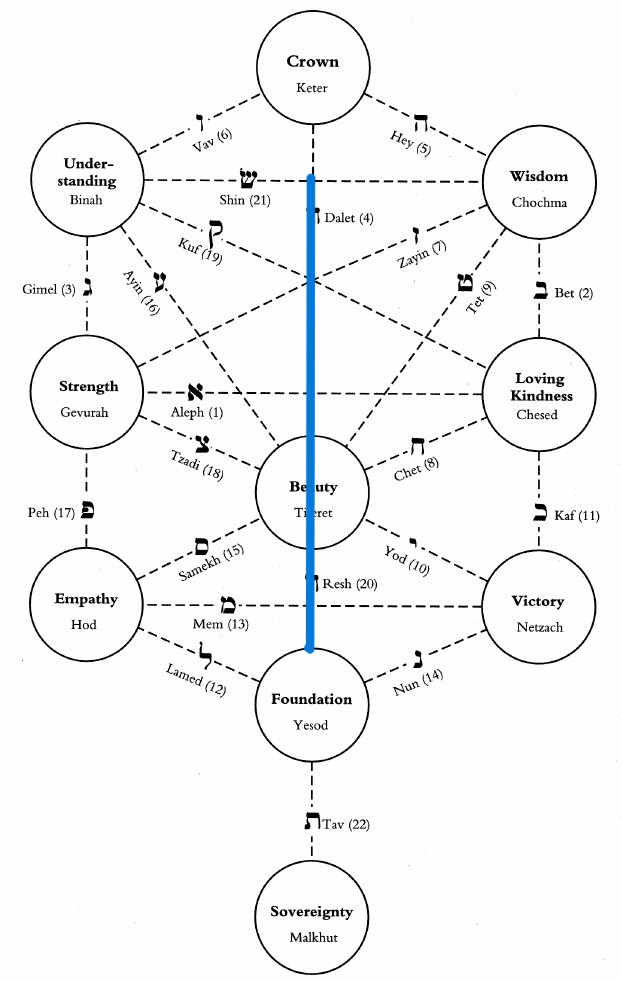
The following chart provides a summary of the paths emanating from Netzach.

PathLetterMeaningSymbol
Netzach Path 7. Hidden Intelligence (Consciousness) (Sekhel Nistar): It is called this because it is the radiance that illuminates the transcendental powers that are seen with the mind’s eye and with the reverie of Faith.   The embodied soul and its strife in everyday life. Our revealing of things is at the same time a concealing of them. The transcendental powers seen with the ‘mind’s eye’ are Love and Will. These two powers are in constant strife as is truth itself in its hiddenness as it is revealed simultaneously.The tarot card of The Chariot #7 is extremely rich in symbolism. It embodies many of the themes expressed in the Sefer Yetzirah and in “The 32 Paths of Wisdom”. The Sphinxes represent Love and Will and their strife. The cubic shape of the chariot illustrates limitations. The wheels represent the two manners in which one may travel the Tree of Life, etc.
Netzach to Chesed Path 26. Renewing Intelligence (Consciousness) (Sekhel MeChudash): It is called this because it is the means through which the Blessed Holy One brings about all new things which are brought into being in His Creation.  Dalet דDoor, gateway. A revolving door. The revealing/hiddenness of the appearance of truth in being.  Indicates the truth of the saying that ‘nature does not lie, it hides’. The truth must be wrested from nature since it  hides itself.
Netzach (Victory)/ Malkhut (Kingdom) Path 31 Continuous Intelligence (Consciousness) (Sekhel Timidi): Why is it called this? Because it directs the path of the sun and moon according to their laws of nature, each one in its proper orbit:Qof קBack of the head, monkey, the eye of the needle. Does the “monkey” refer to the bestial qualities of human being and thus relates it to the figures in The Devil card? “And again I say to you, it is easier for a camel to go through the eye of the needle, than for a rich person to enter the kingdom of God.” The light of the Sun as opposed to the light of the Moon.Hidden, behind. Deception, deceit. The past as hidden from us until it is brought forth into the light? What is behind is unseen. The past deceives (?) us as a shadow At the same time, the outer husk that conceals the fruit contained within. The simultaneous appearance and disappearance of truth, its revealing and concealing.
Netzach (Victory)/ Yesod (Foundation) Path 28. Natural Intelligence (Consciousness) (Sekhel Mutba): It is called this because the nature of all that exists under the sphere of the sun was completed through it.  Nun נ  Fish  Honesty, harvest (reap what is sown, Fate) The elements of hubris and nemesis are present here.
Netzach to Tiferet Path 23. Sustaining Intelligence (Consciousness) (Sekhel Kayam): It is called this because it is the sustaining power for all the Sephirot.  Samekh סSupport, propIndicates that Mercy and Kindness, Love, sustains the Sephirot. Without human beings, there are no Sephirot. The ring and eye of the Divine in contrast to the Ayin of The Devil.
Netzach to Hod Path 29. Physical Intelligence (Consciousness) (Sekhel Mugsham): It is called this because it depicts the growth of all that becomes physical under the system of all the spheres.  Shin/Mem/Alef מ/ש/אFate, ChoiceHow nature is understood is through a “system”, a grid that depicts the ‘growth’ of all that becomes physical in Time. Being and Time. The depictions are representational thought; they occur in metaphors. These depictions become a ‘fate’ chosen by human beings.

Understanding the Paths emanating from Tiferet in Kabbalistic Philosophy

The Paths to and from Tiferet (Part One)

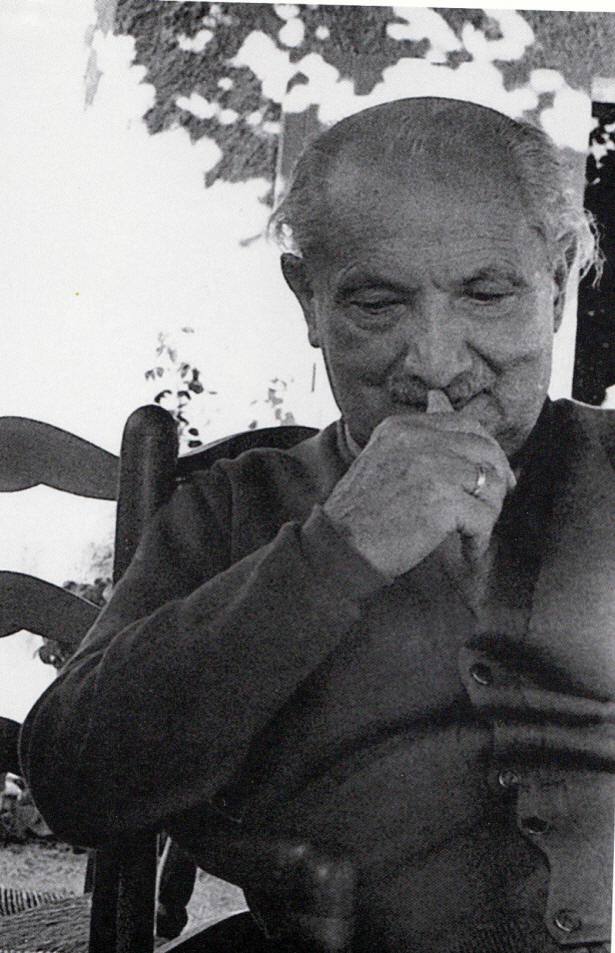
Martin Heidegger

“To those who are superficial and in a hurry, no less than to those who are deliberate and reflective, it must look as though there were no mystery anywhere.” MARTIN HEIDEGGER, “A DIALOGUE ON LANGUAGE”

“If the bleak days scare away all shining radiance, and if all breadth shrivels into the paltriness of narrow conventionality, then the heart must remain the source of what is light and spacious. And the most solitary heart makes the broadest leap into the middle of beyng, if on all sides the semblance of nonbeings stops its noise.” MARTIN HEIDEGGER, PONDERINGS V

In the first part of our discussion of the paths emanating to and from Tiferet, we shall look at Path #6 Intelligence of the Separative/Mediating Influence, Path #16 The Triumphal or Eternal Intelligence, Path #17 Intelligence of the Senses, and Path #20 The Intelligence of the Will. These paths are, I believe, central to understanding the whole of “The Thirty-two Paths of Wisdom” and to understanding the Tree of Life and Kabbalistic philosophy as a whole. They are central to the text and to the journeys outlined in the text through the various paths.

Path Six: Intelligence of the Separative/Mediating Influence

6. Transcendental Influx Intelligence (Consciousness) (Sekhel Shifa Nivdal): It is called this because through it the influx of Emanation (Atziluth) increases itself. It bestows this influx on all blessings, which unify themselves in its essence.

The Sixth Path is called the Intelligence of the Mediating Influence, because in it are multiplied the influxes of the emanations; for it causes that affluence to flow into all the reservoirs of the Blessings, with which these themselves are united.

Alt. Trans. “The sixth path is called the mediating consciousness because through it the emanation of atziluthic influence is increased. It causes that influence to flow unto all those so blessed as to be united to its essence.”

Wescott trans. The Sixth Path is called the Mediating Intelligence, because in it are multiplied the influxes of the emanations, for it causes that influence to flow into all the reservoirs of the Blessings, with which these themselves are united.

Case trans. The sixth path (Tiphareth, the sixth Sephirah) is called the Intelligence of Separative Influence, and it is so called because it gathers together the emanations of the archetypal influence, and communicates them to all those blessed ones who are united to its essence.

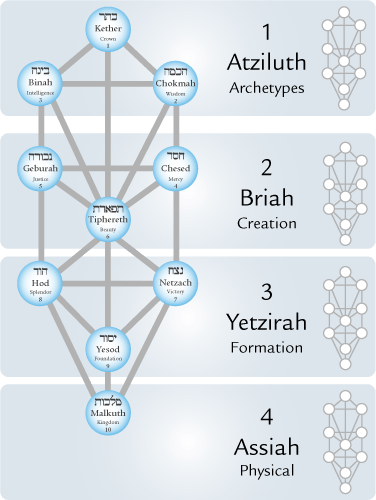
Since all the Sephirot are linked to Tiferet (with the exception of Malkhut), we shall use this section to summarize what has been discovered up to now. Tiferet in Hebrew means Beauty. Tiferet derives its beauty from the Light of Keter and, thus, from the light of the Sun. Its mediating influence can be an atziluthic influence, and it is this influence which is part of the deep mystery of life itself, the erotic that is life, the need that is life. It unites the souls of human beings to the Divine One. Just as the letters Alef, Mem and Shin are united into a one and are present and operating at all times in all the paths of wisdom, Tiferet reflects the ‘friendship’ of this Holy Trinity (the Father, the Son, and the Holy Spirit or the Ain, Ain Sof, and Ain Sof Ur) in the physical manifestation of the Creation. Tiferet is the daimonic realm, the realm of mediation and “messaging”.

One aspect of this mediation is the “friendship” manifested in the letter Samekh which is the path from Netzach to Tiferet. Tiferet is the manifestation of God’s covenant with human beings that is shown in the Beauty of the World. This covenant or bond is mirrored in “the miracle of friendship” between human beings and in the miracle of friendship between God and human beings. The light of the Sun is the metaphor for this mediation of “friendship” or Love, and this light “illuminates” the “intelligence” in its discernment of those things which are “goods” and those which are not. This is the site of the ethical or moral in our human being-in-the-world. The ethical and the intelligible are indiscernible and inseparable in our being-in-the-world.

Tiferet is at that point in the Tree of Life where the Tree of Life manifests itself in two branches. These two branches are the two faces of Eros and of the Logos. The two faces of Eros and Logos provide the various ways and means in which human being can relate to the Otherness that is being-in-the-world. It is that site where, potentially, there is no gap between “intelligence” and Love in the complete human being. There is no gap because of the presence of beauty. Love and beauty are one and the Same.

Other aspects of the mediation through Tiferet are between the Self and the Other, or the subject/ object dualism of modern Western metaphysics where Mind (thinking) understood as rationality (the Latinate interpretation of our understanding of logos) overcomes or rises above, ‘leaps’ ahead of the other through either Love or Will and commandeers and “projects” that other in order to determine what ends that other will serve. This is the Mind’s connection with the lower form of eros. This is “intelligence” understood as techne or “know how”.

The second is that mediation that brings into a unity the individual soul and the Divine One. After the Great Flood detailed in the story of Noah (Genesis 6-9), God’s covenant with human beings was a rainbow. The rainbow is a singular or particular manifestation of the beauty of world which is constantly present and which is the covenant of God. This covenant is the paradoxical conjunction of being and no-thingness and of no-thingness and being.

In the Christian Bible, Jesus said that God’s actual heavenly presence was arriving on Earth through Him (and not merely present as the Beauty of the World which acts much like a photograph of a loved one) and He often likened this to a huge tree, growing and spreading: (He told them another parable: “The kingdom of heaven is like a mustard seed, which a man took and planted in his field. Though it is the smallest of all seeds, yet when it grows, it is the largest of garden plants and becomes a tree, so that the birds come and perch in its branches.” Matthew 13:31-32). Jesus claims to be a tree of life, the whole, a vine that offers God’s life to the world (“I am the vine; you are the branches. If you remain in me and I in you, you will bear much fruit; apart from me you can do nothing. John 15:5). The presence/absence of God in His creation is the why I have used the metaphor of the beauty of the world as being an image or photograph of God i.e., it demonstrates the paradox of being/no-thingness that is the creation.

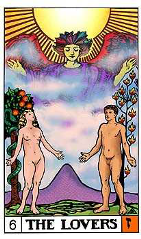
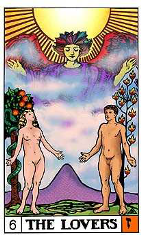
The figures in The Lovers card of the Tarot stand before two trees: The Tree of Life and The Tree of Knowledge of Good and Evil; and these two trees have been placed in the Garden of Eden which is understood here as the whole of Creation itself, and this garden is capable of being experienced in the NOW. Both Life and Good and Evil are the primordial elements of human existence. The Garden of Eden is here in the ever-present NOW. It is worth repeating the words of William Blake from “Auguries of Innocence” to illustrate the point: “God appears and God is Light/ To those poor souls that dwell in night/ But does a human form display/ To those who dwell in realms of day.” The two trees show that the intelligence and Love are inseparable, although in the human condition they have become separated.

In the Sefer Yetzirah and “The Thirty-two Paths of Wisdom”, the human form or body is a microcosm of the macrocosm of the whole of Creation. The human body is “the cross of Christ” and this is the meaning of Christ’s words: “Take up your cross and follow me”, for we experience the afflictions and sorrows of being alive as well as the pleasures, joys and triumphs through the mediation of the human body.

Simone Weil

Tiferet is the path that allows one to look inward towards themselves and outward towards other human beings and to recognize and experience the sense of Otherness in their being-in-the-world. From it, the “loving kindness” of Chesed is realized through an awareness of the “friendship” that exists between the Divine Trinity and the created things shown in the Beauty of the world. It is through this loving kindness that is the emanation of the Divine in created things shown in their Beauty that one is able to know the “essence” of things, including one’s own self as part of that Divine creation and part of that which is Divine. From this knowledge and experience, one can have faith. “Faith is the experience that the intelligence is illuminated by love”, as Simone Weil says. The “intelligence” or “consciousness” of the whole of the 32 paths is illuminated by Love. This experience of faith is not brought about through reason and its applications, but through a consciousness of, an awareness of, the Love of God as present in His Creation. This awareness is given to one by Grace, the Divine Mediation, and is traditionally said to be given to one through the angels or daimons as His messengers. It is a product of the heart as well as the mind.

All of the Sephirot, with the exception of Malkhut, are influenced by the emanations that flow from Tiferet. How these influences come to be interpreted and understood is the essence of the teaching of the Kabbalah. The Atziluthic influence spoken of in this path is The Good which manifests itself in those things we call “good” in our lives, and it shows that that which we call ‘good’ has, as its essence, that which is The Good.  To be able to perceive this good is due to the influx of the mediative forces of the spiritual. There are many passages in the New Testament in which Christ speaks of Himself as this Mediative influence, the parable of the vine and the branches already mentioned being one of them. Through this mediative influence, “the blessed ones” become united to its essence (the One), which is the Good.

The Constituting Intelligence belongs to Chakmah #2 which is the primordial life-force ‘swaddled in darkness’. This primordial life-force is the Will to Power. The ‘hiddenness’, the mystery of the life-force, is that Chaos that is the receptacle or enclosure of all things that are and that will come to be. We have spoken of these enclosures as manifested in the paths of Chet and Tet.

Tiferet belongs to the Sun, not to the darkness. The High Priestess card #2 cannot be placed here i.e., Tiferet, as Case proposes. The Lovers card #6 is properly placed here. As “that which constitutes the essence of creation in pure darkness”, it could be “the Lamb slain from the foundation of the world”, and the darkness is that darkness which is unable to comprehend the Word or the Light which descends into it. This darkness is present in both the realms of Beriyah and of Yetzirah. Creation is both the Beauty of the World and the Cross of Christ and both represent the presence of the Divine in His Creation even though they are contraries. Beauty is the height and the Cross is the depth of that Creation.

Tiferet is “beauty” in Hebrew and this “beauty” and its “light” is the covenant of God. Response to this covenant is Love and Faith, which give hope. From and within this perspective, one is able to recognize that other human beings are those to whom justice is due, and it is here that ethical actions, “right and wrong”, find their root. It is a paradox in that at this stage where one realizes oneself as a complete human being, one feels one’s self as most “individual” and yet, at the same time, as one individual among many others. It is the experience of ‘freedom’ in being most bound. It is the opposite of the “egotism” which relies on the calculations and machinations of the “personality” to achieve its own particular selfish ends. The true individual is the free individual, and this freedom has nothing to do with the exercise of the will or the ‘freedom’ to exercise that will that results in the ‘empowerment’ of the individual ego.

From this position, one can understand the vision of the saints who see “downward” upon the crucified Christ i.e., the paradoxical covenant of God: the beauty of the world as its height, and the crucified Christ as its depths; the light of God amidst the darkness of creation that is the crucified Christ. Most depictions of the crucified Christ are a ‘looking up’ at Him.

Tiferet is the only Sephirot below the primordial Trinity which receives the light of Keter directly through the channels of the letters Alef and Beth (Alef is the light of the Sun in a descent; Beth is the light of the Moon in an ascent?). The light of Beth is that light within the world of Yetzirah.  The letter Beth is that from which all of the other letters are pro-duced or ‘brought forth’. The individual self is not the “personal ego”  that is dominated by the “social” and its goal of “recognition” and “social prestige”, the world of power and money. Access to knowledge of “past incarnations” is that knowledge that is available from one’s culture, from history, since all humanity was, is, and will be One. The individual is not the re-incarnation of Helen of Troy or the village idiot from 15th century Leicester but all of these and more. As individuals, we are re-incarnations of all who have come before us since the individual becomes part of the One upon their death and their goal is to become themselves when they come to be.

The first letter assigned by Case to Tiferet is Gimel, but this might be an error. Tiferet is linked directly to Keter through the letters Aleph and Beth. This is why the reference to Tiferet is “the son”, directly linked to the Father. Since the Father is the whole and has created the whole through a withdrawal, not an expansion, the Son is the link between the Father and His creation. The Son is “the Lamb slain from the foundation of the earth”, and from this one can come to understand the Sefir Yetzirah’s references to the parts of the sacrificial animal and to the human body and its form as microcosms of the Creation itself.

The Sephirot Tiferet is the mediation of all of the other emanations or influences that come from the other Sephirot. It is this mediation which has the ability to bring two things which are incommensurate with each other into a relation of harmony or friendship. The Sephirot are all One, and they are ones individually, linked together by the letter Alef (the light of Keter, the element of Air) and by the “mediating influence” of Tiferet or Beauty. “The reservoirs of the Blessings” are those things which we call “good” in the world and they are “containers”, receptacles, or storage places for the blessings which are all united and share in the One Good. They are referred to as ‘husks’ in the Sefer Yetzirah. The husks are the containers which must be pierced so that their inner essence will come to light.

The 16th Path: The Triumphal or Eternal Intelligence: The Letter Heh

The Sixteenth Path is the Triumphal or Eternal Intelligence, so called because it is the pleasure of the Glory, beyond which is no other Glory like to it, and it is called also the Paradise prepared for the Righteous.

Alt. Trans. ” The sixteenth path is called the eternal consciousness because it is the pleasure of that glory beyond which is no glory like unto it. It is also called the garden of pleasure (Eden), which is prepared for the compassionate (Khasidim).”

Wescott trans. The Sixteenth Path is the Triumphal or Eternal Intelligence, so called because it is the pleasure of the Glory, beyond which is no other Glory like to it, and it is called also the Paradise prepared for the Righteous.

Path 16. Enduring Intelligence (Consciousness) (Sekhel Nitzchi): It is called this because it is the Delight of the Glory (Eden). As it is, there is no Glory lower than it. It is called the Garden of Eden, which is prepared for the (reward of) the saints.

Heh: Tiferet to Chakmah: Path 16: The Eternal Intelligence The second path linked to Tiferet is the letter Heh (but then how does one assign Gimel to its path since the letter is called “king over wealth”? Surely this must be associated with Chesed or Binah which is the physical world and The Emperor #4 card of the Tarot which is associated with wealth and fire, unless one considers the word “wealth” to mean “abundance” in the sense of one’s “cup running over”, the “reservoir” or container of those blessings that are given by God in friendship? This might suggest an association with Binah. The true “abundance” of the world is its Beauty; the true “need” of the world is the Light; and God is perpetually offering His love and friendship in abundance through the Beauty of the World and all those things in the world which we consider ‘beautiful’ and ‘good’. This is how Eros is to be understood.) It is through the Beauty of the World that the “emanations” of the “atziluthic influences” are increased, and “blessed are those” who are united to the cause of the Beauty of the World, the Divine Creator, the Good. The word ‘glory’ and the word ‘beauty’ are synonymous in “The 32 Paths of Wisdom”.

The several paths converging in Tiferet do not influence Tiferet but are influenced by and through Tiferet. Just as the light of Keter is not influenced by the other Sephirot but gives to those Sephirot their presence and ability to be Tiferet, too, determines the nature or the essence of things in their being. Tiferet influences Justice (Necessity) so that its severity and power is balanced and tempered with Mercy and Kindness. The canonical law that is the knowledge and understanding of Gevurah is brought into balance and tempered through the Being in the world of the parousia that is the Son. Our experience of our “need” as human beings urges and prods us to seek for that which will fulfil the absence of that perfection, the completion that we seek.

For human beings, our love of the beauty of the world begins with our love for the beauty of each other through the mediating influence of the light cast upon things which allows us to see them in their outward appearance. We feel the urge of sexual desire, the erotic, through the foundation that is Yesod, the foundation of the physical. We become “friends” through speech, and it is through this speech that we can attempt to become one with the other. While the word of God is perfect speech, our own speech is incomplete and imperfect. When God joins the two together, they then become one.

The Tarot cards associated with Tiferet illustrate the contraries (with the exception of Temperance) to those blessings associated with Tiferet. The speech between “two or three” friends (dialectic) becomes the speech that is to two or three hundred, the rhetoric of those who seek power over others. The experience of love becomes the “hard experience” of The Tower #15 and the knowledge derived from such experience. The cards of The Tower #15 and The Devil #16 are cards without light.

That which endures is Nature. Nature is sempiternal. Consciousness of this is the “Enduring Intelligence”. “Time is the moving image of eternity”, as Plato said. That which endures is Nature; that which passes away is also Nature. In its passing it moves, but in its moving it is ever the Same in its place. The Creation that is is the Garden of Eden which is experienced in the NOW, not at some future point in time. The saints enjoy life as the creation enduring in the NOW. They experience the world of the here and now as Eden.

The Letter Vav and the 17th Path: Intelligence of the Senses

Path 17. Intelligence of the Senses (Consciousness) (Sekhel HaHergesh): This is prepared for the Faithful saints so that they may be able to clothe themselves in the spirit of holiness. In the arrangement of the supernal entities, it is called the Foundation of Beauty (Yesod HaTiferet).

The Seventeenth Path is the Disposing Intelligence, which provides Faith to the Righteous, and they are clothed with the Holy Spirit by it, and it is called the Foundation of Excellence in the state of higher things.

Alt. Trans. “The seventeenth path is called the consciousness of disposition. It provides faith to the compassionate (Khasidim) and clothes them with the Holy Spirit (Ruach Elohim). Within the Supernals, it is called the foundation of beauty (Tiphareth).”

Wescott trans. The Seventeenth Path is the Disposing Intelligence, which provides Faith to the Righteous, and they are clothed with the Holy Spirit by it, and it is called the Foundation of Excellence in the state of higher things.

The Vav is said to represent the Kav, the vertical line extension of the Creator’s perfection into the created world in order to constantly direct it, guiding the cycle of existence step by step, until eventually the perfect Oneness of the Creator which underlies all of creation is revealed. Vav thus relates to the Law of Necessity, the Divine Will, ‘the structure of all that is formed’. The Vav could thus be seen as a barrier but also a way through.

Vav is related to the Orr Yashar, the direct light of the Creator, entering the world; but in the strife of this world, it appears to act as a barrier to the true Light. This would relate it to Christ, the Ain Sof, who is the direct light of the Divine and would thus associate Vav with Tiferet, the sixth Sephirot which is the Beauty of the World. But Vav, being an elemental letter, is capable of only one direction of movement. Is this movement up or down? Is it on the left side or the right side of the Tree of Life? The two sides of the Tree of Life should be viewed as the two faces of Eros, the front (right) and back (left), the two faces of the Ain Sof, or the mirror of the right and the left sides.

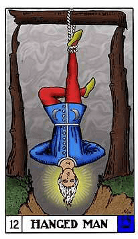
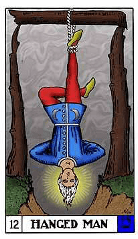
As a connector, Vav contains the mediatory power to connect heaven (mind, reason) and earth. It can be considered a channel or canal, which connects and bestows all the energy of the shefa שפע abundance from above down to the created beings. This suggests that its movement is downwards, and appears to imply that all creation is a movement downwards.  A more proper direction might be said to an “away from”. The Vav is said to represent the ladder of Jacob Yaakov – rooted in earth, with its head in the heavens, what is known as Jacob’s ladder. But if this is the case, then it is upside down (as is suggested by the tarot The Hanged Man#12). The Vav is the extension of the essential dot Yod י, but this extension is an expansion indicating its relation to the will to power and its relation to the physical body. God’s withdrawal is that from which all of creation comes forth and it is contained in Alef. It is the contrary of will to power; it is a denial of power and an expression of Love.

Vav represents the number 6, 1 + 2 + 3, and represents the six days of the creation of the world, as well as the six physical dimensions (right and left, front and back, up and down) of Space. The first day of creation is related to Chesed and is attributed to “kindness”. God’s withdrawal allows creation to be, but the Mercy and Kindness of God are present prior to their manifestation in the physical world of creation and the act of ‘giving’ that is the Creation. The Light of God is two-fold: one Light is beyond Being (the Good) and then there is the light within creation itself from the sun, moon, and heavens. Creation begins at the number 4, Chesed.

The second day of creation has the attributes of “severity”, “contraction”, and “judgement” associated with it, the binding of things in enclosures; it is the Law of Necessity. It relates to the Sephirot Binah, as well as to Gevurah and Hod. The deprivation and need of the original creation is experienced here and its metaphorical significance is the separation of the waters. It is associated with the Flood and with the Tower of Babel i.e., The Tower #15 card of tarot.

The third day of creation is associated with Tiferet and is associated with beauty, mercy and the balance between the positive and negative elements of creation (although, as is suggested here, these elements are prior to the Creation itself). The fourth day of creation is associated with Netzach, with splendour and the victory that comes from “endurance” (but why is this prior to the creation of human beings? One plausible answer is that the heavens and the earth are sempiternal and that one of the chief virtues for human beings is “endurance”). It is also associated with the creation of the sun and moon. The fifth day of creation is associated with Hod and has the attribute of acknowledgement but also of devastation. The sixth day of creation is associated with Yesod and with the creation of human beings. It is associated with Adam whose name contains the letters Alef, Dalet and Mem. Adam is the human being who is perfect in his thought, speech and action i.e., he is the “complete” human being: the first human being is the complete human being and he is referred to as the Adam Caedmon. That he is brought into being on the sixth day shows the association of human beings with Tiferet. But how is it that human beings other than Adam come to be the “perfect imperfection”?

The Vav is also representative of the male phallus, the fertilizing agent, bringing life, abundance, continuity, and addition and represents the extension below Tiferet to Yesod. This is our first experience of eros.

William Butler Yeats

The Intelligence or Consciousness of the Senses is that manner of seeing which allows the saint to become a saint and allows them to view the world as it is, that is, as a Garden of Eden. This viewing is the reward for their saintliness. In doing so, they are ‘clothed’ in the ‘excellence’ that is what we understand by virtue. They achieve what the Greeks called arete. This is the highest form of human being. The ‘courage’ shown by human beings is in their ‘endurance’ of the experience of creation. It is the denial of the third temptation of Christ.

The highest form of human being is shown through their actions. The saint (or philosopher) shows, through their example, what human excellence is. There is no need for proselytizing. “To make disciples of all nations” (Matthew 28: 19-20) is to show by example what the purpose of the journey is. To those whose god is a dispenser of power and fear, they will also be dispensers of power and fear in their spreading of what they conceive the truth to be. The greatest sins are committed by those who believe they are in possession of the truth. ‘Christian nationalism’ and other “-isms” that purport to be the ‘word of God’ are, at best, mistaken in their understanding of Christ’s message, and at worst, blasphemers. One is reminded of the line from W.B. Yeats’ poem “The Second Coming”: “The best lack all conviction/ While the worst are filled with passionate intensity”.

The letter Vav in Hebrew serves as both a conjunction and a verb modifier from present, past and future tenses. It is thus associated with Time. Binah is the Sephirot associated with Time. The mediation of Vav is thus associated with Time and is the influence of Will upon the ready-to-hand of the world. This is why I have associated Vav with the path that extends from Tiferet to Binah.

Because science no longer deals with what was once understood traditionally as Nature (and, thus, reality), the human will prepares each thing of Nature for that completion or perfection that will come from the ends or purposes that human beings determine or devise that are best for themselves. This is what we call “freedom”, the devising of ends which we think are best for ourselves. We believe in this freedom because we believe that, ultimately, we are ‘our own’ as individuals. Freedom is the commandeering and dominating knowing and making that we understand as technology. This dominating knowing and making includes our own bodies. It is also what we understand as ‘artificial intelligence’. What is clear from the Sefer Yetzirah and the traditional religions of the world both West and East is that we are not our own but are called to a higher destiny beyond ourselves.

In the world of the will and of will to power, there are some cases where there are created beings that serve no purpose or ends for the will to power of some human beings; that is, they have no “purpose” or future “use” and cannot be brought into being as part of a “standing reserve” of resources, and to these beings no “justice” nor perfection is due, and that includes some other human beings. This is what has made, and will make in the future, the possibility of genocides and these genocides will be much greater than those that have occurred in the past.

The Letter Ayin and the 20th Path: Intelligence of the Will

Ayin– and Elohim “divided the light from the darkness.” 1:4

Path 20: Tiferet to Gevurah: Intelligence of Will (Consciousness) (Sekhel HaRatzon): It is called this because it is the structure of all that is formed. Through this state of intelligence (consciousness) one can know the essence of Original Wisdom.

The Twentieth Path is the Intelligence of Will, and is so called because it is the means of preparation of all and each created being, and by this intelligence the existence of the Primordial Wisdom becomes known.

Alt. Trans. “The twentieth path is called the consciousness of will because it is the pattern of all that is formed. By this mode of consciousness, one may know the actuality of the primordial wisdom.”

The Twentieth Path, the Intelligence of the Will, is the understanding of the “preparation of all and each created being”, “the pattern of all that is formed”, and may be best understood in the German word gestell as it is used by the German philosopher Martin Heidegger. A Gestell is a framework or “method of organization” which allows created things to be and to come to presence for us. It is the primordial algorithm and taxonomy. Heidegger calls it the essence of technology. It is a manner or disposition of human being-in-the-world (among other possibilities of human being, although it is by far the dominant one) and it determines how the created beings are to be viewed. It is a ‘destiny’, a ‘fate’ of Being that has been given to human beings. While in German Gestell is a noun, Heidegger uses the word in a way that is uncommon by giving Gestell an active role, by viewing gestell as a product of the human will and a product of human action, a human “projection”, “a throwing forth”.

George Grant

In defining the essence of technology as Gestell, Heidegger indicates that all that has come to presence in the world has been “enframed”. Such enframing or the placing within ‘enclosures’ relates to the manner reality appears or unveils itself in the period of modern technology (by “modern” here is meant post-Renaissance) and people born into this “mode of ordering” are always embedded into the Gestell (enframing) themselves. (As the Canadian philosopher, George Grant said, “What we have done to Nature, we first had to do to our own bodies”.) Thus, what is revealed in the world, what has shown itself as itself (the truth of itself) requires first an Enframing, literally a way to exist or to be in the world, to be able to be seen and understood. Path #20 indicates this knowledge when viewed from one possible perspective.

In ordinary usage the word gestell would signify simply a display apparatus of some sort, like a book rack, or picture frame; but for Heidegger, Gestell is literally the challenging forth, or performative (dynamis) “gathering together”, for the purpose of revealing or presentation i.e., the human will as central to how the world will be unveiled. If applied to science and modern technology, “standing reserve” is active in the case of a river once it generates electricity or the earth if revealed as a coal-mining district, the soil as a mineral deposit, or scenic sites as part of the tourism industry. It is this challenging forth that connects gestell to the human will. It is ‘the hook’ or ‘peg’ that is part of the meaning of the letter Vav.

We can see here again the connection between the passages from Genesis related to the coming-to-be of human beings and the coming-to-be of technology in our modern age. Human beings are given the central role in creation; and all that has been created or will be created is given over to them for their disposal. The world itself, created beings themselves, do not reveal themselves in their essence without the aid of human willing. The act of revealing is, literally, a one-way path or a one-way street from this particular viewpoint. This is the way of viewing the world when the Strength card is seen as #8 and that it is connected to Gevurah and Chesed by the paths and when one assigns the letter Tet ט to it.

Path #17 The Intelligence of the Senses and Path #20 The Intelligence of the Will indicate that point where The Tree of Life branches off or becomes two-limbed. This branching occurs when the manner of perceiving the world is determined. It may be determined either through Will or through Love. Will and Love determine the two faces of Eros and of the Logos: the lower eros and the higher Eros on the one hand, and rhetoric and dialectic in language. This determination occurs within the world of Beriyah and it can be distinguished by that thinking which is done by the artisans and technicians and that thinking which is done by the saints and the philosophers. This bifurcation determines the world as ‘standing reserve’ and disposable, or it can view the world as a Garden of Eden.

Another way of viewing the 20th path is to see it as “prudence” or the Strength card as #11 of the Tarot. The essence of technology as outlined by Heidegger devolves into the nihilism of the pure “will to will”, the need to will anything since one has no other alternative given the oblivion of eternity and replaced that eternity with the eternal recurrence of the Same. The technological way of being-in-the-world is a mirror or mimicking of the “primordial wisdom” that is in the realm of the world of Atzilut since it bestows the ‘values’ on things and these ‘values’ are related to their potential uses. This may be seen in the manner of questioning of the thing and how that question will be answered.

“The structure of all that is formed” is the Law of Necessity and it is through the understanding of the Law of Necessity that one is able to know “the essence of Original Wisdom” or the Sephirot Chakmah. Our attempts to understand ‘all that is formed’ comprise our ‘theories of the real’, what we call our sciences, how we attempt to view our world. Our sciences are products of reason and the will. As was said earlier, Artificial Intelligence is a shadow of the shadows of the things of Necessity. In Plato’s allegory of the Cave, artificial intelligence would be a second cave and a further distance, at a greater depth, from the light of the Sun, the Good. Its greatest danger is that it is self-contained and represents the greatest enclosure.

The letter Ayin is erroneously said to have the power to unite everything that is separated in creation and this is why it is confused with the structure of the letter Alef which consists of two Yods separated by a Vav. The letter Ayin as the 20th path is related to the letter Peh and path 13 The Unity Directing Intelligence and the letter Vav Path 17 The Intelligence of the Senses. But is Vav really a true unifier or a barrier, a separator? Literally Vav means “hook” or “peg” and the Hebrew letter is a vertical line ו. The Vav would appear to be a metaphor of the mediation that exists between reason, the logos understood as an extension of the will to power, and the ready-to-hand world about us.

The world is seen as the second Cave of the Internet containing the whole and the Vav is that reasoning that unites the things in that Cave to the algorithm based on the principle of reason. This reasoning is tied together with The Sanctifying Intelligence, the intelligence that separates (diaresis), and The Unity Directing Intelligence (dianoia) the intelligence that brings into a unity, that emanates from the Sephirot Binah. Are these manifestations of the Logos or the Anti-Logos?

The Hebrew letter Ayin means “eye” and correspondingly, the Ayin has to do with vision and bringing forth the light that is hidden, the unveiling or revealing of truth. The Greek philosopher Aristotle begins his Metaphysics with the words: “All men by nature desire to see” for it is through “seeing” that we come to experience the things of the world and to gain knowledge of them. The letter Ayin in Hebrew relates to time and is related to the planet Saturn. It is the 16th letter of the Hebrew alphabet and thus is central to the whole of the 32 paths of wisdom: 16 X 2. Since time begins with Binah in the Beriyah world of the Sephirot  (the third stage in the moment of creation), we can therefore relate Ayin to the left side of the Tree of Life. The strong relationship of the letter with time suggests its relationship to The Tower #16 card of the Tarot (change, revolution) and also with the letter Peh (mouth),  and this suggests the interchangeability between The Devil #15 and The Tower #16 (which I have suggested). Ayin is included in a great number of words associated with time in Hebrew (עת – time,   שעה – hours, עתיד – future,   עבר – past,   רגע – moment, עוד – until, עד – eternity) and vision. It indicates the inextricable link between Being and Time and our inextricable link to Being and Time through seeing and hearing.

The structure of the letter Ayin appears to suggest that it is composed of three other letters: Zayin (manacle or sword), Lamed (the study of that which presences), and Yod (the ego, the self, the point). One can perceive that the letter is suggestive of the anti-Logos. The Yod is a time indicator in the Hebrew language; the Lamed is associated with study as memory, the study of that which has been written down and become ‘historical memory’; and Zayin as being manacled or enchained by the manner of seeing and to Time itself (although this could also be seen as the ‘liberating’ sword from the oppression of the ‘manacle’). This would suggest that what we call ‘historical knowledge’ is not a liberating knowledge, although it can be a ‘leading out’ (and we perceive it as such) but it is also a knowledge that manacles and enfolds those who see it as All within itself. As we have already stated, the principle of reason is founded upon will to power, and the current temptations to artificial intelligence are grounded here. The Intelligence of the Will or path #20 is the intelligence of the principle of reason and its relation to will to power.

If prophecy is the ‘highest speech’ of the visionary who is able to see the past, present, and pre-dict the future, then the vision suggested by Ayin could be said to be the ‘false vision’ which gives voice to the ‘false discourse’ and the ‘false prophecy’. This false discourse and vision is best captured in #15 The Tower and #16 The Devil cards of the Tarot, and is revealed in the letter Peh of the Hebrew language. The Devil card itself is among the darkest of the Tarot, if not the darkest of the Tarot. The only light present is from the torch in the Beast’s left hand which ignites the tail of the male figure in the illustration; the torch is the passions that ignite the desire and the will. That this torch only touches the male figure suggests the patriarchal nature of what we call ‘historical knowledge’, the patriarchal narrative. The torch of The Devil is reminiscent of the fire in Plato’s allegory of the cave which occurs in Bk VII of that dialogue. The Great Beast that is the concrete manifestation of the social occurs in Bk. VI, and I would suggest that these are the Same as what is being shown here on The Tree of Life.

The suggestion is that the figures in the illustration, contrary to the figures in #6 The Lovers illustration, are manacled by their bestiality and by the darkness in which they dwell. They are shown with cloven feet; they have become bestial. The Beast itself stands upon a black cube. This cube is different from the cubes that The High Priestess, The Charioteer, and The Emperor sit upon, and these figures are on the right-hand side of the Tree of Life. On the Beast’s lower abdomen are symbols suggesting that it is the anti-Christ. On its beard is the letter Zayin suggesting its enchainment to Time and to the pleasures and goods that are the products of Time. It can be said to be the overpowering of the influence of Zayin, the influence that shackles or manacles.

Some Hebrew commentators suggest that the pronunciation of the Ayin is also very significant – it is often mispronounced as a silent letter similar to the Aleph; however, Ayin’s correct sound is a guttural throat sound which stimulates the thyroid gland. This mispronunciation also suggests the ‘false discourse’ which gives Ayin the sense of being Aleph, but to think that Ayin is Alef is an error. They are two contrary forces.

Ayin implores us to open our eyes, to see beyond the physical, but in order to do this we require grace. The Ayin requires an other to take us from the dark to the light. The Ayin is ‘the dark boar of the forest’ and the ‘snake’ that hides there from the centre of the Psalms, similar to the beast that dwells at the centre of the labyrinth that is symbolic of the sub-conscious self (Path #7 The Hidden Intelligence). Part of Ayin is the letter Lamed which is the serpent uncoiled and this serpent is the knowledge of which Ayin is composed. The gematria of Ayin is 70 suggesting that the strife associated with the attempt to see properly is associated with Netzach and with The Chariot #7 card of the Tarot. This will be discussed later.

A Commentary on “The Thirty-two Paths of Wisdom” Chapter Two

The Paths Emanating From Chokmah

There are five paths emanating from Chokmah:

  1. The Radiant Intelligence #2 (Chokmah itself)
  2. The Illuminating Intelligence #14 Chokmah > Binah (with an emphasis on Mem) Blue
  3. The Intelligence of Transparency #12 (The Glowing Intelligence) Chokmah > Chesed Letter: Gimel ג Green
  4. The Enduring Intelligence #16 Chokmah > Tiferet Letter: Heh ה Yellow
  5. Intelligence (Consciousness) of the House of Influence #18 Chokmah > Gevurah Letter: Chet ח Red

A variety of paths extend from Chokmah which has been designated The Illuminating or Radiant Intelligence (Consciousness) #2 in this commentary. If the sephirot themselves are “paths”, then they are primary in importance relative to the secondary paths which emanate from them. The sephirot themselves are not in motion since they are “eternal”, and motion is Time. The sephirot themselves would be not so much “paths” as “destinations”. Whether or not the paths themselves are in motion or not is a very perplexing question. Since the paths are “private” paths (netivot), how they will be experienced and traversed is an individual matter; but the Sephirot themselves cannot be private paths nor can they be seen as ‘individual’ in any way. The Sephirot are more akin to archetypes, and the illumination of their paths and meanings is shown to us through our art and literature.

Truth is not “subjective”, nor does it belong to the single individual. The Light of Keter is not an individual light but is present for all to behold. How it will be beheld is another matter, and how it will illuminate the things of the world is not an individual matter. Truth is one. If beauty is in the eye of the beholder, what then do we mean by “beholding”? What is the manner in which this “beholding” has, is, and will take place? At the same time, the source of Keter’s light is beyond human understanding and is in and of the world of Atzilut, which in itself is beyond both Time and Space.

The images of the Tarot are those of the symbols (the images generated by the paths taken) and the archetypes (the representations of the Sephirot) that meet in them and consolidate the various paths in them. The whole journey of the Tarot may be said to mirror the “the hero’s journey” in the way its story unfolds for the individual; and a reading through the use of the cards is the bringing to light that individual’s journey. The individual’s experience may be said to be ‘subjective’, but its meaning is not nor is it confined to the individual ego. Our human being in the world is a being-with-others and our being-with-the-Other (World). How we interpret and understand others and the Other will in turn determine the manner of our being-with-others in our various world(s) i.e. our politics, our ethics, and our loves. (“Where your treasure is, there will your heart be also”. Matthew 6: 21)

Alef provides the illumination to the gloom of Chokmah through the influence of Tiferet, and this illumination is “reflected” by Chokmah to the other seven Sephirot below the primary triangle that is Keter, Chalkmah, and Binah. This illumination is rightly associated with the Moon, since Keter is associated with the Sun and the Moon reflects the Sun’s light, just as water reflects the light of both sun and moon. Chokmah is associated with Mem, water, and this Alef/Mem combination meets with Shin along the first horizontal path of the Tree of Life, crossing over the path of Alef to Tiferet. This crossing over brings about the occurrence of the Creation which results from the production (understood as a ‘bringing-forth’, a poiesis, a ‘procreation’) of the Logos (the Word) which is the meeting point of Alef, Mem and Shin on that first horizontal path (the Cause of Causes). From this meeting, the letters and numbers are manifested and produced and we have the AlefBeth or alphabet. This crossover path can be the first or final re-birth of the individual soul, the first when on the descent i.e. birth, the final when on the ascent i.e. a “death”.

Chokmah or path #2 is associated with the Illuminating or Radiant Intelligence. This is discussed in greater detail in the paths emanating from Keter. The influence of this Radiant or Illuminating Intelligence #2 must be kept in mind when interpreting the paths that emanate from Chakmah.

The Second Path: The Illuminating Intelligence

2. Radiant Intelligence (Consciousness) (Sekhel Maz’hir): This is the Crown of creation and the radiance of the homogeneous unity that “exalts itself above all as the Head”. The Masters of the Kabbalah call it the “Second Glory”.

The Second Path is that of the Illuminating Intelligence. It is the Crown of Creation, the Splendour of the Unity, equalling it, and it is exalted above every head, and named by the Kabbalists the Second Glory.

Alt. Trans. “The second path is that of the illuminating consciousness. It is the crown (Keter) of creation (Beriyah), the splendour of the unity, like unto that which “exalts itself as the head over all.” The masters of kabbalah call it the second glory.”

Wescott trans. The Second Path is that of the Illuminating Intelligence: it is the Crown of Creation, the Splendour of the Unity, equalling it, and it is exalted above every head, and named by the Kabalists the Second Glory.

Case trans. The second path (Chokmah, the second Sephirah) is called the Illuminating Intelligence, and it is the Crown of Creation, and the Splendour of Unity, to which it is the most nearly approximate. In the mouths of the Masters of the Qabalah it is called the Second Glory.

The letter Mem is water mayim מים, the waters of wisdom, knowledge, the Torah, and is thus associated with education and learning at times. It is the middle letter of the Hebrew alphabet. When representing both the waters and manifestation, it requires the illumination from the Light of Keter or the illumination that comes from the fire that is Shin. Otherwise, it is transparent. The meeting point of Mem, Alef, and Shin is the point of the Logos, the Word, and it is said that in every person is the thirst or need for the words of the Creator, which are the waters of life, what Plato called the logistikon in his tripartite view of the soul. Without such a thirst (eros), human beings are not fully human. This thirst is the revealing of truth through the logos.

The open Mem (shown above) refers to the revealed aspects of the Divine such as the Beauty of the World, while the closed Mem ם refers to the concealed part of the Laws of Necessity that nonetheless guide us and all of existence. The open Mem is that which allows the Word to penetrate the soul. In these writings, it is the distinction between Thought and thought, or Love and will, the two faces of Eros. How we understand and interpret the logos will determine how we will view our worlds.

The High Priestess #2, The Emperor #4, and The Devil #16 cards of the Tarot are set upon closed Mems which are cubic in shape. Mem, when influenced by Shin, represents our urges and our will (the  thymoeides part of the soul), and it also represents the time necessary for ripening. It is a representation of the lower form of eros. It indicates to us the importance and need of balanced emotions and of the humility that are aspects of the pillar of Jakim when influenced by Tiferet or Love. These balanced emotions are what are called phronesis (wise judgement) and sophrosyne (moderation, prudence) here. In the past, such dispositions were called “human virtue” or “human excellence”. Today, we seem to have lost any notion of what “human excellence” means although it vaguely remains close to us.

Mem is the manifest symbol of the Holy Spirit which sometimes appears as a “dove of peace” or as “tongues of fire” indicating prophetic speech. Being “exalted above every head” indicates its relationship to Space and to its downward movement; it is associated with the heavens. The closed Mem is indicative of that thinking which drives the technological, whose apogee is to be found in artificial intelligence where a uniform meta-language is the goal i.e. a false reversal of the true speech.

Mem corresponds to the number 40 and represents the time necessary for the ripening process that leads to fruition. (40 days for the development of the embryo, 40 years in the desert before reaching the holy land, 40 years development before Moses was prepared to be the leader of Israel, the 40 days that Christ fasted in the desert before he was tempted by Satan). These will be discussed in more detail when we speak of the paths emanating from Chokmah. The 40 days are symbolic of Memory and of recollection, what Plato referred to as anamnesis.

The Mem also teaches us about the will and balanced emotions – balancing the watery motions of our feelings, giving them shape. And it is about humility – water is the substance that always runs downhill to the lowest place. Fire, on the other hand, always rises.

The Second Path also illustrates that which has been called the “mathematical” in this writing i.e., “that which can be learned and that which can be taught”. It appears that the Sefer Yetzirah indicates the Whole is that which can be learned and that which can be taught i.e., it is infinite potentiality and possibility. The “mathematical” would be indicated by the letter Lamed ל or “study”, “the serpent uncoiled”. What can be learned or what can be taught are the 7 Pillars of Wisdom or the areas of knowledge, the subjects that are studied.

In order for some thing to be learned, it must first be brought to a “stand” or bounded within a horizon so that it may be “de-fined” and a name given to it so that it may be spoken about. This is path #4 The Measuring, Arresting and Receptive Intelligence which will be discussed in Chapter 4 under Chesed. The “numerations” weigh and measure things so that they are brought out of their natural state of metabole or change into something that can be known i.e., they are given a “permanence” of some kind, a “stability” of some kind. Through the ‘measuring’ of the logos, they are ‘arrested’ and brought to a ‘stand’ and then are able to be ‘received’ by the senses. This is, in essence, what we mean by “beholding”: the “holding” is done through the “arresting” which brings them into “being” i.e. be-holding. Numbers are only one example of the “mathematical”. The manner of seeing that results from the “consistency” or reliability of the use of numbers is but one manner of accounting for the laws of Necessity and the relation of created things to the domains of time and space.

The Second Path also indicates the limits of human reason and intelligence and so gives us an awareness of, or consciousness of, the Mystical Intelligence #1. This suggests the limits of our knowledge in the realm or world of Beriyah. Our limited reason and intelligence puts us in a position of suspension (The Hanged Man #12), waiting on God to descend and offer to us His Grace which is received in the card of Strength #11 in the ascent.

The ultimate flowering of the principle of reason which is being described here is artificial intelligence which is a complete self-contained, self-enclosed world based on the principle of reason. This is the closed Mem. I have tried to give a metaphor for this enclosed world by assigning the letters Chet and Tet to it as offspring of the closed Mem.

Rene Descartes

Historically, after Descartes, humans are experienced as an “I” that relates to the world such that it renders this world to itself in the form of connections (relations) correctly established between its representations or judgements and thus sets itself over against this world, and the world becomes understood as “object”. The world itself has no meaning of its own; the human mind gives it its meaning. The subject-predicate and the reasons for their connections must be rendered back to the representing “I”. This reason is a ratio, an account given to the judging “I” regarding the thing. The account must not contradict itself and must render sufficient reasons for the thing being as it is. This is the logos as ‘logic’. When the reasons have been rendered, the thing comes to a stand as an object, an object for a representing subject. The completeness of the reasons to be rendered is the ‘perfection’ of the thing’s stand as an object as firmly established for human cognition or consciousness. The “account” means that all can rely on the account rendered. Everything “counts” as existing only as a calculable object for cognition.

We could say that this world of artificial intelligence creates a state of suspension represented by The Hanged Man #12 who is suspended between the realms of the physical and the spiritual (or the invisible) and he expresses the limits placed on the theoretical knowledge that derive from the principle of reason. He is depicted as suspended from the letter Chet ח meaning ‘enclosure’ in the Tarot deck illustrated here. This enclosure is also represented by the cube.

The letter assigned to The Hanged Man by the illustrator of the Tarot here is Tet ט meaning ‘snake’, and this also suggests the limits that are placed on human knowledge when it is tied to material things. The traditional reason why the snake has been considered as evil in the West is because he is tied to the earth. He is the opposite of the Eastern dragon who is capable of flight and of fire and is considered a symbol of good; a dragon is, literally, the serpent that flies. The serpent is a symbol of the lower eros that has attached the soul to the material things of the world giving special emphasis to the  epithymetikon or the physical part of the soul.

The ‘stability’ established by the principle of reason that arises from the collective or social manner/opinion of viewing the world comes about as a result of the consistency of the results of the calculations or ‘numerations’ that are carried out. This is what is considered ‘knowledge’ and would indicate a connection between The Hanged Man #12 and The Hierophant #5. The ‘numerations’ are the logoi or speech that is shared among the members of the community. I am suggesting here that the path, “The Intelligence of the House of Influx”, is represented by the letter Chet ח.

Because Alef is the source of all the letters, it is capable of both vertical and horizontal movement along the Tree of Life. The direction of Mem is back and forth and down, unless one considers the three Mothers as both horizontal and vertical and that the three Mothers are the three pillars of the Tree of Life (which is what is considered here). The three Mothers act as vowels in the formation of words and thus must be capable of both horizontal, vertical and diagonal movements and relations. Their impact will be seen in how the experience of the path unfolds.

Paul F. Case in his study of the 32 paths sees the paths as that which will lead the human community to a better universal, homogeneous State, the belief in progress. The Illuminati of the paths are those who believe themselves to be the new Übermensch, the Nietzschean “overman”, the next step in the human evolutionary chain. But they are nothing more than those who are expressing a desire to be the “helmsmen” whose use of cybernetics is the core of their power, the goal of which is the unlimited mastery of human beings by other human beings. Such will be the outcomes of artificial intelligence. Technology is inherently tyrannous.

Such progressive hopes as those of Case ignore the lessons of the Sefer Yetzirah regarding the nature of force and power. There is no “human progress” that occurs on the spiritual level along with the progress achieved on the material level. “Novelty” is not progress. The “progress” achieved on the material level is the result of the human will to power, and historical evidence seems to suggest that with the advance of technological power comes a greater increase in human bestiality, violence and destruction through the corollary decrease in human beings’ “humanity”. This was something seen by the poet William Blake in his mythology.

Morally and ethically, human beings, as a whole, have not made any significant progress from their ancestors. This is because the moral and ethical presence of what human beings truly are as human beings has always been present for them to reach out to and grasp. Because human beings lose sight of the chasm which separates the Necessary from the Good, they fail in making true progress. They come to worship power and all of its false idols. This ultimately results in the oblivion of eternity for human beings. The lower eros comes to dominate and the soul is dragged down to satisfaction of its appetitive part.

Since the end of technology is the control of Chance and Necessity to enhance human freedom, the increase in technology’s power is a devolution of the morality of human beings. It is a curious paradox of Life that as we become increasingly “technological” in our activities and pride ourselves in the knowledge that we have achieved, we become increasingly bestial i.e., technology, based as it is on the principle of reason, leads to our further bestiality, not spirituality. This may have to do with the fact that technology is ultimately destructive of the Logos (and of the higher Eros that accompanies the Logos), of that “consciousness” or “intelligence” which distinguishes human beings from other creatures. But what true way of life is to be found that is not an enemy of reason?

The letter Mem is water (mayim מים,) the waters of wisdom, knowledge, and is related to The High Priestess #2 card of the Tarot. Mem’s open format represents esoteric wisdom, wisdom available to the few, while the closed format represents exoteric wisdom or the wisdom allotted to the many. This is shown by the Priestess holding a scroll with the word “Tora” inscribed on it. The revealed letters are the exoteric wisdom of the Torah, while the missing “h” (Heh) represents the esoteric qualities of the writing suggesting that ‘jubilation’ is to be found in the esoteric elements of the Torah rather than the exoteric elements. This esoteric element derives from the influence of Tiferet on Chakmah, the path that is suggested by the letter Heh.

The Path of Heh: The Stabilizing Intelligence

The letter Heh is associated with the number 5 and with ‘jubilation’. The path of the letter Heh is associated with Tiferet and Chokmah and it is “The Stabilizing Intelligence or Consciousness”. It is the root of Faith grounded in Love (Tiferet). It is the illuminating intelligence that is gifted by Love. There are two Hehs in the name of God: Ja Heh Vav Heh.

On the pillar of Jakim behind the Priestess is a Yod signifying the individual, while on the pillar of Boaz is a Beth signifying the “house” of the collective, the society, the city, the whole of creation itself. There is an element of the ‘hidden’ in our understanding of the letter Mem while, paradoxically, it suggests the transparent element of water. On the curtain behind The High Priestess are seven pomegranates in the shape of the lower Sephirot. Pomegranates are symbols of resurrection, eternal life and are significant of the victory of the soul over evil. This evokes The High Priestess’ connection with The Chariot #7 of the Tarot.

Associated with water, the influence of Mem flows downward in the Tree of Life, as the element of fire, Shin, rises upward. Mem is associated with the receptacle of Space into which the creation is received and contained and, metaphorically, the space into which words are created from the other letters. The downward movement of water also suggests gravity, the most elemental sign of the Law of Necessity, and the ‘plan’ of the Divine Will according to which all creation must succumb and submit. The third temptation of Christ is the test of our desire to ‘defy gravity’, but in doing so, to defy Necessity or the will of God itself.

Mem represents both water and manifestation, but it cannot manifest itself until God speaks ‘Let there be light’. It is said that in every person is the thirst for the words of the Creator, which are the waters of life and light is the life itself. The open Mem refers to the revealed aspects of God’s will as the Law of Necessity, while the closed Mem refers to the concealed part of the celestial rule that nonetheless guides us and all of existence. For the Hebrews, this also relates to the Torah. Mem also represents the time necessary for ripening when it is accompanied by fire (Binah and The Empress card #3) and indicates to us the importance of balanced emotions and of humility when it is connected to Netzach, the Sephirot associated with the embodied soul and The Chariot #7 of Tarot.

Mem corresponds to the number 40 and represents the time necessary for the ripening process that leads to fruition. Christ is said to have fasted in the desert for 40 days and nights following which He was tempted by Satan with the three temptations or tests: turning stones into bread; to be given all the power in the world; and the choice of suicide. All human beings ultimately face these three temptations or tests throughout their lives. The power to turn stones into bread, the desire for recognition and the power of social prestige, and the power of suicide where we must choose whether we are our own or belong to God and must not tempt God become present for us at one time or another in our lives. Suicide is a sin because it is a temptation of God.

Path 12: The Intelligence of Transparency

12. Glowing Intelligence (Consciousness) (Sekhel Bahir): It is called this because it is the essence of the Ophan-wheel of Greatness. It is called the Visualizer (Chazchazit), the place that gives rise to the vision that the Seers perceive in an apparition.

The Twelfth Path is the Intelligence of Transparency, because it is that species of Magnificence called CHAZCHAZIT, which is named the place whence issues the vision of those seeing in apparitions. (That is, the prophecies by seers in a vision.)

Alt. Trans. “The twelfth path is called the transparent consciousness because it is the substance of that phase of majesty (Gedulah) which is called revelation (khazkhazit). It is the source of prophesies that seers behold in visions.”

Wescott trans. The Twelfth Path is the Intelligence of Transparency, because it is that species of Magnificence called Khazkhazit, the place whence issues the vision of those seeing in apparitions. (That is the prophecies by seers in a vision.)

Case trans. The twelfth path (Beth, joining Keter to Binah) is called the Intelligence of Transparency because it is the image of that phase of Gedulah literally (“of that wheeling of Gedulah”) which is called Khazkhazit, the source of vision in those who behold apparitions.

The Letter Gimel and the 12th Path

The 12th path is said to come from the verse of Genesis cited below:

Genesis 1. 12 And the earth brought forth grass, herb yielding seed after its kind, and tree bearing fruit, wherein is the seed thereof, after its kind; and Elohim saw that it was good.

The 12th path proceeds from Chalkmah to Chesed and it is indicated by the letter Gimel. If the 11th path is concerned with the veil or hiddenness that is present before the Cause of Causes (the Good), then, presumably, one must have prior knowledge of what causation is in order to recognize that the Good itself, the Uncaused Cause, is hidden from our knowledge and must be experienced through faith alone. One cannot stand before the countenance of the Prince of Faces and not ‘die’ i.e., remain the individual that they are. The ‘dying’ can be either a metaphorical or a literal death. The individual can be consumed by the One itself and thus return to the One or the individual no longer exists as an ‘individual’, which seems to sometimes be the case with the saints or extraordinary persons. The 11th path is concerned with the veil that is drawn between God and His creation through His creation. The 12th path concerns itself with the “apparitions” that result from that veiling.

The particulars of Binah make being more overt for us; we see the world in its particulars. As these particulars reveal themselves in the coming-to-be of things, the more God withdraws or hides in order to allow those particular beings to be by their coming to presence before us. The ‘limiting’ of Binah through the Logos is not a “cutting off” of something but the establishment of the site wherein and from where something commences and emerges as that which it is. It is a ‘procreative site’. This is what “The Sanctifying Intelligence” Path #3 means (and this will be discussed in the next chapter). Through the Logos’ relation to the Space that is Chokmah and Time that is Binah the a priori conditions for possibility and potentiality are given in the making-possible of that on the basis of which beings as such and as a whole are determined for human beings. This is the sephirot Chesed.

The 12th path, “The Intelligence of Transparency”, is that part of the process of thought that creates the images of representational thinking through the individual human being. It links Chokmah to Chesed. It is the ‘clothing’ which provides the outward appearance of things in their emergence but yet hides the essence of those things. The spiritual essence of things is “wrapped” or “assembled” so as to make them ‘present’ before us as a sum of their parts. It is called the ‘revelation’ in one of the translations above. It could also be called an ‘epiphany’.

It should be noted that ‘apparitions’ are ‘shadows’, the outward appearance of a thing, not its essence. To see the thing’s apparition is to see it in the NOW. To make a pre-diction is to speak before the actual appearance of the thing/event/situation from the appearance of the thing as an ‘apparition’. To do so is to speak in ‘prophecy’, which is directed toward the Future. A ‘prophecy’ has past, present and future contained within it.

The past is the Memory element of Chakmah, the looking back of The Fool as he proceeds with his leap; the present is the ‘revelation’ of the physical creation through the senses; and the future is the outcome of the said ‘visions’. It is the manner in which one perceives the visions that is most important. This process is at the root of what we call scientific and artistic ‘seeing’. (This is shown most clearly in Bk VII of Plato’s Republic where those who are able to make predictions about what shadows will pass by next are those who are most ‘honoured’ in the society.) What we have here is the initiation of the possibility of both nature and freedom, nature being that constraint given by the Law of Necessity and freedom being the empowerment of the mind through the principle of reason as will to power.

The translations provided of the 12th path indicate a number of possibilities for interpretation. In the Case translation, we are given the idea that 12th path is the site where one can apprehend that Gedulah or Chesed which is the spiraling motion of the gyre (“that wheeling of Gedulah”) which is the source of the vision of those who behold the “apparitions” of “prophecies”. This beholding is how one views the world of Becoming. Some connections to the whirling dervishes of the Sufis may be made here, I think. The dervishes gyres are not an expansion but a focus on the point of spirituality.

In the alignment of the Hebrew letters to the paths and to the Tarot, there seems to be some confusion with regard to the eleventh and twelfth paths. It would appear to me that The Fool is poised prior to the “fall into the abyss” that will become his or her journey and so stands at the top point of the Wheel of Fortune (#10) which represents the sephirot Malkhut. The Fool’s journey will be a journey upward, an ascent. The Magician (#1) occupies the ascent position since he is associated with the fire of Shin and the element of air from Alef which, in turn, are associated with the human will. The Strength card occupies the descent position, but here the descent is on the part of God to deliver His grace to the figure of Strength who has completed the journey and receives the gift from the Divine. To align these with the Tarot, the Magician #1, the Strength #11, and The World #21 belong together, while The Fool #0, The Wheel of Fortune #10, and the Judgement #20 are also aligned. The choice of The Fool as he makes his leap into the abyss of being is represented by Path #25 “The Intelligence of Trials” (Temptations) and the Judgement #20 card.

If we consider the Sephirot themselves to be paths, the twelfth path seems to refer to the emanations of Chakmah, which appropriately belong to The High Priestess (#2). The artist makes use of the influence of the archetypes of the unconscious and gives them shape and form in order to produce a work. The archetypes have always been present prior to the artist’s being. They are the “apparitions” of the visions that the artist sees; they are ‘shadows’, things without substance, for the things themselves belong to the future. The “visions” are the things seen by the prophets and they are symbolic of the predictive speech of the prophets i.e., the “highest speech”. In our society today, science holds this highest honour for it, too, is “predictive speech” since it can pronounce on the outcomes of various events with some certainty.

In this state, the artist is The Hanged Man #12, that stage prior to the process of “making” the thing, the stage prior to taking action, the “work” to be done. In the ascent direction, this would be the path leading from Malkhut to Hod or the completion of the thing, what was referred to as Justice previously and is rendered by The Judgement card #20. (This is the significance of the titles of the three great works of Kant: The Critique of Pure Reason, The Critique of Practical Reason, and The Critique of Judgement.) The words and numbers the artist needs are already present for him. His path is on the descent, since he is in the process of creation. The desire of human beings to create art and to procreate their species is the longing for the Incarnation. It is the urge given to us by Eros.

This descent that is creation is illustrated by the fact that the figure in The Hanged Man #12 hangs upside down within the ‘enclosure’ represented by the letter Chet and which is Path #18 from Chokmah to Gevurah. This suggests that there is something askew with his seeing of things.

What is askew is that the path that he is on is not influenced by Tiferet. The woman figure of the Strength card, on the other hand, is “prudence” who embodies the Greek idea of sophrosyne or “nothing too much, nothing too little”. She is on the ascent viewing of the Tree of Life as she is concerned with the quality of things, the inner essence of things. The Magician #1 is concerned with those things that come to be through human making, while Strength #11 is concerned with those things that come to be through the Grace of God. It is here a matter of the viewing: whether one sees “as through a glass darkly”, which I believe is the essence of the viewing of The Magician #1, or whether one sees “face-to-face” the true essence of the things that are, which I believe is the essence of the viewing that is illustrated in the Strength card #11. The Strength is one of the bridges between the world of Yetzirah, the world of The Magician, and that of Beriyah (or between the world of Asiyah and that of Yetzirah?). Strength has the elements of the world of Atzilut as is shown in the light of the colour yellow being either the Sun or the Light of Keter.

The Life-force or the dynamis is what the Greeks understood as metabole or change, motion. All of us experience the whirling, swirling motion of Life as it realizes itself in Time. In terms of the Kabbalah, this is the influence of Keter. The “perception” of an “apparition” or a “vision” is that of the outward appearances of things. These are but the “shades” or “shadows” of things in the ascent. Again, the paths of ascension see the things in the “reflected light” of Malkhut, not in the true light of Keter. It is not until they pass through Tiferet that the perceptions of things are no longer that of shadows but of the true essence of the things. While the closest we have to our understanding of the “spiritual” is “energy” the spiritual is, of course, more than that. We align energy with power, force and will.

The Hebrew word translated as “revelation” here is khazkhazit which could also be understood as a “mirror” or a “gazing glass”. A mirror reflects things in reverse, and this could also account for the reversed position in The Hanged Man #12 card. This would seem to suggest a “lunar” influence or the influence of a “reflected light” and, indeed, a self-revelation. This is illustrated in The High Priestess #2 in the descending direction of the Tree of Life (if the descent begins at 10 + 2 = 12). This is the veil separating the Asiyah world and the Yetzirah world in the ascent, and the Beriyah world and Yetzirah world on the descent. The Beriyah world may be said to be the theoretical realm of the mind (the “pure reason” of Immanuel Kant) while the Yetzirah world is the realm in which the “formation” from the theoretical takes place (the “practical reason” of Kant). The suggestion here is that the outer world will take on the appearance that is given to it by the inner world of the mind for it is here that the formative seeing takes place. This is the site of the formative thinking where the making-possible of beings is determined for us.

The “revelation” here is the concrete, factual world of Yetzirah or “formation” and the “majesty” (Kingdom) that is the created world or Nature. To be “transparent” is to be able “to see through” or perhaps “to see by the means of…” One is reminded of the words of St. Paul: “For now we see as through a glass, darkly, but there we will see face to face.” (1 Corinthians 13:12) “Now I know in part; but then shall I know even as also I am known.” The “knowing in part” is represented by The Hanged Man #12, while the knowing “even as also I am known” is that of the Strength card #11. This passage is an indication that all human beings are “one”. Knowing this allows one to be capable of Mercy, Compassion and Loving Kindness which is indicated by the Sephirot Chesed, but this is only achieved through the prior influence of Tiferet.

After Beth establishes the existence of the duality of two different types of being identified as Space and that which encloses Space and is beyond Space i.e., Time, through the presence of the Logos, Gimel arises to resolve and harmonize these two different types of Being through Time. The imposition of limits on the unlimited suggests that both Space and Time are one and the same, and that the imposition of limits is not a “cutting off” but the site wherein and from where being emerges and commences as that which it is, what we have come to call Nature. This ties in with the idea of Creation as a withdrawal rather than an expansion as is commonly believed. We conceive of Time as linear and that as we grow older, we “expand” in terms of our lives and their experiences. But this expansion is, in reality, a withdrawal of the One to give the “open space” that allows those experiences and our lives to be. (The following statement from the Bible indicates this: “He said: “I tell you the truth, unless you change and become like little children, you will never enter the kingdom of heaven. Therefore, whoever humbles himself like this child is the greatest in the kingdom of heaven.” Matt: 18:3. This humility is further in evidence in the letter Dalet.)

Gimel links and balances the Aleph and Beth, between Space and Time by providing limits to the unlimited and, in this provision of limits, allows the particular things to be. This associates the letter Gimel with the third path of the “sanctifying intelligence” that is related to Shin and to Binah, but this association is a mirrored association. All particular beings are “holy”, and it is knowledge of their particular “holiness”, their hidden truth, that is the ‘sanctifying intelligence’ which, through its unveiling of this hidden truth, provides the foundation of Trust which in turn establishes the Faith that is rooted in Love (Tiferet).

Our modern view of the world is one of doubt: we begin by doubting everything and arrive at our truths through questioning and examining things as objects and by challenging them to give us their reasons for being as they are. This examining and challenging is associated with reason and the will. This is done through our application of the mathematical project or projection. While this initial doubting is necessary in the quest, it must be enclosed within the broader embrasure of Trust.

Gimel is a letter of constant transformation, change and motion, and translates literally as “camel”, an animal we associate with its ability to retain water while being in motion. The transformation, change, and motion relates to both the elements of fire and to Shin as well as to water and Mem. This is its connection with the 14th path, “The Illuminating Intelligence”. Gimel includes the contraries of both giving and receiving, reward and punishment, fire and water, creating balance and motion between these contraries. This would seem to be a contradiction of the constancy of Faith and Trust, but Gimel relates more to how we relate to change and motion and the experiences of our lives, that is, that they must be experienced with Faith and Trust i.e., Love.

Gimel resolves the giver and receiver (Aleph and Beth), so it represents giving and receiving. The Creation is the gift of God; we are the ones who receive this gift. In the company of the influx of Tiferet into Chokmah and Chesed, it represents kindness and cultivation, the organic nurturance that causes things to grow (Hebrew Gamol גמול means to nourish until ripe, גמילה – weaning child, ripening fruit ) and refers to the ‘life-force’ that is present in Nature and created things, the procreative force (eros). This life-force is the combination of Mem and Shin. This is why it is associated with The Empress card #3 of the Tarot here.

This life-force can be mistaken for Will and will to power. The West has always been of the view that Nature’s “scarcity” must be attacked and overcome. The view of the Sepher Yetzirah is that Nature is an example of the over-abundance of God and that is why Chesed is sometimes referred to as “The Intelligence of the Over-Abundance” (Path #4). For the philosopher Nietzsche, will to power is “the stamping (marking) of becoming with the character of being”. This stamping or marking is the done through the principle of reason understood as giving permanence to the chaotic change and movement that is Becoming.

Gimel גמול also means “giving”, and the leg of the Gimel is said to represent the rich man running to give charity to the poor (represented by the 4th letter Dalet, the path from Chesed to Netzach). This metaphor signifies the Creator’s eternal presence and benevolence to all creation, manifested with abundant life and prosperity (the life-force), but also the movement of the Creator to give Grace across the expanse that is the realm of Necessity. It seems to suggest that as the Creator further withdrew into and from His Creation, those further points of the Creation were deprived of the presence of God to a greater degree. This is the widening of the gyres at their outer reaches. The giving and receiving aspects of the letter Gimel also illustrate that the World itself is ‘moral’ and ethical in its being.

The Gimel also represents reward and punishment. The word גמול represents the giving of both reward and punishment. The laws of the created world are two-fold: Natural Law and Conventional Law. Natural Law is the permanent law of the realm of Necessity; Conventional Law is the law instituted by human beings which is constantly in motion and subject to change. Both types of Law are based on the rule of Judgment – blessings are able to flow to those who act justly and they do so through the Light, while wrongdoing or sin blocks the receipt of goodness and abundance, or what we mean by grace. It is important to recognize that in the Sefer Yetzirah, the whole of creation is seen as ethical. In the prayer of the Our Father of Christians, we ask the Lord “to forgive us our debts as we forgive our debtors”. This suggests that in the matter of ethics and morals we shall be repaid in the coin of the realm in which we choose to operate, “who lives by the sword, dies by the sword”, for instance, or “render to Caesar the things that are Caesar’s”. This accounts for Gimel being one of the double letters i.e., working both ways.

Another meaning of Gimel is a “bridge” and this would suggest that it provides that cross-over point between the realm of the unlimited (water), Mem, and the realm of the limited (in this case, what we call earth). It is the combination of water and fire that originates earth. It is the Wisdom of Chakmah seen in the “Radiant Intelligence” (Path #2) combined with the “Sanctifying Intelligence” (Path #3) that creates “The Unifying Directing Intelligence” (Path #13). (The Fibonacci sequence of numbers?)

In the Tarot, some decks show the Strength as #8 while Justice is shown as #11. This may be because Gimel is a ‘double letter’ and is one of the 7 double letters representing 7 vertical paths on the Tree of Life. The other double letters are: Beth, Dalet, Kaf, Peh, Resh, and Tav. Each of the double letters and their assignments represent an ambiguity in how they and their associated cards are to be interpreted. Perhaps it may be understood by whether we are looking at an ascent of the Tree of Life or a descent down the Tree of Life. (Is the ascent the cards interpreted in their upright position, a looking upward, and the descent, a looking downwards, the reversal interpretations of the cards? a fullness and a deprival?)

The 14th Path: The Illuminating Intelligence

14. Illuminating Intelligence (Consciousness) (Sekhel Meir): It is called this because it is the essence of the speaking silence (Chashmal). It gives instructions regarding the mystery of the holy secrets and their structure.

The Fourteenth Path is the Illuminating Intelligence, and is so called because it is itself that CHASHMAL which is the founder of the concealed and fundamental ideas of holiness and of their stages of preparation.

Alt. Trans. “The fourteenth path is called the luminous consciousness because it is the essence of the Chashmal [“speaking silence”] which is the instructor in the secret foundations of holiness and their stages of preparation.”

Wescott trans. The Fourteenth Path is the Illuminating Intelligence and is so called because it is that Chashmal which is the founder of the concealed and fundamental ideas of holiness and of their stages of preparation.

Case trans. The fourteenth path (Dalet joining Chokmah to Binah) is called the Luminous Intelligence, because it is the essence of that Chashmal which is the instructor in the secret foundations of holiness and perfection.

Mem (Alef) Shin Path 14: The Illuminating Intellect: “Illuminating Intelligence (Consciousness) (Sekhel Meir): It is called this because it is the essence of the speaking silence (Chashmal). It gives instructions regarding the mystery of the holy secrets and their structure.”

Mem (Alef) Shin — “and Elohim hovered over the face of the waters.” 1:2

Path 14: The Illuminating Intelligence

Path 14, “The Illuminating Intelligence”, is related to the “Radiant Intelligence” Path #2 and the “Sanctifying Intelligence” Path #3 that is the crossover path of Chakmah to Binah on the descent, and from Binah to Chakmah on the ascent.. The “illumination” or “that which brings to presence” is either the light from Keter through Alef in its descent to Tiferet, or the light of the fire of Shin as it crosses over from Binah to Chokmah. Shin relates to reason and the head (the logistikon of the tripartite soul), while Alef relates to love and the heart (the thymoeides or spiritedness, which houses anger, as well as other spirited emotions such as care and concern), which is why Alef’s first descent is to Tiferet and not to Chakmah. Both possibilities are present. The third part of the soul is  the epithymetikon (appetite or desire, which houses the desire for physical pleasures). Each of these divisions of the soul is driven by eros in either a higher or lower form, the higher leading to an ascent and the lower leading to a descent.

These differing ways of viewing the world determine how the physical beings of Chesed will come to be understood and determined for us. Both forms of light are present for us to illuminate the various worlds in which we live, and this illumination is our understanding of that world. Elohim’s ‘hovering over the face of the waters’ is the beauty of the outward appearance of things, and it is an indication of how we should be in the world i.e., contemplating the things of the world as presence-at-hand, ‘hovering over’ and before them, not attached to them.

The illuminating intelligence gives to its receiver the ability to ‘unveil’ the hidden holy secrets of the Divine essence of things i.e., to reveal Truth. It is a “method” or “methodology”. The covenant of God shown in the beauty of the world gives the instructions that the revelation of Truth is to be done through Love, through the imitation of God Himself, by a withdrawal and contemplation of the things that are. It appears that we have made a great error in considering ourselves as human beings to be co-creators with God for, historically, this has led us to believe that we can dispense with God and can rely on our own will to power for our own empowerment or expansion. We are in the position that we can view the world and wish to change it or we can view the world and accept it as it is (the meaning of “Amen”.) We have historically referred to this period in our history as The Age of Humanism which occurs roughly at the same time as the writing of the text of “The Thirty-Two Paths of Wisdom”, so we can say that the text is a post-medieval text.

The Fourteenth Path, “The Illuminating Intelligence”, can also be understood as the intelligence derived from the borrowed light of Malkhut. It is the “intelligence” or “consciousness” present in the cave of Plato’s allegory. In the Cave, there are two sources of light present: the light of the Sun from outside of the Cave which is dimly present (which we are calling here the Light of Keter); and the light of the fire made by the technites to show the shadows of the things that are upon the walls of the Cave to the prisoners within the Cave. The knowledge that human beings take pride in is of their own ability to understand and make things. It is a knowledge that “conceals” the true essence of the sacred or the truth of things, and deters one from understanding the sacred or even acknowledging the sacred. It is a “false light” because it is primarily a human-made light (like the fire inside of the Cave of Plato, like the light inside The Hermit’s lamp in the Tarot card). Human beings, through the power of their “formative” thinking, can close themselves off from the true essence of things. This kind of thinking is representative of those who have chosen to remain satisfied with the “shadows” of the things that are rather than seek for the “holiness” of their true essence. It is here that sin primarily occurs for we are tempted to follow the false light believing that the outcomes of the journey by the light of it will result in the “goods” that become our ultimate goal. As has been mentioned previously, the root of all sin is the sin against the Light which manifests itself in the desire for power.

This sin against the light is the mistaking of what is the Law of Necessity for the Good. The borrowed light of Malkhut illuminates the world of Necessity, the world of Time and Space, of seasons, years and days, and the ‘firmament’ that is the realm of space or the heavens. There are two primary luminaries in the heavens and they are the Sun and Moon. It appears that one may follow the illumination provided by the Sun (Tiferet) or one may follow the illumination provided by the Moon (Chakmah), and these are represented by The Lovers #6 and The High Priestess #2 respectively in the Tarot.

“Holy” means “perfect, pure”, “set apart from defilement.” The Hebrew word means “separate”, and this designates the chasm separating the Divine from creation, Love from Intelligence. The “speaking silence” is much like the word Aum or Om: it begins in “openness”, goes into “hiddenness”, begins with an “in-spiring of breath” and ends in silence. Music is analogous to it, but all forms of hearing are related to it. The translation of Chashmal is “brilliant flame” (fire) which, combined with air and water, produces earth. From this, or prior to this, the Law of Necessity determines the form of everything, be it “potential” (dynamis) or “actual” (energeia). All of what we call knowledge is rooted in and descends from our understanding of the Law of Necessity. The Kabbalistic speech (logos) employs the Law of Necessity; all our actions reflect the laws of Necessity. Only the infinite iota of the soul that is part of the Divine (Yod) is that which is not touched by the Law of Necessity.

The Sixteenth Path: The Triumphal or Eternal Intelligence (Consciousness)

The Sixteenth Path is the Triumphal or Eternal Intelligence, so called because it is the pleasure of the Glory, beyond which is no other Glory like to it, and it is called also the Paradise prepared for the Righteous.

Alt. Trans. ” The sixteenth path is called the eternal consciousness because it is the pleasure of that glory beyond which is no glory like unto it. It is also called the garden of pleasure (Eden), which is prepared for the compassionate (Khasidim).”

Wescott trans. The Sixteenth Path is the Triumphal or Eternal Intelligence, so called because it is the pleasure of the Glory, beyond which is no other Glory like to it, and it is called also the Paradise prepared for the Righteous.

Case trans. The sixteenth path (Vav joining Chokmah to Chesed) is called the Triumphant and Eternal Intelligence, and is so called because it is the delight of glory, the glory of Ain, the No-Thing, veiling the name of Him, the Fortunate One, and it is called also the Garden of Eden, prepared for the compassionate.

Chakmah to Tiferet: Path 16. Enduring Intelligence (Consciousness) (Sekhel Nitzchi): It is called this because it is the Delight of the Glory (Eden). As it is, there is no Glory lower than it. It is called the Garden of Eden, which is prepared for the (reward of) the saints.

The Letter Heh and the 16th Path:

The Hebrew letter Heh, or Hey (האות ה), is the 5th Letter of the Hebrew Alphabet. It also represents the number five. There is a special significance of the letter Heh in Judaism: It appears twice in the Hebrew name of God (יהוה) Yah Heh Vav Heh. (5 x 2 = 10 + 5 = 15)

The 16th path emanates from Chakmah to Tiferet, and contains a number of interesting ideas, particularly in Case’s translation of the text. The first idea that we should pick up here is that the Creation itself is Paradise i.e., the here and the NOW is the paradise prepared for the “compassionate” and for the “righteous”, the “just”, and is not some dwelling place that is to be expected or hoped for after death.

In the various translations, ‘compassion’ and ‘righteous’ are similar or synonymous. This indicates that justice is to be found in our compassionate response to Creation and to the beings within it. This mirrors God’s disposition towards His Creation. What is being said here is that the Garden of Eden is present before us if we are compassionate and act righteously towards it. To act righteously is to render to each being its due or what is owed to it. The Garden of Eden is not something such as a reward for being compassionate: the disposition will create the reward of the Garden of Eden itself. The world before us ‘veils’ or ‘hides’ the name of Him, the Ain, and it does so through its Beauty. The Beauty of the World is but a souvenir of the Good, not the Good itself. Nevertheless, it is the covenant of God with His Creation and all the beings who dwell therein.

This path is represented by the “jubilation” that comes from the awareness of and contemplation of the Divine covenant that is given to us in the Beauty of the world. With the letter Heh we are asked to “Behold”, “to look and see”. Heh goes beyond the mere diaretic knowledge and awareness of Binah and the diaretic knowledge that particularizes the unlimited content of Chakmah in that it sets up distinctions, limitations, horizons, and boundaries so that things may come to appearance and be de-fined as such. Heh is the “fire catching fire” in that the individual soul is enraptured by the physical beauty of the world and is thus led up to the spiritual. This is the operation of the higher Eros.

Hei or Heh represents divine revelation or truth, the breath of the Creator (Psalm 33:6 – By the word of the LORD the heavens were made, and by the breath of his mouth all their host.) The world or worlds (heavens) were created with the utterance of the Hei. It has three literal meanings: “here is” or presence; “to be disturbed” or “to be made to wonder”, “to be confused” (the Greek word here is phrike, what we mean by being ‘freaked out’); and “Behold” or “to look and see”. The word also suggests “jubilation” or the joy upon seeing a revelation, an epiphany, of the beauty of the world and the things within it. The proper response to life is Love and to behold the world with love. Through this beholding, one will dwell in the Paradise that is the NOW.

Heh represents the gift of life and creates the verb of being (היה Haya – being). Its symbolic meaning of jubilation is the proper response to the gift of life. It is divinity, the spiritual life that comes about through the first four letters: 1 + 2 + 3 + 4 = 10. It represents the life essence in all creation, the dynamis of the Greek philosopher Aristotle. It symbolizes the effortlessness of the world and is the symbol of divinity, gentility, and specificity which indicates the three levels of Creation upon which it rests. It contains within it the freedom of choice.

Hei is one of the letters of the Holy Name (Yod Heh Vav Heh), giving it a special significance within the Aleph-Beth. Heh moves upward from Tiferet to Chokmah, and its meaning as “confusion”, “wonder”, “being disturbed” is comparable to the experiences of the prisoners in Plato’s allegory of the Cave in which they are confused by the influx of light they receive at each step of their emergence from the Cave. The prisoner is released from their chains and in a complete turning of the body (primarily the head, but the whole body must follow i.e., a conversion must take place) they are made to see that the ‘shadows’ that they once took for the ‘real’ are only shadows produced by the fire in the cave that is attended to by the technites or the artisans and technicians who are the rulers of the time. There is an emphasis on ‘seeing’ and in the manner of seeing. Heh suggests a correctness in the manner of seeing that is not present in the path of Vav which represents path #17 “The Intelligence of the Senses”.

Ya Heh begins the letters of the Holy Name: “I am”. Ya Heh Vav Heh is the complete name and includes the letters Yod, Alef, Heh, Men, Vav, and Heh repeated. The repeated Hehs represent the duality of the Divine and the Creation.

Path 18: Consciousness of the House of Influence: The Letter Chet

The Eighteenth Path is called the House of Influence (by the greatness of whose abundance the influx of good things upon created beings is increased), and from the midst of the investigation, the arcana and hidden senses are drawn forth, which dwell in its shade and which cling to it, from the cause of all causes.

Alt. Trans. “The eighteenth path is called the consciousness of the house of influence. From its inmost centre flow the Arcanum and veiled ideas, which “abide in its shadow”; thus, is there union with the inmost substance of the cause of causes.”

Wescott trans. The Eighteenth Path is called the Intelligence of the House of Influence (by the greatness of whose abundance the influx of good things upon created beings is increased), and from its midst the arcana and hidden senses are drawn forth, which dwell in its shade and which cling to it, from the Cause of all causes.

Case trans. The eighteenth path (Chet, joining Binah to Gevurah) is called the Intelligence of the House of Influence; and from the interior walls of its perfections the arcana flow down with the hidden meanings concealed in their shadow, and therefrom is union with the innermost reality of the Most High.

Chet: Chakmah to Gevurah Path 18. Intelligence of the House of Influx (Consciousness) (Sekhel Bet HaShefa): By probing with it, a secret mystery (Raz) and an allusion are transmitted to those who ‘dwell in its shadow’ and bind themselves to probing its substance from the Cause of Causes.

Genesis 1.4 And Elohim saw the light, that it was good; and Elohim divided the light from the darkness. 5 And Elohim called the light Day, and the darkness He called Night. And there was evening and there was morning, one day.

The Letter Chet and the 18th Path

The 18th path joins Chokmah to Gevurah and it is the letter Chet which makes this conjunction or relation. In the text of “The 32 Paths of Wisdom”, the House of Influence is singular, though I think we can say that there are a number of worlds that make up a number of houses of influence. There is clearly a duality spoken of in the text: “the arcana and hidden senses are drawn forth” and “dwell in its shade” suggests the realm of becoming, while the truth itself remains hidden which is the union with the Cause of Causes. The letter Chet is an ‘enclosure’ and in the Tarot illustrated here, The Hanged Man #12 is held in suspension from this letter.

Nature does not lie, it hides. The outward appearance of things which the Greeks referred to as the eidos, both reveals and conceals, and here the outward appearance ‘hides’ the reality of the kind of union that is present at the core. This showing forth of the ‘goodness’ of things can seduce the mind and soul of the human being into believing that the outward appearance is, in fact, the truth of the thing. “The Intelligence of the House of Influence” interacts with “The Rooted Intelligence” of Gevurah and “The Sanctifying Intelligence” of Binah to make things ‘holy’ which, in fact, might not be ‘holy’. While the abundance of the world shows forth many ‘goods’, they are not the Good.

Chet is the letter of life חיים. It represents infinite possibilities or the making-possible of that on the basis of which beings as such and as a whole are determined for us. It is undifferentiated substance and energy, containing all the possibilities that could come into being (i.e., it is what is designated as Will to Power here).

We have already indicated that the Logos determines all that is and all that is possible, so Chet is not influenced by the Sephirot Tiferet to any great degree but it passes through the Logos and requires the Logos. It is one aspect of the life-force. As such, it indicates an influence from Chakmah and to The High Priestess #2 card. Chet indicates the illusion of the ability of the human being to rise and go beyond nature (what we understand as our ‘freedom’ encapsulated in our notions of ‘transcendental thought’); but whether this rising beyond is done through the will and the domination and control of nature, or through submission to the Divine Will of Necessity is the matter of choice for the individual human being.

As has been noted, all the Sephirot with the exception of Malkhut are connected to Tiferet in some way. The letter Chet, according to some Hebrew readings, is related to the Neshama, the soul, and thus would relate to the ‘embodied soul’. The body is the “enclosure” of the soul; the physical world is the ‘enclosure’ of the Divine Soul, and yet is at the same time enclosed by the Divine. Chet also represents the power of choice which is given to the soul, as well as the qualities of charm and grace חן . Whether this charm and grace is genuine or a deception is a matter of choice for human beings.

Chet is like a revolving gateway or doorway, and represents the gyring power of Shin which directs the soul to enter a higher level beyond time, to enter the mysteries of one’s soul, and then return to worldly consciousness. The ancient form of the letter looks like a ladder  indicating the ability to go above and beyond limitations. But herein lies the danger. It is not given to human beings to ‘rise up’ in this way i.e., through the use of the will, and this is shown most clearly in The Tower #16 of the Tarot. The ‘rising up’ of human beings could be analogous to an ‘expansion’ and the end or purpose for human beings is to be realized in a ‘diminution’ or decreation.

As the letter with the numerical value of 8, Chet also signifies transcending nature, as represented by the 7 days of creation. This gives the illusion of a transcendence of Time. We can ‘transcend’ Time through Memory, but it is not a true transcendence of time. It is merely the appearance of transcending Time. In this way, Chet is associated with Chokmah and Gevurah; and as an elemental letter, it indicates a diagonal path in its relation to these Sephirot. We can transcend something by knowing the essence of the thing, but this knowing is not a domination and control of the thing but a letting be of the thing as it is. We may perceive the thing as presence-at-hand in which it is merely contemplated or we can perceive the thing as ready-to-hand and disposable for whatever use we may wish to make of it.

It is the essence of the human being to “break through” nature to spiritual realization, but this is not done through the use of Will nor through the transcendental knowledge of the principle of reason. It is done through the revealing of Truth, and this is only partially accomplished in the achievements of our technology based as they are on the principle of reason. Nature does not lie; it hides. Truth may be revealed through reason but this is not the only way, and reason’s revelation of nature is only a partial revelation. This is shown in the path of Tet which crosses over the path of Chet from Binah to Chesed.

Chet is also in the word for prophecy hazon חזון, and wisdom hochmah חוכמה. In The Hanged Man #12, the figure is suspended from a letter Chet formed from wood. His upside down hanging suggests life in suspension, waiting. On the other hand, it could also suggest entrapment and an incorrect viewing of the world in which he is suspended since he is hanging upside down, and it is by this viewing that his suspension is made possible. Is this incorrect viewing a result of the historical knowledge that he/she has come to possess? The figure in the illustration of The Hanged Man does not appear to be in distress. He is waiting on an Other for either Grace or direction.

A Commentary on “The Thirty -Two Paths of Wisdom”: Chapter One (con’d):

Paths Emanating From Keter:

The four paths emanating from Keter are illustrated on the left:

#1: The Mystical Intelligence: Letter: א Alef (fire) Tarot: The Fool, The Magician

#2: The Radiant Intelligence: Letter: מ Mem (water): Tarot: The High Priestess (This will be discussed in Chapter Two: Paths Emanating From Chokmah)

#3: The Sanctified Intelligence: Letter ש Shin (tooth, fire): Tarot: The Empress (This will be discussed in Chapter Three: Paths Emanating from Binah)

#11: The Scintillating/ Glaring Intelligence: Letter Beth Tarot: Strength. The Path from Keter to Tiferet.

#14: The Illuminating Intelligence: Letters: ש Shin א Alef מ Mem Tarot: The High Priestess

The Eleventh Path: The Scintillating/ Glaring Intelligence

The Eleventh Path is the Scintillating Intelligence because it is the essence of that curtain which is placed close to the order of the disposition, and this is a special dignity given to it that it may be able to stand before the Face of the Cause of Causes.

Alt. Trans. ” The eleventh path is called the scintillating consciousness because it is the essence of the veil which is placed before the ordered arrangement of the powers. Who walks this way acquires a special dignity – he can stand face to face before the cause of causes.”

Wescott trans. The Eleventh Path is the Scintillating Intelligence, because it is the essence of that curtain which is placed close to the order of the disposition, and this is a special dignity given to it that it may be able to stand before the Face of the Cause of Causes.

Case trans. The eleventh path (Aleph. Joining Keter to Chokmah) is called the Scintillating or Fiery Intelligence. It is the essence of the veil placed before the dispositions and order of the superior and inferior causes. He who possesses this path is in the enjoyment of great dignity; for he stands face to face with the Cause of Causes.

If the ten Sephirot comprise the first ten paths of the Tree of Life, then the designation of the 11th path would be the 4 of the first four paths of the Sephirot and the 7 remaining Sephirot i.e., 4 + 7 = 11. The original light of Keter would have passed through the whole of Creation and knowledge of this light would be present for the individual who attained it i.e., the individual would be able to stand face to face before the Cause of Causes (the Good). Such is the case with the female figure of Strength shown in the Tarot card on the left. The Strength is the “opposite” or “deprivation” of that power which is shown in The Magician #1. In some modern Tarot decks, the cards of Justice #8 and Strength #11 are interchanged. I will attempt to give compelling reasons why this exchange is not valid nor necessary through the philosophy provided by the text of “The Thirty-two Paths of Wisdom”.

The Strength #11 card and The Magician #1 card represent two of the faces of Eros in human beings, the emotions and the will, the passions and human ‘spiritedness’, the intellect (logos) and the flesh. While the Strength figure has the light of the Sun both behind and within her, the male figure of The Magician draws his power from the bower of Nature above him and from the reflected light from the wall behind him (this is indicated by the bower’s shape as an inverted Bet). He uses his equipment/tools, the wand, to direct his energy and his will towards the cups, the pentacles, the swords and the table, the ready-to-hand upon which they rest, to make his images and to bring the things which are useful for him and to him into being. The Magician is the artisan or technician of the formative world of yetzirah.

Both figures are crowned by the ouroboros, The Magician’s representing the eternal recurrence of the Same and the Strength’s representing “time as the moving image of eternity”. Strength easily controls the lion of the passions that she has under her control, the lower nature of eros which affects the ‘spirited’ part of the soul. She is ‘grace under pressure’ because she is the recipient of Grace through the mediation of Tiferet. (The Da’at, the so-called 11th sephirot which is the Void or the Abyss, may be an indicator of what the saints refer to as the “dark night of the soul” which they report envelops them before they come face-to-face with Cause of causes. It is the ‘veil’ placed before the Cause of Causes. “But,” he said, “you cannot see my face, for no one may see me and live.” Exodus 33:20)

The Scintillating or Fiery Intelligence is similar to The Mystical Intelligence Path #1 but on the level of Beriyah. One is reminded of the words of St. Paul to the Corinthians: “For now we see through a glass, darkly; but then face to face: now I know in part; but then shall I know even as also I am known.” (1 Corinthians 13:12) What Paul appears to be saying here is that our knowledge of the things that are is a mirrored knowledge (such as is seen in the figure of The Magician placed within an inverted Beth), a souvenir similar to a photograph; and like a photograph, it is merely an image of that which is loved, not the reality of that which is loved. This mirror, or curtain, or veil hides the truth that is concealed behind it.

In the illustration of the Tree of Life on the left, the Scintillating Consciousness is indicated by the blue line. The “veil before the dispositions” is the impact of Mem (water) emanating from Chakmah (Wisdom) upon the fire of Shin from Binah (Understanding) which brings about the creation of the physical universe. To see this truth ‘face to face’ would cause one to ‘die’ to oneself; the individual ego would be totally consumed in the fire of the Light of Keter. As it is said in Genesis: “But He said, “You cannot see My face; for no man shall see Me, and live.” In order to “live” (remain in being), the Face of God must be hidden behind a veil. To pierce through this veil, a ‘conversion’, followed by a ‘baptism’ or re-birth (‘born again of the water and of the spirit’ or Mem and Alef) must be attained. This is illustrated in the Strength card #11 of the Tarot. The will to power of The Magician #1 is contrasted with that knowledge that is possessed by the female figure of the Strength #11. The actions and the dispositions of the Strength and The Magician are contrasted.

The journey up the Tree of Life is a decreation and there are three re-births experienced, one at each of the crossroads. Each re-birth corresponds to that part of the soul to which it is directed. The first re-birth is at the crossroad of Mem, the appetites, which joins Netzach (Victory) to Hod (Empathy, Care and Concern). This re-birth is experienced in the path of The Intelligence of Trials (#25) and is represented by the letter Resh and the Tarot card Judgement #20.

The second re-birth occurs at Tiferet and involves the crossroad of Alef between Chesed and Gevurah. It is of the emotions, the heart, the ‘spirited’ part of the soul . The Lovers #6 indicates the choice that has to be made at this stage. The ‘spirited’ eros may assist or obstruct the soul in its journeys upwards on the Tree of Life. It may cause the soul to succumb to the desires for material possessions or it may urge the soul towards its greatest desire, which is re-unification with the Good. When the second conversion and re-birth fails, the soul falls into a love for those things which satisfy the appetites and it ceases its hard journey upwards.

The third re-birth occurs at the crossroad of Shin from Chokmah to Binah, and it regards the head i.e., wisdom and understanding, the logos. The unity of wisdom and understanding is shown in the Strength card #11, and this allows the individual to receive Grace and to stand with special dignity before the Cause of Causes as indicated by path #11. It indicates that the way of being of the philosopher and the saint are one and the same thing. If someone tells you that they are a saint (such as Donald Trump has said), you can be assured that they are not. If someone claims to be a philosopher, you can be sure that they, too, are not.

The ”order of the superior and inferior causes” and the veil placed before them is the Law of Necessity, the Divine Will. The dispositions towards this Law of Necessity or Divine Will are what is contrasted in the Strength and The Magician cards. The Divine Will itself is not scrutable; it is not knowable. Those who claim to know it commit a grave sin, a blasphemy. The Magician’s disposition towards the realm of Necessity is will to power: to constrain, commandeer and overcome Chance in order to enhance human freedom. His desire is to change the world. The freedom that arises from this constraint has made science ‘the highest speech’: its prophecies are what we bow down to and what we look up to. This will to power finds its roots in the individual ego, the subject, and in the principle of reason which becomes a principle of being for The Magician: “nothing is without (a) reason”. The Strength’s disposition toward this realm is one of humility, acceptance and compliance. which shows itself in contemplation and prayer with regard to the ‘buffets and rewards’ of Fortune or Chance.

The Ten Sephirot are the first 10 paths. The direction from Keter to Chalkmah is diagonal, and there is no suggestion that the mother letters provide diagonal channels but as connectors, they must. The 11th path is also called the “Fiery Intelligence”, the “Scintillating Intelligence”. This element of fire belongs to Shin, one of the three mothers, and in the first crossover path it is the element of Shin which predominates. “The mirror placed close to the order of the disposition” is the “reflected light” that is the essence of Malkhut which reflects the light that is present in the other Sephirot. The “mirror” is translated here as “curtain” which separates the true light from the reflected light. In the Tarot of The High Priestess #2, it is the curtain behind her which hangs from the pillars of Jakim and Boaz. The reflected light is that of the Moon. Alef is the letter of the Sun. Alef connects to Tiferet, which is associated with the Sun. The connection of Fire to Water is Air and the three produce Earth which would connect with Chesed #4.

In the Tarot of The High Priestess #2, it is clear that she is connected with the sea, with water, with the subconscious, with the Unlimited. She is depicted with having a veil or curtain behind her, and sitting upon a partially revealed cube. We are limited in that we can only see three sides of the six-sided cube. We also find cubes present in The Emperor #4, The Chariot #7, and The Devil #16 cards of the Tarot. All these cards appear to indicate that there is something that is ‘hidden’ in their foundations. Whether or not The Hierophant is seated upon a cube is not shown as his robe hides his seat in the Tarot deck used here, and whether he does so or not is a matter of speculation.

The letter Alef (ALP) is the reversal of the word PLA which means “wonder”. The journey or quest begins from “wonder”, and it is “wonder” that is the foundation of philosophy and the foundation of questioning and the quest. Does the wonder provoke a question “why” and the response of “because”? Since the direction of the influence of Alef is downward, the reversal of Alef would suggest a movement upwards so that The Fool #0 should be placed at the bottom of the Tree of Life and not at the top. But within the sphere that encompasses the cube of creation, what do “up” and “down” mean? I have tried to clarify this question with the concepts of creation and decreation. The upward movement is a gyre that narrows and focuses itself on the singular point of the Divinity. The downward movement is an ever-widening gyre created by the withdrawal of God which results in His hiddenness. When the soul mistakenly chooses to align itself with the materiality of the world, it is dragged down and overcome by the watery element.

A philosophical life, ruled by the logos’ desire for truth (‘revealing’) brings one to the attainment of self-knowledge and the Good (the Cause of Causes). The satisfaction of the other parts of the soul is also achieved i.e. arete or “human excellence”. The embodied soul is afflicted with the evils that partake of the bodily. The logos is the “pure” state of the soul and is capable of “seeing” the “pure” state of the soul. The Strength card indicates that while the soul remains embodied, there is a constant strife to restrain the jaws of the lion with which she is engaged. The lion represents the ‘spirited’ part of the soul.

The soul’s first love is the love of the “One”, the whole, wisdom. In Republic (611 e 1 -612 a6), the soul must rise up out of the sea “in which it now is”. To do this, the soul engages in dialectics i.e. the love that is “friendship”, the “friendly conversation” that is the essence of the logos, the knowledge of how things are “related” to each other. This knowledge is justice (dike).

Philosophy begins through wonder and so, appropriately, The Fool card is assigned to this path (although in the Hebrew Tree it is the Strength card #11 that is assigned to this path and I concur with the Hebrew Tree here). The path from wonder leads to wisdom, the knowledge of the whole, which is knowledge of “no-thing” since it is knowledge of the All before things emerge in their particularity. It is the knowledge which allows one “to stand before the Face of the Cause of Causes”. This dismissal of the particularity of things is falsely mirrored in the dismissal that occurs in physical sciences of the Renaissance, the sciences of Galileo and Newton.

In the dialogue Sophist, Plato relates the story of the philosopher Thales who fell down a well because his eyes were so fixed on the heavens that he was not paying attention to what was all about him. This caused a nearby housemaid, who was quite attractive, to laugh and say that because he was so fixed on the heavens, he could not see what was right in front of his nose. This story of Thales is an analogy to The Fool card and to the whole of the journey on the Tree of Life. What is right in front of one’s nose is what must be paid attention to.

The fire of Keter when combined with the water of Chalkmah produces Air, from which speech is derived. From these initial three primordial elements earth is produced; and earth, or physical, material things are represented by the Sephirot Chesed and Malkhut. The first is a descending order from Keter through Chalkmah to Chesed. The second is an ascending order from Keter to Malkhut and from Malkhut to Yesod.

The first is “inner” and focuses on the quality of things, the essence of things; the second is “outer” and focuses on the quantity of things, how the things may be measured or weighed. The first path relates to The Fool card in Tarot #0. The second relates The Magician card. The number of the Fool is #0, but this is a placement numeral only, not a zero as we understand the concept i.e., it is the concept of “no-thing”, not “nothing”. The ancient Hebrews and Greeks had no concept of what we today understand by zero. (The numerical value of Alef is 111, or perhaps 1+1+1, which equals 3 but also equals 1 if 1 x 1 x 1 = 1, the Holy Trinity. Our numbers begin at 4, since numbers , the logos, require time and space). The proper placement of The Fool and The Magician cards is at the bottom of the Tree of Life as it is given to us.

Ludwig Wittgenstein

What is sometimes called the “power of God” is represented through speech i.e., “And God said…” Through His speech, God creates the world. Notice that the verb “creates” is not in the past but in the present perfect tense i.e., this creation is still ongoing. What is and whatever will come to be are from the word of God, not through the “creation” of human beings. Human beings are ‘makers’, not ‘creators’. They are ‘procreators’. This word is what the modern philosopher Wittgenstein called “the miracle of language”. It should be noted that language and its use and misuse poses the gravest danger to the being of human beings in our present age.

As we have said previously, the essence of things is veiled in their outward appearance and that veil must be drawn aside, if this is possible. The Scintillating Intelligence or The Fiery Intelligence is the knowledge or awareness of things when they are seen as they are in their essence i.e., their truth. This appearance shows itself in a flash and can only be viewed at a glance. This “unconcealment” or aletheia in Greek, this drawing aside of the veil, is what we understand as truth or what we sometimes refer to as an epiphany or manifestation of the truth of a thing. On the eleventh path, it would be a manifestation of all the paths previous to it on the descent, or a manifestation of all the paths before one on the upward ascent i.e. the ten Sephirot. It reveals God as the Cause of Causes, the “uncaused cause” of the philosopher Aristotle. But, of course, God is much more than this for He is, ultimately, the Good.

The truth clothes itself in appearances in order to descend (the Beauty of the World) and unveils itself in order to allow an ascent (which is the covenant of the Good). No matter which view of the Tree of Life is taken, that from above or that from below, their central focus is in the Sephirot Tiferet. As Christ said: “I am the Way, the Truth, and the Life. No one comes to the Father except through Me.” (John 14: 6) Tiferet is presided over by the archangel Michael whose name means “Like unto God”, and this is shown in the Tarot card The Lovers #6. The friendship that is the Holy Trinity is mirrored in the friendship established between two human beings when it is blessed with the intervention and mediation of the Divine third, “What God has joined together, let no man put asunder.” Matthew 19:6 This is what is understood as dialectics. It is the knowledge of what the Greeks called metaxu or intermediaries, that which brings about relations or ‘friendships’.

The images of The Fool have him standing at the edge of a precipice looking skyward unaware of the depths below. Is the dog accompanying him/her issuing a warning? Or is its gestures those of “excitement” on being taken out for a journey/walk? The dog is The Fool’s companion. The “quest” has not yet begun because no “question” has been asked. The question is still before one. (This would coincide with Path 27 The Exciting or Palpable Intelligence.)

Alef is the path from Keter to Tiferet. It is Air, not Fire. Shin is the letter of the element of Fire and it is the Boaz column of the Tree of Life, the column of Severity, and it is in the lower domain horizontally. It relates to the will, the head, and to reason and more appropriately belongs to The Magician #1 card rather than The Fool #0.

The primary or “superior causes” of the Scintillating Intelligence or Consciousness are the Laws of Necessity. The secondary or “inferior causes” are seen in the conditions or effects which the superior causes bring about. The Laws of Necessity are the Divine Will i.e., space and time; and the agents or forces that bring about the effects and conditions are subject to this Divine Will. The Magician uses these forces to “create” or to “make” through human will power. The Magician’s ‘making’ is one aspect of eros’ “procreation”.

In the Tarot illustration here, The Fool has 10 wheels on his dress (7 trefoils, 7 modes of activity, 7 alchemical metals, 7 chakras in the human body, 7 planets, the 7 lower Sephirot). The letter Shin is on one of the wheels which seems to assure us that assigning Alef to The Fool is an error. Alef is breath, spirit, the Word (Aum/Om: “first the breath then the Word and all that is appeared”.) Alef is the logos or logistikon portion of the soul. Alef flows into Tiferet, not Chalkmah as some commentators have suggested. Beth flows into Tiferet once the Alef has crossed over the horizontal line of Mem/Shin. Alef is the Idea of the Good as well as the “Son”/”Sun” from which both the power and beauty is given to the rest of the Tree of Life. All of the sephirot except Malkhut pass through Tiferet; all emanations of the Divine must pass, or are contained in, Tiferet.

This path is sometimes called “the glaring intelligence”. Is this that which is obvious to the “eye”? On The Fool’s bag is an “eye” (Ayin) and an eagle (the symbol of the evangelist John).

I would associate different Hebrew letters with the Tarot cards than those given by the illustrator of the cards used here.

The Letter Beth

Beth “house”, “container”

Genesis 1.2 Now the earth was unformed and void, and darkness was upon the face of the deep; and the spirit of Elohim hovered over the face of the waters.

The Fourth Path of the “Measuring, Arresting, and Receptacular Intelligence”, which is the Sephirot Chesed, must cross the horizontal path of Mem and Shin before it can come into being. It is from the first three elements that the Otherness of Earth is created. Within the created universe, the physical universe, Space, the Sephirot Chokmah, is the “container” of the Whole, and the letter Beth signifies both the “house” of the Creator (the form) and the “home” that is His creation (substance). The “open region” or the “receptacular” must first be present in order for the thing that is to come to be can come to presence. There must be a site for it, a place. The letter Beth indicates this ‘site’.

It is the Logos which “measures”, and through this measuring “arrests” and brings to a stand the thing so that we may have “under-standing” (Binah), and places into the world that which comes into being and all that which will come into being. The first three paths deal with the primordial triangle of the world of Atzilut, that which is beyond being and becoming. With Alef’s meeting of Beth in the vertical movement from Keter to Tiferet, the fourth path is created, and thus the Creation itself. The creation itself becomes manifest in the Sephirot of Chesed, Loving Kindness. The Creation is a gift of Love.

If the first path of Alef instructs or brings awareness to the intelligence of that which cannot be known, of that which is “hidden” and beyond the intelligence itself, the second path is the beginning of the possibility of knowledge of that which can be known, what is “illuminated” and “radiant”, that which “shines”.

Alef illuminates the gloom of Mem: : “The earth was without form and void, and darkness was over the face of the deep. And the Spirit of God was hovering over the face of the waters.”(Gen: 1:2) Both Mem and Shin meet Alef in the first horizontal movement, crossroad, or path on the Tree of Life so that they share in “The Sanctifying Intelligence or Consciousness” of the third path as well as “The Radiant Intelligence” of the second path. With this illuminated, radiant, sanctified intelligence we come to the fourth path, the ‘measuring’, ‘arresting’, and ‘receptive’ path. There is an indication here that the naming of things is a ‘holy act’ and that language itself is ‘holy’; but before things can be named, they must first be ‘measured’ and ‘arrested’ or brought to a stand. From this bringing to a stand comes our ‘under-standing’ or what is termed Binah on the Tree of Life.

Beth is the 2nd letter of the Hebrew alphabet, signifying the number two. If Keter is the Father, number one, then Beth is the Son, number two, and Mem and Shin are the Holy Spirit or water and fire, number three (and four?). The first letter of the story of creation is Beth, starting the entire Torah/Bible – ברא בראשית. Some commentators suggest that the first letter of the Bible is Alef so that the initial phrase is “Elohim in the beginning created…” rather than Beth which is “God in the beginning created…” This is significant as Elohim is plural and indicative of the Trinity while God is singular and indicative of the One. Vastly different interpretations arise when one chooses either to see the Creator as a One or as a Trinity (Elohim).

Beth represents the beginning of the appearance of duality, with the One Creator bringing forth a created world, so that there can be both a giver (the Creator) and a receiver (the created world) for the Creator to bestow His Love and Grace upon. This creates the illusion that the creation is an “expansion” of God rather than a “withdrawal” of God, and it has prompted the dual version of the whole, one such interpretation being that of Plato where the world is divided into the worlds of Being and Becoming. Since God is All from the beginning, He would not need nor would it be possible to “expand”. Instead, He would “withdraw” to allow something to be other than Himself; and yet at the same time, that which is created is not other than Himself since He is All. With the act of withdrawal, deprivations are created, not opposites. Creation is the deprival of the Divine, of the sense and experience of the One. Man and woman are not opposites: man is deprived of the ability to give birth to another human being and can only be a secondary agent in the process. When one speaks of “deprivals”, one is speaking of a hierarchy of things and a distinction between primary and secondary agencies.

Beth’s literal meaning and form denote a house, and it represents the universal concept of a container or vessel. Thus, the created world is meant to house within it the spiritual. It is the container of the world of Beriyah. It is the bringing together of the ‘Sterile Mother’, or The High Priestess #2 of the Tarot with the ‘Fruitful Mother’ or The Empress #3. On the Tree of Life, Keter (the Light) first goes through Tiferet (the Sun) before begetting its offspring (The Moon) which is the reflected light that is mirrored in the waters.

It is important to see the connections between those letters that are designated as “containers”. The physical world is meant to be a place or site for the Creator’s glory or beauty to manifest. The body is meant to contain the soul, allowing it to act in this world; the spiritual must act through the physical. What is perceived as the dual world contains within it the Ultimate Oneness, but concealed, and it is the ‘unconcealing’ of this Oneness that is what is referred to as the revealing of Truth, though Truth itself is the process of the revealing itself. In this process, the revealing itself is not activated by the will of human beings i.e., it is not a part of human judgement as to its Truth. The Beth is the tool, the source of all building, containing and then bringing forth all the other letters, but Alef is the source of all the letters in their particularities. Thus, where Alef crosses the horizontal path of Mem-Shin, The Logos comes into being that is the world of words and numbering and Beth ‘builds’ this world into a ‘house’ which the Logos then makes a ‘home’.

The text of “The 32 Paths of Wisdom” uses the words “consciousness” and “intelligence” when describing or discussing the paths of the Tree of Life, but I think a better word to use would be the Greek Logos which signifies letter, number and word or the three “texts” of the Sefer Yetzirah: text (Sefer), number (Sephar) and communication (Sippur). So, if we look at the first two paths, we have the “concealed logos” and its contrary the “illuminating logos”. Sephirot #2, Chokmah, the “unlimited”, which is associated with darkness and gloom, can only be “illuminated” through logos, through the presence of word, number. The Word unites the unlimited with the limited and can do so only with the Light that is Keter. This light illuminates all that is below it on the Tree of Life. The light is Keter and it “crowns” the world of Beriyah or the creation from “no-thing”. It is the Light that is the “splendour” or the “shining” of the unity of created things, the Beauty of the world. In Greek this was called nous, the Mind, Consciousness or the Intelligence which is illuminated by Love.

1 + 2 + 3 = 6 or the Sephirot Tiferet. In Hebrew, Tiferet is “son” as well as its designation as Beauty by the Kabbalists. I see in these the unity of Christ and Eros, whose wife is Psyche or the Soul, the “most beautiful of mortals”. (Christ calls Himself the “bridegroom” which signifies that our soul (Psyche) is the “bride”; but all that is Other, the creation itself, is also the Bride. Israel, as understood by the Kabbalists, is the whole of creation, not simply the ‘state of Israel’ as it is known today, and Israel is the Bride.) When the created world is “illuminated” through light, our proper response to it is Love. God is perpetually offering His friendship to us in the form of the beauty of the world and the proper response to this offer of friendship is Love. The Beauty of the world is the covenant of God. This is the covenant of the Voice Spiritual. From this covenant, Faith is born. The rainbow of the story of Noah is but a particular example of the covenant that is the Beauty of the World.

When we view the Tree of Life, the right-hand side is considered Masculine while the left-hand side is considered Feminine. This is puzzling as The High Priestess is most certainly associated with water and “the seas” and she is feminine, while The Magician appears to be primarily associated with fire and the “primal energy” (the will, the ‘spirited’ part of the soul) and is masculine. This is why I would place The Fool and The Magician together as 0-1 and 1-0 respectively. The “illuminating logos” is the air as the medium that brings together fire and water in order to bring about the “work” that is the physical creation itself. The air is the medium for the Light and is the Judgement.

It is through the placing of limits upon the unlimited that things can “appear” for us. These limits are in the form of boundaries and what we mean by the “de-finition” of things, what the things are in their “whatness”. What things are comes about through their “measuring”, their “change” in their form of movement in time and space, and their naming. Both space and time are prerequisites for created things and they make possible our knowledge of number and language. Number and language itself are prior to the world of material things, and they make possible that world. God creates the world through speaking, through the Word. It is the Word that makes possible the placement, arresting, and measuring in space of the created things.

The Greek word techne relates both to the skills of the craftsperson and to the arts of the mind. (The god Hephaestus in Greek myth is married to the goddess of Beauty, Aphrodite in one version.) These skills and knowledge are related to the universe of Yetzirah, the world of formation. This “making” has a poietic nature as it brings something forth; it is a ‘procreation’ i.e., it is a modality of aletheuein, (unveiling), the “revealing” of truth. This is the most relevant aspect of techne rather than the manufacturing or making of something. The revealing of truth is the revelation of the beautiful, and the proper human response to it is love. This knowing and making involves a most difficult conundrum.

A great danger presents itself in the perception of the world as ‘imperfect’. Technology arose from out of the spirit of charity and the perception of the injustice of Necessity. The created world was perceived as ‘imperfect’, requiring human action in order to bring it to completion. The world needed to be changed. This is the will to power of The Magician card. This interpretation prevails in both the Hebrew and “Christian” interpretations of the Sefer Yetzirah. The good of something is its ‘usefulness’, its ‘fittingness’, its ‘aptness’. This has led to our perception of the world as ‘resource’, where everything is on standby for our use for some end that we through our wills have devised, since the created world would have no end in and for itself. Is the place of human beings in the world that of a ‘perfector’ of Nature or that of a shepherd or gardener whose primary mode of being is care and concern for that which is Other than ourselves?

Perhaps a better word for “intelligence” in these paths is “knowledge of” or “awareness of”. The Sephirot Tiferet is the focal point or the “height” of the emanations from all the other Sephirot with the exception of Malkhut. The Sephirot Malkhut is in the “depths” or the furthest distance from the light. A “path” is a way to reach a destination. With a path, the way has already been cleared beforehand. Here, the knowledge of the “mediating influence” is the knowledge of that which “yokes” things together and brings them into a relation; and what yokes or joins things together in the created world is Love. The Mediating Intelligence is required for the bonding together of the Radical Intelligence of Gevurah and the Receptacle Intelligence of Chesed.

The 14th Path: The Illuminating Intelligence (Consciousness)

14. Illuminating Intelligence (Consciousness) (Sekhel Meir): It is called this because it is the essence of the speaking silence (Chashmal). It gives instructions regarding the mystery of the holy secrets and their structure.

The Fourteenth Path is the Illuminating Intelligence, and is so called because it is itself that CHASHMAL which is the founder of the concealed and fundamental ideas of holiness and of their stages of preparation.

Alt. Trans. “The fourteenth path is called the luminous consciousness because it is the essence of the Chashmal [“speaking silence”] which is the instructor in the secret foundations of holiness and their stages of preparation.”

Wescott trans. The Fourteenth Path is the Illuminating Intelligence and is so called because it is that Chashmal which is the founder of the concealed and fundamental ideas of holiness and of their stages of preparation.

Case trans. The fourteenth path (Dalet joining Chokmah to Binah) is called the Luminous Intelligence, because it is the essence of that Chashmal which is the instructor in the secret foundations of holiness and perfection.

Mem (Alef) Shin Path 14: The Illuminating Intellect: “Illuminating Intelligence (Consciousness) (Sekhel Meir): It is called this because it is the essence of the speaking silence (Chashmal). It gives instructions regarding the mystery of the holy secrets and their structure.”

Mem (Alef) Shin — “and Elohim hovered over the face of the waters.” 1:2

Mem (Alef) Shin and the 14th Path

Path 14, The Illuminating Intelligence, is related to the Radiant Intelligence Path #2 and the Sanctifying Intelligence Path #3 that is the crossover path of Chakmah to Binah. The “illumination” or “that which brings to presence” is either the light from Keter through Alef in its descent to Tiferet, or the light of the fire of Shin as it crosses over from Binah to Chokmah. Shin relates to reason and the head, while Alef relates to love and the heart. Both possibilities are present and both offer two faces of both Logos and Eros. These differing ways of viewing the world determine how the physical beings of Chesed will come to be determined for us. Both forms of light are present for us to illuminate the various worlds in which we live, and this illumination is our understanding of that world. One is the light of the Sun which is associated with Tiferet, and another is the reflected light of the Moon which is represented by Chakmah.

Elohim’s ‘hovering over the face of the waters’ is the beauty of the outward appearance of things (‘the face’) and is an indication of the parousia (the being-alongside) of the Divine in His creation, and it is an indication of how we should be in the world i.e., contemplating the things of the world as presence-at-hand, ‘hovering over’ and before them. ‘The waters’ are those of the heavens and of the earth before they are both brought together and separated by air Alef. It is at this point that Beth is established and the alphabet begins. With the alphabet, the Word and the world become manifest.

The “illuminating intelligence” gives to its receiver the ability to ‘unveil’ the hidden holy secrets of the Divine essence of things i.e., to reveal Truth. It is a method or methodology, and this method or methodology maybe Love or it may be reason. The covenant of God shown in the Beauty of the World gives the instructions that the revelation of Truth is to be done through Love, through the imitation of God Himself, by a withdrawal and contemplation of the things that are. It appears that we have made a great error in considering ourselves as human beings to be co-creators with God for, historically, this has led us to believe that we can dispense with God and can rely on our own will to power for our own empowerment or expansion. We have historically referred to this period in our history as The Age of Humanism which occurs roughly at the same time as the writing of the text of “The Thirty-Two Paths of Wisdom”, so we can say that the text is a post-medieval text.

The Fourteenth Path, the Illuminating Intelligence, can also be understood as the intelligence derived from the borrowed light of Malkhut. It is the intelligence present in the cave of Plato’s allegory. In the Cave, there are two sources of light present: the light of the Sun from outside of the Cave which is dimly present (which we are calling here the Light of Keter); and the light of the fire made by the technites (the Magi) to show the shadows of the things that are upon the walls of the Cave to the prisoners within the Cave. In The Magician card shown here, the light is a reflected light from off of the wall behind him. This is indicated by his being partially encircled by an inverted Beth.

The knowledge that human beings take pride in is of their own ability to understand and make things. It is a knowledge that “conceals” the true essence of the sacred or the truth of things, and deters one from understanding the sacred or even acknowledging the sacred. It is a “false light” because it is primarily a human-made light (like the fire inside of the Cave of Plato, like the light inside The Hermit’s #9 lamp in the Tarot card). Human beings, through the power of their “formative” thinking, can close themselves off from the true essence of things (the significance of the closed Mem). This kind of thinking is representative of those who have chosen to remain satisfied with the “shadows” of the things that are rather than seek for the “holiness” of their true essence. It is here that sin primarily occurs for we are tempted or tested to follow the false light believing that the outcomes of the journey by the light of it will result in the “goods” that become our ultimate goal. As has been mentioned previously, the root of all sin is the sin against the Light. We could also rephrase the cliche that “Power is the root of all evil.”

This sin against the Light is the mistaking of what is the Law of Necessity for the Good. The borrowed light of Malkhut illuminates the world of Necessity, the world of Time and Space, of seasons, years and days, and the ‘firmament’ that is the realm of space or the heavens. Necessity is mathematically structured and subject to an inevitable order i.e. it is ruled by the Logos. The revolutions of the heavenly bodies are “whorls” (gyres) which produce the “music” of the cosmos, what we call ‘the music of the spheres’. The spindle of Necessity (see The Chariot #7 of the Tarot) moves with the Three Fates to determine the astral movements and the destinies of individuals (The Star #17 card). There are two primary luminaries in the heavens and they are the Sun and Moon. It appears that one may follow the illumination provided by the Sun (found in Tiferet) or one may follow the illumination provided by the Moon (found in Chakmah), and these are represented by The Strength #11 and The High Priestess #2 respectively in the Tarot.

“Holy” means “perfect, pure”, “set apart from defilement.” The Hebrew word means “separate”, and this designates the chasm separating the Divine from creation, the chasm separating the Necessary from the Good. The “speaking silence” is much like the word Aum or Om: it begins in “openness”, goes into “hiddenness”, begins with an “in-spiring of breath” and ends in silence. Music is analogous to it, but all forms of hearing are related to it. The translation of Chashmal is “brilliant flame” (fire) which, combined with air and water, produces earth. From this, or prior to this, the Law of Necessity determines the form of everything, be it “potential” (dynamis) or “actual” (energeia). All of what we call knowledge is rooted in and descends from our understanding of the Law of Necessity. The Kabbalistic speech (logos) employs the Law of Necessity; all our actions reflect the laws of Necessity. Only the infinite iota or Yod of the soul is that which is not touched by the Law of Necessity.

If the ten Sephirot are assigned the first ten paths and the one letter of Alef, the 11th path or the Scintillating Intelligence must be assigned the letter Beth indicating the beginning of the alefbeth and the beginning of the manifestation of the Word. The letter Beth means ‘house’ or ‘container’. The human body and the physical universe are both seen as ‘containers’ of the Divine Soul. In the Beth shown here, the outer shape encloses the Yod in the centre. In the Tarot deck illustrated here, The Magician is assigned the letter Beth, but as is shown in the card, the letter is reversed; Nature or the physical universe is seen in a mirror, reversed. Strength #11 is the proper placement of the letter Beth.

Keter and Alef must cross the horizontal path of Mem and Shin before the ‘container’ of the visible and physical can come into being. It is from the first three elements that the Otherness of Earth is created. Within the created universe, the physical universe, Space, the Sephirot Chokmah, is the “container” of the Whole, and the letter Beth signifies both the “house” of the Creator (the form) and the “home” that is His creation (substance). The “open region” or the “receptacular” must first be present in order for the thing that is to come to be can come to presence. There must be a site for it, a place. The letter Beth indicates this ‘site’. The site is established by the downward movement of Keter to Tiferet. In this crossing over, the Word is made flesh or corporeal.

If the first path of Alef instructs or brings awareness to the intelligence of that which cannot be known, the Mystical Consciousness, of that which is “hidden” and beyond the intelligence itself, the second path is the beginning of the possibility of knowledge of that which can be known, what is “illuminated” and “radiant”, that which “shines”. Alef illuminates the gloom of Mem: : “The earth was without form and void, and darkness was over the face of the deep. And the Spirit of God was hovering over the face of the waters.”(Gen: 1:2) Human thought mirrors this activity of God when in contemplation, reflection or prayer: it is a ‘hovering over the face’ or the ‘outward appearance’ of the being of Otherness.

Both Mem and Shin meet Alef in the first horizontal movement, crossroad, or path on the Tree of Life so that they share in The Sanctifying Intelligence of the third path as well as The Radiant Intelligence of the second path. With this illuminated, radiant, sanctified intelligence, we come to the manifestation of the logos in the alefbeth and through it, the possibility of “understanding” and discoursing about the world around us. There is an indication here that the naming of things is a ‘holy act’ and that language itself is ‘holy’; but before things can be named, they must first be ‘measured’ and ‘arrested’ or brought to a stand. From this bringing to a stand comes our ‘under-standing’ or what is termed Binah on the Tree of Life.

Beth is the 2nd letter of the Hebrew alphabet, signifying the number two, or 1+1. The letter itself has two components. If Keter is the Father, number one, then Beth is the Son, number two, and Mem and Shin are the Holy Spirit or water and fire, number three (and four?). The first letter of the story of creation is Beth, starting the entire Torah/Bible – ברא בראשית “in the beginning”. Some commentators suggest that the first letter of the Bible is Alef so that the initial phrase is “Elohim in the beginning created…” rather than Beth which is “God in the beginning created…” This is significant as Elohim is plural and indicative of the Trinity while God is singular and indicative of the One. Vastly different interpretations arise when one chooses either to see the Creator as a One or as a Trinity (Elohim).

Beth represents the beginning of the appearance of duality, with the One Creator bringing forth a created world, so that there can be both a giver (the Creator) and a receiver (the created world) for the Creator to bestow His Love and Grace upon. This creates the illusion that the creation is an “expansion” of God rather than a “withdrawal” of God, and it has prompted the dual version of the whole, one such interpretation being that of Plato where the world is divided into the worlds of Being and Becoming. Since God is All from the beginning, He would not need nor would it be possible to “expand”. Instead, He would “withdraw” to allow something to be other than Himself; and yet at the same time, that which is created is not other than Himself since He is All.

With the act of withdrawal, deprivations are created, not opposites. Creation is the deprival of the Divine, of the sense and experience of the One. Man and woman are not opposites: man is deprived of the ability to give birth to another human being and can only be a secondary agent in the process of ‘procreation’. When one speaks of “deprivals”, one is speaking of a hierarchy of things and a distinction between primary and secondary agencies.

Beth’s literal meaning and form denote a house, and it represents the universal concept of a container or vessel. Thus, the created world is meant to house within it the spiritual. It is the container of the world of Beriyah. It is the bringing together of the ‘Sterile Mother’, or The High Priestess #2 of the Tarot with the ‘Fruitful Mother’ or The Empress #3. It is important to see the connections between those letters that are designated as “containers”. The physical world is meant to be a place for the Creator’s glory or beauty to manifest. The body is meant to contain the soul, allowing it to act in this world; the spiritual must act through the physical.

What is perceived as the dual world contains within it the Ultimate Oneness, but concealed, and it is the ‘unconcealing’ of this Oneness that is what is referred to as the revealing of Truth, though Truth itself is the process of the revealing itself. In this process, the revealing itself is not activated by the will of human beings i.e., it is not a part of human judgement as to its Truth. The Beth is the tool, the source of all building, containing and then the bringing forth of all the other letters, but Alef is the source of all the letters in their particularities. Thus, where Alef crosses the horizontal path of Mem-Shin, The Logos comes into being that is the world of words and numbering and Beth ‘builds’ this world into a ‘house’ which the Logos then makes a ‘home’.

The table below summarizes the contents of this post:

CardPathLetterMeaningSymbol
0: The Fool

Keter (Crown) 1. Mystical Intelligence (Consciousness) (Sekhel Mufla): This is the Light that was originally conceived, and it is the First Glory (“Let there be light”). No creature can attain its excellence.
Alef א

Ox (the yoking together; the uniting; the bringing into a relationship of harmony). The friendship that is the Trinity of the Triune God. The Mystical Intelligence: that which the intellect knows it cannot know. It is the Good, the true Perfection.Air is the Breath of Life and allows Fire to be. The Fool begins his journey at the bottom of the Tree of Life. If at the top, then his journey is a ‘fall’ and he is further removed from the Divine.
3: The EmpressKeter (Crown) / Binah (Understanding) 3.Sanctified Intelligence (Consciousness) (Sekhel MeKudash): This is the foundation of the Original Wisdom and it is called “Faithful Faith”. Its roots are AMeN. It is the Father of Faith, and from its power faith emerges.
Alef/ Shin ש א


Fire is related to the head (logistikon), air to the heart (‘spiritedness’), water to the appetites. Fire rises upward and is to be found on the left side of the Tree of Life. 3. The Sanctifying Intelligence: the foundation of wisdom; that which separates the sacred and profane. Diaretic thought. “Amen”: “So be it” indicates either an act of will or a submission to the Divine Will. From Binah comes the understanding of the Law of Necessity.The Fire or Primal Energy or Dynamis (possibility/ potentiality). The possibility of “world”. The Limit placed on the Unlimited. This is possible because of the Logos, word and number. The naming of things. Time. The giving of shape to water. The bower surrounding the Magician illustrated is a mirrored or reversed Beth. Shin is the element necessary for the world of Yetzirah or Formation, “the making of some thing from some thing”.
2: The High PriestessKeter/ Chokmah (Wisdom) 2. Radiant Intelligence (Consciousness) (Sekhel Maz’hir): This is the Crown of creation and the radiance of the homogeneous unity that “exalts itself above all as the Head”. The Masters of the Kabbalah call it the “Second Glory”. The Illuminating/ Radiant Intelligence: the epiphanic illumination of truth; the shining intellect. With The Fire or Primal Energy or Dynamis (possibility/ potentiality). The possibility of “world” and its ‘whorling’.Alef/ Mem מ א

Water Is the movement downwards and denotes the appetites and desires which are based on the physical manifestation of the creation. The lower eros attaches itself to the physical.Lifting up, the Unlimited (education or the “leading out”; the goal of the 7 Pillars of Wisdom) The Incarnation as the destiny for human beings or of human beings The ironic association with water? Space.


11: Strength (I do not consider Strength to be #8 but rather Justice; the symbol of the snake is related to knowledge, the serpent)Keter/Tiferet (Beauty) 11. The Scintillating Intelligence: the manifestation of the created worlds. Love/ Knowledge/ Understanding/ Wisdom. 10. Scintillating Intelligence (Consciousness) (Sekhel MitNotzetz): It is called this because it elevates itself and sits on the throne of Understanding. It shines with the radiance of all the luminaries and it bestows an influx of increase to the Prince of Face(s).
Alef/ Beth ב
House, Temple (Formation); the arrangement of things; the mathematical projection of things which makes the ready-to-hand possible. Camel The beast of burden that produces a work? The combination suggests the triad of Alef, Mem, BethTemple, Attention, Contemplation, Prayer The topos or place where world can occur for human beings. The place of grace. Whereas The Magician uses the power to produce a work, the Strength card is that power itself. Tiferet is prior to the Understanding of Binah and this is illustrated by the many connections between The Magician and the Strength card.
The High Priestess/The Empress
Alef/Mem/Shin The First Crossover Path 14. Illuminating Intelligence (Consciousness) (Sekhel Meir): It is called this because it is the essence of the speaking silence (Chashmal). It gives instructions regarding the mystery of the holy secrets and their structure.
א מ ש


The Cross of Creation. The handle of the mirror of Venus, the glass of which is the light of Keter. ♀ The ‘speaking silence’ of God is His covenant through the Beauty of the World whose instructions are to be compassionate, merciful, and kind. Through Love, the mysteries of the holy secrets and their structure is revealed.The Logos of Being through which all things are made. The ‘gloom of Chokmah’ is made radiant by the light of Tiferet, the light of the Sun. The light of Chokmah itself is the ‘reflected light’ of the Moon. The crossover path determines the final re-birth through Grace.
The Paths Emanating From Keter
Theory of Knowledge: An Alternative Approach

Why is an alternative approach necessary?