

This commentary continues with a discussion of Chapter Five of the Sefer Yetzirah, a central text of the Hebrew mystical tradition. In it, the twelve elemental or simple letters of the Hebrew alphabet are examined along with their significance to early scholars and mystics. One of the central conflicts in the history of thought is the conflict between piety and philosophy. The Sefer Yetzirah is a text that tries to overcome this conflict and attempts to show the true relation between philosophy and the love of the Divine.
Chapter 5.1 Text:
The simple letters are twelve, namely: Heh 5, Vau 6, Zain 7, Heth 8, Teth 9, Yod 10, Lamed 30, Nun 50, Samech 60, Oin 70, Tzaddi 90, and Quoph 100; they represent the fundamental properties, twelve, sight, hearing, smell, speech, desire for food, the sexual appetite, movement, anger, mirth, thought, sleep (imagination), and work. These symbolize also twelve directions in space: northeast, southeast, the east above, the east below, the northwest, southwest, the west above, the west below, the upper south, the lower south, the upper north, the lower north. These diverge to all eternity, and as the arms of the universe.
SUPPLEMENT TO CHAPTER V
(Found in some Versions)
- God produced Heh, predominant in Speech, crowned, combined, and formed Aries in the world, Nisan in the year, and the right foot of man.
- God produced Vau, predominant in Mind, crowned, combined, and formed Taurus in the world, Yiar in the year, and the right kidney of man.
- God produced Zain, predominant in movement, crowned, combined, and formed Gemini in the world, Sivan in the year, and the left foot of man.
- He produced Heth, predominant in Sight, crowned, combined, and formed Cancer in the world, Tammuz in the year, and the right hand of man.
- He produced Teth, predominant in Hearing, crowned, combined, and formed Leo in the world, Ab in the year, and the left kidney in man.
- He produced Yod, predominant in Labor, crowned, combined, and formed Virgo in the world, Elul in the year, and the left hand of man.
- He produced Lamed, predominant in sexual desire, crowned, combined,
and formed Libra in the world, Tisri in the year, and the gall in man. - He produced Nun, predominant in smell, crowned, combined, and
formed Scorpio in the world, Marchesvan in the year, and the intestines in
man. - He produced Samech, predominant in sleep, crowned, combined, and
formed Sagittarius in the world, Kislev in the year, and the stomach of man. - He produced Oin, predominant in Anger, crowned, combined, and formed Capricornus in the world, Tebet in the year, and the liver in man.
- He produced Tzaddi, predominant in Taste, crowned, combined, and
formed Aquarius in the world, Sebat in the year, and the gullet in man. - He produced Quoph, predominant in Mirth, crowned, combined, and
formed Pisces in the world, Adar in the year, and the spleen in man.
Wescott trans. 1. The Twelve Simple Letters are Héh, Vau, Zain, Cheth, Teth, Yod, Lamed, Nun, Samech, Oin, Tzaddi and Qoph; (43)29 they are the foundations of these twelve properties: Sight, Hearing, Smell, Speech, Taste, Sexual Love, Work, Movement, Anger, Mirth, Imagination, (44)30 and Sleep. These Twelve are also allotted to the directions in space: North−east, South−east, the East above, the East below, the North above, the North below, the South−west, the Northwest, the West above, the West below, the South above, and the South below; these diverge to infinity, and are as the arms of the Universe.
Wescott’s Notes:
“This chapter is especially concerned with the Dodecad; the number twelve is itself pointed out, and the characters of its component units, once more in the three zones of the universe, year and man; the last paragraph gives a recapitulation of the whole number of letters: the Supplement gives a form of allotment of the several letters.”
- It is necessary to avoid confusion between these letters; different authors translate them in different manners. Heh or Hé not be confused with Cheth, or Heth, Ch. Teth, Th also must be kept distinct from the final letter Tau, T, which is one of the double letters; the semi−English pronunciation of these two letters is much confused, each is at times both t and th; Yod is either I, Y, or J; Samech is simple S, and must not be confused with Shin, Sh, one of the mother letters; Oin is often written in English Hebrew grammars as Ayin, and sometimes as Gnain; Tzaddi must not be confused with Zain, Z; and lastly Qoph, Q, is very often replaced by K, which is hardly defensible as there is a true K in addition.
- Postellus gives suspicion and Pistorius, mind.
Commentary on 5.1:
Below is a short outline of the meanings of the twelve elemental letters in the Hebrew alphabet. They will be discussed more fully as they relate to “The Thirty-two Paths of Wisdom” and to the Tarot. The diagram of the Tree of Life was determined from the letters as outlined in the original text of the Sefer Yetzirah, and they are shown in the supplement to Chapter 5. The supplement is a product of the Renaissance and not that of the original.
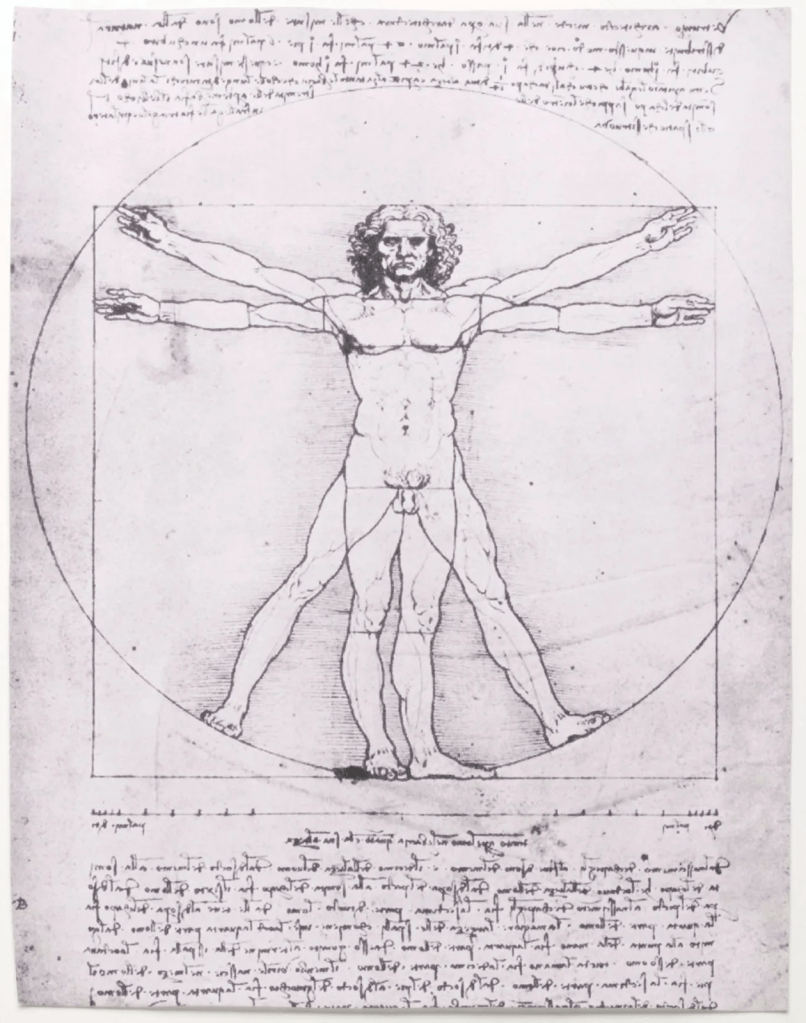
The twelve elementals only have a single sound. They indicate the presence or absence of the attributes attributed to them; they are always there although hidden at times. The chart below outlines the contents of Chap. V and it should be noted that these are modern additions to the Sefer Yetzirah and are not contained in the original ancient text. It should also be noted that the outline of the human being shown here is The Hanged Man or a reversal of the proper figure of a human being! The illustration of DaVinci’s Vitruvian Man shows how the human being is the microcosm of the the macrocosm in space.
| Letter | Sign | Month | Body Part | Attribute |
| Heh ה Jubilation | Aries (Fire) | March | Right foot | Speech |
| Vau/Vav ו Cane | Taurus (Earth) | April | Right kidney | Thought/Mind |
| Zayin ז Manacle/ Yoke | Gemini (Air) | May | Left foot | Motion |
| Chet ח Enclosure | Cancer (Water) | June | Right hand | Sight |
| Tet ט Snake | Leo (Fire) | July | Left kidney | Hearing |
| Yud י Arm | Virgo (Earth) | August | Left hand | Action |
| Lamed ל Study | Libra (Air) | September | Gall bladder | Coition |
| Nun נ Fish | Scorpio (Water) | October | Intestine | Smell |
| Samekh ס Prop | Sagittarius (Fire) | November | Kivah (Chest?) | Sleep Imagination |
| Eyin ע Eye | Capricorn (Earth) | December | Liver | Anger (?) |
| Tzadi צ Righteous | Aquarius (Air) | January | Stomach | Taste |
| Kuf (Qof) ק Monkey | Pisces (Water) | February | Spleen | Laughter |
The arrangements in the above chart appear to be based on the Lunar, not the Solar, calendar and do not follow precisely modern astrological associations. If one begins the start of the year with Aries in March, one begins with Fire. The numbers of the created things, the sensible things, begin at 4.
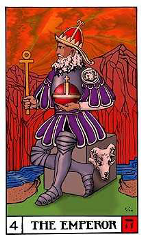
1 + 2 + 3 + 4 = 10, the totality of the whole. If one begins with January with Capricorn, one begins with Earth, and the numbers begin with material things. With the Kabbalah, the universe begins from air, proceeds to water then to fire then to earth. (The Emperor card of the Tarot #4, for instance, has rams’ heads embedded in the throne or seat, significant of Aries. This would indicate a predominance of the element fire mixed with earth, action or movement with material things. But the surroundings in the illustration of the Emperor are sterile for the most part. Does this indicate that the cycle begins with summer (Gemini, The Twins, The Lovers #6 card of Tarot, ruled by Mercury, and thus air and speech) and finds its completion in spring with the planting of the seeds in March where the ground only appears to be sterile but actually holds a great deal of promise?)
Kivah, associated with Sagittarius, means “protector” in Hebrew. It
seems to be related to ‘friendship’ or something someone can lean
on, a prop. This is the Hebrew letter Samekh. As a part of the body, it
would seem to relate to the chest, but I am unable to find its actual
relation (pancreas? spleen?). The mythological association would be
to Artemis, goddess of the hunt, the Archer, and the Moon and thus
the association with sleep, but the night is when she goes hunting.
The associations do not make too much sense in any case. The associations present us with a riddle and are meant to be obscure. It is a common feature of history that writers who are persecuted by the powers in authority come up with ingenious ways to present their truths while keeping themselves hidden from the authorities.
Sefer Yetzirah 5.2
5.2 These twelve letters, he designed, formed, combined, weighed, and changed, and created with them the twelve divisions of the heavens (namely, the zodiacal constellations), the twelve months of the year, and the twelve important organs of the frame of man, namely the right and left hands, the right and left feet, two kidneys, the liver, the gall, the spleen, the intestines, the gullet, and the stomach.
Wescott trans. 5.2. These Twelve Simple Letters He designed, and combined, and formed with them the Twelve celestial constellations of the Zodiac, whose signs are Teth, Shin, Tau, Samech, Aleph, Beth, Mem, Oin, Qoph, Gimel, Daleth, and Daleth. (45)31 The Twelve are also the Months of the Year: Nisan, (46)32 Yiar, Sivan, Tamuz, Ab, Elul, Tishri, Hesvan, Kislev, Tebet, Sabat and Adar. The Twelve are also the Twelve organs of living creatures: (47)33 the two hands, the two feet, the two kidneys, the spleen, the liver, the gall, private parts, stomach and intestines.
He made these, as it were provinces, and arranged them as in order of battle for warfare. And also the Elohim (48)34 made one from the region of the other.
Three Mothers and Three Fathers; and thence issue Fire, Air and Water. Three Mothers, Seven Doubles and Twelve Simple letters and sounds.
Wescott’s Notes to 5.2
45. These letters are the initials of the 12 Zodiacal signs in Hebrew nomenclature. They are: Teth Telah Aries, Mem Maznim Libra, Shin Shor Taurus, Oin Oqereb Scorpio, Tau Thaumim Gemini, Qoph Qesheth Sagittarius, Samech Sartan Cancer, Gimel Gedi Capricornus, Aleph Aryeh Leo, Daleth Dali Aquarius, Beth Bethuleh Virgo, Daleth Dagim Pisces.
46. The month Nisan begins about March 29th. Yiar is also written Iyar, and Aiar: the Hebrew letters are AIIR.
47. The list of organs varies. All agree in two hands, two feet, two kidneys, liver, gall and spleen. Postellus then gives, intestina, vesica, arteriae,” the intestines, bladder, and arteries; Rittangelius gives the same. Pistorius gives, “colon, coagulum (spleen) et ventriculus,” colon−−the large intestine, coagulum and stomach. The chief difficulty is with the Hebrew word MSS, which is allied to two different roots, one meaning private, concealed, hidden; and the other meaning liquefied. 48. The Elohim−−Divine powers−−not IHVH the Tetragrammaton.
Commentary on 5.2
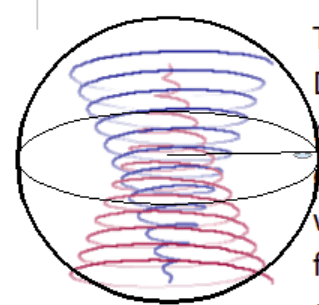
The twelve elementals indicate the circumference of the sphere and the circles within it. The boundaries outline the limits placed upon the unlimited and make it measurable so that it can be weighed and changed. The boundaries or limits give the outward appearance of the thing. They are indications of the limits of human knowledge which is confined to understanding the Laws of Necessity in their manifold representations. The cubic shape below indicates the limits of human perception.
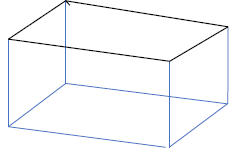
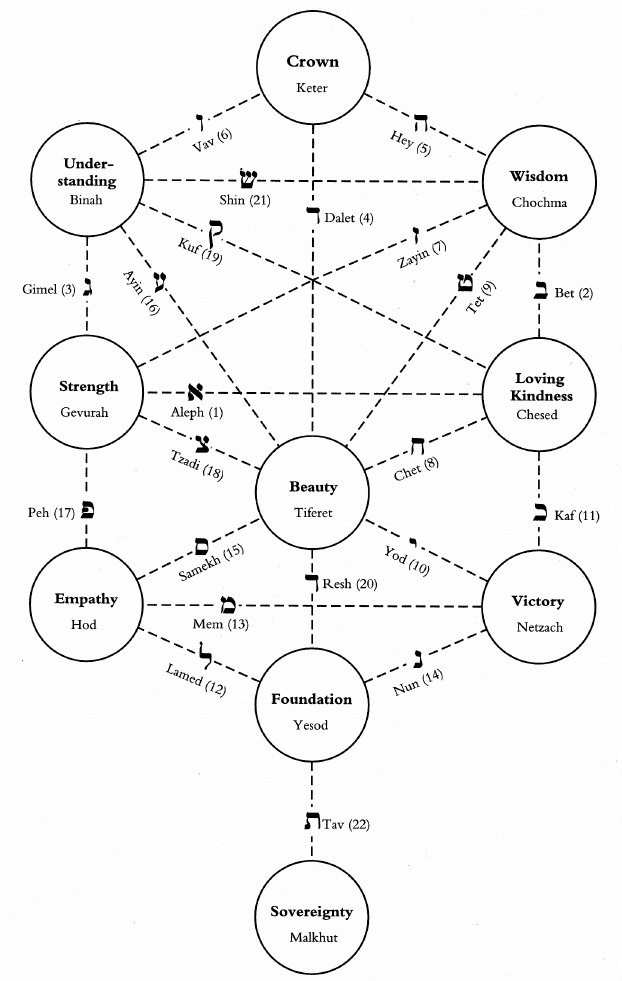
The twelve diagonals to the Tree of Life exist in a one-to-one relationship. The “boundaries” are the limits given to things so that they may appear in space. The boundaries are the realm of Necessity, that which has been imposed on the originary Chaos in order to allow creation to come into being. The Tree of Life is inscribed within a sphere. One must be at the centre of the sphere in order to avoid its oscillations or rotations within Time; one must be both within Time and beyond the realms of Space and Time. One must be at the point of infinity or “the vanishing point”. Thought on the diagonal boundaries assists one in distinguishing the Necessary from the Good; and this indicates why, for the ancients, the practice of geometry was a ‘religious practice’ similar to how we conceive prayer to be. True thinking is given in contemplation, attention and prayer. The thinking involved in the yetzirah realm of “creation” is the knowing and making that we call technology, the “in another for another” that deals with the world as ready-to-hand.
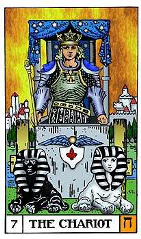
The #7 of The Chariot is the “riding” of the diagonals in the ascension of the Tree of Life. The Chariot is the “embodied soul” and its three living figures represent the tripartite nature of the soul. Netzach (The Chariot #7) and Hod (Justice #8) indicate a descent if the mediator is Yesod (Foundation, represented in Tarot by The Hermit #9), the lower form of eros. If the mediator is Tiferet (Beauty) or the higher form of Eros, the ascension is upward toward Gevurah or to Chesed. The Sephirot Tiferet stands at the meeting place of the worlds of Yetzirah and Beriyah. Tiferet is both the two-faced Eros and the two-faced Logos. Logos itself is composed of number, word and speech. It may be to the many (rhetoric) or it may be among two or three (dialectic).
Keter (from Katar “to surround”) as the Crown indicates the circular or spherical nature of the structure of Creation itself. This is also an indication that God has “descended” into His creation in the form of Beauty (Christ/Eros), in the Beauty of the World. Being at the centre of the circle or sphere is a “negation of the self” where one can become “God’s spies” (King Lear Act 5. Sc. 3), and this allows God to see His creation through those human beings who have attained this level of consciousness and perception. Attaining this level of consciousness, as was the case of King Lear, was achieved through great suffering and affliction. The purpose of suffering and affliction is the destruction of the ‘ego’ self that denies and defies the Other that is the Good. The danger coeval with philosophy is tyranny (see both Plato’s Republic and Symposium), but as King Lear points out to us, they are, in fact, opposite. What is clear from both the writings of Shakespeare and Plato is that this destruction or decreation of the ‘ego’-self is not easily accomplished. Philosophy is only for the few. The saints and the philosophers are few.
God is beyond and absent from His creation and needs human beings to view His creation, to “reveal” His creation to Him through them. (Being needs human beings to “reveal”, “unconceal” its truth). This, to say the least, is not easily done. Human beings by nature choose night and darkness instead of the path towards the Light (“descent” and “ascent” both operate according to Nature; they are subject to the laws of Necessity). For God to answer the supplications and prayers of His creatures, He must pass through the whole of His creation. Klipah or the “evil husks” must be breached before one enters the realm of the spiritual mysteries. (See William Blake’s notes on “The Book of Job”. ) This occurs at the second crossroads or the second re-birth and this corresponds to the Mother letter Alef א. This is the “baptism” of fire and water.
The 12 diagonals are the channels through which the energy of the dynamis or the Life-Force flows through the universe and they are the interface between the physical and the transcendental, that is between the material and the spiritual. They correspond to the realm of Time. They are associated with the twelve signs of the Zodiac, the 28 days of the Lunar calendar, and the “times” of the Book of Ecclesiastes (“a time to be born, a time to die, a time to rend and a time to sew” etc.) The arrangement of “names” gives the ability to “pre-dict”: 14 good times; 14 evil times. The 28 times are arranged on the circumference of the circle and Time indicates movement and change. The 28 times are arranged around the 12 constellations: 12 hours of the day; 12 hours of night.
Sefer Yetzirah Text 5.3
5.3 Three mothers, seven doubles and twelve simples, these are the twenty-two letters with which I H V H Tetragrammaton, that is our Lord of Hosts, exalted, and existed in the ages, whose name is Holy, created three fathers, fire and spirit and water, progressing beyond them, seven heavens with their armies of angels; and twelve limits of the universe.
Wescott trans. 5.3. Behold now these are the Twenty and Two Letters from which Jah, Jehovah Tzabaoth, the Living Elohim, the God of Israel, exalted and sublime, the Dweller in eternity, formed and established all things; High and Holy is His Name.
Commentary on 5.3
Below is an illustration of the twenty-two letters of the ancient Hebrew alphabet. The letters will be discussed in greater detail when we come to speak about “The Thirty-two Paths of Wisdom” later in this blog. What we highlight here is that in the Sefer Yetzirah, the creation comes from Word, the Logos.

The twelve elementals have only a single sound. The absence or presence of the attributes: they are always there, though they may be hidden; just as in every word we form, the remaining letters of the alphabet remain present but hidden.
12 months, 12 tribes, 12 signs of the Zodiac, 12 Books of Plato’s Laws. Whereas the Mothers and the Doubles are concerned with individual spiritual elements, the 12 elementals seem to designate the social, time, and the limits of space within time.
Here in Chapter 5, the significance of the triad, heptad and dodecad (3, 7 and 12) are highlighted. From the three Fathers of fire, air and water, the physical universe was created in the form of 7 heavens (planets) and the 12 limits of space (12 Zodiac constellations). The relation of the Zodiac to the Sefer Yetzirah will be discussed in greater detail later.
Wescott Notes to Chapter V
This chapter is specially concerned with the Dodecad; the number twelve is itself pointed out, and the characters of its component units, once more in the three zones of the universe, year and man; the last paragraph gives a recapitulation of the whole number of letters: the Supplement gives a form of allotment of the several letters.
43. It is necessary to avoid confusion between these letters; different authors translate them in different manners. Heh or Hé not be confused with Cheth, or Heth, Ch. Teth, Th also must be kept distinct from the final letter Tau, T, which is one of the double letters; the semi−English pronunciation of these two letters is much confused, each is at times both t and th; Yod is either I, Y, or J; Samech is simple S, and must not be confused with Shin, Sh, one of the mother letters; Oin is often written in English Hebrew grammars as Ayin, and sometimes as Gnain; Tzaddi must not be confused with Zain, Z; and lastly Qoph, Q, is very often replaced by K, which is hardly defensible as there is a true K in addition.
44. Postellus gives suspicion and Pistorius, mind.
45. These letters are the initials of the 12 Zodiacal signs in Hebrew nomenclature. They are:
Teth Telah Aries Mem Maznim Libra
Shin Shor Taurus Oin Oqereb Scorpio
Tau Thaumim Gemini Qoph Qesheth Sagittarius
Samech Sartan Cancer Gimel Gedi Capricornus
Aleph Aryeh Leo Daleth Dali Aquarius
Beth Bethuleh Virgo Daleth Dagim Pisces
46. The month Nisan begins about March 29th. Yiar is also written Iyar, and Aiar: the Hebrew letters are AIIR.
47. The list of organs varies. All agree in two hands, two feet, two kidneys, liver, gall and spleen. Postellus then gives, intestina, vesica, arteriae,” the intestines, bladder, and arteries; Rittangelius gives the same. Pistorius gives, “colon, coagulum (spleen) et ventriculus,” colon−−the large intestine, coagulum and stomach. The chief difficulty is with the Hebrew word MSS, which is allied to two different roots, one meaning private, concealed, hidden; and the other meaning liquefied.
48. The Elohim−−Divine powers−−not IHVH the Tetragrammaton.


 Theory of Knowledge: An Alternative Approach