What is Called Thinking

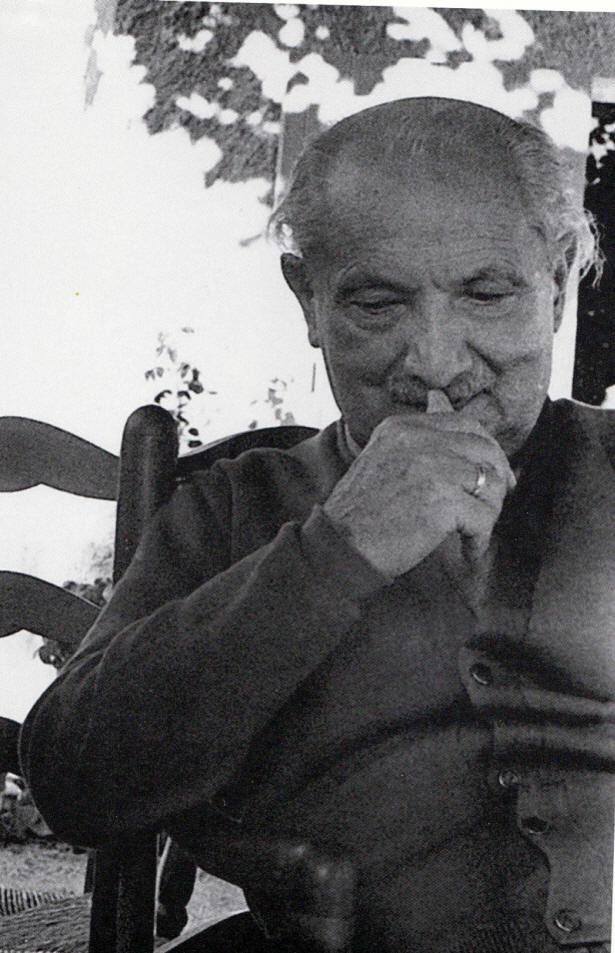
Martin Heidegger

“The answer to the question “What is called thinking?” is, of course, a statement, but not a proposition that could be formed into a sentence with which the question can be put aside as settled…The question cannot be settled, now or ever…Thinking itself is a way. We respond to the way only by remaining underway.” (Heidegger: What is Called Thinking?) 

Aristotle

“Just as it is with bats’ eyes in respect of daylight, so it is with our mental vision in respect of those things which are by nature most apparent.” Aristotle (Metaphysics​ Ch. I, Bk 2, 993b)

“The conditions of the possibility of experience in general are at the same time conditions of the possibility of the objects of experience.” Kant (Critique of Pure Reason, A 158, B 197) (Plato’s Divided Line: B=C)

“There are these two young fish swimming along and they happen to meet an older fish swimming the other way, who nods at them and says ‘morning, boys. How’s the water?’ and the two young fish swim on for a bit, and then eventually one of them looks over at the other and goes ‘what the hell is water?'”- David Foster Wallace. Kenyon. 2005.

Thinking and TOK

TOKQuestion

This writing on Thinking attempts to show how thinking is not so much an “act” or “activity” as it is a way of living or dwelling or, as North Americans would say, “a way of life”, a “lifestyle”. It is a remembering of who we are as human beings and where we belong. It is our struggle to gain self-knowledge and conscious awareness of our being-in-the-world and our being-with-others.

This writing builds on what has been discovered in the reading of Plato’s Allegory of the Cave and attempts to continue on the path to understanding the relationship between “education” and “truth”.

To begin with, thinking is not “having an opinion” or a notion about something. It is not representing or having an idea about something or about some state of affairs. Thinking is not “ratiocination”, developing a chain of premises which lead to a valid conclusion. Lastly, it is not conceptual or systematic. “We come to know what thinking means when we ourselves try to think” (Heidegger).

Thinking involves a questioning and a putting ourselves in question as much as the cherished opinions and doctrines we have inherited through our education or our shared knowledge. Putting in question is not a “method” that proceeds from “doubt” as it was for Descartes. The questioning or inquiring is a “clearing of the path” (and anyone who has had to ‘clear a path’ through dense jungle in this part of the world knows the difficulty of “clearing a path”) with no destination in mind. Questioning and thinking are not a means to an end; they are self-justifying.

But the paths often become “dead-ends”: and our age abhors “dead ends”. The approach to thinking that is thought here is to bring to light what is currently called thinking and to “awaken” a new approach to “what calls for thinking” which is the essence of what you are asked to do in the TOK course.

How is thinking to be distinguished from “method”? What is the relationship between memory as a way of knowing and thinking? Does any “thinking” take place in the areas of knowledge of TOK? Is there room for thinking in TOK i.e. an openness to thinking?

The great work of literature on the relationship between thinking, method and memory is Shakespeare’s Hamlet. Polonius’ observation of Hamlet: “Tho’ this be madness yet there is method in it” could be used as an opening or a way into an analysis of our times. “Rationality” as method may not necessarily be sane…

What is thinking? What Calls for Thinking?

“We all still need an education in thinking, and first of all, before that, knowledge of what being educated and uneducated in thinking means. In this respect Aristotle gives us a hint in Book IV of his Metaphysics (1006a if.): . . – “For it is uneducated not to have an eye for when it is necessary to look for a proof and when this is not necessary.”—Martin Heidegger “The End of Philosophy and the Task of Thinking”

To examine what thinking is and to ask the further question of what calls for thinking, we shall examine what is called thinking and what the philosophers have thought on thinking. We shall try to stay mindful of how the understanding of thinking’s essence and what is called thinking today is a result of the manner in which Plato’s allegory of the cave came to be interpreted, primarily by the Greek philosopher Aristotle. When we are exhorted to think “outside of the box”, the manner of the thinking that we are exhorted towards still remains within the “box” in which thinking has been traditionally framed. This thinking remains an “active doing” upon the objects that present themselves before us.

heidegger

The 20th century’s great philosopher, Martin Heidegger, said: “Most thought-provoking is that we are still not thinking – not even yet, although the state of the world is becoming constantly more thought-provoking.” (What is Called Thinking? 4) For us, thinking is traditionally thought to be “rationality”, “reason”, “judgement”. Heidegger, somewhat provocatively, says: “[M]an today is in flight from thinking.” (Discourse on Thinking 45) Not only do we not think; human beings are actively avoiding thinking.

For Heidegger, all the scientific work today, all the research and development, all the political machinations and posings, even contemporary philosophy, represents a flight from thinking. “[P]art of this flight is that man will neither see nor admit it. Man today will even flatly deny this flight from thinking. He will assert the opposite. He will say – and quite rightly – that there were at no time such far-reaching plans, so many inquiries in so many areas, research carried on as passionately as today. Of course.” (Discourse on Thinking 45)

But for Heidegger, science does not think: and this is its blessing. “This situation is grounded in the fact that science itself does not think, and cannot think – which is its good fortune, here meaning the assurance of its own appointed course.” (What is Called Thinking? 8) What Heidegger is saying is that if science actually thought, we would cease to have science as we know it. And if this should happen, we would no longer have clean toilets, penicillin, and all of the wonderful discoveries of science.

We shall never learn “what is called swimming”, for example, or “what calls for swimming” by reading a book on swimming. Only a leap into the deep end of the pool will tell us what is called swimming and what calls for swimming. The question of “what is called thinking?” can never be answered by proposing a definition of the concept thinking.

Historically, in the West, thought about thinking has been called “logic” which we have associated with “reason as a way of knowing”. This “logic” has received its flowering in the natural and human sciences under the term “logistics” and the preponderance of the algorithms that rule our social media. Logistics, today, is considered the only legitimate form or way of knowing because its results and procedures ensure the construction of the technological world. Logistics is an interesting word in that its use as a noun implies “symbolic logic” (mathematical algebraic calculation) and the conduct of warfare. Its use as mathematical calculation is found in what is called logical positivism which is a new branch of the branch of philosophy that was previously known as empiricism. The thinking here is the thinking expressed as algebraic calculation: only that which can be calculated can be known and is worth knowing.

To elaborate how this has come to be the case would require an analysis of 17th century philosophy and mathematics beyond what we intend in this writing. Suffice it to say that this is part of our inherited shared knowledge that we have received from the philosopher Rene Descartes. It is called Cartesianism.

Calculative Thinking:

Today we think that thought is the mind working to solve problems. We can see this in many of the quotes that are looked to as words of inspiration for young people. Thought is the mind analyzing what the senses bring in and acting upon it. Thought is understanding circumstances or the premises of a situation and reasoning out conclusions, actions to be taken. This is thinking, working through from A to B in a situation. Thoughts are representations of the world (real or not doesn’t matter, only the mind’s action does), or considerations about claims or representations (knowledge issues or questions), and the conclusions that are made. We think we know exactly what thought is because it is what we think we do. And as the animal rationale, the “rational animal”, how is it possible for thinking to be something we can fly from as it is our nature? Any examination of materials for approaching TOK illustrates, rather clearly, that we assume we already know what thinking is, what knowledge is. This is shown in the “to what extent…” beginnings of so many questions that are asked in TOK.

When we use the word ‘thinking’, our thought immediately goes back to a well-known set of definitions that we have learnt in our life or in our studies, what we have inherited from our shared knowledge. To us thinking is a mental activity that helps us to solve problems, to deal with situations, to understand circumstances and, according to this understanding, to take action in order to move forward. Thinking for us also means to have an opinion, to have an impression that something is in a certain way. Thinking means reasoning, the process of reaching certain conclusions through a series of statements. Thinking is “a means of mastery” or control over the ‘problems’ which confront us in our achieving of our ends.

On the special kind of thinking that occurs in science, Heidegger says that it is true that “[s]uch thought remains indispensable. But – it also remains true that it is thinking of a special kind.” (Discourse on Thinking 45) That is, reasoning, rationalization, analysis by concept, logical operation are all part of a particular form of thought, one with presuppositions and operational rules. This is, and has been called, “method”. It is the thinking that you are required to do in order to be successful in the TOK course. It is not, however, a universal way of thought. Nor is it the oldest means of thought; human beings of the past did not approach the world in the manner given by Aristotle, but rather human beings (Aristotle, specifically) had to think in this manner after reaching certain conclusions about the world and human nature. For Aristotle, this view came from his understanding and critique of the Greek philosopher Plato.

The kind of thinking we are probably accustomed to is what Heidegger names “calculative thinking”, and it is the thinking proper to the sciences and economics, which we, belonging to the technological age, mainly — if not solely — employ. Calculative thinking, says Heidegger, “calculates,” “plans and investigates” (1966b, p. 46); it sets goals and wants to obtain them. It “serves specific purposes” (ibid., p. 46); it considers and works out many new and always different possibilities to develop. The apogee of such kind of thinking is Artificial Intelligence.

Despite this productivity of a thinking that “races from one aspect to the next”; despite the richness in thinking activities proper to our age, and testified by the many results obtained; despite our age’s extreme reach in research activities and inquiries in many areas; despite all this, nevertheless, Heidegger states that a “growing thoughtlessness” (1966b, p. 45) is in place and needs to be addressed. This thoughtlessness depends on the fact that man is “in flight from thinking” (ibid., p. 45).

Thoughtlessness”, Heidegger states, “is an uncanny visitor who comes and goes everywhere in today’s world. For nowadays we take in everything in the quickest and cheapest way, only to forget it just as quickly, instantly. Thus one gathering follows on the heels of another. Commemorative celebrations grow poorer and poorer in thought. Commemoration and thoughtlessness are found side by side. (1966b, p. 45)

In the writing on Technology as a Way of Knowing, I have tried to show an example of this by comparing the “making” of the Japanese tea ceremony cup with the ubiquitous Styrofoam cup. The ‘creator’ of the Styrofoam cup, the patent holder, is Dow Chemical, the provider of the funds for Harvard’s “Project Zero”, and they, in turn, provide a number of IB educational institutions with their expertise on “what is called thinking” and are giving the techniques of thinking that will be used in the classrooms of those institutions. What/how are the ends of Dow Chemical, as a corporation, in alignment with the ends of the student learner outcomes as in the IB Learner Profile? How do Dow Chemical’s end contribute to our understanding of what “human excellence” is?

Calculative thinking, despite being of great importance in our technological world, is a thinking “of a special kind.” It deals, in fact, with circumstances that are already given, and which we take into consideration, to carry out projects or to reach goals that we want to achieve. Calculative thinking does not pause to consider the meaning inherent in “everything that is”. It is always on the move, is restless and it “never collects itself” (Heidegger 1966b, p. 46). This fact, paradoxically, hides and shows that humanity is actually “in flight from thinking.” Now, if it is not a question of calculative thinking, then what kind of thinking does Heidegger refer to when he speaks of another way of thinking that might be possible for human beings? And why, if at all, is there a need for it? A possible answer might be that because we have no problem in understanding the importance of calculative thinking, we probably are not so clear about the need, in our existence, for a different kind of thinking.

What Heidegger is saying, however, is something else. His thesis is that “reasoning” is not what thought really is. It is not the essence that defines thought. This is not to say that scientific thought is faulty, as Heidegger reiterates again and again. “The significance of science here (in the modern) is ranked higher here than in the traditional views which see in science merely a phenomenon of human civilization.” (What is Called Thinking? 22) How did science come to have this higher ranking?

Another Way of Thinking: “Poetically Man Dwells…”

Heidegger distinguishes from the traditional concept of thought (what he calls calculative thinking) a second form of thinking, ‘poetic’ thinking (meditative, contemplative thinking). Contrary to what it is commonly thought of, ‘poetic’ thinking is not a kind of thinking that is to be found “floating unaware above reality”, losing touch with reality. Nevertheless, the thinking he is proposing “is worthless for dealing with current business. It profits nothing in carrying out practical affairs.” (Discourse on Thinking 46)

In the “Memorial Address,” Heidegger speaks of two kinds of thinking: the above mentioned “calculative thinking” and “‘poetic’ thinking” (1966b, p. 46). ‘Poetic’ thinking is a kind of thinking man is capable of, it is part of his nature; but nevertheless it is a way of thinking that needs to be awoken. When Heidegger states that man is “in flight from thinking” (1966b, p. 45), he means flight from ‘poetic’ thinking. What distinguishes ‘poetic’ thinking from calculative thinking? What does ‘poetic’ thinking mean? It means to notice, to observe, to ponder, to awaken an awareness of what is actually taking place around us and in us.

‘Poetic’ thinking does not mean being detached from reality or, as Heidegger says,  “floating unaware above reality” (1966b, p. 46). It is also inappropriate to consider it as a useless kind of thinking by stating that it is of no use in practical affairs or in business. These considerations, Heidegger states, are just “excuses” that, if on the one hand appears to legitimize avoiding any engagement with this kind of thinking, on the other hand attests that ‘poetic’ thinking “does not just happen by itself any more than does calculative thinking” (1966b, p. 46-47). ‘Poetic’ thinking requires effort, commitment, determination, care, practice, but at the same time, it must “be able to bide its time, to await as does the farmer, whether the seed will come up and ripen” (Heidegger 1966b, p. 47).

‘Poetic’ thinking does not estrange us from reality. On the contrary, it keeps us extremely focused on our reality, on the essentials of our being, ‘existence’. To enact ‘poetic’ thinking, Heidegger says that we need to:

dwell on what lies close and meditate on what is closest; upon that which concerns us, each one of us, here and now; here, on this patch of home ground; now, in the present hour of history. (1966b, p. 47)

Even though “man is a thinking, that is, a meditating being” we need to train (“educate”) ourselves in the ability to think ‘poetically’, to look at reality, and thus ourselves, in a ‘poetic’ way. The cost of not doing so would be, Heidegger states, to remain a “defenseless and perplexed victim at the mercy of the irresistible superior power of technology” (ibid., p. 52-53). We would be – and today, more so than sixty years ago, when Heidegger gave this speech – victims of “radio and television,” “picture magazines” and “movies”; we would be “chained” to the imaginary world proposed by these mediums, and thus homeless in our own home. It is fairly clear that Heidegger has Plato’s allegory of the Cave in mind here. Heidegger further states:

all that with which modern techniques of communication stimulate, assail, and drive man – all that is already much closer to man today than his fields around his farmstead, closer than the sky over the earth, closer than the change from night to day… (Heidegger 1966b, p. 48)

It is very easy to see how much further from the openness around us we are when we are dwellers in our cities or see ourselves as avatars in virtual worlds on our computers given the pastoral description that Heidegger provides here.

If we view our current thinking in the light of Plato’s Cave, we can see that the risk for humanity in our current approach to thinking is to be uprooted not only from our reality, from our world, but also from ourselves and from our natures as human beings. If we think ‘poetically’, however, we allow ourselves to be aware of the risk implied in the technological age and its usefulness, and we can hence act upon it. We can experience some of the freedom which is spoken about in Plato’s allegory when we are brought out into the Open where the light of the Sun shines and things are shown to us in their own being as they really are.

When we think ‘poetically’ we do not project an idea, planning a goal towards which we move, we do not “run down a one-track course of ideas” (ibid., p. 53). When we think ‘poetically’, we need to “engage ourselves with what at first sight does not go together at all” (ibid, p.53).

In order to understand what this means, think of the comportment (disposition) we have towards technological devices. We recognize that in today’s world technological machineries and devices are indispensable. We need just  think of computers and their usage in daily life activities to be convinced, beyond any doubt, that “we depend on technical devices” (Heidegger 1966b, p.53). By thinking calculatively, we use these machineries and devices at our own convenience; we also let ourselves be challenged by them, so as to develop new devices that would be more suitable for a certain project or more accurate in the carrying out of certain research. (Think of the “madness” regarding the release of Apple’s latest IPhone or IPod.) We even allow our language to be determined by the machines and devices that we use (see Language as a WOK).

If calculative thinking does not think beyond the usefulness of what it engages with, ‘poetic’ thinking, on the other hand, would notice and become aware of the fact that these devices are not just extremely useful to us. It would also notice that they, by being so extremely useful, are at the same time “shackling” us: “suddenly and unaware we find ourselves so firmly shackled to these technical devices that we fall into bondage to them” (ibid., p. 53-54). If human beings, not being aware of this, are in a situation of being chained to their technological devices and tools, then by becoming conscious of this they find themselves in a different relation to them. They become free of them. With this awareness human beings can utilize these instruments just as instruments, being at the same time free to “let go of them at any time” (ibid., p. 54). And this is so because once we acknowledge that their usefulness implies the possibility for us to be chained to them, we deal with them differently; we “deny them the right to dominate us, and so to wrap, confuse, and lay waste our nature” (ibid. p.54). It is a matter of a different comportment (disposition) towards them; it is a different disposition to which Heidegger gives the name “releasement toward things” or “detachment” from the things (ibid, p.54). This “releasement” and “detachment” means an “openness” or “availability” to what-is so as to allow that which is to be present in its mystery and uncertainty. (See Plato’s Cave and the “openness” required to view the beauty of the forms and ideas in their “outward appearance” on the outside of the Cave.)

“Releasement” toward things is an expression of a change in thinking and, similarly to Plato’s prisoners in the Cave, a change in their being in the world. Thinking is not just calculation, but ponders the meaning involved and hidden behind what we are related to and engaged with. This hiddenness, even if it remains obscure, is nevertheless detected – by a meditating thinking – in its presence, a presence that “hides itself.” But, as Heidegger states:

if we explicitly and continuously heed the fact that such hidden meaning touches us everywhere in the world of technology, we stand at once within the realm of that which hides itself from us, and hides itself just in approaching us. That which shows itself and at the same time withdraws is the essential trait of what we call the mystery. I call the comportment which enables us to keep open to the meaning hidden in technology, openness to the mystery. (1966b, p. 55)

“Releasement towards things” and “openness to the mystery” are two aspects of the same disposition, a disposition that allows us to inhabit the world “in a totally different way.” But as we already mentioned, this disposition does not just happen to us. It develops through a “persistent courageous thinking” (ibid., p. 56), which is ‘poetic’ thinking.

The traditional concept of thinking intends thinking as a representing, and therefore as belonging to the context of willing (action). It is still involved with a subjectivism. Subjectivism is “setting up the thinking ‘subject’ as the highest principle of Being, and subordinating everything to the dictates and demands of the subject”. It is what we have come to call “humanism”.

Probably when we hear the word “acting” we immediately relate it to a familiar concept of action, such as the one that thinks of action as that which produces some kind of result, which means that we understand action in terms of cause and effect. To understand what Heidegger means by “higher acting,” we need to refer to the essential meaning that, according to Heidegger, pertains to ‘action’.

In the “Letter on Humanism” (1998b), Heidegger defines the essence of action as “accomplishment”, and he unfolds the meaning of accomplishment as “to unfold something into the fullness of its essence, to lead it forth into this fullness – producere” (1998b, p. 239). “Higher acting” is not, therefore, an undertaking towards a practical doing, but is a ‘higher’ acting as accomplishment, in the sense of leading forth of some thing into the fullness of its essence.

Releasement itself is what makes this available to man. For Heidegger, “higher acting” remains a techne, but it is “making”, a producing or accomplishing, that is more of a poiesis (poetry, for lack of better word) than the cheap, quick making of our production lines. In poiesis, human beings allow something to be in its mystery while at the same time bringing forth of that ‘some thing’ from out of the hiddenness in which it once resided.

Heidegger’s ‘poetic’ thinking is contrasted with the thinking that is present in Aristotle’s four causes: the material cause, the formal cause, the final cause and the sufficient cause.

The conventional view of perception is what is called representational. Representation “places before us what is typical of a tree, of a pitcher, of a bowl . . . as that view into which we look when one thing confronts us in the appearance of a tree, . . .” (Discourse on Thinking 63) Objects are there; they are perceived in both their form and idea (the mathematical as something which can be known).

Heidegger does not think of perception in this manner. Heidegger also includes something called horizon (time), which is, in keeping with the definition, the horizon or limits of that which we perceive (space). Objects are within a horizon, but we do not place them there; rather they “come out of this (openness of the horizon) to meet us.” (Discourse on Thinking 64) For Heidegger, “the Open” that we discussed as outside of Plato’s Cave is that area or realm in which objects can be perceived. Rather than actively search out objects to represent, or passively allowing things to enter into our sense experience, Heidegger believes that we have a sort of “active reception,” where that which is present “comes out to meet us.” The proper state towards that which is perceived is called “unconcealment”; thinking is “in-dwelling in unconcealment to that-which-regions.” (Discourse on Thinking 82) For Heidegger, this thinking is not a “grasping” or an “apprehending” but a “releasement” that allows the thing to be in its being as what it is in the “Openness” of the horizon of its being.

If we think of Heidegger’s “Open” as the region outside of the Cave, we will be close to what Heidegger means by this term (but it should be remembered that for Heidegger, the Cave is our “home”). Whereas Plato emphasizes the “open” as that region outside of the Cave, and thus focuses on “space”, Heidegger’s focus is more on Time as the region where the “Being of beings” is “sighted”. Our conventional thinking is an “active doing” whose purpose is to “change” or to “apprehend” what is in being and to make it a part of our “standing reserve” or as some thing disposable for our use at a later time. Heidegger’s thinking is more related to the Vedanta ananda or “bliss” as being in thinking itself.

What Calls for Thinking:

We cannot properly address the question What Is Called Thinking? without answering the question What Calls For thinking? This distinction between the two questions and the priority given to “what calls for thinking” over “what is called thinking” will be the focus of these discussions on thinking, and this will focus on “rationality” as what has come to be called thinking.

According to Heidegger, one is not thinking if one does not rank the objects of thought in terms of thought-worthiness. This point flies in the face of many contemporary accounts of rationality, for they suggest that one can be thinking well as long as one is following the right method. The emphasis today is on the method of what is called thinking. What one thinks about does not provide the standard for the role on such “ratio-inspired” accounts of thinking (see below for the contrast to legein-inspired or language-inspired models); indeed, critical thinking has come to mean critical whatever method-following thinking instead of critical whatever essential thinking. Heidegger’s point is that such means-end accounts involve and indeed propagate a distortion; a life spent rationally researching the history of administrative memos and emails is not a thoughtful life.  In rationally pursuing anything and everything we are not thinking.

Meta-analysis, meta-cognition, meta-linguistics and all other “meta”-prefixed approaches to thinking remain in the realm of “method” thinking and need to be contrasted with “logos” thinking. This is because these “meta” forms of thinking remain in the realm of the traditional thinking in Western “metaphysics”.

You will notice in many of your classes that you are encouraged to become “inquirers”. This is an attempt to re-introduce philosophy of some kind into the curriculum. The philosopher differs from the chess player, biologist, and politician in that the philosopher’s calling is to think about thinking as such. Moreover, to think philosophically about thinking, is to come to a confrontation with a mode of existing–“being-thoughtful”–and thereby with Being and how you stand in Being.

The Greek experience of thinking was grounded on a link between thinking and Being. This link is present in the earliest Greek thinking and carries over into the works of Plato and Aristotle. With Socrates in particular one catches the notion that built into thinking was a directedness towards order (particularly order within one’s self), goodness, beauty, truth, and Being.  Aristotle’s remarks on God and nature also underline this link. It is more revealing, Aristotle holds, to consider the relation between God and the world in terms of God as idea rather than God as creator or cause. God as idea can explain the striving of natural substances; the acorn seeks to become an oak, and thereby reproduce, and thereby the acorn mimics God’s eternality. In the same way, the human infant is on its way to becoming a thinking being, and so the human’s telos (purpose) is to mimic the highest being’s thinking. Moreover, Aristotle wonders what God would think about, and concludes that thought thinking thought is the only befitting topic for the most divine activity. The philosopher par excellence thus mimics the highest being (God) not only by thinking, but also by thinking about thinking.

What calls for thinking in our time? What is it that you should think about to be “educated”? The present age is the technological age, the age in which brain currents are recorded but the beauty of a tree in bloom is forgotten. What is thought-provoking about our time? Heidegger claims that what is thought-provoking about our time is that we are still not thinking. But what is it about our time that explains why we are still not thinking?

Heidegger diagnoses this age as the time of nihilism. The dominant characteristic of our time, then, is the forgetting or withdrawal of Being, and it is this that explains why we are still not thinking–even as we attempt to mimic intelligence via computer programs or connectionist (social) networks. We call to mind that in the allegory of Plato’s cave, “beauty” and “truth” must be “apprehended” as they will slip into “forgetfulness” or “forgottenness”. Our focus is on a “beauty” that withdraws (the physical appearance; the beauty in the “eye of the beholder”) the beauty that is “subjective” and belongs to the “subject” rather than on the Beauty that presences right before our very eyes in all that is in Being.

We are more distant from Being because the experience of thinking–in our technological age–has been shrunk to that of using a tool to operate within an already-fixed network of ends. This age, in other words, is more thought-provoking because in it ratio has triumphed over legein; thinking has become so severed from the being-thoughtful that the thoughtful being is in danger of being entirely eclipsed. This triumph of ratiocination is discussed further in imagination as a way of knowing.

We are still not thinking–despite Plato’s directive–because we have missed the object and source of thinking—Being, that thinking which occurs in the region of the “Open” outside of the Cave. We will continue to miss this thinking as long as we merely use thinking and do not dwell as thoughtful. All genuine thinking arises from and returns back to thoughtful existence; “thinking” that is not so anchored is homeless “thinking”, e.g., calculating, computing, or even reasoning, or all of the “meta” approaches to thinking that were mentioned earlier. Thoughtful dwelling in the region of the “Open” is the existential ground of thinking; in such a mode we can hear what calls for thought.

The loss of thoughtful dwelling can be “remembered” by looking back to the Greek thinking experience in order to recover that which has been lost in the translation of the Greek legein into the Latin ratio. Legein carries with it two significations that are not preserved by the Latin ratio: thinking as speaking and thinking as gathering. Thinking moved from that which is bound in sense perception as a way of knowing to thinking that thinks in language as a way of knowing is the direction for thought.

Thinking as speaking, as language. Being calls for thinking, i.e., for articulation, and thus to let Being be in language is thinking. William Blake’s Songs of Innocence, for example, houses the carefree Being of playing children. The language of thinking plays a crucial role in the poetry of Blake. That we are not thinking because we are not “mindful” of the language of thinking can be seen in how our technology is taking over the role of language in our being. A full elaboration of this idea is impossible here, but the claim, roughly, is that to be thoughtful is to exist as authentically immersed in language.

To begin, “the language of thinking”… all of these phrases can be taken either in the subjective or objective genitive, and those are possibilities on which we should reflect in our thinking. The phrase, “the idea of God”, for example, can mean “God’s idea” in the subjective genitive and “the idea about God” in the objective genitive. In like manner the phrase “the language of thinking” means “thinking’s language” or “the language found in thinking” in the subjective genitive and “language about thinking” in the objective genitive. The difference, then, is between the language found in thinking generally and the language found in thinking about thinking.

Thinking as gathering. Legein signifies gathering and the gathered. Thinking demands…that we engage ourselves with what at first sight does not go together at all.

Thinking is the gathering of that which calls to be gathered–the modes of our existence and Being as such. Thinking can begin when we hear that which calls for thinking:

Joyful things, too, and beautiful and mysterious and gracious things give us food for thought…if only we do not reject the gift by regarding everything that is joyful, beautiful, and gracious as the kind of thing which should be left to feeling and experience, and kept out of the winds of thought. Only after we have let ourselves become involved with the mysterious and gracious things as those which properly give food for thought, only then can we take thought also of how we should regard the malice of evil. (Heidegger: What is Called Thinking? P. 31)

Thinking, then, is not so much a matter of being an expert or technician in a field–even if the field be philosophy–as it is being responsive to the various ways of being of who we are, and this points to the existential modality or disposition of “being thoughtful” as the ground of thinking.

We may now state some conclusions about thinking:

  1. Those who take as the object of their theories a purely mental activity, “thinking”, are missing the richest part of the phenomenon: being-thoughtful.
  2. Being-thoughtful is not essentially a mental activity; it is rather the encounter with Being (the manifesting of meaning which occurs in the ‘showing’ through the beautiful).
  3. Means-end analyses sever thinking from its existential ground; one can be “means-end” rational and yet not thoughtful (and this is the thinking which occurs in the technological world view of logical positivism).
  4. Receptivity is the distinguishing mark of thoughtful being; the mastering thinking of the human sciences and the natural sciences in their demanding stance towards being and beings do not think; Nietzsche, who stated that what characterizes contemporary science is the victory of scientific method over science, the victory of method over thought.

Thinking and Language:

What is it that is named in “thinking”, “think”, “thought”? The Old English ​thencan, ​​to think, and ​thancian, to thank, are closely related; the Old English noun for thought is thanc ​or thonc–a thought, a grateful thought, and the expression of such a thought; today it survives in the plural “thanks”. ​The “thanc”, that which is thought, the thought implies thanks.
blase-pascal1
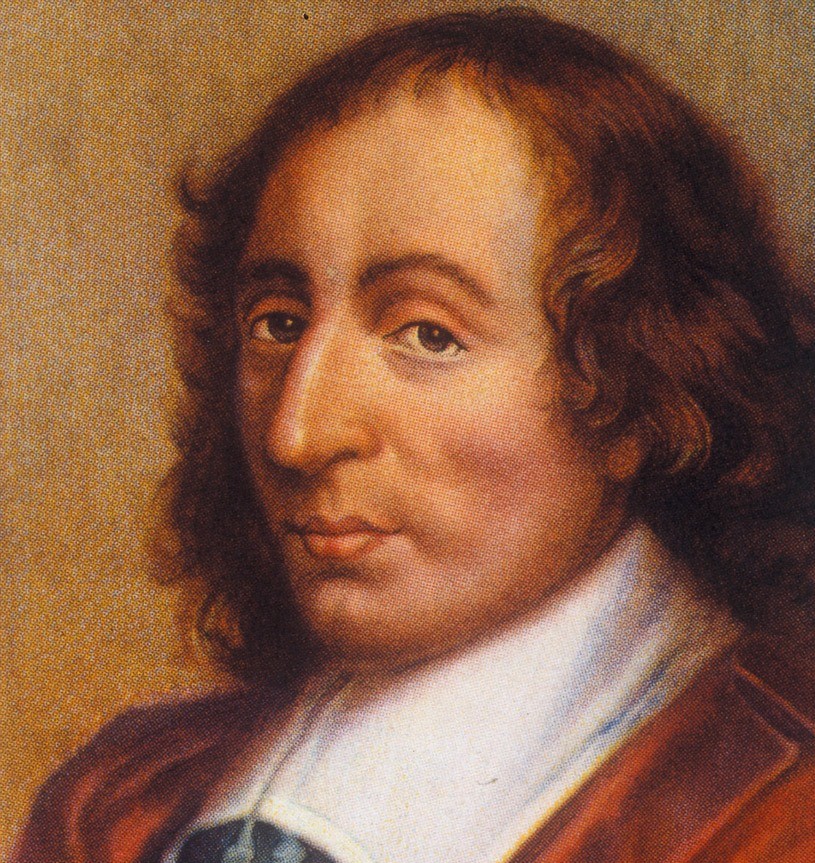
Blaise Pascal

Is thinking a giving of thanks? Or do the thanks consist in thinking? What does thinking mean here? “Thought” to us today usually means an idea, a view, an opinion or a notion. Pascal, the French mathematician and contemporary of Descartes, in his journals given to us as Pensees, ​​searched for a type of “thinking of the heart” that was in conscious opposition to the mathematical thinking prevalent in his day. Thought, in the sense of logical-rational representations (concepts), was thought to be a reduction and impoverishment of the word “thinking”. Thinking is the giving of thanks for the lasting gift which is given to us: our essential nature as human beings, which we are gifted through and by thinking for being what we essentially are.

“The gathering of thinking back into what must be thought is what we call the memory”. (Heidegger).

Today, some perceive that the task facing thinking is the overcoming of what is now described as its weaknesses:

  1. Thinking does not bring knowledge as do the sciences;
  2. Thinking does not produce usable practical wisdom;
  3. Thinking solves no cosmic riddles;
  4. Thinking does not endow (or empower) us directly with the power to act.

These observations of thinking’s weaknesses overrate and overtax thinking.

The question “What is called thinking?” can be asked in four ways:

  1. What is designated by the word “thinking”?
  2. What does the prevailing theory of thought, namely logic, understand by thinking?
  3. What are the prerequisites we need to perform thinking rightly?
  4. What is it that commands us to think?

Resources

References:

—— (1966a). Conversation on a Country Path about Thinking. In: Martin Heidegger, Discourse on Thinking. Trans. John M. Anderson and E. Hans Freund. New York: Harper and Row.

—— (1966b). Discourse on Thinking. Trans. John M. Anderson and E. Hans Freund. New York: Harper and Row.

——(1968). What is Called Thinking?. Trans. J. Glenn Gray. New York. Harper and Row.

Sketch For A Portrait of Evil: The Essence of Evil: Sections III and IV

Section III: The Individual: Evil and Plato’s Divided Line

Plato’s discussion of the Divided Line occurs in Bk VI of his Republic. In Bk VI, the emphasis is on the relation between the just and the unjust life and the way of being that is “philosophy”. Philo-sophia is the love of the “whole” for it is the love of “wisdom” which is knowledge of the whole. Since we are a part of the whole, we cannot have knowledge of the whole. This, however, should not deter us from seeking knowledge of the whole and, indeed, this seeking is
urged upon us by nature, by our nature. All human beings are capable of ‘philosophy’, but only a very few are capable of becoming philosophers. All human beings are capable of “good deeds”, but only a very few are capable of being saints.

The whole is the Good, and that which is is part of the whole so it must, at some point, participate in the Good to some extent. That which we call the “good things” of life such as health, wealth, good reputation, etc. are subject to change and corruption because they are not the Good itself. To only love the “good things” is to love the part, and this love channels one off in another direction from that initial erotic urge directed toward the whole or the Good. This is why the “good things” in themselves can become evils and why we can become obsessed with and succumb to the urges we feel for their possession.

Eros as understood here is not the winged cherub or child named Cupid, nor is it merely the sexual urge which is the modern day focus. “Love (erôs) is the oldest of all the gods,” an Orphic fragment
regarding Eros runs: “Firstly, ancient Khaos’s (Chaos’) stern Ananke (Inevitability, Necessity), and Khronos (Chronos, Time), who bred within his boundless coils Aither (Aether, Light) and two-sexed, twofaced, glorious Eros [Phanes], ever-born Nyx’s (Night’s) father, whom
latter men call Phanes, for he first was manifested.” The two-faced nature of Eros is an apt indicator of how eros can operate in our lives: it can lead upwards, or it can lead downwards. It can allow us to ascend or to descend. Eros is both “fullness” and “need”. Socrates claims that he is an expert in only one thing and that is eros. Socrates is an expert in the ‘neediness’ and the ‘needfulness’ of the human condition.

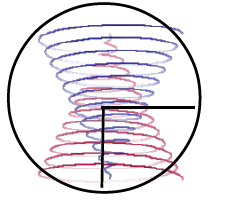
In its ascending direction, Eros’s affect is to make us love the light and truth and hate falsehood. Care and concern develop from Eros. In the illustration of the gyres presented here, the blue gyre is our ascent from the individual ego to the knowledge of the whole of things. The red gyre is the descent of the Good into the being of that which is. “Depth” arises from the ascent; the descent brings about our desires for the surfaces of things, the lower order of eros. Evil is a
‘surface’ phenomenon and eros is a part of it. (The two gyres is a rather abstract representation that is better illustrated in Blake’s painting of “The Red Dragon and the Beast from the Sea” which begins this writing.)

The image of the Divided Line provided by Plato in Bk. VI of Republic is emphatically ethical for it deals with deeds, not with words. The philosophic way of being is erotic by nature. To be erotic is to be “in need”; sexuality is but one manifestation of the erotic, though a very powerful manifestation of this human need. Socrates must chide his interlocutor Glaucon on a number of
occasions in this part of the dialogue of Republic, for Glaucon is ‘erotic’ and is driven by militaristic and sexual passions and, because of such drives, he has a predilection for politics, for seeking power within the community or polis, from which our word ‘politics’ derives. Eros in its lower form drives the appetites and acquisitiveness of human beings, and as Plato indicates in his Seventh Letter: “Of necessity, these States (polis) never cease changing into tyrannies, oligarchies, and democracies, and the men who hold power in them cannot endure so much as the mention of the name of a just government with equal laws.” (325d)

Bk VI of Republic emphasizes the relation between the just and the unjust life and the individual life that is philosophy. The just life is shown by “the love of the learning that discloses (unconceals) the being of what always is and not that of generation and decay”, the knowledge rather than an opinion of what always is. The being of what always is is phusis or Nature. Those who love truth and hate falsehood are erotic by nature i.e., they are ‘needing’ beings by nature; they feel that something is missing. Care and concern develop from this; the love of the whole (the Good) is the great struggle in its attainment. To love the “part” is to be “channeled off” in another direction. This ‘love of the part’ is what we understand as ‘temptation’.

The two-fold or “double” learning is captured in the two types of thinking that are referred to as dianoia and diaeresis. It is also present in the two-fold logos that is rhetoric and dialectic. This two-fold or “double” possibility of learning is emphasized in the construction of the Divided Line and is illustrated by the different directions indicated in the gyres shown previously.

From Plato’s Divided Line we can assert that, for Plato, science does not think in the way that thinkers think. The thinking required to combat evil’s thoughtlessness is not the type of thinking that is to be found in the sciences. Knowledge understood as episteme is dependent on, and in relation to, the higher section of the line (D:C). Socrates (534 a 4-5) relates that dialectical
noesis, the conversation between two or three that runs through the ideas, is to pistis (faith, trust, belief) as natural and technical dianoia is to eikasia (imagination).

The natural dianoia or “gathering together into a one” which is exercised in the physical world by the mind is changed into the power of dialectical insight (the conversion or turnabout of the entire soul) that occurs through the power of speech or conversation between two or three, not through the power of oratory or the written collective memory of the polis one inhabits. The “seeing” is changed into a “hearing”. The “hearing” is changed into a “judgement”. This is why we speak of the “music of the spheres”. It marks the beginning of a new life of philosophia, tolerable only to a few. It is constantly in conflict with our natural and technical dianoia, turning as it does toward the visible world and being immersed in it. Socrates, through the images of the Divided Line and the Cave, takes us on an ascending path away from this turning toward the visible world that is but the shadows reflected on the walls of the Cave.

The philosophic soul reaches out for knowledge of the whole and for knowledge of everything divine and human. It is in need of knowledge of these things, to experience and to be acquainted with these things. The non-philosophic human beings are those who are erotic for the part and not the whole. They are deprived of knowledge of what each thing is because they see by the borrowed light of the moon and not the true light of the sun; their light is a reflected and dim light.

In the Allegory of the Cave, the enchained ones see the shadows of the artifacts carried before the fire that has been ignited by the artisans and technicians. They have no clear ‘pattern’ in their souls, and they lack the experience (phronesis or “wise judgement”) that is tempered with sophrosyne or moderation that they have acquired through the experience of suffering or strife. The philosophic soul has “an understanding endowed with “magnificence” (or “that which is fitting for a great man”) and is able to “contemplate all time and all being” (486 a). The philosophic soul has from youth been both “just and tame” and not “savage and incapable of friendship”. (See the connection to The Chariot card of the Tarot where the two sphinxes, one white and one black representing the mystery of the soul, are in contention or strife (polemos) with each other.)

In looking for the philosophic way of being-in-the-world, Socrates concludes: “…let us seek for an understanding endowed by nature with measure and charm, one whose nature grows by itself in such a way as to make it easily led to the idea of each thing that is.” (486 d) The philosophic soul is such by nature i.e., it grows by itself from out of itself. Is this all souls or only some souls? Are all souls capable of attaining the philosophic way of being? The modern answer to this question, through the strange meeting of the French philosopher Rousseau and the impact of Christianity, has been a “yes”, while the ancient answer appears to be a “no”. Saints and philosophers are rare plants.

The philosophic soul is “a friend and kinsman of truth, justice, courage, and moderation.” (487a) The philosophic soul is able to grasp what is always the same in all respects. (B and C in the Divided Line) The distinction between the philosophic soul and its “seeing” is shown by its contrast to the “blind men” who are characterized as those who are erotic for the part and not the whole; those who are deprived of knowledge of what each thing is; those who see by the light of the moon; those who have no clear pattern in the soul; and those who lack experience phronesis or “wise judgment” tempered with sophrosyne or moderation, what is called arête or ‘human excellence’.

Socrates uses an eikon or image (AB of the Divided Line) to indicate the political situation prevalent in most cities or communities. The eikon uses the metaphor of “the ship of state” and the “helmsman” who will steer and direct that ship of state. The rioting sailors on the ship praise and call “skilled” the sailor or the “pilot”, the “knower of the ship’s business”, the man who is clever at figuring out how they will get the power to rule either by persuading or by forcing the ship-owner to let them rule. Anyone who is not of this sort and does not have these desires they blame as “useless”. They are driven by their “appetites”, their hunger for the particulars. (i.e., what Plato describes as human beings when living in a democracy, an oligarchy, or a tyranny). This is the reason Plato places democracy just above tyranny in his ranking of regimes from best to worst, tyranny being the worst since both of these regimes are ruled by the appetites and not by phronesis and sophrosyne or what we understand as ‘virtue’. Democracy’s predilection for capitalism is a predicate of the rule by the appetites).

The erotic nature of the philosophic soul “does not lose the keenness of its passionate love nor cease from it before it has grasped the nature itself of each thing which is with the part of the soul fit to grasp a thing of that sort, and it is the part akin to it (the soul) that is fit. And once near it and coupled with what really is, having begotten intelligence and truth, it knows and lives truly, is nourished and so ceases from its labour pains, but not before.” (490 b) The language and imagery used here is that of love, procreation and childbirth, and this indicates its
connection to the higher form of Eros as discussed earlier. With regard to the Divided Line, this is the analogy of B=C: the world of the sensible, the visible “is equal to” the world of Thought: the mathemata or “that which can be learned and that which can be taught.” That which can be learned and that which can be thought is initially the visible, that which can be sensed and experienced. Socrates sees himself as a midwife, helping to aid this birthing process that is
learning. (Notice that this indicates the descending motion within the gyres that were shown in the earlier illustration after a gnostic encounter with the Idea of the Good.)

Section IV: Details of the Divided Line

At Republic, Book VI, 508 b-c, Plato makes an analogy between the role of the sun, whose light gives us our vision to see and the visible things to be seen and the role of the Good in that seeing. The sun rules over our vision and the things we see. The eye of seeing must have an element in it that is “sun-like” in order that the seeing and the light of the sun be commensurate with each other. Vision does not see itself just as hearing does not hear itself. No sensing, no desiring, no willing, no loving, no fearing, no opining, no reasoning can ever
make itself its own object. The Good, to which the light of the sun is analogous, rules over our knowledge and the (real) being of the objects of our knowledge (the forms/ eidos) which are the offspring of the ideas or that which brings the visible things to appearance and, thus, to presence or being and also over the things that the light of the sun gives to vision:

“This, then, you must understand that I meant by the offspring of the good that which the good begot to stand in a proportion with itself: as the good is in the intelligible region with respect to intelligence (DE) and to that which is intellected [CD], so the sun is (light) in the visible world to vision [BC] and what is seen [AB].”

Republic Bk VI 508-511

Details of the Divided Line
Below is a summation of some of the thoughts and thinking contained in the Divided Line.

The sphere of space encloses the beings that are in Time. The soul of human beings is eternally in Time. When the soul is assimilated into the One that is the Good, it ceases to be in Time. Nature is eternally in Time: it is sempiternal. “Time is the moving image of eternity.” Nature is “sempiternal”, everlasting, endless. In the illustration to the left, the Divided Line AE should be seen as the circumference of the sphere that is space.

The whole of the Divided Line may be outlined into five sections. Although only four sections are spoken of in the dialogue, the Idea of the Good is implied throughout, though it cannot be properly spoken of as a “section”: a) The Idea of the Good : to the whole of AE; b) the Idea of the Good : DE, the things of the Spirit thought and knowledge; c) DE the things of the Spirit and the contemplation, attention given to them : CD the thinking upon the things of the Spirit; d) BC physical objects and the thinking associated with them= CD the forms/eidos and ideas; e) BC the physical objects and the thinking related to them : AB physical objects and imagination.

Using Euclid’s Elements, we can examine the geometry inherent in the Divided Line and come to see how it is related to the notion of thinking and being. Notice that the Idea of the Good is left out of the calculations conducted here, and this is because it is an incalculable “one”.
Let the division be made according to the prescription:

(A + B): (C + D): : A : B:: C: D.
From (A + B): (C + D): : C: D follows (Euclid V, 16)
(1) (A + B) : :C : (C + D) : D. From A :B : : C: D follows (Euclid V. 18)
(2) (A + B) : B : : ( C + D) : D. Therefore (Euclid V, 11)
(3) (A + B) : C : : (A + B) :B and consequently (Euclid V, 9)
(4) C= B.

The whole line itself (AE) is the Good’s embrasure of both Being and Becoming, that which is within both Time and Space. This embrasure is spherical in shape. (Their geometry showed to the Pythagoreans that our world was spherical and not flat, contrary to the popular notion believed today.) The Good itself is beyond Being and Becoming (i.e., Space and Time), and there is an abyss separating the Necessary (which is both Space and Time) from the Good.

Within the Divided Line, that which is “intellected” (CD) is equal to (or the Same i.e., a One) as that which is illuminated by the light of the Sun in the world of vision (BC). Being and Becoming require the being-in-the-world or participation of human beings i.e., B = C. That which is “intellected”, held in attention or contemplation (the schema, Necessity) is that which comes into being or can come into being through imagination and representational thinking, through images (or the assigning of numbers or signs to images as is done in geometry or algebra) or through the logoi or words of narrative and myth. This representational thinking in images is what we call “experience”, and it is technē as a way of knowing, the knowing of the artisan and the technician.

Below is a more detailed description of the Divided Line:


E. The Idea of the Good: Agathon, Gnosis “…what provides the truth to the things known and gives the power to the one who knows, is the idea of the good. And, as the cause of the knowledge and truth, you can understand it to be a thing known; but, as fair as these two are—knowledge and truth—if you believe that it is something different from them and still fairer than they, your belief will be right.” (508e – 509a) The Idea of the Good is the essence of things that come to be whether in the Visible or Invisible realms. The Good is beyond both Time and Being. When the soul is in direct contact with the Good, gnosis is achieved and the soul is no longer in Time for it becomes part of the One of all that is. The Good is responsible for (aitia) knowledge and truth (aletheia) or the unconcealment of all that is.

D1. Ideas ἰδέαι: Begotten from the Good and are the source (archai) of the Good’s presence (parousia) in that which is not the Good, both in being and becoming. The Good is seen as “the father” whose seeds (ἰδέαι) are given to the receptacle or womb of the mother (space) to bring about the offspring that is the world of AE (time) within space. The realm of AE is the realm of the Necessary. (Dialogue Timaeus 50-52 which occurs the following morning after the night of Republic). Because they are begotten from the Good, they are the essence of things, their “oneness”, what they are through Time. The ἰδέαι beget the eidos which bring beings to presence in time (ousia) for human beings. The things come to a stand through the eidos.D2. Intellection (Noesis): Noesis is often translated by “Mind”, but “Spirit” might be a better translation. Contemplation, attention, dialectic are the activities of noesis. It is that thinking and thought which is beyond what we commonly understand as thought and thinking. Knowledge (γνῶσις, νοούμενα) intellection, the objects of “reason” (Logoi, but not understood as “logistics”) (νόησις, ἰδέαι, ἐπιστήμην). “Knowledge” is permanent and not subject to change as is “opinion”, whether “true” or “false” opinion. Opinions develop from the pre-determined seeing which is the under-standing of the essence of things that is prevalent at the time. Understanding is prior to the interpretations of things and the giving of names to things.
C1. Forms (Eide): Begotten from the Ideas, they give presence to things through their “outward appearance” (ousia). There is no-thing without thought; there is no thought without things. Human being is essential for Being. Being needs human being. “And would you also be willing,” I said, “to say that with respect to truth or lack of it, as the opinable is distinguished from the knowable, so the likeness is distinguished from that of which it is the likeness?” The ‘shapes’ of things (eide) such as the city or society as the individual writ large. The polis or the city is a city of artisans and technicians, of technē. “The knowing one’s way about or within something” caters to the production of novelty, efficiency. The logos, like Eros itself, is two-faced or of two types. The jumping-off point, the leap, is the recognition that the Sun in the realm of Becoming (Time), like the idea of the Good in the realm of Being, is responsible for everything that is. The Sun is Time as “the moving image of eternity”, and all that is in being owes its existence to Time. The Good is eternity, and all that is in Being and Becoming owes its existence to the idea of the Good.C2. Thought (Genus) Dianoia is that thought that unifies into a “one” and determines a thing’s essence. The eidos of a tree, the outward appearance of a tree, is the “treeness”, its essence, the idea in which it participates. We are able to apprehend this outward appearance of the physical thing through the “forms” or eide in which they participate for these give them their shape.
Understanding as hypothesis (διανόια). The “hypothesis” is the “standing under” of that seeing that is thrown forward, the under-standing, the ground. Thought under-stands the limits and boundaries of things and gives them “measure” through the use of number or logoi. The giving of measure to the seeing is geometry, and from it the hearing of the harmonia of music, the music of the spheres, is recognized and produced. Thought comprehends the “measure” of things that brings about a “harmony” . The proportionals are arranged about a “mean” which is hidden or “irrational”. The principle of stringed instruments and their ratios is applicable to the whole of the universe, both the visible and the invisible.
B1. The physical things that we see/perceive with our senses (ὁρώμενα, ὁμοιωθὲν). The things that are at our disposal, the ready-to-hand. Ousia presence is understood as the thing’s way of being-in-the-world. The city or society is the individual writ large. The desires of the body and the needs of the body. Eros is both “fullness” and “need”. Sexuality, procreation, food, drink, etc. BC as the point where we see the two faces of Eros. The wants and needs of the body are radically private and at the same time require other human beings for their fulfillment. The city or polis is an artifact, a product of human making through convention, a Cave. The world of the Cave and the world outside of the Cave are the same world seen differently. There are not two worlds in Plato.B2. Trust, confidence, belief (πίστις) opinion, “justified true beliefs” (δόξα, νοῦν). Opinion is not stable and subject to change. The changing of the opinions that predominate in a community is what is understood as “revolution”. “Then in the other segment put that of which this first is the likeness—the animals around us, and everything that grows, and the whole class of artifacts.” The movement downwards to the techne of the artisans and technicians. The logoi of word and number.
A1. Eikasia Images Eikones: Likenesses, images, shadows, imitations, our vision
(ὄψις, ὁμοιωθὲν). The “icons” or images that we form of the things that are. The statues of Daedalus which are said to run away unless they are tied down (opinion). It is the logoi which ‘ties things down’. The technē or artisan as the servant of the people: “in another, for another”. The technē is the master of the ‘part’, his own art, his ‘know- how’, that knowledge that the philosopher aspires to for the whole of things. The distinction between the simple narrative of poetry and the ‘imitative’ or dramatic narrative. Music and its geometry which leads to the love of the beautiful. All music is ‘imitative’ of the ‘music of the spheres.’ The harmony of music and the harmony of the individual soul is in moderation sophrosyne. Public care and concern (spiritedness) is linked to self-interest. Art (and we mean only great art here) and justice are identical.
A2. Imagination (Eikasia): “Now, in terms of relative clarity and obscurity, you’ll have one segment in the visible part for images. I mean by images first shadows, then appearances produced in water and in all close-grained, smooth, bright things, and everything of the sort, if you understand.” The “representational” thought which is done in images. Our narratives, myths and that language which forms our collective discourse (rhetoric). Conjectures, images, (εἰκασία). The image of a thing of which the image is an image are things belonging to eikasia. We are “reminded” of the original by the image: the Beauty of Nature is the image that reminds us of the Good.
The Divided Line

Every thought and all of our thinking is a product of, or “re-collection” (anamnesis) from experience: we have to first experience before we can “re-collect” that which we have experienced and turn this into a technē. This re-collection is what is referred to as dianoia, the bringing of the separate parts into a “one”. This may account for the confusion between the concepts of eidos and ἰδέαι in the interpretations of Plato.

The ἰδέαι is number as the Greeks understood them; the eidos is number as we understand them: the two concepts represent the “double” nature of thinking (which is mirrored in the two-faced nature of Eros and of the Logos) and the distinction between thought and Intellection when understanding the Divided Line. These distinctions show why there is no separation of “consciousness” from “conscience” for “consciousness” is of those things that are “real”; awareness of the shadows of things is not “consciousness” and thus not knowledge. “No one knowingly does evil.”

The eidos of “three” is composed of three “ones” or units which we arrive at by counting, arithmos 1+1+1. This sequence of “ones” is how we understand Time, as a sequence of distinct units which we call “nows” which progress in a straight line. The idea of “three” is a “one” composed of three and it is achieved through intellection or contemplation. It is the source of the Christian mystery of the Trinity, the three-in-one God. The ἰδέαι beget the eidos and, like a father to his offspring, the father and the child are akin to each other yet separate. Intellection is akin to thinking as it is commonly understood yet separate from that thinking. (See the example in the dialogue Meno of whether or not the father can pass on his knowledge of arête or virtue to his offspring.)

Eide + logoi + ideai: the things seen and heard require a “third”. “Light” is the “third” for seeing as well as what we understand as “air” (aether) for hearing. Arete virtue or human excellence cannot be found present without knowledge and the accompanying “third”, the good. “The outward appearances of the things” + “the light” which “unconceals” them + the idea as that which begets both the outward appearance and the unconcealment. The Sun is an image of the Good in the realm of Becoming because “it gives” lavishly and, as the third, “yokes together” that which sees and that which can be seen. Neither sight itself nor that in which it comes to be (the “eye”) are the Sun itself. The Sun is not sight itself but its “cause” (aitia understood as “responsible for” and “indebted to”). The Sun is the offspring of the Idea of the Good begot in a
proportion with itself: The Good = 1 : the Sun the square root of 5/2 , so (1 + √5)/2). The two together, the Good and the Sun, give what we call the Divine Ratio. 508 c. “As the Good is in the intelligible region with respect to intelligence and what is intellected, so the Sun is in the visible region with respect to sight and what is seen”. (“Faith is the experience that the intelligence is enlightened by Love”.)

The Sun = Time; and from it things come to be and pass away. “Time is the moving image of eternity” i.e., the Sun is Time which is the movement of that which is permanent or ‘eternal’, i.e., The Good, which is that which is beyond the limiting spherical shape which is Necessity which is represented by this limiting spherical shape. “Faith is the experience that the intelligence is illuminated by Love.” Pistis trust or faith is the “experience”, the “contact with reality”, that the intelligence realizes when it is given the light of Love or the Good. This truth aletheia is proportional to the truth aletheia which is the unconcealment of things of the senses in the physical realm when revealed by the Sun i.e., the beauty of the world. This is the
distinction between the “higher” and “lower” form of Eros. The ascent or movement upwards is into “the depth of things”, while the descent deals with their surfaces and imitations.

We can see here some connections to evil. Evil abhors contact with reality and evil-doers will construct a world in which this contact with reality is lessened whether it be by choice through “intentional ignorance” or by active doing through propaganda or gaslighting or by some other misuse of the logoi to create a world in which their evil doing is allowed to flourish. It may occur through the destruction of the logoi such as is seen in the burning and banning of books and thus becomes a conscious anti-Logoi. Because contact with reality is illuminated by Love, the deprivation of love will give rise to hatred and violence; human beings become less humane. Within this world, the soul becomes shrunken or shallow and lashes out at its own betrayal of itself. This is the root of what will be called “malignant narcissism” in Part IV of this writing.

The soul, “when it fixes itself on that which is illuminated by truth” and that which is, “intellects”, knows, and appears to possess intelligence (gnosis). When it fixes itself on that which is mixed with darkness, on coming into being and passing away, it opines and is dimmed. What provides truth to the things known and gives illumination or enlightenment to the one who knows is the Idea of the Good. The Idea of the Good is responsible for (the “cause of”)
knowledge and truth. It is responsible for the beautiful, and that which makes things beautiful (the eidos and idea of the thing). But the Good itself is beyond these. It is the Good which provides “the truth” to the things known, truth understood as aletheia or unconcealment.

As the eye and that which is seen is not the Sun, so knowledge and the things known are not the Good itself i.e., those things that are “goods” for us. When Glaucon in Republic equates the Good with “pleasure”, Socrates tells him to “Hush” for he is uttering a “blasphemy”. It is clear that what is being spoken about here is a “religious phenomenon”. The soul Psyche, “the most beautiful of mortals”, is wedded to Eros who is the offspring of Aphrodite (Beauty) and Ares (“Spiritedness”), and for Plato, these characteristics were the nature of the soul. (In some versions of Greek theogony, Aphrodite is wed to Hephaestus the artisan and technician of the gods.) (For Christians, this may also be understood by Christ’s words “I am the bridegroom and you are the bride”.)

In the Divided Line, since C = B the inequality in length of the “intelligible” and “visible” subsections depends only on the sizes of A (Imagination) and D (Intellection). If then, A: B: B: D or A: C:: C: D, A: D is in the duplicate ratio of either A: B or C: D (Euclid V, Def. 9). This expresses in mathematical terms the relation of the power of “dialectic”, the discursive conversations between friends, to the power of eikasia, the
individual and collective imaginations of human beings. (To put it in modern terms and our relations of thought to our actions, it is the difference between the face-to-face conversations among friends and the collective conversations of social media chat groups, but any other collective is also apt. Modern “talk therapy” in psychology is just another attempt at “dialectic”.) If we imagine
the Divided Line as two intersecting gyres, we may be able to see how this ‘double’ thinking, learning and seeing is possible. Thinking can be either an ascent into the realm of ideas aided by the beauty of the outward appearances of things (eidos) or the dialectical conversation of friends, or thinking can be a descent into the realm of material things using the imagination (eikasia) and the rational applications of the relations of force i.e., the laws of cause and effect and of contradiction (Necessity).

At the end of Book VI of the Republic (509D-513E), Plato describes the visible world of perceived physical objects and the images we make of them (what we call “representational thinking”). The sun, he said, not only provides the visibility of the objects, but also generates them and is the source of their growth and nurture. This visible world is what we call Nature, phusis, the physical world in which we dwell.

Beyond and within this visible or sensible world lies an intelligible world. The intelligible world is illuminated by “the Good”, just as the visible world is illuminated by the Sun. The Sun is the image of the Good in this world. The Good provides growth and nurture in the realm of Spirit, or that which is Intellected, the ‘fire catching fire’. For Socrates and Plato, the world is
experienced as good, and our experience of life should be one of gratitude. The world is not to be experienced as a “dualism”, for a world without human beings is no longer a “world”. Human beings may construct their own worlds from their imaginations, but there is a real world beyond these.

The division of Plato’s Line between Visible and Intelligible appears to be a divide between the Material and the Ideal or the abstract. This appearance became the foundation of most Dualisms, particularly the Cartesian dualism of subject-object which is the foundation of modern knowledge and science. To see it as such a dualism overlooks the fact that the whole is One and the One is the Good. Plato is said to have coined the word “idea” (ἰδέα), using it to show that the outward appearances of things (the Greek word for shape or form εἶδος) are the offspring of the “ideas”, and are akin to the ideas, but they are not the ideas themselves. They are the Same, but not Identical. The word “idea” derives from the Greek “to have seen”, and this having seen a priori as it were, determines how the things will appear to the eye which is “sun-like” i.e., it shares something in common with the light itself and with the sun itself. This
commonality is what we mean by our understanding and experience.

The upper half of the Divided Line is usually called Intelligible as distinguished from the Visible, meaning that it is “seen” and ‘has been seen’ by the “mind” (510E). Mind is a translation of the Greek Nous (νοῦς), and it indicates that ‘seeing’ that is done with the mind rather than with the eye. (In English grammar it becomes “noun” and is a requirement for all statements that are made.)

Whether we translate nous as ‘mind’ or ‘spirit’ has been a topic of controversy in academic circles for many centuries. The translation as ‘mind’ seems to carry a great deal of baggage from our understanding of human beings as the animale rationale, “the rational animal.” Understanding in this manner has come to render what we consider thinking, as the ‘rational’ and ‘logistics’. Thinking has to do with reason only, the principle of reason which is composed of the principles of cause and effect and the law of contradiction. It is clear from Plato’s Divided Line that this is only one aspect of thinking. There is a thinking that is higher than the rational and it is this thinking that distinguishes the scientists from the philosophers.

In modern English, the word “knowledge” derives from “to be cognizant of”, “to be conscious of”, or “to be acquainted with”; the other stems from “to have seen”, “to have experienced”. The first is the cognate of English “know” e.g., Greek gnosis (γνῶσις), meaning knowledge as a direct contact with or an experience of something or someone. “And he knew her” is the intimate knowledge of a person that derives from sexual intercourse with that person. For knowledge, the Greeks also used epistέme (ἐπιστήμη), the root for our word “epistemology”, ‘the theory of knowledge’. Gnosis and epistέme are two very different concepts: gnosis can be understood as direct contact with the object of knowledge, while epistέme is more related to the results of “theoretical knowledge” which reside in the realm of opinion. Socrates asserts, against all common sense, that it is “cognition” which is the difference between the honest man and the dishonest man; obviously, Socrates must have a very different understanding than we do of what “cognition” or consciousness is. ‘Seeing’ is what we understand by ‘knowledge’. We shall have to see how this understanding of ‘seeing’ and thinking are related and how Socrates distinguishes between them. Thinking is not merely ‘technical knowledge’ or technē.

This stem of “to have seen” is what is rooted in the idea of “re-collection” with the associated meanings of “collecting” and “assembling” that are related to the Greek understanding of logos. Logos is commonly translated as “reason” and this has given it its connections to ‘logic’ and ‘logistics’ as the ‘rational’ and ultimately to human beings being defined as the animale rationale, the “rational animal” by the Latins rather than the Greek zoon logon echon, or “that
animal that is capable of discursive speech”. Discursive speech, dialectic, and logos in general are not what we understand by “reason” only. “Intellection”, contemplation, attention as it is understood in Plato’s Divided Line is not merely the principle of cause and effect and the principle of contradiction.

In Republic, Book VI (507C), Plato describes the two classes of things: those that can be seen but not thought, and those that can be thought but not seen. The things that are seen are the many particulars that are the offspring of the eidos, while the “ones” are the ideai which are the offspring of the Good. As one descends from the Good, the clarity of things becomes dimmer until they are finally merely ‘shadows’, deprived of the light of truth because of their
greater distance from the Good.

As there are many particular examples of human “competence” or “excellence” (arête), there is the one competence or excellence that all of these particular examples participate in. This “one” is the idea and the idea is itself an offspring of the Good, the original One. The idea is the ‘measure’ of the thing and how we come to “measure up” the thing to its idea. (Our notion of the hierarchy of the “ideal” derives from this, and consequently what our notions of good and bad are, better and worse, etc. or what has come to be called our “subjective values”. It is here that the greatest distinction between the moderns and the ancients can be seen: Nature and our being-in-the-world is not something that we measure but something by which we are measured.) It is through this measuring that the thing gets its eidos or its “outward appearance”; and in its appearance, comes to presence and to being for us.

At Republic, Book VI, 508B-C, Plato makes an analogy between the role of the Sun, whose light gives us our vision to see (ὄψις) and the visible things to be seen (ὁρώμενα) and the role of the Good (τἀγαθὸν). The Sun “rules over” our vision and the things we see since it provides the light which brings the things to ‘unconcealment’ (aletheia or truth). The Good “rules over” our knowledge and the (real) objects of our knowledge (the forms-eide, the ideas) since it provides the truth in this realm: the contact with reality is the truth that is revealed by the Good–”Faith is the experience that the intellect is illuminated by Love.”: “This, then, you must understand that I meant by the offspring of the good which the good begot to stand in a proportion with itself: as the good is in the intelligible region to intellection [DE] and the objects of intellection [CD], so is this (the sun) in the visible world to vision [AB] and the objects of vision [BC].”

As the Sun gives life and being to the physical things of the world, so the Good gives life and being to the Sun as well as to the things of the ‘spiritual’ or the realm of the ‘intellect’. That which the Good begot is brought to a stand (comes to permanence) in a proportion with itself. These proportions are present in the triangles of the geometers.

At 509D-510A, Plato describes the line as divided into two sections that are not the same (ἄνισα) length. Most modern versions represent the Intelligible section as larger than the Visible. But there are strong reasons to think that for Plato, the Intelligible is to the Visible (with its many concrete particulars) as the one is to the many. The Whole, which is a One, is greater than the parts. The part is not an expansion of the Whole but the withdrawal of the Whole to
allow the part to be as separate from itself, or rather, to appear as something separate from itself since the part remains within the Whole. In this separation from the Whole, the part loses that clarity that it has and had in its participation in the Whole. (It is comparable to the square spoken of earlier from the Meno dialogue: the original square withdraws to allow the “double” to be.)

When Plato equates B to C, we can understand that the physical section limits the intelligible section, and vice versa. We cannot have what we understand as ‘experience’ without body, and we cannot have body without intellect. We place the intelligible section above the physical section for the simple reason that the head is above the feet.

Plato then further divides each of the Intelligible and the Visible sections into two. He argues that the new divisions are in the same ratio as the fundamental division. The Whole, not being capable of being ascribed an “image” by a line is, to the entire line itself, as the ratio of the Good is to the whole of Creation. The whole of Creation is an “embodied Soul”, just as the human being is an “embodied soul” and is a microcosm of the Creation. Just as the Good
withdraws to allow Creation to be, Creation withdraws to allow the human being to be.

Later, at 511D-E, Plato summarizes the four sections of the Divided Line:

“You have made a most adequate exposition,” I said. “And, along with me, take these four affections arising in the soul in relation to the four segments: intellection (contemplation, attention) in relation to the highest one, and thought in relation to the second; to the third assign trust (faith, belief), and to the last imagination. Arrange them in a proportion, and believe that as the segments to which they correspond participate in truth, so they participate in
clarity.”

Republic, 510 d – e

We can collect the various terms that Plato has used to describe the components of his Divided Line. Some terms are ontological, describing the contents of the four sections of the Divided Line and of our being-in-the-world; some are epistemological, describing how it is that we know those contents. There is, however, no separation between the two, just as there is no separation between the components of the soul.

Notice that there is a distinction between “right opinion” and “knowledge”. Our human condition is to stand between thought and opinion. “Right opinion” is temporary, historical knowledge and thus subject to change, while “knowledge” itself is permanent. The idea of the Good is responsible for all knowledge and truth. Such knowledge is given to us by the geometrical “forms” or the eide which bring forward the outward appearances of the things that give them their presence and for which the light of the Sun is necessary. “Knowledge” as episteme and knowledge as gnosis are also distinguished.

By insisting that the ratio or proportion of the division of the visibles (AB : BC) and the division of the intelligibles (CD:DE) are in the same ratio or proportion as the visibles to the intelligibles (AC:CE), Plato has made the sections B = C. Plato at one point identifies the contents of these two sections. He says (510B) that in CD the soul is compelled to investigate, by treating as images, the things imitated in the former division (BC):

“Like this: in one part of it a soul, using as images the things that were previously imitated (BC), is compelled to investigate on the basis of hypotheses and makes its way not to a beginning but
to an end (AB); while in the other part it makes its way to a beginning that is free from hypotheses (DE); starting out from hypothesis and without the images used in the other part, by
means of forms (eide) themselves it makes its inquiry through them.” (CD)

Plato distinguishes two methods here, and these emphasize the “double” nature of how knowledge is to be sought and how learning is to be carried out. The first (the method of the mathematician or scientist and what determines our dominant method today) starts with assumptions, suppositions or hypotheses (ὑποθέσεων) – Aristotle called them axioms – and proceeds to a conclusion (τελευτήν) which remains dependent on the hypotheses or axioms,
which again, are presumed truths. We call this the ‘deductive method”, and it results in the obtaining of that knowledge that we call episteme. This obtaining or end result is the descent in the manner of the ‘double’ thinking that we have been speaking about; we descend from the general to the particular. This type of thinking also involves the ‘competence’ in various technai or techniques that are used to bring about a ‘finished work’ that involve some ‘good’ of some
type i.e., it is ‘useful’ for something. The seeing views the ‘artifacts’, the things made by human beings, not the things made by nature. This technai as knowledge is the ‘knowing one’s way about or in something’ that brings about the ‘production’ or ‘making’ of some thing that we, too, call knowledge be it shoemaking and the pair of shoes that is its end, or the making of artificial intelligence. The end result, the ‘work’, provides some ‘good’ for us in its potential use. This is the light of the fire behind the puppet stage that is shown in the Allegory of the Cave.

In the second manner, the “dialectician” or philosopher advances from assumptions based on trust or belief (opinion) to a beginning or first principle (ἀρχὴν) that transcends the hypotheses (ἀνυπόθετον), relying on ideas only and progressing systematically through the ideas. The ideas or noeton are products of the ‘mind’ or ‘spirit’(nous) that the mind or spirit is able to apprehend
and comprehend due to the intercession of the Good as an intermediary, holding or yoking itself and the soul of the human being in a relationship of kinship or friendship, harmonia. The ideas are used as stepping stones or springboards in order to advance towards a beginning that is the whole. The ‘step’ or ‘spring’ forward is required to go beyond the kind of thinking that
involves a descent. The beginning or first principle is the Good and this is the journey to the Good or the ascent of thinking towards the Good itself as is indicated in the Allegory of the Cave. The ideas are not created by human beings, but are apprehended by human beings. Historically, the ideas have become understood as “values” due to the influence of the philosopher Nietzsche.

Plato claims that the dialectical “method” or way of proceeding (and it is questionable what this “method” is exactly), which again must be understood as the conversations between friends, between a learner and teacher for example or a psychiatrist and his patient, is more holistic and capable of reaching a higher form of knowledge (gnosis) than that which is to be achieved through ‘theoretical knowledge’ or episteme. This possibility of gnosis is related to the Pythagorean notion that the eternal soul has “seen” all these truths in past lives (anamnesis) in its journey across the heavens with the chariots of the gods. (Phaedrus 244a – 257 b).

Plato does not identify the Good with material things or with the ideas and forms. Again, these are in the realm of Necessity; Necessity is the paradigm or the divine pattern, the schema. This schema involves the realms of Time and Space. The Good is responsible for the creative act that generates the ideas and the forms; and that which is is indebted to the Good for its being. The ideas and the forms are ‘indebted to’ the Good for their being and from them emerge truth, justice, and arête or the virtues/excellences of things and beings.

If we put the mathematical statement of the golden ratio or the divine proportion into the illustrations of the Divided Line and the gyres (1 + √5)/ 2), the 1 is the Good, or the whole of things, and the “offspring of the Good” (the “production of knowledge” BC + CD) and the whole of AE is the √5 which is then divided by 2 (the whole of creation: Becoming, plus Being, plus the
Good or the Divine), then we can comprehend the example of the Divided Line in a Greek rather than a Cartesian manner. Plato is attempting to resolve the problem of the One and the many here.

The city’s outline, or the community in which human beings dwell, should be drawn by the painters who use the divine pattern or paradigm (schema) which is revealed by Necessity (500 e). In the social and political realm, the individual must first experience the logoi in order to become balanced in the soul as far as that is possible. This experience, this speech with others, will provide moderation (sophrosyne), justice (recognition of that which is due to other human beings) and proper virtue (phronesis) which is ‘wise judgement’.

If we put this into modern realities, it is said that more than 50% of the American population is capable of only reading at the 12 year-old level. This lack of education can only result in unbalanced souls. According to a 2020 report by the U.S. Department of Education, 54% of adults in the United States have English prose literacy below the 6th-grade level. Since the USA is a society based on the social contract, we can only say that this is an indication of the failure of that social contract.

Socrates says (510B) that in CD the soul is compelled to investigate by treating as images the things imitated in the former division (BC). In (BC), the things imitated are the ‘shadows’ of the things as they really are. These are the realms of ‘trust’ and ‘belief’ (pistis) and of understanding or how we come to be in our world. Our understanding derives from our experience and it is based on what we call and believe to be “true opinion”.

There is no “subject/object” separation of realms here, no abstractions or formulae created by the human mind only (the intelligence and that which is intellected), but rather the mathematical description or statement of the beauty of the world. In the Divided Line, one sees three applications of the golden ratio: The Good, the Intelligible, and the Sensible or Visual i.e., the Good in relation to the whole line, The Good in relation to the Intelligible, and the Intelligible in relation to the Visible. (It is from this that I understand the statement of the
French philosopher Simone Weil: “Faith is the experience that the intelligence is illuminated by Love.” Love (Eros) is the light which is given to us and illuminates the things of the intelligence and the things of the world, what we “experience”. This illumination is what is called Truth for it reveals and unconceals things. There is a concrete tripartite unity of Goodness, Beauty and
Truth. The word ‘faith’ in Weil’s statement could also be rendered by ‘trust’ or pistis.)

This tripartite yoking of the sensible to the intelligible and to the Good corresponds to what Plato says is the tripartite being of the human soul and the tripartite Being of the God who is the Good. The human being in its being is a microcosm of the Whole or of the macrocosm. The unconcealment of the visible world through light conceived as truth (aletheia) is prior to any conception of truth that considers “correspondence” or “agreement” or “correctness” as
interpretations of truth. (See William Blake’s lines in “Auguries of Innocence”: “God appears and God is Light/ To those poor souls that dwell in night/ But does the human form display/ To those who dwell in realms of day.”)

One of the questions raised here is: do we have number after the experience of the physical, objective world or do we have number prior to it and have the physical world because of number? The original meaning of the Greek word mathemata is “what can be learned and what can be taught”. What can be learned and what can be taught are those things that have been brought to presence through language (logos) and measured in their form or outward
appearance through number (logos). Our understanding of number is what the Greeks called arithmos, “arithmetic”, that which can be “counted” and that which can be “counted on” through “measuring”. These numbers begin at 4.

Theory of Knowledge: An Alternative Approach

Why is an alternative approach necessary?