
The Tree of Life from the Kabbalah:
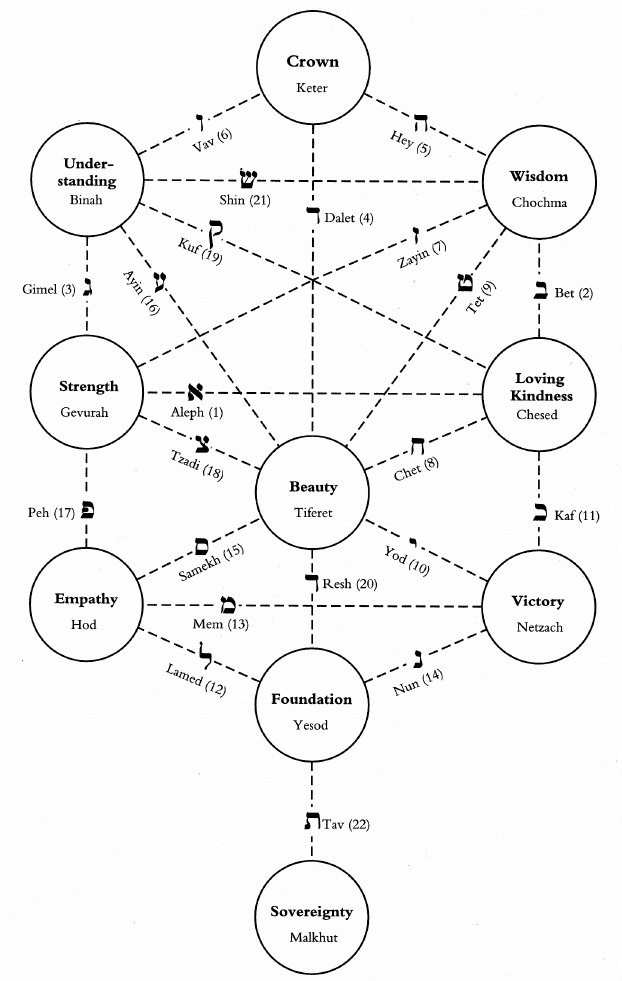
What will be shown in this writing is how the letters and the paths associated with the Sephirot of the Kabbalah correspond to the 22 Major Arcana of the Tarot. The emanations of the Sephirot correspond to the symbols and images presented in the cards; that is, the objects and situations that we encounter within our worlds correspond in their true natures to the numbers and images “revealed” in the cards when interpreted correctly. “Interpretation” involves attention, contemplation and reflection. An “emanation” emanates from a source. An emanation is not an expansion of the source but a withdrawal of the source to allow the emanation to be just as, paradoxically, the perfume of a rose is made possible by the rose’s withdrawal and yet is at the same time a stepping forward of the rose itself to manifest its being as a sign of its presence. The presence involves an absence and a hiddenness at the same time.
The Tarot cards, composed of letters and numbers, are intermediaries between the individual and the world we live in. They are what we understand as art. They are tools or equipment to assist in the overcoming of the distinction between mind/body, soul/body, and the self/world. All that is known (the Greek word gnosis) is brought to presence through language and number, or through Word.
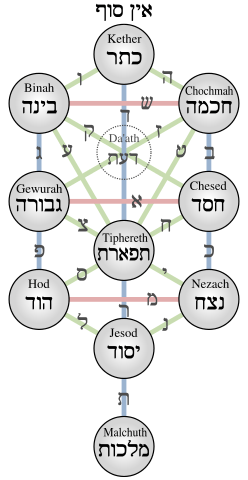
Movement is Life. As illustrated through the Tree of Life, movement, kinesis, begins at 1. the Crown (Keter) and flows to 2. Wisdom (Chakmah), then to 3. Understanding (Binah), through to 4. Loving Kindness (Chesed), then to 5. Strength or Force, Power (Gevurah), through to 6. Beauty (Tiferet), then to 7. Victory (Netzach), then to 8. Empathy, Mercy (Hod), from there to 9. Foundation (Yesod), and finally to 10. Kingdom or Sovereignty (Malkhut). The movement is from right to left or East to West. All the Sephirot pass or are channeled through #6 Beauty (Tiferet) with the exception of #10 Kingdom (Malkhut). This is the movement from top to bottom, from the heavens to the earth, or the direction of the primal creation. The movement upwards involves depth, while the movement downwards tends towards the surfaces or the outward appearances of things; and the further one moves down, the further one is away from the reality of things.
A most important point to note is that the creation of the world is not an “expansion” from God but a withdrawal of God. In making the universe, God allows something other than Himself to be and yet, paradoxically, it is at the same time Him since He is One and the Whole. This Otherness and withdrawal of God signifies both His presence and His absence in His creation just as the presence and absence of the rose is revealed by its perfume.
Text of the Sefir Yetzirah with Commentary:

The Sefer Yetzirah is written in poetry because philosophy is more akin to poetry than to history, which is more akin to prose. Its narrative is a mythos, a story of the God and His Creation. The exercises and statements made in the text are akin to philosophy for they are attempts to answer the questions of Being and of coming-into-being: the how, what, who, where, when and why of created things. In traditional philosophy this is what is called metaphysics.
The translations here render the original poetry of the Hebrew into current modern English prose. As with all translation, something is lost, but something may also be gained by examining the texts closely. There are many versions of the Sefer Yetzirah, with many additions and retractions occurring throughout the ages. The versions here are an attempt to provide a readable translation through an amalgam of the many versions available. Three different translations are provided here.
1.1 In thirty-two mystical paths of wisdom did JAH the Lord of Hosts engrave his name: God of the armies (hosts) of Israel, ever-living God, merciful and gracious, sublime, dwelling on high, who inhabits eternity. He created this universe by the three Sepharim: Number, Writing, and Speech. (The translation used here is from Rabbi Aryeh Kaplan's Sefer Yetzirah: The Book of Formation which can be found here. This book is highly recommended.

https://books.google.co.id/books?id=aqc-61vr4q0C&printsec=frontcover&source=gbs_ge_summary_r&cad=0#v=onepage&q&f=false)

Alt. Trans.:  In two and thirty most occult and wonderful paths of wisdom did JAH the Lord of Hosts engrave his name: God of the armies of Israel, ever-living God, merciful and gracious, sublime, dwelling on high, who inhabiteth eternity. He created this universe by the three Sepharim: Number, Writing, and Speech.

Wescott Trans: . In thirty−two (1) mysterious Paths of Wisdom did Jah, (2) the Jehovah of hosts, (3) the God of Israel, (4) the Living Elohim, (5) the King of ages, the merciful and gracious God, (6) the Exalted One, the Dweller in eternity, most high and holy−−engrave his name by the three Sepharim (7) −−Numbers, Letters, and Sounds.(8)
Wescott NOTES TO THE SEPHER YETZIRAH CHAPTER ONE
(These notes are provided as an appendum to the Wescott translation and may provide some perspective on how the text was translated.)
The twelve sections of this chapter introduce this philosophic disquisition upon the Formation and Development of the Universe. Having specified the subdivision of the letters into three classes, the Triad, the Heptad, and the Dodecad, these are put aside for the time; and the Decad mainly considered as specially associated with the idea of Number, and as obviously composed of the Tetrad and the Hexad.
1. Thirty−two. This is the number of the Paths or Ways of Wisdom, which are added as a supplement. 32 is written in Hebrew by LB, Lamed and Beth, and these are the last and first letters of the Pentateuch. The number 32 is obtained thus−−2 x 2 x 2 x 2 x 2=32. Laib, LB as a Hebrew word, means the Heart of Man. Paths. The word here is NTIBUT, netibuth; NTIB meant primarily a pathway, or foot−made track; but is here used symbolically in the same sense as the Christian uses the word, way−−the way of life: other meanings are−−stage, power, form, effect; and later, a doctrinal formula, in Kabalistic writings.
2. Jah. This divine name is found in Psalm lxviii. 4; it is translated into Greek as kurios, and into Latin as dominus , and commonly into the English word, Lord: it is really the first half of the word IHVH or Jehovah, or the Yahveh of modern scholars.
3. Jehovah Tzabaoth. This divine name is printed in English Bibles as Jehovah Sabaoth, or as “Lord of hosts” as in Psalm xxiv. 10. TzBA is an army.
4. God of Israel. Here the word God is ALHI, which in unpointed Hebrew might be God, or Gods, or My God.
5. The Elohim of the Living. The words are ALHIM ChIIM. Alhim, often written in English letters as Elohim, or by Godftey Higgins as Aleim, seems to be a masculine plural of the feminine form Eloah, ALH, of the divine masculine name EL, AL; this is commonly translated God, and means strong, mighty, supreme. Chiim is the plural of Chi−−living, or life. ChIH is a living animal, and so is ChIVA. ChII is also life. Frey in his dictionary gives ChIIM as the plural word lives, or vitae. The true adjective for living is ChIA. Elohim Chiim, then, apart from Jewish or Christian preconception, is “the living Gods,” or “the Gods of the lives, i.e., living ones.” Rittangelius gives Dii viventes, “The living Gods,” both words in the plural. Pistorius omits both words. Postellus, the orthodox, gives Deus Vivus. The Elohim are the Seven Forces, proceeding from the One Divine, which control the “terra viventium,” the manifested world of life.
6. God. In this case we have the simple form AL, EL.
7. Sepharim. SPRIM, the plural masculine of SPR, commonly translated book or letter: the meaning here is plainly “forms of expression.”
8. Numbers, Letters and Sounds. The three Hebrew words here given are, in unpointed Hebrew, SPR, SPR and SIPUR. Some late editors, to cover the difficulty of this passage, have given SPR, SPUR, SIPR, pointing them to read Separ, Seepur, Saypar. The sense of the whole volume appears to need their translation as Numbers, Letters and Sounds. Pistorius gave “Scriptis, numeratis, pronunciatis.” Postellus gave “Numerans, numerus, numeratus,” thus losing the contrasted meanings; and so did Rittangelius, who gave “Numero, numerante, numerato.”
Comments on the Text: 1.1
The 32 paths indicated in the Kabbalah are the ten digits of one’s hands and the 22 letters of the Hebrew alphabet. The quantities of things, the physical or material things, are calculated and expressed by number and these are what can be counted on and grasped by the hands, the ready-to-hand things. The qualities of things, the categories we use to describe things, are expressed by language, words formed out of letters. Numbers require plurality and only come into existence with the creation of the physical universe, with space and time. The numbers begin at 4; i.e., the Trinity of God as One and Three, and the physical matter of creation at 4. The Sephirot define the numbers because they first came into creation as emanations of God. All numbers are contained in the Ten, and all Ten are contained in the One and all are emanations of the One.
The 32 paths are the number of times God’s name, Elohim, is mentioned in the account of creation in the Book of Genesis. “God said” appears 10 times i.e., the ten Sephirot starting with “In the beginning God created the heavens and the earth.” Elohim is a plural and so is not actually God Himself. The figure of Elohim shares many of the same characteristics as the figure of Eros, and there is a clear connection between Eros and the Logos or the “sayings of God”.
The other 22 times are the 3 where “God made”, (the three Mother letters of the Sephirot Alef, Mem, Shin which indicate the 4 universes comprising the whole: Atzilut, Beriyah, Yetzirah, and Asiyah and the bridging of those worlds: God Himself, being the first, etc.), the 7 references referring to “God saw”, and the 12 other references of Elohim referring to the remaining 12 letters of the alphabet.
The 32 paths are the channels through which “spirit” (understood as the element of Air, and in other places referred to as Mind or Intellect) influences the body and all physical matter; and for human beings all these channels must go through the heart. The channels operate both ways: up and down, spirit or mind influencing the heart and the heart influencing the spirit or mind. The heart is the causal link between the mind/body and it is connected to the Life force. In the passage from St. John the Evangelist, “In Him life was, and this life was the light of human beings” indicates that truth is not some intellectual abstraction but is the actual or authentic way of human beings’ being-in-the-world. The Sefer Yetzirah calls the heart “the king over the soul”, the soul being the kingdom over which the heart rules. It is the heart which establishes the mood of care/concern for those things which have come to be meaningful for us as human beings.
The number 32 is also 25 indicating that there are 5 dimensions to the visible universe. The visible universe is like an onion or a babushka doll whose layers conceal the hidden mystery within. The 32 paths are referred to as Nativ in the Sefer Yetzirah which means a “private” not a “public” path. Each individual must traverse these paths on their own. The means of ascent or descent along the Tree of Life is through 231 Gates with each Gate bearing a “threshold guardian” of some type (one must assume). Understanding what the nature of these threshold guardians is is very important in travelling along the paths. A teacher for example, if he or she is a proper teacher, is a threshold guardian along one of life’s paths.

The paths are said to be “mystical”. In Hebrew the word mystical (peliyot) has connotations of being hidden, separated from the world at large, “occult”. One can see a relation to this hiddenness from the Greek word aletheia which means “to unconceal”, “to reveal”, “to remove from forgetfulness”, ” to make unhidden” and aletheia is the Greek word for “truth”. The human being as a human being and to be an authentic human being is called upon to reveal truth, and the revealing of truth brings one into strife with that which is hidden and with those who would wish it to remain hidden. This is the primary conflict between the individual and the collective. It is the political conflict.

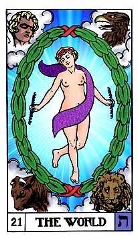
The 32 paths are said to be the paths to/of “wisdom”. “Wisdom” is said to be knowledge of the whole, the One. The Greek word for this knowledge is gnosis. Wisdom is the knowledge of the Same, that which goes beyond the knowledge of the particulars that compose the physical world. “Wisdom” includes what the Greeks understood as phronesis or “wise judgement”, and wise judgement was understood as one of the four virtues or “human excellences” that lead to happiness. Wisdom is also the seeing of unity in the diversity of particular things. It is seeing the tree that is present in all trees whether oak, elm, or beech. It is also to recognize the deprivations of those things that exist, such as Evil, from their fullness, which is the Good. The Wise are able to see Time in its wholeness and can comprehend past, present and future simultaneously. The whole of the Sefer Yetzirah is an attempt to see the unity amidst the diversity of the things that are in space and time. Those who are able to see the whole are “prophets”. The woman presented in the Tarot card “The World” is a prophetess.
We mentioned that Elohim is God’s name used 32 times in Genesis and this corresponds to the 32 paths that lead to Wisdom. The state of Wisdom is the second Sephirot of the Tree of Life, Chakmah. The third Sephirot is Binah, or Understanding, which is knowledge of particulars. This knowledge of particulars corresponds to our apprehension of the particular objects about us and their possible uses for us.
Elohim is a plural in Hebrew and corresponds, I think, to the Trinity that is present prior to the creation of the physical universe, the Trinity that must be present for the universe to be. Understanding is that knowledge which places the limits on the unlimited, what allows particular objects to come to presence for us. To place limits on is to “de-fine”, and it is this defining of things, of what they are, that allows the things to come to presence and be visible to us as the things they are. They are given boundaries and framing. This “defining” is accomplished through language and number, what we have historically come to call metaphysics. Wisdom itself is beyond language and number. Wisdom is associated with the element water, while Understanding is associated with the elements of Air and Fire. Wisdom is associated with emotions/heart, while Understanding is associated with mind/intellect. How these contraries are connected and brought into harmony is the core of the teaching of the Sefer Yetzirah. It is the understanding of the two faces of the Logos and of Eros.

Wisdom is seen as thought thinking thought, pure thought, the same concept as Aristotle’s understanding of God, the Unmoved Mover or the Uncaused Cause. The concept of thought without words, numbers or images is beyond me, unless it is simply thought as the Life-force itself i.e., thought as pure possibility or potentiality, dynamis. This would suggest that the “cause” of the life force itself is the element air in combination with fire and water. Wisdom would be simple unity, harmony. In Plato’s dialogue Timaeus, she is the khôra or receptacle of all: “So likewise it is right that the substance which is to be fitted to receive frequently over its whole extent the copies of all things intelligible and eternal should itself, of its own nature, be void of all the forms. Wherefore, let us not speak of her that is the Mother and Receptacle of this generated world, which is perceptible by sight and all the senses, by the name of earth or air or fire or water, or any aggregates or constituents thereof: rather, if we describe her as a Kind invisible and unshaped, all-receptive, and in some most perplexing and most baffling partaking of the intelligible, we shall describe her truly.”— Plato, Timaeus, 51a. Here, Plato sees the relation between Wisdom and Understanding, or the Sephirot Chakmah and Binah, as most “baffling” and “perplexing”. The word “intelligible” is one that will come under much discussion and scrutiny as we move through this interpretation of the Sefer Yetzirah. This area could be represented by Da’at, the Void, from out of which the Life- force and beings emerge.
The concept of creation which I mentioned earlier as the “withdrawal” of God to allow something to be other than Himself can be understood from the word “engrave”, when He uses the 32 paths to “engrave” the universe. When we speak of writing, we mean we add ink to paper (expansion). When we engrave, we remove material in a clay tablet (or whatever) as we see in cuneiform writing (withdrawal). The word “engrave” could also indicate the setting of boundaries; the limits placed on the unlimited, and it is the shapes of the letters themselves which establish these limits or boundaries in the written word.
The letter Yud in Hebrew has a numerical value of 10, indicating the 10 Sephirot. The letter Heh has a numerical value of 5, indicating the five fingers on the right hand. In the idea of “making”, the hands are important as they are what we use to grasp the things of the world, the ready-to-hand, the materials we use to make the artifacts that are useful to us. The letters of the Divine Name Yah Heh, are present at the beginning of the Creation and are the essence of the Creation (the Trinity and the concept of the Word as God and with God).
There is some difficulty with trying to interpret the YHVH as “the Lord of Hosts” and of the “hosts” understood as “the armies of Israel”. The Sefer Yetzirah suggests that the “hosts” represent all of the beings created through the 10 Sephirot and how these beings are understood by human beings through numbers, writing and speech. We can understand the “hosts” as that moment when God reveals Himself to human beings through His creation; those beings He created are His “hosts” in the same way we can understand being a host of an event such as a dinner party or a meeting. In Shakespeare’s King Lear, King Lear and Cordelia will act as “god’s spies” i.e. they will be his “hosts” for they will allow Him to see His creation through their eyes (Act 5 sc. iii). YHVH indicates a sort of dualism: the first YH separated by the Vah Heh. But again, they indicate the three-in-one concept which is attempting to be illustrated here: YH is God, VH is His creation and both together comprise YHVH.
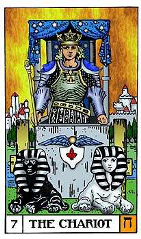
The “Living God” is to be understood as the Life-force itself, what we have come to call Nature, and what the Greeks understood as phusis and poiesis. It is the force (dynamis) that causes things to emerge and come to a stand so that they can be known (energeia). The names of God (Elohim) indicate the activity of this force in the downward motion through the Tree of Life. For example, “God saw” is mentioned 7 times and so this should focus our attention on “seeing” when we are attempting to understand the essence of the Sephirot #7 or Netzach (Victory). This should also focus our attention on the element of sight, on how things are perceived, when attempting to understand the Chariot Tarot card.
The word “Holy” indicates that which is separated from the mundane, the common. It is the separation of God from His creation, what is to be bowed down to or looked up to and not to be given an image or named.
The place of the concept of “will” is troubling in our understanding of who and what we are. In the Sefer Yetzirah, will is placed beyond all other forces in its representation in the Sephirot Keter, #1 and in #10 Malkhut. Both are seen as Kingdoms and God is King of the Universe or the Whole. The Ten Commandments are the will of God. Necessity is the will of God. Is will a motivator prior to Love (Eros) or is Love prior to will? This issue will be explored in this interpretation of the Sefer Yetzirah. For the moment we may understand “God’s will” as the Law of Necessity which is embedded and enmeshed in the creation itself. It is the schema or blueprint used by the demiourgos in his making of what is.
The three “books” used for the creation are text (Sepher), number or cipher (Sephar), and communication or the telling (Sippur). All relate to what the Greeks called logos, while the will is associated primarily with eros. They relate to the quality (emanations), quantity (the physical, material things), and the relation to others or the talking to others of that which has been created. The three books relate to Space (Universe), Time (days of the week) and Soul (how these are to be properly understood and interpreted). These relate to the five dimensions of the universe where space is third, time is fourth, and soul is the fifth dimension.
| The 32 paths can be represented pictorially as we do with the diagram of the Tree of Life (text), or they can be represented numerically as the sequences of the paths, or they can be represented to each other through our speech as our Understanding of the things that are. Our understanding of what things are is prior to our naming of them and speaking about them. The three books are also represented in the form of the letters themselves as they are written, the numerical value assigned to them, or the sounds that are made through the spoken word. Text as form is space (the res extensa or what we understand as objects); numbers are the sequence of time understood as the week and the year, a sequential series of “nows”; and communication is the continuum of soul. It is from these three that the word Sephirot is derived. It is only through the Sephirot in their three aspects that God can be approached. It is through the Sephirot that God reveals Himself to His creation, and it is through the Sephirot that one can reveal God in His creation. It is only through our particular body that we are able to gain access the whole that is beyond our particular self. Matter, the body, is our infallible judge. The Sephirot act as intermediaries or daimons through which one can communicate with God and there are some texts that assign an angel to each of the Sephirot. The Sephirot are the messengers (Hermes and Eros of the Greeks, the angels of Judaism and Christianity, etc.) through whom one communicates with God and He communicates to us. (“Jesus said to him, “I am the way, and the truth, and the life. No one comes to the Father except through me.” (John 14.6) Jesus as human being is the highest of these mediators (Metatron in the angel hierarchy.) |




 Theory of Knowledge: An Alternative Approach